

Bloomberg

Even Jim Cramer Has a Mezcal Brand Now

(Bloomberg) — Now that seemingly every celebrity, from Dwayne Johnson to Kendall Jenner, have tequila brands, might mezcal be next to rise?

Jim Cramer, host of CNBC’s Mad Money and Squawk on the Street, and his wife Lisa Detwiler, who is a Corcoran real estate broker, will launch Fósforo Mezcal in major U.S. markets on April 29, as well as online via e-commerce platform Speakeasy. The lineup includes a straight joven tobala ($90, 45% alcohol by volume) and a tobala penca ($125, 43% ABV); the latter is a style rarely seen in the U.S. that rests roasted penca (agave leaves) in the distillate for several weeks to add caramel-like flavor and a mellow straw hue.

The product—originally slated for a 2021 release, but pushed back to this year due to pandemic-related supply chain issues—has been in the works for about five years. 

“Jim and I have a place in San Miguel Allende, and we used to travel there with some frequency,” explains Detwiler, founder and creative director of Fósforo. Closing out a restaurant visit in the Centro neighborhood, Cramer queried the staff about their drinking plans for the night. “Out of the back, they brought out a plastic milk jug of homemade mezcal,” Detwiler recalls. “We’d had lots of tequila before, but this was just very, very different: smoky, fruity, different sipping stuff we had never had before. Jim in particular just fell in love with it.”

Cramer, a longtime fan of Scotch, saw potential for converting other whisky drinkers to a high-end version of the agave spirit, which can have similarly smoky tones. (Cramer’s role with the brand is largely that of a “taste ambassador,” Detwiler says; “Basically, all the work is mine.”) Even the name of the product involves fire and smoke: In Spanish, fósforo means “matchstick” and “phosphorus,” a key element that causes matches to ignite.

Many consider tobala to be “luxury mezcal.” Indeed, it can be more complex and full-bodied compared to the often leaner feel of the more commodified espadin, the type of agave that accounts for about three-quarters of mezcal production. While espadin takes about six to eight years to reach maturity, wild tobala is a smaller plant and takes 12 to 15 years to mature, says Lou Bank, co-founder and executive director of Sacred, a mezcal advocacy and education initiative. (Farmed tobala can reach maturity faster, he adds.) 

Moreover, while most mezcal sold in the U.S. is produced in Oaxaca, Fósforo is made in Puebla, which was designated as a mezcal-producing region only in 2017, making it the ninth and newest state to receive the designation. Relatively few Puebla mezcals have made their way north.

Rollout plans include the launch of Fósforo Foundation, to be overseen by a pair of scientists (Humberto Pinon, Violeta Coronado) who will study the product’s ecological impact and implement projects such as replanting trees used in the roasting of piñas, the heart of the agave plant that’s cooked down in the distillation process. And Detwiler and Cramer are in the process of selling their Brooklyn restaurants, Bar San Miguel and the Longshoreman, to comply with “tied house laws” that prohibit liquor manufacturers from owning a retail business that sells alcoholic beverages.

So how do the mezcals taste?

Fourth-generation distiller Aarón Alva Sanchez, whose signature appears on the bottle, coaxes a tropical fruit funk and nuanced smokiness in the flagship tobala. The penca, aged between one and three months in glass, bears a passing resemblance to oak barrel-aged reposado mezcals yet distinguishes itself with layers of nuttiness and mesquite and a distinct honeyed-vanilla sweetness. 

For U.S. consumers, Fósforo may taste more like a novelty than an outright luxury, although Detwiler suggests the penca could prove a “gateway” for the Laphroaig or Ardbeg whisky crowd. The penca is a particularly solid sipper worth seeking out.

After the serious run-up of high-end tequila, the time may be right for smart money to get into the luxury mezcal market: IWSR Drinks Market Analysis reports that mezcal sales by volume in the U.S. increased 14.5% in 2020 to 360,000 nine-liter cases, at a retail value of almost $185 million. It forecasts a 10.5% compound annual growth rate (CAGR) from 2021 to 2025.

Detwiler insists, though, that she and her team are not joining a trend: “It was about—truly—the love of the product and a desire to do something in this arena. It was not about OK, mezcal is having its time. We’re just lucky in that regard.”

More stories like this are available on bloomberg.com

©2022 Bloomberg L.P.
Even Jim Cramer Has a Mezcal Brand Now. How’s It Taste?

(Bloomberg) — Now that seemingly every celebrity, from Dwayne Johnson to Kendall Jenner, have tequila brands, might mezcal be next to rise?

Jim Cramer, host of CNBC’s Mad Money and Squawk on the Street, and his wife Lisa Detwiler, who is a Corcoran real estate broker, will launch Fósforo Mezcal in major U.S. markets on April 29, as well as online via e-commerce platform Speakeasy. The lineup includes a straight joven tobala ($90, 45% alcohol by volume) and a tobala penca ($125, 43% ABV); the latter is a style rarely seen in the U.S. that rests roasted penca (agave leaves) in the distillate for several weeks to add caramel-like flavor and a mellow straw hue.

The product—originally slated for a 2021 release, but pushed back to this year due to pandemic-related supply chain issues—has been in the works for about five years. 

“Jim and I have a place in San Miguel Allende, and we used to travel there with some frequency,” explains Detwiler, founder and creative director of Fósforo. Closing out a restaurant visit in the Centro neighborhood, Cramer queried the staff about their drinking plans for the night. “Out of the back, they brought out a plastic milk jug of homemade mezcal,” Detwiler recalls. “We’d had lots of tequila before, but this was just very, very different: smoky, fruity, different sipping stuff we had never had before. Jim in particular just fell in love with it.”

Cramer, a longtime fan of Scotch, saw potential for converting other whisky drinkers to a high-end version of the agave spirit, which can have similarly smoky tones. (Cramer’s role with the brand is largely that of a “taste ambassador,” Detwiler says; “Basically, all the work is mine.”) Even the name of the product involves fire and smoke: In Spanish, fósforo means “matchstick” and “phosphorus,” a key element that causes matches to ignite.

Many consider tobala to be “luxury mezcal.” Indeed, it can be more complex and full-bodied compared to the often leaner feel of the more commodified espadin, the type of agave that accounts for about three-quarters of mezcal production. While espadin takes about six to eight years to reach maturity, wild tobala is a smaller plant and takes 12 to 15 years to mature, says Lou Bank, co-founder and executive director of Sacred, a mezcal advocacy and education initiative. (Farmed tobala can reach maturity faster, he adds.) 

Moreover, while most mezcal sold in the U.S. is produced in Oaxaca, Fósforo is made in Puebla, which was designated as a mezcal-producing region only in 2017, making it the ninth and newest state to receive the designation. Relatively few Puebla mezcals have made their way north.

Rollout plans include the launch of Fósforo Foundation, to be overseen by a pair of scientists (Humberto Pinon, Violeta Coronado) who will study the product’s ecological impact and implement projects such as replanting trees used in the roasting of piñas, the heart of the agave plant that’s cooked down in the distillation process. And Detwiler and Cramer are in the process of selling their Brooklyn restaurants, Bar San Miguel and the Longshoreman, to comply with “tied house laws” that prohibit liquor manufacturers from owning a retail business that sells alcoholic beverages.

So how do the mezcals taste?

Fourth-generation distiller Aarón Alva Sánchez , whose signature appears on the bottle, coaxes a tropical fruit funk and nuanced smokiness in the flagship tobala. The penca, aged between one and three months in glass, bears a passing resemblance to oak barrel-aged reposado mezcals yet distinguishes itself with layers of nuttiness and mesquite and a distinct honeyed-vanilla sweetness. 

For U.S. consumers, Fósforo may taste more like a novelty than an outright luxury, although Detwiler suggests the penca could prove a “gateway” for the Laphroaig or Ardbeg whisky crowd. The penca is a particularly solid sipper worth seeking out.

Fósforo General Manager Chuck Huggins says they’re experimenting with even older pencas: mezcal has been aging in glass for three years, with an eye toward eventually releasing a limited edition five-year-old penca tobala. 

After the serious run-up of high-end tequila, the time may be right for smart money to get into the luxury mezcal market: IWSR Drinks Market Analysis reports that mezcal sales by volume in the U.S. increased 14.5% in 2020 to 360,000 nine-liter cases, at a retail value of almost $185 million. It forecasts a 10.5% compound annual growth rate (CAGR) from 2021 to 2025.

Detwiler insists, though, that she and her team are not joining a trend: “It was about—truly—the love of the product and a desire to do something in this arena. It was not about OK, mezcal is having its time. We’re just lucky in that regard.”

More stories like this are available on bloomberg.com

©2022 Bloomberg L.P.
Boeing Taps Amazon, Microsoft and Google for Cloud Mega-Deal

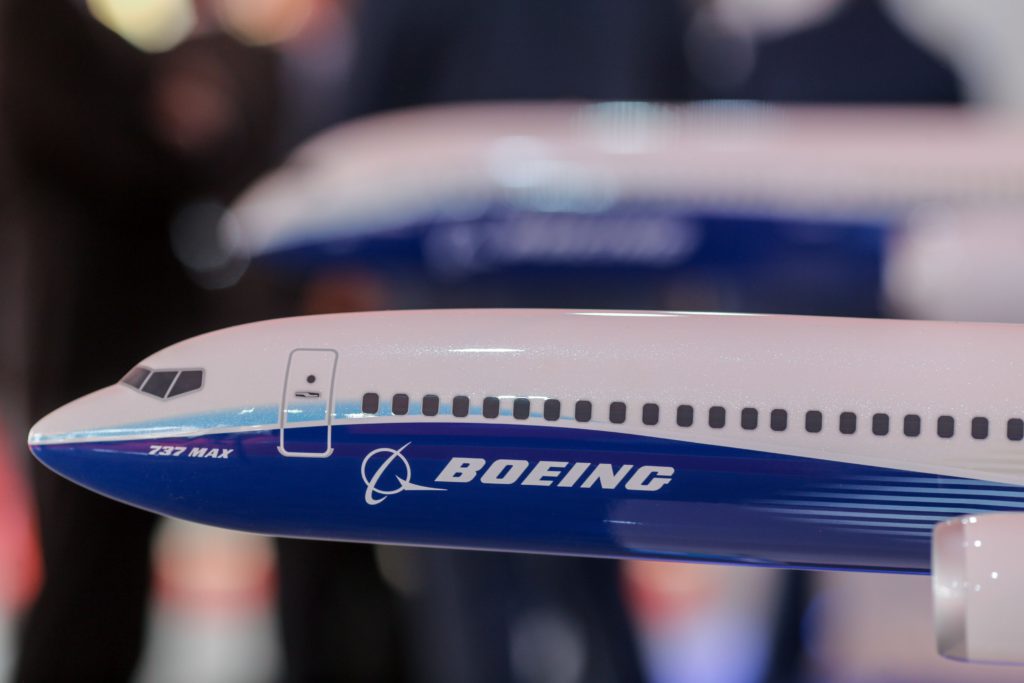
(Bloomberg) — Boeing Co. is hiring the three biggest U.S. cloud-computing companies — Amazon.com Inc., Microsoft Corp. and Alphabet Inc.’s Google — to help with a digital makeover aimed at giving its airplane designers and software developers more tools.

The multiyear agreements are intended to upgrade the company’s current system of hosting and maintaining software applications through a network of servers, which can be difficult to maintain, the Chicago-based manufacturer told employees Wednesday. Boeing plans to shift hundreds of applications to the cloud, where they’ll be stored and maintained in the tech giants’ data centers.

The manufacturing titan is rebooting its technology to help address quality lapses and production gremlins that drive up costs of developing new aircraft. The planemaker is investing in tools such as digital twins — virtual replicas of actual hardware — to model both the performance of its new aircraft concepts and the assembly lines that would build them.

“These partnerships will strengthen our ability to test a system — or an aircraft — hundreds of times using digital twin technology before it is deployed,” Susan Doniz, Boeing’s chief information officer, said in a post on LinkedIn. 

Boeing didn’t disclose the financial terms of the new arrangement. The Information had reported last year that Amazon Web Services, Google Cloud and Microsoft’s Azure were competing for a contract worth more than $1 billion over several years.

Boeing is the latest big tech customer to split its business among multiple cloud providers, eschewing a centralized approach promoted by Amazon. That company, which leads the cloud market, urges customers to go “all in” on AWS. Microsoft and Google, the No. 2 and No. 3 U.S.-based providers, advocate a “multicloud” approach of the sort Boeing is taking.

Boeing has already worked with the companies on a limited basis and will avoid disrupting existing cloud-supported products by keeping all three on board, a spokeswoman said. While the manufacturer eliminated 600 jobs when it outsourced its information-technology infrastructure to Dell Technologies Inc. last year, it doesn’t plan to lay off workers with the latest pacts.

More stories like this are available on bloomberg.com

©2022 Bloomberg L.P.

Jamie Dimon’s Greek Foray Offers JPMorgan a Gateway to Europe

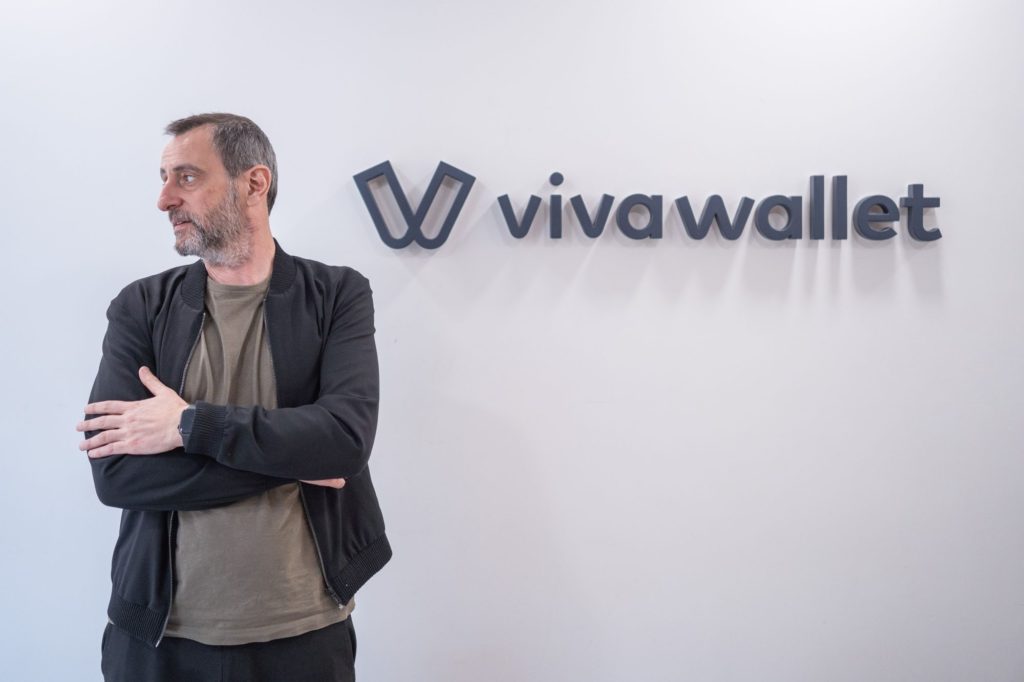
(Bloomberg) — JPMorgan Chase & Co. is planning to use its recently acquired stake in Greek payments firm Viva Wallet to support lending to small businesses across Europe, an ambition that would introduce a rare cohesion to the continent’s fragmented banking markets.

Viva Wallet’s Chief Executive Officer Haris Karonis said in an interview Tuesday that the U.S. lender is backing his firm’s plan to expand into business loans, in the form of merchant advance for its clients. Loans made by Viva Wallet will be immediately transferred to a special purpose vehicle owned by JPMorgan effectively making it the first commercial bank to offer financing across Europe, Karonis said.

“There’s no one currently offering loans to SMEs everywhere in Europe,” he said, noting Viva Wallet has the necessary licensing to offer banking services in 24 European countries. “The model is that banks offer a broad array of services in a handful of countries. We want to offer a handful of services in all countries.” 

The loan transfers to the SPV will help accelerate Viva’s lending, Karonis said.

JPMorgan’s Viva investment — which saw it take a 49% stake in the $2 billion-valued company — was the latest in a streak of acquisitions by the bank. In 2021, the bank had its most prolific year for hunting acquisitions and investments since at least the financial crisis as it fights to fend off fintech startups, augment customer perks and build out businesses.

JPMorgan CEO Jamie Dimon, whose paternal grandfather migrated to the U.S. after working as a banker in Athens, traveled himself to Greece for the deal, where he met Prime Minister Kyriakos Mitsotakis. The purchase of the stake is subject to regulatory approvals, which Karonis cautioned could last for months. 

“We want to be the first bank without a loan book of our own” he said. “We will be like commissioners, selling the loans to the SPV,” thus minimizing risk and leveraging JPMorgan’s vast resources to expand the funds available. 

Karonis also said Viva Wallet will offer JPMorgan tech solutions for use in the U.S., including the firm’s tap-on application, which can be downloaded on a smartphone and accept card payments, thus rendering legacy point-of-sale terminals redundant.  

While Karonis declined to say whether JPMorgan offered to buy the entire firm, he said the founders were never interested or willing to sell their own stake. 

“There’s nothing, which you really need, that you can buy with $100 million, but not with $10 million,” he said, adding that he has no intention of listing Viva Wallet at the Athens Stock Exchange or any other exchange.

More stories like this are available on bloomberg.com

©2022 Bloomberg L.P.

German Coalition Agrees $166 Million Budget for Arming Drones

(Bloomberg) — Chancellor Olaf Scholz’s ruling coalition sealed a deal to arm German drones, approving a defense ministry request to purchase ammunition worth 152 million euros ($166 million) from Israel’s state-run Rafael Advanced Defense Systems Ltd.

The decision to arm the Israeli-made Heron-TP drones, leased by the German military, is part of a wider shift in Berlin’s defense policy triggered by Russia’s invasion of Ukraine. Scholz in late February announced the creation of a debt-financed special fund worth 100 billion euros to modernize the Bundeswehr armed forces and meet NATO’s annual defense spending goal of 2% of economic output each year.

The Bundeswehr has been demanding armed drones for years to help protect soldiers during missions abroad and back up military convoys in dangerous terrain. Combat drones could also play a role in defending Germany and NATO allies. Until now, the army has only used drones for reconnaissance purposes, including in Mali.

Lawmakers on the lower house of parliament’s defense committee approved the government’s request to purchase 140 rockets to arm the Heron drones, according to people familiar with the decision, who asked not to be identified because the information is confidential.

Sixty rockets will be purchased for training purposes and 80 for possible use in combat, the people said. The meeting was not open to the public.

The lower house’s budget committee is expected to approve the purchase later on Wednesday. A draft resolution for the committee obtained by Bloomberg states, among other things, that the drones can only be used in combat if parliament has explicitly approved it.

The Bundestag’s budget committee is also expected on Thursday to give the green light to preliminary plans for spending a first tranche of 2.4 billion euros out of the 100 billion euros from the military fund.

The defense ministry wants to spend the cash on purchasing new gear including more than 305,000 bulletproof vests, 150,000 combat uniforms, 122,000 helmets and 250,000 backpacks.

More stories like this are available on bloomberg.com

©2022 Bloomberg L.P.
Apollo-Backed CAIS Receives Growth Equity From Reverence Capital

(Bloomberg) — CAIS Capital LLC, a tech platform for financial advisers and alternative asset managers, has received a growth investment of $100 million from middle-market private equity firm Reverence Capital Partners LP.

As part of the deal, Reverence Capital Managing Partner Milton Berlinski will join CAIS’s board of directors, according to a statement provided to Bloomberg News. The latest raise is a continuation of the New York-based company’s $225 million round in January, when the business received capital commitments from Apollo Global Management Inc., Motive Partners and Franklin Templeton. 

The newest capital from Reverence “puts us at just over $1.1 billion valuation,” Matt Brown, founder and chief executive officer at CAIS, said in an interview. The fresh funds should be looked at “as one transaction of $325 million,” he said, referring to the company’s raise earlier in the year.

CAIS was founded in 2009 as a software tech developer aiming to give independent financial advisers access to a range of alternative investment strategies. Through the platform, hedge funds, private equity, private credit, real estate and structured notes have been made available to advisers and their clients.

Headquartered in New York, Reverence Capital is a private investment firm focused on providing private equity and structured capital to the financial services sector. The firm was founded in 2013 by Berlinski, Peter Aberg and Alex Chulack.

With more cash on hand, Brown is gearing up for moves that include growing the company’s workforce and looking at potential tuck-in assets, both domestically and internationally. 

“There’s just so much to do,” Brown said. CAIS is also building an internal acquisition team, he added. 

“We are looking at acquisitions that improve areas of technology that we don’t currently have, that we would like to have capabilities in,” Brown said, adding that was one reason the firm was increasing its capital now. “Acquisitions are very much top of mind.”

More stories like this are available on bloomberg.com

©2022 Bloomberg L.P.

Twitter Tests Out Edit Button, Says Work Began Before Musk Poll

(Bloomberg) — Twitter Inc. said it’s starting internal testing of an edit button, and that work on the feature began last year — before new top shareholder and board member Elon Musk polled users on the topic.

The ability to edit tweets after posting them has been the most-requested feature for many years, Jay Sullivan, Twitter’s head of consumer product, wrote in a thread elaborating on the company’s announcement. Roughly 74% of the more than 4.4 million votes cast in Musk’s poll this week were in favor of adding the functionality.

Musk, 50, started the poll after disclosing Monday that he’d taken a more than 9% stake in Twitter. He filed a new form with the Securities and Exchange Commission on Tuesday classifying himself as an active investor, a day after he was late submitting a form for passive shareholders. Twitter agreed on Monday to add Musk to its board.

Twitter posted a GIF on Tuesday hinting at how the edit feature would work. Sullivan, the consumer product chief, said the company would seek “input and adversarial thinking” before launching the functionality.

“Without things like time limits, controls, and transparency about what has been edited, Edit could be misused to alter the record of the public conversation,” he wrote. “Protecting the integrity of that public conversation is our top priority when we approach this work.”

Twitter shares fell as much as 2.6% to $49.66 before the start of regular trading Wednesday. The stock has soared 30% since Musk disclosed his investment, the biggest two-day gain since the company’s 2013 initial public offering.

(Updates with Musk’s new filing in the third paragraph.)

More stories like this are available on bloomberg.com

©2022 Bloomberg L.P.

Tesla Halted, Chips Pile Up as Shanghai Lockdown Upends Business

(Bloomberg) — Tesla Inc.’s factory shutdown has stretched out to at least 12 days, much-needed semiconductors are piling up at manufacturers amid a shortage of truck drivers, and bankers are camping in their offices as Shanghai’s Covid-19 lockdown disrupts businesses in China’s financial hub. 

Cases are at a record in the city, now the epicenter of China’s worst outbreak since the start of the pandemic, and the lockdown has been extended indefinitely. While the country is sticking to its rigid Covid-Zero containment playbook, President Xi Jinping’s request to limit the economic consequences is becoming harder to achieve in the face of the highly transmissible omicron variant. 

The lockdowns and virus containment measures threaten to slow China’s economic growth this year to below the government’s 5.5% target, according to Bloomberg Economics. They also risk further havoc on already stressed global supply chains, with companies from chip giant Semiconductor Manufacturing International Corp. to a South Korean noodle maker caught up in the fallout.    

Why China Is Sticking With Its Covid Zero Strategy: QuickTake

Electric-car pioneer Tesla on Tuesday told some suppliers and workers that its Shanghai factory — which has been shuttered since the city went into a phased lockdown on March 28 — will remain closed at least through Thursday, according to people familiar with the matter, who asked not to be identified because the information isn’t public. 

Following a separate a two-day shutdown in March, Tesla has now lost 12 days of production in recent weeks, including this week’s holiday. The first Gigafactory outside Tesla’s home country produced half of its vehicles last year, and builds cars not just for the lucrative Chinese market, but for export to Europe and elsewhere in Asia. 

A spokesperson for Tesla China didn’t immediately respond to a request for comment. 

Staff at banks and fund management firms that were called back to work before the lockdown started remain stuck in their offices.

One fund manager said he and colleagues plugged up a floor drain on concern it could facilitate viral spread after a few people on the level above tested positive but were delayed moving into a quarantine facility, mandatory for all Covid cases in China regardless of severity. 

Workers are worried about an outbreak emerging, and while the firm has been trying to come up with a solution it’s a difficult problem to solve, said the person, who asked not to be named talking about private company matters. 

What Bloomberg Economics says:

Shanghai’s lockdown has dealt a blow to China’s economy. But an out-of-control outbreak would lead to an even worse outcome. Choosing lockdowns — despite their growing costs — suggests China is not yet ready to take an alternative Covid exit path. — Eric Zhu, economist

Some companies, including chip giants Taiwan Semiconductor Manufacturing Co. and SMIC, as well as iPhone assembler Pegatron Corp. have been able to keep plants running by implementing a so-called closed loop system where workers live on-site and are tested regularly. For the likes of SMIC, a new headache is emerging: securing the trucks they will need to get their chips to clients. A representative for SMIC declined to comment on logistics.

Read more: Shanghai Factories Isolate Staff to Keep Operating in Lockdown

South Korean companies are also being affected, with operations at the Shanghai plants of noodle maker Nongshim Co., confectionery manufacturer Orion Corp. and cosmetics producer Amorepacific Corp. suspended since early this month. The companies all told Bloomberg News that they have been following instructions from local authorities and don’t know when they can reopen.

Singapore’s Spindex Industries Ltd., which supplies precision components used by the automobile industry, has extended the closure of its Shanghai plant until April 10 or whenever local authorities allow work to resume. The uncertainty over the extension of the lockdown is expected to have a negative impact on the company’s financial performance, it said in an exchange filing.

More stories like this are available on bloomberg.com

©2022 Bloomberg L.P.

Russian Car Sales Plunge as War Leads to Supply, Price Shock

(Bloomberg) — Russian car sales plunged last month as sanctions imposed over the invasion of Ukraine battered the ruble and many global auto companies joined a boycott of the country, leaving buyers confronting sparse showrooms.

New vehicle sales fell 63% in March compared to a year earlier, the biggest decline since a nationwide Covid-19 lockdown in April 2020, the Association of European Businesses said in a statement Wednesday. Rolf, the country’s largest dealership, forecasts demand will fall by half this year to a level on par with Spain, which has one-third the population of Russia, according to Chief Executive Officer Svetlana Vinogradova.

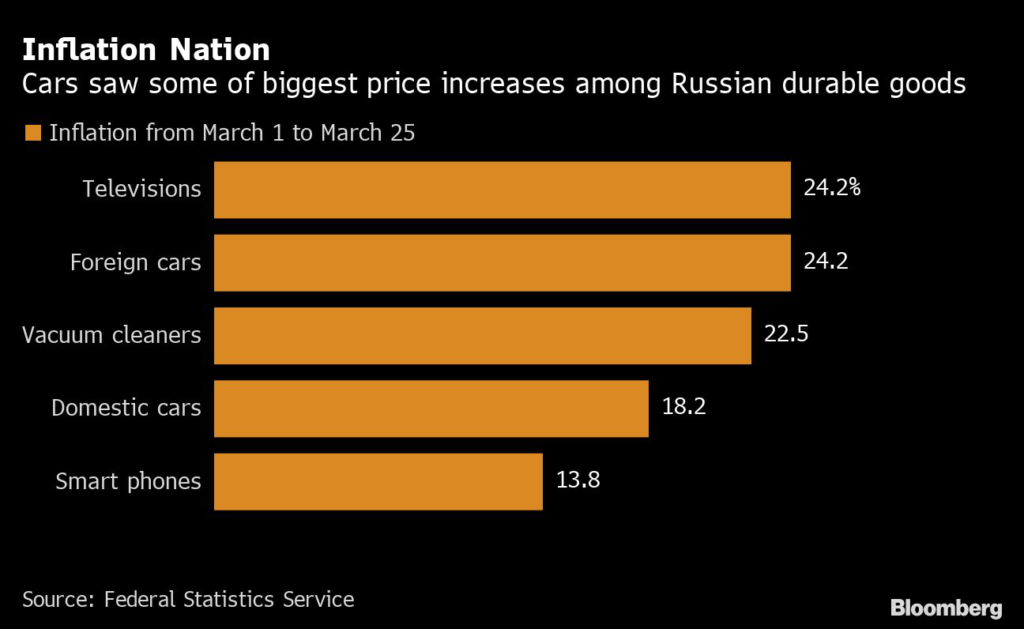
The collapse in car sales comes with consumers shifting their spending to essentials as they brace for a recession brought on by the war. Vehicle prices rose 40% in March by some estimates, while automakers from Toyota Motor Corp. to Volkswagen AG halted production in Russia as part of an unprecedented international boycott. 

With buyers facing higher prices and fewer options, the government is seeking to stimulate domestic production. Imported cars from Europe and Japan may be replaced with Chinese and Indian models, according to Anton Shaparin, a vice-president of the National Automobile Union. 

“Many people are saying that our Chinese comrades won’t leave our market,” Shaparin said, noting that prices for Great Wall Motor Co.’s Haval cars assembled in Russia have risen 50% since the invasion. “Of course they won’t, they’ll milk it until the last ruble.”

That contrasts with producers from Ford Motor Co. to Honda Motor Co. that are no longer shipping vehicles or spare parts to Russia. Renault SA suspended operations in what is its second-largest market and warned it may write down the value of its business. 

Sticker Shock

Local carmakers’ heavy reliance on imported components has also led to sticker shock. The largest domestic producer, Renault-owned AvtoVaz, raised prices three times so far this year. 

Russia’s Federal Statistics Service said last week foreign car prices rose 29% from the start of the year. 

With new cars hard to find in Russia and accelerating inflation threatening to devalue their savings, some Russians have turned to neighboring markets that have remained open to them. 

Russian customers accounted for about 10% of sales at Autodom in the Kazakh city of Kostanay, 180 kilometers (110 miles) from the border, according Yevgeniy Biber, the dealership’s sales chief. Previously, they made up about 1% of buyers, he said. 

Even before the crisis, Russia was already battling a deficit of new cars due to supply-chain disruptions and distribution delays that the automotive industry has contended with globally. 

Russian new car sales last year were down nearly 50% from their peak in 2012 as the economy stagnated since the 2014 annexation of Crimea from Ukraine.  

Amid a dearth of parts needed to keep factories open, Interfax reported that AvtoVaz plans to introduce a stripped down version of its Lada brand made with a minimum of foreign parts such as airbags and anti-lock brake systems. 

Vehicle sales in March were among the worst in the last 15 years, according to Azat Timerkhanov of Russia’s Autostat consultancy. 

“If Europe doesn’t restore deliveries, China will be the main beneficiary, at least in terms of market share,” Timerkhanov said. “But volumes are going to continue to fall.”

(Updates with car sales chart after second paragraph)

More stories like this are available on bloomberg.com

©2022 Bloomberg L.P.

Lead Edge Capital Raises $1.95 Billion for Growth-Equity Bets

(Bloomberg) — Lead Edge Capital raised $1.95 billion for its largest fund to date, to make bets on software, internet, consumer, and tech-enabled service companies.

The firm, which has offices in New York and Santa Barbara, California, favors companies that have recurring revenue and those that are profitable on an Ebitda basis, founding partner Mitchell Green said in an interview. The new vehicle, Lead Edge Capital VI, will be deployed over three years.

“We think valuations have gotten ahead of themselves and they’ll become more realistic,” said Green, whose firm aims to write equity checks of $15 million to $200 million and seeks a seat on the board around 60% of the time. “It’s a good environment to invest in as there’s less competition today than there was five months ago.”

And if a downturn occurs, Green said he’s ready to pounce. “Investing in a recession is how fortunes are made,” he said.

The firm searches for companies that meet criteria including demonstrated capital efficiency and a diversified customer base; $10 million or more in revenue; revenue growth at an annualized pace of 50% or above; gross margins of 70% or higher and at least 90% gross retention. Lead Edge can invest up to 25% of its latest fund in public equities.

“We’re always looking for the best risk-adjusted returns and we think having the opportunity to invest in public markets makes us better, more disciplined private-market investors who are more thoughtful around valuation,” Green said. 

Lead Edge counts unicorns including Hinge Health, LaunchDarkly, ID.me and Benchling among its current holdings. Its past investments include Spotify Technology SA, Toast Inc., Figs Inc., Asana Inc. and Bumble Inc. The firm has about $5 billion under management, Green said. 

Green said his firm has a more “hands-on” approach with founders than rivals. He pointed to a network of over 500 executives, all of whom are limited partners or investors in its funds alongside institutions including the San Francisco City & County Employees’ Retirement System, Teacher Retirement System of Texas and the University of Virginia’s endowment. 

“Don’t invest in our fund unless you’ll help our companies” is the message Green broadcasts to Lead Edge’s entrepreneur backers. Asana found its audit chair Sydney Carey through the Lead Edge network, he said.

Meg Whitman, the former chief executive officer of Hewlett-Packard Co. and EBay Inc., has backed three Lead Edge funds including its most recent.

“I like their approach of involving their investors,” Whitman said in an interview. “They’re always sending opportunities to help or make introductions.”

Whitman has made customer introductions for at least one of the firm’s portfolio companies, Arrive Logistics. The former California gubernatorial candidate who has been nominated as the U.S. ambassador to Kenya said she has connected potential candidates with roles at Lead Edge portfolio companies, and been involved in CEO coaching.

More stories like this are available on bloomberg.com

©2022 Bloomberg L.P.

Close Bitnami banner
Bitnami