

Bloomberg

Twitch’s New Star of Streaming Charts Is Anime Avatar Ironmouse

(Bloomberg) — There’s a new face topping the charts of video game live-streaming site Twitch: She’s an anime avatar with flowing pink hair.

Known as Ironmouse the character is operated by a real woman, whose facial expressions and movements are relayed using motion-capture tools that feed data through computer animation software. With her high-pitched voice, Ironmouse sings karaoke or cracks jokes while playing hit games like Elden Ring for a rapt audience of 11,000 live viewers. Her antics have made her the female streamer with the most subscribers on the platform and the third-most subscribed streamer of all time. She ranks right behind Tyler “Ninja” Blevins, who was one of the first Twitch streamers to break into the mainstream, playing Fortnite. 

Ironmouse currently has more than 1 million followers, and as of March 7 had 171,800 subscribers who pay a $5 minimum monthly fee to patronize her content, according to data from TwitchTracker. Behind the cutesy veneer, with her tiny fang-like teeth and purple eyes, little white horns and frilly, white princess dress, Ironmouse’s operator is a Puerto Rican woman who keeps her identity secret to protect herself from harassment. 

“It’s like putting on a superhero costume,” Ironmouse said in an interview on gaming chat app Discord.  


Ironmouse is among the most prominent English-speaking VTubers, or virtual YouTubers — a genre of entertainment that spawned on YouTube in Japan six years ago. The form has since migrated to Twitch, where the service’s live-streaming format gives fans the impression of interacting with a living anime character. There are now more than 17,000 VTubers across the globe, according to Japanese analytics firm User Local.

On Twitch, which is owned by Amazon.com Inc., VTubing content grew 467% in 2021 compared with a year earlier, according to data provided by the company. 

“Streamers, anime and role-playing are three of the hottest trends right now, with VTubers being the perfect amalgamation of these genres,” said Jason Krebs, chief business officer at live-stream firm StreamElements. “The market has spoken and made it clear that virtual content creators are a big hit, so the future is continued growth.” 

The $25 billion anime market has fueled interest in watching VTubers, and also in becoming one. Much of the appeal, Ironmouse said, is the freedom to become her best or most entertaining self, liberated from the constraints of her body. “I don’t like the pressure of having to be on camera,” she said. Ironmouse has an immune deficiency disease that she says has impacted her confidence. “Through VTubing, I have learned to love myself. Otherwise, I just don’t think I could ever bring myself to be a famous person on camera.” 

The mother of VTubing, Kizuna AI, launched her YouTube channel in Japan in 2016 with enormous fanfare, and quickly attracted an international audience of anime and video game fans. She has appeared in ads for Cup Noodle, eye drops, SoftBank Corp. and Japan’s National Tourism Organization. In the intervening years, a half-dozen talent agencies and management companies in Japan and the U.S. have cropped up to manage VTubers’ ballooning careers and facilitate deals with brands like Taco Bell. 

Companies including Sega Sammy Holdings Inc., Netflix Inc.and Micro-Star International Co. have launched their own branded VTubers. In March, U.S.-based VTuber agency Vshojo raised $11 million in funding.

“At first, people were just streaming with a webcam,” said Justin Ignacio, Vshojo’s chief executive officer and a member of Twitch’s founding team. “Now, you can go beyond the reality of being a person, and enter a new reality of who you truly are below that.”

The VTubing boom coincides with the push into the metaverse, a digital world envisioned by tech and gaming companies as an immersive version of the internet, where people will interact, play games or complete tasks as a digital avatar. VTubers may be ahead of the metaverse curve. 

“VTubers are living in the same time as the audience,” says Eiji Araki, CEO of VTubing software company Reality. “They say good morning to you over Twitter, stream games as you play them, invite other VTubers to the stream and say good night to you.” Their massive popularity demonstrates online audiences’ willingness to suspend disbelief and fully embrace avatars as they would real people.

“As the metaverse becomes the daily platform to live, play, connect and others, we all will become VTubers in some form,” Araki said. 

More stories like this are available on bloomberg.com

©2022 Bloomberg L.P.
Ethereum’s Coming ‘Merge’ Could Make or Break Crypto

(Bloomberg Markets) — Sometime later this year, Ethereum is set to make the biggest change in its near-decade history, an event that’s certain to ripple through the entire ecosystem of cryptocurrencies and digital assets. Think of it this way: The most important commercial highway in crypto is about to be completely repaved.

Ethereum is essentially computer software that uses so-called blockchain technology to provide a digital ledger for recording transactions. It’s become the most popular basis for a growing array of commercial crypto assets and applications, including lending products, nonfungible tokens (NFTs), as well as its native token, Ether. Ethereum isn’t owned by anyone but built and refined by a community of developers, and it runs on a network of data centers throughout the world. These data centers operate as “miners” on the network, ordering transactions that are posted to the digital ledger. In return they get paid in Ether. This system has been dubbed “proof of work.”

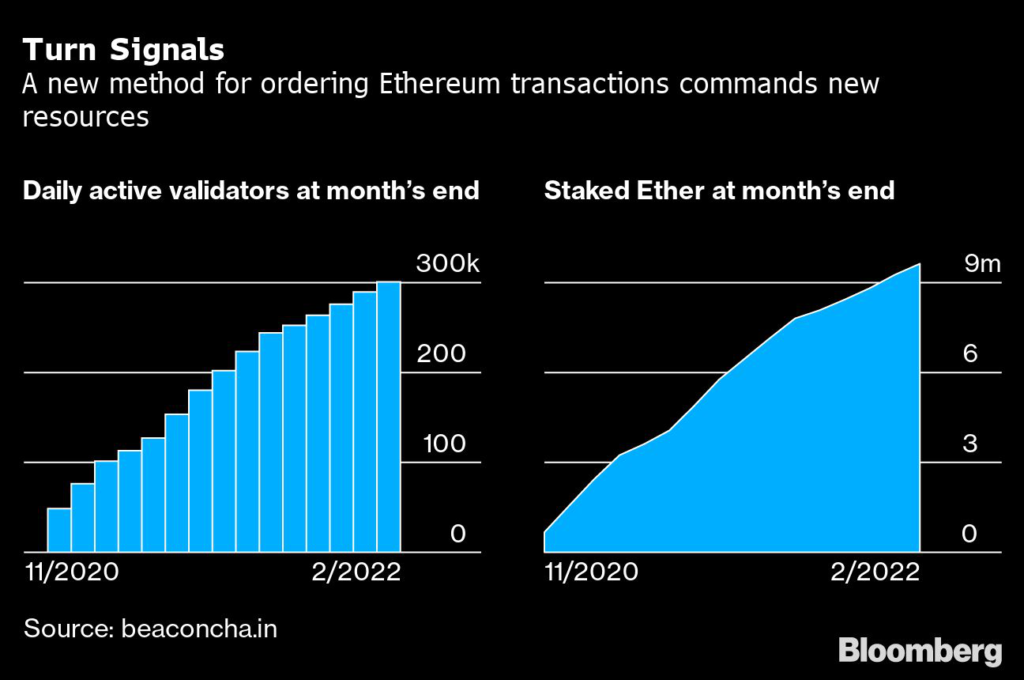
Developers who work on refining the Ethereum software roll out periodic upgrades, but none has been as major as the one expected this year. Named “the Merge,” it will replace miners with so-called stakers. Miners order transactions by solving complex calculations using millions of powerful servers—a system that’s been criticized for its heavy use of electricity. Stakers, by contrast, will order transactions by putting up their own Ether on a new system, which has been in testing since December 2020. People can already use their digital wallets to stake Ether on this test system, called the Beacon Chain; after the Merge they will start to be selected at random to become what are known as validators, ordering transactions on the Ethereum digital ledger into blocks and getting paid with new Ether. This is called “proof of stake.”

ETHEREUM’S $415.3 BILLION market capitalization depends on the Merge going smoothly, but so do the thousands of businesses that operate on the blockchain, plus millions of users. Some $121.5 billion of capital is locked in Ethereum’s decentralized finance (DeFi) apps, according to tracker DappRadar. Most NFTs—also with a total value in the billions—use Ethereum.

“There’s never been, in the history of blockchain networks, a change on the scale of Ethereum’s transition from proof of work to proof of stake,” says Chase Devens, an analyst at researcher Messari.

The Merge will be a nail-biter because a lot could go wrong. There could be software bugs or hacks, or miners could create an alternative Ethereum network. During a 2020 network upgrade, a bug split Ethereum in two, wreaking havoc on its nascent DeFi ecosystem, the apps that let people trade, borrow, and lend without intermediaries like banks.

Most centralized crypto exchanges are expected to pause Ether withdrawals and deposits around the Merge as a precaution. DeFi apps may pause, too, if something goes wrong.

“With all technical upgrades of all these large chains, you need to use caution,” says Katie Talati, director of research at digital asset manager Arca. “At the end of the day we are dealing with unknown technology.”

THE MINERS ARE causing the most worries. Many may quit the network right before the Merge, figuring they can make more money by selling their gear than by waiting to get the last of the rewards. Too steep a drop in the network’s mining power, or the “hash rate,” could weaken Ethereum’s security, spelling disaster for its token and the various apps using the network. Ethereum’s core developers have planned for that scenario. “If we see the hash rate dropping, we could pull the Merge forward,” says Tim Beiko, a computer scientist who coordinates Ethereum developers. “All the software is built with an emergency option.”

Miners may also choose to fork Ethereum, by taking the existing proof-of-work software and continuing to support it. That would create two different versions of Ethereum that run in ­parallel: proof of work and proof of stake.

“We believe POW and POS will coexist for a period of time after the switch,” says Danni Zheng, vice president of BIT Mining, a mining provider that’s also expanding its staking services.

In this scenario, crypto exchanges and users could become confused about which chain’s Ether they’re holding or trading. Two networks will mean more work for app developers, says Dieter Shirley, chief technology officer at Dapper Labs, the maker of an Ethereum-based cat-breeding game, CryptoKitties.

“A contentious fork, it’s likely it would hasten our departure from the Ethereum ecosystem,” Shirley says. Dapper may consider moving CryptoKitties to its own blockchain, Flow, he says.

A fork, or at least a lot of public criticism, is exceedingly likely because many Ethereum miners don’t seem to know the Merge is coming. Ethereum developers communicate about the Merge on Discord and Telegram, messaging apps that many miners don’t use, Beiko says. Mining pools, which provide most of the transaction-­ordering on Ethereum today, take a percentage of the miners’ earnings, and it’s in their interest not to notify their members of the Merge so that mining continues at least until the network upgrade, he says.

“I am more concerned about the people who don’t even know this is happening, and they buy this $3,000 miner, and three months later it stops working,” Beiko says. “It would be a bad idea to start mining today.”

And some miners just don’t believe the Merge is really coming, because it’s been delayed in the past.

“There’s a lot of skepticism because Ethereum has promised proof of stake for five years,” Beiko says. “It’s hard to convince people that this time it’s for real.”

SHUTTING ETHEREUM’S old chain will send shock waves through the cryptomining industry. Scrambling to find other uses for their equipment, miners will migrate their machines to other, similar chains such as Dogecoin, Litecoin, and Monero. The hash rate on those other chains will balloon by 5 to 10 times overnight, says Sam Doctor, chief strategy officer at Bitooda, a digital asset fintech company. Overall revenue for this type of mining could drop as much as 90%, pushing many miners out of business, he says.

U.S. miners will pursue clients outside the crypto industry, in areas such as artificial intelligence and genome sequencing, Doctor says. “But none of them have customer-acquisition experience.”

INVESTORS MAY BENEFIT from the Merge. The number of new coins issued on Ethereum as rewards for ordering transactions should decrease 50% to 90%, as the proof-of-stake chain will offer lower rewards, Beiko says.

In the next two years the amount of Ether that’s used for staking will probably increase from 8% to 80%, according to staking ­services provider Staked. That will reduce the Ether in circulation, potentially pushing up its value.

Stakers will be able to use the Ether they receive as rewards for ordering transactions, but not the Ether that they stake—at least not until another software upgrade, expected six months or so after the Merge. Stakers are more likely to hold their Ether for the long term than miners, who often need to sell some to cover electricity costs, says Kyle Samani, co-founder of Multicoin Capital.

After the Merge, the energy consumption of Ethereum’s network should drop more than 99%. To order transactions on the new proof-of-stake network, a validator can use a high-end laptop instead of a server farm. The entire proof-of-stake ­Ethereum is expected to consume around 2.62 megawatts—about as much as a small town with 2,100 American homes. By contrast, current proof-of-work setup gobbles up the energy of a midsize country.

“Even my daughter has picked up the ‘NFTs are boiling the oceans’ hysteria,” says Ben Edgington, lead product owner at ­ConsenSys, which builds infrastructure for the Ethereum blockchain. “I expect that freeing ourselves from the negatives of proof of work will definitely help make applications like DeFi and NFTs much more socially acceptable, leading to significantly accelerated adoption.”

Much will depend on whether the Merge goes smoothly, of course. “If we do our jobs well, nobody will notice the moment that Ethereum moves from proof of work to proof of stake,” ­Edgington says.

Kharif covers cryptocurrencies for Bloomberg News in Portland, Ore.

More stories like this are available on bloomberg.com

©2022 Bloomberg L.P.

Crypto Startup Blockchain.com Launches Asset Management Service

(Bloomberg) —

Blockchain.com, the startup that last week raised a new round of funding valuing the company at $14 billion, has launched an asset-management brand on Wednesday.

The service, called BCAM, will cater to institutional investors, family offices and high-net worth individuals. It was created in partnership with Altis Partners, an investment firm that manages futures portfolios. While Blockchain.com powers BCAM, Altis provides investment management. 

BCAM launches with a strategy that tracks the price of Bitcoin versus the dollar. Another strategy it is rolling out focuses on reducing the volatility that comes with investing in Bitcoin by offering “algorithm-based risk-managed exposure” to the currency.

It is also readying a product that manages exposure to decentralized-finance coins, tied to applications that let people trade, borrow and lend without intermediaries, Charlie McGarraugh, chief strategy officer at the company, said in an interview.

Blockchain.com is doubling down on its institutional business with the launch of the new service, McGarraugh said. 

“Like everything in crypto you won’t know until you try,” he said. “But like with everything in crypto, we think we are growing into the clear blue sky. It’s a big opportunity.”

Following its purchase of Altonomy’s over-the-counter trading and executions business in March, Blockchain.com has thousands of institutional clients, about $8 billion in loan originations and $15 billion in lifetime trading volume related to institutions, McGarraugh said.

Last week, Blockchain.com raised a round of funding that catapulted it into the ranks of crypto’s most valuable companies. It was led by Lightspeed Venture Partners with major participation from Baillie Gifford & Co.

Blockchain.com, which was founded in 2011 and is led by Chief Executive Officer Peter Smith, has 37 million verified users with 82 million wallets created and more than $1 trillion transacted, according to its website.

More stories like this are available on bloomberg.com

©2022 Bloomberg L.P.

Twitter Restricts Russian Accounts, Bars Prisoner-of-War Content

(Bloomberg) — Twitter Inc. will stop amplifying Russian government accounts and ask other government-affiliated media to remove posts featuring prisoners of war, it said in a blog post Tuesday that cited international humanitarian law.

It’s the latest example of how social media platforms are attempting to strike a balance that honors freedom of expression amid a flood of harrowing and often manipulative images and accounts being shared from the front line of Russia’s invasion of Ukraine.

San Francisco-based Twitter said it will add warnings to state-backed accounts’ posts about prisoners when they have a “compelling public interest,” it said in its blog citing Article 13 of the Geneva Convention III. 

Twitter will also mandate the removal of posts from any user, state-linked or not, who posts about prisoners of war with “abusive intent” such as insults, calls for retaliation, or mocking suffering. 

The site will also immediately stop amplifying or recommending government accounts belonging to states that “limit access to free information and are engaged in armed interstate conflict,” said Twitter vice president of global public policy Sinead McSweeney “We will first apply this policy to government accounts belonging to Russia.”

More stories like this are available on bloomberg.com

©2022 Bloomberg L.P.

China’s UN Envoy Calls Violence in Bucha ‘Deeply Disturbing’

(Bloomberg) — China’s envoy to the United Nations expressed dismay at the killing of unarmed civilians in Bucha, while calling on all sides to refrain judgment until a probe establishes who is responsible.

“Attacks against civilians are unacceptable and should not occur,” Ambassador Zhang Jun said Tuesday at a UN Security Council briefing on Ukraine. “The reports and images of civilian deaths in Bucha are deeply disturbing.”

Zhang stopped short of condemning Russian President Vladimir Putin for the violence, saying that “circumstances and specific causes of the incident should be verified and established” and “all sides should exercise restraint and avoid unfounded accusations.”

Chinese Foreign Ministry spokesman Zhao Lijian said Wednesday at a regular press briefing in Beijing that China is “highly concerned” about the harm done to civilians. “The reports and images of civilian deaths in Bucha are deeply disturbing,” he said, echoing Zhang. 

President Joe Biden has said Putin could face a war crimes trial related to the civilian deaths in Bucha, on the outskirts of Kyiv, and other Ukrainian towns vacated by Russian soldiers. Russia has denied its forces killed civilians, saying pictures of bodies strewn on the streets were a fabrication by Ukraine.

China has come under increased pressure from Washington and Brussels to take a stance on the conflict, as its diplomats and state media play down civilian casualties and cast Putin as a victim of the U.S.-backed expansion of NATO. European leaders told President Xi Jinping in a tense Friday video summit that “equidistance is not enough” on Ukraine, according to European Commission President Ursula von der Leyen.  

The European Union’s top diplomat on Tuesday described that call as a “deaf dialog,” saying China wanted to avoid talking about the war. “The European side made clear that this compartmentalization is not feasible, not acceptable,” Josep Borrell, who accompanied European leaders in the exchange, told the European Parliament.   

Chinese state media outlets including the overseas edition of Communist Party mouthpiece the People’s Daily, China Central Television’s military affairs channel and China Daily posted Zhang’s comments to China’s Twitter-like Weibo. They attracted little attention compared to items on the Covid-19 outbreak in Shanghai and unverified footage of Ukrainian marines surrendering in Mariupol, which was briefly the second top trending item. 

Before Zhang’s remarks at the UN, state media had mostly amplified Russia’s denial that Putin’s army was involved in the killings. On Monday, CCTV published Russian defense ministry claims that all photos and videos of Bucha were “directed by the Ukrainian government for Western media.”

That theory, dismissed as a falsehood by numerous governments, was widely circulated on Chinese social media, while posts showing how newspapers around the world were condemning Russia’s massacre on their front pages were censored.

The Communist Party backed Global Times tabloid referred to the mass killings as the “Bucha incident” in a Wednesday editorial, which called the U.S. the “initiator” of the Ukraine crisis and blamed it for exacerbating tensions by sanctioning Russia.

Still, some internet users were outraged by Russian’s atrocities, comparing them to the Nanjing massacre, in which an invading Japanese army killed tens of thousands of people over several weeks from late 1937 to early 1938. While China puts the death toll of that incident at 300,000, some in Japan continue to question accounts of the event. 

“As Chinese people who have the memories of the Nanjing massacre, those who can still defend massacre of civilians have utterly lost their conscience,” said one Weibo user in a post shared nearly 900 times.

(Updates with Chinese foreign ministry comment in the fourth paragraph.)

More stories like this are available on bloomberg.com

©2022 Bloomberg L.P.

Snap Pays Women in Britain 53% Less Than Men

(Bloomberg) — Snap Inc. said it paid women in Britain 53% less than men when judging median hourly wages, one of the worst figures among major tech companies.

The tech sector has become one of the U.K.’s best paid industries after firms including Google and Facebook have hired thousands of developers in the country. 

Men heavily outnumber women in better-paid roles like engineering and product development, Snap said in its report on the numbers. Some 85% of the best-paid quartile at the business were men. Stock-based compensation also vests more frequently at Snap than some rivals; if it was excluded, the gap would be 20%, the company said.

One of its top competitors TikTok, owned by China’s ByteDance Inc., said it paid women an average of 30% less than men. TikTok said the binary definition of gender required in reporting doesn’t represent its position on gender identification.

Since 2017, every U.K. business with more than 250 employees has had to report their pay gap averages. The median man at a U.K. business was paid 9.8% more than the median woman last year, compared with 10% in 2020, according to a Bloomberg News analysis of filings submitted to the government. The gap was 9.2% when businesses were first required to report the data in 2017.

See the data: U.K. Finance, Mining and Construction Failing on Gender Pay Gap

Here’s how those numbers stack up against the U.K. arms of other big tech firms this time around, all of which are in favor of men:

  • Alphabet Inc.’s Google had a difference of 15%, also pointing to a lack of women in engineering, as well as senior leadership
  • Twitter Inc. said its men were paid 13% more than women
  • Apple Inc. reported a 9% difference across its three U.K. units, rising to 19% at the two not focused on retail
  • Meta Platforms Inc.’s Facebook posted a gap of 8%
  • Microsoft Corp. said its figure was 7%
  • Amazon.com Inc. said the overall gap at its U.K. workforce was 0.8%

The headline median gap shows the difference between men’s and women’s average earnings regardless of role or seniority. Several companies distinguish that metric from “pay equity” — the figure awarded for people with the same role and tenure.

Other outliers in the tech sector included Japan’s NEC Software, with men paid 42% more than women, chipmaker Intel Corp. at 32%, payments operator PayPal Holdings Inc. at 30%, and German cloud provider SAP SE, with a gap of 28%.

More stories like this are available on bloomberg.com

©2022 Bloomberg L.P.
Twitter Rival in India Tests Giving Users Power to Self-Verify

(Bloomberg) — Koo, the microblogging and social networking app for Indian languages, is hoping to go one up on rival Twitter Inc. by allowing users to self-verify their profiles, as competition for millions of first-time users heats up.

A verified profile on social media such as Twitter and Instagram — typically marked by a badge or tick next to the profile name — gives the user credibility because it means the service has confirmed the authenticity of the person. A verification badge is typically used by celebrities and other influencers, and obtaining one can be difficult and take weeks or months.

Koo, backed by Tiger Global and Accel, said it has streamlined the process by allowing users to self-authenticate. Under the new process, users link their accounts to a unique biometric number from the Indian government’s digital identity database, Aadhaar, which is similar to a U.S. Social Security number. They then activate the verification by sending a password to a mobile phone linked to that Aadhaar number. It typically takes just a few minutes.

“Microblogging sites’ biggest bane is automated bots, fake accounts and anonymous trolling,” Aprameya Radhakrishna, Koo’s co-founder and chief executive officer, said via Zoom. “This voluntary self-verification feature is toward making social media safer and more real.”

Koo, started in March 2020, has about 30 million users and the self-verification system will lend credibility to the content they share. India’s social media is rife with fake accounts, toxic content and misinformation spreading on platforms like Twitter and WhatsApp.

Those self-verifying will have green ticks attached to their profiles. The Bangalore-based startup, formally known as Bombinate Technologies Pvt., has a separate yellow tick program for eminent users and cricketers, Bollywood stars and government ministers.

The app is available in 10 Indian languages and a dozen more are being added as more regional users go online. The app is also available in Nigeria, a testing ground for expansion abroad.

The green ticks will “democratize self-verification” and cut down the lengthy process, Radhakrishna said. They will improve the platform’s authenticity over time and “advertisers will prefer a social network with real people, not bots,” he said.

Later this week, in another social media first, Koo plans to release its algorithms to the public. They will give insights into how Koo users get their feed, how it recommends who to follow and how it builds hashtag trends.

More stories like this are available on bloomberg.com

©2022 Bloomberg L.P.
China Tech Stocks Slide on Hawkish Fed, Lingering Delisting Risk

(Bloomberg) — Chinese tech stocks fell, as investors responded to hawkish comments from the Federal Reserve and awaited more clarity on how Beijing’s new rules will help keep local firms listed on U.S. exchanges.  

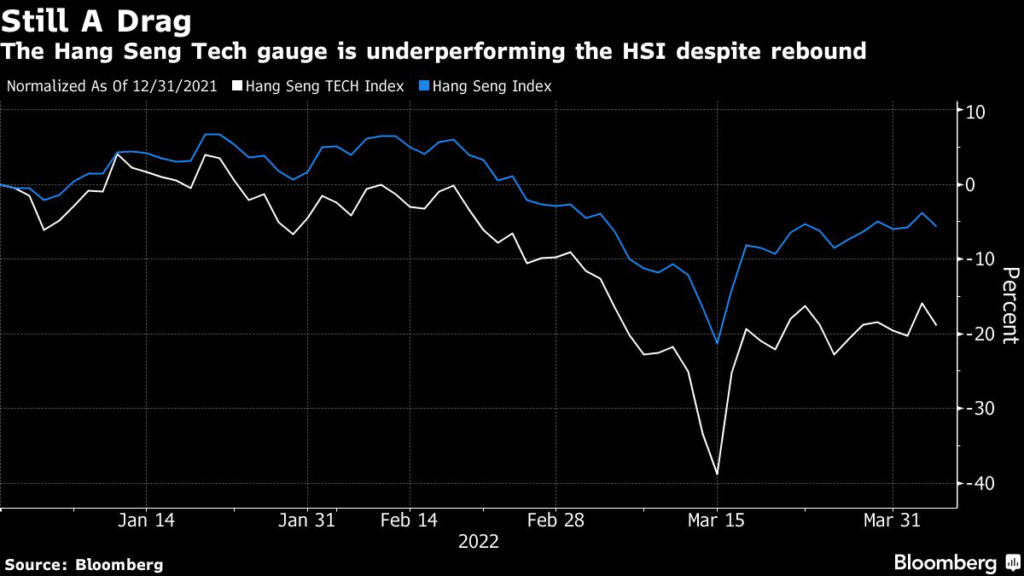
The Hang Seng Tech Index slid 3.8% as trading in Hong Kong resumed after a holiday, with Alibaba Group Holding Ltd. and JD.com Inc. among the biggest decliners. The broader Hang Seng Index dropped 1.9%.

Tech shares led broad losses in Asian equities on Wednesday after Fed Governor Lael Brainard said the central bank will raise interest rates steadily while starting balance sheet reduction as soon as next month. The Nasdaq Golden Dragon Index fell 4.6% overnight, after a two-day 12% rally, while the tech-heavy Nasdaq 100 index dropped 2.2%.

Wednesday’s losses cut short a rebound earlier this week as Chinese regulators sought to defuse U.S. delisting risks with a radical rule change proposal over the weekend. While Chinese shares listed in the U.S. and Hong Kong initially staged strong rallies following the news, investors say that there are still some hidden risks. 

Of particular concern is whether Beijing’s plan to modify a rule restricting offshore-listed firms from sharing sensitive financial data with foreign regulators will be enough to satisfy U.S. requirements, Tai Hui, chief Asia market strategist at JPMorgan Asset Management, said in a briefing on Wednesday. 

In China, where local markets opened for the first time this week, the CSI 300 Index closed 0.3% lower. Among worries included Shanghai’s growing Covid outbreak, the nation’s worst to date, with harsh restriction measures hurting the outlook for growth.

“Risks remain for the broader Chinese economy as Covid lockdowns prompt analysts to cut GDP and earnings forecasts, with the results season unable to ease worries,” wrote Marvin Chen, a Bloomberg Intelligence analyst.

Economists have been rushing to cut China’s growth forecasts as lockdowns and various curbs cover vast swathes of the nation. A Wednesday report by Caixin Media and IHS Markit showed China’s composite purchasing managers’ index for March slumped to 43.9, the lowest in more than two years and falling deeper into contraction. 

More stories like this are available on bloomberg.com

©2022 Bloomberg L.P.
U.S., U.K. and Australia Plan to Develop Hypersonic Weapons

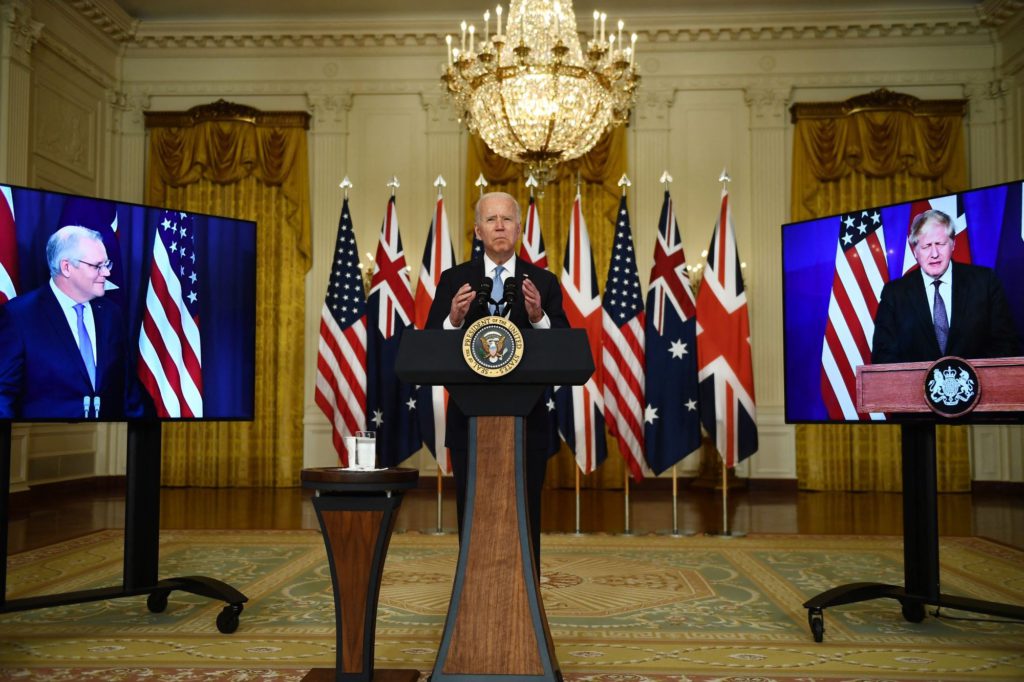
(Bloomberg) — The U.K., U.S. and Australia said they are working on developing hypersonic weapons — military technology already deployed by Russia in Ukraine — as part of their new trilateral security pact called AUKUS.

Their plan is to “accelerate development of advanced hypersonic and counter-hypersonic capabilities,” according to a joint statement. The alliance wants to counter the threat of such weapons, which can evade traditional missile defense systems and travel five times faster than the speed of sound, and develop its own as a deterrent, a U.K. official said on condition of anonymity.

Read More: Russia Uses Hypersonic Weapons as War Enters Bloodier Phase (1)

Russia’s invasion of Ukraine has pushed Western governments to reassess their military capabilities. The AUKUS leaders — Australia’s prime minister Scott Morrison, U.S. President Joe Biden and British premier Boris Johnson — said in a joint statement Tuesday that they are also deepening defense cooperation on issues such as electronic warfare, where adversaries seek to use the electromagnetic spectrum to gain an advantage on the battlefield.

“In light of Russia’s unprovoked, unjustified, and unlawful invasion of Ukraine, we reiterated our unwavering commitment to an international system that respects human rights, the rule of law, and the peaceful resolution of disputes free from coercion,” they said in the statement. The AUKUS alliance is also working collectively on areas like cyber warfare and artificial intelligence.

Australia is also one of the countries on the front line of rising competition between the U.S. and China, with relations between Canberra and Beijing rapidly deteriorating in recent years. The Australian government has denounced allegations of human rights abuses in China and called for an independent investigation into the origins of Covid-19, which resulted in Australian exports facing obstacles entering Chinese ports.

Chinese Foreign Ministry spokesman Zhao Lijian was critical of the latest plan by AUKUS, saying Wednesday at a regular press briefing in Beijing that it would “escalate the arms race in Asia-Pacific, and undermine peace and stability in the region,” while also dismissing the grouping itself.

“It follows the old logic of Cold War mentality, bloc politics, and the old trick of seeking military confrontation and adding fuel to the fire with the ultimate goal of building a Nato-like bloc in the Asia-Pacific region,” he said.

Explainer: Hypersonic Weapons — Who Has Them and Why It Matters

The AUKUS pact announced in September last year was designed to help Australia develop at least eight nuclear-powered submarines, a project that could take more than a decade, and also coordinate military capabilities to promote security in the Indo-Pacific region. Biden, Morrison and Johnson said they are “pleased” with the progress on delivering the submarines and that they remain committed to a “free and open” Indo-Pacific.

The Australian government, which is expected to hold an election in May, has been playing up its national security credentials ahead of the vote. On Tuesday, Australia announced A$3.5 billion ($2.7 billion) to accelerate the acquisition of improved weaponry for the Australian Defense Force, including missiles and maritime mines.

“We want to make sure that our country has the capability to deter any act of aggression against our country, but it’s a very real and serious situation. We need to be realistic about what is going on to happen over the next few years or the next decade,” said Australian Defense Minister Peter Dutton on Tuesday.

(Updates with comments from China’s Foreign Ministry.)

More stories like this are available on bloomberg.com

©2022 Bloomberg L.P.

Buffett-Backed Paytm Aims to Break Even in Under Two Years

(Bloomberg) — Paytm, the Indian digital payments pioneer grappling with a regulatory audit of its data-management systems, expects to break even on an operating basis over the next year-and-a-half.

The startup backed by SoftBank Group Corp. and Jack Ma’s Ant Group Co. predicts it will become profitable in six quarters on an operating earnings before interest, tax, depreciation and amortization basis. That forecast followed a doubling of its gross merchandise value to 2.59 trillion rupees ($34.3 billion) in the three months ended March, the company said in a statement Wednesday.

The brand that listed as One 97 Communications Ltd., which competes with the likes of Google Pay and Walmart Inc.’s PhonePe, climbed more than 3% after revealing its projection. It averaged almost 71 million transacting users in the quarter, it added.

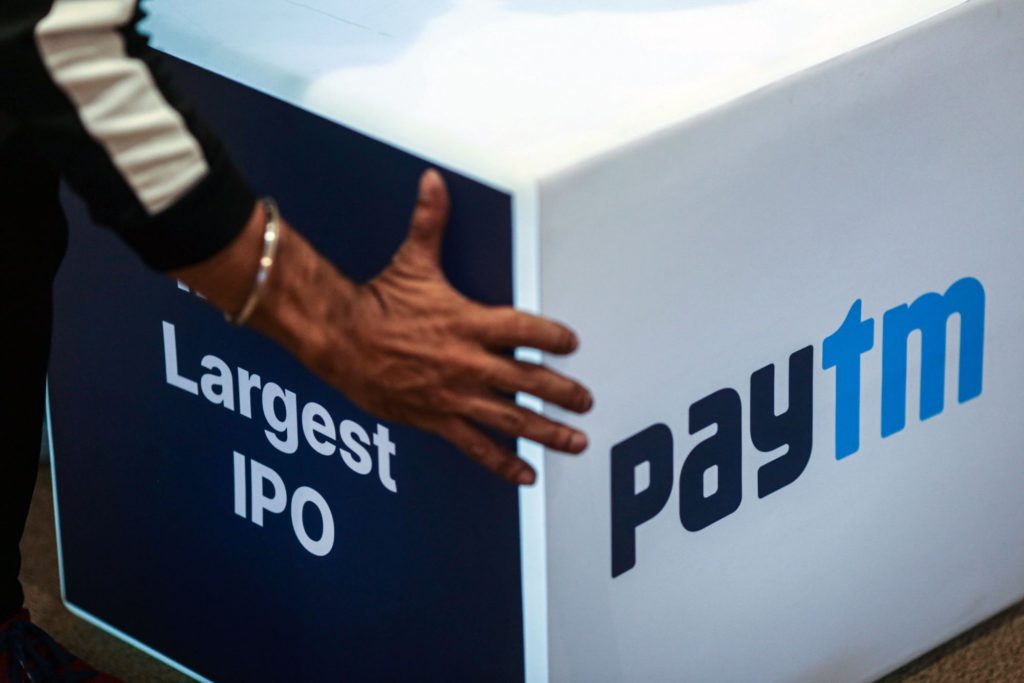
Paytm founder Vijay Shekhar Sharma has been struggling to win back investor support since the company pulled off India’s largest-ever initial public offering in November, touted by some as a symbol of India’s growing appeal as a destination for global capital. While the offering raised a record-setting $2.5 billion, shares plunged 27% on debut and have dropped more than 70% from the 2,150 rupee IPO price.

Investors have grown increasingly wary of its longer-term growth prospects and potential regulatory tangles. In March, the central bank barred the company’s lending venture from accepting new customers, citing concerns that it may have shared local users’ data abroad, including with Chinese-based entities. Paytm has yet to appoint an independent firm to audit its practices. The company has shed about 70% of its value since its IPO.

The 43-year-old Sharma, from the small central Indian town of Aligarh, founded One97 about two decades ago and won acclaim nationwide as a small-town-boy-made-big. But analysts including those at Macquarie Capital Securities (India) Pvt. have questioned his ability to turn Paytm — which also counts Warren Buffett’s Berkshire Hathaway Inc. as an investor– into a profitable business any time soon.

Read more: Paytm Analyst Who Predicted Slump Further Cuts Target Price

(Updates with share action in the third paragraph. A previous version corrected the timeframe for GMV.)

More stories like this are available on bloomberg.com

©2022 Bloomberg L.P.

Close Bitnami banner
Bitnami