

Bloomberg

Musk’s ‘Passive’ Twitter Stake Starts With Poll on Edit Button

(Bloomberg) — When Elon Musk disclosed his stake in Twitter Inc., he had a choice.

Shareholders who intend to remain “passive” — those who don’t seek to influence or change control of a company — file a shorter form with the U.S. Securities and Exchange Commission, called a 13G. Those angling for board seats or seismic shakeups typically file a longer and more in-depth form, a 13D, within 10 days of buying their stake. The rule applies to anyone acquiring 5% or more of a public company’s stock.

Musk announced his 9.2% stake by filing the 13G. But the billionaire, 50, isn’t exactly one to stay passive. The chief executive officer of Tesla Inc. and SpaceX has called out Twitter for “failing to adhere to free speech principles” and the need to root out cryptocurrency scams that are prolific on the social media platform, which was co-founded by his friend Jack Dorsey. Musk is also among Twitter’s most watched users, with more than 80 million followers. Late Monday, he asked them — in a Twitter poll — if they wanted an edit button, a feature that many users of the platform have long requested. 

“The idea that Elon Musk falls within a passive category is probably a stretch. He’s not the most passive guy,” said Jill Fisch, a securities law professor at the University of Pennsylvania. “One has to ask the question: Is Elon Musk really going to be happy with a stake of this size, and remaining passive?”

Twitter is particularly vulnerable to outside pressure because unlike Alphabet Inc., Meta Platforms Inc., Amazon.com Inc. and Snap Inc., the company’s founders don’t have special voting control over its future.

Fisch noted that the status of Musk’s stake could change —  technically, investors can file a 13G and then change their minds. A 13D requires more disclosure — shareholders have to say what their plans are, and how they’re financing the purchase of the stock. Musk and Jared Birchall, the head of his family office, didn’t respond to inquiries about his intentions. The filing with the SEC shows that the date of the event that triggered the disclosure was March 14.

Matt Levine’s Money Stuff: Elon Musk Bought Some Twitter

With Twitter’s May 25 annual meeting rapidly approaching, it’s probably too late for this year if Musk is aiming to push for drastic changes. But the size of his stake means he can still wield enormous sway, if he so chooses.

“He’s not trying to get board seats, take over the board, or push the company to sell itself,” said Eleazer Klein, a partner at law firm Schulte Roth & Zabel. “He’s not trying to be an activist shareholder. But you can be influential without being an activist. He can certainly talk to the company, and say ‘I’m concerned about crypto and as a shareholder I want you to know my views.’”

Other securities law experts said that kicking off his stake disclosure with a “passive” filing gives Musk more flexibility, and keeps everyone guessing as to what his real intentions are.

“It seems that Musk is advocating for change, not control,” said Charles Elson,  founding director of the Weinberg Center for Corporate Governance at the University of Delaware. “But it’s going to be a mess for Twitter, because Elon Musk is not your ordinary shareholder.” 

Whether Musk stays passive or switches to active, Twitter shares soared 27% on Monday, a signal that shareholders welcome his investment — and his likely involvement in the company’s direction.

“Regardless of whether it’s a G or a D, you’re going to hear a lot from him,” Elson said. “He’s a thunder cloud walking in. He is a highly vocal, attentive and attention-seeking individual.”

(Updates with Musk’s Twitter poll on edit button in third paragraph.)

More stories like this are available on bloomberg.com

©2022 Bloomberg L.P.

Okta CEO Says Lapsus$ Hack is ‘Big Deal,’ Aims to Restore Trust

(Bloomberg) — Okta Inc. doesn’t yet know how many of its customers were affected by a January data breach that the company waited nearly two months to make public, Chief Executive Officer Todd McKinnon said Monday during an interview with Bloomberg Television.

Okta, which provides user authentication services, revealed last month that it had been hacked in January after a group taking responsibility for the intrusion, Lapsus$, posted screenshots that appeared to show access to Okta accounts. As the “trusted identity provider for over 15,000 companies,” McKinnon said, “anytime something like this happens, it’s a big deal.”

The hackers used an unnamed competitor’s software to break into a third-party call center, where about 40 people acted as support agents for Okta to provide help to customers, he said. Hackers took screenshots of what the support agents were doing on their computers and posted them, McKinnon said.

“I want to be really clear that we’re responsible,” he said. “So third-party this and third-party that. It’s our responsibility to make sure this stuff doesn’t happen.”

McKinnon said as many as 366 customers were potentially affected, but the investigation hasn’t yet determined the exact number.

While Okta learned about the security incident in January, the San Francisco-based company confirmed the compromise on March 22, after Lapsus$ hackers went public with evidence of a breach. The delay was “unacceptable,” McKinnon said Monday, adding that the “communication was not as clear as it should have been.” 

But he said an initial investigation in January didn’t reveal the extent of the incident.

“For all intents and purposes, the first time we knew about the severity of this and what hackers actually got, was on March 22,” he said. He said the technical impact to the customers – what they need to do, what disclosures they need to make –  is “near zero.”

Okta also is preparing to release a report to customers including more details about the incident, he said. The company no longer works with the call center where the compromise occurred. 

“We are a trusted brand and that trust has been damaged,” McKinnon said. 

Sitel Group, the third party at the center of the breach, said in a statement Monday that it “took swift action to contain the incident and to protect any potentially impacted clients.” The company also said that it enlisted the services of a global cybersecurity firm to conduct an investigation and would continue to work with the firm to evaluate other potential risks. In a March 29 statement, Sitel Group said that it had traced the breach to another firm it had acquired in August 2021. 

As a result of its assessments, “we are confident there is no longer a security risk,” the company said in the statement Monday.

(Updates to include Sitel Group comment in the final two paragraphs.)

More stories like this are available on bloomberg.com

©2022 Bloomberg L.P.

Musk Polls Twitter Users on Edit Button After Taking 9.2% Stake

(Bloomberg) — Elon Musk asks users in Twitter poll if they want an edit button.

  • In early voting with 23 hours remaining, 76.4% appeared to support the edit button from ~300,000 votes as of 9:04pm ET
  • Earlier, Musk took a 9.2% stake in Twitter Inc. to become the platform’s biggest shareholder, a week after hinting he might shake up the social media industry
  • NOTE: Musk in 2021 polled Twitter users on whether he should sell a 10% stake in Tesla, which a majority supported

Read More: Musk Is Diversifying World’s Biggest Fortune With Twitter Stake

More stories like this are available on bloomberg.com

©2022 Bloomberg L.P.

U.S. Sees Rising Risk in ‘Breathtaking’ China Nuclear Expansion

(Bloomberg) — China’s “breathtaking expansion” of its strategic and nuclear arsenal is a quickly escalating risk for the U.S., the head of U.S. Strategic Command plans to tell lawmakers at a closed-door hearing on Tuesday.

China’s first test of an intercontinental ballistic missile-launched hypersonic glide vehicle last July is a “technological achievement with serious implications for strategic stability,” Admiral Charles Richard wrote in prepared testimony posted on the website of the House Defense Appropriations subcommittee. 

The hypersonic vehicle flew 40,000 km (25,000 miles) for more than 100 minutes, Richard wrote in the testimony — the most detailed U.S. account of the test to date. It was “the greatest distance and longest flight time of any land attack weapon system of any nation to date,” according to the testimony. Richard gave similar testimony to both the House and Senate Armed Services Committees last month.

Every operational plan in the Pentagon and “every other capability we have, rests on the assumption that strategic deterrence, and in particular nuclear deterrence, will hold,” Richard said in his statement, which singled out the rising threat from Beijing as well as Moscow. 

Both China and Russia have the capability to “unilaterally escalate a conflict to any level of violence, in any domain, worldwide, with any instrument of national power, and at any time,” Richard said. The U.S. armed forces no longer have “the luxury of assuming the risk is always low, particularly during a crisis,” he added.

Hypersonic Investments

“If strategic or nuclear deterrence fails, integrated deterrence and no other plan or capability in the DoD will work as designed,” he said. 

China is investing heavily in hypersonic and directed energy weapons technology for global strike and defeat of missile-defense systems, anti-satellite, anti-missile, and anti-drone capabilities, Richard added. 

Beijing has also boosted construction of nuclear missile fields in western China, each with about 120 missile silos, allowing the country to have “robust” ballistic missiles that would be capable of reaching the continental U.S., Richard said. Other advancements in the last year include ground-based, large phased array radars and at least one geostationary satellite capable of detecting ballistic missile launches, he said.

Russia is in its second decade of investing substantial resources to expand their strategic and non-strategic nuclear capabilities.

New Bombers

According to its publicly available nuclear strategy, “Russia acknowledges it could use nuclear weapons first, including in response to conventional attacks that threaten the ‘existence of the state,’” Richard said.

Last January, Russia accepted delivery of the first of 10 brand-new Tu-160M strategic bombers with updated NV-70M radar and NK-32-02 engines, according to the testimony. 

That represented “an accomplishment not seen since the Cold War,” he wrote adding that “restarting the Tu-160M production line required cooperative efforts between the Kremlin and the Russian industrial base.”

More stories like this are available on bloomberg.com

©2022 Bloomberg L.P.

Jackson Clears GOP Hurdle, on Path for Confirmation This Week

(Bloomberg) — The Senate set Ketanji Brown Jackson on a path for confirmation this week, placing her history-making ascension as the first Black woman on the Supreme Court within reach. 

The Senate voted 53-47 to discharge Jackson’s nomination from the Senate Judiciary Committee, a procedural step made necessary hours before when that panel deadlocked on its vote to advance President Joe Biden’s first Supreme Court pick. Monday’s floor vote sets the stage to begin debate on Jackson on Tuesday, with a final vote as early as Thursday.

Democrats want to confirm her before leaving for a two-week recess later this week.

Jackson’s elevation is all but certain despite Democrats’ wafer-thin control of the 50-50 Senate. No Democrat has said they’ll oppose the appellate court judge and former public defender, and three Republicans — Susan Collins of Maine, Lisa Murkowski of Alaska and Mitt Romney of Utah — announced they will back her confirmation.

Jackson, 51, would be the sixth female justice in the court’s history, the third African American and the first to have once been a federal public defender. She would succeed the retiring Justice Stephen Breyer, for whom she once worked as a law clerk. Confirmation won’t alter the court’s conservative tilt but would add a fresh voice to its three-member liberal wing.

Republicans have not disputed Jackson’s qualifications — she’s served as a federal judge for nine years — but they have argued she would not adopt a restrained judicial philosophy. 

Some Republican senators said some sentences she imposed earlier in work as a District Court judge in Washington, D.C., were too lenient, including convictions for those who possessed child pornography.

South Carolina Republican Senator Lindsey Graham, who voted in 2021 to confirm Jackson to the D.C. Circuit Court of Appeals, said during Monday’s committee hearing that Jackson would be the first Supreme Court pick he would vote against. Graham has accused Jackson of judicial activism, lenient sentencing and advocating for liberal causes. “After four days of hearings, I now know why the left likes her so much,” Graham said.

Democrats defended her qualifications, which also included serving as vice chairman of the U.S. Sentencing Commission, as well as what she described as a careful and even-handed methodology in deciding her cases. They also chastised Republicans for the grilling they gave to Jackson during her days of testifying at last month’s confirmation hearings, which included frequent interruptions of the nominee.

“The nation saw the temperament of a good, strong person ready to serve on highest court in the land,” Judiciary Chair Dick Durbin, an Illinois Democrat, said. 


More stories like this are available on bloomberg.com

©2022 Bloomberg L.P.
U.K. Startup’s ‘Big Friendly Gun’ Achieves Fusion Breakthrough

(Bloomberg) — A U.K. startup backed by China’s Tencent Holdings Ltd. proved a novel approach to generating fusion energy in a breakthrough that could slash the technology’s cost by providing cheap, clean nuclear fuel.

First Light Fusion Ltd. is among about two dozen startups trying to harness the power that makes stars shine. Some focused on building machines that hold fused atoms together, while the Oxford-based company concentrated on the fuel elements that catalyze the reaction.

First Light used a hypervelocity gun, which engineers call their “Big Friendly Gun,” to fire a projectile at 6.5 kilometers (4 miles) a second into a fuel target to generate energy. Each thimble-sized target, which is heated and compressed at extreme density, could release enough energy to power an average U.K. home for two years, the company said.

“We have identified a genuine route to commercial fusion,” First Light Chairman Bart Markus said in a statement. “Fusion must show it is more than an expensive science experiment.”

U.K. Atomic Energy Authority regulators confirmed the achievement.

Rather than splitting atoms like in traditional fission reactors, fusion plants seek to bind them together at temperatures 10 times hotter than the sun. Doing so releases huge quantities of carbon-free energy with no atomic waste.

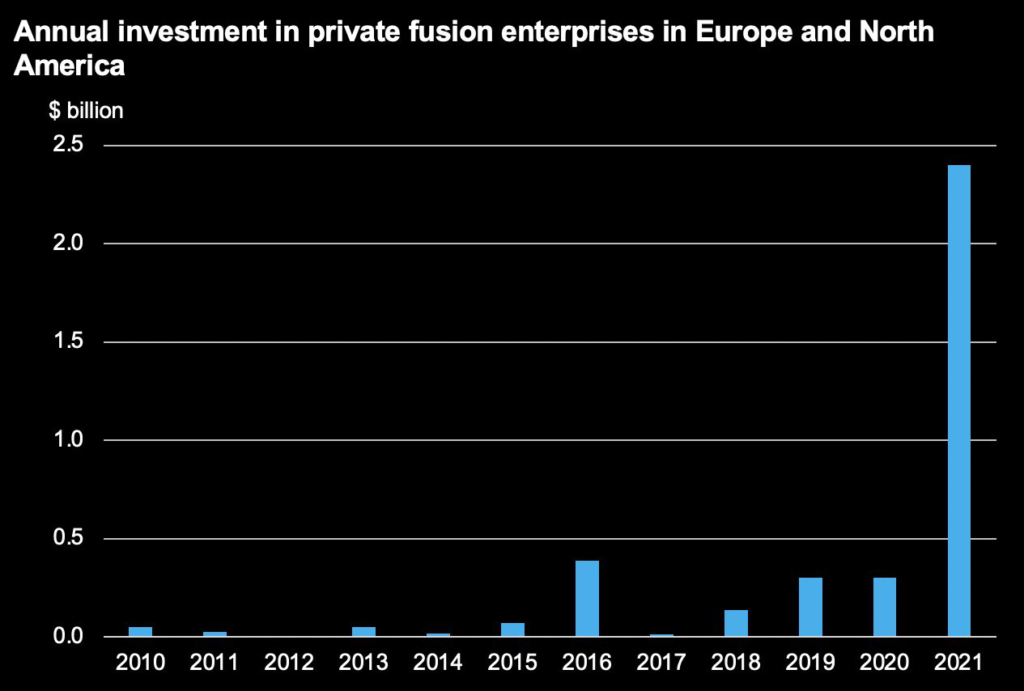
Globally, more than $3 billion has poured into private fusion startups such as TAE Technologies Inc. and Commonwealth Fusion Systems in the U.S.

First Light, which also is backed by IP Group Plc and Oxford Sciences Innovation Plc, plans to manufacture the fuel targets for $10 to $20 each, and it’s working with UBS Investment Bank AG to explore “strategic options.”

“This pursuit of practical and affordable fusion will give us the clean and abundant baseload power that we so desperately need in our effort to address — and hopefully reverse — global warming,” co-founder Yiannis Ventikos said.

Laboratories such as the $3.5 billion U.S. National Ignition Facility have been inducing fusion for years by bombarding gold-encased exotic elements with high-energy lasers.

First Light worked to drive down costs by replacing lasers with gas guns and swapping out precious metals in the fuel. That approach is about 1,000 times cheaper, Chief Executive Officer Nicholas Hawker said.

“The physics is simpler,” Hawker said.

More stories like this are available on bloomberg.com

©2022 Bloomberg L.P.
U.S. Is Out-Innovating Global Rivals Including China on Patents Filed in Europe

(Bloomberg) — The U.S. is out-innovating global rivals, according to patent applications filed in Europe last year. 

Data released by the European Patent Office show that new ideas percolated at a record pace despited the isolation forced upon many by the global pandemic. U.S. companies and inventors filed 5.2% more patent applications in Europe in 2021, helping to reverse the overall decline seen in 2020.

“The strong demand for patents last year shows that innovation has remained robust,” EPO President Antonio Campinos, said in a statement. “It highlights the creativity and resilience of innovators.”

U.S. inventors filed a record 46,533 patents, almost three times more than China. The American growth was driven by increased patent applications in five fields: Medical technology, computer technology, digital communications, pharmaceuticals and biotechnology. The U.S. led in semiconductor patenting ahead of both China and South Korea.

Overall, the European Patent Office received 188,600 applications in 2021. Following the U.S. were Germany, Japan, China and France among the top five countries. But, when ranked by patent applications per million inhabitants, the U.S. drops to 14th place.

Patent applications are highly concentrated. The top five countries account for almost two-thirds of European patent applications, and the top 20 countries account for 95%.  

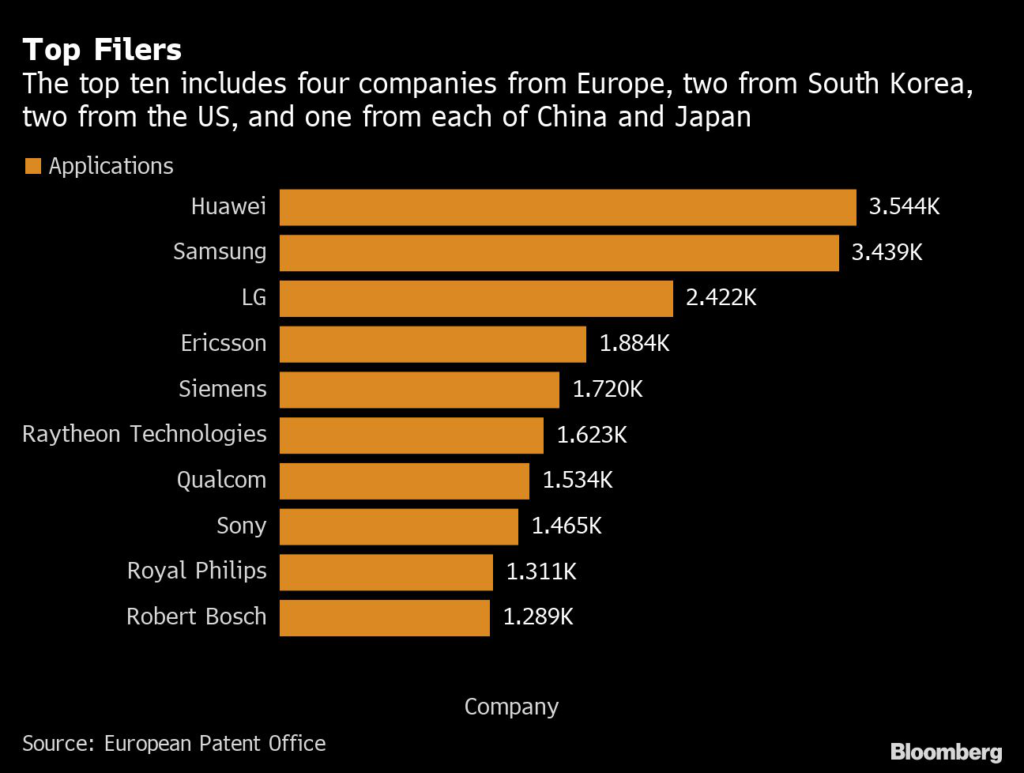
Raytheon Technologies Corp. became the new top U.S. patent applicant at the EPO, filing a total 1,623 patent applications, and pushing Qualcomm Inc. into second place. Microsoft Corp. and Alphabet Inc. followed with more than 1,000 each. 

Overall, Raytheon came in sixth place by patent applications. Huawei Technologies Co. jumped ahead of Samsung Electronics Co. as the leading patent applicant at the EPO in 2021. The top ten include four companies from Europe, two from South Korea, two from the U.S., and one from each of China and Japan.

About three-quarters of applicants last year were large enterprises, 20% individual inventors or small or medium-sized enterprises with fewer than 250 employees, and the remainder universities and public research organizations.

More stories like this are available on bloomberg.com

©2022 Bloomberg L.P.

Algorithmic Stablecoin Neutrino Loses Peg as Token Slumps

(Bloomberg) — An algorithmic stablecoin known as Neutrino that is associated with the Waves blockchain lost its peg to the dollar after the price of the underlying token tumbled. 

Waves, the token backing Neutrino USD, or USDN, dropped by more than 26% in the past 24 hours. USDN was trading at about $0.796, according to CoinGecko.

Stablecoins are typically used to facilitate trading on exchanges by minimizing the volatile price swings seen by most cryptocurrencies. Most hold assets such as dollars in reserve to maintain the one-to-one relationship, while others such as Neutrino seek to keep at equilibrium by issuing and burning tokens. If the value of the underlying token drops sharply, the peg can drop below the target level. 

The failure comes in the wake of the fall last year of Iron Finance, a decentralized finance project that sought to build a stablecoin without being backed by fiat currencies. Neutrino had a market value of about $828 million, making it the 101st-largest cryptocurrency, according to data from CoinMarketCap. Waves is valued at about $3.9 billion. 

Waves gained attention earlier this year amid speculation that some Russians could be rushing into the Russia-rooted blockchain because of geopolitical tension. The token had been one of the best performing cryptocurrencies this year among the top 50 cryptocurrencies by market capitalization, according to data from Messari.

Similar to other algorithm stablecoins like Terra’s UST or Iron Finance’s IRON, USDN’s peg is maintained by Waves’ own Waves token. For every USDN being issued, Waves tokens would be locked in smart contracts, or codes running on blockchain. When Waves’ price fell sharply, USDN’s peg broke.

A representative of Waves project didn’t immediately respond to a request for comment.

Terra blockchain, which powers the UST algorithm stablecoin, recently launched a Bitcoin reserve to help improve UST’s peg to the dollar. 

More stories like this are available on bloomberg.com

©2022 Bloomberg L.P.

Palantir Is Now in Space

(Bloomberg) — Palantir Technologies Inc. launched its first satellite this month allowing information to be processed in orbit, instead of being gathered and sent back to Earth, a step toward broadening the applications of the data analysis software.

The company, co-founded by the billionaire Peter Thiel and Alex Karp, is working with the Earth-mapping company Satellogic Inc. Palantir said its software will improve the speed and quality of data collected from space.

Palantir, a longtime government contractor, has some experience beyond Earth. It works with the military’s Space Systems Command, among other Pentagon agencies. It’s investing in the space industry and said its software can run on drones, aircraft and now satellites. Its military work has raised controversy over the years.

Karp, the chief executive officer, is seeking to expand his business on this planet, too. He wrote a letter posted to the company’s website last month that used the war in Ukraine as an opportunity to highlight Palantir’s work with the U.S. government and its allies. He said his company was able to grow because the U.S. “took an interest in software and understood its potential to reshape national defense” and that European nations should follow suit.

“The continent certainly understands that its defense and that of its allies now requires the development of an indigenous source of strength and capacity to defend itself, and quickly,” Karp wrote. “Our software is in the fight around the world.”

In an interview on Bloomberg Television, Palantir Chief Operating Officer Shyam Sankar said European governments and groups are using its software to organize the distribution of materials such as food and beds to Ukrainian refugees who fled during the war. Palantir’s software is also being used to power military responses to Russia’s invasion of Ukraine, he said.

(Updates to add details about Palantir’s efforts around Ukraine in the final paragraph.)

More stories like this are available on bloomberg.com

©2022 Bloomberg L.P.

Cathie Wood Sees Potential for Twitter Shakeup After Musk Takes Stake

(Bloomberg) — Cathie Wood speculated that Elon Musk’s new ownership stake in Twitter Inc. might open the door to a management shakeup at the social media company. 

Musk is sending a “strong signal” to Twitter chief executive officer Parag Agrawal, Wood, the founder and chief executive officer of Ark Investment Management LLC, said in an interview on Bloomberg Radio. “This could be setting up for another leadership change,” she said. Agrawal replaced founder Jack Dorsey in November.

Wood, whose flagship fund has almost 10% of its assets in Tesla Inc., has not spoken to Musk about the carmaker’s CEO taking a 9.2% stake in Twitter to become the platform’s biggest shareholder, which was revealed Monday in a regulatory filing. The news came a week after Musk hinted he might attempt to shake up the social media industry. 

“I think he is sending a strong signal to the new CEO,” Wood said.

Wood’s flagship investment fund, ARK Innovation ETF (ARKK), tumbled 24% last year after surging almost 150% in 2020. The fund plunged another 30% in the first quarter, as investors soured on the richly valued growth stocks she targets.

In the wide-ranging interview, Wood reiterated her warning that aggressive rate hikes by the Federal Reserve risked dangerously slowing the economy. A 50-basis point hike, which bond traders anticipate at the central bank’s next meeting, would lead to a more severe inversion of the yield curve, Wood said.

Wood said last week the Fed raising interest rates as the yield curve inverts would be a mistake. The central bank seems to be “playing with fire,” she wrote on Twitter.

“We think the Fed hikes are priced into the market,” she said Monday. “If you look at the two-year treasury yield, you’ll see most of those are priced in.” The rate on the two-year note, among the most sensitive to Fed policy plans, spiked almost 150 basis points in the first quarter.

The Nasdaq 100, home to technology and growth stocks, had plunged 20% into a bear market ahead of the Fed’s March 16 rate hike. Wood said the announcement marked the bottom for many of her fund’s top names. Zoom Video Communications Inc., Twilio Inc. and Roku Inc. — all top 10 in the ARKK ETF — have jumped at least 26% in the almost three weeks since. The Nasdaq is up 13% in that time.

Those companies had been in free fall as inflation surged to the highest in four decades, making it harder to justify lofty valuations for future profits. Wood said she saw a “buying opportunity” for her holdings, even at the expense of Tesla.

“When there are risk-off periods, traditional investors really diversify and sell our stocks as they move close to their benchmarks,” she said. “So it’s a great buying opportunity for us — I will say I can’t believe how long that buying opportunity lasted.”

More stories like this are available on bloomberg.com

©2022 Bloomberg L.P.

Close Bitnami banner
Bitnami
