
Bloomberg

Shopify’s 50% Slump Proves That It’s No Amazon

(Bloomberg) — Shopify Inc. has been called “Amazon Junior.” Those shoes are proving too big to fill.

Both companies are seen as bellwethers for the e-commerce sector and they are index heavyweights, too: Shopify is 3.1% of Canada’s benchmark stock index and Amazon.com Inc. is 3.7% of the S&P 500. 

Unfortunately for Shopify investors, that’s where the similarities end. 

Shopify provides the software and other services that allow small businesses to sell on their own websites, an increasingly competitive business that skeptics say is becoming commoditized. Amazon is not only a mammoth online retailer in its own right and offers a marketplace for smaller businesses, but it also operates a fabulously profitable cloud-computing business.

That helps explain why Shopify has been routed this year along with many other high-multiple software stocks — falling 48%, erasing about $83 billion in market value. Amazon is down less than 1%.

“They are two different businesses,” said David Trainer, chief executive officer and founder of research firm New Constructs. “Even with the recent stock price decline, shares remain priced for Shopify to be bigger than Amazon. Shopify remains significantly overvalued.” Trainer has one of two sell ratings on it, according to data compiled by Bloomberg.

Both stocks received a huge lift when the pandemic hit in 2020 and consumers turned en masse to online shopping. But Shopify has given back most of those gains as investors take a closer look at the fundamentals. 

The company’s growth, while still impressive, is slowing. In its last earnings report, Ottawa-based Shopify warned that sales growth will be lower in the first quarter of this year. For the year, analysts expect sales to increase 31%, down from 57% last year.  

Without a true cash-cow business like Amazon Web Services, Shopify’s profitability is modest and its valuation is sky high. The company’s enterprise value, which includes net debt, is more than 140 times estimated earnings, compared with less than 19 for Amazon. 

That’s not uncommon for a young company that’s growing, of course. But therein lies the problem for the stock: Software providers with rich valuations are one of the market’s most out-of-favor groups. It’s a combination of a retreat from high-valuation stocks because of rising interest rates, skittishness about companies that aren’t very profitable, and slowing growth rates after the pandemic pulled forward demand for some tech services. 

Read more: Shopify’s Shrinking Valuation Summons the Curse of Canada Tech

Despite the brutal selloff, some Shopify bulls are undaunted. 

“If you can look past the next couple of years, you see that there is still good secular growth at an expensive price,” said Jordan Stuart, client portfolio manager at Federated Hermes. “A lot of portfolio managers are looking at large cap indexes, saying I have that exposure, what else do I want to own? I’ve got to own something different and Shopify is going to provide that opportunity.”

Tech Chart of the Day

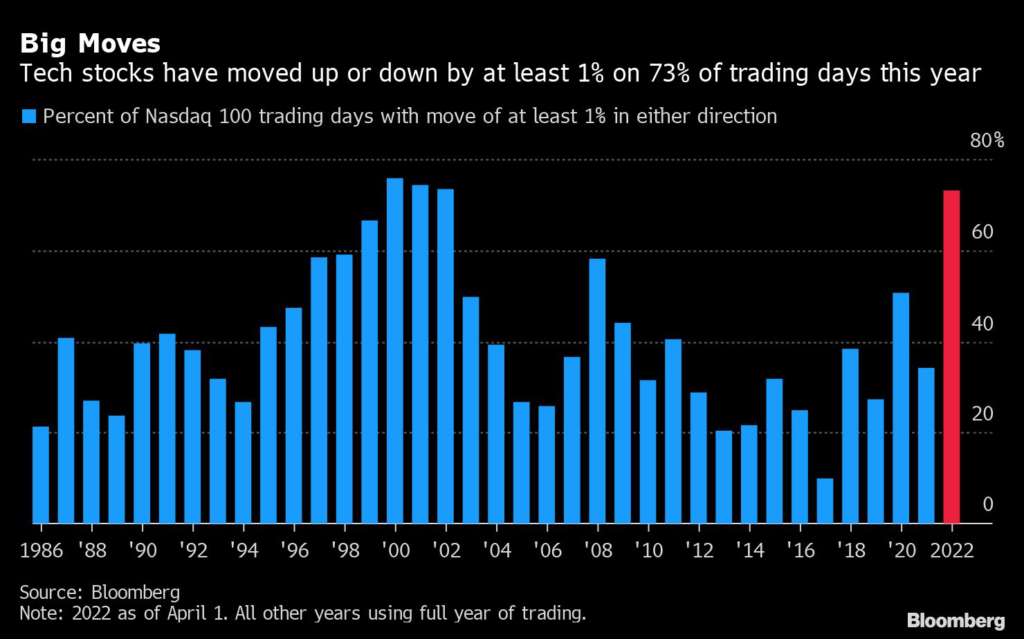
Tech investors have been treated to a wild ride over the first three-plus months of the year. The Nasdaq 100 Index has closed higher or lower by at least 1% on 73% of trading days in 2022, which would be the highest percentage in two decades if the trend were to continue for the remainder of the year.

Top Tech Stories

  • Chinese stocks listed in the U.S. rallied on Beijing’s plans to modify restrictions on the data that overseas-listed companies are allowed to share with foreign regulators, easing concerns that these companies could be kicked off American exchanges.
  • Chinese fast-fashion e-commerce startup Shein is weighing a funding round at a valuation of about $100 billion, according to people familiar with the matter
  • Indonesia’s GoTo will give away thousands of shares to each of 600,000 drivers as part of its $1.1 billion initial public offering, setting a precedent for Southeast Asia’s sharing economy
  • Delivery Hero SE said it expected the entire company to hit a measure of profitability next year for the first time
  • French campaigners are successfully winning support in courts to block Amazon.com Inc.’s plans to construct distribution facilities in the country
  • FinAccel Pte, the parent company of fintech platform Kredivo, has acquired a majority stake in Indonesia’s PT Bank Bisnis Internasional TB, pitting itself against Southeast Asia’s biggest internet companies for a share of a growing digital banking arena

(Updates share price moves throughout.)

More stories like this are available on bloomberg.com

©2022 Bloomberg L.P.

Hasbro Adds Gaming-Industry Veterans to Board at It Faces Proxy Fight

(Bloomberg) — Hasbro Inc. added two industry veterans to its board as the company looks to expand its digital-gaming business while fending off a proxy fight.

Elizabeth Hamren, chief operating officer of Discord Inc. and a former executive with Microsoft Corp.’s Xbox operations, and Blake Jorgensen, executive vice president of special projects for Electronic Arts Inc., joined the Hasbro board on April 1, the company said Monday in a statement. They bring significant management experience and expertise in strategic areas like digital gaming, technology, brand development and capital allocation, the company said.

New Chief Executive Officer Chris Cocks wants to increase consumer engagement for Hasbro brands, like he did while running the company’s fast-growing Wizards of the Coast playing card and digital-gaming unit. Meanwhile, investor Alta Fox Capital Management has urged the company to spin off the business and has also nominated five directors to the board.

“While we will share the full scope of our ambitions at an investors day this fall, the fundamental gameplan we used at Wizards will be the roadmap we follow for the rest of Hasbro,” Cocks said in a letter to shareholders that was also released Monday.

Hasbro shares were little changed at 10:08 a.m. New York time. The stock had fallen 17% this year through Friday’s close.

Alta Fox’s founder and managing partner, Connor Haley, said expanding Hasbro’s board seems to be a “defensive and reactionary” move. 

“The Board’s desire to continue operating Hasbro like a family business is a flashing red light for change and an obvious indicator that shareholder-appointed directors are needed,” Haley said in a statement. 

(Updates with shares in fifth paragraph, Alta Fox comment in sixth and seventh.)

More stories like this are available on bloomberg.com

©2022 Bloomberg L.P.

Elon Musk Wasn’t Happy When Jack Dorsey Left Twitter. Then He Took a 9% Stake

(Bloomberg) — Elon Musk has dropped hints at his rationale for taking a 9.2% stake in Twitter Inc. on the platform itself, starting shortly after Jack Dorsey stepped down as chief executive officer.

The Tesla Inc. boss posted a meme on Dec. 1 superimposing incoming Twitter CEO Parag Agrawal’s face onto Joseph Stalin’s. The doctored image depicts Agrawal, formerly Twitter’s chief technology officer, purging Dorsey, as Stalin did to Soviet secret police chief Nikolai Yezhov.

The post suggested Musk, 50, believed Twitter’s new CEO had thrown his predecessor overboard. And Musk and Dorsey, 45, have been friendly going back years.

When Dorsey was asked in February 2019 to name the most exciting, influential person on Twitter, he singled out Tesla’s CEO and alluded to his recent “ups and downs” on the microblogging service.

The U.S. Securities and Exchange Commission had just alleged Musk violated a settlement of the securities fraud lawsuit the agency brought months earlier over the billionaire’s tweets about trying to take Tesla private.

Musk returned the favor a year later when billionaire activist investor Paul Singer’s Elliott Management Corp. called for changes at Twitter, including possibly replacing Dorsey.

“Just want say that I support @Jack as Twitter CEO,” Musk wrote in March 2020.

The two have bonded more recently over Bitcoin, extolling the possibilities for cryptocurrency during a virtual panel in July. They also fed off one another late last year in poking fun at web3, the catchall term venture capitalists use to describe online services built using blockchain technology, where control isn’t concentrated in a single entity.

There have been hints since then that Musk may share concerns about the future of free speech on Twitter under Agrawal, 37. Politically conservative commentators including David Sacks, a fellow member of the so-called PayPal mafia, shared a link to a more than hour-long streamed discussion of whether Dorsey’s resignation would lead to more censorship. Sacks co-founded Callin, the social-podcasting app where the talk took place.

Musk took a poll late last month asking Twitter users whether the service “rigorously adheres” to the principle that “free speech is essential to a functioning democracy.” After more than 70% said no, he asked whether a new platform was needed and said he was giving serious thought to starting his own.

The regulatory filing uploaded Monday disclosing Musk’s stake in Twitter doesn’t say anything about why Musk purchased shares in the company. He didn’t respond to messages seeking comment.

More stories like this are available on bloomberg.com

©2022 Bloomberg L.P.
Alibaba, Didi Fuel $80 Billion Rally for Chinese Stocks in U.S.

(Bloomberg) — Alibaba Group Holding Ltd. and Didi Global Inc. rallied for a second day, adding $80 billion in value to U.S. listed Chinese stocks as fears of potential delistings eased.

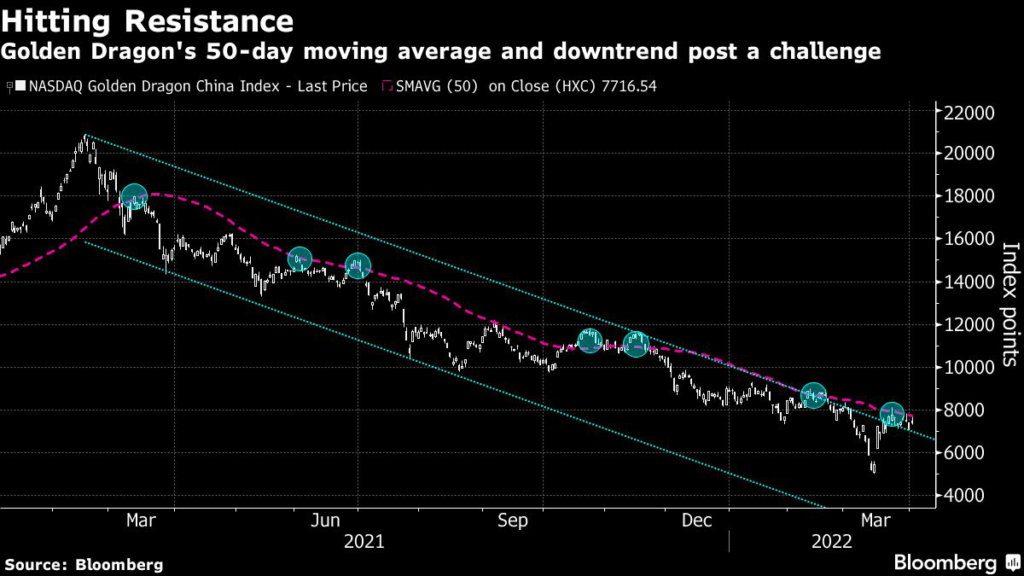
The Nasdaq Golden Dragon China Index jumped as much as 6.1% Monday, adding to Friday’s climb after Beijing regulators published revised draft rules scrapping requirements that on-site inspections should be mainly conducted by Chinese regulatory agencies.

Alibaba rose as much as 5.2% and Didi climbed 8.5%, while JD.com Inc. advanced 7.2%. Pinduoduo Inc., Bilibili Inc. and iQiyi Inc. were among the top gainers, climbing at least 6.5% each. The advance in American depositary receipts tracked a 5.4% gain in Hong Kong’s Hang Seng Tech Index, the sharpest in two weeks. China was closed for a holiday.

China Removes Key Hurdle to Allow U.S. Full Access to Audits 

“For now, investors are erasing the regulatory risk premium which is helping both markets and sentiment recover,” said Olivier d’Assier, head of APAC applied research at Qontigo. While the regulatory risks is receding, there still leaves a lot of macro risk which is yet unknown, as well as geopolitics, he added.


Beijing’s move could potentially remove a key hurdle to U.S. regulators gaining full access to auditing reports for Chinese companies listed in New York, ending a long-running dispute over data sharing. Last week, Bloomberg News had reported that Beijing is drafting a framework that will allow a majority of Chinese firms to keep their listings.

“We believe this is an important step in clarifying China’s stance on the audit dispute,” Morgan Stanley equity strategists led by Laura Wang said in an April 3 note. “We maintain our view that the likelihood of a final agreement being reached over the ADR audit dispute is now higher.”

China Rule Change to Help Ease U.S. Delistings Risk: Street Wrap

While the latest statement appears to show Beijing is more constructive on this, some remain cautious until the final resolution comes through. 

“I am expecting more twists going forward, as the U.S. and China go back and forth on this,” said Henry Guo, an analyst at M Science LLC. “The regulation overhang for Chinese ADRs should remain in the near future and investors are cautious about investing in them as regulation-related risks are totally out of their control.” 

SEC chief last week dialed down speculation of an imminent deal with Chinese counterpart on the delisting issue. 

(Updates share price moves and adds details throughout.)

More stories like this are available on bloomberg.com

©2022 Bloomberg L.P.

Hertz Plans Electric Car Fleet Expansion With 65,000 Polestars

(Bloomberg) — Hertz Global Holdings Inc. plans to buy 65,000 electric vehicles from Polestar over the next five years, betting its renters are both EV curious and eager to drive brands beyond Tesla.

The vehicles from Polestar, the all-electric automaker controlled by Volvo Car AB and its owner Zhejiang Geely Holding Group Co., will join some 100,000 Teslas that Hertz has said it’s buying for more than $4 billion. The new deal delivered a boost to shares of Hertz and Gores Gugenheim Inc., the special purpose acquisition company planning to merge with Polestar.

The Tesla and Polestar purchases give Hertz a steady stream of some of the most coveted battery-powered cars, even as manufacturers scurry to keep up with swelling order books. Polestar expects to double sales this year, delivering 65,000 vehicles globally. It plans to produce 290,000 EVs a year by 2025, a tally Tesla now reaches in less than three months.

“It is our objective to build the largest fleet of electric vehicles, certainly in North America,” Hertz Chief Executive Officer Stephen Scherr said. “We felt Polestar was at the right place and at the right level of maturity.”

Hertz shares rose as much as 3.2% to $21.79 shortly after the open of regular trading Monday, while Gores Guggenheim’s stock soared as much as 10% to $12.63.

Hertz’s Tesla plan fueled a more than 40% spike in the car renter’s shares in late October, though the stock swooned in early November. The two deals represent roughly a third of Hertz’s current fleet, an influx of vehicles Scherr says will help win business from corporate clients with environmental objectives and ride-share drivers keen to spend less on gas. What’s more, Hertz is expecting the cars to require less maintenance and stay in the fleet longer than those with combustion engines.

“Electric vehicles really open up the fleet to a variety of different business cases,” Scherr said.

Traditionally, carmakers have reserved some of their least-popular models for rental customers. Rental companies typically make the bulk purchases at steep discounts, which can hurt resale values and tarnish brands if the auto companies aren’t careful.

For Polestar, however, the Hertz order provides a sizable, dependable stream of revenue while it’s still pushing to open dealerships. The company has just 125 showrooms around the world.

“Let’s face it, a new brand like us, to gain access and visibility in the broader market … it’s a great opportunity,” Polestar CEO Thomas Ingenlath said. “Customers will be experiencing Polestar in different situations than an ordinary test-drive can offer,” he added. “You will have a much longer period in the car; your family might be with you.”

Hertz and Polestar didn’t share the financial terms of the planned purchase. The starting sticker price of the Polestar 2 sedan is $45,900, meaning the deal would generate almost $3 billion of revenue if Hertz pays at or close to that price.

The announcement bolsters Polestar as it prepares to debut on the public markets this quarter via the reverse merger with Gores Gugenheim. The companies have said they expect the deal to value Polestar at about $20 billion. The company is also close to unveiling a sport utility vehicle, its third model and one of three new machines slated to roll out by 2025.

The rental business will provide a tide of de-facto test drives to customers who may not otherwise have considered a Polestar — or any EV. Polestar has positioned itself as a Tesla alternative. Its recent Super Bowl ad trolled Elon Musk’s cosmic ambitions with a pledge: “No conquering Mars.” Musk responded with the rolling-on-the-floor-laughing emoji. 

Hertz has said that, in time, its global fleet of cars — roughly half a million vehicles — will be electric and it intends to work with every EV maker on the market to make that happen.

(Updates with shares trading in the second and fifth paragraphs.)

More stories like this are available on bloomberg.com

©2022 Bloomberg L.P.
AMD Buys Networking Technology Maker Pensando for $1.9 Billion

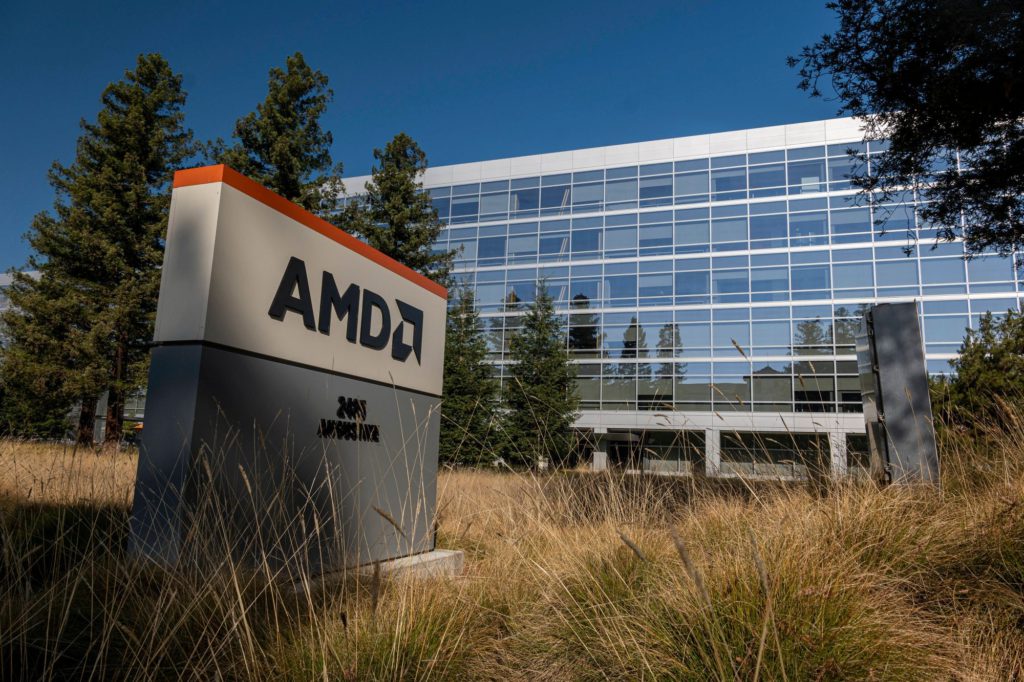
(Bloomberg) — Advanced Micro Devices Inc. is acquiring closely held Pensando Systems Inc. to add chips and software used to route information inside computer systems. 

AMD will pay about $1.9 billion, before working capital and other adjustments, the Santa Clara, California-based company said in a statement. The acquisition is expected to close in the second quarter, AMD said. Pensando’s customers include Goldman Sachs Group Inc., Microsoft Corp.’s Azure, Hewlett Enterprise Co. and Oracle Corp.’s cloud unit. 

Under Chief Executive Officer Lisa Su, AMD has resurrected its data center chip business where it’s the chief rival to Intel Corp. in providing microprocessors that run corporate networks and the internet. Su is adding new capabilities — programmable chips, graphics parts and now data packet processing chips — to beef up the company’s offerings and satisfy more of the growing demand for machinery that controls and makes sense of internet data.

“To build a leading-edge data center with the best performance, security, flexibility and lowest total cost of ownership requires a wide range of compute engines,” Su said in the statement. “The Pensando team brings world-class expertise and a proven track record of innovation at the chip, software and platform level which expands our ability to offer leadership solutions for our cloud, enterprise and edge customers.”

Recapturing share in data center chips where AMD had been reduced to less than 1% of the market has been a key component to helping the company grow and become more profitable. AMD’s shares climbed as much as 1.7% in intraday trading Monday after news of the deal.

AMD’s 2021 revenue grew 68% from the preceding year. Its gross margin — the percentage of sales remaining after deducting costs of production — will be about 51% this year. That’s nearly on par with Intel’s projection for 51% to 53%. In 2016, Intel had boasted a margin of more than 63%, while AMD was at 31%.

(Updates with shares in the penultimate paragraph.)

More stories like this are available on bloomberg.com

©2022 Bloomberg L.P.
Ukraine Crisis Tests Cyber Warfare’s Red Lines, Bitdefender Says

(Bloomberg) — Russia’s invasion of Ukraine has ushered in a new era of cyber warfare, raising the risks of spillover from conventional conflicts, according to the chief executive officer of Bitdefender Holding BV.

Florin Talpes, whose Romania-based cybersecurity software company has filed for an initial public offering in the U.S., said that the ongoing war has split the hacking community, with Anonymous attacking Russian institutions and some ransomware groups backing Moscow.

“The major change we’re seeing is the fact that private cybercrime groups are taking sides,” the CEO said in an interview. The appearance of these actors, “which play an active role in the war, boosts the risks because they don’t have the same war logic or frameworks as countries.”

Meanwhile, Russia has become a global “superpower” in state-run cyber capabilities, he said. Kremlin-backed hackers have intensified their social-media influence and the spread of fake news to counter the narrative that Russia is the aggressor, according to the CEO.

Talpes said the type of attacks targeting Ukraine has also changed. While previously hackers mainly focused on extracting ransom from companies, many now target the destruction of key infrastructure sites, he said, citing a recent attack on a Ukrainian telecoms provider.

More and more “red lines” are being tested, which is a “risk and a significant challenge,” he said. Bitdefender is offering free cyber-protection to Ukrainian companies and individuals during the war.

The company, which competes against Webroot Inc., McAfee Inc. and NortonLifelock Inc., confidentially filed for an IPO to the Securities and Exchange Commission late last year. While the start up was valued at $600 million in 2017, when private-equity firm Vitruvian Partners LLP purchased a minority stake, it may now be worth more than a $1 billion.

“We might be the first unicorn headquartered in Bucharest,” Talpes said. He declined to comment further on the IPO process.

More stories like this are available on bloomberg.com

©2022 Bloomberg L.P.

BOE’s Andrew Bailey Says Crypto Is the ‘New Front Line’ for Scams

(Bloomberg) — Cryptocurrencies are the new “front line” in criminal scams that regulators are trying to prevent, Bank of England Governor Andrew Bailey said.

Speaking at a “Stop Scams” conference organized by the U.K. central bank, Bailey said that the underlying technology of crypto is contributing a good deal of innovation to financial services, but also created an “opportunity for the downright criminal.” 

“You only have to ask the question: What do people committing ransom attacks usually demand payment in? The answer is crypto,” he said.

The U.K.’s financial regulator, the Financial Conduct Authority, last week extended a deadline for its approval of crypto operations. That gave a dozen firms more time to get their applications or affairs in order. So far, 33 have been approved for permanent registration with the FCA, which allows them to continue providing cryptocurrency services from within the U.K. after April 1.

Despite the extension, the crypto industry has warned of an impending exodus of companies moving their operations abroad if they could not gain FCA approval, which requires them to meet strict U.K. anti-money laundering rules.

Still, Bailey lamented that some cryptocurrency users act as though national rules do not apply to them. 

“Some crypto enthusiasts say they shouldn’t be covered by Russian sanctions because that’s not their world,” he said. “I’m sorry, it is your world. We’re all in the same world.”

He called on banks, tech companies, and government institutions to work with the BOE to tackle scams against consumers, which he acknowledged was a job that “will never be done.”

Read more:

  • U.K. Faces Crypto Exodus as Firms Sound Off Before FCA Deadline
  • FCA Extends Key Crypto Deadline for Revolut, 11 Other Applicants


More stories like this are available on bloomberg.com

©2022 Bloomberg L.P.
Nigeria to Bar 75 Million Phone Lines in Bid to Stop Kidnappings

(Bloomberg) — Nigeria ordered the nation’s wireless companies to bar outgoing calls from phone numbers not linked to the National Identity Number in a bid to control extortions and abductions. 

The rule will come into effect Monday, the National Communications Commission said in an emailed statement. President Muhammadu Buhari in December 2020 ordered all phone lines to be linked to an identity number to curb rising incidents of abductions in the country’s northern region. 

Kidnappers usually call relatives of their victims with unregistered subscriber identity module, or SIM, cards, which authorities in Africa’s most populated nation are unable to trace. The latest rule will mean about 75 million phone lines that aren’t linked to the national identity number won’t be able to make calls. 

Out of the nation’s 198 million phone connections, 125 million SIM cards had been verified and linked to 78 million unique national identity numbers, according to the commission’s statement. 

MTN Group Ltd.’s Nigerian unit is the largest operator with 75 million subscribers, giving it a market share of about 38%. Other major operators include billionaire Sunil Mittal-backed Airtel Africa Plc and Globacom Ltd.  

More stories like this are available on bloomberg.com

©2022 Bloomberg L.P.

Close Bitnami banner
Bitnami
