Bloomberg

Fintechs Stung by High Brazil Rates as Big Banks Contain Fallout

(Bloomberg) — Brazil’s massive interest-rate hikes are hampering the business model for financial technology firms including Warren Buffett-backed StoneCo Ltd. and PagSeguro Digital Ltd., who had been offering cheaper loans and services than big banks and growing at a furious clip. 

The fintech industry, which exploded in recent years with record venture capital investments and public equity sales, is suddenly facing a reckoning, as Brazil’s central bank jacked its key rate up by nearly 10 percentage points in a year to combat inflation. That’s making it harder to offer competitive rates on loans without compromising already tight profit margins.

Financial costs for big banks like Itau Unibanco Holding SA and Banco Bradesco SA have not risen as much due to their larger and more diversified base of retail customers, which often leave their money parked at bank accounts in exchange for returns below the basic rate or no return at all — something big professional investors usually wouldn’t accept. Meanwhile, individuals in Brazil can pay as high as 346.3% a year for credit card loans.    

“Fintechs were born with a main advantage for clients — charging less than bigger banks,” said Cynthia Cohen Freue, top analyst for financial services and banks in Latin America at S&P Global Ratings. “So, for them it is difficult to pass along higher borrowing expenses to clients.”

The pandemic accelerated the digitalization of financial services everywhere but especially in Latin America’s largest economy, where mobile and internet banking already represent almost 70% of the transactions. A record $8.85 billion was poured into startups in the nation in 2021 and the year was capped in December by Nu Holdings Ltd. much-anticipated initial public offering that valued the digital credit card issuer at $45 billion, more than Itau or Bradesco at the time. Nubank, as the company is known, raised $2.8 billion on the IPO. 

But the benign rate environment ended abruptly. Brazil’s annual inflation went from below 2% in May 2020 to 10.5% last month. Wary of falling behind the curve, the central bank started hiking in March 2021, taking the benchmark rate to 11.75% in one of the most hawkish cycles globally. 

That’s upending balance sheets.

StoneCo, a merchant acquiring and payment-technology firm, more than tripled its financial expenses in 2021 compared to a year before, to 1.27 billion reais ($270 million). Its financial income, meantime, grew just over 14%, to 1.88 billion reais, as it delayed increasing prices to clients.

“We didn’t want to hurt our customers with higher costs, which we felt we could absorb for a while,” said Stone’s Chief Executive Officer Thiago Piau, in an earnings call on March 17. “But, in the end, the impact was too big in our bottom line and so we began repricing in November.”

This strategy helped the company to end 2021 with 1.8 million costumers, surpassing the guidance of 1.4 million, StoneCo said. 

PagSeguro Digital Ltd., a StoneCo competitor, reported financial expenses of 790.6 million reais in 2021, more than six fold higher than a year before, while financial income grew about 60%, to 3.7 billion reais, according to filings. 

In a statement to Bloomberg, the company said that part of the increase in financial costs was due to growth in payment volumes, which reached 252 billion reais in 2021, 56% more than in 2020. PagSeguro has about 22 million retail clients using its digital accounts and acquired a bank license in 2019 in order to further diversify its source of funding, the company said.

Nubank also saw financial costs increase more than three fold to $367.3 million, according to filings. But interest income and gains with financial instruments grew almost in the same proportion, to more than $1 billion. 

The firm, also backed by Buffett’s Berkshire Hathaway Inc., has deposits from small companies which pay no interest rates and, as any credit card issuer in Brazil, receives payments from costumers ahead of the payments to the networks. Nubank can invest those two sources of cash to generate financial revenue.  

By comparison, Itau, Brazil’s biggest bank by market value, saw expenses with financial intermediation actually decrease last year, almost 10%. Bradesco, the second biggest, posted an increase of less than 7%. 


Brazil’s slower economic growth poses an additional hurdle to fintechs, as delinquency rates tend to rise and demand for loans fades. While that’s a challenge for the whole financial industry, some newcomers attract clients with lower credit scores than big banks as part of their aggressive growth business strategy, according to S&P Global Ratings. Banks can simple cut credit in tougher environments, while fintechs promise investor they will keep expanding regardless of a possible GDP contraction.   

After advancing about 4.6% in 2021, Brazil’s economy is expected to expand just 0.5% this year. October presidential elections that pit former President Luiz Inacio Lula da Silva against incumbent Jair Bolsonaro will also lead to greater volatility in the second half of the year, while Fed rate hikes and the war in Ukraine are adding stress.

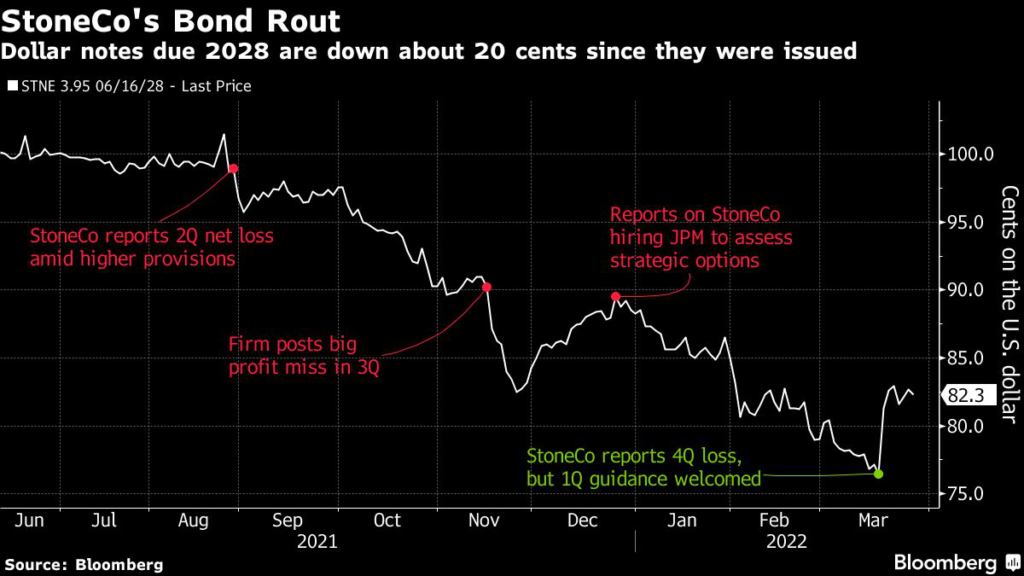
Those challenges are affecting prices for StoneCo’s $500 million dollar bond due in 2028 — its yield has jumped about 100 basis points this year to 7.2%. 

The poor bond performance also reflects some of StoneCo’s own challenges — it halted lending to small and middle-sized companies in October after a bad experience and its adjusted net income fell 79% in 2021. Meanwhile, its main competitor Cielo SA, owned by Bradesco and Banco do Brasil SA, reported a 98% increase in net income.

“The concern is not that interest rates are so high, because Brazilians are generally used to higher rates, but the pace at which they have risen recently,” said Diksha Gera, an analyst at Bloomberg Intelligence. “Fintechs will need to compromise on price if they want to focus on clients expansion.”

More stories like this are available on bloomberg.com

©2022 Bloomberg L.P.

SoftBank Group Lines Up 11 Lenders for Arm’s $8 Billion Loan

(Bloomberg) — Japan’s SoftBank Group Corp. has lined up banks including JPMorgan Chase & Co. for an $8 billion term loan secured by the shares of its unit Arm Ltd.

Barclays Plc, Banco Santander SA, BNP Paribas SA, Credit Agricole Corporate and Investment Bank and Goldman Sachs Group Inc. are also among the 11 lenders involved, a spokesperson for the Japanese company said, confirming a Bloomberg report citing people familiar with the matter. 

The loan agreement comes as Masayoshi Son’s technology investment company is seeking a valuation of at least $60 billion for when Arm goes public, Bloomberg reported late last month.

SoftBank’s request for a margin loan will test banks’ appetite for riskier forms of financing after some high-profile blow ups in recent years. This isn’t the first time Son has linked mandates for initial public offerings to margin loans. 

In 2018 it lined up commitments for a loan of $9 billion for its Vision Fund, provided by advisory firms including arrangers of its Japanese wireless business’s IPO, who had been asked to lend to other parts of the parent company’s empire, Bloomberg reported.

Initial offerings globally have had one of the worst starts to the year ever amid a rout in technology stocks, concerns about rising interest rates and geopolitical tensions. That makes mandates like Arm particularly sought after by investment banks. 

Other lenders involved are:

  • Daiwa Securities Group
  • Deutsche Bank AG
  • Mizuho Financial Group
  • Natixis SA
  • Sumitomo Mitsui Banking Corp.

(Updates to include names of other lenders in bullets)

More stories like this are available on bloomberg.com

©2022 Bloomberg L.P.
Spain Plans to Invest $12.4 Billion in Chips, Semiconductors

(Bloomberg) — Spain plans to invest 11 billion euros ($12.4 billion) to develop microchips and semiconductors in a bid to modernize its tourism-dependent economy.

“We want our country to be at the vanguard of industrial and technological progress,” Prime Minister Pedro Sanchez said Monday in Madrid, without giving more details. He said the project will be approved soon by his cabinet.

The investment is the latest effort to rebuild the economy, which suffered more than most European peers from the pandemic and is under pressure again following Russia’s invasion of Ukraine. Sanchez said the war has disrupted supplies of gases such as argon and neon that are key for making semiconductors.

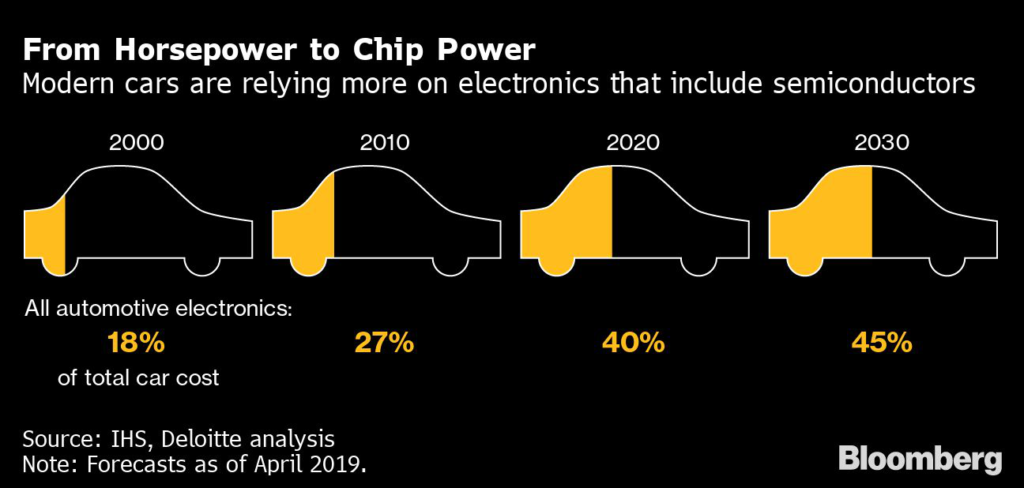
The chips are key for Spain’s auto industry, which is Europe’s second-largest, representing about 10% of gross domestic product.

Policy makers across the continent are racing to put in place plans to invest in chips and cut reliance on imported technology. The European Union aims to become a key semiconductor maker with a goal of producing a fifth of the world’s supply by 2030.

With its 45 billion-euro Chips Act, the European Commission freed up public funding last month to produce chips considered “first of a kind” in Europe. Individual countries are acting too: Germany is looking to grant Intel Corp. 5 billion euros in public funds to help fund a 17-billion semiconductor plant, people familiar with the matter said last month.

Spain is deploying unprecedented recovery funds from Brussels to reduce its reliance on tourism and bring down one of the EU’s highest unemployment rates. But spiking energy costs worsened by the war in Ukraine have complicated the turnaround.

Surging power prices, which propelled inflation to its highest in nearly four decades, have forced steelmakers to trim output and consumers to spend less. Rising living costs, meanwhile, have fanned discontent, with truckers staging a three-week protest that halted some companies’ operations and caused shortages of milk and other products. 

(Updates with economic background in seventh paragraph.)

More stories like this are available on bloomberg.com

©2022 Bloomberg L.P.
SoftBank’s Fisher Steps Down as Head of Vision Fund’s U.S. Arm

(Bloomberg) — Ron Fisher, one of Masayoshi Son’s longest serving lieutenants, is stepping down as head of the U.S. arm of SoftBank Group Corp.’s Vision Fund.

Fisher will leave his position as director and chairman of SoftBank Investment Advisors U.S. April 15 but remain a senior advisor to Son, SoftBank’s founder and chief executive officer. Fisher left SoftBank’s board last year and has been cutting back on the amount of time spent working at the company.

Fisher began working with Son more than two decades ago when SoftBank was largely focused on telecom operations, helping the Japanese billionaire through his acquisition of the American wireless operator Sprint Corp. Fisher also championed SoftBank’s investment in WeWork, the office-sharing startup that crashed in its first attempt to go public before completing a successful listing in 2021.

When Fisher left the board last year, Son said that he had always been a “source of wisdom.”

More stories like this are available on bloomberg.com

©2022 Bloomberg L.P.

The Battery Metal Really Worrying China Is Lithium, Not Nickel

(Bloomberg) —

Nickel has captured much of the limelight among battery metals in recent weeks, and understandably so. Wild price swings, including an unprecedented 250% advance over two trading sessions amid a short squeeze, and concerns tied to Russia’s role as a key supplier have added to longstanding worries among automakers about securing enough of the material.

Even so, it’s another metal that’s been causing concern in the world’s largest electric vehicle market. 

China’s government last month hauled in a whole range of market players for two days of talks focused on halting a breakneck run-up in lithium, the metal that’s vital for almost all rechargeable batteries and critical to the roll-out of emissions-free cars and clean energy. 

Lithium carbonate in China jumped about 472% from a low last June to a record high on March 15, according to pricing provider Asian Metal Inc. An index of global lithium prices compiled by Benchmark Mineral Intelligence has surged almost 490% in the past year.


At the March seminar, which included industry groups, raw materials suppliers and battery manufacturers, China’s Ministry of Industry and Information Technology, demanded “a rational return” to more typical lithium prices. Talks focused on supply bottlenecks, pricing mechanisms and what officials described as the healthy development of the country’s new-energy vehicle and battery sectors.

While similar interventions to manage soaring commodity prices have been common for coal and steel, it’s a rare step in the electric vehicle sector and underscores Beijing’s nervousness about the impact of rising lithium costs. 

As my colleague Danny Lee wrote earlier Monday, automakers are already grappling with the hikes in raw materials. Several have raised sticker prices in response. By making electric models too expensive, they risk slowing the pace of adoption.

“The industry is facing a very strong headwind from cost escalation,” Brian Gu, president of Xpeng Inc., told Bloomberg Television last week. The Guangzhou-based producer last month raised the price of its vehicles by between 10,100 yuan ($1,572) and 20,000 yuan.

Vehicle manufacturers are suffering from “opportunistic price hikes,” to lithium products, Nio Inc.’s founder William Li said on an earnings call last month. He urged suppliers to consider the impact of higher costs on development of the EV industry.

The sector’s challenges follow decisions to slow or halt expansions and new projects during a two-year lithium price slump through the middle of 2020. That, combined with Covid-19 disruptions, means additions to supply simply can’t keep pace with rising requirements. 

Demand for lithium will jump fivefold by the end of the decade, according to BloombergNEF. Roughly $14 billion of investment is needed to finance lithium resource and refining capacity by 2025, plus another as much as $5 billion by 2030, BNEF forecasts. 

There are some signs that governments, producers and consumers are now recognizing the scale of that task. 

Tesla Inc. signed two recent supply pacts with developers of future projects in Australia, while Ganfeng Lithium Co. — one of the world’s largest producers — said last week it’ll use record profits to support a huge expansion program, aimed at delivering eventual capacity of 600,000 tons of lithium carbonate equivalent, compared to production of about 89,000 tons now. 

China’s authorities have called for quicker development of a domestic lithium sector that already dominates world production, highlighting growth prospects in Qinghai, Sichuan and Jiangxi provinces. In the U.S., President Joe Biden last week added battery metals, including lithium, to a list of items covered by the Defense Production Act, meaning companies can access funding to boost output or to study potential new developments.

More stories like this are available on bloomberg.com

©2022 Bloomberg L.P.

AmEx Customers Face Further Disruption With Website and App Down

(Bloomberg) — Some American Express Co. customers are facing further disruption as a systems issue limits access to the credit card-giant’s digital services, a company spokesperson said in an email Monday.

The issue, which was also reported on Friday afternoon, is preventing some cardholders from making payments on the website and app. This has led to a backlog of customer care calls which is causing longer-than-usual wait times.

“We are working to resolve the issues and apologize to our customers for any inconvenience,” the spokesperson said in the statement.

More stories like this are available on bloomberg.com

©2022 Bloomberg L.P.
Crypto Rally Broadens Beyond Bitcoin to Likes of Solana, Terra

(Bloomberg) —

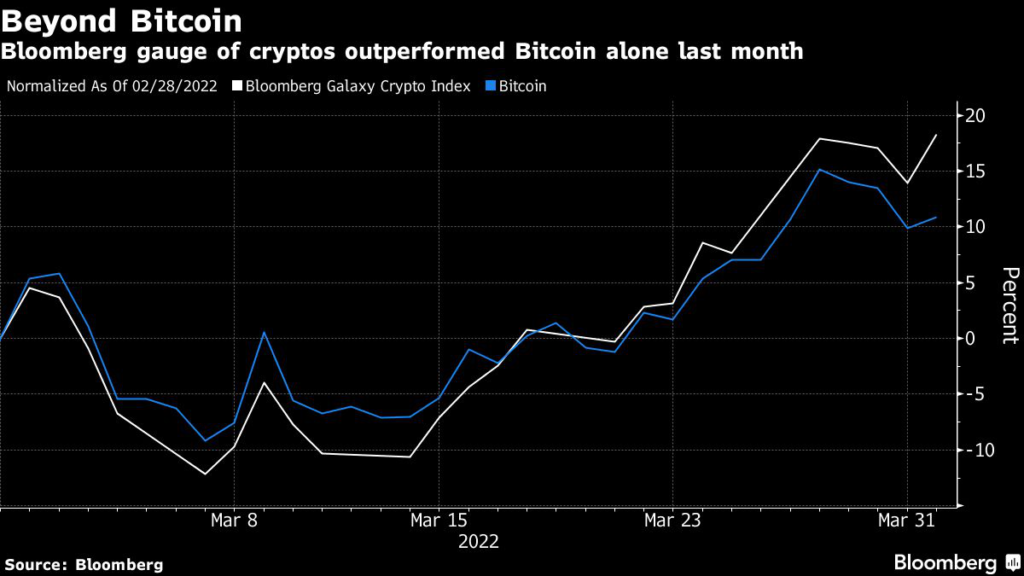
Solana’s SOL and Terra’s Luna have been among the biggest gainers in the cryptocurrency universe in the past week, a sign of a broadening rally in digital tokens following Bitcoin’s revival.

SOL is up 28% in the past seven days and Luna about 22%, according to tracker CoinGecko. Bitcoin over the same period is little changed, having jumped about 40% from a January low.

“Bitcoin is now cooling off,” Antoni Trenchev, managing partner and cofounder of crypto lender Nexo, wrote in a note Sunday. “There’s a whole load of excitement taking place outside of Bitcoin.”

Solana may be benefiting from moves to include nonfungible tokens from its blockchain on major marketplace OpenSea, as well as the popularity of the Solana-based, fitness-related app called STEPN, said Jonathan Cheesman, head of over-the-counter and institutional sales at crypto-derivatives exchange FTX.

Luna is now a top 10 crypto token by market capitalization. The firm behind Luna’s affiliated Terra blockchain has purchased more than $1 billion in Bitcoin since the end of January. That’s part of a plan to back its UST stablecoin with a reserve comprised of the world’s largest cryptocurrency.

This overall strategy has drawn some criticism, since Bitcoin is volatile, but also brought attention to Luna.

“Luna Foundation Guard have bought 30,000 Bitcoin to diversify reserves,” Cheesman noted. “They have said they will buy at least double that in phase one but there hasn’t been any movement now for four days.”

More stories like this are available on bloomberg.com

©2022 Bloomberg L.P.
Tesla Gains as Record Deliveries Outweigh Shanghai Shutdown

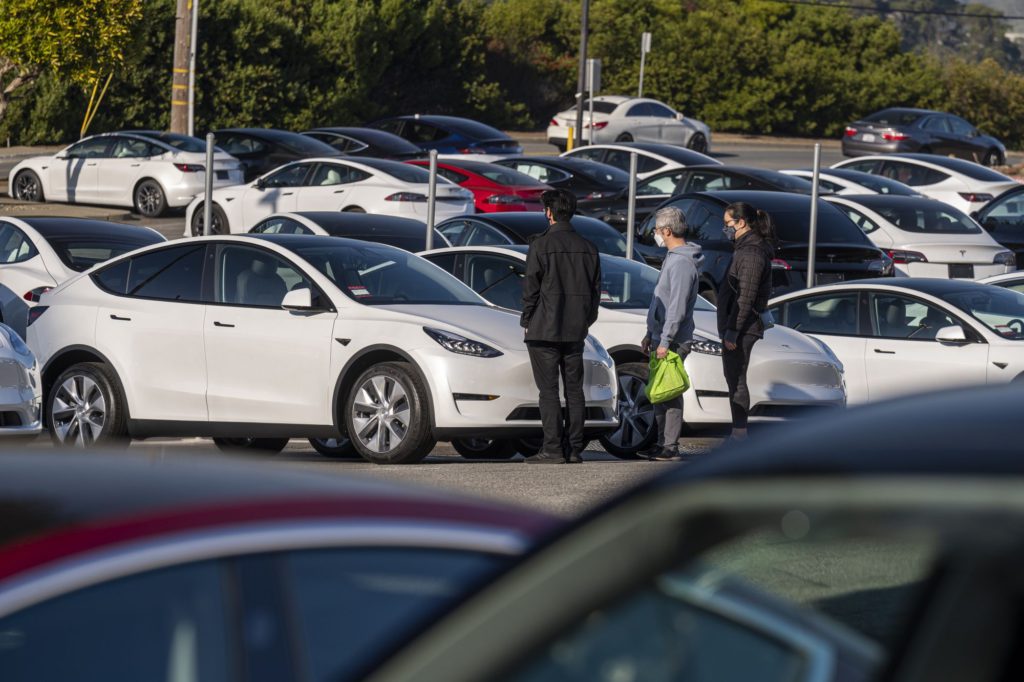
(Bloomberg) — Tesla Inc. shares gained after the automaker posted record first-quarter deliveries, bolstering investor confidence that the company can power through disruptions including the continued shutdown of its Shanghai factory.

Tesla rose 1.8% in premarket trading on Monday after the electric-vehicle maker said over the weekend it shipped 310,048 cars worldwide in the three months through March — about 900 vehicles ahead of the average analyst estimate compiled by Bloomberg. The mark was set despite supply-chain snarls caused in part by growing Covid-19 infections and a maze of rules worldwide designed to keep the virus from spreading.

Those complications intensified Sunday, with word that Tesla’s factory in Shanghai will stay closed Monday, according to an emailed company memo reviewed by Bloomberg. Tesla asked staff to stay home and abide by community orders in the Chinese city, whose 25 million residents are under phased lockdowns. Production at the plant has been suspended intermittently since mid-March.

For now, investors are betting on Chief Executive Officer Elon Musk’s push to build even more cars, with a new factory just opened in Berlin and another set to open in Austin, Texas, on April 7 — its fourth overall. Musk said on Twitter it had been “an exceptionally difficult quarter” and praised Tesla workers and suppliers.

Tesla’s deliveries were “better than feared” given the supply chain issues, Wedbush analysts led by Dan Ives wrote in a note. “We believe roughly 20k-25k units were pushed out of 1Q into 2Q due to the logistical and factory issues which makes this underlying demand number still look strong with a robust trajectory for the rest of 2022.”

The U.S. and China are Tesla’s largest markets, and the bulk of sales were of the Model 3 sedan and Y crossover. Tesla makes the 3 and Y models, as well as the older Model S sedan and X crossover, in Fremont, California. Shanghai produces 3 and Y models, while Berlin has just started delivering Ys.

The Model 3 now represents about one in every four luxury sedans sold in the U.S. and is the fourth-best selling luxury sedan in China, Piper Sandler analyst Alexander Potter said in a note. 

That’s “an impressive achievement” given luxury sedans from European automakers like BMW AG, Mercedes-Benz AG and Audi were “once untouchable” in China, Potter said, adding that he rates Tesla as still “firmly overweight.”

(Updates with premarket shares in second paragraph)

More stories like this are available on bloomberg.com

©2022 Bloomberg L.P.
U.K. Designer Ted Baker Invites Bids as Interest Builds

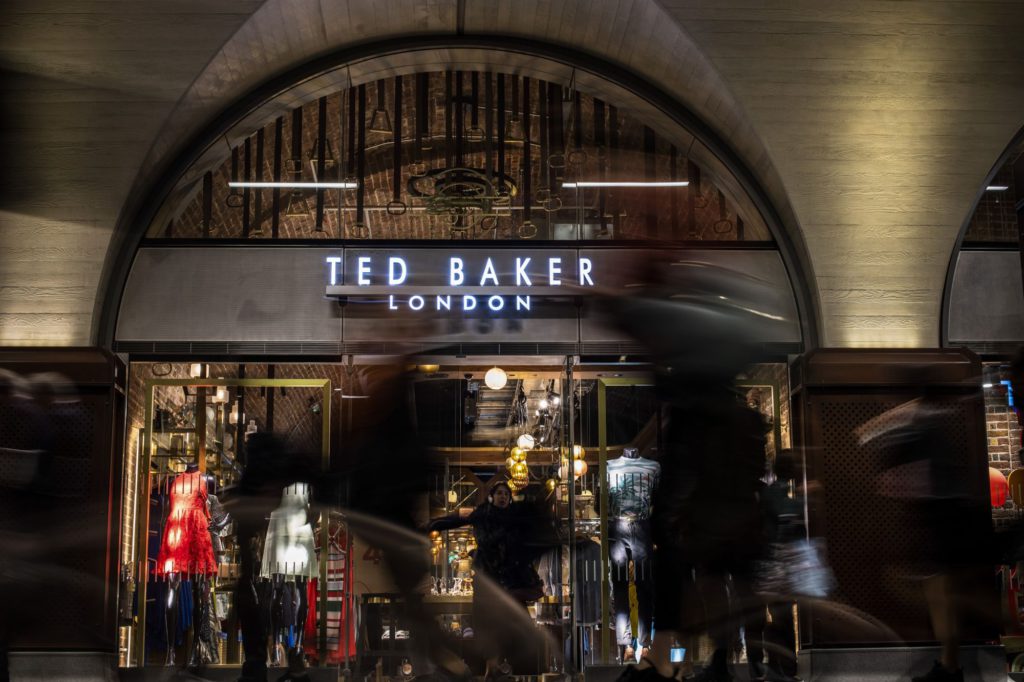
(Bloomberg) — Ted Baker Plc is starting a formal sale process seeking higher bids after private equity fund Sycamore Partners Management LP improved its offer for a second time.

The U.K. fashion designer said Monday it has received unsolicited third party bid interest, and it’s inviting Sycamore to join the process. The stock was up 12% as of 9:46 a.m. in London, giving the company a market value of about 264 million pounds ($346 million).

Chief Executive Officer Rachel Osborne has been seeking to revive Ted Baker by cutting debt and product markdowns, boosting online sales and refreshing the brand. The shares have lost more than 90% of their value in the past four years. 

Sycamore is a New York-based fund with about $10 billion in capital that focuses on consumer and retail businesses. Last week, Ted Baker said it rejected an offer from the firm for about 254 million pounds. If the company doesn’t join the sales process, it has until April 15 to make a bid or withdraw.

Ted Baker said the U.K. takeover panel is granting an exception to bidders, who won’t need to disclose themselves publicly as they make an initial non-binding offer. Ted Baker said it will later invite a select number of parties to continue discussions. 

The retailer’s founder Ray Kelvin departed in 2019 after being accused of inappropriate hugs and other behavior in the workplace, which he denied. The company reported a 35% gain in fiscal fourth-quarter revenue in February.

A buyer would have three key shareholders it would need to convince on a bid: Toscafund Asset Management, which owns a 28% stake; Kelvin, who has about 11% and Schroders Plc, which has 13%, according to data compiled by Bloomberg.


(Updates with details on bid process starting in fourth paragraph)

More stories like this are available on bloomberg.com

©2022 Bloomberg L.P.
Chinese Tech Stocks Jump as U.S. Delisting Concerns Ease

(Bloomberg) — Chinese technology stocks advanced as Beijing sought to remove a key sticking point in its audit dispute with the U.S., easing investor concerns over shares getting kicked off from American exchanges.

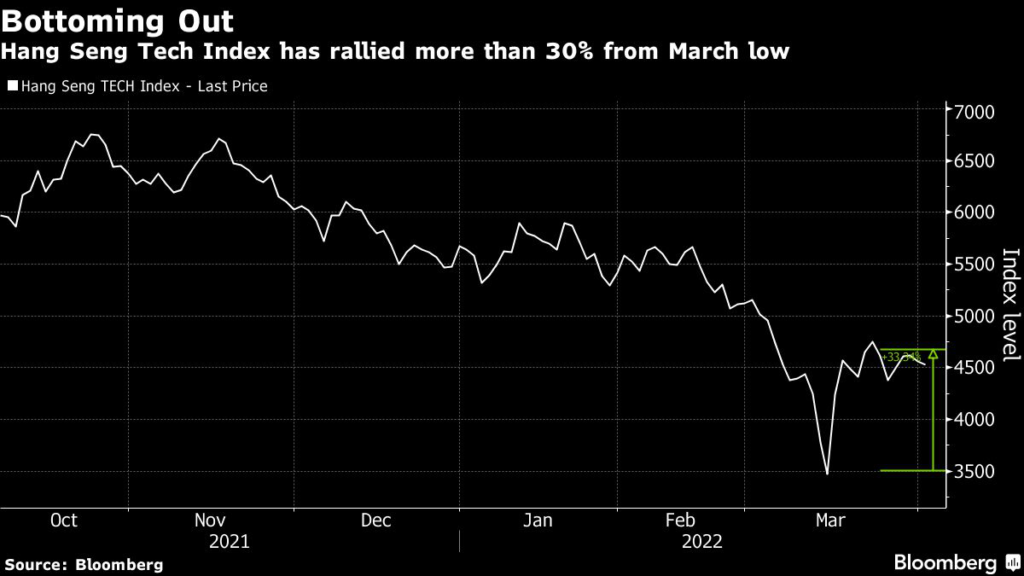
The Hang Seng Tech Index gained 5.4%, the most in more than two weeks, counting shares of companies that are also listed in the U.S. such as Bilibili Inc., XPeng Inc. and Baidu Inc. among its top gainers.

China is planning to modify a rule that restricts offshore-listed firms from sharing sensitive financial data with foreign regulators, Beijing said on Saturday. The changes may pave the way for U.S. authorities to gain full access to auditing reports of Chinese firms listed there, helping resolve a key bilateral dispute that had unnerved investors. 

Read: China Removes Key Hurdle to Allow U.S. Full Access to Audits

The Nasdaq Golden Dragon Index of Chinese firms jumped on Friday as Bloomberg reported of China’s considerations. Financial markets in the mainland are closed due to a public holiday on Monday. 

“The modification will partially address concerns of delisting risks if the cross-border regulatory cooperation could go smoothly as laid out per the rule,” Citigroup analyst Alicia Yap wrote in a report on Monday.

Read: China’s Rule Change to Help Ease Delisting Risks: Street Wrap  

However, some analysts caution that more definitive action is needed from Chinese authorities to fully resolve the tension with U.S. regulators over delisting risks. They add that certain companies like state-owned enterprises and tech firms with more sensitive data may be barred from U.S. listings ultimately.

The Hang Seng Tech Index is down near 60% since its February 2021 peak, driven by Beijing’s regulatory crackdown and uncertainties over the fate of Chinese tech giants trading in the U.S. 

That’s even after the gauge has recovered more than 30% from a record low in mid-March after Beijing vowed to keep capital markets stable and make regulatory changes more predictable.  

“In order to negate investors’ fears totally on the aspect of ADR delisting, we need to see or have some form of concrete actions finalized from China rather than pipelines framework that are still in the midst of drafting,” said Kelvin Wong, analyst at CMC Markets. 

Explainer: How U.S. Is Targeting Chinese Firms for Delisting

More stories like this are available on bloomberg.com

©2022 Bloomberg L.P.

Close Bitnami banner
Bitnami