Bloomberg

FinAccel Spends $200 Million for Indonesia Digital Banking Push

(Bloomberg) — FinAccel Pte, the parent company of fintech platform Kredivo, has acquired a majority stake in Indonesia’s PT Bank Bisnis Internasional TB, pitting itself against Southeast Asia’s biggest internet companies for a share of a growing digital banking arena.

The Singapore-based company, which spent a total of about $200 million on accumulating the holding, will have a 75% stake in the Jakarta-based lender by the end of this week, Chief Executive Officer Akshay Garg said in an interview.

Since the second quarter of 2021, closely held FinAccel has been snapping up stakes from entities owned and controlled by the Suriadi family, which runs a textiles and real estate centered business based in Indonesia, through subsidiary PT FinAccel Teknologi, he said. Shares of PT Bank Bisnis have more than tripled in the past year, giving it a market value of about $1.2 billion.

The move accelerates FinAccel’s ambitions to expand beyond the online lending business into Indonesia’s highly competitive digital banking space. Its peer, Ant Group Co.-backed Akulaku Inc., is set to raise its stake in Jakarta-based Bank Neo Commerce. Singapore’s Sea Ltd. last year acquired Bank BKE to gain a foothold in the fintech arena. 

Ride-hailing and food-delivery platform Grab Holdings Ltd. teamed up with Singapore Telecommunications Ltd. to buy a minority stake in Bank Fama, while rival Gojek in 2021 spent about $160 million to raise its holding in PT Bank Jago.

“Some of our competitors might benefit from large ecosystems where they can cross-sell digital banking products to other customers on their platforms,” Garg said. But FinAccel — mainly centered around its buy now, pay later product Kredivo — can find a leg up by offering competitive consumer credit rates and a smooth customer experiences, he added.

Many small banks in Indonesia, some part-owned by local tycoons, have been looking to tech players for fresh funds after the country’s regulator raised capital requirements for banks in 2020.

The region’s internet giants are using this opportunity to aggressively expand their suite of financial service products in Indonesia, a country of about 273 million people where many have limited access to bank accounts and credit cards.

FinAccel’s purchase comes shortly after its planned merger with a blank-check company collapsed. The combination with Chicago-based Victory Park Capital Advisors LLC was canceled after a tepid climate rocked confidence in many deals.

Read more: SPAC Mergers Are Falling Apart at Rapid Pace in Sign of Fatigue

Aborted SPAC mergers reached a record high of 15 in the first quarter and more than 30 for the past year, according to data compiled by Chicago-based SPAC Research. In part, that’s because the deals were negotiated when prospects for SPACs and the macro outlook were brighter.

“Our ability to raise money from that fundraiser came down significantly,” said Garg. 

More stories like this are available on bloomberg.com

©2022 Bloomberg L.P.

Chinese Tech Stocks Rise as U.S. Delisting Concerns Ease

(Bloomberg) — Chinese technology stocks advanced as Beijing sought to remove a key sticking point in its audit dispute with the U.S., easing investor concerns over shares getting kicked off from American exchanges.

The Hang Seng Tech Index climbed as much as 2.9% in early Monday trading, led by Bilibili Inc., XPeng Inc. and Baidu Inc., which all have shares also listed in the U.S.  

China is planning to modify a rule that restricts offshore-listed firms from sharing sensitive financial data with foreign regulators, Beijing said on Saturday. The changes may pave the way for U.S. authorities to gain full access to auditing reports of Chinese firms listed there, helping resolve a key bilateral dispute that had unnerved investors. 

Read: China Removes Key Hurdle to Allow U.S. Full Access to Audits

The Nasdaq Golden Dragon Index of Chinese firms jumped on Friday as Bloomberg reported of China’s considerations. Financial markets in the mainland are closed due to a public holiday on Monday. 

“The modification will partially address concerns of delisting risks if the cross-border regulatory cooperation could go smoothly as laid out per the rule,” Citigroup analyst Alicia Yap wrote in a report on Monday.

Read: China’s Rule Change to Help Ease Delisting Risks: Street Wrap  

However, some analysts caution that more definitive action is needed from Chinese authorities to fully resolve the tension with U.S. regulators over delisting risks. They add that certain companies like state-owned enterprises and tech firms with more sensitive data may be barred from U.S. listings ultimately.

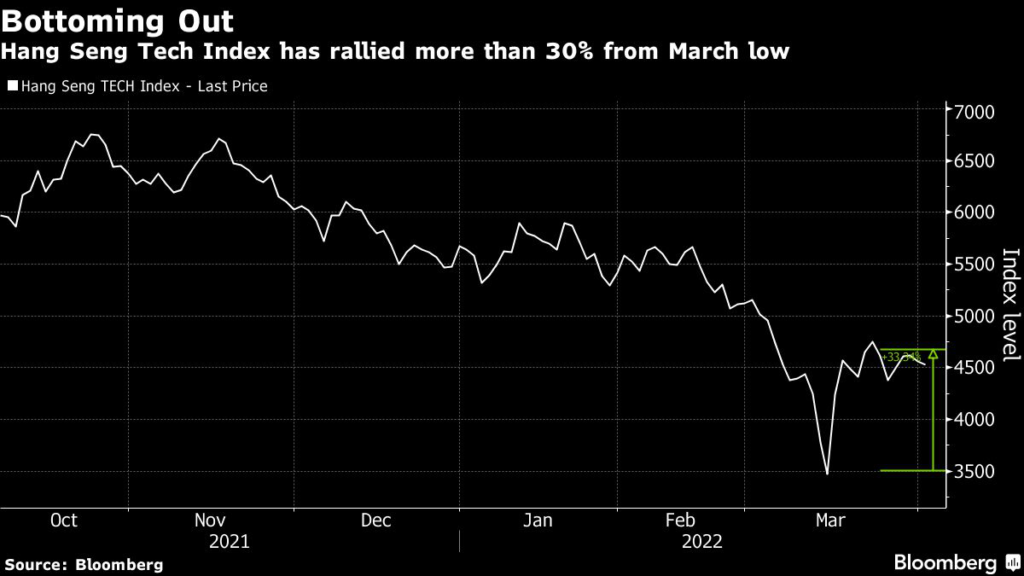
The Hang Seng Tech Index is down near 60% since its February 2021 peak, driven by Beijing’s regulatory crackdown and uncertainties over the fate of Chinese tech giants trading in the U.S. 

That’s even after the gauge has recovered more than 30% from a record low in mid-March after Beijing vowed to keep capital markets stable and make regulatory changes more predictable.  

“In order to negate investors’ fears totally on the aspect of ADR delisting, we need to see or have some form of concrete actions finalized from China rather than pipelines framework that are still in the midst of drafting,” said Kelvin Wong, analyst at CMC Markets.   

More stories like this are available on bloomberg.com

©2022 Bloomberg L.P.

A $71 Billion Plunge Casts Doubt on Singapore’s New Economy Aura

(Bloomberg) — Singapore’s two largest new-economy firms have been touted as the next big thing for years. A $71 billion rout in their share prices in 2022 seems to show investors aren’t buying the story.

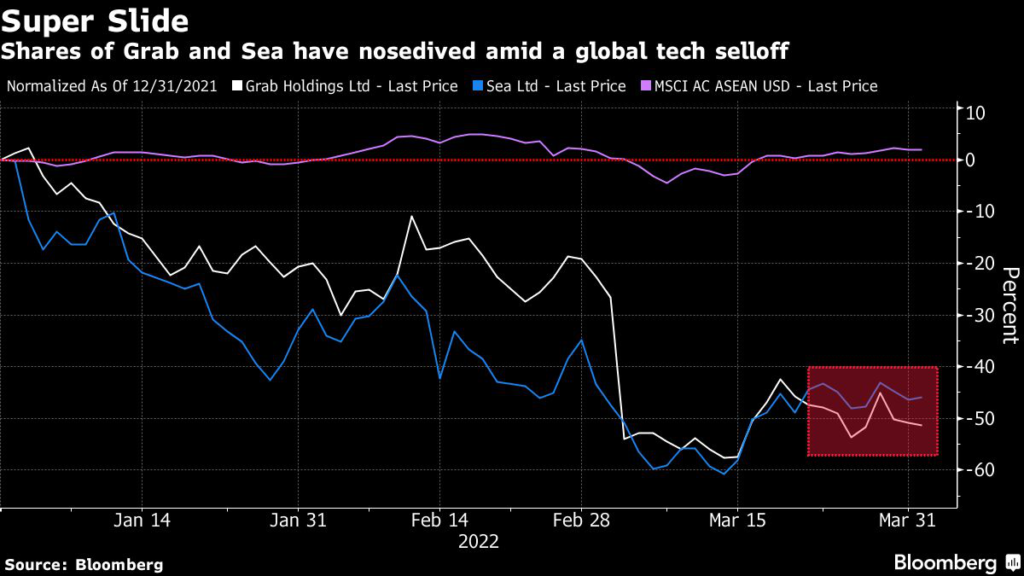
Shares of ride-hailing company Grab Holdings Ltd. have more than halved since the start of the year while gaming and e-commerce giant Sea Ltd.’s stock price has tumbled by 46%. The two U.S.-listed firms are languishing at the bottom of the MSCI Asean Index, with Grab among the biggest losers on the Asia Pacific stock benchmark as well.

The slump comes months after MSCI Inc. added the shares to its indexes amid much fanfare as it sought to give its regional gauges more exposure to new economy stocks. The tech selloff and waning global interest in special purpose acquisition companies have taken a toll on the firms.

“Passive investors would have lost a fair bit of money on these stocks,” said Brian Freitas, an analyst who publishes research on independent research website Smartkarma. Future price action “depends on how the companies perform and the global macro environment — neither of which look terribly encouraging at the moment.”

Grab was added to the MSCI Asean Index in February, hot on the heels of its merger with blank-check company Altimeter Growth Corp. Sea’s inclusion in the gauge began in May last year. 

Freitas estimates that passive holdings of Sea and Grab are close to $2.8 billion and $280 million, respectively. The stocks have lost a combined $71 billion in market value this year.

Judging by the earnings outlook, there may be little respite in store. Sea, which counts Chinese social media leader Tencent Holdings Ltd. as its biggest shareholder, is betting on growth at its online retail unit Shopee as its gaming arm faces slower bookings. But, Sea shut its main e-commerce operation in India on March 29, soon after the country banned its marquee flagship game Free Fire along with dozens of apps it says are of Chinese origin, citing security concerns. 

“Shopee’s growth trajectory is flattening rapidly alongside India and France exits,” said Oshadhi Kumarasiri, an equity analyst with LightStream Research. “For a company priced expensively based on its future growth, it’s difficult to brush off the impact of an exit from a huge market like India. The growth story of Sea is falling apart.”

Meanwhile, Grab’s losses are mounting and the firm continues to splurge on subsidies.

Still, analysts have been slow to cut target prices given the two companies’ status as market leaders in Southeast Asia. They expect a return of at least 68% on both stocks over the next 12 months, according to data compiled by Bloomberg. 

More stories like this are available on bloomberg.com

©2022 Bloomberg L.P.

Tesla Crypto Tokens Rise as Shanghai Shutdown Discounted

(Bloomberg) — Tesla Inc. investors are signaling confidence that the automaker can power through disruptions such as the continued shutdown of its Shanghai factory due to Covid-19 lockdowns, at least based on crypto-token trading that suggests its shares will rise Monday.

The electric-vehicle maker said Saturday it delivered a record 310,048 cars worldwide in the first quarter, about 900 vehicles ahead of the average analyst estimate compiled by Bloomberg. The mark was set despite supply-chain disruptions caused in part by Covid-19 infection rates and a maze of rules worldwide designed to keep the disease from spreading.

Those complications intensified Sunday, with word that Tesla’s factory in Shanghai will stay closed Monday, according to an emailed company memo reviewed by Bloomberg. Tesla asked staff to stay home and abide by community orders in the Chinese city, whose 25 million residents are under phased lockdowns. Production at the plant has been suspended intermittently since mid-March.

For now, investors are betting on Chief Executive Officer Elon Musk’s push to build even more cars, with a new factory just opened in Berlin and another set to open in Austin, Texas, on April 7 — its fourth overall. Tesla crypto tokens on the FTX exchange were trading at $1,141.55 as of 2:45 p.m. Sunday in New York, about 5.3% above Friday’s Nasdaq closing price of $1,084.59.

Musk said on Twitter it had been “an exceptionally difficult quarter” and he praised Tesla workers and suppliers.

Tesla’s deliveries were “better than feared” given the supply chain issues, Wedbush analysts led by Dan Ives wrote in a note. “We believe roughly 20k-25k units were pushed out of 1Q into 2Q due to the logistical and factory issues which makes this underlying demand number still look strong with a robust trajectory for the rest of 2022.”

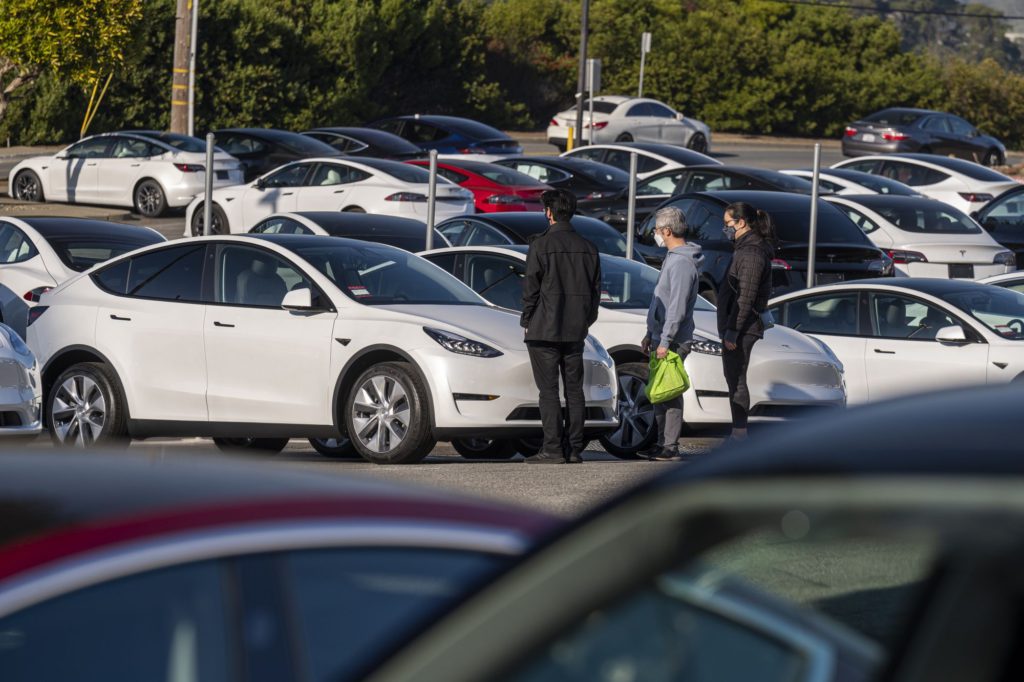
The U.S. and China are Tesla’s largest markets, and the bulk of sales were of the Model 3 sedan and Y crossover. Tesla makes the 3 and Y models, as well as the older Model S sedan and X crossover, in Fremont, California. Shanghai produces 3 and Y models, while Berlin has just started delivering Ys.

The Model 3 now represents about 1 in every 4 luxury sedans sold in the U.S. and is the fourth-best selling luxury sedan in China, Piper Sandler analyst Alexander Potter said in a note. 

That’s “an impressive achievement” given luxury sedans from European automakers like BMW AG, Mercedes-Benz AG and Audi were “once untouchable” in China, Potter said, adding that he rates Tesla as still “firmly overweight.”

(Adds analyst comment in 8th paragraph.)

More stories like this are available on bloomberg.com

©2022 Bloomberg L.P.

A 30-Year-Old Crypto Billionaire Wants to Give His Fortune Away

(Bloomberg Markets) — The Economic Club of New York has hosted kings, prime ministers, and presidents, as well as Amazon.com Inc.’s Jeff Bezos and JPMorgan Chase & Co.’s Jamie Dimon. Central bankers’ comments at the 115-year-old organization have moved markets. Sam Bankman-Fried, a 30-year-old cryptocurrency billionaire, is probably the first person to play a computer game while giving a talk.

As the featured guest one morning in February, Bankman-Fried looks schlubby as usual, reclining on a gaming chair in blue shorts and a gray T-shirt advertising his cryptocurrency exchange, FTX, his mop of curly hair flattened by his headphones. He’s speaking by Zoom from his office in the Bahamas.

Subscribe to The Big Take newsletter: One must-read story, delivered to your inbox daily. 

Off camera, the detritus of someone who more or less lives at work litters his desk: crumpled bills from the U.S. and Hong Kong, nine tubes of lip balm, a stick of deodorant, a 1.5‑pound canister of sea salt labeled “SBF’s salt shaker,” and an open packet of chickpea korma that he had for lunch the day before. The beanbag where his assistant says he sleeps most weekdays is so close he could practically roll onto it.

As he fields questions about how the U.S. should regulate his industry, he pulls up a fantasy game called Storybook Brawl, chooses to play as “Peter Pants,” and prepares for battle with someone who goes by “Funky Kangaroo.”

“We’re anticipating a lot of growth in the United States,” Bankman-Fried says as he casts a spell on one of the knights in his fairy-tale army.

The novelty of appearances like this has long since worn off for Bankman-Fried, who’s testified before Congress twice since December. The previous weekend, he watched the Super Bowl from box seats just in front of NBA star Steph Curry—an FTX endorser. There was lunch with basketball legend Shaquille O’Neal and a party DJ’d by the head of Goldman Sachs Group Inc. The singer Sia invited him to a dinner at a Beverly Hills mansion with Bezos and actor Leonardo DiCaprio, where Kate Hudson sang the national anthem and he chatted about crypto with pop star Katy Perry. The next day she told her 154 million followers on Instagram, in an unsolicited endorsement, “im quitting music and becoming an intern for @ftx_official ok”

Bankman-Fried is so blasé that he lets me watch his six screens over his shoulder as he fields the kind of messages that most executives protect like state secrets. Just that morning he appeared on NPR and emailed with reporters for Puck and the New York Times. His top Washington strategist wrote at one point to say that Senator Cory Booker, a Democrat from New Jersey, would sign on to his preferred approach to regulation. Bankman-Fried got a message saying MoneyGram International Inc. was for sale and spent a few seconds considering whether the company could be a good bet. An assistant informed him that the head of an investment bank was in the Bahamas and wanted to visit him for five minutes. “Meh,” Bankman-Fried wrote back. That evening he planned to fly to the Munich Security Conference for a meeting with the prime minister of Georgia.

Given the insane speed and riskiness of his climb to the top echelons of the financial world, almost anything else must seem low stakes by comparison. Five years ago, Bankman-Fried was working for a charitable organization that promoted the then-fringe idea of “effective altruism”: using scientific reasoning to figure out how to do the most good for the most people. Then he spotted a seemingly too-good-to-be-true pricing anomaly in Bitcoin and decided that, for him, the right path would be making tons of money to give away. Now, Bankman-Fried is one of the richest people in the world, with a fortune of more than $20 billion, according to the Bloomberg Billionaires Index, after venture capitalists recently invested in FTX and its U.S. arm at a combined $40 billion valuation.

For all his wealth, Bankman-Fried tells me his core philosophy remains the same. He’ll keep enough money to maintain a comfortable life: 1% of his earnings or, at minimum, $100,000 a year. Other than that, he still plans to give it all away—every dollar, or Bitcoin, as the case may be. He’s a kind of crypto Robin Hood, beating the rich at their own game to win money for capitalism’s losers. Yet he’s now part of the power structure that causes the problems he says he wants to fix. He makes big political contributions and pushes his company’s agenda in Washington. And so far he’s donated less to charity than he’s spent on naming rights for the Miami Heat’s arena (cost: $135 million over 19 years) and airing a Super Bowl ad with comedian Larry David portraying a curmudgeonly crypto skeptic (an estimated $30 million). He sees no inconsistency; he’s investing to maximize the amount of good he does, eventually, even if he’s risking what he’s already made in crypto.

As by far the richest person to emerge from the effective-altruism movement, Bankman-Fried is a thought experiment from a college philosophy seminar come to life. Should someone who wants to save the world first amass as much money and power as possible, or will the pursuit corrupt him along the way?

The way Bankman-Fried’s peers describe him, he sounds like a strange sort of capitalist monk. One says he worked so hard in the early days that he rarely showered. Another says he swore off relationships because he doesn’t have time. It seems like he views even sleep as an unnecessary luxury. “Every minute you spend sleeping is costing you X thousand dollars, and that directly means you can save this many less lives,” says Matt Nass, a colleague and childhood friend.

These days, Bankman-Fried lives in Nassau, the capital of the Bahamas. FTX is planning to build a 1,000-employee campus overlooking the ocean. For now it’s headquartered in a one-story red-roofed building near the airport. Desks are still labeled with names written on sticky notes, as if the roughly 60 people who work there haven’t had time to unpack. The day before his prestigious talk/Storybook Brawl gaming session, as I’m talking to his assistant in the break room, Bankman-Fried shuffles in shoeless, wearing white crew socks. “Oh, hey,” he says. We sit down later in a conference room. I ask him about his trip to the Super Bowl. “I don’t know if ‘fun’ is exactly the word I would use to describe it,” Bankman-Fried says, scratching an itchy patch on his arm. “Parties are not my scene.”

Bankman-Fried lives like a college student perpetually cramming for finals. He drives a Toyota Corolla, and when he’s not at the office, he crashes at an apartment with 10 or so roommates, though it’s a penthouse at the island’s nicest resort. Bankman-Fried figures as many as five of his co-workers are also billionaires. All are around his age. Friends say he calmly assesses the odds in any situation, whether it’s in the middle of a board-game marathon or after he’s been nudged awake on his beanbag to weigh in on a tricky trade. He tells me that, while he doesn’t like to waste time by economizing, he doesn’t see much value in buying things.

“You pretty quickly run out of really effective ways to make yourself happier by spending money,” Bankman-Fried says. “I don’t want a yacht.”

The crypto industry might seem like an odd choice for a do-gooder: It’s facilitated endless scams, turned ransomware into an industry, and sucks up tons of energy—as much as the country of Malaysia, by some estimates. Bankman-Fried doesn’t see it that way. He says FTX is running an honest market, checks customers’ backgrounds, buys carbon credits to offset its emissions, and is more efficient than the mainstream financial system. But it’s clear the main appeal for him is getting rich quick.

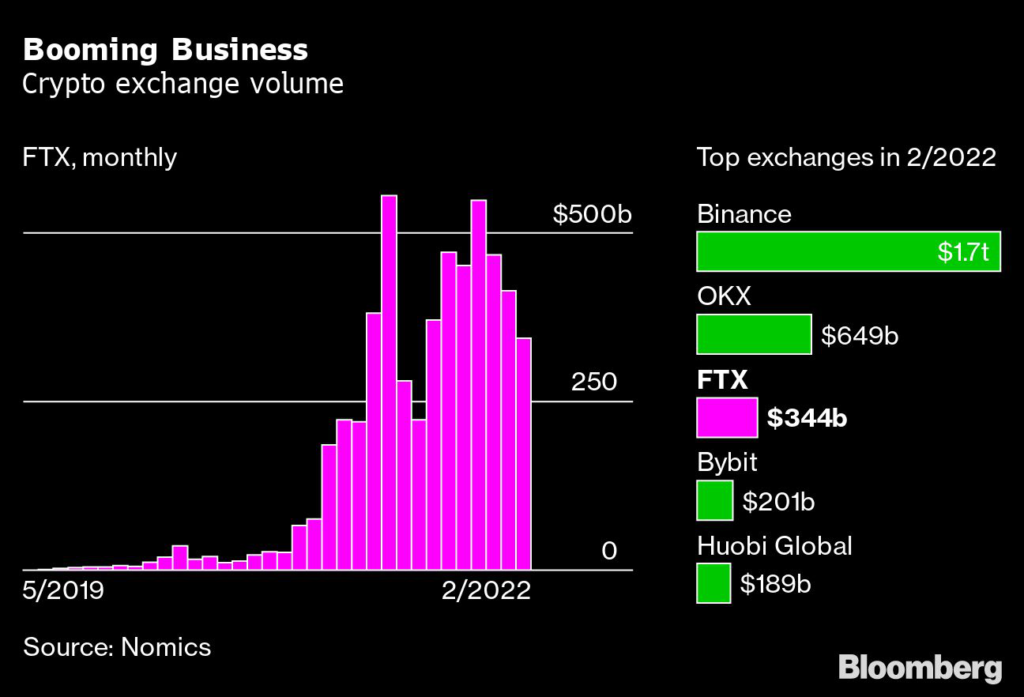
He smiles as he shares a chart that shows FTX growing faster than his largest competitors, such as Binance. The market is huge. FTX is only the No. 3 crypto exchange by volume yet handles $15 billion of trading on a good day. Instead of shares of Microsoft Corp., users are buying and selling Bitcoin, Ether, Dogecoin, and hundreds of other weird cryptocurrencies.

Bankman-Fried has set his sights on the U.S. market, which is dominated by Coinbase Global Inc. He wants to offer cryptocurrency futures, swaps, and options, which he sees as a potential $25 billion-a-day market. If he succeeds in taking over crypto, the mainstream finance industry is next. “We’re sort of playing in the kiddie pool,” Bankman-Fried says. “Ideally, I would want FTX to become the biggest source of financial transactions in the world.”

The me-first ethics of the novelist Ayn Rand have been the inspiration of ruthless entrepreneurs from Uber Technologies Inc.’s Travis Kalanick to tech mogul Peter Thiel. Bankman-Fried’s capitalist muse is the utilitarian philosopher Peter Singer, a professor at Princeton and an animal-rights advocate. Bankman-Fried first came across Singer’s work when he was a teenager living in Berkeley, Calif. His parents are both Stanford law professors. His mother also runs an influential data-driven Democratic donor group, and his father trained as a clinical psychologist.

In writings since the 1970s, Singer has posed a deceptively simple ethical question: If you walked by a child drowning in a shallow pond, would you stop to pull her out, even if it would muddy your clothes? He then argued that if you’d do that—and who wouldn’t?—you have no less of a duty to save a faraway person from starvation by donating to an international aid group. Not giving large sums of money away is as bad as letting the child drown.

Bankman-Fried agrees, though he wasn’t always sure what to do about it. “It is very demanding, if you take it seriously,” he says. “But I do think it’s basically right. Like, if that’s the right thing to do, then I don’t want to deny that because it seems hard.” By 2012, when he was a junior studying physics at MIT, he described himself as a utilitarian like Singer and had become a vegan. He joined a coed fraternity called Epsilon Theta, where, instead of throwing keggers, members stayed up all night playing board games and slept in an attic full of bunk beds. Bankman-Fried recruited other “Thetans” to hand out pamphlets for an anti-factory-farm group.

That year, Bankman-Fried went to a talk by Will MacAskill, a 25-year-old doctoral student at Oxford who was trying to turn Singer’s ideas into a movement. He and his collaborators aimed to use mathematical calculations to figure out how individuals could do the most good with their money and time. They dubbed it “effective altruism.”

Over lunch, MacAskill told Bankman-Fried more about another one of his ideas: “earning to give.” He said that for someone of Bankman-Fried’s mathematical talents, it might make sense to pursue a high-paying job on Wall Street, then donate his earnings to charity. GiveWell, an effective-altruism group based in Oakland, Calif., says each $4,500 spent on insecticide-treated bed nets to fight malaria in Africa can save one life. MacAskill estimated at the time that a successful banker who donated half her income could save 10,000 lives over the course of a career.

MacAskill’s ideas are controversial. Some say the ends don’t justify the means—that Wall Street perpetuates inequality and undermines whatever good might be done by donations. (MacAskill argues that while altruists shouldn’t take jobs that harm society, much of finance is neutral.) Others say the movement flatters the rich by painting them as heroes and fails to address the root causes of poverty. “Effective altruism doesn’t try to understand how power works, except to better align itself with it,” Amia Srinivasan, an Oxford philosophy professor, wrote in a 2015 review of a book by MacAskill.

But MacAskill’s pitch appealed to the young utilitarian. MacAskill, laughing, remembers Bankman-Fried’s matter-of-fact response: “He basically said, ‘Yep, that makes sense.’ ”

Another MacAskill acolyte had gone to work for Jane Street Group, a high-frequency trading firm in New York. Bankman-Fried got a job there, too, and for three years after graduation, he worked as a trader and every year gave away about half of his six-figure salary to animal-welfare groups and other effective-altruism-approved charities. But he grew restless. He left for MacAskill’s Centre for Effective Altruism. Then he happened upon a cryptocurrency website and noticed something odd.

It was 2017, and crypto was in the middle of its first boom. The price of Bitcoin spiked 10 times that year, and investors sank almost $5 billion into hundreds of “initial coin offerings,” or ICOs, many of them barely concealed scams. Bankman-Fried, like many on Wall Street, didn’t understand crypto. What caught his attention was a page on CoinMarketCap.com that quoted prices from exchanges around the world.

Despite crypto proponents’ talk about a decentralized financial revolution, most activity relies on private exchanges to match buyers and sellers. People who want to buy Bitcoin or Litecoin or Ether simply send their dollars, yen, or euros to an exchange, trade back and forth for a while, and then withdraw their cash.

Bankman-Fried saw that certain coins were selling for way more on some exchanges than others. This was the kind of buy-low, sell-high arbitrage opportunity he’d learned to exploit at Jane Street. But there he’d built complex mathematical models for trades that aimed to make money off tiny price differences. On crypto exchanges, the discrepancies were hundreds of times bigger. “That’s too easy,” Bankman-Fried recalls thinking. “Something’s wrong.”

Some of the data were false, and some of the trades were impossible to pull off. Capital controls prevented traders from sending cash home from South Korea, where Bitcoin sold for 30% more than in the U.S. But in Japan, which didn’t have those rules, Bitcoin still traded at a 10% premium. In theory, someone could earn 10% every day by buying Bitcoin on a U.S. exchange and sending it to a Japanese one to sell. At that rate, in a little more than four months, $10,000 would turn into $1 billion.

Bankman-Fried recruited a few friends to help him with the project. There was Gary Wang, a housemate from MIT then working on flight data for Google; Caroline Ellison, a trader from Jane Street; and Nishad Singh, a friend of his younger brother’s who was then an engineer at Facebook. All were effective altruists who bought into Bankman-Fried’s pitch that this was their best chance to make and give away a lot of money. They moved into a three-bedroom house in Berkeley and dug into the arbitrage.

The obstacles to the trade were mainly practical. Bankman-Fried named his company Alameda Research to sound harmless. But U.S. banks viewed cryptocurrency as so sketchy that some wouldn’t let him open an account. Japanese exchanges would allow only Japanese people to withdraw money in yen. So he opened a subsidiary in Japan and hired a local representative. Still, the business sounded fishy, and bank tellers would raise questions about his overseas wire transfers. He had so much trouble sending the money that he started calculating whether it made sense to charter a plane, fly to Japan, and have a planeload of people withdraw cash and bring it home. (It didn’t.)

Once Bankman-Fried found willing banks, each day became a race. If they didn’t wire the money out of Japan before the branch closed, they’d miss out on that day’s 10% return. Completing the cycle required the precision logistics of a heist movie. A team of people spent three hours a day in a U.S. bank to ensure money transfers went through, and another team in Japan waited for hours at the front of the teller line when it was time to wire the money back. At the peak, Alameda was sending $15 million back and forth daily and generating a $1.5 million profit. Within a few weeks, before the price difference disappeared, the company had earned about $20 million.

Few bets paid off as easily, but there were others that came close. Compared with the stock market, crypto offered fat targets because ordinary investors were piling in, and only a handful of smart-money players were hunting for arbitrages. In 2018, Bankman-Fried went to a Bitcoin conference in Macau where he met some of the other big players in the market and decided to stay at the center of the action. He told his colleagues on Slack that he wouldn’t be returning to Berkeley. Eventually, many of them joined him in Hong Kong, which has more permissive regulations than the U.S.

By 2019, Alameda was throwing off hundreds of thousands of dollars of profit a day, enough, by effective altruists’ logic, to save a life every hour if Bankman-Fried had chosen to give the money to the right charities. Instead, he and his colleagues decided to reinvest their winnings, partly into building their own crypto exchange.

The marketplaces were in a sorry state. They were buggy, frequently crashing when prices plummeted or spiked. Some charged Alameda fees to compensate the exchanges for their own losses on margin loans to customers—a practice unheard of on the New York Stock Exchange. One of the largest, BitMEX, was under U.S. investigation. (Two of its founders pleaded guilty in February to violations of the Bank Secrecy Act and face potentially yearslong prison sentences.)

It took Bankman-Fried’s crew four months to write the code underlying a new exchange, which opened for business in May 2019. FTX catered to big traders, offering dozens of different coins to bet on, complex derivatives like tokens with built-in leverage or index futures, and even bets on elections and stock prices. It offered margin loans, so traders could ramp up their returns—and risk. Customers could borrow up to 101 times their collateral—slightly higher leverage than offered by the competition. (FTX cut the limit to 20 times last year after criticism.) And, crucially, traders could put up cash as collateral to borrow any coin they wanted, which some rivals didn’t allow.

It was a hit, in part because so many people wanted to use the exchange to trade with Alameda. Daily trading volume reached $300 million by July of that year and an average of $1 billion in 2020. FTX takes a cut of two basis points (a basis point is one one-hundredth of 1% in Wall Street jargon) on most orders—that’s about $9 in fees to buy one Bitcoin for $45,000, the price in late March. That added up to revenue of $1.1 billion for the exchange last year, and about $350 million in profit, Bankman-Fried says. (Alameda, which he no longer runs day to day, made an additional $1 billion in profit in 2021 alone.) Dan Matuszewski, co-founder of the crypto investment fund CMS Holdings, says Bankman-Fried handled customer service at all times of day and solicited ideas for new things to trade. “They have colossal risk appetite,” says Matuszewski, who trades on FTX and also invested in the exchange. “They’ll try things that fail constantly. It’s calculated, and it’s smart.”

If Bankman-Fried had stayed in Berkeley, many of the bets FTX offered would’ve been not quite, well, legal. Gary Gensler, chair of the U.S. Securities and Exchange Commission, says most cryptocurrencies should be regulated like stocks and exchanges such as FTX like traditional markets. Those that ignore the rules aren’t following the law, he says. “This asset class is rife with fraud, scams, and abuse,” Gensler said in a speech last year. “Right now, we just don’t have enough investor protection in crypto.”

FTX, incorporated in the Caribbean country of Antigua and Barbuda, initially barred Americans from trading, though many professionals such as Matuszewski were able to access it because they already controlled offshore companies.

But the U.S. market for crypto is huge. Rival Coinbase generates more than $600 million a month in revenue, even though it offers only coins it argues don’t fall under SEC rules. In 2020, Bankman-Fried opened a U.S. exchange with a limited menu of tokens to trade. He’s been on a marketing blitz for it since. On top of the Super Bowl commercial and naming the FTX Arena in Miami, he’s spent $210 million to sponsor a video-gaming team and signed up endorsers including quarterback Tom Brady, former Red Sox slugger David Ortiz, and tennis star Naomi Osaka. (FTX in March also acquired the company behind Storybook Brawl.) He’s now pushing Congress for new rules that would allow him to offer more coins and crypto derivatives.

He says the SEC should share oversight for crypto with the Commodity Futures Trading Commission, generally viewed as more friendly to the industry. He’s hired a former CFTC commissioner as head of regulatory strategy, bought a derivatives exchange licensed by the agency, and made the maximum $5,800 donation to about a dozen members of Congress from both parties. (In 2020 he donated $5 million to a committee supporting Joe Biden, becoming one of the president’s biggest donors.) Perhaps unsurprisingly, he’s gotten a friendly reception when he’s gone to Washington. “I’m offended you have a much more glorious Afro than I once had,” Booker, the New Jersey senator, joked at a February hearing. Bankman-Fried says he’s trying to lay out a framework for federal oversight and move the debate away from extremes such as “ban it or let it go wild.”

Rohan Grey, a law professor at Willamette University who’s worked with Democrats to develop crypto regulations, says the market needs strict rules to protect consumers from fraud and prevent its swings from destabilizing the broader financial system. In his view, lobbying like Bankman-Fried’s hinders those efforts. “Anytime people propose stronger regulations, people like him go out and try to prevent it from happening,” Grey says. “And, of course, big money talks.

Young tech entrepreneurs like Bankman-Fried have turned the effective-altruism movement into a force in philanthropy. More than 7,000 people have pledged at least 10% of their career earnings through a group run by the Centre for Effective Altruism. Dustin Moskovitz, a Facebook founder, donates hundreds of millions of dollars a year to charities the movement has identified as effective. Tesla Inc.’s Elon Musk enlisted a pro-poker-player-turned-effective-altruist to advise him on giving.

Bankman-Fried tells me he gave away $50 million last year, including to pandemic relief in India and anti-global-warming initiatives. This year he says he’ll donate at least a few hundred million and up to $1 billion, as much as the largest foundations. Like other effective altruists, Bankman-Fried has been drawn to threats that could lead to humanity’s extinction. In his view, something that has even a tiny chance of saving the lives of the trillions of people who might live in future generations can be more valuable than alleviating suffering today. Some dangers sound like science-fiction plotlines: rogue artificial intelligence, deadly bioweapons, and warfare in space. MacAskill, the effective-altruism movement founder, says Bankman-Fried was momentarily excited by the idea of buying up coal mines—both to prevent emissions and to keep fuel on hand in case it’s needed in a post-apocalyptic scenario. (He decided it wasn’t cost-effective.)

Bankman-Fried now says his top priority is pandemic preparedness. A future disease outbreak, he says, could be as lethal as Ebola and as contagious as Covid-19. He’s funding an advocacy group headed by his younger brother that’s pushing governments to spend more, and he gave $5 million to the nonprofit investigative journalism group ProPublica to cover the topic. “We should expect that pandemics will get worse over time and more frequent, just because of the possibility of lab leaks,” he says. “This has a nontrivial chance of destabilizing the world if we don’t get prepared for it.”

I ask Bankman-Fried whether he ever has any doubt about dedicating his life completely to making money and giving it away. He presses his face in his hands for a few seconds before answering. “It’s not a decision that I constantly reevaluate, because I think it just doesn’t do me any good to be constantly reevaluating anything,” he says. “It doesn’t, minute to minute, feel to me like a decision anymore.”

Around 5 p.m. the day of the Economic Club talk, Bankman-Fried crashes, passing out first in his gaming chair, then curling up on the blue beanbag next to his desk, his elbow cradling his curly hair. The office is quiet, other than the clicking of employees chatting on Slack. Behind Bankman-Fried, a programmer examines some code, his feet up on his desk and his shorts stained with soy sauce. After about an hour, Bankman-Fried stirs, eats a package of Nutter Butters, then closes his eyes again. During his catnap, traders will swap about $500 million of Bitcoin, Ether, and other cryptocurrencies on his exchange, and FTX will skim off an additional $100,000 or so in fees.

Faux is a senior reporter on the investigations team in New York.


More stories like this are available on bloomberg.com

©2022 Bloomberg L.P.

Tesla Crypto Tokens Suggest Shares to Rise on Record Deliveries

(Bloomberg) — Tesla Inc. investors are signaling confidence that the automaker can power through disruptions such as the continued shutdown of its Shanghai factory due to Covid-19 lockdowns, at least based on crypto-token trading that suggests its shares will rise Monday.

The electric-vehicle maker said Saturday it delivered a record 310,048 cars worldwide in the first quarter, about 900 vehicles ahead of the average analyst estimate compiled by Bloomberg. The mark was set despite supply-chain disruptions caused in part by Covid-19 infection rates and a maze of rules worldwide designed to keep the disease from spreading.

Those complications intensified Sunday, with word that Tesla’s factory in Shanghai will stay closed Monday, according to an emailed company memo reviewed by Bloomberg. Tesla asked staff to stay home and abide by community orders in the Chinese city, whose 25 million residents are under phased lockdowns. Production at the plant has been suspended intermittently since mid-March.

For now, investors are betting on Chief Executive Officer Elon Musk’s push to build even more cars, with a new factory just opened in Berlin and another set to open in Austin, Texas, on April 7 — its fourth overall. Tesla crypto tokens on the FTX exchange were trading at $1,141.55 as of 2:45 p.m. Sunday in New York, about 5.3% above Friday’s Nasdaq closing price of $1,084.59.

Musk said on Twitter it had been “an exceptionally difficult quarter” and he praised Tesla workers and suppliers.

Tesla’s deliveries were “better than feared” given the supply chain issues, Wedbush analysts led by Dan Ives wrote in a note. “We believe roughly 20k-25k units were pushed out of 1Q into 2Q due to the logistical and factory issues which makes this underlying demand number still look strong with a robust trajectory for the rest of 2022.”

The U.S. and China are Tesla’s largest markets, and the bulk of sales were of the Model 3 sedan and Y crossover. Tesla makes the 3 and Y models, as well as the older Model S sedan and X crossover, in Fremont, California. Shanghai produces 3 and Y models, while Berlin has just started delivering Ys.

More stories like this are available on bloomberg.com

©2022 Bloomberg L.P.
Fashion Startup Shein Raising Funds at $100 Billion Value

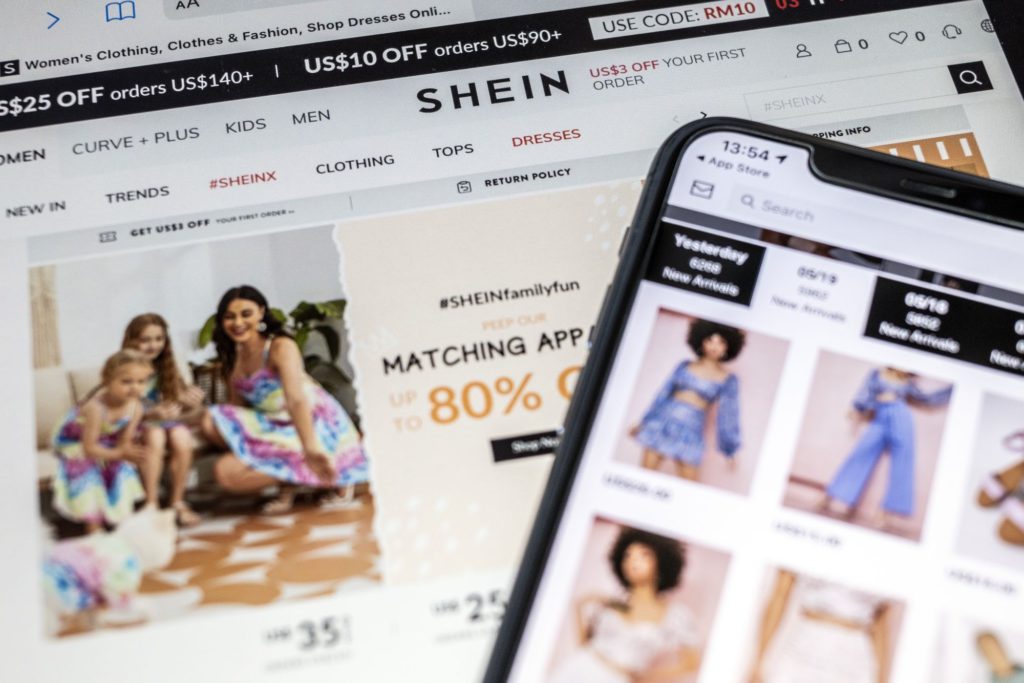
(Bloomberg) — Chinese fast fashion e-commerce startup Shein is weighing a funding round at a valuation of about $100 billion, according to people familiar with the matter.

The online retailer is in talks with potential investors including General Atlantic to raise about $1 billion, the people said, asking not to be identified as the information is private. Achieving the $100 billion mark would make it the third most valuable startup in the world, after ByteDance Ltd. and SpaceX, according to data provider CB Insights.

Shein responded last May to media reports on its fundraising and whether it would go public, saying in a statement that it was valued at several billion dollars and it had no plan for an initial public offering in the short term.

Deliberations are ongoing and details such as the size of the fundraising and valuation could still change, the people said. Representatives for Shein didn’t immediately respond to requests for comment outside normal business hours. An official for General Atlantic declined to comment. 

Shein has become a juggernaut thanks to a combination of supply-chain savvy, data-driven clothing design, and tax loopholes in the U.S. and China that came to the fore during the trade war. Last year it overtook Amazon.com Inc. in downloads of shopping apps on U.S. stores.

Read More: Trump’s Trade War Created China’s Global Fashion Giant

The company has operations in Guangzhou, Singapore and Los Angeles, according to a recent press release. It offers more than 600,000 items to customers in over 150 countries. The startup’s backers include Tiger Global Management, IDG and Sequoia.

(Updates with investor in second paragraph and General Atlantic declining to comment in fourth paragraph.)

More stories like this are available on bloomberg.com

©2022 Bloomberg L.P.
Bitcoin Breakout Is Making Proponents Wary of Another Fakeout

(Bloomberg) — Bitcoin broke out of its narrowest trading range in months in the waning days of March following a rough start to the year. Now, as the digital token approaches another key trendline, investors are wondering whether they’re being set up for disappointment again. 

With the largest cryptocurrency settling in near the top of the $30,000 to $50,000 range he predicted just weeks ago, Michael Novogratz said Thursday that he was “more constructive” on crypto while also not providing a new forecast. The billionaire investor had warned earlier not to expect big gains in 2022 with the Federal Reserve raising interest rates. 

Bitcoin traded within 10% of its 50-day average price for 51 days through March 26, the longest stretch of tight trading since July 2020, according to data compiled by Bloomberg. The breakout last weekend wiped out losses for the year but left Bitcoin still trading about 30% below its record high set in November. 

Now, it’s approaching what may be an even more important threshold — its average price over 200 days. The coin had, as of Friday, traded below that threshold for 95 days, the longest streak of bearish pattern since April 2019. After coming within 1% of its 200-day average on March 28, it now sits about 4% away.

Digital assets, like many other riskier areas of the market, have been beset by a Fed working on tamping down inflation, as well as turmoil sparked by Russia’s unprovoked invasion of Ukraine. That’s left Bitcoin bobbing up and down all year. 

“There seems to be a range where Bitcoin starts to look like a pong game,” said Chris Kline, COO and co-founder of Bitcoin IRA. “There are headwinds across markets, not just in crypto. We’ve got inflation that is not transitory. There’s uncertainty around rate hikes and conversations about a recession. There is a lot of waiting on the sidelines.”

Market-watchers see an explanation that’s become popular this year: that Bitcoin is moving in the same way that stocks are. Over the same period as the coin’s mini-surge in March, the S&P 500 gained 6% and rounded off its best month of the year. The 90-day correlation coefficient of the coin and the stocks gauge now stands at 0.55, among the highest such readings since Bloomberg started tracking the data. (A coefficient of 1 means the assets are moving in lockstep, while minus-1 would show they’re moving in opposite directions.)

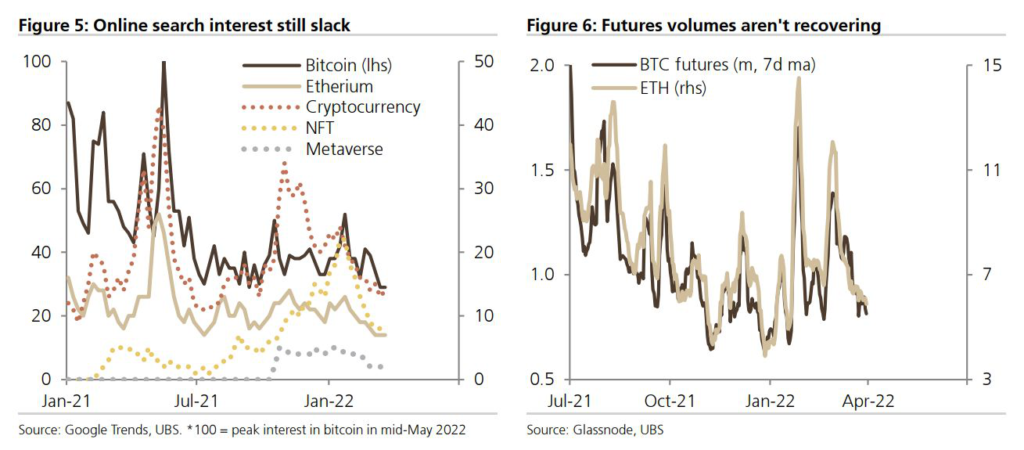
UBS strategists including James Malcolm and Alexey Ostapchuk, say it’s difficult to find evidence of a broader pickup in interest around cryptocurrencies. They cite slack online search interest, and subdued futures volumes and funding rates. 

“If you just looked at these charts, you’d say ‘Go away, nothing’s happening. Wake me up some other time,’” Malcolm, head of foreign exchange and crypto research at the bank, said by phone. He described Bitcoin’s trading as “still bang in the middle of the range,” and says he’s sticking to his view the year will be a difficult one for cryptos. 

Malcolm says we’re in a moment when both bulls and bears can come up with a convincing narrative. “If you want to tell a negative story, we’re still down 35% from November. If you want to tell a positive story, we’re up 45%” from the January lows. 

Analysts at Citibank led by Alexander Saunders and Hannah Sheetz looked at four models, including stock-to-flow, to try to value the coin, coming up with ranges between $20,000 and $152,000. 

To be sure, crypto products are still seeing inflows, with Bloomberg data compiled by UBS showing digital-asset ETFs attracted roughly $550 million over the past two weeks. That doesn’t include a new Solana product from CoinShares that’s got around $100 million under management, UBS said.

That leaves a lot of portfolio managers grappling with how they want to recommend crypto to their clients. 

“From an investment standpoint, it should be viewed as something that is highly speculative and should not be a meaningful part of a client portfolio because of its very high levels of volatility and just uncertain utility over time,” Jeremy Zirin, senior portfolio manager and head of private client U.S. equities, UBS Asset Management, said by phone. “I see it more as a speculative component of one’s portfolio.”

Liz Young, head of investment strategy at SoFi, says that because crypto is a new asset class, it’s likely to see a lot of volatility. The current moment is setting the historical precedent and investors and strategists are trying to figure out how Bitcoin behaves during different points of an economic cycle and what it’s correlated with. But because it’s still new to investors, it’s difficult to label it as an inflation hedge or a store of value. “It’s kind of done all of those things at different points in time.”

“I tell people that are interested in crypto that it’s OK to have a small portion of your portfolio in it,” she said. “I don’t think that it’s an asset class that’s going away. I do think that it’s here and it’s here to stay, but it will go through a lot of different price discovery phases in these next few years.”

More stories like this are available on bloomberg.com

©2022 Bloomberg L.P.
Sri Lanka Throttles Social Media, Protests as Unrest Builds

(Bloomberg) — Sri Lankan President Gotabaya Rajapaksa barred gatherings and ordered internet service providers to restrict social media access, tightening curbs amid demonstrations calling for his ouster over soaring living costs and a foreign exchange crisis. 

Several dozen opposition lawmakers had set off on a march toward Independence Square in Colombo, defying a weekend curfew although they were stopped by armed troops. Restrictions to several social media platforms including Facebook, YouTube, TikTok, Twitter and WhatsApp were lifted after nearly 13 hours, users reported online.  

The lifting of the restrictions came after the country’s Human Rights Commission condemned the move and summoned the police, the telecommunications regulator and the defense and information secretaries to explain the issue, local media reported.  The government said in a statement it respects the right to peaceful assembly but defended the need to ensure peace and safety. 

Rajapaksa’s tightening of social media curbs initially came as Sri Lankans back home were making plans to gather in Colombo and surrounding areas on Sunday afternoon to peacefully protest against the economic crisis. Meanwhile, #GotaGoHome trended on Twitter in countries with significant Sri Lankan communities such as Singapore, Australia and the U.K. 

The government declared a public emergency late on Friday after citizens protesting spiraling inflation and widespread power cuts clashed with police outside the Rajapaksa’s private residence. The declaration gave him sweeping powers to suspend laws, detain people and seize property, which he said was essential for the protection of public order. 

The slew of restrictions from Rajapaksa drew criticism from diplomats in the country. Germany’s envoy to Sri Lanka Holger Seubert said in a tweet that “people demonstrating for their rights are no emergency. It’s the emergency that brings them to the streets.” 

British High Commissioner Sarah Hulton said she was concerned by reports of the use of force against journalists and protesters.  

Police said they had arrested 664 people who had violated curfew in the Western province where the capital is situated, between 10 p.m. Saturday and 6 a.m. Sunday.

Severe Shortage

The island nation is undergoing a severe shortage of food and fuel as it runs out of dollars to pay for imports. Inflation has accelerated to almost 19%, the highest in Asia and has played a major part in people taking to the streets to call for Rajapaksa and his family to resign from government.

Rajapaksa’s elder brother Mahinda serves as prime minister and Basil, the youngest, holds the finance portfolio, while the eldest Chamal controls the agriculture ministry and nephew Namal is the sports minister. In a possible sign of friction within the clan, Namal openly criticized the latest curbs involving social media.

The Rajapaksa family still enjoys two-thirds majority support in parliament. National elections will be held in 2023 at the earliest. 

Rajapaksa’s administration in recent weeks has devalued the rupee, raised interest rates, placed curbs on non-essential imports, and reduced stock-trading hours to preserve electricity and foreign currency. He has also dropped resistance to seeking a bailout from the International Monetary Fund and is simultaneously in talks with nations including India and China for bilateral aid. 

The IMF last month said Sri Lanka faces a “clear solvency problem” due to unsustainable debt levels, as well as persistent fiscal and balance-of-payments shortages.

(Updates with social media restrictions lifted from paragraph two)

More stories like this are available on bloomberg.com

©2022 Bloomberg L.P.
Tesla Shanghai Plant Remains Closed Amid Lockdown

(Bloomberg) — Tesla Inc.’s factory in Shanghai will remain closed on Monday, people familiar with the matter said, after a media report that the company planned to resume production at the facility on April 4.

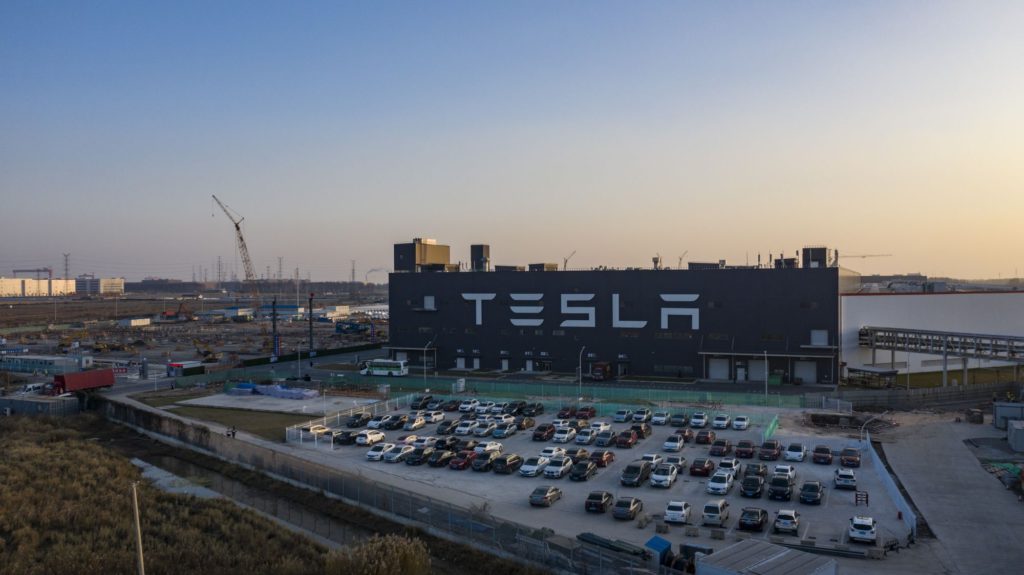
The electric-vehicle maker told employees on Sunday that existing Covid restrictions remained in place, and asked staff to stay home and abide by community orders, according to an emailed company memo reviewed by Bloomberg. Tesla has extended the shutdown of its Gigafactory a few times in the past week as Shanghai puts its 25 million residents in some form of lockdown.

Reuters reported earlier that Tesla plans to resume production in the factory southeast of downtown Shanghai from Monday as some workers begin to return from a lockdown. The eastern half of the mega Chinese city — where the Tesla factory is located — remains under tight movement restrictions despite the end of a four-day sweeping lockdown Friday morning.

The city will start a new round of mass testing on Monday, according to local authorities. More than 8,000 new Covid infections were reported in the city on Saturday, including 7,788 asymptomatic infections.

Tesla’s billionaire Chief Executive Officer Elon Musk said in a tweet that China’s Covid Zero policies and general supply-chain interruptions made the first quarter “exceptionally difficult,” after the company delivered record amount of cars.

More stories like this are available on bloomberg.com

©2022 Bloomberg L.P.
Close Bitnami banner
Bitnami