
Bloomberg

Macron on Track for Another Run at Revamping the French Economy

(Bloomberg) —

French voters will decide this month if they want to give Emmanuel Macron another chance to overhaul the country’s economic and social fundamentals.

The independent centrist won over the French in 2017 with promises to improve the business environment with tax cuts and encourage work with changes to labor and welfare laws. But after a flurry of action in the first year of his presidency, that reform drive was slowed by the Yellow Vests movement and brought to a halt by the Covid pandemic.

Pollsters predict that after winning the first round April 10, Macron will likely face and beat nationalist candidate Marine Le Pen in the second round April 24. If they’re right, then these are the key policies that will shape France for the next five years — bearing in mind the war in Ukraine casts a shadow over the feasibility of some of his plans.

Fiscal Policy

► Taxes

The French leader says he would continue cutting tax rates to drive economic activity and lighten the fiscal burden on labor.

For businesses, he plans further cuts to levies on production and lower charges for the self-employed. For households, he pledges to abolish the television license fee and raise the ceiling for tax-free inheritance.

The cuts would cost the state a total of 15 billion euros ($16.5 billion) once fully implemented.

► Spending

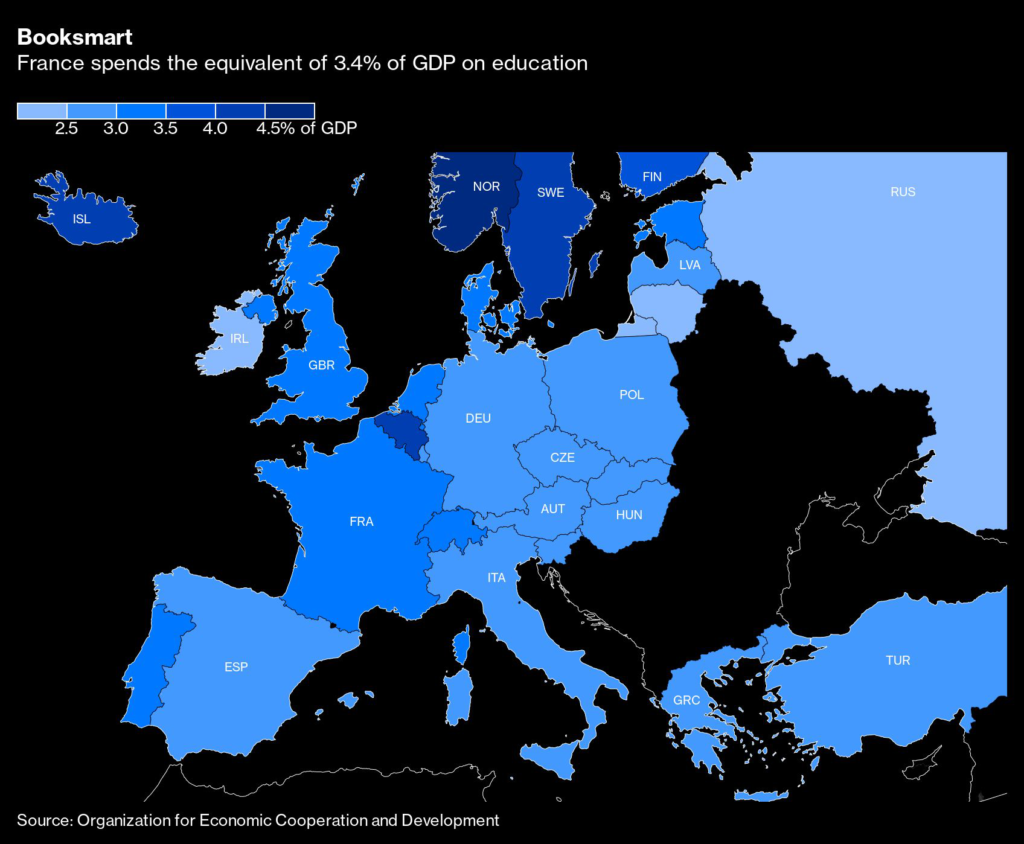
Macron plans to set aside 10 billion euros for the green transition, which would include renovating buildings, subsidies on electric vehicles and planting trees. Education and health are also in line to get a boost from public investment.

Combined with the tax cuts, the total cost of Macron’s program would reach 50 billion euros a year by the end of a five year term in 2027.► FinancesTo foot the bill, Macron says he has lined up the equivalent amount of cost savings. In the manifesto, there is little detail on specific measures under the broad headings of modernizing the state, cutting operating costs and curbing local authority spending. 

Overall, Macron’s team says the budget deficit would still fall below 3% of economic output by 2027, in line the forecasts of his current government. The plan is based on optimistic assumptions on growth and the impact of reforms on the country’s growth potential in the long run.

Social Policy

► Labor

Macron is sticking to the mantra that guided economic policy making during his first term: make work pay. Some measures could prove popular, such as tripling the tax-free allowance for bonuses he introduced during the Yellow Vests protests, guaranteeing a childcare solution for all, bolstering profit-sharing mechanisms, or introducing more flexibility on vacation days.

Beyond those carrots to make work more attractive, there are also sticks that may prove red flags to France’s labor unions. Macron says he would add conditions to the minimum level of welfare and vary the generosity of unemployment insurance according to the strength of the job market.

According to the manifesto, the changes would drive unemployment down to 5% — a level not seen since the end of the 1970s.

► Health

Macron wants to incentivize the production of medicine in France, after facing shortages during the Covid crisis, and organize a conference on how to make sure there are no “medical deserts,” areas without any doctors.

To boost the quality of life of older people, he wants to recruit retirees to give their time in a variety of areas, from helping children with homework to advising entrepreneurs. He also pledges to set aside 1,100 euros a month as the floor for pensions for those who have worked their all their lives. Following reports of mistreatment in care homes, he plans to recruit more carers.

► Pensions

When Covid plunged France into recession in 2020, Macron hit pause on his plans to overhaul pensions. The key difference in his new proposal is a clear pledge to raise the retirement age to 65 from 62 — something he’d excluded in his 2017 manifesto — rather than focusing on abolishing a multitude of sector-specific rules to create a single system. While he still aims for some simplification, the new plan no longer focuses solely on the unpopular idea of abolishing a multitude of sector-specific rules and advantages.

The changes he proposes would do a lot of the heavy lifting for the rest of his economic framework by increasing revenues for the state, reducing spending and boosting the country’s growth potential. 

► Education

Of the 12 billion euro investment for education, half of that sum would go to increasing teacher pay for those starting their careers and those willing to change how and where they work. Schools would also get more organizational autonomy and greater power over hiring.  

Climate

Macron has made a clear commitment to nuclear power with a pledge to build six next-generation reactors. He also promises a 10-fold increase in solar power and the construction of 50 offshore wind turbines between now and 2050. That could involve the state taking over some of the assets of Electricite de France SA, Macron has said. 

The manifesto also sets out regulations to improve carbon-footprint labeling of consumer goods and an obligation to tie executive pay to their company’s social and environmental objectives. Macron wants to renovate at least 700,000 homes a year to help cut energy consumption.

Security and Defense

Macron plans to continue bolstering on-the-ground policing with 200 new gendarme brigades in rural areas and action forces including teachers and magistrates for the poorest suburbs. To combat cyber-crime, the state would hire 1,200 specialists and create filters to warn internet users. 

To maintain military spending at 2% of economic output, he has outlined a plan to modernize the army with more jets, nuclear powered submarines, and armored vehicles. 

Macron has pledged to “keep fighting radical Islam” by closing some mosques that don’t adhere to a charter on accepted behavior as well as expelling preachers and closing schools. He also wants to create a new border force and speed up the process for deporting people in the country illegally.

Foreign Affairs

Macron is adopting the pro-European Union stance that proved successful in the 2017 run-off against Le Pen.

In the name of strategic autonomy, he is calling for the EU to massively increase its defense capabilities and coordinate its national armies. He seeks to build a European version of the metaverse, a network of virtual, 3D worlds that U.S.-based Meta is working on.

Macron has made clear that Europe should keep the economic pressure on Russia following the war in Ukraine while avoiding verbal escalation against Vladimir Putin to keep all channels open for discussion. He also wants the bloc to move away from Russian oil and gas in the long term, and welcome a share of Ukrainian refugees.

Read more: France’s Stunning Economic Rebound May Seal Macron’s Re-ElectionHow Macron’s Campaign Got a Boost From Ukraine War: QuickTake

More stories like this are available on bloomberg.com

©2022 Bloomberg L.P.
Sweden Revives Cold-War Military Forces to Help Shield the Baltic From Putin’s Russia

(Bloomberg) — Sweden’s top army officer has been waiting a long time to get back to the windswept Baltic Sea island of Gotland. 

Karl Engelbrektson was a unit commander on Gotland in 2005 when Sweden withdrew its military from the crucial perch in the center of the Baltic, taking advantage of the post-Cold War peace. Even then, he thought the move was ill-judged. 

“Disbanding large parts of the armed forces, in the peace euphoria of that time, may have made sense to a lot of people,” Engelbrektson, clad in army fatigue next to a German-made Stridsvagn 122 tank, said in an interview at the Gotland base in late March. “History proves that this was a mistake.”

Gotland gives the Swedish military a dominant position in the Baltic from which it can control critical naval routes and airspace, a strategic bastion that seemed irrelevant before Russia invaded Ukraine. A wealthy Nordic nation that had become accustomed to being far away from war zones, Sweden — along with governments across the region — is preparing for the possibility, unthinkable until recently, of a conflict with Russia.  

Sweden lies at the center of the Baltic Sea region, the northern flank of the European Union, where neighboring Finland shares a 1,300-kilometer (800-mile) border with Russia and the Baltic states — Estonia, Latvia and Lithuania — had a half-century history under Soviet rule. 

When Sweden and Finland held military exercises off Gotland in March, four Russian fighter jets briefly violated Swedish airspace east of the island — an incident the Swedish Air Force regarded as especially serious given the context. 

Vladimir Putin’s invasion order — and experts on Russian state television holding forth on an incursion into the Baltic — has triggered a rush across the north of the EU to top up defense budgets, arm previously hollowed out militaries and deliver weaponry to Ukraine. In Sweden and Finland, both of which carefully remained non-aligned during more than four decades of the Cold War, consensus is building to join the North Atlantic Treaty Organization. 

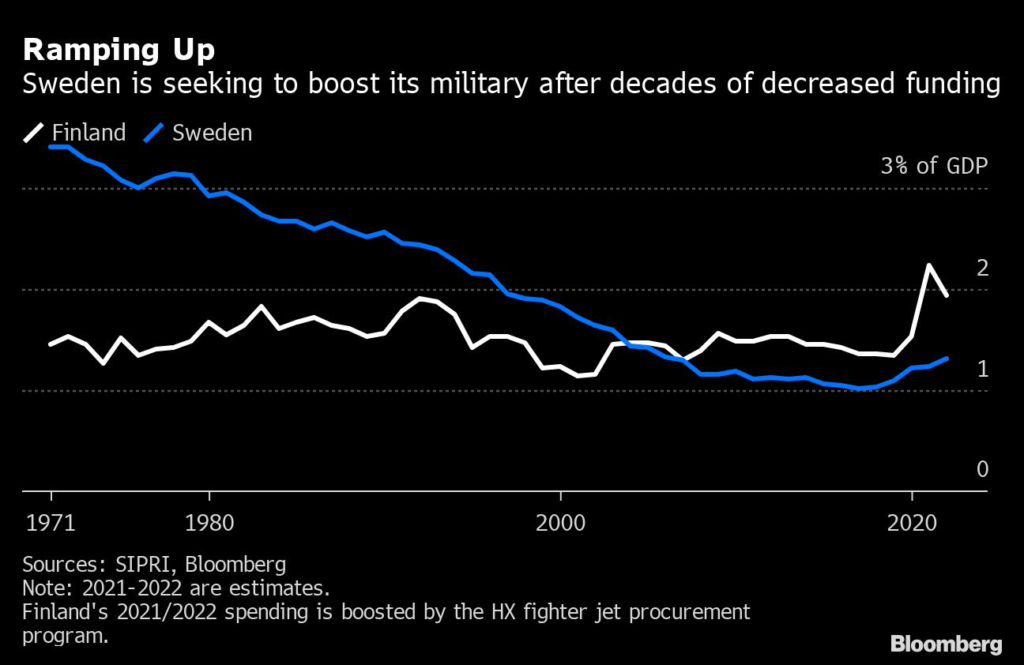
Few places encapsulate the shift as Gotland, where Sweden stationed artillery and anti-aircraft units as well as an armored brigade of several thousand troops in the decades when western Europe faced the Soviet threat. In the 1960s, the nation could muster 800,000 troops from a population of fewer than 8 million, and dished out 4% of its gross domestic product on defense. 

After the collapse of the Berlin Wall, spending plunged and Sweden embraced the new security equilibrium. When Engelbrektson’s unit left in 2005, Putin was still making overtures to the U.S. and its allies and Gotlanders faced only the onslaught of summer tourists in search of crisp Baltic beaches and the medieval walls of Visby, the county seat. 

Although a permanent garrison returned in the years after Putin seized the Crimean peninsula from Ukraine in 2014, the Swedish public was largely sanguine until recently. 

Security experts have noted that the Swedish island would be a linchpin in any Russian incursion into the Baltic states. Lieutenant General Michael Claesson, the chief of the Swedish military’s joint operations, said control over Gotland gives a nation effective control over the Baltic. 

Any NATO response to a rapid attack would be stymied if Russian forces held the island, Claesson said. The island, Sweden’s largest, got a shout-out in Ukrainian President Volodymyr Zelenskiy’s address to the parliament in Stockholm, who said all of Russia’s neighbors are in danger. 

“You can make it harder to defend NATO territory in the Baltics, as well as Sweden and Finland,” the officer said in an interview. “You also have to consider that we aren’t part of any military alliance, and it may be tempting to Russia to challenge a country that doesn’t have formal security guarantees.” 

War jitters on Gotland have taken hold, even though Sweden hasn’t ceded control of the island since 1808, when it was briefly occupied by Russian troops during the Finnish War, in which the Russian Empire helped itself to a third of the Kingdom of Sweden — modern-day Finland. 

“We get questions every day about shelters, about how much water and food you should store at home, et cetera,” Rikard von Zweigbergk, the head of preparedness and civil defense for the Gotland region, said in an interview. 

Claesson gave the order to send reinforcements and armed personnel carriers to Gotland in January. The deliberate show of force prompted the Kremlin to blame Sweden for escalating tensions in the region. The complaint, from Putin’s chief spokesman, Dmitry Peskov, gave Claesson a “sense of accomplishment,” he said. 

Sweden’s martial action cuts to the heart of a policy debate in the country, where officials are torn between caution over a delicate regional balance and a recent surge in public support for joining NATO. 

Polls now show a plurality of Swedes favor entering the alliance. Prime Minister Magdalena Andersson — who faces an election in September — isn’t ruling out membership, even as she’s said an application in the current situation could threaten regional security. Her government, which currently spends about 1.3% of GDP on defense, wants to bolster that level to 2% of GDP — the NATO threshold — as soon as “practically possible.” 

“The war in Europe will affect the Swedish people,” Andersson said earlier in March. “Russia is now threatening the entire European security order, on which Europe’s countries, including Sweden, base their security.”

Sweden, known more for its high living standard and lack of corruption, is no stranger to arms. A significant weapons exporter, it has provided everything from artillery rounds to jet fighters to militaries across the world. The anti-tank shoulder-fired weapon NLAW, originally developed by Sweden’s Saab AB, is one of the most important pieces of equipment for the Ukrainian forces fighting the Russian army. 

Engelbrektson, the army chief, said on Gotland that the financial commitment and Sweden’s industrial capability put it in a good position. 

“We are in the fortunate position that we can actually throw money at a problem and get results,” he said. 

More stories like this are available on bloomberg.com

©2022 Bloomberg L.P.

Sri Lanka Blocks Social Media, Imposes Curfew to Curb Protests

(Bloomberg) — Sri Lankan President Gotabaya Rajapaksa barred gatherings and restricted access to social media amid demonstrations calling for his ouster over the government’s handling of inflation and a foreign exchange crisis.

People are banned from being on any public grounds or property without prior permission during a curfew that has been imposed from Saturday evening through 6 a.m. Monday, according to an extraordinary gazette issued late Saturday. Metrics on NetBlocks, an internet observatory, showed restrictions on multiple social media platforms including Facebook, Twitter, WhatsApp, Viber and YouTube in Sri Lanka from the early hours of Sunday.

The private Adaderana news website cited the director general of the Telecommunications Regulatory Commission of Sri Lanka as saying that service providers have been advised to temporarily restrict access to social media websites, on the request of the Ministry of Defence. 

Calls made by Bloomberg to the Ministry of Telecommunication and Information Department went unanswered.

The government declared a public emergency late on Friday after citizens protesting spiraling inflation and widespread power cuts clashed with police outside the Sri Lankan leader’s private residence. The emergency declaration gives Rajapaksa sweeping powers to suspend laws, detain people and seize property. The step was essential for the protection of public order and maintenance of supplies and services, he said in Friday’s extraordinary gazette. 

The island nation is undergoing a severe shortage of food and fuel as it runs out of dollars to pay for imports. Inflation has accelerated to almost 19%, the highest in Asia. 

Sri Lankans had taken to social media to call people to gather in Colombo and surrounding areas on Sunday afternoon to peacefully protest against the economic crisis. The curfew prevents such demonstrations from taking place.

Police said they had arrested 664 people who had violated curfew in the Western province where the capital is situated, between 10 p.m. Saturday and 6 a.m. Sunday.

Rajapaksa’s administration in recent weeks has devalued the rupee, raised interest rates, placed curbs on non-essential imports, and reduced stock-trading hours to preserve electricity and foreign currency. He has also dropped resistance to seeking a bailout from the International Monetary Fund and is simultaneously in talks with nations including India and China for bilateral aid. 

The IMF last month said Sri Lanka faces a “clear solvency problem” due to unsustainable debt levels, as well as persistent fiscal and balance-of-payments shortages.

More stories like this are available on bloomberg.com

©2022 Bloomberg L.P.
Russian Space Agency Head Threatens to End Future ISS Missions

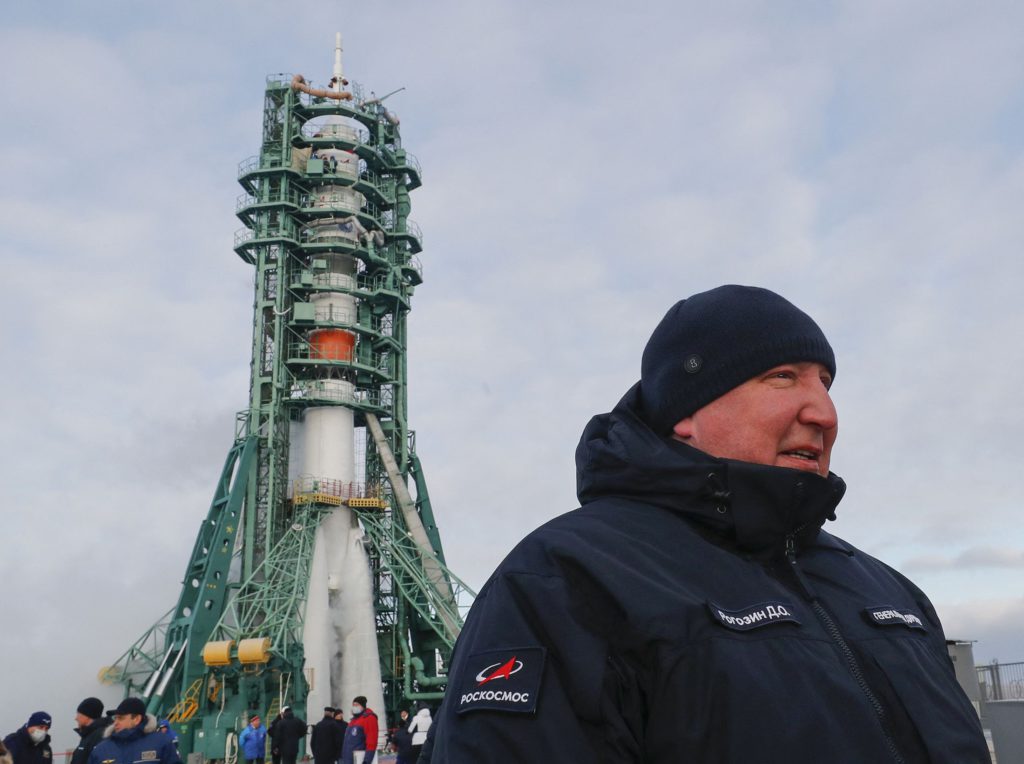
(Bloomberg) — The director of Russia’s space program said economic sanctions aimed at the country threaten partnerships at the International Space Station and he supports a move to end future cooperation with other agencies.

In a series of social media posts Saturday, Roscosmos general director Dmitry Rogozin shared what he claimed were replies from the respective heads of the National Aeronautics and Space Administration, the European Space Agency and the Canadian Space Agency to his demand that their countries lift sanctions against enterprises involved in the Russia space industry.  

“NASA will continue to work with relevant U.S. Federal departments and agencies to facilitate continued cooperation on and operation of the ISS,” read one of the posted statements that appears to be signed by NASA Administrator Bill Nelson. A phone call to NASA on Saturday to confirm the authenticity of the letter wasn’t returned.

Questions regarding Russia’s relationship with the ISS have brewed since the country invaded Ukraine in February. Rogozin told a state-owned television network last month that Russia would end sales of rocket engines to the U.S., and Moscow canceled the launch of three dozen satellites for OneWeb, a London-based satellite internet company partly owned by the U.K. government. 

Rogozin will shortly submit to Russian leaders specific proposals on ending cooperation on the ISS, he said in the social media posts.   

At the moment though, ISS operations seem mostly unaffected by politics on Earth. NASA astronaut Mark Vande Hei returned to earth in a Soyuz capsule on Wednesday, landing in Kazakhstan with two cosmonauts. Vande Hei spent a record 355 days onboard the ISS. Three Americans, three Russians and a German are currently based at the ISS, while Axiom Space plans to send up three space tourists and their captain as soon as April 6. 

NASA plans to operate the space station through 2030. SpaceX and Northrop Grumman Corp. were awarded NASA contracts on March 25 for a dozen more cargo missions to the ISS.  

More stories like this are available on bloomberg.com

©2022 Bloomberg L.P.
KKR Plans to Abandon Telecom Italia Deal Without Due Diligence

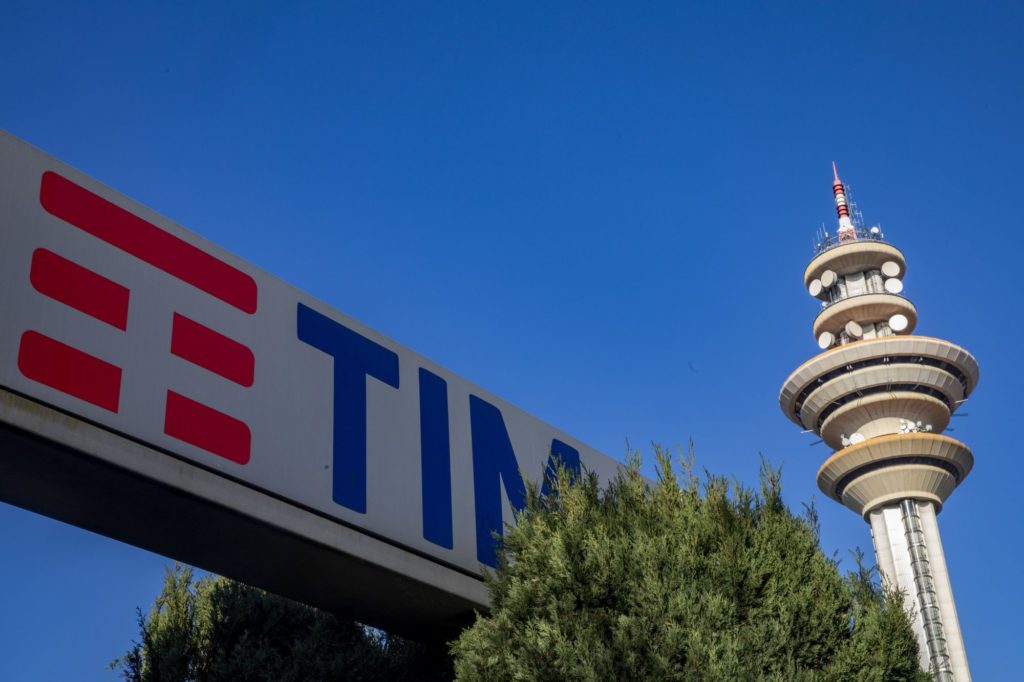
(Bloomberg) — KKR & Co. plans to drop its 10.8 billion-euro ($11.9 billion) takeover proposal for Telecom Italia SpA if the troubled former phone monopoly doesn’t grant it the due diligence it requested since last November, according to people familiar with the matter.

In a letter expected on April 4, KKR is set to reiterate its interest in making a possible bid, the people said asking not to be identified because the matter isn’t public. The U.S. investment firm will make clear that it wants to review the phone carrier’s finances even more than before as market conditions have changed, the people added. 

Russia’s invasion of Ukraine, and recent downgrades on Telecom Italia’s credit rating, are among these reasons, they said.

Spokespeople for KKR and Telecom Italia declined to comment.

The Single Network

Telecom Italia Chief Executive Officer Pietro Labriola is working on a plan that rivals KKR’s full takeover of Telecom Italia. Under that project, the landline assets would be merged with its smaller, state-backed rival Open Fiber SpA, aligning Telecom Italia with a government goal of building a single national fiber network while avoiding duplicate investments. It’s a process that could take several months and would need approval from European regulators, people familiar with the matter said in March.

Under the plan, state lender Cassa Depositi e Prestiti SpA, Telecom Italia’s second-largest investor, would get a majority stake in the company’s fixed network assets, people familiar with the matter said earlier this year. CDP is also the controlling shareholder of Open Fiber. 

On Saturday, Telecom Italia confirmed in a statement it signed a non-disclosure agreement with CDP to start preliminary discussions on integrating its network with that of Open Fiber. This deal is also open to KKR and other funds, two other people familiar with the matter said.

Labriola has also a plan to separate all Telecom Italia’s commercial services into another unit called ServCo, according to Telecom Italia’s business plan. 

Last month, CVC Capital Partners made a non-binding offer for 49% of Telecom Italia’s new enterprise services unit. Telecom Italia plans to discuss CVC’s non-binding bid in a board meeting scheduled for April 7 after the company’s annual general meeting, the people said.

More stories like this are available on bloomberg.com

©2022 Bloomberg L.P.
Tesla Delivers Record 310,048 Cars in ‘Difficult’ Quarter

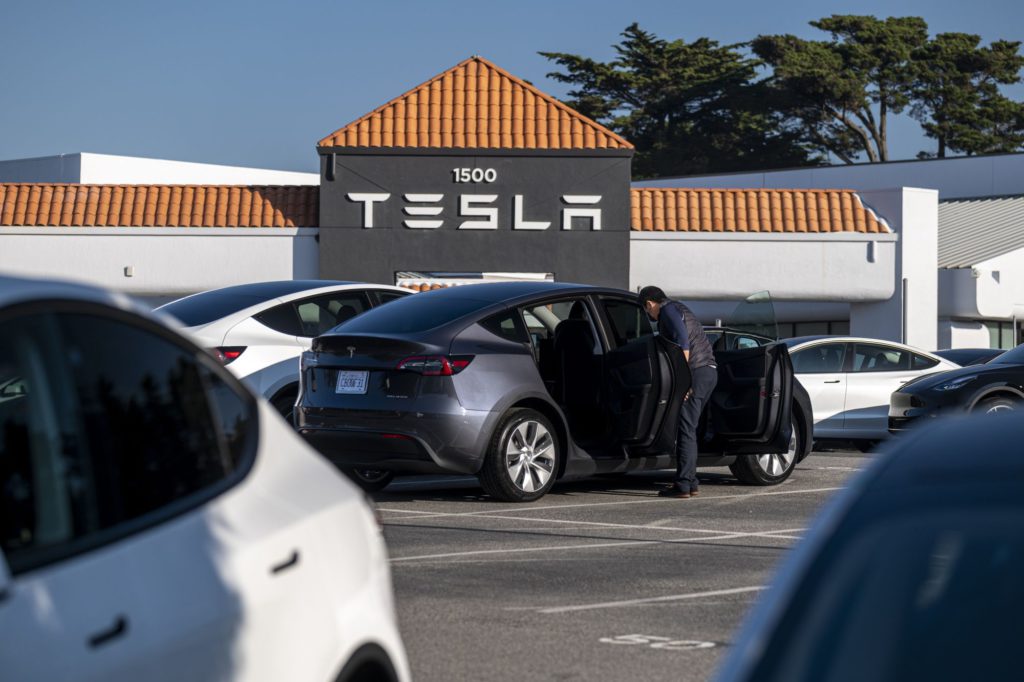
(Bloomberg) — Tesla Inc. delivered a record 310,048 cars worldwide in what Elon Musk said was an “exceptionally” difficult first quarter, as a growing tide of consumers made the switch to electric vehicles. 

The results, posted Saturday, slightly edged out expectations. Analysts had expected that 309,158 vehicles would be shipped, based on the average of estimates compiled by Bloomberg.

Fluctuations in Covid-19 infection rates and rules worldwide continue to impact logistics and supply chains. The automaker also temporarily suspended production at its Shanghai factory beginning last month after the city enacted a lockdown over its worsening coronavirus outbreak.  

“This was an *exceptionally* difficult quarter due to supply chain interruptions & China zero Covid policy,” Musk, Tesla’s chief executive officer, said in a tweet. “Outstanding work by Tesla team & key suppliers saved the day.”

Tesla’s deliveries were “better than feared” given the supply chain issues, Wedbush analysts led by Dan Ives wrote in a note. “We believe roughly 20k-25k units were pushed out of 1Q into 2Q due to the logistical and factory issues which makes this underlying demand number still look strong with a robust trajectory for the rest of 2022.”

Quarterly deliveries are among the most closely watched indicators for Tesla since they underpin the carmaker’s financial results. The figure is widely seen as a barometer for EV demand generally, since the Austin, Texas-based company has led the charge for battery-powered cars. 

Tesla had said that its delivery count is conservative and that final numbers could vary by 0.5% or more. The company produced 305,407 vehicles for the quarter. 

The carmaker doesn’t break out sales by geography, but the U.S. and China are its largest markets and the bulk of sales were of the Model 3 sedan and Y crossover. 

Tesla makes the 3 and Y models, as well as the older Model S sedan and X crossover in Fremont, California. The Shanghai factory produces the 3 and Y models. Tesla recently began delivering Model Ys from a new plant in Berlin and will celebrate the opening of a factory in Austin with a “Cyber Rodeo” event for 15,000 people on April 7.

(Updates with analyst comment in fifth paragraph.)

More stories like this are available on bloomberg.com

©2022 Bloomberg L.P.
Tesla Delivers Record Number of Cars in ‘Difficult’ Quarter

(Bloomberg) — Tesla Inc. delivered a record 310,048 cars worldwide in what Elon Musk said was an “exceptionally” difficult first quarter, as a growing tide of consumers made the switch to electric vehicles. 

The results, posted Saturday, slightly edged out expectations. Analysts had expected that 309,158 vehicles would be shipped, based on the average of estimates compiled by Bloomberg.

Fluctuations in Covid-19 infection rates and rules worldwide continue to impact logistics and supply chains. The automaker also temporarily suspended production at its Shanghai factory beginning last month after the city enacted a lockdown over its worsening coronavirus outbreak.


“This was an *exceptionally* difficult quarter due to supply chain interruptions & China zero Covid policy,” Musk, Tesla’s chief executive officer, said in a tweet. “Outstanding work by Tesla team & key suppliers saved the day.”

Tesla’s deliveries were “better than feared” given the supply chain issues, Wedbush analysts led by Dan Ives wrote in a note. “We believe roughly 20k-25k units were pushed out of 1Q into 2Q due to the logistical and factory issues which makes this underlying demand number still look strong with a robust trajectory for the rest of 2022.”

Quarterly deliveries are among the most closely watched indicators for Tesla since they underpin the carmaker’s financial results. The figure is widely seen as a barometer for EV demand generally, since the Austin, Texas-based company has led the charge for battery-powered cars. 

Tesla had said that its delivery count is conservative and that final numbers could vary by 0.5% or more. The company produced 305,407 vehicles for the quarter. 

The carmaker doesn’t break out sales by geography, but the U.S. and China are its largest markets and the bulk of sales were of the Model 3 sedan and Y crossover. 

Tesla makes the 3 and Y models, as well as the older Model S sedan and X crossover in Fremont, California. The Shanghai factory produces the 3 and Y models. Tesla recently began delivering Model Ys from a new plant in Berlin and will celebrate the opening of a factory in Austin with a “Cyber Rodeo” event for 15,000 people on April 7.

(Updates with analyst comment in fifth paragraph.)

More stories like this are available on bloomberg.com

©2022 Bloomberg L.P.
Tiger Global’s 34% Tumble Brings Coleman’s Firm Back to Earth

(Bloomberg) — In his 20s, he was a hedge-fund wunderkind. By his 40s, a hedge-fund legend. But suddenly, Chase Coleman is stumbling, and hard. 

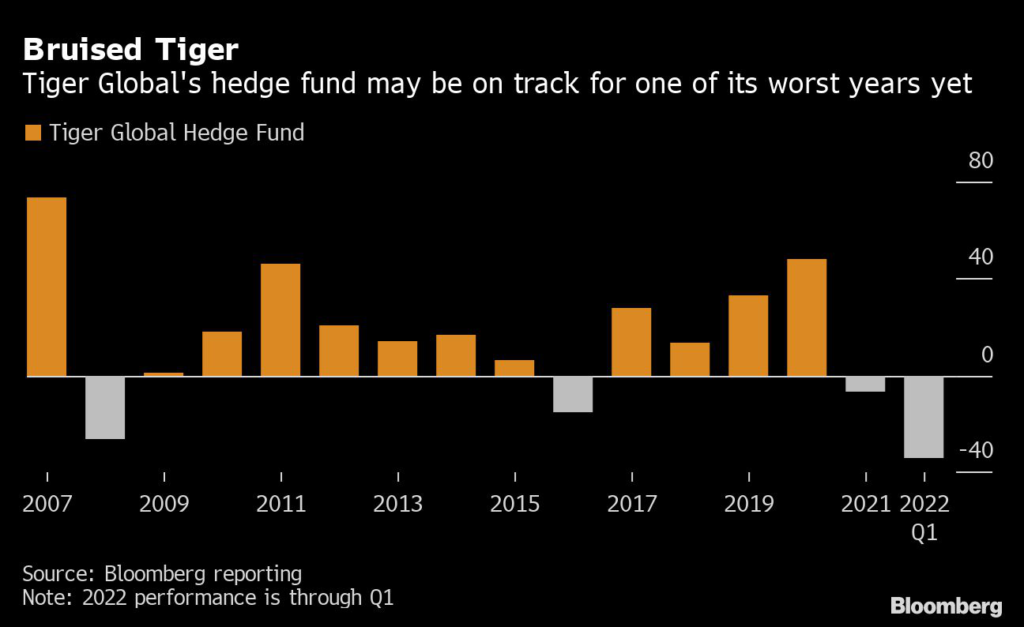
After a tough 2021, his Tiger Global Management has piled up losses this year that have set the industry abuzz — a staggering 34% slump for the firm’s hedge fund through March. The speed of the reversal has shocked just about everyone, considering that Coleman is celebrated as one of his generation’s brightest stars, a standout among the elite money managers mentored by the famed Julian Robertson. 

The bad run has been fueled by massive bets on stocks that have been hammered, market gyrations amid Russia’s invasion of Ukraine and a serious rough patch for the fast-growing tech companies in the U.S. and China that for so long drove Tiger Global’s gains. On Friday, the poor performance prompted humility, something the $100 billion behemoth has rarely had to express over its two decades of nearly unblemished success. 

“In this moment, we are humbled, but steady in our conviction and confident about the go-forward opportunity,” the firm’s investment team wrote in a letter sent to investors. “We are reassessing and refining our models using all the inputs available to us.”

A Tiger Global spokeswoman declined to comment. 

Built by Coleman and his partner Scott Shleifer, Tiger Global has long been seen as a throwback to the industry’s glory years, when double-digit returns were the norm and hotshot managers unerringly backed winning companies and shorted the losers. Coleman, 46, showed that fees of 2-and-20 could still be a price worth paying: in 2020 alone, his flagship hedge fund jumped 48%.

The recent turn in Tiger Global’s fortunes have hurt more than Coleman’s professional pride. Across the firm’s $35 billion in funds focused on public companies, this year’s losses have triggered a more than $10 billion hit to investors that include foundations, endowments and pension funds, as well as Tiger Global insiders. And Coleman’s personal wealth has dropped by $1.3 billion, according to calculations by the Bloomberg Billionaires Index.  

Coleman worked as a technology analyst at Robertson’s Tiger hedge fund for less than four years before he became an official Tiger Cub in 2001, the term for Robertson proteges who started their own firms.

Originally Tiger Technology, the new shop expanded to payments, education and other sectors and changed its name to Tiger Global. In the early 2000s, Coleman and Shleifer added private investments to the mix, realizing before many of their peers that they might find higher returns outside of public markets.

The firm’s first serious bump was during the 2008 financial crisis, when it lost 26%, followed by a 1% gain the next year. Coleman regrouped, vowing to return to his tech roots and avoid industries where politics or macro events could interfere.

That approach paid off spectacularly. Through 2020, Tiger Global’s annualized returns at its hedge fund were more than 20%, with just two years of losses. 

Failing Bets

But now its biggest wagers are dragging the fund down. While markets were already jittery this year due to high inflation and expectations of rate hikes, Russia’s war against Ukraine triggered a flight from risk. 

The tech-heavy Nasdaq 100 and the Russell 2000 of small-caps each entered a bear-market decline of 20% in the first quarter, though losses were pared at the end of March. 

Tiger Global’s particular undoing was sticking closely to tech companies, particularly from China, that had brought it so much success. 

One example is JD.com Inc., which started out as a $200 million bet in 2009 and eventually produced a $5 billion net profit. As of Dec. 31, it was the fund’s largest holding. 

Battered by the markets, a regulatory crackdown in China and rising tensions between Beijing and Washington, JD.com slid 20% last year in New York trading and is down 16% in 2022. 

“In hindsight, we should have sold more shares across our portfolio in 2021 than we did,” Tiger Global’s investment team said in Friday’s letter.

The fund isn’t alone in its struggles. Fellow Tiger cub Philippe Laffont’s Coatue Management, another firm that’s had stellar performance on the back of its tech wagers, tumbled 10% in the first quarter. Some of its biggest equity holdings at year-end, Rivian Automotive Inc.and Moderna Inc., dropped 52% and 32%, respectively. 

The MSCI World Information Technology Index, which rose 562% in the decade through 2021, fell 10% in the first three months of the year, according to data compiled by Bloomberg. 

Private Questions

The damage for Tiger Global’s hedge fund extended to its private holdings. 

Managers have “adjusted valuations down” for the fund’s private investments to account for pressure on their public-market peers, they said in the letter to clients. The fund owns shares of private companies including ByteDance, Stripe, Checkout and Databricks.

It’s unclear what those mark downs mean for Tiger Global’s venture capital business, where assets were $65 billion at the end of last year. 

Almost a quarter of Tiger’s private wagers as of August were in China, which has become a minefield for investors amid the regulatory crackdown.

President Xi Jinping tightened his grip on the nation’s tech sector, imposing new restrictions and imprisoning some executives to rein in what he sees as capitalism’s excesses. While recent signals from the ruling Communist Party suggest the crackdown may be easing, the policy has shaken faith in even the biggest and most successful firms. 

Also weighing on share prices has been an auditing dispute between China and the U.S. that threatens to result in Chinese companies being booted off American exchanges. There was fresh optimism Saturday that such an outcome could be avoided after China signaled a willingness to grant U.S. regulators full access to corporate audit reports. 

In its letter, Tiger Global said it’s been “encouraged” by China’s recent support for stable capital markets and statements that the government is focused on the competitiveness of tech companies. Still, the firm said it’s aware that risks remain and will be “data-seeking as the situation evolves.” 

Led by Shleifer, Tiger’s Private Investment Partners funds — which take non-controlling stakes in startups — have returned 27% annually on average. Last year, those funds gained 54% and returned $4 billion to investors, according to a person familiar with the matter. Even amid the tumultuous start to this year, investor appetite remains undimmed: in Friday’s letter, the firm said it had received net inflows every month this year in its public funds and recently closed its PIP 15 venture fund with $12.7 billion.

More stories like this are available on bloomberg.com

©2022 Bloomberg L.P.

Who Hurts Most in $600 Million Axie Heist? ‘Not the Venture Capitalists’

(Bloomberg) — After learning that hackers had made off with an eye-popping $600 million from a software system tied to their beloved Axie Infinity video game, players reacted with shock and disbelief — and for the most part, kept on playing.

In the Philippines and Vietnam, users took to Twitter and Facebook to air everything from complaints about cryptocurrencies frozen in their wallets to conspiracy theories. “I feel sad this happened,” Axie player Joni Watanabe said on Twitter on March 30, the day after the hack was announced. He added an admonishment to Axie’s operator about using proper security protocols, joining a chorus of crypto gamers clamoring for an explanation of how this could happen — and demanding that it be fixed.

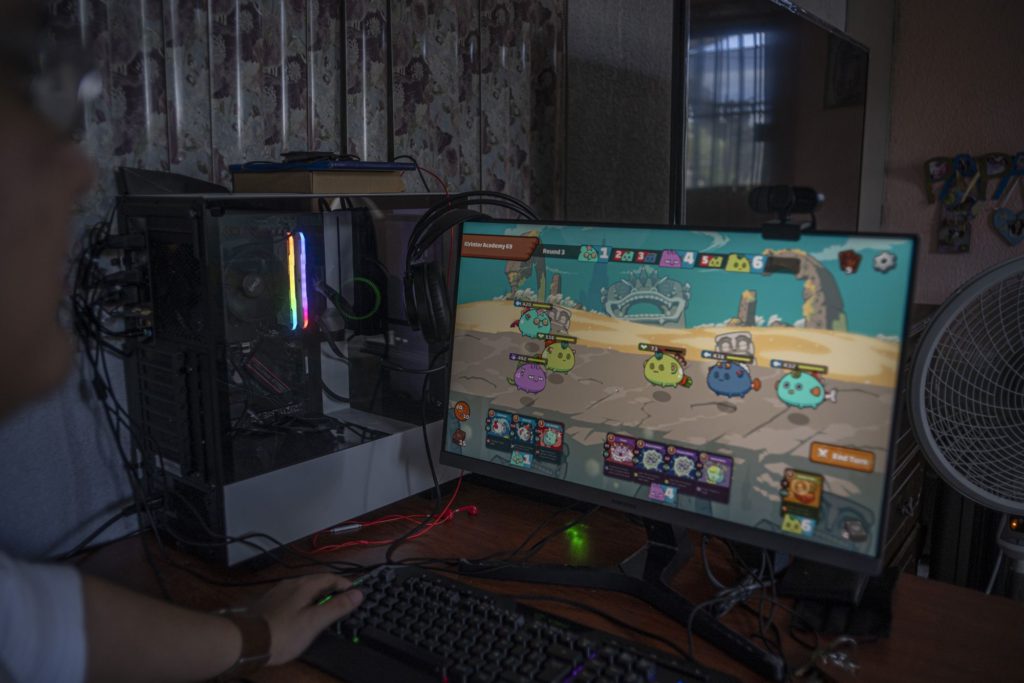
While players can still steer their blob-like Axie creatures around the game’s virtual world of Lunacia in search of Smooth Love Potion (SLP) and Axie (AXS) tokens, one crucial aspect is now missing: The ability to move some crypto earned in the game out of the virtual world and into other digital currencies or fiat, and vice versa. 

That’s because the hackers targeted software known as a “bridge,” penetrating its security protocols and making off with a huge haul of Ether as well as USDC stablecoins. That software, called the Ronin Bridge, was designed to allow Axie Infinity users to swap their AXS and SLP into Ether or USDC, an intermediary step to converting them to cash. It’s attached to the Ronin Network, the blockchain Axie Infinity runs on. 

Activity on the Ronin Bridge has been paused while its operators investigate the incident and try to plug any security holes, though access to AXS and SLP withdrawals via crypto exchange Binance came back online Saturday. Sky Mavis, Axie Infinity’s owner, says it plans to make whole those players who lost funds in the heist, but has yet to provide further details on how. A recent exploit on the Wormhole bridge, which transfers tokens between Ethereum and Solana, was resolved when its sponsor Jump Trading replaced roughly $300 million in stolen Ether.

Read More About the Ronin Heist

  • Crypto-Bridge Hacks Reach Over $1 Billion in Little Over a Year
  • When ‘Code Is Law’ Costs $600 Million: Bloomberg Crypto
  • Giant Ronin Bridge Hack Could Change How VCs Invest in Crypto

“The easiest way to look at this is like the bridge is the bank for the Ronin Network,” Aleksander Leonard Larsen, chief operating officer of Sky Mavis, said Thursday by text message. “The heist that happened took out all the ETH and USDC. So the ETH/USDC on Ronin Network is not currently backed by anything. But we are looking at other options.”  

While Sky Mavis hasn’t said whether the hack has caused an exodus of players from Axie Infinity, blockchain data compiled by DappRadar as of early evening Friday New York time showed a roughly 34% plunge in the volume of trading on the Axie Marketplace in the previous 24 hours and a 24% drop during the prior seven days. However, that doesn’t necessarily mean game playing is down, because you can still play Axie Infinity without registering transactions on the blockchain, which is what DappRadar monitors, said Pedro Herrera, a senior data analyst at the firm.

Trapped money is a big deal in markets such as the Philippines and Vietnam, low-wage countries where gamers have come to rely on Axie Infinity to pad their incomes. In the Philippines, by far the largest market for Axie Infinity, its popularity has been such that the authorities last year saw fit to remind gamers that profits from playing are subject to tax, local media reported.  

Mark Cuban-Backed Crypto Game a Hit With Pandemic UnemployedA Dec. 10 post on Axie Infinity’s blog, “The Lunacian,” showed the number of daily active users had jumped to around 2.5 million, an increase of roughly 1 million from three months before. The Philippines accounts for about 40% of active players, according to two different third-party websites that track gaming usage. 

The carbon footprint from mining Bitcoin and many other (though not all) digital currencies means crypto as a whole typically isn’t associated with the “E” in ESG — short for environmental, social and governance. But proponents have argued that it easily meets the “S” in that it helps with cheap and instant cross-border transfers in developing countries, or in the case of Axie Infinity, offers the promise of financial gains to those in poverty.

Players Hurting

With a large chunk of Axie Infinity players’ money locked in the virtual realm, that argument gets less convincing. Sky Mavis’s investors include billionaire Mark Cuban, Animoca Brands and Alexis Ohanian, the co-founder of Reddit. 

“In terms of who gets harmed the most by this, it’s not the venture capitalists,” said Catherine Flick, associate professor in computing and social responsibility at De Montfort University in the U.K. “Even a few days’ delay in refilling the bridge, that’s going to affect someone feeding their family or paying bills, and in much, much greater a way than having a bit of a blip on someone’s investment portfolio.”

As Axie Infinity grew more popular, the up-front cost of playing by buying a squad of its mini monsters rose too high for some new users to afford. This led to the creation of “scholarship” programs, where Axie players can have their entry cost funded in exchange for providing these backers, known as guilds, with a chunk of their earnings. What this effectively created was a form of payday lending within the game — and as long as the Ronin bridge remains offline, scholars aren’t able to repay their debts.

“It’s basically indentured labor,” said Flick, noting that Axie Infinity’s developers are still able to reap the benefits of player activity even if the users can’t cash out their earnings. “These games create this kind of two-tier system, further dividing the haves and have-nots.”

Discussions in Axie Infinity’s Discord group showed guild managers complaining that the hack might be a catalyst that causes scholars to lose trust in the game’s earnings potential, similarly affecting their ability to monetize the teams they run. They lamented a lack of public assurances from Sky Mavis’s investors to date, noting that the delay to re-fund the Ronin bridge has now gone on longer than it took for VCs to step in during other previous high-profile bridge attacks.

Conspiracy Theories

Manh Hung, a 27-year-old from Ho Chi Minh City who’s been playing Axie Infinity for six months, said that because deposits and withdrawals via the Ronin network were suspended after the attack was revealed, he wasn’t able to add Ether or SLP from outside then. With prices of Axie characters initially falling sharply after the hack announcement, that means he an missed opportunity for bargains, Hung said in a Facebook message. Prices of both SLP and AXS fell more than 10% after the hack news Tuesday before largely recovering by Saturday, according to data from CoinGecko.

Hung, who would only give his first and middle names, said he’s joined several social-media communities for Axie Infinity players. He said they’re rife with conspiracy theories, including that the hack was a “publicity stunt” by the game’s developer, or a convenient excuse to delay the launch of the new “Axie Infinity: Origin” game, as Axie on Thursday announced it would do. 

Sky Mavis’s Larsen said the theft was the result of a “social engineering attack combined with a human error,” and that the company doesn’t suspect insider involvement. He told players on Friday that the firm’s “top priority” was to ensure the Ronin bridge was safe and secure before it would reopen for business.

Ronin said on Saturday that the ability to convert tokens into Ether remains closed for the moment, while an exact timeline for the bridge’s reopening is dependent on security audits and updates to the bridge.

Whatever is behind the Ronin Bridge shutdown, it doesn’t change Hung’s calculus. “I still keep playing the game as normal,” he said, adding that he doesn’t plan to alter how he manages his wallets. “I hope the developer will improve the security of Ronin Network.” Others may not be so forbearing.

(The story was updated to reflect that access to AXS and SLP tokens in the Ronin network has resumed via Binance.)

More stories like this are available on bloomberg.com

©2022 Bloomberg L.P.

Social Media Buzz: Sarah Palin, Will Smith, March Madness

(Bloomberg) — What’s buzzing on social media this morning: 

BUZZING HEADLINES: 

Former Alaska governor and vice presidential candidate Sarah Palin will run for a congressional seat in the state, according to a a statement she released on Friday. “We need leaders who will combat the left’s socialist, big-government, America-last agenda,” Palin said. The seat became vacant after Representative Don Young died last month. 

Pope Francis apologized on Friday for the Roman Catholic Church’s abuses of Indigenous Canadians. The pope told a visiting delegation that he felt “sorrow and shame” for the harm brought on the population for more than a century.

BUZZING TWEETS:

Will Smith resigned from the group that runs the Oscars. The Academy of Motion Pictures Arts & Sciences initiated disciplinary proceedings against the Oscar winner for slapping comedian Chris Rock at the March 27 show. 

The University of Connecticut Huskies and the University of South Carolina Gamecocks will face off in the women’s NCAA March madness finals after both teams won their final four games last night. The championship will take place Sunday night. 

More stories like this are available on bloomberg.com

©2022 Bloomberg L.P.

Close Bitnami banner
Bitnami