Bloomberg

S&P Cuts Turkey Local Currency Rating on Ukraine War Impact

(Bloomberg) — S&P Global Ratings cut Turkey’s local currency credit rating further into junk, while keeping a negative outlook on the country and affirming the foreign currency score. 

The company lowered Turkish debt’s local-currency rating by one notch to B+, four levels below investment-grade, citing the impact of soaring energy prices from Russia’s war in Ukraine. It kept the foreign currency score at B+, on par with Bahrain and Bolivia. 

“The fallout of the Russia-Ukraine military conflict, including rising food and energy prices, will further weaken Turkey’s already tenuous balance of payments and exacerbate inflation,” S&P said in a statement Friday. “The latter is on course to average 55% in 2022, the highest level of all the sovereigns we rate.”  

More stories like this are available on bloomberg.com

©2022 Bloomberg L.P.

Airbnb Suit Over Host’s Spying on Couple Goes to Arbitrator

(Bloomberg Law) — A couple’s suit against Airbnb Inc. over a host’s secret videotaping at a vacation rental property must go to an arbitrator, the Florida Supreme Court held.

The Airbnb user agreement that the couple signed bound them to having an arbitrator, not a judge, decide whether the dispute can be litigated in court, Justice Ricky Polston said Thursday for the 6–1 state high court.

The ruling is a win for the online property rental company in its efforts to try and keep suits by users out of court.

The Texas couple, identified by the pseudonyms John and Jane Doe, allege they rented a condominium in Longboat Key through Airbnb. The condominium’s owner allegedly recorded their whole three-day stay there on hidden cameras, including interactions that the lower court summarized as “private and intimate.”

After they learned of the recordings, the Does sued both the owner and Airbnb, which they say should have warned them of previous privacy violations at other properties, and should have made sure the Longboat Key property didn’t have hidden cameras.

Airbnb sought to compel arbitration, and the trial court granted Airbnb’s request to allow the arbitrator to decide the right venue for the couple to pursue their complaint.

The intermediate court reversed in a split decision, saying the user agreement’s reference to arbitration rules wasn’t clear enough to indicate the couple’s consent to that.

The Florida top court here reinstated the trial judge’s ruling, saying the intermediate court’s decision was an “outlier.”

The kind of agreement used by Airbnb, known as a “clickwrap,” itself “is entirely silent on the question of who determines” whether the case can be heard in court, Polston said.

“Here, Airbnb and the Does clearly and unmistakably agreed that an arbitrator decides” the issue, Polston said. “Airbnb’s Terms of Service explicitly incorporate by reference” the rules of the American Arbitration Association, he said.

Such incorporation of the AAA rules “clearly and unmistakably evidences the parties’ intent to empower an arbitrator” to resolve where the case will be heard—in a court or in arbitration, he said.

The court joined all the federal appeals courts that have addressed the matter, he said.

Brannock Humphries & Berman and Mallard Perez PLLC represented the Does.

Joel S. Perwin, who practices in Miami Beach, Fla., and Hinshaw & Culbertson LLP represented Airbnb.

The case is Airbnb, Inc. v. Doe, 2022 BL 114039, Fla., No. SC20-1167, 3/31/22.

To contact the reporter on this story: Martina Barash in Washington at mbarash@bloomberglaw.com

To contact the editors responsible for this story: Rob Tricchinelli at rtricchinelli@bloomberglaw.com; Steven Patrick at spatrick@bloomberglaw.com

(Additions added throughout.)

More stories like this are available on bloomberg.com

©2022 Bloomberg L.P.

Visa Changes Rules for Gas Stations to Avoid $125 Pump Limit

(Bloomberg) — Visa Inc. and Mastercard Inc. are planning a raft of changes to rules for gas stations to allow larger transactions after a surge in fuel prices across the U.S. made it hard for some drivers to fill up using credit cards.

Many gas stations have a $125 limit for Visa transactions at the pump because larger transactions trigger higher fees for certain cards, as well as additional liability in the event of fraud. In recent months, that’s forced some customers — those who drive large SUVs in states with high fuel prices, for example — to pay using two transactions to top off their tanks. 

Starting next month, the San Francisco-based company will quadruple the maximum transaction amount that carries better interchange rates for purchases made with small-business and commercial cards, according to a document seen by Bloomberg. Visa will also raise the fraud-liability threshold to $175, according to a person familiar with the matter. Taken together, the moves should mean gas stations can raise limits and fewer consumers will face pump shutoffs.

“In response to increased fuel prices, Visa is making an adjustment,” according to the document. “This change will ensure the best-available interchange rates are received for larger fuel transactions, which should lead to fewer pumps shutting off while cardholders are refueling.”

A spokesman for Visa confirmed the authenticity of the document. 

Rival Mastercard will increase the amounts it pre-authorizes at gas stations to $175 from $125 for consumer cards and to $500 from $350 for commercial cards.

“In light of current fuel prices and in an effort to support fuel merchants, Mastercard is planning to increase pre-authorization levels,” the Purchase, New York-based company said. “This will be complemented by additional fraud-monitoring efforts to support fuel merchants during this time.“

Gas prices have soared in recent months, with the national average for a gallon of regular unleaded fuel reaching $4.21 this week, according to the American Automobile Association. That’s up from $3.61 a month ago and just $2.88 a year ago.

The move is just one of many that Visa and Mastercard are making in the coming weeks. 

More Changes

Mastercard, for instance, will lower the fees it charges for any transaction under $5 by about 300 basis points, according to separate people with knowledge of the matter. The firm is also planning to lower the rates it charges hotels, rental-car companies, daycare facilities and casual-dining restaurants.

The company’s so-called digital-enablement fee, which it charges on all online transactions, will increase to 0.2% of a purchase price from 0.1%, and Mastercard will charge a minimum of two cents per transaction. That means that, for a $50 online purchase, the fee will triple from half a cent to two cents.  

The fee will also be capped at 20 cents, meaning that for larger online purchases — those over $1,000 — Mastercard will be cutting the amount a merchant pays.

As part of that move, Mastercard is bundling more of its services into the digital-enablement fee, such as charges for mitigating fraud, preventing identity theft or verifying addresses.

“Our focus remains ensuring the safety and security of payments while balancing the interests of all parties,” Mastercard said in a statement. “Electronic payments have proven even more valuable since the start of the pandemic. And that’s why we’re seeing merchants encouraging their customers to use electronic forms of payment due to the significant value that they receive in return.”

The company is also planning to increase the rates it charges so-called Merit I merchants, which covers most e-commerce spending. Merit III retailers — those involved in most in-store spending — along with convenience stores and supermarkets will also see increases in swipe fees starting this month.

Smaller Retailers

Visa, for its part, announced earlier this month it will cut the fees it charges those businesses with less than $250,000 in Visa consumer credit-card volume by 10%. The change would apply to the vast majority of U.S. businesses, the network said.

At the same time, though, the firm is also planning to increase the fees it charges for most online spending. The network first planned to introduce the change as part of an update it made to its rate tables in 2020. At the time, the Visa described the changes as the biggest in a decade. The new charges were delayed due to the pandemic.

In a statement, Visa said the increase can be avoided if retailers adopt some of its technologies designed to improve the security of a transaction.

“Any rate increases are largely avoidable and apply to transactions that are sent to Visa with insufficient data, are coded incorrectly, carry increased risk or are processed without using” the firm’s chip card technology, Visa said in the emailed statement. “These rates are designed to maintain high data quality and integrity across our network to prevent fraud.”

Taken together, the planned changes by Visa and Mastercard will add some $475 million to merchants’ acceptance costs, consultancy CMSPI estimated.

‘Especially Troubling’

Merchants have been decrying the firms’ plans to increase swipe fees. This week, the Merchants Payments Coalition trade group asked the U.S. House Committee on Financial Services to examine the fees.

“It’s just especially troubling given the level of inflation right now,” Stephanie Martz, general counsel of the National Retail Federation and an executive committee member for the Merchant Payments Coalition, said in an interview. “We’re clawing our way to hang onto our slim margins as is. Given that these fees sometimes exceed what our margins are, we have to pass some of those rate raises onto consumers.”

While Visa and Mastercard set the levels for swipe fees, it’s the banks that issue credit and debit cards and thus reap the bulk of the income. While many of the changes in the works would amount to mere pennies per transaction, the fees add up. 

In 2020, merchants paid $110 billion to accept electronic payments, a 5.2% decline from a year earlier, according to the Nilson Report, a trade publication. That drop came even as spending on cards rose overall in 2020, the latest for which data is available. That’s because, during the pandemic, consumers increasingly have been using debit cards, which are generally cheaper than credit cards for merchants to accept.

(Updates with information about Mastercard beginning in first paragraph.)

More stories like this are available on bloomberg.com

©2022 Bloomberg L.P.

Google Target Mandiant Sued by Shareholders Over Acquisition

(Bloomberg) — Mandiant Inc. was sued in New York by a shareholder alleging the cybersecurity company made incomplete and misleading disclosures while asking investors to approve its proposed $5.4 billion purchase by Alphabet Inc.’s Google.

The deal, announced on March 8, was the second-biggest ever for Google, adding internet security products that will aid its cloud-computer division as the company competes with larger rivals Amazon Web Services and Microsoft Corp.

In a lawsuit filed Friday in federal court in Manhattan, shareholder Shiva Stein said a proxy statement filed by Mandiant with the U.S. Securities and Exchange Commission and sent to investors recommending a vote in favor of the deal contains “materially incomplete and misleading” information from Mandiant’s financial adviser, Goldman Sachs Group Inc.

The statement fails to give information about financial projections that were provided to Goldman by Mandiant’s management and provides values for financial metrics not included in generally accepted accounting principles without reconciling them to comparable measures, according to the complaint. 

The suit seeks to block the deal or force Mandiant to disclose the omitted information.

Mandiant didn’t immediately respond to a request for comment.

The transaction signals that Alphabet has returned to large deal making despite intense regulatory scrutiny. Buying Mandiant will give Google a wider range of software tools to protect clients as it seeks to expand its third-place cloud-infrastructure unit, which sells computing power and storage via the internet.

The case is Stein v Mandiant, 22-cv-2697, U.S. District Court, Southern District of New York.


More stories like this are available on bloomberg.com

©2022 Bloomberg L.P.

Chinese Stocks in the U.S. Surge as Delisting Worries Ease

(Bloomberg) — U.S.-listed Chinese stocks rallied on Friday after a Bloomberg News report that Beijing is preparing to give U.S. regulators full access to auditing reports for a majority of the 200-plus companies listed in New York as soon as mid-this year.

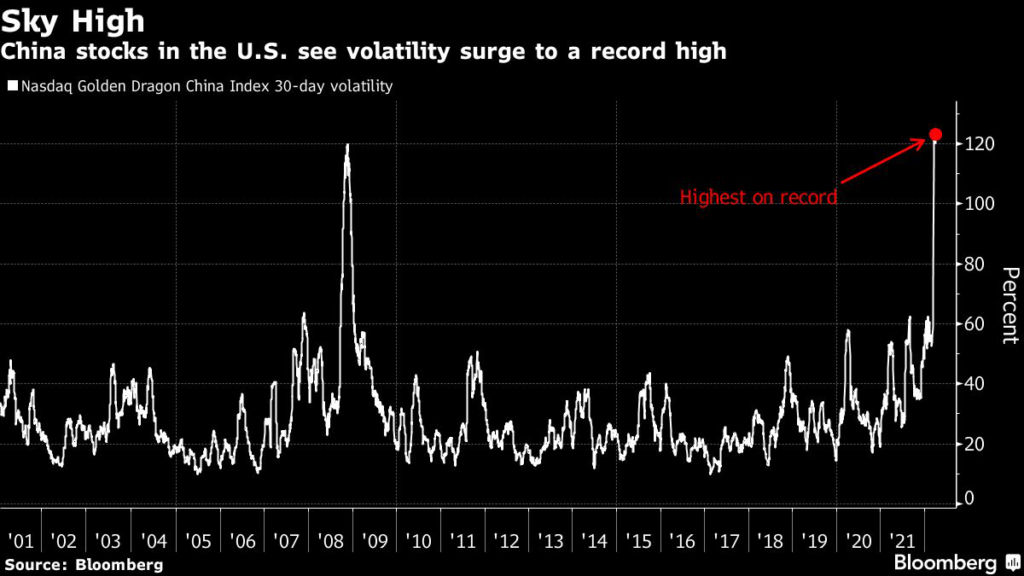
Didi Global Inc. led the advance in American depository receipts, rising 13%. E-commerce giant Alibaba Group Holding Ltd. climbed 1.3%, while JD.com Inc. gained 2.1% and Baidu Inc. jumped 6.6%. The Nasdaq Golden Dragon China Index rose 4.7%, just a day after locking in its worst start to a year since 2008.

READ: China Weighs Giving U.S. Full Access to Audits of Most Firms

“It’s a big game-changer,” said Matt Maley, chief market strategist at Miller Tabak + Co., cautioning that Chinese authorities will need to allow access. “It will cause a lot of bearish investors to reconsider their stance that China is ‘uninvestable.’”

China Securities Regulatory Commission and other national regulators are in the process of drafting a framework that will allow most Chinese companies to keep their listings, according to people familiar with the matter. Details are still under discussion and may change, the people said.

Such a plan could potentially alleviate concerns that the U.S. is moving closer to delisting Chinese companies, since the Securities and Exchange Commission started publishing a provisional list of firms running foul of requirements in early March. Baidu, Futu Holdings Ltd. and iQIYI Inc. were among five additions to SEC’s delisting watch list this week.

SEC Chair Gary Gensler said on Wednesday that Chinese authorities could face a “hard set of choices” to avoid security delistings, continuing to play down expectations of an imminent resolution to the audit dispute.

READ: How U.S. Is Moving Closer to Delisting Chinese Firms: QuickTake

For investors, Friday’s report is just the latest twist in what has been a roller-coaster ride to begin the year. Realized volatility for the Nasdaq Golden Dragon China Index over the last 30 days has soared to its highest on record, surpassing its prior peak seen during the global financial crisis.

The gauge — which tracks firms on American exchanges that conduct a majority of their business in China — has surged about 43% from its lowest close in more than eight years last month. Still, U.S.-listed Chinese stocks may not be in the clear just yet.

“The probability of delisting has declined, which is why you see the stocks rebound,” according to Brendan Ahern, chief investment officer at Krane Funds Advisors LLC. That said, “the names won’t fully rebound until definitive resolution is found.”

(Updates pricing throughout.)

More stories like this are available on bloomberg.com

©2022 Bloomberg L.P.

GameStop Split Brings a Hint of Meme-Mania to Friday’s Trading

(Bloomberg) — A proposed stock split by GameStop Corp. brought back echoes of peak-meme mania days to trading forums on Friday, with investors snatching up shares in the company and other retail favored-names.

The video-game retailer jumped as much as 14% in New York before erasing gains to trade close lower Friday after it said it will ask shareholders to approve a plan to increase the number of Class A shares to 1 billion from 300 million. The proposal, if approved, will open up a flood of GameStop shares with lower price tags — a combination highly favored by retail investors, who tend to concentrate bets on lower priced names.

The action on Friday showed the group didn’t waste any time with GameStop being the most bought stock on Fidelity’s platform in the session. Its buy orders were nearly double those for the next most-active company, Advanced Micro Devices Inc. Over 13 million GameStop shares changed hands, more than double the average volume over the past month.

Excitement was palpable in popular forums like Reddit’s WallStreetBets and chatroom Stocktwits where it was trending. Fellow meme stock AMC Entertainment Holdings Inc. also saw a boost in retail trader sentiment as Fidelity users snapped up shares.

GameStop’s split plans follows similar moves that bolstered the stock prices of technology giants Amazon.com Inc. and Tesla Inc. in recent weeks.

Lucas Mantle, a data scientist at Vanda Research, expects retail investors to keep aggressively buying GameStop in the coming weeks if the announcement is anything like those issued by Tesla. However, he warned that retail enthusiasm for stocks that have announced splits tends to wane closer to the actual stock split date. 

Wedbush analyst Michael Pachter concurred. “Instead of a medium pizza cut into four slices, they are cutting it into six. The pizza is the same, but each slice is smaller and costs more,” he said in an email.

While the revival stands out compared to the broader market, a basket of 37 meme stocks tracked by Bloomberg is up more than 35% from a March bottom, it has yet to match some of the swings seen in 2021 when stocks such as GameStop almost tripled in a single session. GameStop capped a four-day slide Friday, but has soared 82% in the past two weeks.

“I wouldn’t at all be surprised to see more management teams embrace stock splits, in some cases perhaps quite cynically to try and create fresh share price momentum,” Russ Mould, investment director at AJ Bell said, adding that over the long term fundamentals will prevail.

(Updates share price moves throughout and adds more details.)

More stories like this are available on bloomberg.com

©2022 Bloomberg L.P.

White House Press Secretary Jen Psaki in Talks to Join MSNBC

(Bloomberg) — White House Press Secretary Jen Psaki is in exclusive talks to join MSNBC, according to a person familiar with the matter. 

The discussions involve Psaki hosting a show on Comcast Corp.’s streaming service, Peacock, and she’d also appear on other MSNBC programs, said the person, who asked not identified. Psaki is expected to step down from the White House this spring and then formalize a deal with the network. 

Psaki said Friday when asked about the discussions that she has “nothing to confirm” about when she plans to leave the White House or her “next plans.”

“My focus every day continues to be speaking on behalf of the president, answering your questions,” she said during her daily press briefing.


The spokeswoman said she has “received rigorous ethics counseling, including as it relates to any future employment.”

The news was reported earlier by Axios. Both CNN and MSNBC had been trying to hire Psaki, Puck reported in February.

Psaki would be the latest Biden administration spokesperson to join the left-leaning network. Symone Sanders, the former spokeswoman for Vice President Kamala Harris, left the White House at the end of last year. She will host a weekend show on MSNBC in May that will also stream on Peacock.

The moves are part a broader talent shakeup at MSNBC. In December, Brian Williams, who hosted an 11 p.m. show, left and has been replaced by Stephanie Ruhle. Rachel Maddow, the network’s biggest star, has been on hiatus and recently signed a new deal that would allow her to pursue other projects. She’s expected to dial back her nightly show and appear less often on the network after this year.

(Updates with Psaki comments starting in third paragraph)

More stories like this are available on bloomberg.com

©2022 Bloomberg L.P.

Amazon Union Win in NYC Holds Potential to Spread Far and Wide

(Bloomberg) — Two years ago Amazon.com Inc.’s general counsel suggested focusing public attention on fired employee and labor activist Christian Smalls because he “wasn’t smart or articulate.” 

On Friday, Smalls led the fledgling union he founded to victory at one of Amazon’s New York warehouses — a seismic event that could upend the relationship between Amazon and its workers as well as help revitalize the struggling U.S. labor movement. 

After winning an election in Staten Island, Smalls celebrated his victory with a few choice words of his own. “Amazon tried to make it about me from day one,” he said. “It’s always going to be Amazon versus the people and today the people have spoken, and the people wanted a union.” 

Then the characteristic Smalls zinger: “We want to thank Jeff Bezos for going to space because while he was up there we were signing people up.”

To be clear, Smalls’ Amazon Labor Union won an election at just one warehouse, a result the company signaled it will fiercely contest. Negotiating a contract, assuming Smalls even gets that far, won’t be easy. Still, he’s just getting started.

A second vote is set for another Amazon warehouse in Staten Island, and the ALU is trying to sign up workers at two other facilities in the New York borough. Moreover, Smalls is emerging as a folk hero and potential guide to frontline workers all across the country, people who toiled through a dangerous pandemic and are now looking to redress the power imbalance between themselves and their employers.

“Win one warehouse and everyone will understand you can stand up to billionaires,” said former AFL-CIO organizing director Richard Bensinger, who has been spearheading a surprisingly successful union campaign at Starbucks Corp.

Unions have often been wary about pursuing labor board elections against powerful corporations, leery of business-friendly U.S. labor laws that let companies hold mandatory meetings to try and persuade workers that a union could leave them worse off. Even if employers fire organizers, they typically suffer minor penalties.

The ALU’s victory against Amazon showed that the seemingly impossible is possible and that a grassroots campaign can be surprisingly effective. Some activists, including Smalls, have argued that the Retail, Wholesale and Department Store Union lost an election last year at an Amazon warehouse in Bessemer, Alabama, in part because its organizers were perceived as outsiders who didn’t understand the local conditions. 

The RWDSU did much better in a second election that coincided with the Staten Island showdown. The union had a freer hand to make its case in Bessemer than it did last year, when the pandemic was still raging. The RWDSU is trailing by a little more than 100 votes and could possibly win once 416 disputed ballots are reviewed. 

Read more: Amazon Fired and Disparaged Him. Then He Started a Labor Union

Partly because he didn’t have much money and partly because he’s fond of the dramatic gesture, Smalls deployed confrontational tactics — tweeting photos of labor consultants he deemed “union-busters,” encouraging employees to disrupt the company’s anti-union meetings and handing out literature in the facility’s parking lot. 

Smalls was even arrested at one point and charged with trespassing, resisting arrest and obstructing governmental administration. (He said a judge adjourned the case for six months and will dismiss the charges so long as he isn’t charged with a crime during that time.) Amazon said it called the police after warning Smalls multiple times that he wasn’t allowed on the property — a decision some labor experts predicted would backfire on the company.

The ALU’s approach clearly resonated. Justine Medina, who previously did gig work, decided to get a job as a packer at the Staten Island warehouse after following the campaign. “I wanted to help the labor movement, and for me that meant putting myself where my values lie,” she said. 

Other workers said they were similarly inspired, a sentiment that helped the ALU win 2,654 yes votes versus 2,131 no votes. “It proves what we’ve said over and over again,” said Kate Bronfenbrenner, the director of labor education research at Cornell University. “You have to do the work on the ground.”

Sara Nelson, president of the Association of Flight Attendants, said the broader labor movement should heed Smalls’ D.I.Y. success. “Any kind of attempt to control the excitement and the creativity and the spontaneity of the awakening of solidarity is a foolhardy action,” she said.

Like other union officials, Nelson said success in one place can motivate workers in another and that the recent campaigns at Starbucks and Amazon have already inspired more employees to get involved in efforts such as her own union’s campaign at Delta Airlines.

“Just the vote alone in Bessemer made the phone ring off the hook,” she said. “The workers are ahead of us, and we’ve got to run to catch up to them.”

More stories like this are available on bloomberg.com

©2022 Bloomberg L.P.

Ukraine Update: EU Warns China Not to Interfere With Sanctions

(Bloomberg) — Negotiators from Ukraine and Russia spoke Friday via video link, though previous talks failed to agree even to a temporary cease-fire. Russian Foreign Minister Sergei Lavrov said Moscow is preparing a response to Ukraine’s proposals on ending hostilities.  

President Xi Jinping said China finds the situation in Ukraine “deeply regrettable.” Xi held a virtual summit Friday with European Union leaders, who said they expect Beijing at the very least not to interfere with sanctions imposed on Russia.

Russia said two Ukrainian helicopters made a rare strike across the border, hitting an oil tank facility in the city of Belgorod. There was no confirmation from Kyiv. The military in Ukraine said it retook several villages in the Kherson region to the south. 

(See RSAN on the Bloomberg Terminal for the Russian Sanctions Dashboard.)  

Key Developments

  • Gazprom Starts Telling Clients How to Pay for Gas in Rubles 
  • Mariupol’s Splintering Loyalties May Be Enough for Putin
  • Putin Set for $321 Billion Windfall If Oil, Gas Keep Flowing
  • There’s Now an App for Ukrainians Seeking to Remain in the U.S.
  • Chinese Buyers Given Flexibility to Pay in Yuan for Russian Oil
  • Russia Seeks New Ways to Sell Its $20-Billion-a-Year Gold Output

All times CET:

Russia Says Fire Out at Belgorod (9:26 p.m.)

The Russian Emergency Ministry said the fire at the Belgorod oil depot has been extinguished, Tass reports. The Belgorod mayor said on Telegram people living near the facility can return to their homes. 

Earlier Friday, Moscow said two Ukrainian military helicopters attacked the facility, about 50 km (30 miles) north of the border.

Russian Pullout from Chernobyl Completed, IAEA Says (7:44 p.m.)

All Russian forces have left the Chernobyl nuclear plant in Ukraine — site of the deadly 1986 meltdown — and international monitors are preparing to go in, the International Atomic Energy Agency said on Twitter.

Director General Rafael Mariano Grossi “intends to head an IAEA assistance and support mission” to the plant “as soon as possible,” the agency said.

U.K. Creates Sanctions Exception for Russia Bond Payments (7:24 p.m.)

The U.K. Treasury has approved a sanctions exception for the banks, clearinghouses and other intermediaries that help funnel payments on Russia’s international sovereign bonds to investors.

The British government published a notice outlining the exemption from its Russia-related sanctions regime to allow for financial services enabling the transfer of such payments. The measure applies to debt that was issued by the Russian government before March 1, is effective from April 1 and is set to expire June 30.

U.S. Sees Sanctions Hobbling Russia Despite Ruble Rebound (7:05 p.m.)

The U.S. Treasury Department sees a Russian economy hobbled by a deep recession, high inflation and a lack of access to much-needed imports, especially technology, as sanctions imposed by the U.S. and its allies begin to eat away at the country’s economic defenses despite a recent rebound in the ruble and the benefit of higher oil prices.

Russia’s economic resilience is based on its ability to produce and sell natural resources, principally oil, into the global market but it will now have the extremely difficult problem of  being able to consume only what it makes, according to a senior Treasury official who briefed reporters on condition of anonymity.

The official discounted reports of a rebound in the ruble, saying that Russia has imposed a number of severe controls on its currency in order to prop it up and said that a better measure of the strength of the currency was its domestic value, which has been undermined by a spike in inflation as a result of the sanctions. The official also said that while a black market for the currency has emerged, it is not organized.

Putin Unlikely to Give Up Goal in Ukraine, Analyst Says (7:00 p.m.)

Russian President Vladimir Putin may agree on a cease-fire with Ukraine but he’s unlikely to give up his long-term goal to subjugate his neighbor, said Angela Stent, a senior fellow at the Brookings Institution.

“I can see a path toward a cease-fire that might last for some time,” Stent said in an interview on Bloomberg Television’s “Balance of Power With David Westin.” “Ukraine could make concessions as well as Russia. But as long as Putin’s in the Kremlin, I doubt he will give up his dream.”

Ukraine’s leaders have offered Putin an off-ramp from the war by saying they’re open to neutrality. Putin could present this as a victory to his people, Stent said, although she sees no signs yet the Russians are prepared to withdraw their troops.

Ukraine Raises $600,000 Through Museum NFT Sales (6:20 p.m.)

The money will be used to rebuild museums, theaters and other cultural institutions. Ukrainian MetaHistory NFT-Museum sold 1,282 artworks on its first day of sales, raising 190 Ether cryptocurrency tokens for the Ministry of Digital Transformation of Ukraine, the museum said in an email.  

Sberbank’s U.K. Arm to Be Wound Down Amid Sanctions (6:15 p.m.)

The U.K. arm of Russia’s biggest lender Sberbank of Russia PJSC is being wound down, London’s highest-profile financial casualty in the aftermath of the invasion of Ukraine. 

Sberbank CIB U.K. Ltd. will enter so-called special administration, a form of insolvency that ensures there’s minimal disruption to financial markets, a London judge ordered on Friday. As with many Russian financial subsidiaries in countries that have imposed sanctions, Sberbank CIB has struggled to carry on as key staff leave and counterparties walk away.

EU Leaders Warn China on Russia Sanctions (4:13 p.m.)

“We expect China, if not supporting the sanctions, at least to do everything not to interfere in any kind,” European Commission President Ursula von der Leyen told reporters after the meeting with Xi. “On that point we were very clear.” She added the EU expected China to use its influence on Russia to end the war.

Chinese Premier Li Keqiang said during the summit that Beijing has been promoting peace talks on Ukraine in its own way, and is willing to play a constructive role. 

Refugees May be Able to Swap Hryvnias Into Euros (2:15 p.m.)

Ukrainian refugees in the EU may soon be able to swap some of their banknotes into euros and other currencies. The EU’s executive arm asked member states to set up facilities that allow each person to exchange up to 10,000 hryvnia ($339) free of charge at an official rate set by the Ukrainian central bank. Poland started a similar initiative in March.

Ukraine Refugees in EU Given Hope of Swapping Hryvnia Banknotes

Many of the 4 million people who’ve fled Ukraine invasion — over half of them going initially to Poland — have had trouble swapping hryvnia for local currency because banks haven’t been willing to take risks related to wild exchange-rate swings.

Russia’s Chief Negotiator Says Talks Have Resumed (12:55 p.m.) 

Talks between Russia and Ukraine resumed on Friday via video conference, Russia’s chief negotiator Vladimir Medinsky said on his Telegram channel, adding his country’s stance on Donbas and Crimea is unchanged. Mykhailo Podolyak, an adviser to the Ukrainian president’s chief of staff, confirmed that the discussions are continuing.

Gazprom Starts Giving Details on Ruble Payment Plan (12:35 p.m.)

Russia’s Gazprom is starting to tell clients how to pay for their gas after Putin said purchases from “unfriendly” nations including Europe would need to be settled in rubles. Germany is still going over the details before coming to any conclusions, government spokesman Wolfgang Buechner told reporters.

Meanwhile the Kremlin signaled that gas would keep flowing, and said payments for April gas weren’t due until late in the month or early May.

Lavrov Says Moscow Working on Response (11:36 a.m.)

Foreign Minister Sergei Lavrov said Russia is preparing a response to Ukraine’s proposals on security guarantees and ending the war. Lavrov made televised comments during a press briefing in New Delhi. 

Russia is ready to discuss Kyiv’s proposals on non-nuclear, neutral status, he said, adding that Ukraine has shown “more understanding” of the realities in Crimea and Donbas. Tass cited an unidentified person from the Russian side of negotiations saying talks with Ukraine would resume Friday via video. 

Russia’s Yamal-Europe Gas Pipeline Flows in Reverse (10:29 a.m.)

Russian gas flows via the Yamal-Europe pipeline reversed this morning, with fuel flowing from Germany to Poland — the opposite of the normal direction. That’s been a common occurrence for this pipeline over the past few months, and doesn’t signal a halt in Russian gas flows to Europe. In many cases, it just shows German companies are ordering less gas, while demand in Poland is higher.

Flows via Nord Stream, the direct link to Germany, were near the pipeline’s full capacity. 

Don’t Read Too Much Into Reverse Gas Via Russia Pipeline

Natural Gas Fluctuates as Traders Weigh Putin’s Demand (9:43 a.m.)

Natural gas prices in Europe fluctuated as traders weighed the potential impact on the market by Russia’s decision to shift payment for its supplies to rubles, with colder weather also set to boost demand. 

European stocks and U.S. equity futures rose slightly as investors evaluated the economic outlook amid moderating oil prices, tightening Federal Reserve monetary policy and Russia’s war in Ukraine.

Russian-Linked Containers Pile Up in Rotterdam (9:34 a.m.)

Measures taken against Russia are snarling thousands of steel shipping containers in Rotterdam as each box needs to be carefully inspected to make sure moving it won’t somehow breach sanctions, according to the CEO of the massive port. 

His comments gave unique insights into how the beating heart of Europe’s real economy is being battered by measures taken against Moscow after its invasion of Ukraine.   

Ukrainian Retakes Ground in Kherson, Chernihiv Regions (8:49 a.m.)

Eleven villages in the southern Kherson region and several others in the Chernihiv region northeast of Kyiv have been returned to Ukrainian control, according to the military’s General Staff. Shelling of towns and villages along the contact line in the east continued overnight, with civilian casualties reported after nine apartment buildings and nine private houses were shelled.

The intensity of shelling declined in Chernihiv and Kharkiv, although a missile hit the center of Kharkiv Thursday night. Fighting continues near Chernihiv, Izyum and at the border of Kherson and Mykolayiv regions to the south. 

Refugees Arriving in Poland Now Top 2.4 Million (8:45 a.m.)

Another 23,000 people arrived in Poland from Ukraine on Thursday, and another 3,500 early Friday, taking total refugees since Feb. 24 to 2.415 million, Polish border authorities said.

Over 4 million people have fled Ukraine since the start of the Russian invasion.  

Ukraine Said to Make Rare Strike in Russian Territory (8:30 a.m.)

Moscow said two Ukrainian military helicopters attacked an oil-storage facility in the Russian city of Belgorod, about 50 km (30 miles) north of the border, causing a large fire early Friday.

Tass quoted Belgorod Governor Vyacheslav Gladkov as saying the aircraft flew in at low altitude. Eight oil fuel tanks were burning and authorities said the fire might spread. Two workers were reported to have been injured and nearby residents were being evacuated.

Focused on fighting Russian troops on their own territory since Feb Ukrainian forces haven’t claimed any strikes on the other side of the border since the start of the war on Feb. 24. 

World Underestimating Impact of War, OECD Says (8:00 a.m.) 

Governments aren’t sufficiently aware of the longer-lasting economic fallout from Russia’s invasion of Ukraine, said OECD Chief Economist Laurence Boone. 

“I really believe we’re underestimating the medium-term impact of this war,” Boone told Bloomberg Television’s Francine Lacqua in Cernobbio, Italy, on Friday. “The longer the war will last, the more uncertainty we have, and the more worried we’re getting because uncertainty deters consumer purchases and business investment.”

Russia Redeploying Forces From Georgia, U.K. Says (7:45 a.m.)

Russia is redeploying as many of 2,000 troops from Georgia to reinforce its invasion of Ukraine, the U.K. defense ministry said. The forces are being reorganized into battalion tactical groups. 

“It is highly unlikely that Russia planned to generate reinforcements in this manner and it is indicative of the unexpected losses it has sustained during the invasion,” the U.K. said. 

Russia Jamming Jet Navigation, France Says (6:00 a.m.)

Russia’s military has been jamming satellite navigation systems used by commercial aircraft since the invasion of Ukraine, highlighting the need for robust alternatives, according to a French safety regulator.

Airline pilots have reported disruptions in regions around the Black Sea, eastern Finland and the Kaliningrad enclave, said Benoit Roturier, head of satellite navigation at France’s civil aviation authority DGAC. The interference appears to be caused by Russian trucks carrying jamming equipment typically used to protect troops and installations against GPS-guided missiles, he said.

Russia Is Jamming Jet Navigation, French Safety Official Says  

More stories like this are available on bloomberg.com

©2022 Bloomberg L.P.

Amazon NYC Warehouse Workers Support Union in Historic Labor Win

(Bloomberg) — Amazon.com Inc. workers at a New York warehouse voted to join an upstart labor union, an historic victory that gives organized labor its first foothold in the company’s U.S. operations and could embolden workers at other employers.  

The election at Amazon’s JFK8 fulfillment center in Staten Island wasn’t close, with the Amazon Labor Union winning 2,654 yes votes versus 2,131 no votes for the company. After signing the election results, ALU founder Christian Smalls clapped, pointed his fingers to the sky and raised a fist in triumph.

The victory is a watershed moment for Amazon. The Seattle-based company has managed to keep unions out of its U.S. operations for more than a quarter-century. Unless the company can get the result overturned, Amazon will have to start contract negotiations that potentially could hamper its ability to adjust work requirements and scheduling on the fly. The company has until April 8 to dispute the results.

“Amazon wanted to make me the face of the whole unionizing efforts against them,” Smalls tweeted as the results came in Friday. “Welp there you go! Welcome the 1st union in America for Amazon.”

Smalls’ triumphant tweet testifies to a landmark achievement, starting a successful union and beating one of the world’s most powerful companies with little help from organized labor. With limited funds, he employed unconventional tactics — tweeting photos of Amazon consultants he deemed “union-busters,” encouraging employees to disrupt the company’s anti-union meetings inside the warehouse and handing out literature in the facility’s parking lot.

Smalls will get a second opportunity to extend his victory on April 25, when workers at another Amazon facility in Staten Island start voting on whether or not to join the ALU. Meanwhile, Smalls is hoping to force elections at two more Amazon facilities in the New York borough.

In an emailed statement, Amazon signaled a lengthy legal battle could lie ahead. The company said it was “evaluating our options, including objections based on the inappropriate and undue influence by the NLRB” that Amazon and some business groups had observed. 

One of the industry groups Amazon cited, the National Retail Federation, sent a letter to lawmakers Friday requesting an investigation of the NLRB general counsel’s decision to file a lawsuit in federal court seeking an injunction to reinstate an activist that prosecutors alleged was illegally fired from the warehouse. (Amazon has denied wrongdoing.) The letter argued that the lawsuit’s timing “gives the appearance of an attempt to influence the outcome” of the election.

Labor experts expect the victory in New York to galvanize labor activists and workers at Amazon and beyond.

“This is a huge shot in the arm for the entire labor movement,” said Kate Bronfenbrenner, the director of labor education research at Cornell University. “This is going to inspire workers, not just throughout the U.S. In people’s eyes, Amazon and Walmart are interchangeable as the biggest private-sector employers that everyone thought couldn’t be beaten. It takes one of the biggest, and says you can organize anyone.”

Even before the Amazon upset, there were a spate of high-profile union election wins in recent months among sub-contracted Google Fiber staff in Missouri, sales employees at REI in New York, tech workers at the New York Times and baristas at Starbucks cafes in New York, Arizona and the company’s Seattle hometown.

Smalls, 33, hasn’t set out a detailed agenda but surveyed workers to assess their priorities. Among them: bringing back monthly productivity bonuses the company eliminated in 2018, giving hourly workers Amazon stock and raising pay to $30 an hour compared with the current average starting wage of $18 an hour. 

Read more: Amazon Fired and Disparaged Him. Then He Started a Labor Union

Smalls has been tangling with Amazon since 2020, when he was working at the JFK8 facility in Staten Island. Smalls helped organize a walkout there after colleagues began calling in sick and showing up with Covid-19 symptoms. Not long after, Amazon told Smalls to stay home because he had possibly been in contact with an infected colleague. Smalls showed up for a rally and was fired, prompting him to file a lawsuit alleging racial bias in Amazon’s Covid safety protocols. A judge dismissed the case in February.

Tensions between Smalls and Amazon came to a head later that month, when he was arrested at JFK8 and charged with trespassing, resisting arrest and obstructing governmental administration. Amazon spokesperson Kelly Nantel says the police were called after Smalls was warned multiple times that he wasn’t allowed on company property. (Smalls says a judge adjourned the case for six months and will dismiss the charges so long as he isn’t charged with a crime during that time.)

“I say what I say and that’s what got me here,” Smalls told Bloomberg before the election. “The same thing with the union: It represents what the workers want to say.”

(Updated with Amazon comment.)

More stories like this are available on bloomberg.com

©2022 Bloomberg L.P.

Close Bitnami banner
Bitnami