Bloomberg

BlockFi Sold $239 Million of Crypto, Warned of Job Cuts Before Bankruptcy

(Bloomberg) — BlockFi Inc. sold about $239 million of its own cryptocurrency and warned almost 250 workers that they would lose their jobs in the run-up to its Chapter 11 bankruptcy filing, court papers show. 

BlockFi sold the holdings to cover expected bankruptcy expenses and isn’t planning on taking out a loan to help fund itself while under court protection, company adviser Mark Renzi said in a sworn statement filed in court Monday. 

The crypto lender has started cutting costs in preparation for a restructuring, including warning two-thirds of its more than 370 workers about impending job cuts.

Read more: Crypto Lender BlockFi Goes Bankrupt in Aftermath of FTX

The company intends to reorganize in bankruptcy court rather than sell itself, but is open to any deal that maximizes recoveries for creditors, Renzi said. What users ultimately get back depends largely on whether other crypto players live up to their contracts with BlockFi and how the insolvency of FTX Group plays out, he said. 

“While the debtors are hopeful, the full extent of the fallout from FTX’s collapse remains to be determined,” Renzi said. The company had “no choice” but to seek to seek court protection from creditors after FTX collapsed, he said. 

BlockFi lets customers earn interest on their crypto and allows them to borrow money against those deposits. The company survived an initial shakeout in crypto tied to the collapse of hedge fund Three Arrows Capital after FTX agreed to lend it $400 million, calming users who had raced to withdraw their funds. 

But the stability was short-lived. On Nov. 8, BlockFi asked to borrow $125 million under the rescue loan, but FTX didn’t send the funds. Soon after, BlockFi paused client withdrawals and cut down on other site functionality. FTX filed for bankruptcy days later. 

In Renzi’s statement, part of a slate of papers typically filed on the first day of a bankruptcy, the financial adviser argued that BlockFi is in a stronger position than FTX.

“To date, I have not found any failure of corporate controls or systems integrity, and I have found BlockFi’s financial information to be trustworthy,” Renzi said. He touted its efforts to comply with regulators, including a settlement reached with the US Securities and Exchange Commission. BlockFi still owes the SEC $30 million, court papers show.

As part of the filing, BlockFi also sued one business partner for failing to turn over collateral after a loan went into default.

BlockFi will make its first bankruptcy court appearance at 11:30 a.m. on Tuesday in New Jersey. 

The case is BlockFi Inc., 22-19361, U.S. Bankruptcy Court for the District of New Jersey (Trenton).

More stories like this are available on bloomberg.com

©2022 Bloomberg L.P.

Trafigura Traders Enjoy 247% Share Price Gain After Record Year

(Bloomberg) — The price of shares in Trafigura Group held by its top employees surged 247% in its last financial year, as the trading house benefited from commodity market volatility to post a record profit.

Executives at Trafigura were informed of the share-price gain after its financial year closed at the end of September, according to people familiar with the matter, who asked not to be identified as the figures are private. The company is due to report its annual results next week.

The spectacular increase represents a boon for the roughly 1,000 top employees who are shareholders, as the war in Ukraine and soaring commodity prices thrust trading houses to the forefront of a global race for commodity security. It stands in contrast to the sell-off in public equity markets, as well as the big writedowns being taken by private equity investors in previously hot sectors like tech and crypto.

The surge in value is also an indication that Trafigura had yet another stellar year. Profit at the company, which is among the world’s largest oil, gas and metals traders, climbed to a record over the period, people familiar with the matter said.

Trafigura declined to comment on the gain in the price of the preference shares and the company’s results.

“Over the last year, the service we provide to supply commodities and energy to customers has become more complex and is more critical than ever before,” a spokesperson said in a statement.

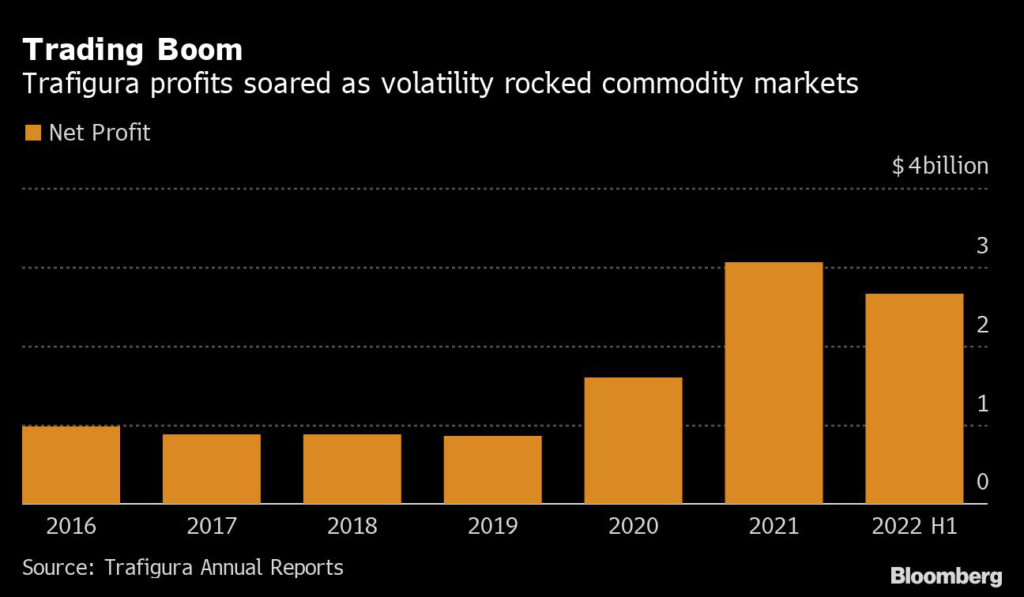
Wild swings in prices and supply chain disruptions arising from the Covid-19 pandemic and Russia’s invasion of Ukraine are providing opportunities for trading houses. Trafigura delivered net profit of $2.7 billion in the first half of 2022 — almost matching the total for the previous year. Cargill Inc., Vitol Group and Glencore Plc are making more money than ever before.

The buybacks also showcase how the gains of the current commodities boom are being shared out between a relatively small group of traders and executives who own many of the industry’s major players. Last year, rival energy trader Vitol paid $3 billion through share buybacks to the roughly 450 of its senior staff.

About 1,000 traders and executives at Trafigura have a stake in the company through preference shares in holding company Trafigura Beheer BV. Each year the company buys back some shares from its employees, as one of its key ways of remunerating top staff.

The war in Ukraine has also raised the profile of trading houses as strategic suppliers of key resources. In October, Trafigura reached a deal to supply half a million tons of non-Russian base metals to Germany, with the German government backstopping an $800 million credit deal in return.

More stories like this are available on bloomberg.com

©2022 Bloomberg L.P.

Crypto Exchange Kraken Settles With US on Alleged Iranian Sanctions Violations

(Bloomberg) — Cryptocurrency exchange Kraken has agreed to pay a little over $360,000 to settle allegations that it violated US sanctions against Iran. 

“Due to Kraken’s failure to timely implement appropriate geolocation tools, including an automated internet protocol (IP) address blocking system, Kraken exported services to users who appeared to be in Iran when they engaged in virtual currency transactions on Kraken’s platform,” Treasury’s Office of Foreign Assets Control said in a statement Monday. 

As part of the deal, the company — whose legal name is Payward Inc. — agreed to invest an additional $100,000 to improve its sanctions compliance, including in training and technical measures to assist in sanctions screening.

“Even before entering into this resolution, Kraken had taken a series of steps to bolster our compliance measures,” Marco Santori, the company’s chief legal officer, said in a statement. “With these enhanced systems in place, we are in a stronger position to continue our mission of accelerating the adoption of cryptocurrency so people from around the world can achieve financial freedom and inclusion.”

OFAC characterized the apparent sanctions violations as “non-egregious” and said Kraken voluntarily disclosed them to the government, as well as cooperated with its investigation. Those factors were considered when reaching the settlement amount, the office said. 

The settlement comes at a difficult time for the crypto industry as companies and retail investors deal with the fallout of cryptocurrency exchange FTX’s spiral into bankruptcy earlier this month. Treasury officials have previously said they will hold digital-asset firms that violate their sanctions rules accountable. 

According to OFAC, between Oct. 14, 2015 and June 29, 2019, Kraken processed 826 transactions, totaling almost $1.7 million on behalf of individuals who appeared to have been in Iran at the time of the transactions.

OFAC said Kraken undertook a number of remedial actions to address the sanctions issue, including employing geolocation blocking technology to prevent customers in prohibited locations from accessing their accounts, hiring a dedicated person to lead their sanctions compliance program, and implementing blockchain analysis tools.  

(Adds statement from Kraken in the fourth paragraph.)

More stories like this are available on bloomberg.com

©2022 Bloomberg L.P.

Elon Musk Says Apple Has Mostly Stopped Advertising on Twitter

(Bloomberg) — Elon Musk said that Apple Inc. has cut back its advertising on Twitter Inc., suggesting that the iPhone maker has joined other major brands in rethinking its relationship with the social network. 

“Apple has mostly stopped advertising on Twitter,” Musk tweeted on Monday. “Do they hate free speech in America?”

A number of large companies have paused their ads on Twitter since the billionaire acquired the company for $44 billion last month. The exodus included General Mills Inc. and Pfizer Inc., and Musk acknowledged that the defections led to a “massive drop” in revenue. Since the takeover, he has cut thousands of jobs at Twitter, raising concerns that the platform won’t be able to combat hate speech and misinformation. A new approach to verifying accounts also opened the door to trolls impersonating major brands, as well as Musk himself.

Twitter’s relationship with Apple is particularly significant because the tech giant’s app store is one of the main ways that people get on the social network. Phil Schiller, the longtime Apple executive who oversees the app store, deleted his Twitter account after Musk reinstated the account of former President Donald Trump, who had been booted from the platform in the wake of the Jan. 6, 2021, attack on the US Capitol.

Apple, based in Cupertino, California, didn’t immediately respond to a request for comment.

Musk has previously tweeted that if Twitter is removed from Apple and Google’s app stores, he will make an alternative phone that can work with the platform.

More stories like this are available on bloomberg.com

©2022 Bloomberg L.P.

Stocks Drop With China, Fed Worries; Oil Rallies: Markets Wrap

(Bloomberg) — Stocks fell on concern China may have to tighten its Covid curbs further, undermining prospects for global growth. Oil rallied as OPEC+ is seen considering deeper output cuts amid a faltering market.

The S&P 500 pared its monthly gain as traders also sifted through remarks from US central bank officials. Federal Reserve Bank of St. Louis President James Bullard said markets may be underestimating the chances of higher rates and his New York counterpart John Williams noted policymakers have more work to do to curb inflation. The dollar rose with bond yields.

The bout of investor anxiety around China hit Bitcoin, with the crypto market also digesting BlockFi Inc.’s bankruptcy filling. It was another session of big moves for US-listed Chinese shares, which rebounded from a selloff. Apple Inc. slid as Bloomberg News reported that turmoil at its key manufacturing hub of Zhengzhou is likely to result in a production shortfall of close to 6 million iPhone Pro units this year.

China’s woes complicate expectations of its path to reopening, which — along with speculation about more moderate Fed hikes — had recently buoyed sentiment. Authorities deployed a heavy police presence in Beijing and Shanghai to deter a repeat of the weekend’s demonstrations. Chances are growing of a messy exit from the Covid Zero policy, analysts at Goldman Sachs Group Inc. warned.

“This is going to keep economic activity subdued in the country, and beyond,” said Fawad Razaqzada, market analyst at City Index and Forex.com. “The civil unrest is adding another layer of uncertainty over the economic situation there. It is certainly hurting investor sentiment across the financial markets.”

Alongside the situation in China, Razaqzada noted investors will look ahead to a busy week for economic data and Fed Chair Jerome Powell’s speech Wednesday. Analysts expect him to cement expectations the central bank will slow its pace of hikes next month, while reminding Americans that its fight against inflation will run into 2023.

Read: Yardeni Says Curve Inversion Shows Bonds, Stocks Have Bottomed

Just when the S&P 500 was trying to break above the highs of mid-November, sentiment turned negative, threatening the market’s recent momentum. Timing is most inconvenient here as the index approaches a crucial technical zone in the shape of both the 2022 downtrend and the 200-day moving average. Should the recent bullishness evaporate, short-term tactical bear trades might spark a bout of profit taking.

Stock markets are in for a wild ride next year as they don’t yet reflect the risk of a US recession, according to strategists at Goldman Sachs and Deutsche Bank. Their calls are a warning after equities rallied sharply in the past two months on bets that a peak in inflation will lead to a softening of hawkish central bank policies.

BlackRock Inc.’s Chief Investment Officer Rick Rieder sees a chance for rates volatility to turn lower and provide a necessary, “though perhaps not sufficient” condition for stabilization in risk assets markets.

Stagflation is the key risk for the global economy in 2023, according to investors who said hopes of a rally in markets are premature following this year’s brutal selloff. Almost half of the 388 respondents to the latest MLIV Pulse survey said a scenario where growth continues to slow while inflation remains elevated will dominate globally next year.

Read: Long-Dated Credit Does Best Since 2008 as Buyers Bet on Pivot

Key events this week:

  • Euro area economic confidence, consumer confidence, Tuesday
  • US Conference Board consumer confidence, Tuesday
  • EIA crude oil inventory report, Wednesday
  • China PMI, Wednesday
  • Fed Chair Jerome Powell speech, Wednesday
  • Fed releases its Beige Book, Wednesday
  • US wholesale inventories, GDP, Wednesday
  • S&P Global PMIs, Thursday
  • US construction spending, consumer income, initial jobless claims, ISM Manufacturing, Thursday
  • BOJ’s Haruhiko Kuroda speaks, Thursday
  • US unemployment, nonfarm payrolls, Friday
  • ECB’s Christine Lagarde speaks, Friday

Some of the main moves in markets:

Stocks

  • The S&P 500 fell 1.1% as of 1:14 p.m. New York time
  • The Nasdaq 100 fell 0.9%
  • The Dow Jones Industrial Average fell 1%
  • The MSCI World index fell 1%

Currencies

  • The Bloomberg Dollar Spot Index rose 0.4%
  • The euro fell 0.3% to $1.0366
  • The British pound fell 0.8% to $1.1996
  • The Japanese yen rose 0.2% to 138.90 per dollar

Cryptocurrencies

  • Bitcoin fell 2.4% to $16,179.16
  • Ether fell 3.7% to $1,170.51

Bonds

  • The yield on 10-year Treasuries advanced four basis points to 3.71%
  • Germany’s 10-year yield advanced two basis points to 1.99%
  • Britain’s 10-year yield was little changed at 3.13%

Commodities

  • West Texas Intermediate crude rose 1.2% to $77.20 a barrel
  • Gold futures fell 0.7% to $1,755.90 an ounce

This story was produced with the assistance of Bloomberg Automation.

–With assistance from Sujata Rao, John Viljoen, Vildana Hajric, Peyton Forte and Isabelle Lee.

More stories like this are available on bloomberg.com

©2022 Bloomberg L.P.

From Amazon to Meta to Twitter: The US Tech Companies Cutting Jobs

(Bloomberg) — Tech companies are trimming staff and slowing hiring as they face higher interest rates and sluggish consumer spending in the US and a strong dollar abroad. 

The tech industry shed 9,587 jobs in October, the highest monthly total since November 2020, according to Challenger, Gray & Christmas Inc., a consulting firm that tallies job cuts announced or confirmed by companies across telecom, electronics, hardware manufacturing and software development.

In recent earnings reports, Alphabet Inc., Amazon.com Inc., Meta Platforms Inc., Microsoft Corp. and others fell short of projections, sending shares plunging and shaving hundreds of billions of dollars from their market valuations. Meta, for instance, has lost more than 67% of its value so far this year.

Read More: It’s White-Collar Jobs That Are at Risk in the Next Recession

Here’s a running list of who’s cutting jobs and pulling back on hiring. 

Amazon

The e-commerce titan plans to cut about 10,000 jobs. The layoffs will likely target Amazon’s devices group, responsible for the Echo smart speakers and Alexa digital assistant, as well as the retail divisions and human resources, Bloomberg News reported.

In November, Amazon halted “new incremental” hiring across its corporate workforce. 

Apple

The iPhone maker has paused hiring for many jobs outside of research and development, an escalation of its plan to reduce budgets heading into next year, according to people with knowledge of the matter. The break generally doesn’t apply to teams working on future devices and long-term initiatives, but it affects some corporate functions and standard hardware and software engineering roles.

Chime

The digital-banking startup Chime Financial Inc. is cutting 12% of its staff, or 160 people. A spokesperson said the company remains well-capitalized and the move will position it for “sustained success.”

Cisco

Cisco Systems is beginning a restructuring plan that will affect about 5% of employees. The company says it will incur pretax charges of about $600 million for severance, termination and other costs. The employees will be given a chance to move to other jobs within the company, Chief Financial Officer Scott Herren said in an interview. 

“This is not about reducing our workforce — in fact we’ll have roughly the same number of employees at the end of this fiscal year as we had when we started,” Herren said. Cisco had more than 83,000 employees as of July 30.

Dapper Labs

Dapper Labs Inc. founder and Chief Executive Officer Roham Gharegozlou said in a letter to employees that the company had laid off 22% of its staff. He cited macroeconomic conditions and operational challenges stemming from the company’s rapid growth. Dapper Labs created the NBA Top Shot marketplace for nonfungible tokens, a digital asset class that has seen a steep drop in demand since the crypto market downturn.

Digital Currency Group

Cryptocurrency conglomerate Digital Currency Group embarked on a restructuring last month that saw about 10 employees exit the company. As part of the shake-up, Mark Murphy was promoted to president from chief operating officer.

Galaxy Digital

Galaxy Digital Holdings Ltd., the crypto financial services firm founded by billionaire Michael Novogratz, is considering eliminating as much as 20% of its workforce. The plan may still be changed and the final number could be in a range of 15% to 20%, according to people familiar with the matter. Galaxy’s shares have plummeted more than 80% this year, part of a rout for cryptocurrencies.

HP

HP Inc. will cut as many as 6,000 jobs over the next three years as declining demand for personal computers cuts into profits. In addition to reducing its workforce by about 10%, the company will reduce its real estate footprint. 

Intel

Intel Corp. is cutting jobs and slowing spending on new plants in an effort to save $3 billion next year, the chipmaker said. The hope is to save as much as $10 billion by 2025, a plan that went over well with investors, who sent the shares up more than 10% on Oct. 28. Bloomberg News reported earlier that the headcount reduction could number in the thousands. 

Lyft

Lyft Inc.’s cost-saving efforts include divesting its vehicle service business. It’s eliminating 13% of staff, or about 683 people. The company had already said it would freeze hiring in the US until at least next year. It’s now facing even stiffer headwinds. 

“We are not immune to the realities of inflation and a slowing economy,” co-founders John Zimmer and Logan Green said in a memo. “We need 2023 to be a period where we can better execute without having to change plans in response to external events — and the tough reality is that today’s actions set us up to do that.”

Meta

The Facebook parent is cutting 11,000 jobs, the first major round of layoffs in the social-media company’s history. Meta’s stock has plunged this year, and the company is trying to pare costs following several quarters of disappointing earnings and a slide in revenue. The reductions equal about 13% of the workforce, and Meta will extend its hiring freeze through the first quarter. 

“I want to take accountability for these decisions and for how we got here,” CEO Mark Zuckerberg said in the statement. “I know this is tough for everyone, and I’m especially sorry to those impacted.”

Opendoor

Opendoor Technologies Inc. said that it’s laying off about 550 employees — roughly 18% of its headcount. The company, which practices a data-driven spin on home-flipping called iBuying, is coping with slowing housing demand because of higher mortgage rates.

Peloton

Peloton Interactive Inc. laid off 500 employees globally, or about 12% of the workforce, in October. It was the fourth time this year the company has cut staff. Along with other expense reduction measures, Peloton said the move will help it reach the break-even point on cash flow by the end of fiscal 2023.

“I know many of you will feel angry, frustrated and emotionally drained by today’s news, but please know this is a necessary step if we are going to save Peloton, and we are,” CEO Barry McCarthy said in an October memo. “Our goal is to control our own destiny and assure the future viability of the business.”

Qualcomm

Qualcomm Inc. said that it’s frozen hiring in response to a faster-than-feared decline in demand for phones, which use its chips. It now expects smartphone shipments to decline in the double-digit percent range this year, worse than the outlook it gave earlier.

Salesforce

Salesforce Inc. is focusing on margins as demand for its software products slow. The company has cut hundreds of workers from sales teams as it looks to improve profitability. Since 2017, Salesforce had almost tripled its workforce. 

Seagate

Seagate Technology Holdings Plc, the biggest maker of computer hard drives, said that it’s paring about 3,000 jobs. Computer suppliers, including Seagate and Intel, have been hard hit by a slowdown in hardware spending. Customers are sitting on a pile of extra inventory, hurting orders and weighing on Seagate’s financial performance, CEO Dave Mosley said. That necessitated cuts. “We have taken quick and decisive actions to respond to current market conditions and enhance long-term profitability,” he said.

Stripe

Payments company Stripe Inc., one of the world’s most valuable startups, is cutting more than 1,000 jobs. The 14% staff reduction will return its headcount to almost 7,000 — its total in February. Co-founders Patrick and John Collison told staff that they need to trim expenses more broadly as they prepare for “leaner times.”

Twitter

The upheaval at Twitter has more to do with its recent buyout — and the accompanying debt — than economic concerns. But the company has suffered some of the deepest cuts of its peers right now. Elon Musk, who bought Twitter for $44 billion, eliminated about 3,700 jobs by email. Musk also reversed the company’s work-from-anywhere policy, asking remaining employees to report to offices.

“Regarding Twitter’s reduction in force, unfortunately there is no choice when the company is losing over $4M/day,” Musk tweeted on Nov. 4.

Upstart

Upstart Holdings Inc., an online lending platform, said in a regulatory filing it cut 140 hourly employees “given the challenging economy and reduction in the volume of loans on our platform.”

(Adds HP job cuts.)

More stories like this are available on bloomberg.com

©2022 Bloomberg L.P.

Mastercard, Block Back Group to Lobby for Canada Finance Reforms

(Bloomberg) — Payment firms including Mastercard Inc. and Block Inc. are banding together with fintech companies to press Canada to move faster on rules that may boost competition in financial services. 

More than 40 companies have joined forces to launch Fintechs Canada, a lobby group that will push for so-called open-banking rules and other regulations they say would enable more innovation in a financial sector that’s dominated by a handful of domestic banks. 

Open banking is a regulatory system that makes it easier for consumers to share their financial data with third parties — reducing barriers to switching from one financial provider to another. Many countries, including Australia and the UK, offer some form of it. In the US, the Consumer Financial Protection Bureau is trying to move ahead with long-awaited measures in that direction. 

Read more: US Banks Face Fresh Push to Share Client Data with Fintech Firms

Canada has been slowly moving ahead with consultations on an open-banking framework. Data protection and consumer privacy are key issues. In March, the federal government named lawyer and consultant Abraham Tachjian as its czar on the topic. But the process is moving too slowly for some firms. 

‘Gray Zone’

“Regulatory barriers to entry in Canada’s financial sector remain high, making it hard for fintechs to operate and grow in Canada,” Alex Vronces, executive director of the lobby group, said in an interview. “My worry is that the future of responsible innovation is at risk.”

Equifax Inc., Block’s Square payment division, online brokerage Wealthsimple Inc. and Power Corp. of Canada’s Portage Ventures unit are all listed as members of the group, according to a draft statement seen by Bloomberg. It replaces a smaller organization known as Paytechs. 

An open-banking framework would eventually bring more options for consumers, Vronces said. 

“It’s going to bring the entire industry out of that kind of gray zone, and make it clear that customers have a right to access their data for other financial services than their main financial institution,” said Yves-Gabriel Leboeuf, chief executive officer of Flinks and a board member of Fintechs Canada.  

Montreal-based Flinks provides infrastructure for companies to access the bank data of their clients, and is potentially one of the winners of a open-banking system. It’s majority-owned by National Bank of Canada, the country’s sixth-largest commercial bank.

At the Canadian Club of Toronto last week, the head of the Canadian Bankers Association expressed concerns about payment providers operating in the absence of a proper regulatory structure. 

“Payment services providers deal directly with consumers, so the absence of consumer protection is a significant shortcoming,” CBA CEO Anthony Ostler said. “Let’s be clear: we don’t want the next FTX or Celsius coming from Canada’s payment ecosystem.”

Officials from Finance Minister Chrystia Freeland’s department didn’t respond to a request for comment. 

More stories like this are available on bloomberg.com

©2022 Bloomberg L.P.

Yardeni Says Curve Inversion Shows Bonds, Stocks Have Bottomed

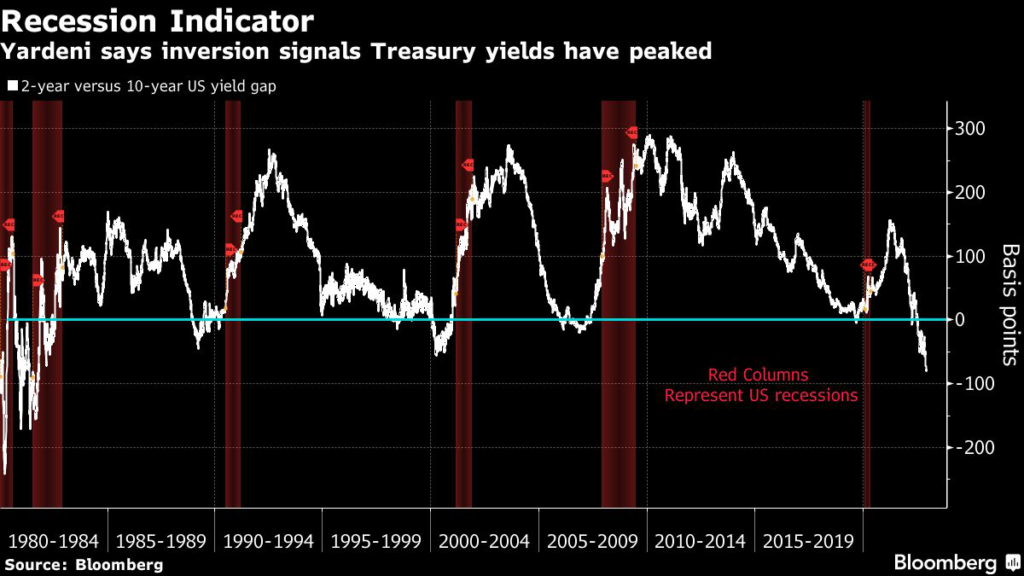
(Bloomberg) — The inversion of the US Treasury yield curve is flashing that long-term interest rates have peaked, stocks have bottomed out and the Federal Reserve’s policy tightening is approaching its limit, according to Ed Yardeni of Yardeni Research Inc.

With the Fed aggressively boosting rates to tame inflation, short-dated yields have eclipsed those on longer maturities since around mid-year, a phenomenon with a long history of flagging a looming recession. The gap is now as extreme as it was when then-Fed Chair Paul Volcker’s rate-hiking campaign to break inflation tanked the economy in the early 1980s.

The upside-down curve is also a strong signal for other events, including a squeeze in credit, says Yardeni. The veteran strategist is known for coining the term “bond vigilantes” to describe investors who sell bonds to protest monetary or fiscal policies they consider inflationary.  

“Yield-curve inversions actually predict that the Fed’s monetary policy is getting too tight, which could trigger a financial crisis that could quickly morph into a credit crunch, causing a recession,” Yardeni, the firm’s president and founder, wrote in a note published Sunday. “The Fed should be done tightening early next year, as anticipated by the inversion of the yield curve since this past summer.”

Cause for Hope

His view might bring some cheer to holders of both bonds and equities. The Treasury market has lost about 12% this year, on pace for an unprecedented annual decline. Meanwhile, the S&P 500 Index has slumped around 16%, putting it on track for the steepest drop since 2008.

Two-year Treasury yields exceeded 10-year rates by about 81 basis points at one point Monday, a level last seen in 1981. The inversion has deepened as traders ramped up how high they expect the Fed to lift rates. The market now sees it reaching around 5% toward mid-2023, raising the prospect of a slump in economic growth sometime next year.

“Arguably the Fed’s tight monetary policy has already triggered several financial crises,” including the cryptocurrency meltdown, Yardeni said. “Yet, there’s no sign of an economy-wide credit crunch so far.” 

Yardeni’s view is that the 10-year yield may have peaked on Oct. 24, when it finished at 4.24%, the highest close this year. It was last around 3.7%.

As for stocks, the firm’s analysis suggests the market may have bottomed on Oct. 12, when the S&P 500 ended at 3577 — its lowest close this year. The index traded at around 3990 on Monday.

The trade-weighted dollar also likely topped out last month, given the approaching end of the Fed’s tightening, Yardeni said.

Fed Chair Jerome Powell is widely expected to use a Wednesday appearance to cement expectations that the central bank will slow its rate increases next month, while also stressing that its fight to tame inflation will extend into 2023. 

“We are still expecting a ‘growth recession’ or a ‘mid-cycle slowdown’ rather than the more typical recession predicted by similar yield-curve inversions in the past,” Yardeni said.

More stories like this are available on bloomberg.com

©2022 Bloomberg L.P.
Activision Analysts Don’t Need Microsoft Deal to Be Bullish

(Bloomberg) — Activision Blizzard Inc. is gaining fans on Wall Street as a flurry of analysts raise their recommendations on the stock even as Microsoft Corp.’s planned acquisition looks increasingly dicey.

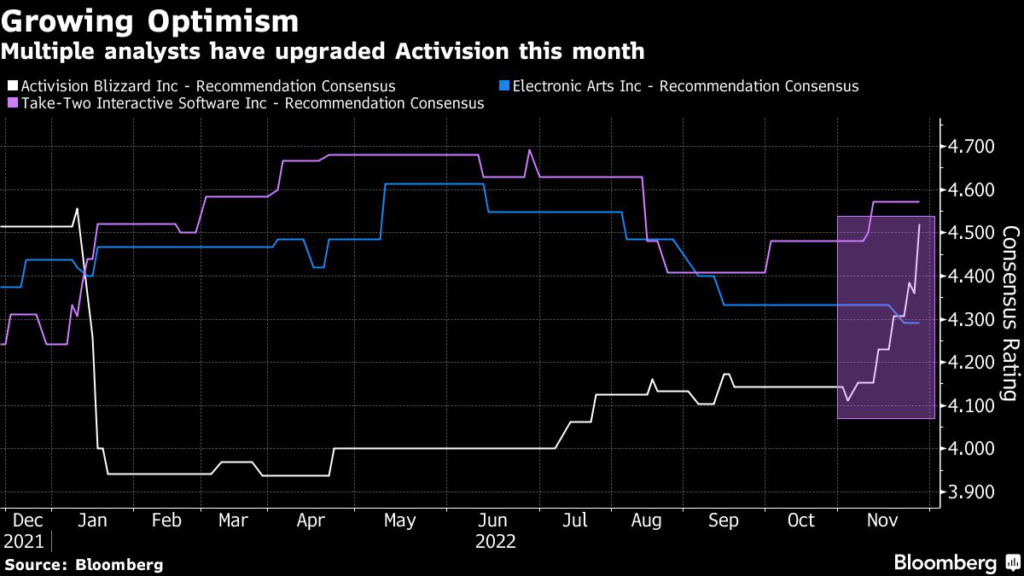
At least six firms have boosted their ratings in November, including three on Monday: Wells Fargo, Truist and Morgan Stanley. Raymond James, MKM Partners and Baird all raised their view earlier this month. Currently, 76% of analysts recommend buying the stock, compared with 57% at the start of the month, according to data compiled by Bloomberg.

The growing optimism about Activision comes despite questions over whether Microsoft’s deal will close. The acquisition faces an in-depth European Union probe and scrutiny from US regulators. 

Read more: Microsoft’s Activision Deal Hangs on Long-Shot FTC Accord

“The market is undervaluing ATVI relative to both outcomes,” wrote Wells Fargo analyst Brian Fitzgerald, referring to whether Microsoft’s $69 billion deal will close. Truist analysts led by Matthew Thornton said that the stock has an attractive risk profile, adding that Activision should have a “big” 2023, given the health of its Call of Duty and World of Warcraft franchises.

The Bloomberg consensus rating on the stock — a ratio of its buy, hold and sell ratings — has jumped to 4.52 out of five, its highest since January, and up from an April low of 3.94. This has made Activision nearly as well liked among Wall Street analysts as Take-Two Interactive Software Inc., which boasts a consensus rating of 4.57. Additionally, Electronic Arts Inc. has a consensus rating of 4.29. 

Shares of Activision rose 1.6% to $74.61 on Monday, more than 20% below Microsoft’s offer to buy it for $95 per share.

Since the takeover was announced in January, the gap between Activision’s trading price and Microsoft’s all-cash bid has been widening, driven by mounting antitrust concerns, as well as its sheer transaction size and long closing process. 

The deal’s so-called merger arbitrage spread widened last week after Politico reported that the FTC is likely to file an antitrust lawsuit to block the sale. The market was pricing in roughly 40% odds of the deal successfully closing, Cowen’s merger arbitrage specialist Aaron Glick said on Friday.

–With assistance from Yiqin Shen.

More stories like this are available on bloomberg.com

©2022 Bloomberg L.P.

Musk’s Twitter Risks Being EU Outlaw After Staff Exodus

(Bloomberg) — Twitter Inc.’s main European Union privacy watchdog said it’s “very concerned” about the ability of Elon Musk’s social media giant to abide by EU laws following an exodus of staff and news last week that a senior executive in Dublin had to go to court to avoid losing her job. 

Twitter’s top data watchdog in the EU said it contacted the company on Monday, seeking answers to a number of questions and assurances about its continued compliance with EU law.

“We are very concerned about what we’re reading in the media,” Graham Doyle, deputy commissioner at the authority, said by phone. “We have written to Twitter this morning again, seeking answers.” He was referring to reports in RTE that Sinead McSweeney, Twitter’s global vice president for public policy, was granted an injunction after telling an Irish court that she was treated as if she no longer worked for the company. 

The Irish watchdog, the lead privacy authority for some of Silicon Valley’s biggest tech firms in the EU because of their base in Dublin, says it’s been in almost daily contact with Twitter’s Dublin office after the departure of staff in recent weeks sparked safeguarding fears. Initial concerns after the departure of the firm’s top privacy chief were addressed when Twitter appointed Dublin-based Renato Monteiro as its acting data protection officer. 

Read More: How EU Could Frustrate Musk’s Plans for Twitter: QuickTake

But new concerns have emerged since that Twitter may lack staff to ensure continued compliance with a raft of EU regulations, including the bloc’s strict General Data Protection Regulation, which could in all cases lead to hefty fines in case of a breach. Twitter in recent days lost its remaining employees in its Brussels office, a key EU regulatory hub for any big tech company.

The concern about the lack of transparency from Twitter toward its staff and about who is still working in what role is key for the Irish watchdog, which needs to ensure that the company can continue to take decisions about the processing of EU user data in Dublin. Under EU rules this is key for a company to retain Dublin as their main hub in the bloc.

An email sent to Twitter’s press team wasn’t responded to. McSweeney didn’t immediately answer a message sent to her over LinkedIn. 

After meeting with Twitter staff in Dublin last week, EU Justice Commissioner Didier Reynders said he was concerned about how the firings and resignations affected the company’s ability to comply with EU rules. While he received solid commitments that EU user data will remain safe, he said he needs to see “concrete measures to be in full compliance.”

Aside from privacy rules, big tech firms such as Twitter must comply with the EU’s new Digital Services Act, which follows concerns that social media have done too little to prevent the spread of objectionable or misleading content from destabilizing politics and society and harming the vulnerable. 

If it doesn’t comply, regulators can issue strongly worded demands and fines equivalent to as much as 6% of Twitter’s annual revenue.

–With assistance from Morwenna Coniam.

(Updates with background on other EU rules in last two paragraphs)

More stories like this are available on bloomberg.com

©2022 Bloomberg L.P.

Close Bitnami banner
Bitnami