Bloomberg

Amazon Vows to Replenish All the Water It Uses for Data Centers

(Bloomberg) — Amazon Web Services, the largest cloud-computing provider, is promising by 2030 to replenish the water its massive data centers consume, the latest environmental pledge from the internet giant. 

Parent company Amazon.com Inc. said in a statement Monday it’s supporting efforts to replenish groundwater in California, the UK and India to offset the water the company’s cloud centers use. Google, which has vowed to offset 120% of its water usage, revealed last week that its global data centers consume 4.3 billion gallons of water a year. Microsoft Corp. has already committed to replenish more water than it consumes by the end of the decade. 

Data centers use a considerable amount of electricity and water to cool the racks of servers and computers. While Amazon and its rivals have disclosed more of their energy footprints, they have been less willing to share how much water they use. That’s caused political tension in areas facing droughts. 

AWS declined to share the total gallons it consumers, but reported that in 2021 it used a quarter liter of water for every kilowatt-hour of electricity at its data centers. That metric is the best reflection of water efficiency, said Will Hewes, global water lead for AWS. 

Right now, AWS said it relies on recycled water for 20 of its data centers, including two in drought-stricken California, but it’s challenging to expand that number because re-using water is often tricky in regions where utilities aren’t set up for the practice. “Water is complicated,” Hewes said.

More stories like this are available on bloomberg.com

©2022 Bloomberg L.P.

BlockFi Bankruptcy Filing Shows It Owes $30 Million to SEC

(Bloomberg) — The US Securities and Exchange Commission is one of the largest creditors to BlockFi, which filed for bankruptcy in the wake of a number of failures within the digital-assets space. 

The regulator has a $30 million unsecured claim against the crypto lender, according to a filing Monday. That makes it BlockFi’s fourth-biggest creditor, behind Ankura Trust Company, which is listed as being owed more than $729 million; West Realm Shires Inc., which is the entity that operates FTX US and which is owed $275 million; as well as an unnamed customer due more than $48 million. 

Ankura acts as a trustee for BlockFi’s interest-bearing crypto accounts, according to its website.

BlockFi’s bankruptcy is the latest in a string of crypto firms that have gone bust amid a plunge in digital-asset prices as well as the recent meltdown of crypto-exchange FTX, as well as a handful of important projects and firms that combusted earlier in the year. 

BlockFi said in a statement that it will use the Chapter 11 process to “focus on recovering all obligations owed to BlockFi by its counterparties, including FTX and associated corporate entities,” adding that recoveries are likely to be delayed by FTX’s own bankruptcy. Chapter 11 bankruptcy allows a company to continue operating while working out a plan to repay creditors. 

“The only surprise is it took this long, given that when your white knight gets slayed by a dragon of their own making, it’s only a matter of time until you also perish in the fire,” said Max Gokhman, chief investment officer at asset manager AlphaTrAI, which has crypto funds. 

Read more: Crypto Lender BlockFi Goes Bankrupt in Aftermath of FTX Meltdown

BlockFi was founded in 2017 by Zac Prince and Flori Marquez and in its early days had backing from influential Wall Street investors like Mike Novogratz and, later on, Valar Ventures, a Peter Thiel-backed venture fund as well as Winklevoss Capital, among others. It made waves in 2019 when it began providing interest-bearing accounts with returns paid in Bitcoin and Ether, with its program attracting millions of dollars in deposits right away. 

But regulators worried that customers didn’t understand how much risk they were taking on when participating in crypto-lending projects. In July 2021, securities regulators for Alabama, Texas, New Jersey, Kentucky and Vermont brought actions against BlockFi alleging that the company was offering unregistered securities. In February, BlockFi agreed to pay $100 million to the Securities and Exchange Commission and state regulators over allegations it illegally offered a product that pays customers high interest rates to lend out their digital tokens.

Now the main US securities regulator will need to wait in line to get paid, just like all the other creditors. 

–With assistance from Jeremy Hill.

More stories like this are available on bloomberg.com

©2022 Bloomberg L.P.

China Stocks Rally in US on Bet Protests Will Spur Covid Shift

(Bloomberg) — Chinese stocks listed in the US rallied Monday amid speculation that nationwide protests could hasten the government’s shift away from the Covid Zero policies that are exerting a major drag on its economy.

The Nasdaq Golden Dragon China Index jumped as much as 4.7%, the most in two weeks, while the exchange-traded KraneShares CSI China Internet ETF advanced as much as 5.5% in New York.

Stocks that stand to gain strongly from an end to virus-related lockdowns helped to drive the advance, including restaurant operator Yum China Holdings Inc. and online travel agency Trip.com Group Ltd. 

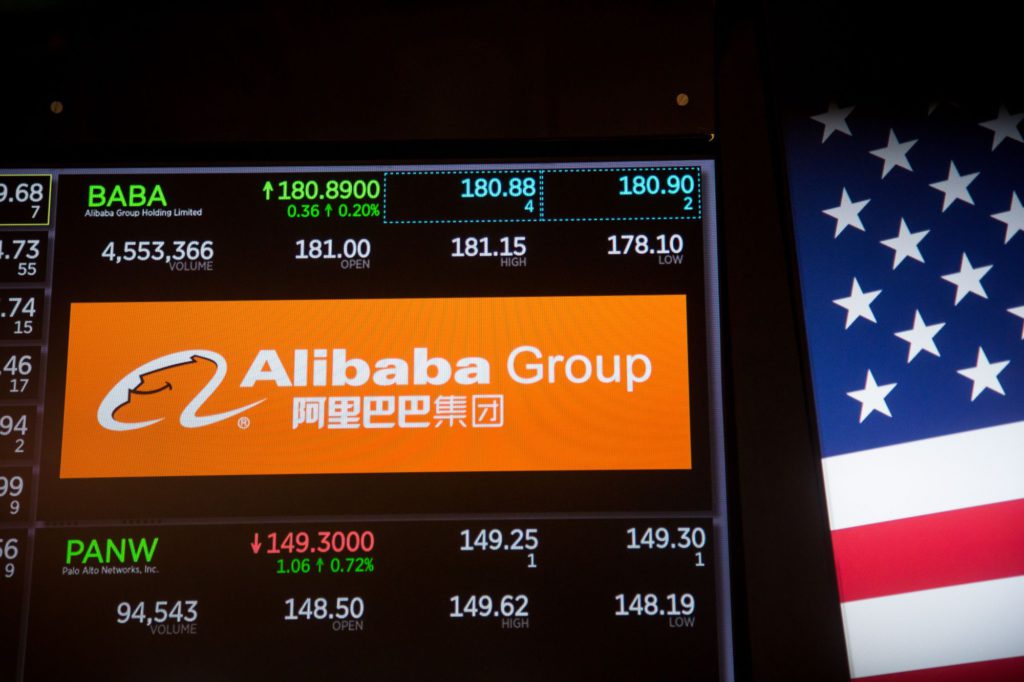
E-commerce firm Pinduoduo Inc. rallied 14% after better-than-expected earnings, while Internet giants Alibaba Group Holding Ltd. and JD.com Inc. also gained after slumping in Hong Kong. KE Holdings, a platform that facilitates housing transactions, jumped 4.7% as China’s securities regulator issued new measures to support listed housing developers.

Protesters took to the streets across China over the weekend in a rare act of defiance against the government and its landmark strategy of lockdowns and mass testing campaigns to contain the Covid-19 pandemic.

“This will likely accelerate reopening” even though “there will be no official end to zero Covid,” Brendan Ahern, chief investment officer at Krane Funds Advisors wrote in a note to clients.

The gains in the US stand in contrast to trading in Asia Monday, when Chinese stocks slid on concern about the fallout from the protests. 

The civil unrest comes even after Beijing loosened some Covid restrictions this month in a surprise move, fueling gains in the Chinese stock market. The MSCI China Index is on pace for its best month this century after gaining nearly 19% in November, though it remains down sharply this year as investors wait for a clear signal that Beijing is softening its zero-tolerance stance toward the pandemic.

While China’s government has deflected questions about the unrest, some localities — including the capital city of Beijing — have been paring back restrictions despite surging Covid cases. A local official in the capital said movement restrictions imposed to trace the source of Covid or identify those infected generally must not exceed 24 hours. Meanwhile, Xinjiang said it will lift lockdowns of designated high-risk areas as soon as possible.

Yet with the country’s virus caseload spiking and signs of public discontent boiling over, Goldman Sachs Group Inc. economists said China could face a “disorderly” exit from its Covid Zero policies. Mark Mobius, founding partner at Mobius Capital Partners, echoed such caution in an interview with Bloomberg Television, saying in an interview Chinese markets could retreat in the near term if Beijing cracks down on protesters.

Although the social tension may help accelerate China’s reopening, “it is undeniably adding another layer of uncertainty for the Chinese market at the moment when most of the investors are re-calibrating their positions in preparation for 2023,” said Xiadong Bao, a fund manager at Edmond de Rothschild Asset Management in Paris.

–With assistance from Lynn Chen.

(Updates with share moves, quote in the fifth graph and details throughout)

More stories like this are available on bloomberg.com

©2022 Bloomberg L.P.

Crypto Lender BlockFi Goes Bankrupt in Aftermath of FTX

(Bloomberg) — BlockFi Inc. filed for bankruptcy, the latest crypto firm to collapse in the wake of crypto exchange FTX’s rapid downfall. 

BlockFi said in a statement Monday that it will use the Chapter 11 process to “focus on recovering all obligations owed to BlockFi by its counterparties, including FTX and associated corporate entities,” adding that recoveries are likely to be delayed by FTX’s own bankruptcy. Chapter 11 bankruptcy allows a company to continue operating while working out a plan to repay creditors. 

The petition, filed in New Jersey, lists BlockFi’s assets and liabilities at between $1 billion and $10 billion each. The company said in the statement that it had around $257 million of cash on hand, and is starting an “internal plan to considerably reduce expenses, including labor costs.”

Citing “a lack of clarity” over the status of bankrupt FTX and Alameda Research, the Jersey City, New Jersey-based company earlier halted withdrawals and said it was exploring “all options” with outside advisers.

Following investigations into FTX by the US Securities Exchange Commission and Commodity Futures Trading Commission over potential misuse of customer funds, it became unclear to BlockFi where funding for a credit line from FTX US and collateral on loans to Alameda, which included Robinhood Markets Inc. stock, came from, Bloomberg News reported earlier this month. BlockFi had also been in the process of shifting over its assets over to FTX for custody, but the majority of the assets had not been moved prior to FTX’s collapse. 

FTX US is listed in the company’s petition as one of its top unsecured creditors, with a $275 million loan.


The company’s largest unsecured creditor, Ankura Trust Company, is owed about $729 million, according to the petition. Ankura acts as a trustee for BlockFi’s interest-bearing crypto accounts, according to its website.

BlockFi was founded in 2017 by Zac Prince and Flori Marquez and in its early days had backing from influential Wall Street investors like Mike Novogratz and, later on, Valar Ventures, a Peter Thiel-backed venture fund as well as Winklevoss Capital, among others. It made waves in 2019 when it began providing interest-bearing accounts with returns paid in Bitcoin and Ether, with its program attracting millions of dollars in deposits right away. 

The company grew during the pandemic years and had offices in New York, New Jersey, Singapore, Poland and Argentina, according to its website. Co-founder Prince in a March 2021 interview with Bloomberg said BlockFi was using proceeds from a $350-million funding round to expand into new markets and fund new products. Bain Capital Ventures and Tiger Global were among the investors in the that round.

Originally valued at $3 billion in March 2021, BlockFi looked to raise money at a reduced valuation of about $1 billion in June. The firm also faced scrutiny from financial regulators over its interest-bearing accounts and agreed to pay $100 million in penalties to the SEC and several US states in February. The SEC is listed on the bankruptcy filing as BlockFi’s fourth-largest creditor, with $30 million owed to the agency.

BlockFi worked with FTX US after it took an $80 million hit from the bad debt of crypto hedge fund Three Arrows Capital, which imploded after the TerraUSD stablecoin wipeout in May.

The company had significant exposure to the empire of companies founded by former FTX Chief Executive Officer Sam Bankman-Fried. The company received a $400 million credit line from FTX US in an agreement that also gave the company the option to acquire BlockFi through a bailout orchestrated by Bankman-Fried over the summer. BlockFi also had collateralized loans to Alameda Research, the trading firm co-founded by Bankman-Fried.

The company is the latest crypto firm to seek bankruptcy amid a prolonged slump in digital asset prices. Lenders Celsius Network LLC and Voyager Digital Holdings Inc. also filed for court protection this year. 

The case is BlockFi Inc., 22-19361, U.S. Bankruptcy Court for the District of New Jersey (Trenton).

–With assistance from Jeremy Hill and Vildana Hajric.

(Adds history of the company’s entanglement with FTX beginning in the fifth paragraph.)

More stories like this are available on bloomberg.com

©2022 Bloomberg L.P.

‘Knives Out’ Was a Missed Opportunity for Netflix, Analyst Says

(Bloomberg) — Glass Onion: A Knives Out Mystery, the first movie from Netflix Inc. to appear in the largest theater chains before it’s available on streaming, brought in $13.3 million over five days in a closely watched limited run.

The total is projected to reach $15 million in the US and Canada when the movie completes its seven-day run this week, according to a person familiar with the matter. The movie played on almost 700 locations, for revenue of about $19,000 per screen, the best average for any film over the weekend, the person said.

The film, a sequel to the 2019 hit Knives Out, played in theaters owned by AMC Entertainment Holdings Inc., Regal Entertainment Corp. and Cinemark Holdings Inc., the biggest US circuits. The companies have resisted working with Netflix because the streaming provider prefers to debut its movies simultaneously or shortly after they appear in cinemas. Once Glass Onion’s theatrical run ends, it won’t be available again until Dec. 23, when it appears on Netflix.

Analyst Eric Handler of MKM Partners, who follows theaters, said Netflix “missed out on an opportunity to make a lot more money” by limiting the film’s run to one week. He called the company’s marketing “subpar.”

Still, he predicted Netflix will offer a few films a year through theaters but said the “marketing support will be minimal.”

AMC Chief Executive Officer Adam Aron tweeted Sunday that he was encouraged by the results, saying they would lead to “more of Netflix down the road.” Boxoffice Pro had projected that Glass Onion would gross as much as $15 million over the five-day weekend that started Nov. 23. 

The result was good enough for third place in an otherwise slow weekend for theaters in North America. Walt Disney Co.’s Black Panther: Wakanda Forever was No. 1 with a $64 million haul over five days, while the company’s animated Strange World brought in a disappointing $18.6 million, according to Comscore Inc.

On an Oct. 18 earnings call, Netflix Co-Chief Executive Officer Ted Sarandos played down the significance of the Knives Out theatrical release, calling it “another way to build anticipation for the film and build buzz” ahead of its debut on the streaming service.

Netflix was little changed at $284.04 at $11.23 a.m. in New York. AMC, the largest theater chain, was down 2.8% to $7.30 while Cinemark dropped 2.6% to $13.49. Cineworld Group Plc, owner of Regal, filed for bankruptcy protection in the US in September.

Amazon.com Inc.’s plan to spend more than $1 billion a year on movies to be released in theaters could spur companies such as Netflix and Apple Inc. to follow suit, according to Bloomberg Intelligence analyst Geetha Ranganathan.

At the same time, it’s unclear whether the industry will ever return to prepandemic sales given the rise of streaming and a 40% shorter theatrical window, she said.

–With assistance from Gerry Smith.

(Updates with analyst’s comment starting in fourth paragraph.)

More stories like this are available on bloomberg.com

©2022 Bloomberg L.P.

Bitcoin Drops as Tremors From China Unrest Spook Global Markets

(Bloomberg) — Cryptocurrencies slid Monday as BlockFi Inc. filed for bankruptcy, the latest crypto firm to collapse in the wake of crypto exchange FTX’s rapid downfall. 

Prices had slumped earlier amid a bout of investor anxiety in global markets sparked by protests in China against Covid restrictions.

Bitcoin, the largest token, at one point shed 3.2% and was trading at about $16,090 as of 11:04 a.m. in New York. Second-ranked Ether fell about 5%, while the likes of Solana, Avalanche and Dogecoin suffered even sharper losses.

BlockFi said in a statement that it will use the Chapter 11 process to “focus on recovering all obligations owed to BlockFi by its counterparties, including FTX and associated corporate entities,” adding that recoveries are likely to be delayed by FTX’s own bankruptcy. Chapter 11 bankruptcy allows a company to continue operating while working out a plan to repay creditors. 

Crypto markets have been on edge over the contagion spreading from the fall of Sam Bankman-Fried’s FTX exchange and sister trading house Alameda Research.

Read more: China Covid Unrest Boils Over as Citizens Defy Lockdown Efforts   

The drop in crypto assets Monday came amid a slide in Asian and US stocks. One risk in China is that Beijing’s ongoing policy of Covid-zero mobility curbs is an impediment to stabilizing domestic demand, Katrina Ell, senior economist at Moody’s Analytics Inc., said on Bloomberg Television.

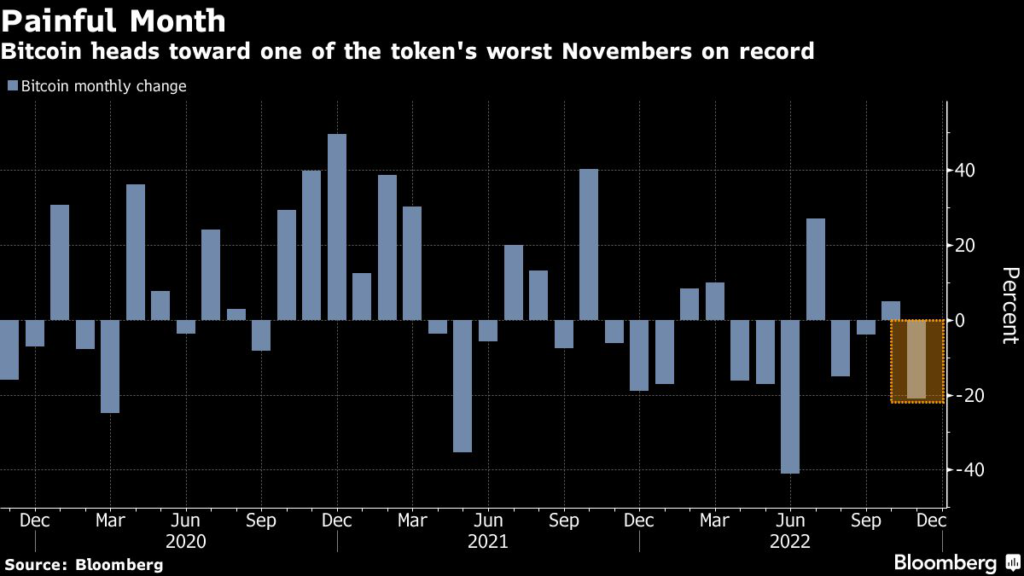
Bitcoin’s Bad Month

Markets may also be fretting that unrest in China will cause further supply chain constraints globally, said Hayden Hughes, chief executive officer of social-trading platform Alpha Impact. Such snarls can make it harder to beat back inflation, leaving interest rates higher.

Bitcoin is down about 21% so far in November, the token’s worst monthly performance since June. This year’s crypto rout has sliced almost 70% off a gauge of the top 100 digital assets.

The collapse of FTX — which once boasted a $32 billion valuation but tumbled into a bankruptcy in a matter of days this month — continues to threaten a wider reckoning for the digital-asset sector. 

Read more: FTX Tensions Intensify as Bahamas Blasts Firm’s New Chief Ray

“Elevated contagion risk is being profiled into the cryptocurrency complex,” said John Toro, head of trading at digital-asset exchange Independent Reserve.

For crypto market prices: CRYP; for top crypto news: TOP CRYPTO.

More stories like this are available on bloomberg.com

©2022 Bloomberg L.P.

Populist House Republicans Picking a Fight With US Business Over ‘Woke Capitalism’

(Bloomberg) — Republicans and their longtime corporate allies are going through a messy breakup as companies’ equality and climate goals run headlong into a GOP movement exploiting social and cultural issues to fire up conservatives.

The ensuing drama will unfold over the next two years in the US House, where the incoming GOP majority plans to pressure companies on immigration, equality and climate-change stances that are now being assailed by key Republicans as “woke capitalism.”

Most directly in the GOP cross-hairs is the US Chamber of Commerce, which is under pressure from likely House Speaker Kevin McCarthy to replace its leadership after the nation’s biggest business lobby backed some Democratic candidates.

As the conflict simmers, the California Republican and his top lieutenant, Steve Scalise, have refused to meet with Chamber representatives, according to a person familiar with their thinking. And rank-and-file Republicans are largely disregarding the once-influential “key vote alerts” the Chamber distributes, a former senior Republican aide said.

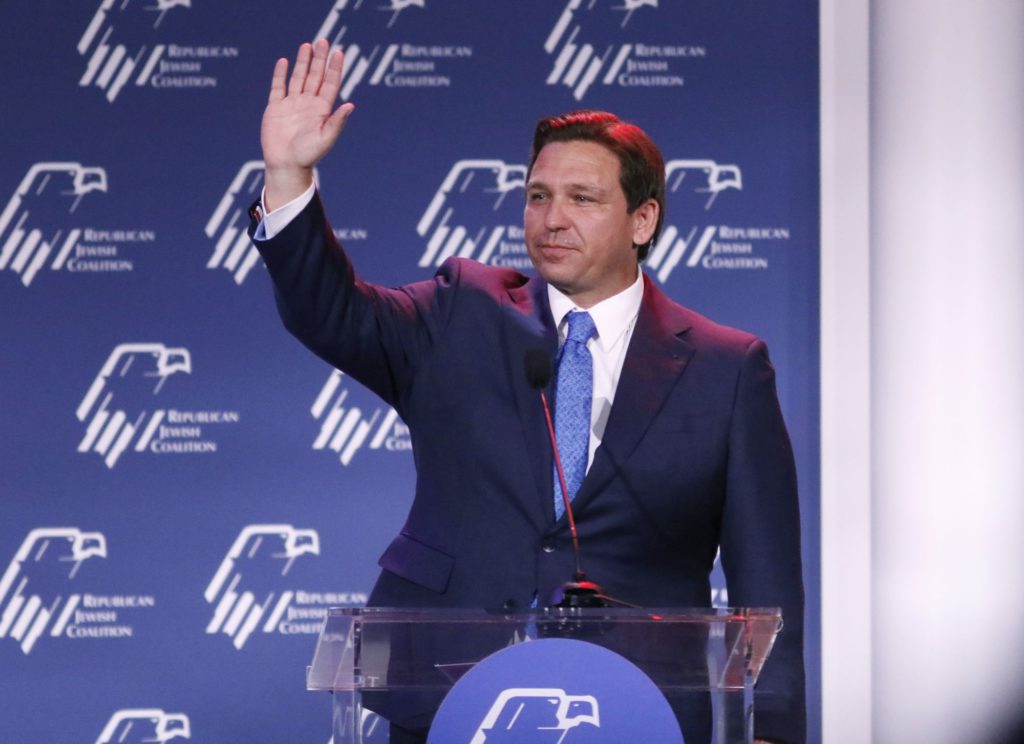
The confrontation has spread beyond Washington, with Florida Governor Ron DeSantis building a national brand and possible 2024 presidential campaign on opposition to corporate environment, social and governance investing policies. He has singled out PayPal Holdings Inc. in his battle against ESG and punished Walt Disney Co., which operates its Walt Disney World theme park near Orlando, after it criticized a law limiting school instruction about gender identity and sexual orientation.

Divisions between populist Republicans and big business are rooted in President Donald Trump’s attacks on executives such as General Motors Co.’s chief executive officer, Mary Barra, Merck & Co. Chairman Kenneth C. Frazier, and Amazon.com Inc.’s Jeff Bezos. When companies suspended campaign donations after the Jan. 6 Capitol insurrection to Republicans who denied the result of the 2020 presidential election, the rift widened, even though many businesses have since resumed their giving.

With Trump mounting his third presidential campaign and DeSantis positioning himself as a potential rival, the discord between corporate interests and conservatives threatens to intensify. 

Interviews with lawmakers, lobbyists and former congressional aides highlighted the growing tensions with a new crop of Republicans more focused on social and cultural issues than business priorities.

“All of those companies are going to have a hell of a time getting back into the good graces of Republicans,” said John Feehery, a veteran House Republican aide who is now a partner with the lobbying firm EFB Advocacy.

Corporations and their representatives in Washington are meeting with incoming Republicans, typically a friendly formality after an election. Yet some of the sessions aren’t going well this year, according to one lobbyist for a business association who asked not to be identified discussing private conservations.

The issue, this person said, is the incoming freshman class has deep-rooted opinions and little experience with trade policy, the debt limit or the policies surrounding ESG.

Changing Faces

More than half of the Republicans who were in Congress in 2017 won’t be in office when the next Congress is seated in January. Some key allies of the business community, including Senator Rob Portman of Ohio and the House Ways and Means Committee’s top Republican, Representative Kevin Brady of Texas, are retiring.

Indiana Representative Jim Banks, the head of the conservative Republican Study Committee who took office in 2017, characterized the split as a divorce and asserted that his party is much healthier now. Republicans, he added, can now focus on American workers and distance themselves from ESG efforts, which he called a “scam” that hurts America and helps China.

At the Chamber, the board has publicly backed president and CEO Suzanne Clark amid McCarthy’s private calls for her ouster for, among other things, the group’s endorsing more than a dozen Democrats in the midterm elections.

The feud, brewing for years over trade, immigration and other policy disagreements, quickly escalated days before the Nov. 8 elections when the Chamber backed Representative Abigail Spanberger, a Virginia Democrat and a top Republican election target. A Chamber executive even appeared with Spanberger in her district and another donated $1,000 to her campaign. She narrowly won re-election, helping limit the GOP’s midterm gains.

Clark, in a statement, struck a positive tone. 

“We are optimistic that the new majority in the House will seize this opportunity to fight inflation and crime, rein in regulation and hold agencies accountable through oversight, and put our economic security front and center,” she said.

But within Republican circles, the Chamber’s moves were considered a betrayal, and one not soon forgotten, a former Republican congressional aide said. Only a grand political gesture from the Chamber could repair the relationship, the person added. 

Tech companies and banks could face the bulk of GOP scrutiny next year. Republicans have said they think conservative voices are being silenced on platforms including Facebook. They are also eager to question bank executives about if their lending practices put oil and gas companies at a disadvantage to renewable energy.

Law firms and consultants who specialize in preparing executives for congressional testimony are ramping up efforts to sign new clients and prepare potential witnesses for the new Republican majority. Some bank CEOs, including top executives for Bank of America Corp. and JPMorgan Chase & Co., got a taste of what next year could look like at a September hearing where Republicans asked questions about their preferences for investing in fossil fuels, as well as social policies for employees.

A more conservative alternative to the Chamber, the American Free Enterprise Chamber of Commerce, is rushing to fill the void with its focus on deregulation and lower taxes. However, it’s unclear that the Iowa-based group, which charges $99 annual dues, will amass the membership or financial resources to match the US chamber’s influence.

The Free Enterprise Chamber didn’t respond to multiple requests for comment.

But grassroots outreach has helped populist Republicans flourish, and they may not miss the Chamber’s reach or its war chest. 

The midterm elections broke records for political giving, including large hauls from far-right members like Representatives Jim Jordan of Ohio and Marjorie Taylor Greene of Georgia, who raised nearly $25 million combined. Greene, blacklisted by several companies, raised massive sums from individual donors and conservative political action committees, proving that bombastic tweets and emails are a lucrative business. 

‘Vigorous Oversight’

“This is going to be the new normal, and that’s a good thing,” said Vivek Ramaswamy, the author of “Woke, Inc.: Inside Corporate America’s Social Justice Scam.” “You don’t want any political party to be in lockstep with the captains of industry.”

For moderate Democrats like Spanberger, the rift gives them a chance to bolster ties to corporations looking for new political alliances. 

“For businesses, weathering these attacks requires strengthening relationships with all of their stakeholders so they aren’t left vulnerable to policy makers,” said Stacy Kerr, a former aide to House Speaker Nancy Pelosi, who now advises companies. 

Divided government brings gridlock and neither party will likely get much legislation enacted. But House Republicans will now have the authority to haul in executives for public testimony. 

“While Republican committee chairs in prior years may have thought twice before taking on private-sector targets, the incoming chairs are likely to conduct vigorous oversight of the private sector,” said Alyssa DaCunha, who advises companies on congressional investigations at Wilmer Cutler Pickering Hale & Dorr LLP. “They are prepared to deploy more aggressive investigative techniques.”

(Adds details on earlier hearing in 20th paragraph. An earlier version corrected ESG definition in fifth paragraph)

More stories like this are available on bloomberg.com

©2022 Bloomberg L.P.

Crypto Lender BlockFi Goes Bankrupt in Aftermath of FTX Meltdown

(Bloomberg) — BlockFi Inc. filed for bankruptcy, the latest crypto firm to collapse in the wake of crypto exchange FTX’s rapid downfall. 

BlockFi said in a statement that it will use the Chapter 11 process to “focus on recovering all obligations owed to BlockFi by its counterparties, including FTX and associated corporate entities,” adding that recoveries are likely to be delayed by FTX’s own bankruptcy. Chapter 11 bankruptcy allows a company to continue operating while working out a plan to repay creditors. 

The petition, filed in New Jersey, lists BlockFi’s assets and liabilities at between $1 billion and $10 billion each. The company said in the statement that it had around $257 million of cash on hand, and is starting an “internal plan to considerably reduce expenses, including labor costs.”

Citing “a lack of clarity” over the status of bankrupt FTX and Alameda Research, the Jersey City, New Jersey-based company earlier halted withdrawals and said it was exploring “all options” with outside advisers. 

FTX US is listed in the company’s petition as one of its top unsecured creditors, with a $275 million loan.

The company’s largest unsecured creditor, Ankura Trust Company, is owed about $729 million, according to the petition. Ankura acts as a trustee for BlockFi’s interest-bearing crypto accounts, according to its website.

BlockFi in July received a capital injection from a now-collapsed FTX US, and also had collateralized loans to Sam Bankman-Fried’s trading firm Alameda Research. 

The company is the latest crypto firm to seek bankruptcy amid a prolonged slump in digital asset prices. Lenders Celsius Network LLC and Voyager Digital Holdings Inc. also filed for court protection this year. 

The case is BlockFi Inc., 22-19361, U.S. Bankruptcy Court for the District of New Jersey (Trenton).

(Updates with additional details throughout.)

More stories like this are available on bloomberg.com

©2022 Bloomberg L.P.

Retailers’ Inflation-Fighting Discounts Yield Modest Growth on Black Friday

(Bloomberg) — US retailers eked out modest growth over Black Friday weekend with deep discounts that lured shoppers seeking a reprieve from stubborn inflation.

In-store traffic ticked up 2.9% at brick-and-mortar retailers versus 2021, according to preliminary data compiled by Sensormatic Solutions. Salesforce Inc. said the average consumer discount on Black Friday was expected to be greater than 30%, up from 28% last year and close to the 33% rate in 2019.

“Actual sales volumes reflect a little inflation, but it’s also reflecting some growth,” Bloomberg Intelligence analyst Jennifer Bartashus said by phone Sunday.

Retailers struggled to keep their shelves stocked last year because of supply-chain bottlenecks and got burned earlier this year after over-ordering — which has forced them into deep markdowns to flush out excess inventory. During the current holiday season, inflation is making that balance harder. Some retailers are banking on volume to make up for the discounts, while others are trying to spark repeat visits by getting shoppers in the door, Bartashus said.

“Inflation has made it very difficult for retailers, even some of the most seasoned retailers,” to effectively manage inventory, she said. “They had to make sure they were able to right-size inventory, have the right promotions, get people spending, and finish up the year on a strong note.”

An S&P retail index climbed 1% at 9:52 a.m. in New York amid moderate declines in broader US stock gauges. The retail index tumbled 30% this year through last week, while the S&P 500 index fell 16%. 

Amazon.com Inc. climbed 2.3% in Monday trading. Target Corp. advanced 1.2%, and Walmart Inc. and Best Buy Co. rose less than 1%. 

‘Fewer Items’

While Cyber Monday results will paint a fuller picture of demand, retailers managed to meet expectations, Bartashus said. Even accounting for inflation, sales were slightly up overall.

Online sales during the biggest US shopping day of the year rose 2.3% to $9.12 billion, Adobe Analytics said Saturday. That was slightly ahead of the company’s initial projection of $9 billion, although the percentage increase lagged far behind the country’s inflation rate, which is running at almost 8%.

“People are still buying fewer items given that they’re stretching their wallets further,” said Rob Garf, Salesforce’s vice president of retail.

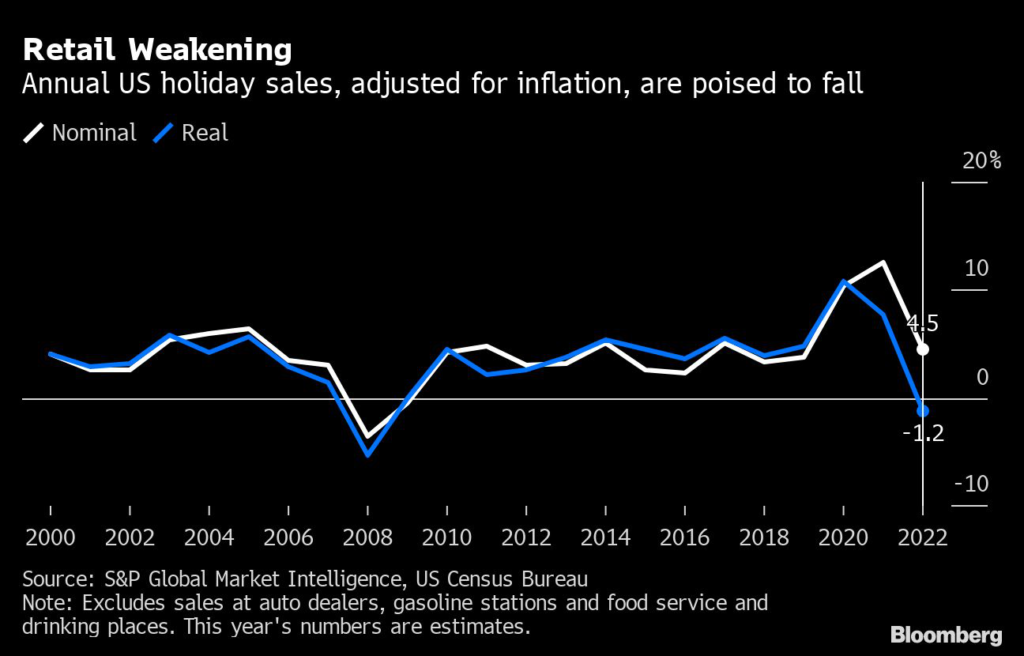
While a definitive accounting of sales isn’t available yet, S&P Global Market Intelligence last week forecast that after adjusting for inflation, seasonal sales are likely to fall 1.2%, the first decline since 2009.

During the Black Friday weekend, customer traffic was solid but not strong, Noah Zatzkin, an analyst at KeyBanc Capital Markets Inc., said in a report. 

In-store traffic was lighter in part because the doorbuster deals that had shoppers lining up at 5 a.m. have been replaced by earlier online promotions, Bartashus said. More stores are offering “all-store” discounts instead of just select items. And shoppers are increasingly going back to pre-pandemic habits, such as waiting until later in the holiday season to make purchases, Cowen Inc. analyst Oliver Chen said in an interview with Bloomberg TV. 

From a retailer profitability standpoint, Black Friday discounts weren’t as deep as feared, said Dana Telsey of Telsey Advisory Group. 

There were pockets of growth in categories such as toys, or clothing for professionals seeking to update their wardrobes for return-to-office. 

Shoppers spent their money primarily on electronics, smart-home items and audio equipment, while toys and sporting goods performed well, Adobe said. Hot items included toys such as Fortnite, Roblox and Bluey. Shoppers also bought up Xbox Series X and PlayStation 5 devices, as well as drones and Apple MacBooks, Adobe said.

–With assistance from Olivia Rockeman and Brendan Case.

(Updates with shares in sixth paragraph, analyst comment in 12th paragraph.)

More stories like this are available on bloomberg.com

©2022 Bloomberg L.P.

Hedge Fund That Beat 99% of Peers Places Contrarian Bet on Meta

(Bloomberg) — As Big Tech reels from the blow of higher interest rates and slowing growth, one top-performing hedge fund manager is going against the tide to bet on the sinking shares of Facebook-owner Meta Platforms Inc.  

Expensive Silicon Valley tech would not normally feature on the shopping list for the Liontrust GF Tortoise Fund, which its manager Tom Morris describes as a “value-focused hedge fund,” seeking out shares it deems to be cheap. 

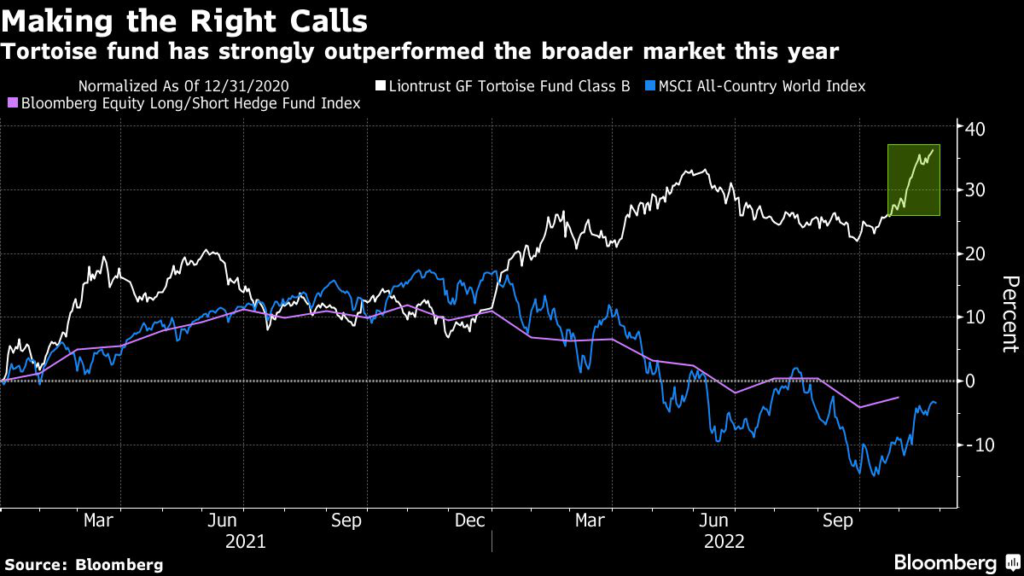
That strategy enabled London-based Tortoise to beat 99% of its long-short equity fund peers this year, with returns of about 22%, according to data compiled by Bloomberg, versus a 17% loss for the MSCI All-Country World Index and a 12% fall for the Bloomberg Equity Long/Short Hedge Fund Index. Now though, Morris reckons it’s time to be “sensibly contrarian.” 

“We are value managers but parts of tech are actually value stocks now,” Morris, who co-manages the $600 million fund with Matthew Smith, told Bloomberg in an interview in London. 

Tortoise ran “relatively large” short positions on the S&P 500 and the Nasdaq early in the year, as well as on some US tech stocks, and had long positions in the likes of staples and health care, before switching the portfolio back toward neutral starting from April, according to Morris. More recently, the managers have moved to a “cautiously optimistic stance,” he added.

Big deratings have left some names “basically in the doghouse,” trading at multiples of 10 to 11 times earnings, levels unseen for the past five or ten years, he said, in a reference to the ongoing tech rout that has wiped trillions of dollars off the value of the vaunted sector. 

That’s the case with Meta, in which Tortoise took a long position last month. Following a hefty price plunge — almost 70% year-to-date — Meta trades at about 11 times 2023 earnings, half the price-to-earnings levels seen a year ago, Bloomberg data show. 

Meta and its tech peers have failed to really benefit from recent signs that central banks may slow their rate-hiking pace, but Morris said the company’s high net cash position, growing user numbers and cost-cutting possibilities made it a good buy for the longer-term. The company’s shares dropped as much as 1% on Monday with most other big tech stocks, after risk appetite was sapped by protests in China. 

His other long tech positions include IBM Corp., alongside chipmakers Micron Technology Inc. and Intel Corp., according to filings from end-October. The fund also recently closed short positions in two other semiconductor firms Nvidia Corp. and Advanced Micro Devices Inc., as well as crypto exchange Coinbase Global Inc., trades that Morris said had “worked out well.”   

Low on Leverage

The fund’s outperformance this year contrasts starkly with the bulk of long-short equity hedge funds, with many sitting on losses and facing client outflows.

READ: Hedge Funds Paid for Stockpicking Genius Show Little of It

Morris attributes his successful run to a relatively simple strategy. The fund holds about 60 positions in total, and unlike many hedge fund peers, it does not have high leverage and avoids illiquid positions. 

“We’ve got a long book of companies who we think are too cheap and a short book of companies who we think are too expensive, we occasionally do a bit of FX hedging and that’s it, there’s nothing particularly fancy going on, such as high frequency or derivatives,” he said. 

Morris sees opportunities for additional long positions even though the MSCI All-Country World index has recouped some losses of late, with gains of about 13% this quarter. 

The fund retains positions in energy, another flagship value industry that is this year’s best-performing equity subgroup. Holdings include TotalEnergies SE and Shell Plc. 

In addition, Tortoise has exposure to European banking shares, with Morris being “quite enthusiastic” about the sector, citing rising profitability on higher rates and improving financial health. “Banks are fundamentally different beasts now to what they were 10 or 12 years ago,” Morris said.

–With assistance from Tim Craighead.

(Adds Meta shares in seventh paragraph, details on banks in last paragraph)

More stories like this are available on bloomberg.com

©2022 Bloomberg L.P.
Close Bitnami banner
Bitnami