Bloomberg

China Tech Stocks Drop for Second Day Amid U.S. Delisting Risks

(Bloomberg) — Chinese technology stocks fell for a second day amid continued concern about the risk of local firms getting kicked off American exchanges.

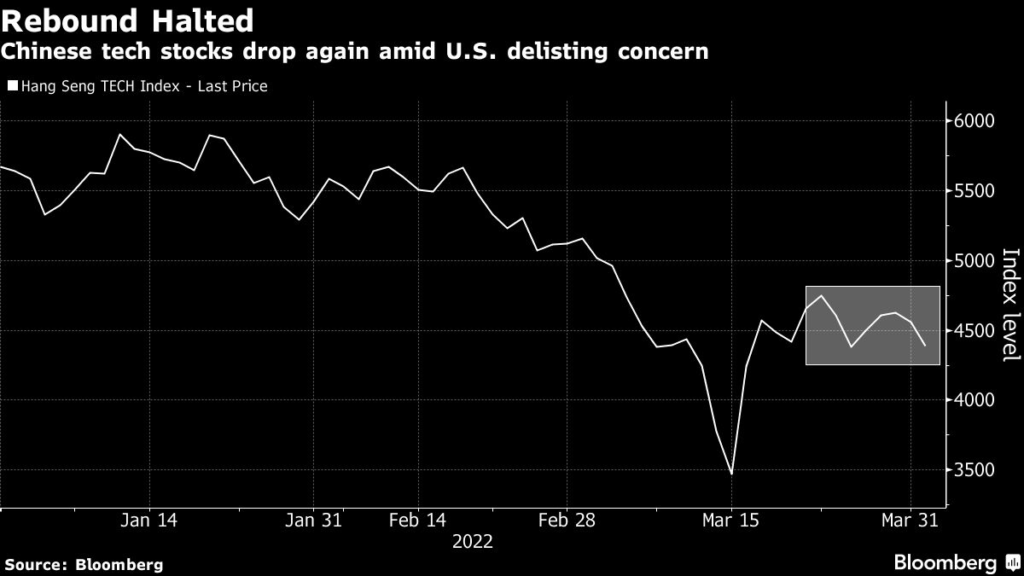
The Hang Seng Tech Index, which tracks some of the biggest Chinese firms in the sector, closed down 0.7% Friday, having earlier lost as much as 3.9%. It fell 1.4% on Thursday after the U.S. securities regulator played down the prospect of an imminent deal to keep Chinese companies listed there.

Baidu Inc., which was added to the list of firms facing possible delisting, slumped 4.5% as the worst performer on the tech gauge.  

“A solution between the U.S. and China regulators may not be as near as previously hoped,” said Marvin Chen, an analyst at Bloomberg Intelligence. “Markets may have gotten ahead of themselves over the past two weeks.”

The two-day selloff in tech names shows that investors remain on edge amid a long-standing dispute over whether American regulators can get full access to U.S.-traded Chinese company audits. In response to comments by the Securities and Exchange Commission chair tamping down speculation that a deal to avoid delistings is near, China said talks with the U.S. accounting watchdog will continue.

Having lost about a third of its value last year amid Beijing’s relentless crackdown on the sector, the Hang Seng Tech Index has plunged another 20% so far in 2022 as investors remained concerned about further regulatory action. Beijing is preparing new regulations on the live-streaming industry including a daily cap on tipping, the Wall Street Journal reported on Wednesday. Later that afternoon, China’s regulators pledged to eradicate crimes including tax evasion on such platforms.

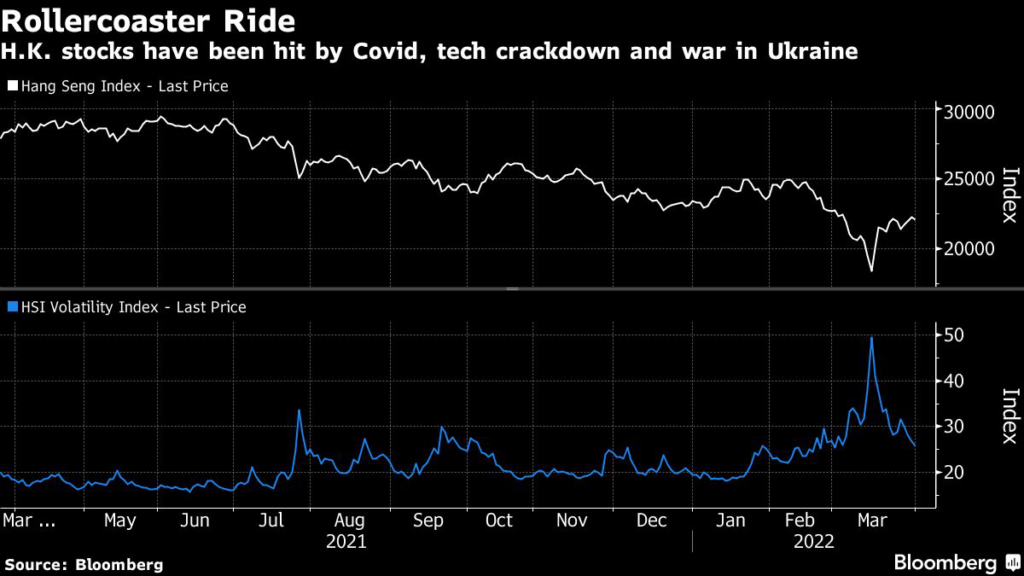
The Hang Seng Index gained 0.2% on Friday, having earlier slid as much as 2% as dozens of firms had trading halted after missing a deadline to publish annual results. China’s CSI 300 Index gained 1.3%, led by an advance in consumer shares. 

Read: CSI 300 Rises to Two-Week High as Consumer Shares Gain 

“My gut feeling is that there is a strong chance that they (American Depositary Receipts) will get delisted in a few years. I know both the regulators are working but I think there’s a reasonable chance in the future,” said Sean Taylor, Asia-Pacific chief investment officer at DWS, adding that they are still happy to hold ADRs provided there’s another listing elsewhere.

READ: Chinese ADRs Off to Worst Start Since 2008 on Delisting Threat

More stories like this are available on bloomberg.com

©2022 Bloomberg L.P.

Bitcoin Drops to Near $45,200 Amid Technicals, Regulation Issues

(Bloomberg) —

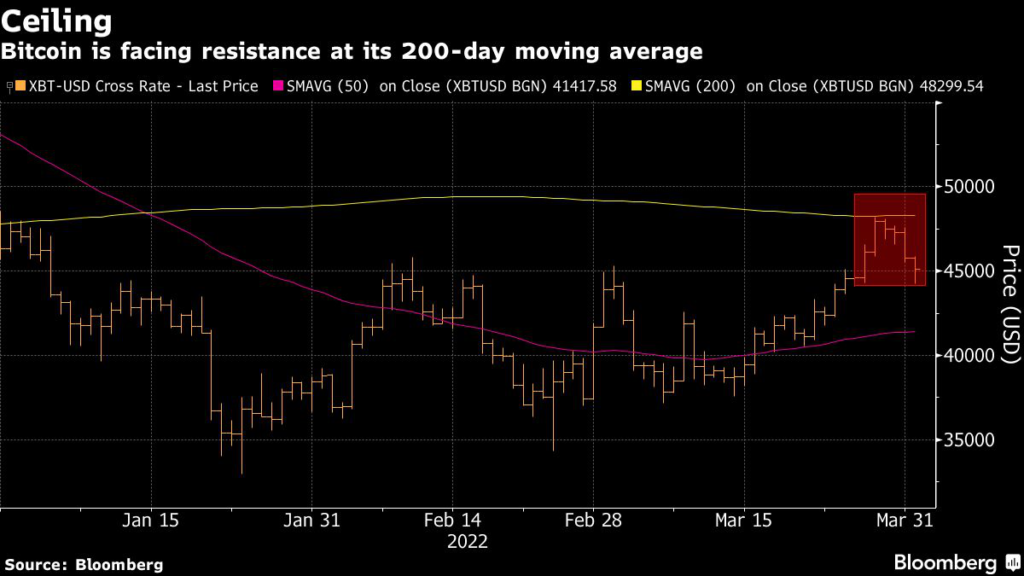
Bitcoin fell back toward the top of a range that’s largely defined it so far in 2022, after meeting resistance at a key technical level and amid some concerns about potential regulation.

The largest cryptocurrency pared most of its loss after falling as much as 3.3% on Friday to $44,252 and is still trending toward its fourth-straight decline after making a run toward its 200-day moving average earlier in the week. 

“Bitcoin and other digital assets declined overnight due to a mix of factors,” said Hayden Hughes, chief executive officer of social-trading platform Alpha Impact. “Technically, markets were entering overbought territory and even in sustained bull runs, we expect pullbacks along the way.”

Hughes and Edul Patel, the chief executive officer and co-founder of digital-asset trading platform Mudrex, also cited a plan backed Thursday by a panel of the European Parliament wherein crypto transactions would be covered by EU rules requiring that financial transfers carry information about the identities of payers and payees.

“Although this does not ban interactions with unhosted wallets such as Metamask, it will place significant friction on users,” Hughes said.

Read more: Crypto Transfer Anonymity Would End Under EU Lawmakers’ Plan

Market dynamics may also be an issue, according to JPMorgan Chase & Co., which sees stablecoins’ share of cryptocurrency market value as an indicator of potential for rallies or declines. The assets are tokens that typically are pegged to traditional currencies like the dollar.

“The share of stablecoins in total crypto market cap no longer looks excessive and as a result we believe that any further upside for crypto markets from here would likely be more limited,” JPMorgan strategists led by Nikolaos Panigirtzoglou wrote in a note. “This share currently stands below 7% which brings it back to its trend since 2020.”

Another factor making waves in crypto was an interview with U.S. Senator Elizabeth Warren, a high-profile critic of the crypto industry, on NBC News Now’s “Meet the Press Reports.” She backed further efforts to create a U.S. central-bank digital currency, and compared crypto markets to asset bubbles in the past. 

“The whole digital world has worked very much like a bubble works,” Warren said. “And that is it keeps going up based on what? Based on additional production? No. Based on the fact that it has demonstrated that it’s solved all these other problems and it is now being used exponentially in areas where it hadn’t been used before? Not really.”

“It’s moved up on the fact that people all tell each other that it’s going to be great,” Warren said. 

More stories like this are available on bloomberg.com

©2022 Bloomberg L.P.

Panasonic to Spend $5 Billion on EV Batteries, Software

(Bloomberg) — Panasonic Holdings Corp. will invest 600 billion yen ($4.9 billion) in automotive batteries, supply chain software and other areas the company sees as core to its growth.  

The Osaka-based manufacturer will invest 400 billion yen in growth segments including electric-vehicle cells, and another 200 billion yen in technology such as hydrogen devices over three years through fiscal 2024, according to a statement Friday. Panasonic is also targeting an accumulated operating profit of 1.5 trillion yen over the period.

Panasonic, a sprawling 104-year-old Japanese company that used to top global consumer electronics sales, is seeking new avenues for growth. The company’s previous Chief Executive Officer Kazuhiro Tsuga spent close to nine years shedding struggling businesses, such as plasma TVs, before handing the reins to Yuki Kusumi a year ago.

Kusumi, head of a leaner company that’s no longer bleeding red ink, is now faced with the challenge of steering Panasonic onto a path of sustained growth. He spent the past year shaping it into a holding company, which the CEO says will make it easier to decide where to invest for long-term growth. 

When looking to define areas of growth, Panasonic “considered what society will look like in 2030 and back-cast from there,” Kusumi said in a briefing. 

Read more: Panasonic CEO Says Efficiency to Fuel Tesla Business, Growth

One of those areas of growth is Panasonic’s business supplying batteries for EVs. The manufacturer is in talks over a site for a factory in the U.S. where it plans to build next-generation 4680 batteries for Tesla Inc. and potentially other automakers. The multibillion-dollar plant could begin operating as soon as 2024, Bloomberg News reported.

Panasonic also sees opportunities in supply-chain software. Last year, it spent $7.1 billion to buy Blue Yonder, one of the Japanese firm’s biggest-ever acquisitions. Arizona-based Blue Yonder makes supply-chain management tools and uses artificial intelligence to predict product demand. The idea is to wrap Blue Yonder’s solutions together with Panasonic hardware, such as cameras and sensors, to offer higher-margin products to customers. 

Kusumi said in an interview in June that he plans to spend two years “specializing and sharpening” Panasonic’s remaining businesses. Boosting efficiency over that period will increase the company’s ability to generate cash, freeing up hundreds of billions of yen to direct toward new initiatives including mergers and acquisitions, he said. 

Compared with past results, Panasonic’s new operating profit target “appears ambitious,” Kusumi said. However, the company’s working on “continuously improving in order to achieve its goals,” he said, adding that over the past year he’s gotten a “good sense” of what the company needs to do further develop its operations.

(Updates with comments from the CEO in the fifth and tenth paragraphs.)

More stories like this are available on bloomberg.com

©2022 Bloomberg L.P.

Ukraine Update: Rare Cross-Border Strike; Talks May Resume

(Bloomberg) — Russia said two Ukrainian military helicopters made a rare strike across the border, hitting an oil tank facility in the city of Belgorod. There was no immediate confirmation from Kyiv. In Ukraine, Kyiv said its forces retook several villages in the Kherson region to the south, and that talks between the two sides are set to resume by video conference on Friday. There’s still no verification of that from Moscow.

The United Nations said relief convoys had so far failed to reach Mariupol, with the southern port city devastated by weeks of shelling. Russia said a humanitarian corridor from Mariupol was planned for Friday.

President Vladimir Putin said Russia would continue supplying gas to Europe even as it demands customers pay in rubles, easing fears the change could lead to damaging disruptions. European Union leaders plan to warn Putin’s key ally China that it will suffer a blow to its global role if it offers support for the invasion.

(See RSAN on the Bloomberg Terminal for the Russian Sanctions Dashboard.)  

Key Developments

  • Mariupol’s Splintering Loyalties May Be Enough for Putin
  • Biden Embraces Oil as Ukraine War Overwhelms His Climate Agenda
  • EU to Warn China It Will Damage Global Role by Helping Russia
  • Biden Orders Huge Oil Release, Prods Drillers to Step Up Output
  • Russians Embrace Putin’s Ukraine War as Kremlin Muzzles Dissent

All times CET:

Ukrainian Retakes Ground in Kherson, Chernihiv Regions (8:49 a.m.)

Eleven villages in the southern Kherson region and several others in the Chernihiv region northeast of Kyiv have been returned to Ukrainian control, according to the military’s General Staff. Shelling of towns and villages along the contact line in the east continued overnight, with civilian casualties reported after nine apartment buildings and nine private houses were shelled.

The intensity of shelling declined in Chernihiv and Kharkiv, although a missile hit the center of Kharkiv Thursday night. Fighting continues near Chernihiv, Izyum and at the border of Kherson and Mykolayiv regions to the south. 

Refugees Arriving in Poland Now Top 2.4 Million (8:45 a.m.)

Another 23,000 people arrived in Poland from Ukraine on Thursday, and another 3,500 early Friday, taking total refugees since Feb. 24 to 2.415 million, Polish border authorities said.

Over 4 million people have fled Ukraine since the start of the Russian invasion.  

Ukraine Said to Makes Rare Strike in Russian Territory (8:30 a.m.)

Moscow said two Ukrainian military helicopters attacked an oil-storage facility in the Russian city of Belgorod, about 50 km (30 miles) north of the border, causing a large fire early Friday.

Tass quoted Belgorod Governor Vyacheslav Gladkov as saying the aircraft flew in at low altitude. Eight oil fuel tanks were burning and authorities said the fire might spread. Two workers were reported to have been injured and nearby residents were being evacuated.

Focused on fighting Russian troops on their own territory since Feb Ukrainian forces haven’t claimed any strikes on the other side of the border since the start of the war on Feb. 24. 

World Underestimating Impact of War, OECD Says (8:00 a.m.) 

Governments aren’t sufficiently aware of the longer-lasting economic fallout from Russia’s invasion of Ukraine, said OECD Chief Economist Laurence Boone. 

“I really believe we’re underestimating the medium-term impact of this war,” Boone told Bloomberg Television’s Francine Lacqua in Cernobbio, Italy, on Friday. “The longer the war will last, the more uncertainty we have, and the more worried we’re getting because uncertainty deters consumer purchases and business investment.”

Russia Redeploying Forces From Georgia, U.K. Says (7:45 a.m.)

Russia is redeploying as many of 2,000 troops from Georgia to reinforce its invasion of Ukraine, the U.K. defense ministry said. The forces are being reorganizaed into battalion tactical groups. 

“It is highly unlikely that Russia planned to generate reinforcements in this manner and it is indicative of the unexpected losses it has sustained during the invasion,” the U.K. said. 

EU to Warn China Over Russia (6:00 a.m.)

European Union leaders plan to tell President Xi Jinping in a virtual summit that China will hurt its global stature if it hands Russia an economic or military lifeline. That pointed message will test Beijing’s commitment to keeping the war from damaging its ties with Brussels. 

Russia Jamming Jet Navigation, France Says (6:00 a.m.)

Russia’s military has been jamming satellite navigation systems used by commercial aircraft since the invasion of Ukraine, highlighting the need for robust alternatives, according to a French safety regulator.

Airline pilots have reported disruptions in regions around the Black Sea, eastern Finland and the Kaliningrad enclave, said Benoit Roturier, head of satellite navigation at France’s civil aviation authority DGAC. The interference appears to be caused by Russian trucks carrying jamming equipment typically used to protect troops and installations against GPS-guided missiles, he said.

Russia Is Jamming Jet Navigation, French Safety Official Says

Russia Says Ukraine Struck Oil Facility Near Belgorod (5:20 a.m.)

Russia said two Ukrainian helicopters crossed the border and attacked an oil-storage facility in the city of Belgorod, causing a large fire early Friday.

Tass quoted Belgorod Governor Vyacheslav Gladkov as saying the aircraft flew in at low altitude. Eight oil fuel tanks were burning and authorities said the fire might spread. Two workers were reported injured and nearby residents were being evacuated.

Focused on fighting Russian troops on their own territory, Ukrainian forces haven’t claimed any strikes on the other side of the border since the start of the war. There was no immediate comment from Kyiv on the Belgorod fire.

Stocks Mixed as Crude Oil Drops (5:08 a.m.)

U.S. equity futures pushed higher and Asian stocks were mixed as investors evaluated the economic outlook amid moderating oil prices, tightening Federal Reserve policy and the war.

Oil held losses on a move by the U.S. to release roughly a million barrels a day from reserves to tackle rising energy costs. Russia’s invasion has disrupted commodity flows, fanning prices for everything from fuel to food.

China Minister Says No One Can Split G-20 (4:51 a.m.)

All members of the Group of 20 nations have equal status and no one has the power to split the group, Chinese Foreign Minister Wang Yi said, according to a ministry statement. Biden has previously said Russia should be removed from the G-20.

Japan Won’t Exit Sakhalin-1 or 2 (4:00 a.m)

Prime Minister Fumio Kishida said the country won’t withdraw from the Sakhalin-1 or 2 oil and gas project in Russia.

Resource-poor Japan currently gets 3.6% of its imported crude oil from Russia, while roughly 90% of it comes from Middle Eastern countries, according to trade ministry data. Japan procures 9% of its LNG and 13% of its thermal coal imports from Russia. 

UN Aid Convoy Reached Sumy, Mariupol Blocked (10:40 p.m.)

The United Nations said its aid convoy was able to get through to the northeastern city of Sumy, where it delivered food, medicine and other supplies. But it said that the UN and partners have still not been able to deliver aid to other regions, including Mariupol.  

Ukraine Says Russian Forces Exposed to Radiation (9:33 p.m.)

Russian troops began leaving the Chernobyl nuclear plant after soldiers got “significant doses” of radiation from digging trenches at the highly contaminated site, Ukraine’s state power company said. 

The International Atomic Energy Agency said it was unable to confirm the reports of radiation exposure and is “seeking further information.” The IAEA said it was told by Ukrainian officials that Russia has transferred control of the facility, in writing, back to Ukraine.

Ukraine Says Less Than 1,500 People Evacuated Thursday (9:08 p.m.)

Despite guarantees from the International Red Cross and Moscow, Russian troops blocked Ukrainian buses from entering Berdyansk, a port about 90 kilometers (56 miles) from Mariupol, and Melitopol, Vereshchuk said. 

At the requests of French President Emmanuel Macron and German Chancellor Olaf Scholz, Russia will open a humanitarian corridor from Mariupol to Kyiv-controlled territory on Friday as well, Ria Novosti reported, citing the Defense Ministry.

White House Jabs Putin, Again (8:21 p.m.)

Biden said there are signs that Putin has fired or detained key advisers.

“There’s a lot of speculation,” Biden said, adding that Putin “seems self-isolated.” Biden also said it’s an “open question” how misinformed Putin is about the status of his military’s efforts in Ukraine.

“But I don’t want to put too much stock in at this time because we don’t have that much hard evidence,” he added. 

Russian Forces Seen Leaving Chernobyl (7:50 p.m.)

Ukraine’s nuclear regulator said the head of Russian troops at the Chernobyl facility said they are departing after taking the facility infamous for its 1986 meltdown in the early days of the war. 

Leonid Oliynyk, Energoatom’s spokesman, confirmed a letter posted on Telegram announcing the departure. Oliynyk — who isn’t at Chernobyl — said he was told that most Russian troops left the facility in two columns and appeared headed toward Belarus. It didn’t appear that all Russian troops had departed, however. 


More stories like this are available on bloomberg.com

©2022 Bloomberg L.P.

A Stock Trader’s Guide to Hungary’s Election and What Follows

(Bloomberg) — With Premier Viktor Orban tipped to win a fourth consecutive term in Sunday’s general election, stock investors in Hungary are already focusing on how he’ll fix the budget hole created to help his government stay in power.

Although politicians have been silent on the prospects of tax hikes or spending cuts, such moves “seem inevitable” following the ballot, according to Peter Oszlay, the chief investment officer at Erste Asset Management in Budapest. How they’re implemented will set the direction for equity valuations, he said. 

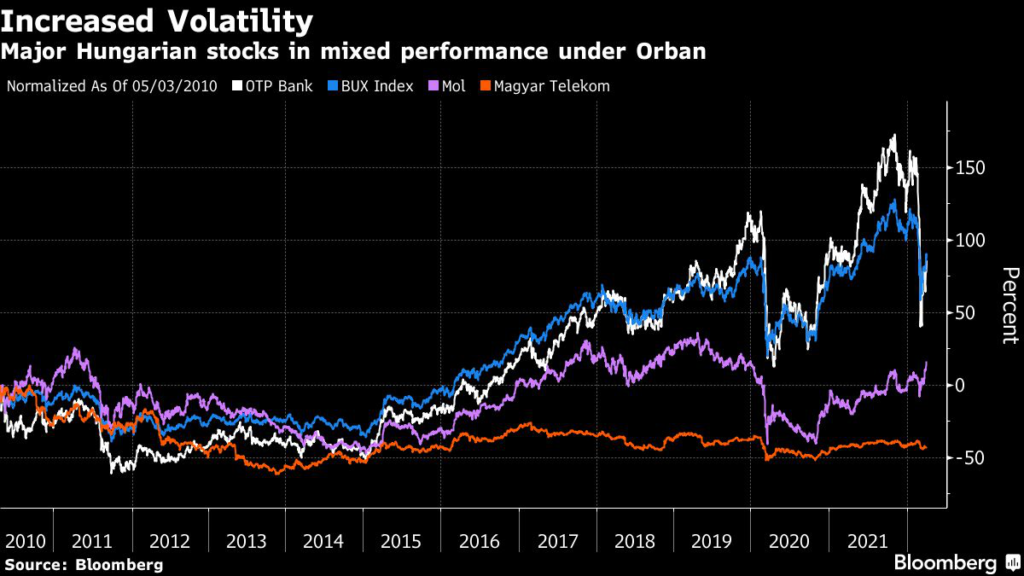
Budapest stocks have been among the hardest hit by Russia’s invasion of neighboring Ukraine. In U.S. dollar terms, the BUX index is lagging emerging-market peers even after bouncing back in past weeks as Orban’s Fidesz party regained a lead over a coalition of six opposition groups. 

The resurgence in opinion polls boosted expectations for a continuation of the status quo and reduced the risk of a potentially chaotic handover of power. Fidesz’s popularity has been fueled by a spending spree including nearly $2 billion in tax rebates for families, increases in pensions and public-sector wages. 

For investors it’s clear that regardless of the election outcome, Hungary will need to reduce its budget deficit and that raising levies on corporations may be part of the solution.

“Whoever wins the elections will be in a situation of economic duress,” said Gabor Szocs, a senior portfolio manager at Hold Asset Manager. “There’s very little room for maneuver, with public finances between a rock and a hard place.” 

Banking Proxy

OTP Bank Nyrt., with a 38% weight in the BUX index, has long been seen as a proxy investment bet on Hungary’s $156 billion economy. While the stock has bounced back since losing a third of its value in the week following Russia’s invasion of Ukraine, it may reverse gains, especially if the government embraces austerity. 

“Painful steps” are needed, said Erste’s Oszlay. “Economic growth is likely to slow down significantly, which may create a headwind for all local stocks.”

Finance Minister Mihaly Varga has signaled the need to redo the budget after the election and downgraded this year’s economic outlook. In a boon for OTP, Hungary’s key interest rate is already the highest in the EU as inflation hit a 15-year-high of 8.3% in February, before the effects of the war fed into prices.

Orban Inc.

In power since 2010, Orban has gained sway over all facets of public administration as well as the broader economy, to the point where critics complain that competition is skewed in favor of Fidesz’s business allies. 

Opus Global Nyrt., a conglomerate spanning finance, construction, tourism and banking, and 4iG Nyrt., an IT and telecom company, have been standout beneficiaries from Orban’s rule as they racked up government contracts and subsidies in addition to state aid and loans. These companies’ growth trajectories could suffer if the opposition somehow beats Fidesz on Sunday, Szocs said.

An opposition victory could prove messy with Orban’s party so entrenched in positions of power. It could, however, help Hungary access European Union recovery funds, which have been frozen due to a row over democratic standards. 

“Foreign investors might become more relaxed if the new government would implement a more EU-friendly approach,” Oszlay said. “However, uncertainty would also be higher initially.”

More stories like this are available on bloomberg.com

©2022 Bloomberg L.P.
China Chipmaker’s Buyer Missed $9 Billion Payment Deadline

(Bloomberg) — The winner of a bidding process for Tsinghua Unigroup Co. has missed its March 31 deadline to complete a 60 billion yuan ($9.4 billion) takeover payment, according to people familiar with the matter.

A consortium led by JAC Capital has yet to pay the remaining 14.6 billion yuan of the agreed price tag for the chip business, the people said, asking not to be identified as the information is private. The group was picked as the winner of an auction for China’s debt-ridden semiconductor giant, whose rescue was viewed as a national security issue.

The acquirer could still receive an extension to the deadline, the people said. Representatives for JAC Capital and Unigroup didn’t immediately respond to requests for comment by email and phone.

The Beijing-based company affiliated with prestigious Tsinghua University — Xi Jinping’s alma mater — remains a linchpin in a race for technological supremacy. JAC, a state-backed semiconductor investment fund, defeated a rival consortium led by Chinese e-commerce leader Alibaba Group Holding Ltd. JAC and affiliate Wise Road Capital had offered 60 billion yuan to pay off debts to creditors.

Any agreement would likely have included conditions for restructuring Unigroup’s onshore and offshore debt, Bloomberg News reported in November. The reorganization plan was approved by a court in January, according to an exchange filing.

Apple Inc. is testing sample NAND flash memory chips made by Unigroup’s prized Yangtze Memory Technologies Co. unit and is in discussions about a tie-up, Bloomberg News reported Thursday.

More stories like this are available on bloomberg.com

©2022 Bloomberg L.P.
Billionaire Niel Eyes $750 Million Food, Garden Retail Deal

(Bloomberg) — A blank-check firm backed by French telecom billionaire Xavier Niel is holding exclusive talks to buy a retail business selling garden supplies, food and pet-food business.

2MX Organic SA, a so-called special purpose acquisition company, wants to combine with InVivo Retail in a deal that gives the latter an enterprise value of 675 million euros ($750 million), according to a statement Thursday. The two believe a combination will help InVivo Retail cement its position in the gardening and pet nutrition markets in France while scaling up its food business at a time of growing demand for locally-sourced products. 

The transaction is expected to close during the second half of this year. 2MX shares rose as much as 2.3% in Paris Friday.

2MX’s initial investors also include banker Matthieu Pigasse, head of Centerview Partners’s Paris office as well as supermarket chain owner Moez-Alexandre Zouari. The SPAC was listed in December 2020 in France with a two-year window to find a target.

InVivo Retail is owned by InVivo Group which is one of Europe’s biggest agri-food businesses with annual sales of about 10 billion euros and 188 member cooperatives that represent more than half of French farmers. 

Should the transaction go through, InVivo will be paid in newly issued 2MX shares. The combined entity will be 60% owned by grain trader InVivo, and the rest will be held by the three main shareholders as well as investors who joined after the SPAC went public, Pigasse said in an interview.

InVivo Retail generates only 10% of its 2.5 billion-euro revenue from the food division, partly via its Frais d’Ici stores. Pigasse said there’s great growth potential since the business is backed by the biggest agricultural cooperative in France which includes 300,000 farmers. The combined entity will also have a 1 billion-euro war chest to do more M&A deals, the banker added.

Thierry Blandinieres, the current CEO of InVivo Group, said there’s scope to boost the food distribution via its Jardiland and Gamm Vert as well as Frais d’Ici stores. He is set to become chairman of the combined entity.

InVivo Retail is capable of becoming a leader on the food category since it’s at “the heart of the system,” Zouari said, adding he expects the food category to represent half of total revenue of the combined entity within the next five years. This push will come via the launch of a new local and fresh food distribution brand “Le Grand Marche- Frais d’Ici.”

Niel is known for his telecommunications, media, technology and real estate investments. Pigasse also owns media assets in France such as Les Inrockuptibles magazine, Radio Nova and music festival Rock en Seine. 

Niel and Pigasse teamed up in 2016 to launch a vehicle for media acquisitions which led to the creation of Mediawan SA. Pigasse is also working with Artemis, the family office founded by billionaire Francois Pinault as well as Iris Knobloch, a former WarnerMedia executive, to find a target in the entertainment and leisure industries for the I2PO SPAC which listed in Paris last year.

Zouari owns 49% of frozen food retailer Picard and Lion Capital owns the rest. 

(Updates with shares in third paragraph)

More stories like this are available on bloomberg.com

©2022 Bloomberg L.P.

Stocks Suspended; Home Sales Slump Deepens: Evergrande Update

(Bloomberg) — Embattled Chinese developers, including Sunac China Holdings Ltd. and Shimao Group Holdings Ltd., were among stocks that were suspended Friday after missing a deadline to report annual results.

Recent Covid outbreaks coupled with auditor changes are forcing dozens of Hong Kong-listed firms to postpone their earnings. Meanwhile, China’s home sales slump deepened in March, keeping pressure on cash-strapped builders even as policy makers vow to support the property market. 

A gauge of property stocks slid as much as 1.4%, while Chinese high-yield dollar bonds were 1 to 2 cents lower on the dollar Friday morning.

Key Developments:

  • China Top 100 Developers See March Sales Down 52.7% Y/y: CRIC
  • China Aoyuan Says Unable to Publish 2021 Annual Results
  • Shimao Won’t Publish 2021 Unaudited Annual Results Due to Covid
  • CIFI Prices HK$1.96b 6.95% Convertible Bonds Due 2025
  • China Junk USD Bonds Add to Gains After Country Garden Results
  • Chinese Builder Result Delays Raise Downgrade Pressure: Fitch
  • China Property SOEs’ Bond Sales Soar as Private Peers Struggle


China Home Sales Slump Worsens (1:12 p.m. HK)

China’s home sales slump deepened in March, keeping pressure on cash-strapped developers even as policy makers vow to support the property market. 

The 100 biggest companies in China’s debt-ridden property industry saw a 53% drop in sales from a year earlier, according to preliminary data from China Real Estate Information Corp. That’s the steepest decline this year.

The enduring downturn contrasts with a two-week rebound in developers’ stocks and dollar bonds after Chinese officials reiterated a pledge to prevent a disorderly collapse in the property market. Regulators have eased their clampdown on leverage in the industry by urging banks to boost lending to builders and cut mortgage down payments for homebuyers. 

E-House Seeks to Exchange USD Notes (11:55 a.m. HK)

Chinese real-estate services firm E-House is proposing to exchange two dollar bonds, one of which matures later this month, warning it may not have sufficient funds to repay holders, according to a filing to the Hong Kong stock exchange. 

China High-Yield Dollar Bonds 1-2 Cents Lower (10:35 a.m. HK)

Chinese high-yield dollar bonds were 1 to 2 cents lower on the dollar Friday morning, according to credit traders, after having risen 10 of the prior 11 days according to a Bloomberg index tracking the sector. 

Loomis Voices Frustration Over China Property Debt Restructuring (9:07 a.m. HK)

The slow and opaque nature of debt restructuring at Chinese property developers is causing frustration and aggravating concern about the country’s corporate governance, according to Loomis, Sayles & Co.

“We’re hearing a lot of reasons: it has to do with local authorities, it has to do with Covid, but it’s definitely been a much slower process on any type of restructuring discussions than we would expect,” said Elaine Stokes, a fund manager at the Boston-based firm. “It feels like it’s at a standstill.” 

Stokes’ comments highlight the unease among many international investors caught up in a record wave of bond defaults by Chinese real-estate firms, with billions of dollars at stake and limited power to negotiate. The lack of transparency about the magnitude of financial stress at some of the developers and over the state-guided debt workout process are added uncertainties. 

Stressed China Builders Face $11 Billion of Bond, Trust Payments (9:02 a.m. HK)

Stressed developers face at least $3.1 billion of payments on dollar and onshore public bonds, according to data compiled by Bloomberg, a pullback from the previous month’s level. In addition, the sector has 53.6 billion yuan ($8.45 billion) of trust payments due in April, according to data tracker Use Trust.

China’s property sector faces another robust month of bond and trust obligations, after March saw further signals of investor concern about builders’ repayment capabilities.

Guangzhou R&F, Agile Group Indicate Debt Levels (8:30 a.m. HK)

Guangzhou R&F Properties Co.’s end-2021 net debt-to-equity ratio fell to 123.3% from 130.2% a year earlier, the Chinese developer said in its unaudited annual results statement.

Agile Group’s end-2021 gearing ratio also fell to 50.8% from 61% year earlier.

Shimao Won’t Publish 2021 Unaudited Annual Results Due to Covid (6:30 p.m. HK)

Shimao Group is not in a position to publish its unaudited 2021 annual results on Thursday due to the latest Covid outbreak, which led to the lockdown of its headquarters in Shanghai, it said in a filing to HKEX late Thursday.

Trading in shares will be suspended with effect from 9 a.m. local time on Friday; board meeting will be postponed.

More stories like this are available on bloomberg.com

©2022 Bloomberg L.P.

Ukraine Update: Russia Says Kyiv Makes Rare Cross-Border Strike

(Bloomberg) — Russia said two Ukrainian military helicopters made a rare strike across the border, hitting an oil tank facility in the city of Belgorod. There was no immediate confirmation from Kyiv. In Ukraine, Kyiv said its forces retook several villages in the Kherson region to the south, and that talks between the two sides are set to resume by video conference on Friday. There’s still no verification of that from Moscow.

The United Nations said relief convoys had so far failed to reach Mariupol, with the southern port city devastated by weeks of shelling. Russia said a humanitarian corridor from Mariupol was planned for Friday.

President Vladimir Putin said Russia would continue supplying gas to Europe even as it demands customers pay in rubles, easing fears the change could lead to damaging disruptions. European Union leaders plan to warn Putin’s key ally China that it will suffer a blow to its global role if it offers support for the invasion.

(See RSAN on the Bloomberg Terminal for the Russian Sanctions Dashboard.)  

Key Developments

  • Mariupol’s Splintering Loyalties May Be Enough for Putin
  • Biden Embraces Oil as Ukraine War Overwhelms His Climate Agenda
  • EU to Warn China It Will Damage Global Role by Helping Russia
  • Biden Orders Huge Oil Release, Prods Drillers to Step Up Output
  • Russians Embrace Putin’s Ukraine War as Kremlin Muzzles Dissent

All times CET:

EU to Warn China Over Russia (6:00 a.m.)

European Union leaders plan to tell President Xi Jinping in a virtual summit that China will hurt its global stature if it hands Russia an economic or military lifeline. That pointed message will test Beijing’s commitment to keeping the war from damaging its ties with Brussels. 

Russia Jamming Jet Navigation, France Says (6:00 a.m.)

Russia’s military has been jamming satellite navigation systems used by commercial aircraft since the invasion of Ukraine, highlighting the need for robust alternatives, according to a French safety regulator.

Airline pilots have reported disruptions in regions around the Black Sea, eastern Finland and the Kaliningrad enclave, said Benoit Roturier, head of satellite navigation at France’s civil aviation authority DGAC. The interference appears to be caused by Russian trucks carrying jamming equipment typically used to protect troops and installations against GPS-guided missiles, he said.

Russia Is Jamming Jet Navigation, French Safety Official Says

Russia Says Ukraine Struck Oil Facility Near Belgorod (5:20 a.m.)

Russia said two Ukrainian helicopters crossed the border and attacked an oil-storage facility in the city of Belgorod, causing a large fire early Friday.

Tass quoted Belgorod Governor Vyacheslav Gladkov as saying the aircraft flew in at low altitude. Eight oil fuel tanks were burning and authorities said the fire might spread. Two workers were reported injured and nearby residents were being evacuated.

Focused on fighting Russian troops on their own territory, Ukrainian forces haven’t claimed any strikes on the other side of the border since the start of the war. There was no immediate comment from Kyiv on the Belgorod fire.

Stocks Mixed as Crude Oil Drops (5:08 a.m.)

U.S. equity futures pushed higher and Asian stocks were mixed as investors evaluated the economic outlook amid moderating oil prices, tightening Federal Reserve policy and the war.

Oil held losses on a move by the U.S. to release roughly a million barrels a day from reserves to tackle rising energy costs. Russia’s invasion has disrupted commodity flows, fanning prices for everything from fuel to food.

China Minister Says No One Can Split G-20 (4:51 a.m.)

All members of the Group of 20 nations have equal status and no one has the power to split the group, Chinese Foreign Minister Wang Yi said, according to a ministry statement. Biden has previously said Russia should be removed from the G-20.

Japan Won’t Exit Sakhalin-1 or 2 (4:00 a.m)

Prime Minister Fumio Kishida said the country won’t withdraw from the Sakhalin-1 or 2 oil and gas project in Russia.

Resource-poor Japan currently gets 3.6% of its imported crude oil from Russia, while roughly 90% of it comes from Middle Eastern countries, according to trade ministry data. Japan procures 9% of its LNG and 13% of its thermal coal imports from Russia. 

UN Aid Convoy Reached Sumy, Mariupol Blocked (10:40 p.m.)

The United Nations said its aid convoy was able to get through to the northeastern city of Sumy, where it delivered food, medicine and other supplies. But it said that the UN and partners have still not been able to deliver aid to other regions, including Mariupol.  

Ukraine Says Russian Forces Exposed to Radiation (9:33 p.m.)

Russian troops began leaving the Chernobyl nuclear plant after soldiers got “significant doses” of radiation from digging trenches at the highly contaminated site, Ukraine’s state power company said. 

The International Atomic Energy Agency said it was unable to confirm the reports of radiation exposure and is “seeking further information.” The IAEA said it was told by Ukrainian officials that Russia has transferred control of the facility, in writing, back to Ukraine.

Ukraine Says Less Than 1,500 People Evacuated Thursday (9:08 p.m.)

Despite guarantees from the International Red Cross and Moscow, Russian troops blocked Ukrainian buses from entering Berdyansk, a port about 90 kilometers (56 miles) from Mariupol, and Melitopol, Vereshchuk said. 

At the requests of French President Emmanuel Macron and German Chancellor Olaf Scholz, Russia will open a humanitarian corridor from Mariupol to Kyiv-controlled territory on Friday as well, Ria Novosti reported, citing the Defense Ministry.

White House Jabs Putin, Again (8:21 p.m.)

Biden said there are signs that Putin has fired or detained key advisers.

“There’s a lot of speculation,” Biden said, adding that Putin “seems self-isolated.” Biden also said it’s an “open question” how misinformed Putin is about the status of his military’s efforts in Ukraine.

“But I don’t want to put too much stock in at this time because we don’t have that much hard evidence,” he added. 

Russian Forces Seen Leaving Chernobyl (7:50 p.m.)

Ukraine’s nuclear regulator said the head of Russian troops at the Chernobyl facility said they are departing after taking the facility infamous for its 1986 meltdown in the early days of the war. 

Leonid Oliynyk, Energoatom’s spokesman, confirmed a letter posted on Telegram announcing the departure. Oliynyk — who isn’t at Chernobyl — said he was told that most Russian troops left the facility in two columns and appeared headed toward Belarus. It didn’t appear that all Russian troops had departed, however. 

EU Pushed to Debate Withholding Some Energy Revenue (7:45 p.m.)

Estonian Prime Minister Kaja Kallas asked the European Commission to present a proposal to withhold a share of the revenue that goes to Russia for its energy exports as a possible alternative to a broader energy embargo, according to a document seen by Bloomberg News.

The Baltic nation, which has demanded tougher sanctions on Moscow, is proposing that the money stay frozen in a special account until Russia withdraws its troops from Ukraine, and wants the proposal to be included in the EU’s next sanctions package. Kallas said that the EU has collectively paid more than 22 billion euros ($24 billion) to import energy from Russia since the start of the war last month.


More stories like this are available on bloomberg.com

©2022 Bloomberg L.P.
Australia Names RBA’s First Female No. 2, Likely Lowe Successor

(Bloomberg) — Australia named Michele Bullock as the Reserve Bank’s first female deputy governor, propelling her to the front of the queue to succeed Philip Lowe in the top job.

Bullock was appointed to a five-year term as the central bank’s No. 2 official and will take up her role immediately, according to statements from the treasurer and the RBA Friday. The announcement is a further step in efforts to redress generations of male dominance at the upper echelons of the institution.

“Bullock will become the first female deputy governor of the RBA in their 62-year history,” Treasurer Josh Frydenberg said in announcing her appointment. Bullock replaces Guy Debelle who resigned for a job in the private sector. 

Bullock is the most experienced of the RBA’s five assistant governors and was widely seen as a front-runner for the role. She was assistant governor for currency and business services between 2010 and 2016, before taking on her most recent position overseeing the financial system. 

She is working with a group of other central banks and the Bank for International Settlements to help develop prototypes for a common digital currencies platform.

“Michele Bullock is a strong appointment,” said John Hawkins, who previously worked at the RBA, Australian Treasury and the BIS. “With increasing discussion of issues such as the impact of decentralized finance and the question of whether the bank should issue its own digital currency, her experience would be very useful.”

Bullock will make her first public speech as deputy governor on May 3 at a payments summit in Sydney.

Her appointment comes as global central banks and the private sector take strides toward gender equality. The Federal Reserve had been headed up by Janet Yellen and the European Central Bank is currently led by Christine Lagarde. In some parts of Asia, women dominate central banking and financial supervision, despite being in traditionally more patriarchal societies.

The RBA has faced criticism of being insular and lacking diversity, prompting commentators to suggest the time was ripe to look outside the bank after Debelle resigned.

“Bullock’s fairly quick appointment suggests that the RBA did not look externally, continuing a long-established tradition of promoting from within,” said Su-Lin Ong, head of Australian economic and fixed-income strategy at Royal Bank of Canada. Ong pointed out that unlike previous deputy governors, Bullock has not spent time overseeing economics. 

Governor Lowe pledged to improve gender equality shortly after taking the helm at the RBA in late 2016, after being challenged by his then 15-year-old daughter about the dearth of females in senior roles. While women held four of five assistant governor posts — up from zero — the top two roles had remained the preserve of men.

The RBA’s gender struggles mirror those in the nation’s private sector. 

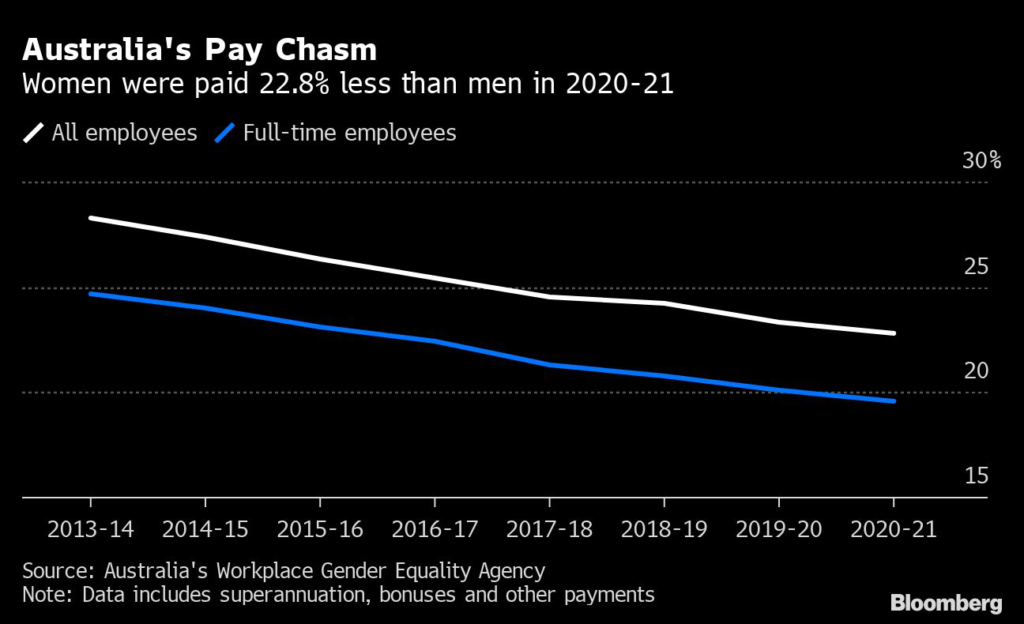
Under Lowe, the RBA has made progress in filling more jobs with women. It has a longer term goal of 40% women in managerial positions, from 34.4% now. The gender pay gap at the RBA has declined to 14.5% under Lowe, better than the nationwide disparity of 22.8%.

Almost 10 years ago, Bloomberg interviewed senior female executives at the bank for a story on Australian women in economics. Asked at the time how far Australia was from having a woman run its central bank, Bullock concluded in her deadpan country style: “probably a while.”

(Updates with comment from economist in sixth paragraph.)

More stories like this are available on bloomberg.com

©2022 Bloomberg L.P.

Close Bitnami banner
Bitnami