Bloomberg

Toshiba Rises After Top Holder Spurs Bain Buyout Speculation

(Bloomberg) — Toshiba Corp. climbed after the Japanese company’s largest shareholder spurred speculation of a takeover bid by U.S. private equity firm Bain Capital.

Shares rose as much as 6.3% in Friday trading in Tokyo after Effissimo Capital Management Pte., which owns 9.9% of Toshiba, said it had agreed to tender its entire stake if Bain decided to launch a tender offer for two-thirds or more of Toshiba. 

In a statement Thursday, Bain said no decision had been made on a takeover bid. Toshiba said Friday that it isn’t involved in any discussions between Bain and Effissimo.

Toshiba’s future was thrown into limbo last week when shareholders voted down two proposals at an extraordinary general meeting. The first, put forward by management, sought to split the company in two. The second, by the firm’s second-largest investor, called for Toshiba to reconsider alternative options including a sale.

Japan’s government will assess the situation after reports of a potential Bain takeover bid, trade minister Koichi Hagiuda said Friday. 

“Toshiba owns many technologies related to national security, like nuclear power and semiconductors, so we will keep close watch of the situation,” he said.

Read more: Toshiba’s Biggest Investor to Tender Stock If Bain Makes Bid

(Updates with Japan trade minister comments from fifth paragraph)

More stories like this are available on bloomberg.com

©2022 Bloomberg L.P.

AusSuper, Singtel-owned ATN Buys Phone Towers Business Axicom

(Bloomberg) — Australian Tower Network Pty Ltd, the former Singtel Optus Pty Ltd phone towers unit taken over by AustralianSuper last year, has agreed to a A$3.58 billion ($2.68 billion) deal for peer Axicom Pty Ltd, the companies said Friday.

The deal for the business, which is owned by Macquarie Asset Management and runs about 2000 sites located in each of Australia’s capital cities, will dilute the Singapore Telecommunications Ltd’s remaining ownership in ATN down to 18% from 30%, while expanding the Australian pension fund’s stake to 82%, the companies said. 

Axicom is the largest independent operator of mobile phone towers at a time when the nation’s two largest telecommunications players, Singtel and Telstra Corp, have each sold part of their phone tower assets garnering $2.1 billion and $1.4 billion, respectively.

“Axicom is complementary to our existing digital infrastructure portfolio and this acquisition will result in the creation of a provider with a truly national footprint that will connect the vast majority of Australian families and businesses,” AustralianSuper Head of Infrastructure Nik Kemp was quoted as saying.

Macquarie Asset Management invested in Axicom in 2015, and has more than doubled the weighted average lease length, the firm said in its own statement. 

“This acquisition is a unique opportunity to scale up ATN’s operations and expand its customer base,” Singtel Group Chief Corporate Officer Lim Cheng Cheng was quoted as saying. “It also reinforces Singtel’s commitment as a long-term investor in the Australian telecoms space.”

More stories like this are available on bloomberg.com

©2022 Bloomberg L.P.

Banks Pinpoint Sanction Risks After Russia Clampdown

(Bloomberg) — At a fintech company in London last week, algorithms fielded thousands of queries per second from banks and businesses trying to get Russian clients off their books.

ComplyAdvantage’s computers and human staff scoured 25,000 information sources, aiming to alert clients within 15 minutes of a new target appearing on the various government sanction lists drawn up since Vladimir Putin’s invasion of Ukraine. Algorithms searched for the names of Russian lawmakers, originally written in Cyrillic, and now in languages including Korean, Chinese and Japanese. 

“It’s all hands on deck,” said Charles Delingpole, founder and chief executive officer of ComplyAdvantage, whose clients include trading platform eToro and Banco Santander SA. The business has had huge amounts of data requests in recent days and traffic to its website soared 30-fold.

Multiple rounds of sanctions targeting Russia rank as among the most complex ever enforced and have thrust a cottage industry of experts into the spotlight. Armies of lawyers, compliance specialists and fintechs are being deployed to help banks avoid the billion-dollar scandals that previous sanctions have wrought.

“It’s been like the Super Bowl of sanctions,” said Joel Lange, head of business management at Dow Jones Risk & Compliance, which handles many banks. 

It is a race against time to track down the funds, as the targets of sanctions usually try to move their money swiftly, according to Delingpole. “There are huge challenges and new fronts for attack. Have the oligarchs just moved their assets to Bitcoin?” 

Banks also use companies like LexisNexis and Refinitiv World-Check to carry out similar work. Bloomberg LP, the parent company of Bloomberg News, competes with Dow Jones, LexisNexis and Refinitiv to provide financial news, data and information. 

Lenders have also lent heavily on their own compliance teams and external lawyers, stretching the capacity of the U.K.’s pool of sanctions experts. 

Their task is particularly challenging due to the speed of the Russia prohibitions and because the emerging rules are not fully aligned across jurisdictions, according to experts. Matthew Townsend, sanctions partner at law firm Allen & Overy, said there aren’t enough specialized lawyers to deal with the challenge. “We’re seeing an unprecedented demand for sanctions-related services, there is a big capacity squeeze,” he said. 

Tehran Lesson

The stakes are high, as banks have learned the hard way from falling foul of government sanctions against Iran and other countries in the past. 

BNP Paribas SA agreed to pay almost $9 billion in 2014 after admitting to processing banned transactions involving Sudan, Iran and Cuba. UniCredit SpA agreed in 2019 to to pay $1.3 billion to settle U.S. charges for violating sanctions against Iran that had been hanging over the company since 2011. The same year Standard Chartered Plc agreed to pay more than $1 billion to resolve an investigation into its Iran business.

Banking executives believe mistakes are likely as the industry rushes to impose the still-growing measures against Russia, potentially triggering fines later. Arguments that the problems could not be avoided will not be accepted, as lawmakers and the public have seen banks’ multi-billion pound profits and large bonuses being paid to staff, according to a senior industry figure.  

The direction is to err on the side of caution by extensive dropping of clients, said Michelle Linderman, a partner at Crowell & Moring LLP: “People are talking about totally de-risking. Russia could become like Iran was a few years ago, where it’s almost completely isolated from the western world’s financial institutions.”

European and U.S. banks’ ties to Moscow are limited due to caution in recent years about the political environment, but there are still many individuals, their relatives and multiple businesses which need to be sifted through. Citigroup became one of the first banks to disclose its level of connections, saying in a regulatory filing on Monday that it has $9.8 billion exposure to Russia, including through consumer and institutional banking services in the country.

Deliberately Unclear

The challenge is compounded by the overlapping of sanctions regimes. The past few days have seen more than 1,000 pages of sanctions legislation from the European Union, U.K., U.S., Canada and others, according to Crowell & Moring’s Linderman. “With Russian companies often the structure is opaque,” she said. “Where oligarchs have been added there is a heck of a lot of work, people are literally firefighting.”

Added to the problem is what lawyers call “strategic ambiguity” about the kind of trade that’s prohibited. Guidance from government agencies is often deliberately vague, said Anna Bradshaw, a partner at law firm Peters & Peters. “The reason is the more uncertain you are the more likely you are to be risk averse,” she said. “It’s almost like chess — you have to think several steps ahead at all times.”

It’s all creating work for the sanctions industry. ComplyAdvantage is looking to recruit dozens more staff to help clients ensure they do not break the rules. Dealing with sanctioned entities “is the kiss of death”, said Delingpole.

(Corrects to remove chart that inaccurately described U.K. sanctions.)

More stories like this are available on bloomberg.com

©2022 Bloomberg L.P.

S&P Joins MSCI and FTSE in Cutting Russian Stocks From Indexes

(Bloomberg) — S&P Dow Jones Indices will remove Russian stocks from its gauges, joining a growing cohort of global index compilers in shunning the nation after it was sanctioned for invading Ukraine.

The benchmark provider joins the likes of MSCI Inc. and FTSE Russell in excluding Russian assets from products, leaving Russia increasingly isolated economically as its securities become almost impossible to trade. Bloomberg said Friday that it will remove Russian debt from its fixed-income indexes, according to a statement.

The exclusions are yet another sign that Russia’s links with global markets are disintegrating. With foreign reserves frozen, capital controls in place and a ban on foreigners selling local securities, international investors are searching for an exit that has slammed shut. That has money managers trying to determine their next steps in a volatile and uncertain environment. 

“When this happens, the positions become off-benchmark,” said Malcolm Dorson, a portfolio manager at Mirae Asset Global Investments in New York. “If you’re an index tracker, you won’t have exposure. If you’re index agnostic and OK with taking active risk, then it’s a different story — but it’s difficult to hypothesize this situation right now if one can’t operationally buy Russian assets.”

S&P is excluding Russian assets due to “deterioration in the level of accessibility of the Russian market,” which could affect the ability of market participants to replicate its gauges, according to a statement. The decision will be effective prior to the open on March 9, and will include all stocks listed or domiciled in Russia, including American depositary receipts and global depositary receipts. 

The securities will be pulled from all of S&P’s benchmarks at a price of zero, and Russia will be cut to “standalone” classification, from emerging market status previously. A return to that status would involve Russia going through the standard country classification review process. 

S&P said subject to compliance with applicable law and pricing availability, it would keep publishing some of the country gauges on a standalone basis — separate from broader indexes and designed for a Russia-based investor perspective. These may include some assets that are ineligible for money managers in the U.S., U.K. or EU, according to the statement. S&P Russia BMI and Dow Jones Russia Index are among those that will be maintained. 

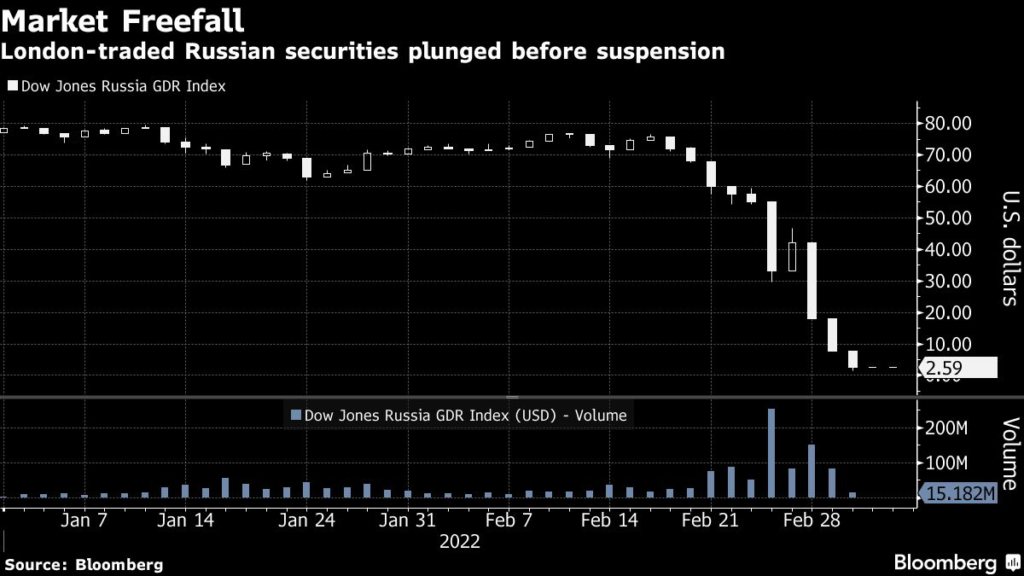
Since the Moscow Exchange’s equity trading was last open on Feb. 25, Russian stocks listed in London lost more than 90% of their value before getting suspended, and European companies with business exposure to the country have erased more than $100 billion in market value.

Stoxx Ltd. also said this week it will delete Russian companies from its indexes, as did Bloomberg, which announced changes to both its stock and bond gauges. The shifts in Bloomberg’s bond gauges will take place at month-end and include high-yield and emerging-market measures. 

Bloomberg LP, the parent of Bloomberg News, is also the parent company of Bloomberg Index Services Limited (BISL), which administers these indexes.

(Adds Bloomberg index announcement, investor comment and context throughout.)

More stories like this are available on bloomberg.com

©2022 Bloomberg L.P.

Bitcoin Falls for Second Day as Risk Aversion Grips Markets

(Bloomberg) — Bitcoin extended losses as the war between Russia and Ukraine intensified, weighing on investor sentiment across asset classes.

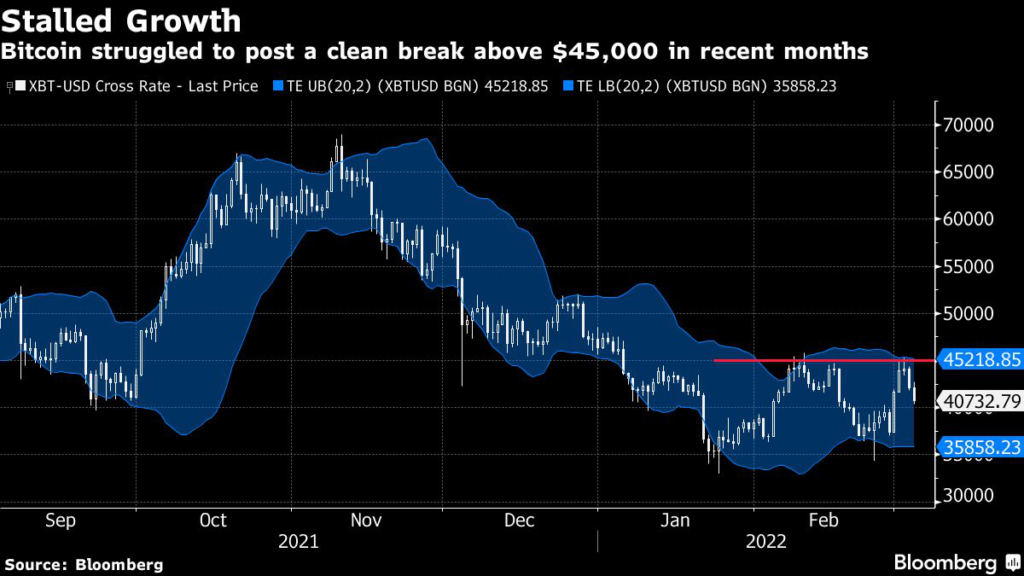
The largest cryptocurrency by market value declined for a second day, dropping as much as 6.7% to $39,259 in New York, setting it on a path to end the week on a down note after rallying 17% from Monday through Wednesday. Ether, the No. 2 token, fell more than 7%. Leading altcoins lower, Polkadot and Solana were both down more than 6% over the last 24 hours, according to data from CoinMarketCap.

“The conflict in Ukraine continues to escalate, putting the world on edge,” Lindsey Bell, chief markets and money strategist at Ally, said in a note. “Markets have been plagued by uncertainty, creating a very challenging investing environment.”   

Europe’s largest atomic power plant located in southeastern Ukraine was attacked by Russia in a move some denounced as “nuclear terrorism.” There were no causalities and the fire has been extinguished. 

The start of the week was characterized by large gains, with cryptocurrencies outperforming stocks. The imposition of sanctions drove speculation that Russians and Ukrainians would turn to digital assets as a means to move money. Volumes have since slowed.

It poured fuel on the fire of assertions by advocates who long touted Bitcoin as a store of value, detached from broader moves in the financial markets. A 50-day correlation with Bitcoin and the S&P 500 currently stands at 0.5. A coefficient of 1 represents locksteps moves, while zero denotes completely unrelated behavior.

“There is a group of investors that do see this as a risk-on asset, just like they would see stocks or anything else,” said Brett Munster, a portfolio manager at hedge fund Blockforce Capital. “In the long run, I think the store of value narrative wins out.”  

More stories like this are available on bloomberg.com

©2022 Bloomberg L.P.

Ukraine Update: Russia Blocks Facebook as Media Crackdown Grows

(Bloomberg) — Russia’s parliament passed harsh laws that would impose prison terms for people charged with spreading “fake news” about the military or calling for sanctions against the country. The BBC said it’s suspending the work of its journalists there for now.

Facebook was blocked in Russia by the country’s communications regulator, Interfax reported, the latest sign of Moscow’s pushback on news sources not sanctioned by the government. 

The Biden administration is weighing a ban on U.S. imports of Russian crude oil under pressure from a bipartisan group of members of Congress.

The move comes as events grow ever more fraught on the ground in Ukraine, with heavy fighting near key cities and fears the humanitarian disaster could be compounded by an environmental one. That’s after a brief fire at a training center attached to Europe’s largest nuclear power plant that Ukraine said was caused by Russian bombing. 


Key Developments

  • White House Considering Ban on Russian Oil Imports to U.S.
  • JPMorgan Warns Russia Headed for 1998-Like Economic ‘Collapse’ 
  • More Than a Million People Have Fled Ukraine in Just One Week
  • How Ukraine’s Rail Network Threw Russia’s Military Off Track
  • Railways Helped Drive Russia Off Track and Into Ukraine’s Cities
  • NATO Won’t Risk Broader Russia War With a Ukraine No-Fly Zone

All times CET:

Biden and Duda Discuss Ukraine, European Security (8:41 p.m.)

President Joe Biden spoke with Polish President Andrzej Duda for 53 minutes Friday to discuss efforts to impose severe punishments on Russia, as well as humanitarian efforts in Ukraine and the U.S. commitment to NATO security.

Biden “welcomed Poland’s partnership in hosting 9,000 U.S. forces, including 4,700 additional servicemembers deployed there in recent weeks, to reassure Eastern flank Allies, deter Russian aggression against NATO, and stand shoulder to shoulder with their Polish counterparts to maintain security and stability in Europe,” the White House said in a statement.

The call came as General Mark Milley, the chairman of the Joint Chiefs of Staff, met with his Polish counterpart, General Rajmund Andrzejczak during a visit to Warsaw.

Crypto Donations Pay for Bulletproof Vests, Other Supplies (8:35 p.m.)

Ukraine has already spent $15 million of the donations it received in cryptocurrencies on military supplies, including bulletproof vests that were delivered Friday, Alex Bornyakov, deputy minister of Digital Transformation of Ukraine, told Bloomberg News.

The Ukrainian government anticipates crypto donations to reach $100 million in the next few days, double the amount received so far, Bornyakov said. Most of the donations have been in Bitcoin and Ether.

White House Considering Ban on Russian Oil Imports to U.S. (8:27 p.m.)

The Biden administration is weighing a ban on U.S. imports of Russian crude oil as Congress races toward passing such a restriction to punish the Kremlin for its invasion of Ukraine.

Conversations are taking place within the administration and with the U.S. oil and gas industry on the impact such a move would have on American consumers and the global supply, according to people familiar with the matter.

S&P to Remove All Stocks Listed, Domiciled in Russia (7:31 p.m.)

S&P Dow Jones Indices said it will remove all stocks listed and/or domiciled in Russia including ADRs/GDRs from its standard equity indices at a price of zero, effective prior to the open on March 9.

The company will also reclassify Russia to a standalone category from emerging markets effective the same day, the latest move in efforts to isolate the country from global finance over the war. 

Russian Watchdog Blocks Facebook (7:17 p.m.)

Facebook was blocked in Russia by the country’s communications regulator, Interfax reported, the latest sign of Moscow’s pushback on news sources not sanctioned by the government. 

Facebook was banned in retaliation for its freezing of accounts of RT, Sputnik and RIA Novosti and other media, communications regulator Roskomnadzor said in a statement.

Two liberal broadcasters, Ekho Moskvy and TV Rain, went off air Thursday under pressure from prosecutors, while the websites of the BBC, Deutsche Welle and Meduza, an independent news group, weren’t accessible Friday.

Russia Condemned Over Actions at Nuclear Plant (6:49 p.m.)

Russia’s actions at the Zaporizhzhia nuclear plant came under heavy criticism from a range of countries during an emergency session of the United Nations Security Council in New York.

‘It was incredibly reckless and dangerous. And it threatened the safety of civilians across Russia, Ukraine and Europe,” U.S. Ambassador to the UN Linda Thomas-Greenfield said.

Russia’s UN envoy, Vassily Nebenzia, said Western countries and Ukraine are exaggerating the incident. He insisted that Russian forces “negotiated” control of the facility and emphasized what he called the shared experience of the Chernobyl nuclear disaster in the 1980s.

Harris to Travel to Europe Next Week (6:45 p.m.)

U.S. Vice President Kamala Harris will visit Poland and Romania next week, according to a person familiar with the plans. There were no further details. 

Moldova Tensions Rise Over EU Application (6:15 p.m.)

Signs of tensions emerged in Moldova, a former Soviet state that borders Romania and Ukraine, the day after the government lodged an official request to join the European Union.

The self-proclaimed government in the pro-Russian breakaway region of Transnistria has asked the international community to recognize its independence. In a statement, the Transnistria foreign affairs ministry said the Moldovan government failed to consult it on the EU application, “completely disregarding the region’s stance on the subject.”

U.S. Secretary of State Antony Blinken is due to visit Moldova on Saturday to discuss its efforts to help Ukrainian refugees as well as “U.S. support for Moldova’s democracy, sovereignty, and territorial integrity,” the State Department said. Moldova has said it wants to remain neutral in the conflict, except for helping refugees, and won’t apply any sanctions on Russia.

BBC Temporarily Pauses Work of Its Journalists in Russia (5:26 p.m.)

The BBC said it was acting in response to newly-passed legislation that “appears to criminalize the process of independent journalism” there. The British national broadcaster said its news operation for Russia will continue to operate from outside the country. 

“Our journalists in Ukraine and around the world will continue to report on the invasion of Ukraine,” BBC Director-General Tim Davie said in a statement. The new law “leaves us no other option than to temporarily suspend the work of all BBC News journalists and their support staff within the Russian Federation while we assess the full implications of this unwelcome development.”

Russia to Punish Sanctions Appeals and ‘Fake News’ on Military (5:18 p.m.)

People convicted of spreading what the authorities deem to be false information concerning the military’s activities face fines and imprisonment for as long as 15 years under the legislation, which now goes to President Vladimir Putin to sign. 

The law will allow “those who lied and made statements discrediting our Armed Forces to be punished, and very severely,” as soon as it comes into force, Speaker Vyacheslav Volodin said Friday, when lawmakers in the State Duma unanimously endorsed the measure. 

While there have been only scattered protests so far in Russia against the war, the government has throttled access to social media and ordered Russian news outlets only to publish information from official sources.

Microsoft to Suspend Sales, Services in Russia (5:01 p.m.)

Microsoft Corp. is suspending sales of products and services in Russia, and says it’s working closely with the U.S., European Union and U.K. to comply with a range of coordinated sanctions levied against Moscow.

The tech giant vowed to continue its efforts to help Ukraine stave off Russian cyberattacks, such as a recent one against a major broadcaster. Several other U.S. tech companies, including Apple Inc. and Intel Corp., have also pulled the plug on Russia since the invasion of Ukraine.

BlackRock Russia ETF Among Funds Halted (4:27 p.m.)

Three major Russia-focused exchange-traded funds were halted in New York on Friday. BlackRock Inc.’s iShares MSCI Russia ETF (ERUS) was among those affected, after the New York Stock Exchange took action based on what it said was “regulatory concern.” The fund had plunged about 80% in the past two weeks.

U.S. Aims New Measures at Russian Oil Refiners (4:22 p.m.)

The U.S. will target Russia’s oil refining sector with new export controls, and has identified 91 entities it says support the Kremlin’s military activities. The actions will further restrict Russia’s access to U.S. commodities, software, and technology, the Commerce Department said.

European Natural Gas Prices Rise to Records (4:00 p.m.)

European gas prices jumped as much as 33% on Friday on growing fears the war will end up severing supplies. Natural gas prices are now the equivalent of about $350 a barrel of oil, posing a massive risk to inflation and output. Oil rose another 5% in volatile trading, while grains surged as the key Black Sea region is cut off from global trade.

Scholz Expresses ‘Deep Concern’ in Call With Putin (3:30 p.m.) 

German Chancellor Olaf Scholz spoke for an hour on the phone with the Russian president, according to Scholz’s spokesman.

Putin told Scholz that Russia and Ukraine plan a third round of talks this weekend and the two leaders agreed to speak again “in the near future,” Scholz’s spokesman said by email. Ukrainian officials have not confirmed a date for further talks aside from saying they might happen sometime soon. 

More Than 1,000 Civilian Casualties in Ukraine, UN Says (3:15 p.m.)

Most of the casualties were caused by the use of weapons with a wide impact area, including heavy artillery, multi-launch rocket systems, missiles and air strikes, the Office of the UN High Commissioner for Human Rights said.

Stoltenberg Says Russia Breaking International Law (3:05 p.m.)

NATO Secretary General Jens Stoltenberg accused Russia of breaching international rules and said allies were collecting details to hold Moscow to account.

“We have seen the use of cluster bombs, we have seen reports of use of other types of weapons, which would be in violation of international law,” Stoltenberg said in Brussels on Friday after a meeting of the alliance’s foreign ministers.

Group Says Russian Cluster Bombs May Constitute War Crime (2:45 p.m.)

Russia’s firing of cluster munitions into residential areas of Ukraine’s second largest city on Feb. 28 may rise to the level of a war crime, the group Human Rights Watch said in a report Friday.

Video analysis and interviews with witnesses reveal submunitions were deployed via Russian-made cluster munition rockets in Kharkiv, the group said. The attacks killed at least three civilians.

Cluster munitions open in the air and disperse dozens or hundreds of small, lethal bomblets across a wide area. Their use in populated areas is prohibited under international humanitarian law, although Russia isn’t a party to that protocol. The US also hasn’t signed on.

War Spurs Johnson to Look at U.K. Property Declaration Deadline (2:41 p.m.)

Spurred by Russia’s invasion of Ukraine, Prime Minister Boris Johnson’s government is now open to cutting a grace period for foreign owners of U.K. property to register their interests, two people familiar with talks between the ruling Conservatives and opposition parties said.

Under legislation to be debated Monday in the House of Commons, individuals would have had 18 months to join a register that identifies the ultimate foreign owners of U.K. property, preventing them from hiding behind shell companies — but this period looks set to be reduced. The proposed register, which may affect the many Russians who have invested in property in Britain, has been on the back-burner for successive Tory administrations since 2016.

ETF Fund Tracking Russian Stocks Halted in New York (2:20 p.m.)

The New York Stock Exchange halted trading in a U.S. exchange-traded fund tracking Russian equities after it tumbled 68% this week.

Trading in the iShares MSCI Russia ETF was stopped at 4 a.m. local time, according to a statement by BlackRock. It said it supported the decision due to the ETF’s “concentrated exposure to Russian equities, the closure of the Russian stock market and MSCI’s decision to remove Russian securities from its Emerging Markets Indexes.”

Swedes, Finns Favor NATO Entry in Shift After Ukraine War (1:40 p.m.)

Swedes and Finns are increasingly in favor of joining the NATO defense bloc after Russia’s invasion of Ukraine, adding pressure on the countries’ leaders to change long-standing policies of military non-alignment.

Polls released in the two Nordic countries on Friday showed 51% of Swedes and 48% of Finns now back joining the North Atlantic Treaty Organization. It’s the first time a Swedish majority favored entry. 

Ukraine Says Suppressing Russian Threat to Odesa So Far (1:40 p.m.)

Defensive artillery is suppressing Russian attempts to fire on Odesa from warships, with no immediate threat to the Black Sea port city of almost 1 million people, Ukrainian military officials said.

In a briefing Friday, the officials said that, to the east, Mariupol was partially under siege, with Ukrainian troops trying to prevent the city’s complete encirclement. Russian troops have partial control of the Zaporizhzhia nuclear power plant after overnight shelling, while a powerful air attack has been thwarted so far around Chernihiv, a large city between Kyiv and the Belarus border, they said. Kharkiv and Akhtyria are holding out against heavy bombardment.

“We can feel reserved optimism,” presidential spokesman Oleksiy Arestovych said during the morning video briefing. “The overall situation is under control.”


Austrian Ex-Chancellor Resigns From Lukoil Post (12:58 p.m.)

Former Austrian Chancellor Wolfgang Schuessel resigned from the supervisory board of oil company Lukoil PJSC, citing Russia’s attack on Ukraine and its civil population, the APA news service cited him as saying. Schuessel is the latest in a string of high-profile politicians leaving management posts in Russia.

On Thursday, German Chancellor Olaf Scholz called on his predecessor Gerhard Schroeder to leave his positions at Rosneft PJSC and Nord Stream AG.

Russian Slide to Rival 1998 Default, JPMorgan Says (12:33 p.m.)

The Russian economy’s slump from crushing sanctions following its war on Ukraine could rival the fallout from the country’s 1998 default, JPMorgan Chase economists said in a note to clients.

The “peak-to-trough” collapse in Russia’s GDP is now expected to be about 11%, they said. “Russia’s export earnings will be disrupted, and capital outflows will likely be immediate despite its large current-account surplus,” they said. “Imports and GDP will collapse.”

Ukraine’s Nuclear Regulator Comments on Seized Plant (12:30 p.m.)

Around 100 Russian military vehicles broke through a roadblock near the Zaporizhzhia nuclear power plant overnight, entering the city of Energodar and began to fire on the plant, Petro Kotin, the head of the Energoatom regulator said in a statement.

A shell hit the plant’s first production unit, which was under maintenance. The second and third units were put into safe “cold mode” and the fourth remains in operation, as it’s at the most distant from the shelling zone, Kotin said. He added that radioactivity level at the plant was within norm during last measurement, although currently no monitoring is taking place.

Italy to Halt Loan Guarantees to Russia and Belarus (12:15 p.m.)

Italy’s export credit agency is poised to temporarily stop guaranteeing new loans in Russia and Belarus amid worsening risk due to the invasion of Ukraine, according to people familiar with the matter. The decision won’t affect the roughly 5 billion euros of outstanding loans to Italian companies exporting to Russia currently guaranteed by the agency.

Ukraine Nuclear Talks Pitched After Plant Fire (12:11 p.m.)  

International Atomic Energy Agency Director General Rafael Mariano Grossi reiterated his grave concern following overnight shelling of Zaporizhzhia, Europe’s biggest atomic generator, in southeastern Ukraine.

Gross said he’s offered to meet Russian and Ukrainian representatives in a bid to dial down safety risks caused by the Kremlin’s invasion. 

“We are fortunate that there was not a release of radiation and that the integrity of the reactors themselves were not compromised,” Grossi said. 

Lithuania Urges End to EU Energy Imports From Russia (11:30 a.m.)

The European Union should give up gas and oil imports from Russia and disconnect all Russian banks from the SWIFT messaging system to deter further aggression, Lithuanian President Gitanas Nauseda told Bloomberg TV. Sanctions imposed so far haven’t had the impact expected because of the Russian government’s “brutality,” he said. 

“We have to stop buying oil and energy resources from this country,” Nauseda said, adding that Lithuania is ready to switch to alternatives. 

Nauseda said Russian shelling of Ukraine’s Zaporizhzhia power plant was “nuclear terrorism” that went “far beyond the behavior of what we call normal human beings.” 

Russia Weighs Law Punishing Protesters With Conscription (11:10 a.m.)

Russia’s lower house of parliament will consider a proposal Friday to punish people convicted of joining unsanctioned protests against the actions of the Russian military abroad.

Under the plan, protesters would be drafted into the Russian military and required to serve in the Donetsk and Luhansk People’s Republics, the two breakaway regions of eastern Ukraine that President Vladimir Putin last month recognized as independent.

Czechs, Poles Intervene to Shield Their Currencies (11:04 a.m.)

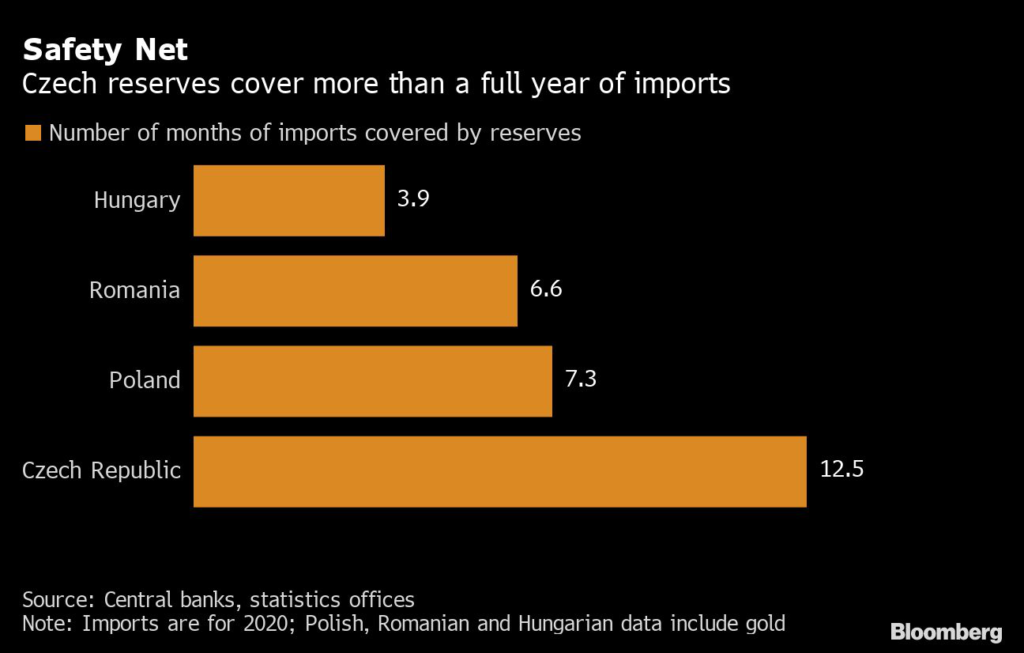
The Czech and the Polish central banks stepped in to protect their currencies, which are among the hardest hit by the market impact of Russia’s invasion of Ukraine. 

In Poland, the central bank’s third intervention this week let the zloty recoup some of the losses that pushed it to the weakest against the euro since 2009. The Czech move helped the koruna rebound and made it the best performing emerging market currency on Friday.


Zelenskiy Calls for Tougher Sanctions Against Russia (10:27 a.m.)  

President Volodymyr Zelenskiy again called for tougher sanctions against Russia in a video address on Friday, after Russia shelled Ukraine’s Zaporizhzhia nuclear power plant. He also urged a no-fly zone to be enforced over Ukraine, a step NATO has rejected so far. 

“We survived a night that could have stopped the history,” he said. “Russian troopers knew what they were shelling at. It is a terror of unseen level.” 

Russia is deliberately targeting civilians and residential neighborhoods, Zelenskiy said, adding that on Thursday, 47 casualties were reported in Chernihiv, north of the capital Kyiv.  

NATO Won’t Risk Broader War With Ukraine No-Fly Zone (10:08 a.m.)

President Volodymyr Zelenskiy stepped up his calls for a no-fly zone to shield Ukraine from Russia’s escalating bombardment, but NATO remains highly unlikely to support one.

Czech Foreign Minister Jan Lipavsky on Friday summed up the attitude that NATO governments have expressed thus far. A “no-fly zone means NATO being in a conflict, since it would be NATO’s forces enforcing this no-fly zone,” he said ahead of a meeting of ministers from the military alliance in Brussels. The “proper solution” was to give Ukraine weapons to enforce the zone itself, he said. 

While the war has prompted NATO to bolster its eastern border, it has so far held the line on sending troops into Ukraine. There’s also the concern that escalation between NATO and Russia could heighten tensions on the nuclear front.

Ukraine Sinks Navy Flagship to Avoid Its Capture (9:35 a.m.)

The commander of Ukraine’s Navy complied with an order to sink the flagship frigate Hetman Sagaidachny, which was under repair, to avoid it falling into Russian hands, Defense Minister Alexei Reznikov said in a statement.

Images of the vessel at dock in the port city of Mykolaiv, lying half-submerged on its side, appeared on social media Thursday. It comes as Russian troops advance closer to key Black Sea targets.


Russia Passes Law Criminalizing Fake News on Military (8:46 a.m.) 

Russia’s State Duma unanimously passed a law making it a crime to distribute false information about the country’s armed forces, punishable by up to 15 years in prison.

The government has throttled access to social media and ordered local news outlets to only publish information from official sources, which describe the invasion of Ukraine as a special operation.

Two liberal broadcasters, Ekho Moskvy and TV Rain, announced they were going off air Thursday after the Russian Prosecutor General ordered that access to them be restricted because of their coverage of the attack.

Russian Stock Market Closed Until at Least Wednesday (8:41 a.m.) 

The Russian stock market will remain closed to trading until at least next Wednesday, marking a record in the country’s modern history, in a continuing bid to stave off the impact of global sanctions for domestic investors. 

The Moscow Exchange said on Friday that trading across all markets will be shut March 5, 7 and 8.

What We Know About Ukraine’s Shelled Nuclear Plant: QuickTake 

Fire at Nuclear Plant is Extinguished (5:46 a.m.)

The blaze in a training complex at Zaporizhzhia was contained to an area of about 2,000 square meters (20,000 square feet) and is now out, local emergency services said on Facebook. Three floors of a training complex at the site were involved in the fire. 

The U.S. did not detect any elevated radiation readings near the facility. U.S. President Joe Biden urged Russia to halt fighting near Zaporizhzhia after speaking with Ukrainian President Volodymyr Zelenskiy about the incident. “If there is an explosion, it is the end of Europe,” Zelenskiy said in a video message. He’s appealed to Putin to meet, saying it’s the only way to stop the war.

Russia’s Defense Ministry said the incident was a Ukrainian “provocation” and that Kyiv fired the missile. Ukraine, U.S. and others have warned that Russia would be trying to engineer such incidents, which they said would be accompanied by a strike against Ukrainian communications equipment. 


More stories like this are available on bloomberg.com

©2022 Bloomberg L.P.

Apollo Is Next S&P 500 Contender as Athene Deal Opens Door

(Bloomberg) — Apollo Global Management Inc., the buyout firm, on Friday may find out if its acquisition of insurer Athene Holding Ltd. bought it a ticket into the S&P 500 Index. 

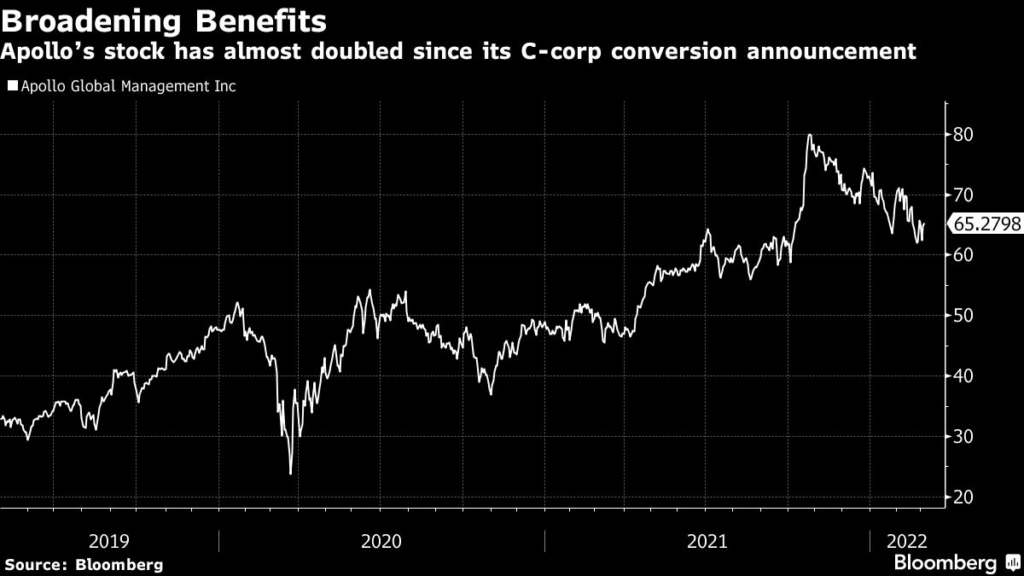
The merger removed an impediment to Apollo’s inclusion in the U.S. stock-market benchmark by creating one class of voting shares, replacing the multi-tier structure that had made it ineligible. With a market capitalization of more than $37 billion, it’s one of the largest U.S. companies eligible to be added to the S&P 500 — a possibility that Apollo raised in connection with the acquisition. 

That has left analysts speculating that the New York-based company may be included in one of the index’s shakeups, the next of which may be announced after markets close Friday as part of S&P Dow Jones Indices’s quarterly weighting changes. Some stocks may be bumped to make way for new entrants, with over 10% of the S&P 500 companies now below the minimum threshold for inclusion.

Shares that are added to the S&P 500 typically see increased liquidity and sometimes rise because funds that track the benchmark need to buy them. 

BMO Capital Markets analyst Rufus Hone sees the possible addition of Apollo to the S&P 500 as a significant potential catalyst for the stock. “Unlike prior index inclusion catalysts brought about by Apollo’s conversion from a publicly traded partnership to a corporation in 2019, which were fairly well telegraphed,” he said, “we think addition to the S&P 500 is not priced in.”

Wells Fargo analyst Finian O’Shea said in a note that if Apollo is added to the S&P 500 “the percentage of total shares in the stable hands of index-oriented investors likely would increase by roughly 10 percentage points to the low 20s from the current low teens.”

New entrants to the S&P 500 must have a market value above $13.1 billion and meet profitability, liquidity and share-float standards. 

Representatives for Apollo weren’t immediately available for comment.

Some other candidates for entry include Camden Property Trust and Steel Dynamics Inc., two S&P MidCap 400 Index members whose share-price gains have pushed their market values above the level needed to join the S&P 500. Thirteen of the 19 stocks added to the S&P 500 over the past year have come from the MidCap 400.

S&P Dow Jones Indices said it cannot comment on potential index changes. 

Separately, S&P Dow Jones announced Friday that it will remove Russian stocks from its indexes after the country was hit by sanctions over its invasion of Ukraine. MSCI Inc. and FTSE Russell have already decided to drop Russian stocks from many of their indexes.

This will clearly cause some scrambling for asset managers, but it shouldn’t take too long to straighten out. “ETFs and index providers have been able to manage changes driven by sanctions fairly well,” Citigroup Inc. strategist Scott Chronert said.

“In 2019, Venezuelan paper was phased out of indices over five months,” he said. “Timing was quicker with respect to the removal of Chinese military-industrial complex companies from equity indices. That took just two months.”

(Adds S&P’s decision to cut Russian stocks from its indexes.)

More stories like this are available on bloomberg.com

©2022 Bloomberg L.P.
U.S. Plans More Labor Complaints in Mexico After Union Votes

(Bloomberg) — The U.S. is investigating labor-rights violations in Mexico and expects to bring more complaints after cases at two automotive plants led to workers voting to recognize independent unions.

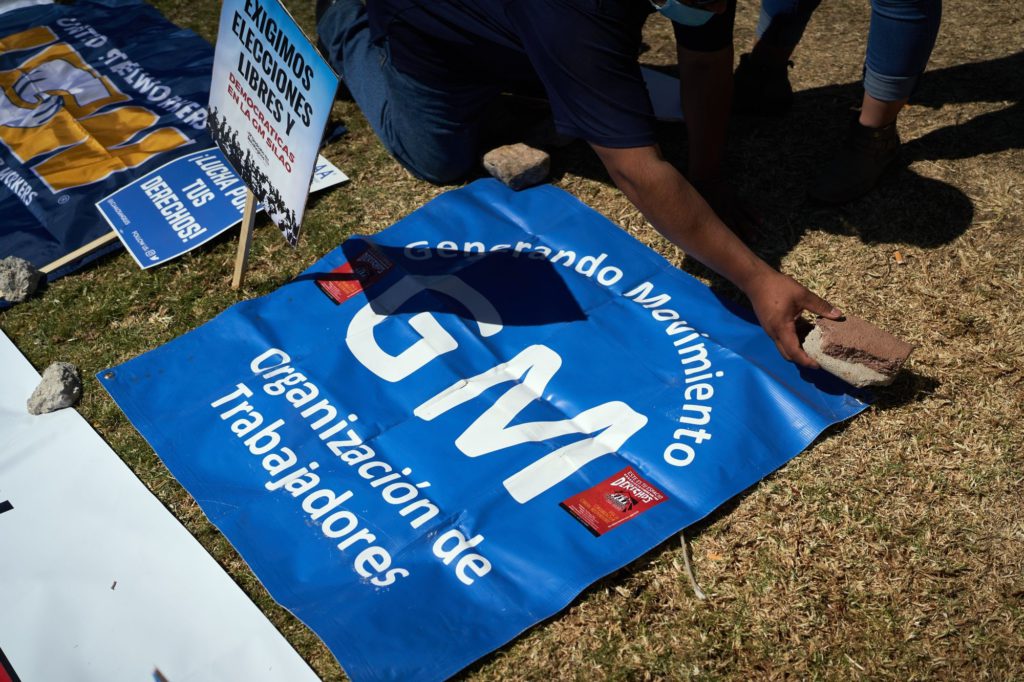
The votes on Monday at parts maker Tridonex and last month at a General Motors Co. truck plant show that the rapid-response mechanism of the U.S.-Mexico-Canada Agreement is working, Deputy U.S. Trade Representative Jayme White said in an interview on Thursday.

Both cases saw workers oust CTM, Mexico’s old-guard labor organization, which activists have long criticized for negotiating deals to suppress pay for workers making a fraction of their U.S. peers. Low labor costs led manufacturers to move jobs south of the border, a key complaint for President Donald Trump when he demanded to renegotiate the North American Free Trade Agreement.

The votes, following complaints last year by the USTR and the AFL-CIO labor federation, send a “strong market signal” to employers that the U.S. and Mexico won’t tolerate worker abuse, said White, who helped craft the labor rules as a staff member in the U.S. Senate. 

More Probes

The U.S. is receiving tips from workers and labor unions and is cooperating closely with the Mexican government, White said. 

President Andres Manuel Lopez Obrador’s administration pushed through a law in 2019 that expands workers’ rights, partly in hopes that it will eventually lead to higher wages. American labor groups want to see wages in Mexico increase to reduce the incentive for companies to shut factories in the U.S. and move jobs abroad.

“There are some folks that we’re eyeing and investigating,” White said, while declining to identify them. “As part of the USMCA, we have more resources for labor in general, for rapid response. This is very much a priority for this administration.”

The Biden administration’s trade agenda has focused on workers and enforcement of existing deals rather than continuing talks begun under Trump for new agreements with the U.K. and Kenya. The Tridonex and GM cases were the first two tests of the rapid-response labor dispute-settlement mechanism from the USMCA deal that took effect in July 2020.

The U.S. is also looking “very closely” at concerns regarding Mexico’s proposed electricity overhaul, White said. He added that he’s raised the issue several times with his Mexican counterpart, undersecretary of economy for trade Luz Maria de la Mora. 

U.S. Trade Representative Katherine Tai has discussed it with Mexican Economy Minister Tatiana Clouthier and the U.S. is trying to resolve the issue diplomatically, according to White.

“It is very much on our radar,” he said.

Energy Reforms

Mexico’s president is proposing to change the constitution, currently being debated to give state utility CFE a bigger share of the power market. But Mexico’s carbon-emissions risk and electricity costs could jump if the country passes the reforms, according to a report by the U.S. Energy Department’s National Renewable Energy Laboratory.

Lopez Obrador is a long-time critic of energy reforms enacted in 2013-14 that ended almost eight decades of energy nationalization, saying that they betrayed the nation’s citizens by handing natural resources to private companies. Since taking office in 2018, he’s vowed to return the state-owned oil company Petroleos Mexicanos, known as Pemex, and CFE to their former glory by scaling back private-sector participation in the industry.

White, who keeps a chess board on the conference room table in his office at USTR headquarters in Washington, said that part of the calculus in deciding whether to lodge a formal complaint includes anticipating how Lopez Obrador’s administration would react.

“You have to be thinking a few moves down,” he said.

The U.S., Mexico and Canada are in the process of forming a dispute resolution panel for a disagreement on regional content for cars. White disagreed with Mexican Economy Minister Tatiana Clouthier’s criticism that the U.S. is disputing the Mexican and Canadian view of the rules for political rather than legal reasons. The United Auto Workers, the industry’s largest U.S. union, supports the Biden administration’s stricter interpretation of the USMCA.

USTR lawyers have “expressed a lot of confidence in our position,” White said. “I don’t think that we’re motivated by politics. We’re motivated by the text and spirit of the USMCA.”

More stories like this are available on bloomberg.com

©2022 Bloomberg L.P.
Short Sellers Who Foresaw Russia Slump Find Cashing Out Is the Hard Part

(Bloomberg) — Short sellers were right when they bet against Russia. Whether they’ll collect their winnings of more than $723 million is another matter. 

That’s how much the shorts stand to make on a basket of Russian stocks listed in the U.S., U.K. and Europe that have plunged since the start of this year, according to data tracked by S3 Partners. Just one hitch: Trading suspensions tied to the Ukraine invasion have kept those bearish investors from cashing out, and there’s a risk that their profits could dwindle before trading resumes. 

Short sellers borrow shares, sell them on the assumption that the price will drop, and buy them back later at a lower price so they can pocket the difference as their profit; they then return the borrowed stock. In lieu of Russian shares, the trades are often executed using American Depositary Receipts in U.S. markets or Global Depositary Receipts elsewhere.

“Russian ADRGDR short sellers are sitting on a large amount of unrealized profits, but they are not bankable until their trades are closed out and profits are realized,” Ihor Dusaniwsky, a managing director at S3, wrote in a research note. “With trading halted in many securities and liquidity in tradable stocks limited, that may be easier said than done.” 

What’s more, the suspensions could eat deeper into those profits because interest rates charged to short sellers by their brokerages can rise while the delay drags on, Dusaniwsky wrote. The average amount on U.S. and other regionally traded Russian securities is 2.02%, well above the 0.65% average seen in December. 

Moscow Exchange stock trading was shuttered this week and the London Stock Exchange halted dozens of Russian stocks on Thursday, but not before a more than 97% drop in the Dow Jones Russia GDR Index since mid-February. Major index providers rushed to drop Russian companies from benchmarks, too, pushing values even lower.

Some of the biggest short positions are against Russia’s biggest bank, Sberbank PJSC, according to S3. Other targets include Ozon Holdings Plc — an internet company that warned on Friday it might default on its debts if trading suspensions are extended — and gas producer Gazprom PJSC.

More stories like this are available on bloomberg.com

©2022 Bloomberg L.P.

YouTube Offers Up to $300,000 to Get Podcasters to Make Videos

(Bloomberg) — YouTube is reaching out to podcasters and podcast networks, offering “grants” of up to $300,000 to entice them to create video versions of their shows, according to people with knowledge of the matter.

The company is extending offers of $50,000 to individual shows and $200,000 and $300,000 to podcast networks, according to the people, who asked not to be identified because the matter is private. The money could help producers create filmed versions of their episodes or make other kinds of videos.

The move could bring more substantial programming to the Alphabet Inc.-owned streaming service and bulk up its overall podcast lineup. YouTube has become a powerful podcasting platform without devoting much money to the format.

Major stars, like Joe Rogan and the H3 team, grew their followings on the service thanks to its discovery algorithm. They have gone on to become some of the most-popular podcasters in the U.S., according to Edison Research. However, the cost to build a studio, hire editors, and develop a fully functioning video publishing pipeline can deter networks and shows from adopting the platform. 

At the same time, YouTube has made a couple moves that suggest a growing interest in the space. Last fall, it appointed longtime executive Kai Chuk to lead its podcasting efforts. It’s also stopped charging users in Canada for a feature previously limited to a premium tier, the ability to continue listening while doing other things on the device.

Google declined to comment.

More stories like this are available on bloomberg.com

©2022 Bloomberg L.P.
Close Bitnami banner
Bitnami