
Bloomberg

A $1 Billion Deal With Putin Traps Renault in Russia Quandary

(Bloomberg) — Volkswagen AG, BMW AG and Toyota Motor Corp. have idled Russian plants and suspended shipments to the country as part of a broader retreat by global corporate giants. The one automaker with the most to lose, Renault SA, has remained conspicuously quiet.

The French company has lost more than a third of its market value in two weeks, as Russia invaded Ukraine and was hit with unprecedented economic sanctions. Russia is the second-biggest market for Renault, which is paying a heavy price for the $1 billion deal it sealed in 2007 with a top ally of Russian President Vladimir Putin.

Renault’s majority control of AvtoVaz, the Soviet-era maker of Ladas, and reliance on Russia for about 12% of its revenue are now matters of investor concern. Cutting ties with the venture would come at a tremendous cost, and prospects for a broader economic slump across Europe risk derailing the company’s already-tenuous turnaround effort.

“It would be perfectly legitimate for Renault to consider an exit from AvtoVaz,” said Jefferies analyst Philippe Houchois. “Renault could take the loss, but an exit would be a tough decision.”

Russia accounted for about 5 billion euros ($5.5 billion) of Renault’s revenue last year, and roughly 315 million euros of operating profit could be at risk, according to Michael Dean, a Bloomberg Intelligence analyst. Renault shares fell another 4.4% on Friday to close at the lowest since November 2020.

As a flood of companies worldwide pull back from Russia and unload assets, Renault and the French government — its most powerful shareholder — have kept mum on AvtoVaz. So has the other partner in the venture, Rostec State Corp., a Russian government-owned defense conglomerate headed by Sergey Chemezov, a close Putin ally.

“Renault has promised to abide by sanctions,” Gabriel Attal, the French government spokesman, said Thursday on France Info radio. A spokesman for AvtoVaz declined to comment beyond operational issues. Renault continues to monitor the situation, according to a spokesman.

Renault’s foray into Russia a decade and a half ago was decided at the highest levels of government, and any exit would be politically fraught. If the company stands pat, it may have a hard time collecting money from a business it’s sunk more than $2 billion into over the years.

“One risk for Renault is that capital controls could prevent it remitting profits or cash from AvtoVaz and its other Russian operations,” said Redburn analyst Charles Coldicott.

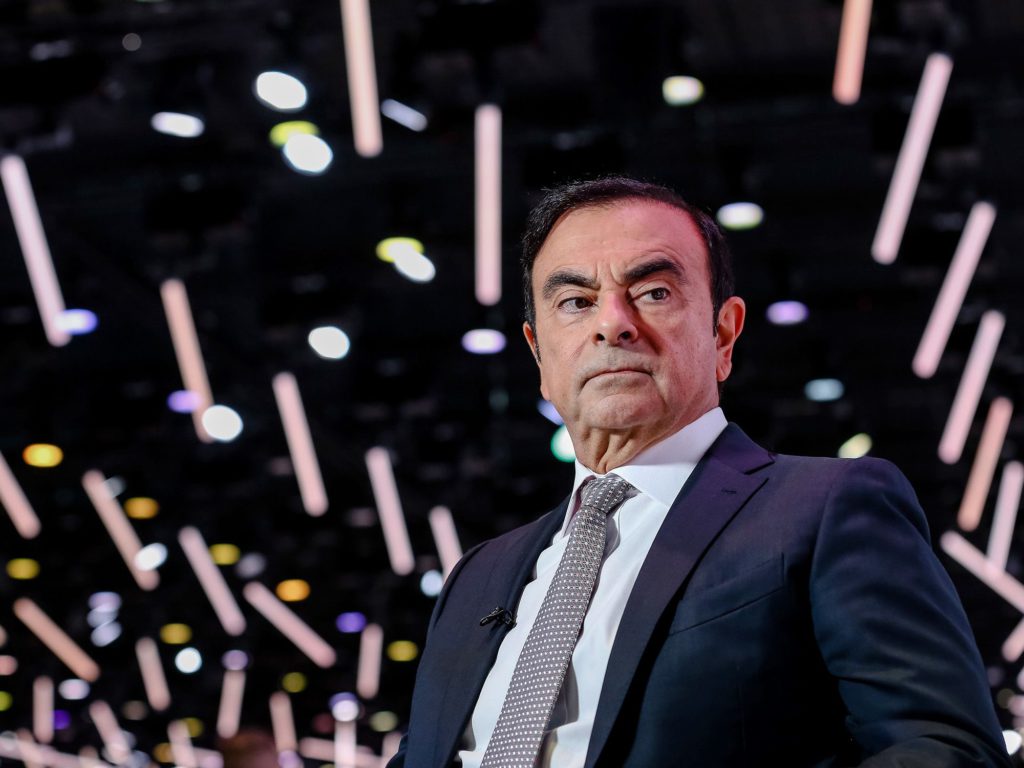
Back in 2007, Putin dictated Renault’s initial deal for a 25% stake in AvtoVaz with former leader Carlos Ghosn. The accord was backed by France and spearheaded by Chemezov. The Rostec CEO’s close ties with Putin trace back to when they lived in the same Dresden apartment complex in Germany during the 1980s as the future president worked as a KGB officer.

“When we decided to move into Russia and make this alliance with AvtoVaz, everything was fine,” Ghosn said Thursday in an interview with Bloomberg Television. “It made a lot of sense.”

Ghosn, who resigned from his Renault roles in the wake of his late 2018 arrest in Japan, said he was surprised current management hasn’t communicated on the situation. “I’m stunned by the fact that it’s complete silence,” he said.

The Russian state was highly involved in the subsequent increases in Renault’s AvtoVaz shareholding. The country now accounts for about 18% of Renault’s total vehicle sales. AvtoVaz sold about 385,000 Ladas last year, mostly in Russia.

AvtoVaz’s reliance on the domestic market means a deep economic slump would spell trouble. “Historically, during times of recession in Russia, AvtoVaz has been heavily loss-making,” Redburn’s Coldicott said.

Founded with the help of Fiat SpA in 1966, when Russia was part of the Soviet Union, AvtoVaz’s Lada commanded an almost 80% share of the market during the Communist era, and still has about a fifth of the market now. Renault has refurbished the massive Togliatti plant on the banks of the Volga River and redesigned models with an eye toward erasing consumer perceptions of shoddy workmanship and style.


Turnaround Plan

Brightening prospects in recent years for Lada formed part of Renault Chief Executive Officer Luca de Meo’s revival plan for the group. He’s envisioned an “incredibly profitable” business model for the Lada and Dacia budget-car brands, with shared manufacturing processes and technology.

The war in Ukraine isn’t the first time AvtoVaz has tripped up Renault. Within a year of its initial investment, the financial crisis saw AvtoVaz’s value plummet, and Putin pressed Renault to come to the rescue. Ghosn’s move to take a controlling stake for Renault and Japanese partner Nissan was aimed at gaining a foothold in what were expected to be key growth markets — the so-called BRICs.

In 2014, Russia was hit with a first round of sanctions after Putin annexed the Ukraine region of Crimea. Renault acquired a controlling 51% stake in 2016 after Ghosn pledged to do “whatever it takes” to back the loss-making venture on the verge of collapse.

The ongoing war in Ukraine is now posing a new and perhaps more serious threat to the carmaker because of the potential to reverberate beyond Russia’s borders.

“Renault’s turnaround plan is predicated on a recovery in the European auto market,” Houchois said. “The longer the crisis continues, the greater the likelihood of a recession in Europe.”

(Updates with share move at the close in the fifth paragraph.)

More stories like this are available on bloomberg.com

©2022 Bloomberg L.P.

Apple Sets April 11 Return-to-Work Deadline for Corporate Staff

(Bloomberg) — Apple Inc. has set an April 11 deadline for corporate employees to return to in-person work, marking a key test of whether the tech giant can reestablish office life in the Zoom era. 

Employees will be required to work from the office at least one day per week by that date, according to a memo sent by Chief Executive Officer Tim Cook on Friday. By three weeks after April 11, employees will be expected in the office twice per week. And on May 23, employees will need to be in the office at least three days a week — on Mondays, Tuesdays and Thursdays. 

“For many of you, I know that returning to the office represents a long-awaited milestone and a positive sign that we can engage more fully with the colleagues who play such an important role in our lives,” Cook said. “For others, it may also be an unsettling change.”

The company has been trying to bring employees back to the office since last June, but had postponed the return deadline several times as Covid cases surged during fall and winter. Apple had previously postponed September, October, January and February deadlines before ultimately scrapping its return plans indefinitely in December.

“In the coming weeks and months, we have an opportunity to combine the best of what we have learned about working remotely with the irreplaceable benefits of in-person collaboration,” Cook said in the memo. “It is as important as ever that we support each other through this transition, through the challenges we face as a team and around the world.”

Apple has also told staff that they will get an additional month of work-from-home time for the year as part of a hybrid pilot program. Alphabet Inc.’s Google recently adopted a similar policy, requiring employees to work from the office three days per week. Other companies, such as Meta Platforms Inc. and Twitter Inc., have been less stringent, saying they’ll let some employees work from home indefinitely despite having corporate offices. 

Apple has gradually loosened Covid-19 protocols across the company. It recently began to phase out its mask mandate at retail stores for both shoppers and employees and no longer requires office workers in some regions to wear masks if they are vaccinated. The Cupertino, California-based company has also doubled its Covid-19 testing to twice per week for all employees. 

Masks will become optional at most U.S. sites in the coming weeks, Cook said Friday. “As always, we will continue monitoring local conditions and are prepared to adjust our protocols as necessary for the health of our teams and communities.”

Apple has corporate offices across the world, including in Silicon Valley, London and Japan. In the U.S., it has offices in Los Angeles, San Diego, Austin, Boulder, New York and Miami.

Read the full memo below:

Team,

As our response to Covid-19 continues to evolve, I’d like to share an update on our plans to return to our offices.

In many locations, officials have started lifting pandemic restrictions in accordance with the guidance of public health experts. And based on the latest data, we are optimistic that this progress will continue into the spring.

While many of you have been coming in regularly for quite some time, we are now looking forward to welcoming those of you who shifted to working remotely back to our corporate offices. In the United States, beginning on April 11, we’ll begin the phased approach to the hybrid pilot, with teams returning to the office initially one day a week, and then, beginning in the third week, two days a week. This transitional period will now be extended from four to six weeks.

We will then begin the hybrid pilot in full on May 23, with people coming to the office three days a week — on Monday, Tuesday and Thursday — and working flexibly on Wednesday and Friday if you wish.

Though the timing may vary to some degree in different countries/sites based on local conditions, we will follow the same process wherever we are not yet back in the office. You’ll hear more details from your local teams on specific timing as it applies to your location.

As a reminder, our offices and many services like Caffè Macs and our espresso bars are currently open and many people are already coming in each week. Between now and April 11, I encourage you to join them, whether it’s to grab coffee with a colleague, check out your workspace or hold a team meeting.

Due to the decline in active cases, most, if not all of Apple’s U.S. sites will revert to being mask-optional over the next few weeks. As always, we will continue monitoring local conditions and are prepared to adjust our protocols as necessary for the health of our teams and communities. I also want to make clear that you are always welcome to wear a mask and you should feel comfortable doing so. And I want to reiterate the vital importance of getting the vaccine and a booster if you are able to. You can always find the latest on our protocols on Welcome Forward.

For many of you, I know that returning to the office represents a long-awaited milestone and a positive sign that we can engage more fully with the colleagues who play such an important role in our lives. For others, it may also be an unsettling change. I want you to know that we are deeply committed to giving you the support and flexibility that you need in this next phase — a commitment that begins with this gradual introduction of our hybrid pilot and includes the option to work remotely for up to four weeks a year. If you have any questions, you can find more details on the People site.

As we begin this pilot, we are looking forward to learning as we go and adjusting where we need to, all in service of fostering a really collaborative and flexible approach to our work together.

In the meantime, I can’t tell you how much I am looking forward to being together again. And I want to thank each and every one of you. Whether you’ve been working from home or coming into our stores, labs or offices, you have been an essential part of this incredible team, and I am so grateful for all that you bring to Apple.

In the coming weeks and months, we have an opportunity to combine the best of what we have learned about working remotely with the irreplaceable benefits of in-person collaboration. It is as important as ever that we support each other through this transition, through the challenges we face as a team and around the world. I look forward to being together and to learning together during this pilot as we continue to build on the culture that makes Apple such an incredible place.

Tim

(Updates with full memo after final paragraph.)

More stories like this are available on bloomberg.com

©2022 Bloomberg L.P.
Stock Trading Halt on Russian Firms Risks $2.4 Billion in Bond Defaults

(Bloomberg) — Investors in the debt of Russian companies registered abroad are poring over the details of bond contracts to figure out if the suspension of the firms’ shares means they can demand early repayment in full.

Search engine Yandex NV, social network operator VK Co Ltd, and online marketplace Ozon Holdings are three Russian companies with a combined $2.4 billion in convertible dollar bonds — notes that can be exchanged for common stock in the issuing company. Their bonds include clauses that allow noteholders to ask for early repayment if the shares of the company are delisted or if their trading is suspended for a number of days.  

The key question is whether the decision to halt Russian companies trading on the Nasdaq counts as a “delisting event” for bonds convertible into equity. Such an event is unprecedented, according to two convertible bond bankers, who spoke to Bloomberg on condition of anonymity.

“If it were to be delisted that would surely create a default,” said Antoine Lesne, head of ETF strategy and research for SPDR, State Street’s ETF offering, a bondholder of Yandex. The complexity of the language suggests the delisting event could “be a good exam question for lawyers and investors.”

Yandex, a Russian company registered in The Netherlands, has $1.25 billion outstanding, while VK Co has a $400 million bond due 2025, and online marketplace Ozon Holdings has a $750 million convertible note that matures in 2026.

Yandex said in an emailed statement that if its share trading doesn’t resume by the end of March 4, a delisting event will be triggered, initiating a process whereby bondholders could seek a redemption of the bonds at par. Ozon confirmed in a filing to the SEC that a delisting event could take place if trading of its shares don’t resume by the end of March 8, and would lead to investors being able to request a redemption of the bonds. 

A spokeswoman for VK Co said they are working with the London Stock Exchange to resume trading “as soon as possible.”

Default Risk

Both Yandex and Ozon have said they’ll struggle to pay bondholders if they demand an early repayment. 

Ozon warned that its Russian subsidiaries may not be able to send the cash to its Cypriot holding company, which issued the bonds.

The Yandex group as a whole “does not currently have sufficient resources to redeem the notes in full,” the company said. The firm had about a $615 million-equivalent of euro and U.S. dollar-denominated cash balance at the end of February, it said, adding that only around 60% of that amount is located outside of Russia. 

Fitch Ratings downgraded Yandex by two steps to junk on Friday afternoon and placed its ratings on credit watch negative, adding that international sanctions represent a “huge shock” for Russia’s credit fundamentals.

For the time-being, uncertainty reigns among bondholders. Investors are seeking clarity ahead of anything else, according to one of the bankers.

(Adds Fitch Ratings downgrade in penultimate paragraph)

More stories like this are available on bloomberg.com

©2022 Bloomberg L.P.
Facebook Gaming Is Overrun With Strange Videos and Scams

(Bloomberg) — Facebook Gaming was supposed to be the social media giant’s answer to Amazon.com Inc.’s Twitch  — a place to watch people play video games. Four years after its promising launch, the service has turned into an eerie digital ghost town where some of the most-watched accounts aren’t even gamers, some of the top live streams aren’t even live, and a large portion of the real gamers’ video views have disappeared.

The typical fare on a game-streaming site involves a player narrating as they play. But on a recent February morning, the No. 1 spot on Facebook Gaming was dominated by video from the military game Arma 3 billed as footage of Russia’s Ukraine invasion. Other top videos included a montage of chiropractic footage and an unmanned digital double-decker airplane, floating with no narration. Sometimes, the top live videos show southeast Asian women selling foot callus removal kits or diet pills with content tags like “playing Grand Theft Auto V” or “playing League of Legends.” Some videos that purport to be live run for up to 11 hours, looping recorded footage.

Such content differs starkly from the game livestreaming showcased on Twitch and YouTube Gaming. Seven of the top 10 most-watched Facebook Gaming accounts in late 2021 were responsible for the strange or off-topic videos, which can draw over 50,000 Facebook users at once, according to data from Stream Hatchet, which draws data directly from Facebook’s API. Some were eligible to run ads or receive donations through Facebook. After Bloomberg raised the issue with Facebook parent Meta Platforms Inc., many of the suspicious channels were delisted or removed. 

As the prerecorded, commerce, or simply bizarre video activity takes over — in the last quarter of 2021, it accounted for 42% of the hours watched on Facebook Gaming’s 200 top channels, according to data from Stream Hatchet reviewed by a livestream analyst — it becomes difficult for serious game streamers to make a name for themselves or build an enthusiastic audience around their work. The number of Facebook Gaming streamers has declined since 2021, with top personalities like Jeremy “DisguisedToast” Wang and Corinna Kopf—each with millions of social media followers—defecting to Twitch  in the last few months. 

“We have more and more fake streamers and less and less real streamers,” said Facebook Gaming user Daniel Popa. 

The fast fade of Facebook Gaming shows Meta’s challenge in driving young people and their vibrant communities to its flagship social network, and the limitations of its strategy to copy competitors’ successful products. Facebook overall shrank in daily users for the first time in the fourth quarter, causing the company to lose more than a third of its market value since its earnings report. Meta Chief Executive Officer Mark Zuckerberg has rallied his employees around prioritizing video products that can help the company attract the next generation of users. Now, another copycat product — Reels, a competitor to TikTok — is Zuckerberg’s main strategic focus.

Despite the difficulties, Facebook considers its gaming effort a success. “As we zoom out we see a long term upward trend in both the number of creators and viewership on Facebook Gaming,” the company said in a statement. Meta is focusing on its “ability to help creators reach audiences who care deeply about their content and communities and are more likely to return and engage with future streams.”

With its 2018 launch, Meta invested heavily in trying to make the gaming platform cool, luring some of Twitch’s top game-streaming stars, such as Wang, with deals reportedly exceeding $1 million in some cases. Facebook Gaming would be a dedicated hub for gamers to livestream Call of Duty or Rocket League, build audiences, and chat with fans about their favorite game. Those creators could make money off of their content through programs that let streamers receive donations or run ads. 

In 2020, Facebook launched its Facebook Gaming mobile app. Months later, when Microsoft Corp. shuttered its game livestreaming service Mixer, Facebook offered incentives for them to move their streaming business to under their roof. Streamers saw it as a chance to stand out with less competition than they faced on Twitch. Popa, a U.K.-based video game streamer, says he amassed an impressive 28,000 followers playing Euro Truck Simulator in 2020 on Facebook Gaming. When he was live, his viewer number hovered around 700 — a stark upgrade from Twitch, where he only attracted about 10 or 15 live viewers, he said.

But that didn’t last. Unlike on Twitch, where his viewers talked with him constantly in the accompanying chatbox, on Facebook, most of them were totally silent, or complained that his stream was an unwelcome surprise in their newsfeed. 

Last year, Popa’s metrics, and those of several other gamers who spoke with Bloomberg, fell precipitously. Popa’s viewers weren’t chatting in his channel because most weren’t actually watching him, he believes. Facebook had seeded his video across newsfeeds of people who might not have sought out his content. It would autoplay as users scrolled. Then, over time, Facebook flipped the switch, promoting his and others’ streams in a more targeted way.

“One of Facebook Gaming’s unique strengths is our foundation as a social media platform, offering creators the ability to reach audiences that may not be connected directly to them (by following, for instance),” a Facebook Gaming spokesperson said in a statement. Over time, Facebookbecame better at showcasing streamers’ content with “unconnected audiences who are more likely to be interested,” the company said. That contributed to “a reduction in their unconnected reach.” 

The drop in metrics gave gamers less incentive to stay, and created a vacuum to be filled with the off-topic pre-recorded videos. Many of the artificial channels had or have “Partner” or “Level Up” status, which allows them to monetize through Facebook with ads and donations from users. Facebook creates an incentive for looped video and e-commerce channels to flood the platform with content:  In order to be eligible to make money off of streams, users need to “stream gaming content, with game tagged, for at least 4 hours across 2 of the preceding 14 days,” the company says.  

Still, the number of hours watched on the service continued to rise. “Reaching the right creators caused a problem due to fake creators: there is no doubt in this,” says India-based streamer Sanjeev Kumar, who goes by AKELA Gaming. 

A Facebook Gaming spokesperson said the company moderates the platform with a “blend of proactive detection and reports made by people.” The company pointed to policies that “do not allow for improper tagging of non-gaming videos as gaming,” adding that the company can “automatically identify and demote videos that are tagged as a game but are displaying non-gameplay content to artificially gain reach on our platform.” They added that it’s normal to see a mixture of live videos and “was-lives.” Tagging a game without actually playing it, as the ecommerce videos do, can result in being kicked out of the money-making program.

Additionally, unlike Twitch, Facebook Gaming is much more popular outside of the U.S., with many viewers tuning in from Vietnam, Indonesia and South or Central America, according to data from StreamsCharts.


Game live-streamers draw in a younger, Gen Z audience, as opposed to one-sided television or movies, interactive video that can attract more engaged viewers, who are also more engaged with ads and sponsorships. Advertisers may be wary of investing money in content with no way to ensure the audience is real, attentive humans, or that the ads are playing on channels operated by live streamers. 

View inflation is an enormous problem for game livestreaming ecosystems — although it does make these livestreaming platforms appear more engaging to advertisers. Video game blog Kotaku reported in 2018 and 2019 that some Twitch livestreams’ viewers were inflated due to a scheme that embedded them across millions of websites. The livestreamers were often placed at the very bottom or somewhere viewers couldn’t necessarily see them. In 2020, YouTube Gaming’s most-watched videos were also dominated by scams and autoplaying, recorded videos–including ones of inappropriate content directed toward children.

As Facebook Gaming struggles to attract, retain and nourish game streamers, some users are giving up. “These days, I’m streaming on Twitch,” Popa said. “Less headaches.”

More stories like this are available on bloomberg.com

©2022 Bloomberg L.P.
China Vows to Continue Strict Crackdown on Crypto Speculation

(Bloomberg) — China reiterated it would continue its crackdown on crypto speculation, according to a statement from the country’s central bank on Friday.

The annual meeting, which is convened by the People’s Bank of China, maps out regulatory priorities for the country’s financial market in the coming year. Heads of local banks, National Internet Finance Association of China, foreign currency settlement and clearing services providers participated a conference call meeting on Tuesday, POBC said in the statement.

Beijing carried out one of the most comprehensive crackdowns on crypto trading and mining last May, forcing major crypto exchanges and mining companies out of the country. Financial regulators have played a major role by preventing commercial banks from providing services to trading platforms such as over-the-counter trading desks and exchanges. Bank accounts from such companies have been blacklisted or canceled so that crypto platforms can not cash out on tokens or offer a fiat on-ramp to their users. Regulators have also worked with the police to monitor and track cross-border transactions from trading platforms. 

China intensified crackdowns on crypto with a more concerted and enforceable effort among different departments within the government compared to its approach a few years ago, when the central bank issued warnings without clear definition of the crypto entities it wanted to target or detailed instructions to execute the clampdown.

Bitcoin trading in China’s domestic market has plummeted to 10% of the total in the world down from 90%, according to another statement from PBOC on Thursday. 

More stories like this are available on bloomberg.com

©2022 Bloomberg L.P.
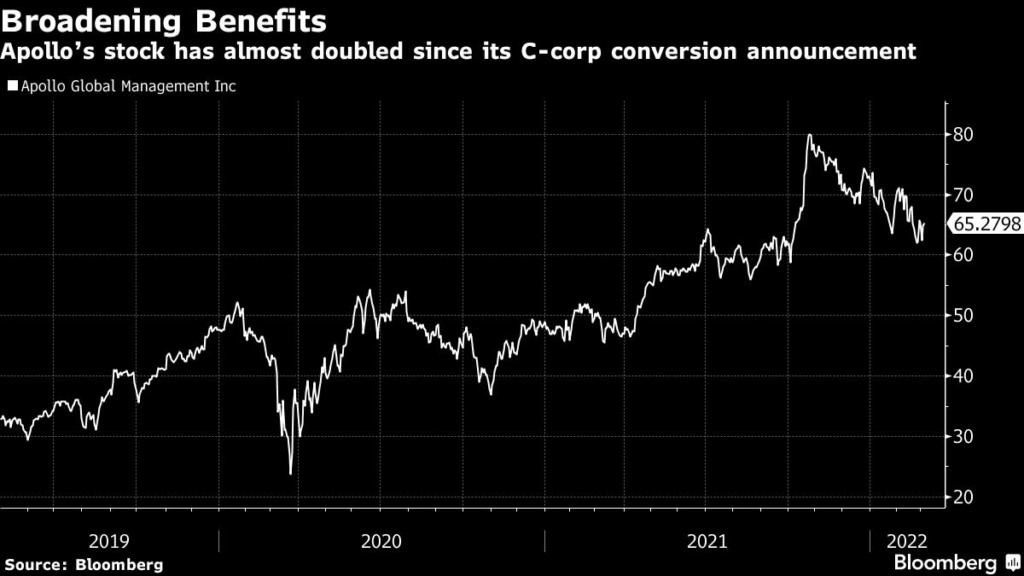
Apollo Is Next S&P 500 Contender as Deal for Athene Opens Door

(Bloomberg) — Apollo Global Management Inc., the buyout firm, on Friday may find out if its acquisition of insurer Athene Holding Ltd. bought it a ticket into the S&P 500 Index. 

The merger removed an impediment to Apollo’s inclusion in the U.S. stock-market benchmark by creating one class of voting shares, replacing the multi-tier structure that had made it ineligible. With a market capitalization of more than $37 billion, it’s one of the largest U.S. companies eligible to be added to the S&P 500 — a possibility that Apollo raised in connection with the acquisition. 

That has left analysts speculating that the New York-based company may be included in one of the index’s shakeups, the next of which may be announced after markets close Friday as part of S&P Dow Jones Indices’s quarterly weighting changes. Some stocks may be bumped to make way for new entrants, with over 10% of the S&P 500 companies now below the minimum threshold for inclusion.

S&P Dow Jones Indices, which has also been consulting with market participants on the potential removal of Russian stocks from its indexes in light of the Ukrainian war, has said it planned to announce those results Friday, as well. 

Shares that are added to the S&P 500 typically see increased liquidity and sometimes rise because funds that track the benchmark need to buy them. 

BMO Capital Markets analyst Rufus Hone sees the possible addition of Apollo to the S&P 500 as a significant potential catalyst for the stock. “Unlike prior index inclusion catalysts brought about by Apollo’s conversion from a publicly traded partnership to a corporation in 2019, which were fairly well telegraphed,” he said, “we think addition to the S&P 500 is not priced in.”

Wells Fargo analyst Finian O’Shea said in a note that if Apollo is added to the S&P 500 “the percentage of total shares in the stable hands of index-oriented investors likely would increase by roughly 10 percentage points to the low 20s from the current low teens.”

New entrants to the S&P 500 must have a market value above $13.1 billion and meet profitability, liquidity and share-float standards. 

Representatives for Apollo weren’t immediately available for comment.

Some other candidates for entry include Camden Property Trust and Steel Dynamics Inc., two S&P MidCap 400 Index members whose share-price gains have pushed their market values above the level needed to join the S&P 500. Thirteen of the 19 stocks added to the S&P 500 over the past year have come from the MidCap 400.

S&P Dow Jones Indices said it cannot comment on potential index changes. 

A decision on the removal of Russian stocks due to the sanctions and decreased liquidity would follow those from other indexing companies. MSCI Inc. and FTSE Russell have already decided to drop Russian stocks from many of their indexes.

Citigroup Inc. strategist Scott Chronert said “ETFs and index providers have been able to manage changes driven by sanctions fairly well.”

“In 2019, Venezuelan paper was phased out of indices over five months,” he said. “Timing was quicker with respect to the removal of Chinese military-industrial complex companies from equity indices. That took just two months.”

More stories like this are available on bloomberg.com

©2022 Bloomberg L.P.

Tesla’s German EV Factory Gets Green Light in Boon to Musk’s European Expansion

(Bloomberg) — Tesla Inc. received final approval for its factory outside Berlin, bolstering the carmaker’s push to expand in Europe’s fast-growing electric-vehicle market.

Authorities in the state of Brandenburg announced the decision Friday after months of delays due to red tape and concerns over the factory’s water usage.

“This is a new chapter in our industrial development,” Brandenburg State Premier Dietmar Woidke told reporters in Potsdam. “We need big projects like Tesla.”

The long-awaited decision is a boon to Tesla Chief Executive Officer Elon Musk, who plans to challenge the likes of Volkswagen AG, BMW AG and Mercedes-Benz AG on their home turf just as they broaden their own EV offerings. The facility in one of the world’s most competitive auto markets is designed to eventually make batteries and as many as 500,000 cars a year.

Tesla needs to secure an operating license to be able to start production, a process that is expected to take roughly two weeks. The automaker still has to meet dozens of requirements listed in the permit, including setting up emissions-monitoring equipment and putting in place measures to protect groundwater reserves and prevent accidents.

German politicians have backed the factory in the small town of Gruenheide because it promises thousands of jobs in a region that has little heavy industry. Local police are preparing for an opening party at the facility attended by Musk on March 22 or March 23, the Tagesspiegel newspaper reported this week.

Court Case

Musk has warned that ramping up the plant will be the difficult, partly because it will use lots of new technology. The CEO told locals in October that Tesla targets making between 5,000 and 10,000 vehicles a week by the end of this year. Tesla has hired about 2,500 of as many as 12,000 workers for the site.

Environmental groups have sued local authorities over concerns the plant would use too much water in a region that’s suffering from prolonged droughts due to climate change. The case went to court earlier Friday.

Officials say the large majority of the local population is in favor of the factory and Brandenburg authorities are backing efforts to drill for more water.

“We are aware of the water scarcity,” Brandenburg Environment Minister Axel Vogel told reporters. “The state does what it can.”

(Updates with detail on permit in fifth pararaph.)

More stories like this are available on bloomberg.com

©2022 Bloomberg L.P.
Microsoft Will Suspend All New Sales of Products and Services in Russia

(Bloomberg) — Microsoft Corp. said it’s suspending all new sales of products and services in Russia as it condemned the country’s “unjustified, unprovoked and unlawful invasion” of Ukraine.

The U.S. tech giant also said it’s working closely with governments of the U.S., European Union and U.K. and stopping many aspects of its business in Russia in compliance with coordinated sanctions rules.

“We will take additional steps as this situation continues to evolve,” Microsoft President Brad Smith said in a blog post on Friday.

Microsoft said its “single most impactful area of work almost certainly is the protection of Ukraine’s cybersecurity.” The company will help officials in Ukraine defend against Russian attacks, such as a recent one against a major Ukrainian broadcaster. Earlier this week, Microsoft said it was removing the news apps of Russia’s state-controlled news agency, RT, from its app store.

The EU, U.S. and U.K. have compiled an extensive list of sanctions in an effort to isolate the country, financially, economically and technologically, after its invasion of Ukraine last week. Beyond concerns about the war, operating in Russia has become challenging for outside companies, given the sanctions and a U.S. ban on transactions with the country’s central bank. Besides Microsoft, several U.S. tech companies have pulled out of Russia in recent days. 

Apple Inc. has halted sales of the iPhone and other popular products in Russia and removed the RT News and Sputnik News applications from App Stores outside the country. Alphabet Inc.’s YouTube said it will stop running advertisements on channels from Russian state-backed media and certain other accounts. Intel Corp. is suspending all shipments to customers in Russia and Belarus, which is allied with Russia.

Wedbush Securities analyst Dan Ives said he expects even more tech companies to “pull the plug on Russia by this weekend given the horrific atrocities seen coming out of Ukraine.” 

In a note to investors on Friday, Ives said he expects the pullback to have a minimal impact on the U.S. tech industry, saying that even in a worst-case scenario, a wholesale retreat would amount to a 1% to 2% hit to revenue. 

“This is a move the Street would gladly applaud given the heartbreaking Ukraine invasion by Russia that is playing out in front of the world’s eyes,” Ives wrote.

(Updates with other tech companies’ actions from sixth paragraph.)

More stories like this are available on bloomberg.com

©2022 Bloomberg L.P.
Splunk Jumps on Hellman & Friedman’s 7.5% Stake in Tech Company

(Bloomberg) — Private equity firm Hellman & Friedman has taken a 7.5% stake in Splunk Inc., a show of confidence in the software company’s incoming chief executive officer.

Hellman & Friedman’s holdings are valued at $1.38 billion, according to a securities filing Friday. The disclosure sent the stock climbing as much as 8.3% in intraday trading.

Shares in Splunk, like many software companies, are down since late last year. It has lost about a quarter of its value since November. Splunk got a short-lived boost from news that Cisco Systems Inc. had discussed an acquisition for more than $20 billion, but the talks stopped early last month.

Splunk said this week that Gary Steele, currently the CEO of cybersecurity company Proofpoint Inc., will take the helm at Splunk starting April 11. He replaces Doug Merritt, who resigned in November.

The Wall Street Journal reported news of the private equity investment earlier Friday. Hellman & Friedman said in the filing that Splunk is undervalued and has “tremendous long-term growth potential.”

(Updates with shares in the second paragraph. A previous version corrected a misspelling of the company name in the headline, which was due to an editing error.)

More stories like this are available on bloomberg.com

©2022 Bloomberg L.P.

Wall Street Brings Bankers Back to Offices Remade for Hybrid Era

(Bloomberg) — The new staples of office life go beyond hand sanitizer and air filters. For some Wall Street banks, they involve natural light, lots of plants and cold brew on tap, too.

As return-to-office plans accelerate — with hopes they will stick this time —  many bosses are embracing new setups and perks meant to evoke the comforts of home. At Mizuho Americas, Bank of Montreal and Deutsche Bank AG, the changes have gone even further: New York workers came back from the pandemic to entirely different buildings. 

The moves, while planned well before Covid hit, gave the banks an opportunity to revamp space for new types of work, particularly as each company embraces hybrid policies allowing many employees to be remote at least part of the week. From pool tables to open seating, their arrangements show how once-stodgy Wall Street offices are turning into a shared collaborative space more reminiscent of Silicon Valley’s tech digs. 

“There’s a huge emphasis on wellness, air filtration, the idea of natural light as part of the environment, the ability to see the sun move through the sky in the course of the day,” said Mary Ann Tighe, chief executive officer of the New York tri-state region for brokerage CBRE Group Inc. “These values have been moved to the top of the hierarchy for office space among financial-service firms.” 

It’s a trend likely to continue: In January, Citigroup Inc. said it would overhaul its London tower to “reflect the changing nature of work,” with emphasis on shared spaces and new technology. 

For banks, revamped office space isn’t just about providing extra perks for employees. They’re in competition to retain and attract new talent  —  not just from other finance firms, but from tech and cryptocurrency companies as well. Cost-cutting also is a factor, with some companies simply finding ways to do more with less space. With Covid concerns ebbing, this month stands to be a key one for New York’s efforts to bring back workers. A January survey by the Partnership for New York City found that the majority of Manhattan employers believe their daily office attendance will exceed 50% by the end of March.  Here is a look at how Mizuho, BMO and Deutsche Bank have set up their new offices as staff come back. Mizuho AmericasOld address:  320 Park Ave.New address:  1271 Avenue of the Americas

Mizuho relocated to its new Midtown tower —  originally known as the Time & Life Building — in February 2020, just before the pandemic exploded. The move brought together the firm’s securities business, which was originally stationed at 320 Park Ave., and bankers who were just across the street at 1251 Avenue of the Americas, where the company still has some space.  The firm gave staffers the option to return to in-person work in September. Last month, employees were told they were expected to be back, albeit with most still operating on a hybrid basis. 

“There is an energy in the office and it feels more permanent this time. Lots of smiles and gatherings again in the lounges and huddle areas,” said Jerry Rizzieri, chief executive officer of Mizuho Securities USA. “Some haven’t seen each other in two years and for our new hires, it is their first time in the office.”

They’re being welcomed to cafeterias outfitted with cold brew on tap and lunch rooms that overlook the stretch of road made famous by the Macy’s Thanksgiving Day Parade. Many spaces feature large works of art that allude to Mizuho’s Japanese roots.  

The firm now has three types of meeting spaces throughout its new offices, including central cafes for small impromptu gatherings, so-called huddle rooms for meetings of as many as four people and conference rooms for larger groups. 

Each room is equipped with video conferencing technology aimed at making sure everyone, whether at home or in the office, is on a level playing field during meetings. Trading floors, which can accommodate as many as 800 people each, are even outfitted with extra benches to make space for unscheduled confabs. 

“For our junior employees, we are an apprenticeship business, so face-to-face and spontaneous collaboration is great to see,” Rizzieri said. Bank of MontrealOld address: 3 Times SquareNew address: 4 Times Square

BMO is calling it quits on reserving corner offices for top executives. In the Toronto-based firm’s new Times Square tower, senior bankers are situated in the middle of the floor, allowing junior employees to reserve desk space around the exterior of the building where natural light is plentiful.  

“We don’t have large offices that take up walls and walls of windows,” said Summer Hinton, chief operating officer of BMO’s capital markets business. “It’s made a huge difference.”BMO started refilling its New York location with bankers last month, with most staff expected to return on a hybrid basis by early April. Its new building, which shares common space with Nasdaq and TikTok, includes a view of the New Year’s Eve ball — along with the bank’s prior offices. Employees can peer through the windows at their previous workspace, their old, wooden desks still sitting there.Conference rooms are decked out with large screens to make video calls easier for staff working from home. For those contributing to meetings in person, couches replace traditional office chairs. 

“We had a bit of an advantage because we were already planning a hybrid work environment and thinking about collaboration in our design,” Hinton said. “The pandemic simply accelerated ideas around the future of work.”

Amenities in the updated space include lockers for workers who want to store their belongings without occupying a dedicated desk space. The ninth floor offers a terrace for outdoor entertaining.Deutsche BankOld address: 60 Wall St.New address:  10 Columbus Circle

With its move last summer, Deutsche Bank became the last banking giant to leave Wall Street in lower Manhattan, the longtime financial industry stronghold. The German lender traded in its mahogany- and marble-laden headquarters for a new spot in Midtown’s Columbus Circle. There, the company installed a bevy of planters that stretch up the wall that towers over 500 of the firm’s traders.

As the firm was planning to allow more staffers to enter its new Manhattan workspace, it began reconfiguring the way it designed personal offices to ensure staff could meet in person and via videoconferencing. It also installed large patios for employees to gather outside overlooking the southwest corner of Central Park. 

The Frankfurt-based firm has a social area called Der Bar where smaller teams and groups can meet and unwind. Nearby, employees can try their hand at ping pong or pool during downtime. Deutsche Bank has ramped up in-office events as it welcomes more of its staffers back. The building requires Covid-19 vaccination for entry and employees will be tested for the virus on-site at an expanded medical facility each week. 


“It’s been great to walk around and feel the energy of colleagues connecting and teams working together, and it feels great to bump into so many that I’ve only seen on a computer screen for more than two years,” said Christiana Riley, CEO of Deutsche Bank’s business in the Americas. 

More stories like this are available on bloomberg.com

©2022 Bloomberg L.P.

Close Bitnami banner
Bitnami
