Bloomberg

Hong Kong Tycoon Victor Li Nears £15 Billion Sale of U.K. Power Assets to Private Investors

(Bloomberg) — A consortium led by Macquarie Group Ltd. and KKR & Co. is in advanced talks to buy the U.K. electricity distribution business controlled by Hong Kong tycoon Victor Li, in what could be one of the sector’s largest deals this year, people familiar with the matter said. 

The bidder group also includes APG, China Investment Corp., Ontario Teachers’ Pension Plan Board and PSP Investments, according to the people. A deal could value UK Power Networks Holdings Ltd. at as much as 15 billion pounds ($20 billion) and an agreement may be reached in the coming weeks, they said.

UK Power Networks is jointly owned by the Li family’s CK Infrastructure Holdings Ltd. and fellow group companies Power Assets Holdings Ltd. and CK Asset Holdings Ltd. 

Shares in CK Infrastructure climbed 5% in Hong Kong trading Friday, their biggest gain in more than a year. Power Assets closed 1% higher, while CK Asset sank 0.9%.

The business could also still attract interest from other infrastructure investors and energy companies, the people said, asking not to be identified discussing confidential information. 

CK Infrastructure, Power Assets and CK Asset said in a joint Hong Kong stock exchange filing Friday that unnamed parties have expressed an interest in buying part or all of their stakes in UK Power Networks. The interest hasn’t yet been properly analyzed, and there’s no certainty an agreement will be reached, according to the filing. 

Representatives for APG, KKR, Macquarie, OTPP and PSP declined to comment, while a spokesperson for CIC couldn’t immediately provide comment. 

Formerly owned by France’s Electricite de France SA, UK Power Networks owns and maintains electricity cables across London and the south east and east of England and serves about 8.3 million homes. It was acquired in 2010 by Li’s companies.

Distribution grids are the local networks that feed directly into homes and businesses, putting them at the heart of the energy transition. Higher allocations from pension and sovereign wealth funds and investors’ desire for long-term, stable returns have made infrastructure one of the hottest sectors for dealmaking. 

Last year, National Grid Plc agreed to buy PPL Corp.’s U.K. electricity distribution business for 7.8 billion pounds as it prepares for a low-carbon future. As part of this push the London-listed utility is looking to offload its roughly $10 billion gas transmission business, which is drawing interest from Macquarie, Bloomberg News has reported.

Elsewhere, SSE Plc has lined up banks to lead the sale of minority stakes in two electricity networks valued at more than 10 billion pounds.

(Updates with CKI exchange filing in sixth paragraph)

More stories like this are available on bloomberg.com

©2022 Bloomberg L.P.

Foreign Russia Bondholders Still Haven’t Received March 2 Coupon

(Bloomberg) — Foreign holders of Russia’s local-currency government bonds still haven’t received coupon payments three days after they were due, according to financial data provider CBonds and five investors at American and European firms. 

Russia’s National Settlement Depository received the interest — 11.2 billion rubles ($98 million) on 339 billion rubles of bonds known as OFZs due February 2024 — from the government on Wednesday and paid local investors, they said. But international investors weren’t paid because of the Russian central bank’s order barring foreign payments.

“Money is in NSD, payments to Russian bondholders were made,” said Elena Avdonicheva, Head of Russia & CIS Fixed Income Department at CBonds. “Payments to non-residents weren’t made due to government ban, this money is frozen in NSD until further notice. Technically we can expect that money will reach bondholders later.”

The five investors asked not to be identified because they’re not authorized to talk about it.

Local Russian debt has a grace period of 10 working days after the Moscow Stock Exchange publishes what it calls a technical default, according to Cbonds. It’s unclear if that will happen because technically, Russia paid.

“Officially in Russia it is not called a default,” Avdonicheva said. “But if we follow the logic: money hasn’t reached bondholders in the right time and investors couldn’t reinvest coupon payments, then it is a technical default.” 

While Moscow did pay this week, investors are concerned about whether it will be able or willing to make future payments as the war and sanctions escalate. Investor confidence is already fragile, with default insurance contracts signaling a record likelihood of default.

All eyes are now on Russia’s foreign-currency debt. The government is due to pay more than $100 million of coupons on two dollar bonds on March 16. It also has another interest payment due on March 21 and a $2 billion bond maturing on April 4.

Grace Period

International bonds have a 30-day grace period and a failure to pay in that time could trigger credit-default swaps, though there’s concern about whether those would pay out as well.

Two of the investors who own the ruble bonds said they were encouraged by news that a Russian telecommunications company paid a coupon due Thursday on dollar bonds.

A default by Russia might carry a smaller risk of contagion to global financial markets than in 1998 because investors have reduced their holdings of Russian assets, according to some analysts. Direct exposures to Russia through trade flows and foreign banks’ claims have already dropped by two thirds since 2013 and are almost half of those before Russia’s last default, according to JPMorgan Chase and Co.

More stories like this are available on bloomberg.com

©2022 Bloomberg L.P.

Seizing Superyachts of Russia’s Elite Is Harder Than It Sounds

(Bloomberg) — Politicians around the world have made a show of talking tough about taking away the comforts of Russia’s wealthy elite after the country’s invasion of Ukraine. Yet actually seizing those assets will be much more difficult.

There are layers of shell companies and vast troves of wealth hidden in tax havens. Elites might transfer assets to relatives or, in the case of superyachts and private jets, park them in out-of-reach jurisdictions. Cryptocurrencies further complicate the global hunt. 

The key difference, according to lawyers, economists and ex-government officials interviewed by Bloomberg, is that sanctions can be passed relatively quickly, while seizure is a more drastic step that involves a potentially lengthy legal process.

Still, the level of cooperation signaled by governments is unprecedented, with parallel sanctions coming down in the European Union, U.K. and U.S., while a global financial watchdog is discussing an approach to trace Russian money flows to curb sanctions evasion.

President Joe Biden’s administration said Thursday it would sanction eight wealthy Russians and their families, including billionaire Alisher Usmanov, after unveiling a unit called “KleptoCapture,” which will complement a transatlantic task force. 

Whether the moves turn out to be largely symbolic or something more will depend on several critical factors. Here are some of them. 

Property Rights

Taking assets is especially tricky when dealing with Russia, where tycoons amassed the foundation for their wealth decades ago and have reinvested proceeds from Soviet privatizations into legitimate businesses.

Seizures demand a civil or criminal legal process that needs court approval, said Alex Iftimie, a partner at Morrison & Foerster and a former senior national security official at the Justice Department.

A common basis is violating money-laundering laws. In the pursuit of Russian wealth, efforts to seize assets will likely involve gathering information from other countries, according to Anders Aslund, a professor at Georgetown University who has written about the effectiveness of past rounds of sanctions against Russia.

Property rights in the U.S., U.K. and elsewhere are the foundation for legal challenges to seizing assets.

“You’ve got to be very, very clear on what those assets are. Are they proceeds of a crime? If so, what is the crime?” said Justine Walker, global head of sanctions, compliance and risk at ACAMS, a trade organization for specialists in detecting financial crimes. 

Even for assets frozen under sanctions, not seized, individuals can appeal to be delisted or sue to be unblocked, said Ori Lev, a partner at Mayer Brown who formerly led the enforcement division of the Treasury’s office of foreign assets control.

Still, courts have held that individuals without a U.S. presence don’t have due process rights under the Constitution, Lev said.

Concerns over due process can be addressed by limiting asset seizures to people connected to Putin and maintaining a “high threshold” for targets, said Gabriel Zucman, a University of California at Berkeley economics professor who researches wealth, inequality and tax havens.

Blocking Boats

Two brushes with superyachts in the EU this week illustrate how sanctions don’t go as far as seizures.

In France, customs officials blocked Rosneft Chief Executive Officer Igor Sechin’s superyacht from an urgent departure from the Mediterranean port of La Ciotat, near Marseille, according to the French Finance Ministry. 

Sechin was sanctioned by the bloc on Monday. However, the asset has not been seized by the state.

In Germany, Usmanov’s superyacht is docked in Hamburg and will need an export waiver to depart. A local ministry said “no yacht leaves port that is not allowed to do so.”

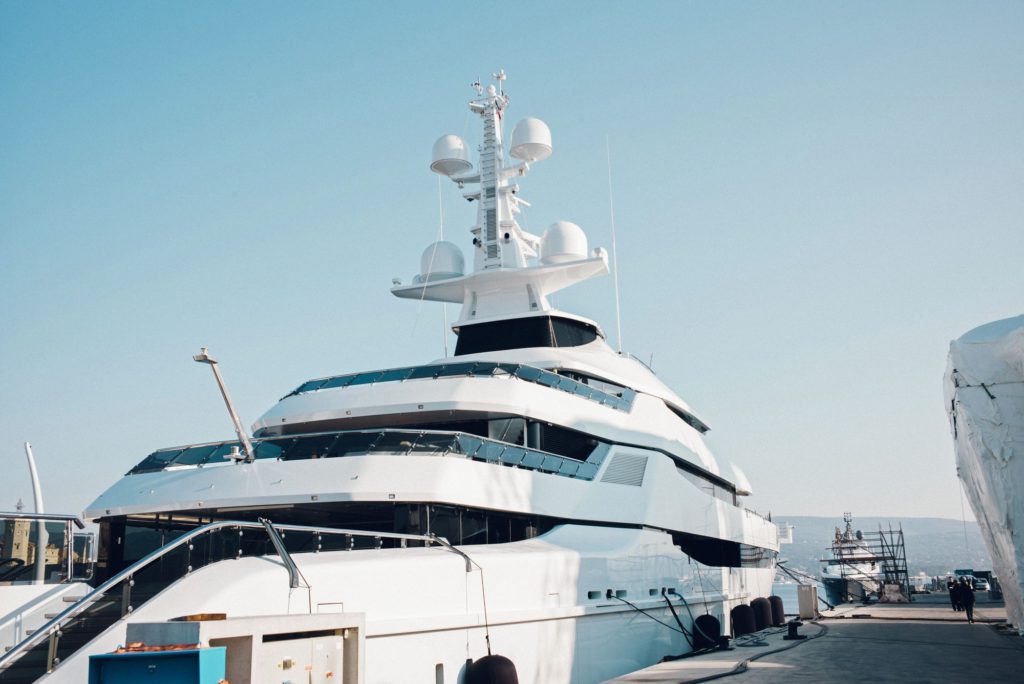
Meanwhile, many Russian-owned luxury yachts are out of reach of countries that have imposed penalties. Among those vessels cruising around the Maldives right now is the 465-foot Nord, owned by Alexey Mordashov, a steel billionaire who was sanctioned by the EU on Monday.

Shell Game

Superyachts and private jets are one thing. Other forms of wealth — bank accounts, trust funds, or apartments cocooned inside a series of offshore companies — are less conspicuous. 

“Regulators that need to track down assets and transactions en masse may be overwhelmed by their volume,” said Yuliya Guseva, a professor at Rutgers Law School.

One formidable obstacle: shell corporations.

“It’s quick and easy to set up companies and to combine hundreds of such companies into complex networks across the globe, often in highly secretive offshore jurisdictions,” said Rebecca Lee, chief impact officer at OpenCorporates, which maintains a global database of corporations. “It is often impossible” to find out who has ultimate control, she said.

The U.K. this week introduced new legislation that would, among other things, create a registry of foreign owners of British property and expand government powers to investigate the source of their wealth. The laws would require anonymous overseas owners to disclose their identity so they can’t hide behind “secretive chains of shell companies.”

There’s precedent for Russian elites to evade sanctions this way.

Shell companies linked to Arkady and Boris Rotenberg, two brothers close to Putin, transferred more than $120 million to Russia during a four-day window in 2014 after the annexation of Crimea, according to a 2020 report by the U.S. Senate’s Permanent Subcommittee on Investigations. 

The brothers, who were again sanctioned by the U.S. on Thursday, also used an intermediary to buy art for companies they owned or funded, according to the report. The purchases, at auction houses and through private dealers in New York, amounted to $18.4 million. 

“The targeted individuals use sophisticated ways to hide their assets,” Lev said. “The international, multilateral approach to this can only increase its effectiveness.”

Cryptocurrency Challenges

Cryptocurrencies further complicate the effort to enforce sanctions. They bypass traditional financial institutions, giving criminals and those suspected of wrongdoing a new way to conceal the illicit origins of funds. 

“We are at a crossroads with cryptocurrency, and frankly we need to focus on a new category of crime and that’s the use of cryptocurrency to conduct criminal activity,” Deputy Attorney General Lisa Monaco said Wednesday on Bloomberg TV.

Law enforcement agencies have recently scored wins in tracking down crypto wealth. Still, it took the U.S. more than five years to seize the $3.6 billion in Bitcoin stolen during a hack of the Bitfinex currency exchange. 

Speeding Up 

To exert pressure on Putin, governments will have to act fast. To some experts, the cooperation through a transatlantic task force is reason to think potential seizures will be swifter this time around. 

The authority asserted by the Justice Department to muster resources of other government branches will also help ensure the effort doesn’t get mired in court fights, Iftimie said.

“The wheels of justice turn slowly, so the key with this task force is to serve as an accelerant,” he said.

So-called asset reshuffling by targeted Russian tycoons can be a potential issue, Zucman said. That could be addressed by pushing offshore centers to join the effort. Switzerland, which has long been attractive for wealthy Russians because of its discretion and light-touch regulation, has already followed in the EU’s footsteps. Monaco has also adopted sanctions.

The Financial Action Task Force, an inter-governmental body that sets standards on anti-money laundering, has been talking about priority jurisdictions that will receive additional scrutiny to ensure Russian capital isn’t able to evade recent penalties, people familiar with the matter told Bloomberg News.

“If avenues are closed off in the U.K., and the U.S., even Switzerland, Singapore, where is the money going to go?” said Justyna Gudzowska, director of illicit finance policy at the Sentry, an organization that investigates global networks that benefit from conflict and kleptocracy. “It’s going to go to the weakest link.”

(Updates with global financial watchdog, U.K. transparency bill starting in fourth paragraph.)

More stories like this are available on bloomberg.com

©2022 Bloomberg L.P.

Microsoft Vaults Further Into Health-Care Services With Closing of Nuance Deal

(Bloomberg) — Microsoft Corp. completed its acquisition of Nuance Communications Inc., pushing the software giant deeper into the market for health-care services and artificial intelligence.

The $19.6 billion deal, announced last April, lets Microsoft add cloud-computing and AI offerings aimed at health-care, finance and customer-service clients. Nuance counts 77% of U.S. hospitals and 19 out of 20 of the world’s top financial institutions among its customers, which use services like voice transcription and fraud-prevention tools, Microsoft said in a blog post Friday.

Nuance Chief Executive Officer Mark Benjamin will remain head of the business, reporting to Microsoft Cloud and AI Executive Vice President Scott Guthrie.

Microsoft and cloud rivals like Amazon.com Inc.’s Amazon Web Services are increasingly tailoring services to specific industries — on top of their original approach offering computing power and storage. With Nuance, Microsoft also gets a wealth of data that will help it better train AI services.

Other tech titans are expanding in health care as well. In December, Oracle Corp. agreed to buy medical-records systems provider Cerner Corp. for about $28.3 billion.

Even as Microsoft targets more specific industries, it will rely on partners to build some of these products, Guthrie said in an interview. The company isn’t going to build every kind of software for every industry, he said.

“But having a few specialized capabilities — Nuance is clearly it for health care, as well as financial services and for customer care broadly — this is going to give us a real leg up, an edge in this space,” he said. The deal will “allow us to start conversations where we can go much deeper, much faster than any other cloud provider.”

More stories like this are available on bloomberg.com

©2022 Bloomberg L.P.

Moderna, WHO Set for Vaccine Clash as Patents Threaten mRNA Use

(Bloomberg) — Moderna Inc. is heading for a clash with the South African government and the World Health Organization over patent claims that vaccine advocates say could threaten the continent’s access to Covid-19 shots. Medecins Sans Frontiers and other health and relief groups are calling on the vaccine-maker to abandon three patent applications filed years …

Moderna, WHO Set for Vaccine Clash as Patents Threaten mRNA Use Read More »

Invasion Fallout Frays Supply Lines Risking Wide Inflation Shock

(Bloomberg) — Sign up for the New Economy Daily newsletter, follow us @economics and subscribe to our podcast.

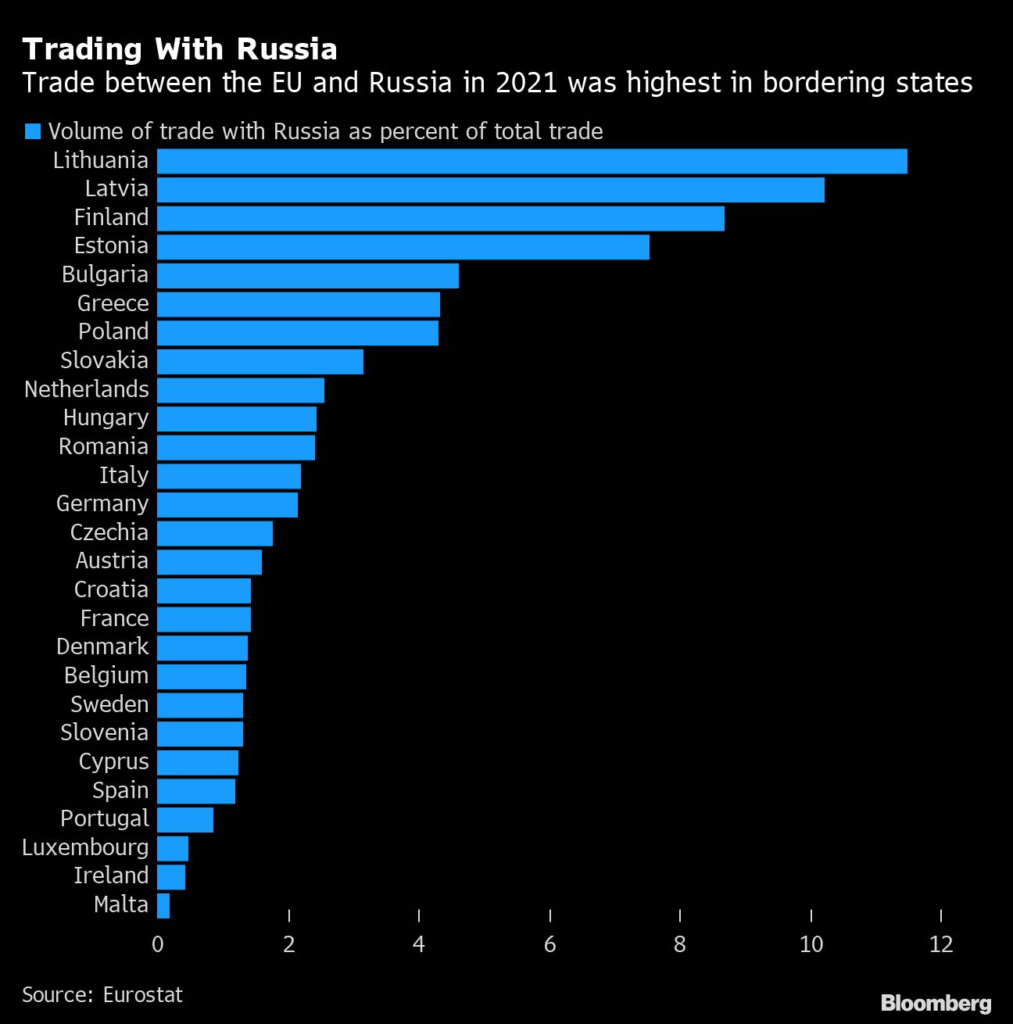
Supply chains that rattled the global economy through the pandemic are unleashing another shock as efforts to choke off trade with Russia strain resources ranging from fertilizer needed for crops and palladium for car-making, to oil that’s used to produce almost everything.

The upshot: a world economy that again faces the prospect of stagflationary forces as inflation quickens and growth fades, compelling central banks to choose which to tackle while fearing the challenge they don’t take on then gets out of hand. 

The choice is even starker now than it was during the early days of the pandemic. Back then, monetary policy makers elected to buoy demand as a recession hit. Now inflation is at multi-decade highs, forcing them to focus on runaway prices, although perhaps alert to the risk they may have to move more slowly than anticipated.  

“Were this 2022 supply shock a first, central banks would be more confident of its transitory inflation impact,” said Alan Ruskin, chief international strategist at Deutsche Bank AG. “But this is an inflation shock compounding pre-existing evidence of sticky inflation, so adding to concerns that policy will have to treat attendant higher prices as more than a temporary phenomena, even if growth slows.”

Already, signs are mounting that supply lines are fraying anew as the sanctions-driven economic blockade increases President Vladimir Putin’s reliance on domestic production and prevents Russian companies from reaching markets and investors abroad.

Almost all of the 10-largest container shipping companies — responsible for moving some 80% of global trade — have stopped accepting bookings for Russian cargo and ports from Europe to the U.S. are turning away the nation’s vessels. Some companies are choosing to self-sanction by refusing to buy Russian commodities, even if it remains legal to do so.

The fallout is extending far beyond Russia and Ukraine, with Copenhagen-based A.P. Moller-Maersk A/S, the world’s No. 2 container carrier, warning customers “this is a global impact, and not only limited to trade with Russia.” On Friday, Maersk suspended new intercontinental rail bookings, both east and westbound, between Asia and Europe.

For auto makers, the dependence on Russian supplies is deep. The country is the third-largest supplier of nickel in lithium-ion batteries and provides 40% of the palladium for catalytic converters, with that metal also impacted by widespread flight bans. About 90% of U.S. semiconductor-grade neon supplies comes from Ukraine, according to Fitch.

Toyota, Honda

Japan’s biggest carmakers joined the widening global corporate pullback from Russia, following the likes of Ford Motor Co. Others in closer proximity to the war such as Germany’s BMW AG and Volkswagen AG are warning of production outages. Shares of Renault SA, the European carmaker most exposed to Russia, have tumbled almost 25% since the invasion began.

In the U.S., Boeing Co. is in a bind after the U.S. banned flights by a Russian-operated company it relies upon, meaning it can’t transport some structures from other places to its main wide-body plant in Everett, Washington.

Titanium is the other vital input for the aerospace industry, with firms stockpiling the key material and looking to diversify away from Russia. Engine maker Safran SA gets almost half of its titanium from Russia’s VSMPO-Avisma Corp., while Rolls-Royce Holdings Plc said 20% of its titanium comes from the country.

The isolation of a commodities powerhouse also has prices for fuel and food soaring. Oil, of which Russia produces more than 10% of the world’s output, is now topping $110 a barrel, while European natural gas hit an all-time high this week. Wheat soared past $11 a bushel to the highest level in 14 years.

Even prices for the widely used nitrogen fertilizer urea surged over the past week, drawing howls of protest from farmers as far afield as Iowa and Brazil.

For China, trade with Russia poses new risks, costs and potential obstacles. Railway transport from China through Russia is currently in operation, said Mark Ma, the owner of Seabay International Freight Forwarding Ltd., a company that handles Chinese goods sold on platforms such as Amazon.com Inc.

However, some logistics companies have decided to stop shipping out goods because the journey takes time and any uncertainties linger in the process of transit arrangement, customs clearance, goods safety as well as payment collection.

Ma said his company has seen a reduction of available seaborne shipping capacity, which could increase the demand for land routes.

All told, the mounting supply chain crisis could end up being enough to knock $1 trillion off the value of the world economy and add 3% to global inflation this year, according to the U.K.’s National Institute for Economic Research.

“The conflict in Ukraine imposes further economic stress on a system stretched by Covid,” said Jagjit Chadha, director of NIESR. “Supply chains will be further fractured, and monetary and fiscal policies put under a severe examination.”

What Bloomberg Economics Says…

“Russia’s invasion of Ukraine has upended the European economic outlook. The extreme level of uncertainty calls for caution and we expect that to be reflected in the European Central Bank’s policy meeting on March 10.”

— Jamie Rush (economist)

Of course,  Russia still had the most to lose with its output set to be almost 10% lower annually in the long term than if trade relations hadn’t changed, according to data from the Kiel Institute for the World Economy and the Austrian Institute of Economic Research.

But around the world, economists are also raising their forecasts for inflation and cutting those for growth. JPMorgan Chase & Co. economists now see global growth of 3.1% on a fourth quarter to fourth quarter basis, down 0.8 percentage point since Feb. 18. And they forecast inflation of 4.6% in the final three months of the year, up 0.9 percentage point. 

At issue for central banks are the tradeoffs between raising rates to offset a supply-side inflation jolt they aren’t equipped to fix, just as those pressures weigh on consumers spending and corporate confidence. 

“The key question mark is global monetary policy makers’ response: Will they prioritize economic growth amid elevated uncertainty or opt to tighten monetary policy even faster due to the inflationary shock,” said Tuuli McCully, head of Asia-Pacific economics at Scotiabank.

The betting of most is that they will still focus on restraining inflation before it becomes entrenched in their economies. The Organisation for Economic Cooperation and Development reported on Thursday that inflation averaged 7.2% across its members in January, the most since 1991.

Circa 1970s 

“Policy makers need to adjust policy in the same way as they eventually did following the averse oil supply shocks of the 1970s, which is to lift rates,” said Steve Barrow, head of FX strategy at Standard Bank.

U.S. Federal Reserve Chair Jerome Powell on Wednesday signaled a quarter percentage-point hike in interest rates this month, joining a chorus of central bankers raising rates around the world as they try to cool inflation.

As he was speaking, Bank of Canada Governor Tiff Macklem was already beginning what may turn out to be a series of rate increases. Hungary followed the next day.

Having hiked twice in recent months, Bank of England officials are warning that the fallout from the attack on Ukraine will potentially upend the outlook for the U.K. economy, although they still seem on track to act again this month.

Still, the invasion’s fallout is likely to deepen a policy divergence as some push up borrowing costs and others either slow their tightening, or stay on the sidelines for now.

The war muddies the outlook for the European Central Bank, which had been tip toeing toward constraining monetary policy, but whose economy is more closely-linked to Russia’s than most. Having previously flagged next week’s meeting as a decisive one for the future of policy, officials are now more likely to stay in a holding pattern

In Asia, the Bank of Japan continues to support the economy while the People’s Bank of China is cutting interest rates.

It’s not only the central banks thinking about the economic aftershocks. The war will also force European governments to borrow more to pay for an influx of migrants and strengthen their armies.

Gary Luk, who runs a Hong Kong-based freight forwarding company, said about 20% of his business has been affected by the war because it involves organizing cargo including audio equipment and electronic gadgets to be flown or shipped from China to Eastern Europe.

Plunging currencies mean his clients in Russia and Ukraine face skyrocketing costs to pay for his service in U.S. dollars, so they are delaying payment, Luk said. Overdue payment has amounted to a six-digit figure in dollars, putting increasing pressure on his company’s cash flow, he said.

“Now we don’t dare to accept new orders from the region,” Luk said. ”We’ve already been suffering from rising charges by airlines and shipping companies, and the war now is adding insult to injury.”

More stories like this are available on bloomberg.com

©2022 Bloomberg L.P.
Russia’s War Hits World Economy With Another Big Inflation Shock

(Bloomberg) — Sign up for the New Economy Daily newsletter, follow us @economics and subscribe to our podcast.

Supply chains that rattled the global economy through the pandemic are unleashing another shock as efforts to choke off trade with Russia strain resources ranging from fertilizer needed for crops and palladium for car-making, to oil that’s used to produce almost everything.

The upshot: a world economy that again faces the prospect of stagflationary forces as inflation quickens and growth fades, compelling central banks to choose which to tackle while fearing the challenge they don’t take on then gets out of hand. 

The choice is even starker now than it was during the early days of the pandemic. Back then, monetary policy makers elected to buoy demand as a recession hit. Now inflation is at multi-decade highs, forcing them to focus on runaway prices, although perhaps alert to the risk they may have to move more slowly than anticipated.  

“Were this 2022 supply shock a first, central banks would be more confident of its transitory inflation impact,” said Alan Ruskin, chief international strategist at Deutsche Bank AG. “But this is an inflation shock compounding pre-existing evidence of sticky inflation, so adding to concerns that policy will have to treat attendant higher prices as more than a temporary phenomena, even if growth slows.”

Already, signs are mounting that supply lines are fraying anew as the sanctions-driven economic blockade increases President Vladimir Putin’s reliance on domestic production and prevents Russian companies from reaching markets and investors abroad.

Almost all of the 10-largest container shipping companies — responsible for moving some 80% of global trade — have stopped accepting bookings for Russian cargo and ports from Europe to the U.S. are turning away the nation’s vessels. Some companies are choosing to self-sanction by refusing to buy Russian commodities, even if it remains legal to do so.

The fallout is extending far beyond Russia and Ukraine, with Copenhagen-based A.P. Moller-Maersk A/S, the world’s No. 2 container carrier, warning customers “this is a global impact, and not only limited to trade with Russia.” On Friday, Maersk suspended new intercontinental rail bookings, both east and westbound, between Asia and Europe.

For auto makers, the dependence on Russian supplies is deep. The country is the third-largest supplier of nickel in lithium-ion batteries and provides 40% of the palladium for catalytic converters, with that metal also impacted by widespread flight bans. About 90% of U.S. semiconductor-grade neon supplies comes from Ukraine, according to Fitch.

Toyota, Honda

Japan’s biggest carmakers joined the widening global corporate pullback from Russia, following the likes of Ford Motor Co. Others in closer proximity to the war such as Germany’s BMW AG and Volkswagen AG are warning of production outages. Shares of Renault SA, the European carmaker most exposed to Russia, have tumbled almost 25% since the invasion began.

In the U.S., Boeing Co. is in a bind after the U.S. banned flights by a Russian-operated company it relies upon, meaning it can’t transport some structures from other places to its main wide-body plant in Everett, Washington.

Titanium is the other vital input for the aerospace industry, with firms stockpiling the key material and looking to diversify away from Russia. Engine maker Safran SA gets almost half of its titanium from Russia’s VSMPO-Avisma Corp., while Rolls-Royce Holdings Plc said 20% of its titanium comes from the country.

The isolation of a commodities powerhouse also has prices for fuel and food soaring. Oil, of which Russia produces more than 10% of the world’s output, is now topping $110 a barrel, while European natural gas hit an all-time high this week. Wheat soared past $11 a bushel to the highest level in 14 years.

Even prices for the widely used nitrogen fertilizer urea surged over the past week, drawing howls of protest from farmers as far afield as Iowa and Brazil.

For China, trade with Russia poses new risks, costs and potential obstacles. Railway transport from China through Russia is currently in operation, said Mark Ma, the owner of Seabay International Freight Forwarding Ltd., a company that handles Chinese goods sold on platforms such as Amazon.com Inc.

However, some logistics companies have decided to stop shipping out goods because the journey takes time and any uncertainties linger in the process of transit arrangement, customs clearance, goods safety as well as payment collection.

Ma said his company has seen a reduction of available seaborne shipping capacity, which could increase the demand for land routes.

All told, the mounting supply chain crisis could end up being enough to knock $1 trillion off the value of the world economy and add 3% to global inflation this year, according to the U.K.’s National Institute for Economic Research.

“The conflict in Ukraine imposes further economic stress on a system stretched by Covid,” said Jagjit Chadha, director of NIESR. “Supply chains will be further fractured, and monetary and fiscal policies put under a severe examination.”

What Bloomberg Economics Says…

“Russia’s invasion of Ukraine has upended the European economic outlook. The extreme level of uncertainty calls for caution and we expect that to be reflected in the European Central Bank’s policy meeting on March 10.”

— Jamie Rush (economist)

Of course,  Russia still had the most to lose with its output set to be almost 10% lower annually in the long term than if trade relations hadn’t changed, according to data from the Kiel Institute for the World Economy and the Austrian Institute of Economic Research.

But around the world, economists are also raising their forecasts for inflation and cutting those for growth. JPMorgan Chase & Co. economists now see global growth of 3.1% on a fourth quarter to fourth quarter basis, down 0.8 percentage point since Feb. 18. And they forecast inflation of 4.6% in the final three months of the year, up 0.9 percentage point. 

At issue for central banks are the tradeoffs between raising rates to offset a supply-side inflation jolt they aren’t equipped to fix, just as those pressures weigh on consumers spending and corporate confidence. 

“The key question mark is global monetary policy makers’ response: Will they prioritize economic growth amid elevated uncertainty or opt to tighten monetary policy even faster due to the inflationary shock,” said Tuuli McCully, head of Asia-Pacific economics at Scotiabank.

The betting of most is that they will still focus on restraining inflation before it becomes entrenched in their economies. The Organisation for Economic Cooperation and Development reported on Thursday that inflation averaged 7.2% across its members in January, the most since 1991.

Circa 1970s 

“Policy makers need to adjust policy in the same way as they eventually did following the averse oil supply shocks of the 1970s, which is to lift rates,” said Steve Barrow, head of FX strategy at Standard Bank.

U.S. Federal Reserve Chair Jerome Powell on Wednesday signaled a quarter percentage-point hike in interest rates this month, joining a chorus of central bankers raising rates around the world as they try to cool inflation.

As he was speaking, Bank of Canada Governor Tiff Macklem was already beginning what may turn out to be a series of rate increases. Hungary followed the next day.

Having hiked twice in recent months, Bank of England officials are warning that the fallout from the attack on Ukraine will potentially upend the outlook for the U.K. economy, although they still seem on track to act again this month.

Still, the invasion’s fallout is likely to deepen a policy divergence as some push up borrowing costs and others either slow their tightening, or stay on the sidelines for now.

The war muddies the outlook for the European Central Bank, which had been tip toeing toward constraining monetary policy, but whose economy is more closely-linked to Russia’s than most. Having previously flagged next week’s meeting as a decisive one for the future of policy, officials are now more likely to stay in a holding pattern

In Asia, the Bank of Japan continues to support the economy while the People’s Bank of China is cutting interest rates.

It’s not only the central banks thinking about the economic aftershocks. The war will also force European governments to borrow more to pay for an influx of migrants and strengthen their armies.

Gary Luk, who runs a Hong Kong-based freight forwarding company, said about 20% of his business has been affected by the war because it involves organizing cargo including audio equipment and electronic gadgets to be flown or shipped from China to Eastern Europe.

Plunging currencies mean his clients in Russia and Ukraine face skyrocketing costs to pay for his service in U.S. dollars, so they are delaying payment, Luk said. Overdue payment has amounted to a six-digit figure in dollars, putting increasing pressure on his company’s cash flow, he said.

“Now we don’t dare to accept new orders from the region,” Luk said. ”We’ve already been suffering from rising charges by airlines and shipping companies, and the war now is adding insult to injury.”

More stories like this are available on bloomberg.com

©2022 Bloomberg L.P.
EV Leaders Warn ‘Not Every Startup Will Survive’ Market Shakeout

(Bloomberg) — It’s been a rough stretch for electric-vehicle startups lately, marked by manufacturing blunders, swooning stocks and regulatory investigations. That’s ratcheting up the tension as smaller players scale up production and compete for kind of mainstream success enjoyed by Tesla Inc.

“Not every startup will survive the shakeup that will occur in the nascent commercial EV sector,” Rick Dauch, chief executive officer of electric-van maker Workhorse Group Inc., said this week on a conference call with analysts. The words were echoed by Lordstown Motors Corp. chief Dan Ninivaggi, who said most smaller manufacturers will succumb to bigger players. Both of the companies have market values below $1 billion.

The candid comments underscore the challenging environment for EV startups these days. This week alone, EV makers have cut production targets, warned of the need to raise capital, killed a vehicle model or upset customers with price hikes.

Read more: Russian Mogul’s EV Startup Struggles One Year After SPAC Deal

The EV market has drawn new entrants in recent years, with a number of firms going public through reverse mergers with blank-check companies. As startups have run into trouble — in some cases facing scrutiny by federal authorities — many have fallen below their debut prices.

That’s not to suggest that the entire EV space is ailing. Indeed, Tesla ranks among the most valuable companies in the world, while automotive pioneer Ford Motor Co. this week announced a sweeping reorganization to capitalize on the growth potential of plug-in models.

Even as some smaller firms stumble, many startup leaders insist their own companies will come out fine on the other side, pointing to their distinct offerings.

Takes Lucid Group Inc., the maker of luxury EVs that has a market capitalization of $37 billion despite only recently beginning deliveries. As CEO Peter Rawlinson put it on a conference call, “We don’t see ourselves competing directly with any particular car companies.”

More stories like this are available on bloomberg.com

©2022 Bloomberg L.P.

JPMorgan Boosts Its Electronic Trading Venue as Clients Look to Sell Bonds 

(Bloomberg) — JPMorgan Chase & Co. is upgrading its electronic trading platform to make it easier for the firm to sell corporate bonds to clients, as market weakness leaves dealers across Wall Street looking to offload securities on behalf of their customers. 

The JPMorgan Liquidity Network, which the bank has been building and adding to for months, can now send requests to customers to bid on corporate bonds, according to Austin Garrison, head of North America credit trading at JPMorgan. Previously, the system only allowed for customers to ask the firm for bids.

The move has been in the works for some time, and isn’t in response to recent drops in bond prices. But it comes at a time when many investors are looking to sell debt securities, and finding buyers can be hard as the market’s size has doubled over the last decade by some measures. 

“We’re trying to make sure we continue to provide best-in-class liquidity as the market structure changes and client needs become more nuanced and in some ways more complex,” Garrison said in an interview. 

Changes in market structure have vexed investors and dealers alike in the corporate bond market. During the early stages of the pandemic in 2020, buyers for the securities were hard to find, with risk premiums on the Bloomberg U.S. Corporate index of high-grade credit shooting more than 2.75 percentage points higher in a matter of weeks, an eye-popping move. The Federal Reserve announced a series of extraordinary steps to support credit markets, including buying individual bonds.

Those market moves have spurred many Wall Street banks and third parties to increase investments in algorithmic credit trading technology, to improve their performance when prices move steeply. Until recent years, most credit trading took place over the phone and through instant messages.

The corporate bond market has been facing new selling pressure this year, as the Fed gets ready to boost interest rates and the Russian invasion of Ukraine has made many investors more reluctant to take risk. Risk premiums on high-grade U.S. corporate bonds have widened to their highest level since late 2020, according to Bloomberg index data, and the securities have lost around 6% on a total return basis this year through Wednesday.  

Muni Bonds

The JPMorgan Liquidity Network has also started automating the bank’s requests for quotes and bids on municipal bonds, which historically were done manually, Garrison said. The bank also plans to connect its European and emerging market corporate bond trading desks to the electronic platform in the first half of this year.

The platform, which has been rolled out in phases since November 2020, allows clients to electronically trade North American corporate and municipal bonds with JPMorgan as the sole dealer. That can mean cost savings on fees for clients who might otherwise trade with the bank through a third party, such as platforms like MarketAxess Holdings Inc. and Tradeweb Markets Inc. that feature multiple dealers.

JPMorgan’s platform gives clients access to the bank’s data and includes pre-and-post trade analytics and services. Another key advantage, the bank says, is that by only interacting with one bank, a client reduces the chance that their efforts to sell a bond results in word of a possible trade getting out and hurting market prices.

“Credit is extremely fragmented. You may think you’re getting a great price by asking four or five dealers for prices via a trading venue and picking the best bid or the best offer, but you’re also leaving an information footprint behind,” said Subodh Karnik, head of client intelligence marketing at research firm Coalition Greenwich. “The cost of transparency, and the cost of information leakage gets baked back in.”

“The biggest guys on the block like JPMorgan have figured out that they should have a single dealer electronic platform,” Karnik said. “Clients get to enjoy JPMorgan’s prices and JPMorgan’s access without leaking information to the market.”

JPMorgan is one of the biggest traders of corporate debt on Wall Street, helped by its position as the biggest underwriter of the debt in many markets including the U.S. 

Automated Transactions

The Liquidity Network platform works with JPMorgan’s algorithmic trading technology, which can price and trade some bonds without any human input. The bank hopes that all the new technology means liquidity is improved, even in periods of market stress.

“Our algorithmic trading capabilities have been largely improved over the last several years, and they’re connected to this network,” said Pasquale Cataldi, head of JPMorgan’s Digital Markets Lab, which designed the new platform. “In general, our ability to give quotes during highly volatile periods has significantly increased, as we tap multiple sources of internal and external liquidity in real time.”

Read More: Credit Robots Are Muscling Into Junk, Emerging Markets Bonds

Bloomberg LP, the parent company of Bloomberg News, competes with sell-side bond dealers to offer fixed-income trading, data and information to the financial services industry.

The U.S. investment-grade corporate bond market has more than doubled in size over the last decade, while the junk market has grown by about 60%. At the same time, banks often have to find buyers almost immediately for any bonds they buy, because of post-financial crisis rules make it expensive for them to hold onto securities they buy.   

Those trends pressured the market in 2020, and may still be an issue. Last month, even when bond prices moved sharply, overall corporate bond trading volume was down slightly from February 2021, according to Trace data published by the Financial Industry Regulatory Authority. 

But a higher percentage of volume may be heading for electronic systems. Tradeweb posted record average daily volume for fully electronic high-grade credit trading in February, the company said. 

More stories like this are available on bloomberg.com

©2022 Bloomberg L.P.

Ford and GM Spinoffs Look Likely, But Not for a While Longer

(Bloomberg) —

Ford and General Motors face some pressure from investors and analysts about splitting up their companies — creating new, separately listed entities that would focus just on their growing electric-vehicle businesses and operate independently of their gas-burning vehicle operations.

Old Co. and New Co. can have licensing agreements for brands and share parts and engineering work where needed. The argument is New (EV) Co. needs to be separate and ideally valued at a Tesla-like premium. That will enable the spun-out business to raise the billions needed to go electric. The increasingly out-of-vogue Old Co. will be isolated and pay nice dividends until the internal combustion engine becomes a fossil.

The old-line automakers aren’t ready to do this yet. Ford looked hard at a spinoff, but in the end decided just to split its cast of engineers and executives internally into an EV half and an internal-combustion half. Its shares rose more than 8% after the announcement Wednesday morning. GM Chief Executive Officer Mary Barra said in December that electric drive is just another form of propulsion — it’s still the same business of making cars and trucks — and that she doesn’t need to raise money to fund the company’s $35 billion electric push.

I polled a group of advisers and bankers who sell, split or merge companies. The consensus is that truly splitting up an automaker would be very hard, very risky and yield uncertain rewards. EVs and conventional vehicles share about 80% common parts. The people who develop most of both kinds of vehicles are scrambled up in carmakers like eggs in an omelette. It’s no easy task to send some to the EV company and others to the internal-combustion one. And, I’ve got to ask, who wants to work for Old Co. knowing that it’s going to wither away?

Also, what about that Tesla-like valuation that the EV companies want — how sure is that? Tesla is a unique animal. It trades stratospherically because it’s now a 1 million EVs-a-year business with technological advantages. And it carries the promise that Elon Musk, whose other companies fly to space and bore tunnels under big cities, can innovate like no one we’ve seen.

Other EV pure plays include Rivian Automotive and Lucid Group. They both have huge market caps for companies with trace levels of revenue, but Rivian stock has lost half its value so far this year, while Lucid is down more than 40%. Harley-Davidson plans to spin out electric-bike brand LiveWire at a $1.8 billion value. That’s a 28% bump on Harley’s value, which is a nice return, but Tesla is valued at 10-times Ford or GM. None of this tells me that hypothetical EV spinouts by GM or Ford will be able to raise cash for a decade the way Tesla did.

They also don’t need to do this right now. GM and Ford are printing money selling pickups and SUVs. That’s funding the vehicles of tomorrow without selling expensive equity or borrowing at rising interest rates.

There are spinouts that could create value in a few years. GM’s Ultium battery unit is soon to be a four-factory EV cell-making business, with Honda as another customer. Similarly, Ford has its BlueOvalSK venture with Korea’s SK Innovation. Both could be spun out much more cleanly than their entire EV businesses. So, too, could GM’s Cruise LLC and Ford’s Argo as autonomous-vehicle companies. Both already have diverse shareholder bases.

Barra offered an instructive response when pressed at Wolfe Research’s investor conference about spinning out Cruise: “This is not, ‘GM’s decided to keep it,’” she said, meaning GM won’t ever take it public. Barra wants to grow the business, then in a year, or two, or three, look at bigger options. That’s the kind of spin investors might see. But two different carmakers coming out of GM or Ford is, for now, off the table.

More stories like this are available on bloomberg.com

©2022 Bloomberg L.P.
Close Bitnami banner
Bitnami