Bloomberg

Virgin Active Raises £88.4 Million, Buys Real Foods Health Chain

(Bloomberg) — Virgin Active Holdings Ltd. raised 88.4 million pounds ($118 million) from backers including billionaire Christo Wiese, and will expand with the acquisition of the nutrition assets of South Africa’s Real Foods Group. The U.K. health chain, part-owned by Richard Branson’s Virgin Group Ltd. and private-equity firm Brait SE, plans to create a combined …

Virgin Active Raises £88.4 Million, Buys Real Foods Health Chain Read More »

Higher Prices, Budget Strains to Hit Africa From War in Ukraine

(Bloomberg) — Russia’s invasion of Ukraine is likely to hurt Africa’s coronavirus-ravaged and fragile economies through fiscal constraints, weaker investment flows and higher commodity costs.  The most pronounced challenge will be the surge in prices, particularly of oil and wheat, as these will have implications for inflation, current-account and budget balances, said Yvonne Mhango, Renaissance …

Higher Prices, Budget Strains to Hit Africa From War in Ukraine Read More »

Commodities’ Historic Week Sends Shock Waves Around the World

(Bloomberg) — Commodities are wrapping up a historic week as Russia’s invasion of Ukraine roils markets, with foodstuffs soaring, metals setting records, and oil in the throes of the biggest crisis for decades. The Bloomberg Commodity Spot Index has rallied more than 9% this week. Soaring raw materials prices from crude to aluminum and wheat …

Commodities’ Historic Week Sends Shock Waves Around the World Read More »

Brutal China Tech Giants Selloff May Not Yet Be Done

(Bloomberg) — China’s technology stocks are back in oversold territory, with a gloomy outlook suggesting the selloff may not yet be done. 

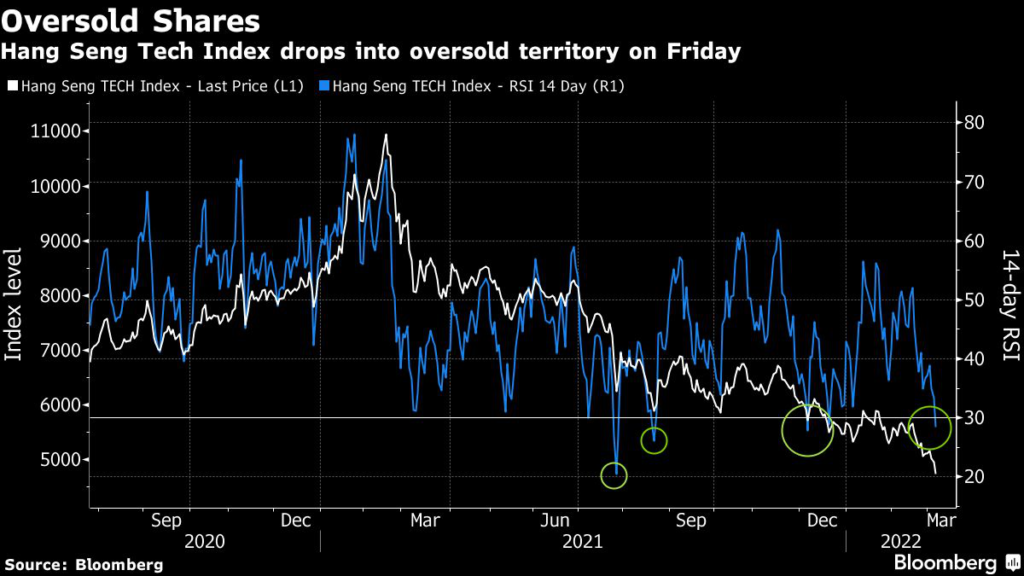
A three-day, 8% plunge has sent the Hang Seng Tech Index into the oversold zone for the first time in more than two months, as investors dumped the sector amid earnings shocks and the escalating war in Ukraine. 

Some of the country’s biggest technology firms, including gaming giant Tencent Holdings Ltd. and mobile-phone maker Xiaomi Corp have dropped to or near territory oversold territory, Bloomberg data shows. A drop in the 14-day relative strength index below 30 is traditionally seen as a signal to technical analysts that a security has fallen too far, too fast.

History shows the index rose by an average 2.8% in the week after dropping into the oversold zone. However, even as technical indicators look more favorable, investors will have to bear the risks of a weak earnings outlook and a global flight to safety. With the Ukraine war in focus and the Federal Reserve having turned more hawkish, buying into the shares remains risky. 

“It’s very hard to say the selloff is overdone,” said Willer Chen, analyst at Forsyth Barr Asia Ltd. “Fundamentally speaking, they all have very dim growth outlook, with ads getting hit due to macro,” delays with gaming license approvals and fierce e-commerce competition, he said.

The Hang Seng Index tech gauge has lost 56% since peaking in February last year. Despite being valued like a utility stock already, Alibaba Group Holding Ltd. slumped to fresh record low after reporting the slowest quarterly revenue growth. Video platform operator Bilibili Inc. declined after weaker-than-expected guidance.

Tech Chart of the Day

Some U.S. tech stocks are also trading at a steep discount, led by Facebook-owner Meta Platforms Inc. A dismal earnings update and slowing user growth for its flagship social media platform has eroded more than $500 billion in market value since last September’s peak.

Top Tech Stories 

  • Airbnb Inc. is suspending its operations in Russia and Belarus, Chief Executive Officer Brian Chesky said in a tweet Thursday evening
  • Broadcom CEO gave an upbeat view of the chip industry Thursday, saying demand from corporate customers is “on fire,” though he warned that the gains won’t last forever
  • Amazon’s Twitch, the popular site where people go to watch other people play video games, has lost at least six top employees since the beginning of the year
  • Sony Group and Honda Motor are joining forces to develop electric vehicles, seeking to marry their strengths as the cars of the future become more technology-driven and interconnected
  • Coinbase Global Inc. CEO said he wont ban all Russian uses for now as “some ordinary Russians are using crypto as a lifeline now that their currency has collapsed”


More stories like this are available on bloomberg.com

©2022 Bloomberg L.P.

A Deal With Putin Leaves Automaker Renault Trapped in Russia

(Bloomberg) — Volkswagen AG, BMW AG and Toyota Motor Corp. have idled Russian plants and suspended shipments to the country as part of a broader retreat by global corporate giants. The one automaker with the most to lose, Renault SA, has remained conspicuously silent. 

The French company has lost nearly 30% of its market value in the wake of Russia’s invasion of Ukraine and ensuing economic sanctions. Russia is Renault’s second-biggest market, and it’s paying a heavy price for a $1 billion deal sealed in 2007 with a top ally of Russian President Vladimir Putin.

Renault’s majority control of AvtoVaz, the Soviet-era maker of Ladas, and reliance on Russia for about 12% of its revenue are now matters of investor concern. Cutting ties with the venture would come at a tremendous cost, and prospects for a broader economic slump across Europe risk derailing its already-tenuous turnaround efforts.

“It would be perfectly legitimate for Renault to consider an exit from AvtoVaz,” said Jefferies analyst Philippe Houchois. “Renault could take the loss, but an exit would be a tough decision.”

Russia accounted for about 5 billion euros ($5.5 billion) of Renault’s revenue last year, and roughly 315 million euros of operating profit could be at risk, Bloomberg Intelligence estimates. Renault shares continued their downward slide that started last week falling as much as 7.5% Friday to the lowest since November 2020.

As a flood of companies worldwide pull back and unload assets in Russia, Renault and the French government — its most powerful shareholder — have kept mum on AvtoVaz. So has the other partner in the venture, Rostec State Corp., a Russian government-owned defense conglomerate headed by Sergey Chemezov, a close ally of Putin.

“Renault has promised to abide by sanctions,” Gabriel Attal, the French government spokesman, said Thursday on France Info radio. A spokesman for AvtoVaz declined to comment beyond operational issues. Renault continues to monitor the situation, according to a spokesman.  

Renault’s foray into Russia a decade and a half ago was decided at the highest political levels, and any exit would be politically fraught. If the company stands pat, it could have a hard time collecting money from a business it’s sunk more than $2 billion into over the years.

“One risk for Renault is that capital controls could prevent it remitting profits or cash from AvtoVaz and its other Russian operations,” said Redburn analyst Charles Coldicott.

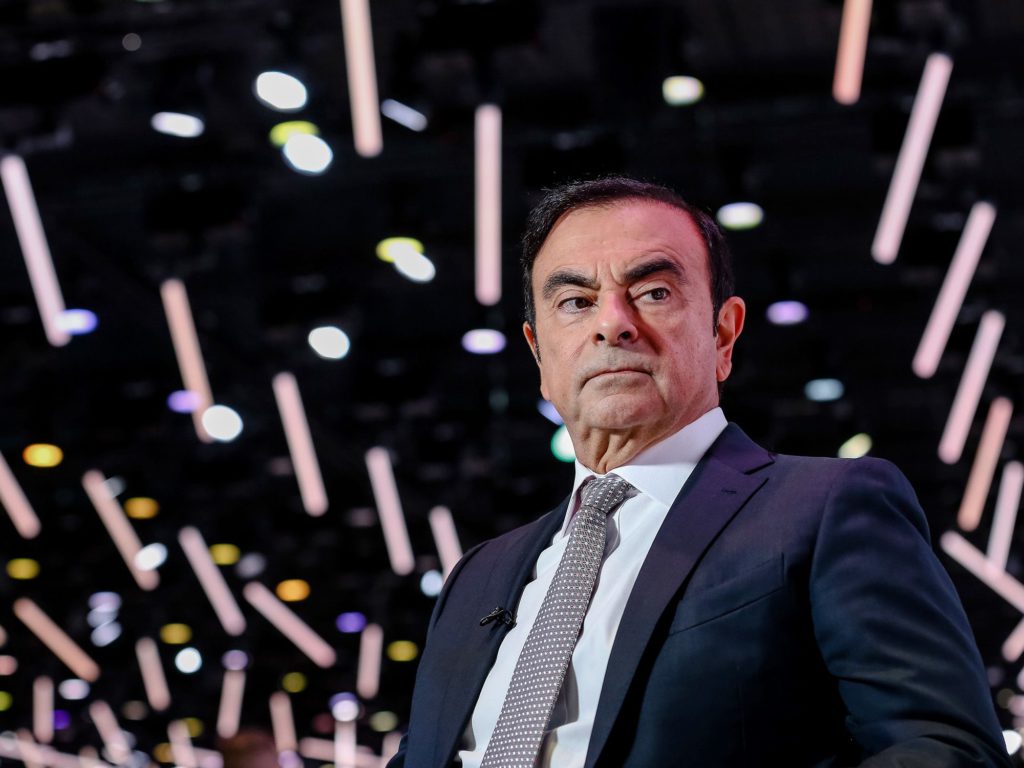
Back in 2007, Putin dictated Renault’s initial deal for a 25% stake in AvtoVaz under former leader Carlos Ghosn. The accord was backed by France and spearheaded by Chemezov. The Rostec CEO’s close ties with Putin trace back to when they lived in the same Dresden apartment complex in Germany during the 1980s as the future president worked as a KGB officer. 

“When we decided to move into Russia and make this alliance with AvtoVaz everything was fine,” Ghosn said Thursday in an interview with Bloomberg TV. “It made a lot of sense.”

Ghosn, who was ousted from his role in 2018, said he was surprised that Renault’s current management hasn’t communicated on the situation. “I’m stunned by the fact that it’s complete silence.”

Following Renault’s initial investment in AvtoVaz, subsequent increases in its shareholding were also piloted by the Russian state. Russia now accounts for about 18% of the company’s total vehicle sales. AvtoVaz in 2021 sold about 385,000 Ladas, mostly in Russia. 

AvtoVaz’s reliance on the domestic market means a deep economic slump would spell trouble. “Historically, during times of recession in Russia AvtoVaz has been heavily loss making,” Coldicott said. 

Founded with the help of Fiat SpA in 1966 when Russia was part of the Soviet Union, AvtoVaz’s Ladas had almost 80% of the market during the Communist era and still command about a fifth of the Russian market. Renault has refurbished its massive Togliatti plant on the banks of the Volga River and redesigned the cars to try to reverse local consumer perception of shoddy workmanship and style. 

Turnaround Plan

Brightening prospects in recent years for Lada formed part of Renault Chief Executive Officer Luca de Meo’s revival plan for the group. He forecast an “incredibly profitable” business model for the Lada and Dacia budget-car brands, with shared manufacturing processes and technology.  

The war in Ukraine isn’t the first time AvtoVaz has tripped up Renault. Within a year of its initial investment, the financial crisis saw AvtoVaz’s value plummet and Putin pressed Renault to come to the rescue. Ghosn’s move to take a controlling stake for Renault and Japanese partner Nissan was aimed at gaining a foothold in one of the biggest emerging growth markets — the so-called BRICs at the time — after mostly missing out in the others.

Then in 2014 a first round of sanctions hit after Putin annexed the Ukraine region of Crimea. Renault acquired a controlling 51% stake in 2016 after Ghosn pledged to do “whatever it takes” to back the loss-making venture on the verge of collapse.

The ongoing war in Ukraine is now posing a new and perhaps more serious threat to the carmaker because of the potential to reverberate beyond Russia’s borders.  

“Renault’s turnaround plan is predicated on a recovery in the European auto market,” Houchois said. “The longer the crisis continues, the greater the likelihood of a recession in Europe.”

(Updates with shares in fifth paragraph)

More stories like this are available on bloomberg.com

©2022 Bloomberg L.P.

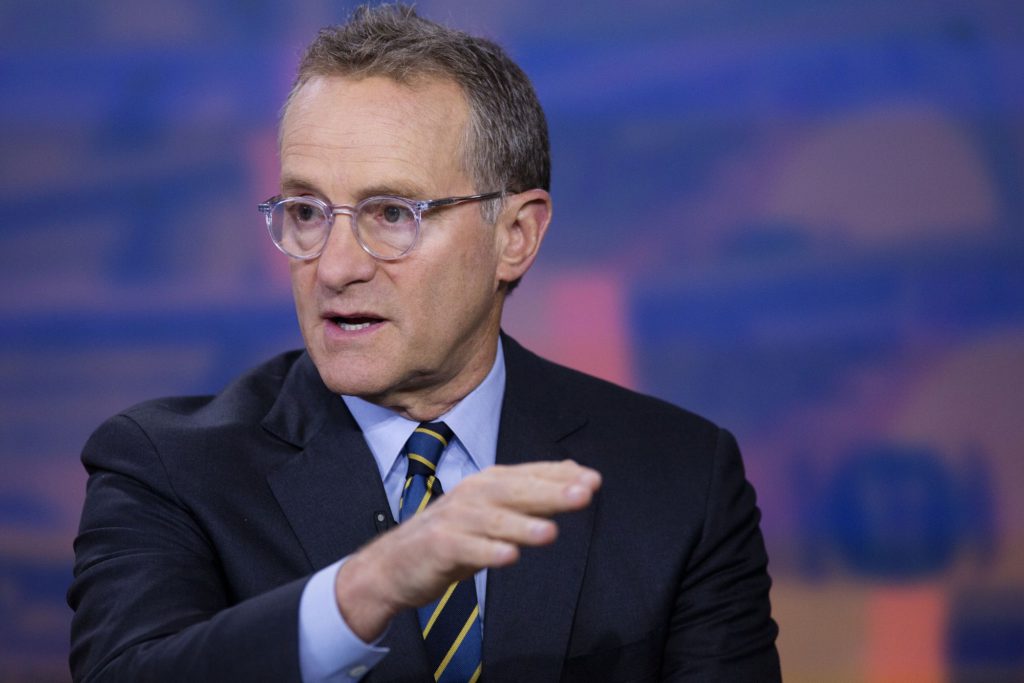
Howard Marks Calls China Market a ‘Buy’ in Oaktree WeChat Debut

(Bloomberg) — Oaktree Capital Management’s co-founder vowed to participate in China’s market in the long run by “always buying,” as the distressed-debt investor launched a WeChat social media account. 

“Losing sight of those long-term prospects because of the desire to avoid short-term volatility can result in investors missing out on great opportunities,” Howard Marks said in an interview posted to the platform. “Your entry price matters, and today’s climate should lead to many attractive entry points.”

Oaktree, with offices in Shanghai and Beijing, has made more than 30 billion yuan ($4.7 billion) of investments in China, according to the post. “Stimulating its economy while staying true to the ‘common prosperity,’ and deleveraging its financial system will be China’s greatest challenge,” Marks said. 

Read more on Oaktree’s deals with troubled Chinese developers

Marks said late last year that the Los Angeles-based firm was actively working on deals to finance China’s struggling real estate companies, even as contagion from China Evergrande Group kept other financiers away. The firm seized a plot of land owned by Evergrande in Hong Kong, the Financial Times reported in late January. 

While the property sector’s woes and the Covid-19 pandemic are dragging on the economy, Marks expressed optimism in the WeChat interview. 

“If China was a person, it would be someone in their youth,” he said. “While the young experience ups and downs, the future is bright.” 

More stories like this are available on bloomberg.com

©2022 Bloomberg L.P.

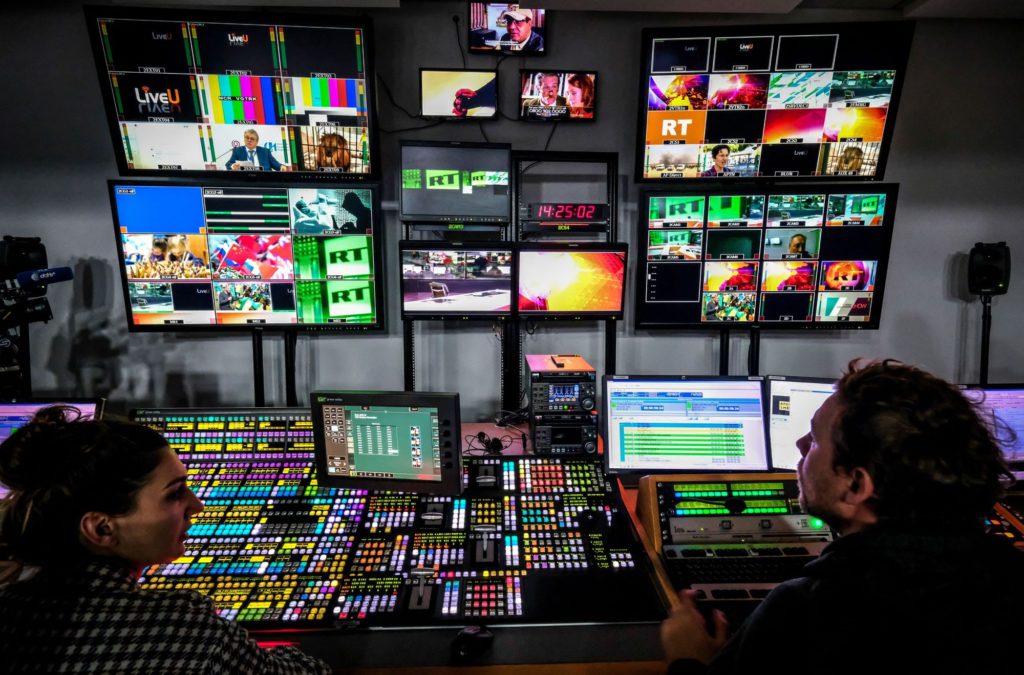
Putin Propaganda Machine Undercut by Social Media Blackout

(Bloomberg) — Russia’s invasion of Ukraine dredged up concerns that the country’s aggression would extend to social media, and that the Kremlin’s long-running campaign to use the internet to stir doubt and division in democracies would confuse public opinion on the war. 

Instead, social media has become an unexpectedly effective vehicle for galvanizing public opinion across many countries against President Vladimir Putin’s actions, while at the same time silencing much of his propaganda. 

In the five years since Russia meddled in the 2016 U.S. presidential election, companies including Facebook parent Meta Platforms Inc. and Twitter Inc. have built systems to ensure they wouldn’t be blindsided the next time. Their jobs were made easier by warnings from U.S. intelligence about the planned attack — making it more difficult for Putin to disseminate false pretexts for aggression — as well as directives from the European Union about banning Russian state media.

“There has probably been a miscalculation on Putin’s part about what the response of the West would be,” said Joshua Tucker, a professor at New York University who runs the school’s Center for the Advanced Study of Russia. In the U.S., opposition to Putin is a rare point of bipartisan agreement, making it an easy decision for Facebook and Twitter to act, he added. “It might be more dangerous for [social media companies] not to take decisive action.”

For years, Russian operatives have embedded themselves into democracies including the U.S. through social media, running fake accounts that masqueraded as real citizens with polarizing opinions. Most famously, ahead of the election that made Donald Trump president, Russia created accounts that exchanged memes online about hot-button issues such as gun control and immigration, while encouraging Black people not to vote. 

Social media companies were scolded by regulators worldwide for not catching such campaigns sooner, causing them to invest in more sophisticated content-moderation systems. The efforts also raised questions about Putin’s goals, and whether he was aiming to cause chaos or was working toward something more specific, like weakening the global response to an invasion.

“A war in Europe, preceded by a years-long propaganda and influence campaign that destabilized, captured and divided European and U.S. populations,” Emily Bell, the director of the Tow Center for Digital Journalism, said in a Feb. 23 Twitter post. “This does not seem a random path.”

But this time, social media companies were better prepared to crack down on Russian propaganda, moving more quickly at the request of multiple governments and the EU. Facebook and Instagram have banned ads from Russian state-backed media, and Twitter isn’t showing ads in Russia at all. Snap is blocking ads from all Russian advertisers. 

Facebook and Twitter have also started labeling posts that include links to Russian state-backed media outlets so people know what they’re reading. Facebook also removed a pro-Russia disinformation network that was targeting users in Ukraine.

Read more about Big Tech’s Russian State Media takedowns 

YouTube, Google’s video site, which is hugely popular in Russia, hosts a number of news outlets and online personalities close to the Kremlin. RT, the state-backed network formerly called Russia Today, bills itself as the “most watched news network on YouTube.” This past week YouTube removed ads from channels run by RT and other state-backed networks, blocked them in Europe and limited the amount they recommended them to viewers. TikTok did the same.

Laura Edelson, a researcher and misinformation expert at New York University, noted her surprise in a tweet thread. “TECH PLATFORMS: They’re not totally beefing it!” she wrote. Companies were assisted by the U.S. government’s unusual approach of sharing intelligence information in order to combat false narratives coming out of Russia. “Not leaving an information vacuum for your opponent to fill makes their job much, much, harder,” she added.

Also flooding the sites: Ukraine’s messaging. President Volodymyr Zelenskiy has become a popular hero for his on-the-ground selfie videos during the war, providing a contrast with the imagery of Putin’s speeches from vast opulent ballrooms. Ukrainian government accounts have been posting videos, photos and even memes to build support for the country’s fight.

Experience may be the most important factor guiding the social media companies’ response this time. When Meta removed a disinformation network targeting Ukrainians, it was the same type of disinformation campaign the company has been taking down with regularity since discovering them in 2017. The technology and process needed to label user posts was also well-established — Facebook, Instagram, Twitter and YouTube have been labeling posts for years for various reasons, including for misinformation.

Not everyone is ready to applaud social networking companies, though, especially given their track record of failing to act on problems until they become full-blown crises. Despite blocking Russian media in the EU, YouTube has kept most of the channels up, and some have published videos with millions of views.

The battle is not just against Russia’s content. On TikTok, for example, people have used old audio clips on top of new video to share fake “war footage,” according to a report from Media Matters. Such videos can help accounts gain followers, or solicit donations from sympathetic viewers. Even when videos are removed within hours they can garner millions of views. 

“We continue to respond to the war in Ukraine with increased safety and security resources to detect emerging threats and remove harmful misinformation,” TikTok said in a statement.

Others have said the social media companies’ blocking of state media is too little, too late.

“The platforms should get no credit for taking temporary steps against some of Vladimir Putin’s disinformation websites and popular YouTube channels,” said Gordon Crovitz, co-CEO of NewsGuard Technologies, a startup that tracks news credibility. “They have known for years that their users were seeing Putin’s disinformation without warning them.”

In 2014, Russia Today was one of several state-controlled news outlets that amplified government claims that Ukraine shot down Malaysia Airlines Flight 17. Only overwhelming evidence showed that the plane was shot down by Russian-backed separatists, likely by accident.

Articles from Russia Today promoting the fake story were liked and shared thousands of times on Facebook, with one post reaching nearly 6,000 likes and 4,800 shares. On Twitter, conspiracy theorists would continue linking to RT and Sputnik’s stories to justify their wild claims.

It wasn’t an isolated incident. Crimea’s 2014 disputed referendum to become a part of Russia was covered as an exercise of democracy by RT. Three years later, Sputnik claimed a Ukrainian language law was “linguistic genocide.” And in 2018, RT aired an interview with the Skripal poisoning suspects who claimed they were tourists just visiting Salisbury Cathedral.

Edelson noted that while it’s positive for social networks to block Russia-backed media in Europe, it should also be blocking those outlets worldwide. “Not blocking long-time spreaders of misinformation globally when the government that controls them is actively trying to lie about their war atrocities is… NUTS,” she tweeted.

Following the annexation of Crimea by Russia in 2014, English-language media outlets owned by the Russian state, such as RT, have been producing large amounts of content regarding Ukraine. Over the past year, such articles have received over 500,000 likes, comments and shares from Facebook users, according to research by the Center for Countering Digital Hate.

Now, the companies have political cover to be aggressive against such content. Russia’s invasion of Ukraine has been almost universally condemned, and a lot of the restrictions on Russian state-backed media have been implemented at the request of governments, including the European Union, which voted over the weekend to block Russian state media across the bloc. Opposing an invasion by an authoritarian leader isn’t the kind of thorny policy or political decision that Meta and Twitter typically face.

Social media platforms are rolling out many of the strategies developed during other challenges, such as the spread of Covid-19 conspiracy theories, or the violent rhetoric that bubbled ahead of a 2021 insurrection at the U.S. Capitol.

Meta recently “amplified” its cybersecurity team with a special operations center, and stopped Ghostwriter, a known threat actor with a history of spreading Kremlin-friendly propaganda, from posting content including a YouTube video supposedly showing Ukrainian soldiers waving a white flag and surrendering to Russian troops.

“Each passing incident probably updates their thinking,” Tucker said.

Government officials are still calling for platforms to do more to tackle Russian disinformation. The prime ministers of Poland and the Baltic countries also urged Google, YouTube, Meta and Twitter to take a stand against Russia by taking down the accounts of the Russian and Belarusian governments, their leaders and associates.

There may be risks that Russia will retaliate against western tech companies’ bans on their state media. Companies and experts are worried that Russia could cut off its citizens’ access to credible information. 

After Berlin banned RT’s German operation last month, Russia responded by revoking Deutsche Welle’s accreditation, prompting its Moscow bureau to shut. Russia has also been throttling the performance of social media sites in its country, where citizens organized protests in the early days of the war.

“If the Russians now kick out all the Western media, I mean, then what’s the net loss or benefit?” said Stephan Lewandowsky, a cognitive scientist and misinformation expert at the University of Bristol. “There are always flow-on consequences of this.”

More stories like this are available on bloomberg.com

©2022 Bloomberg L.P.

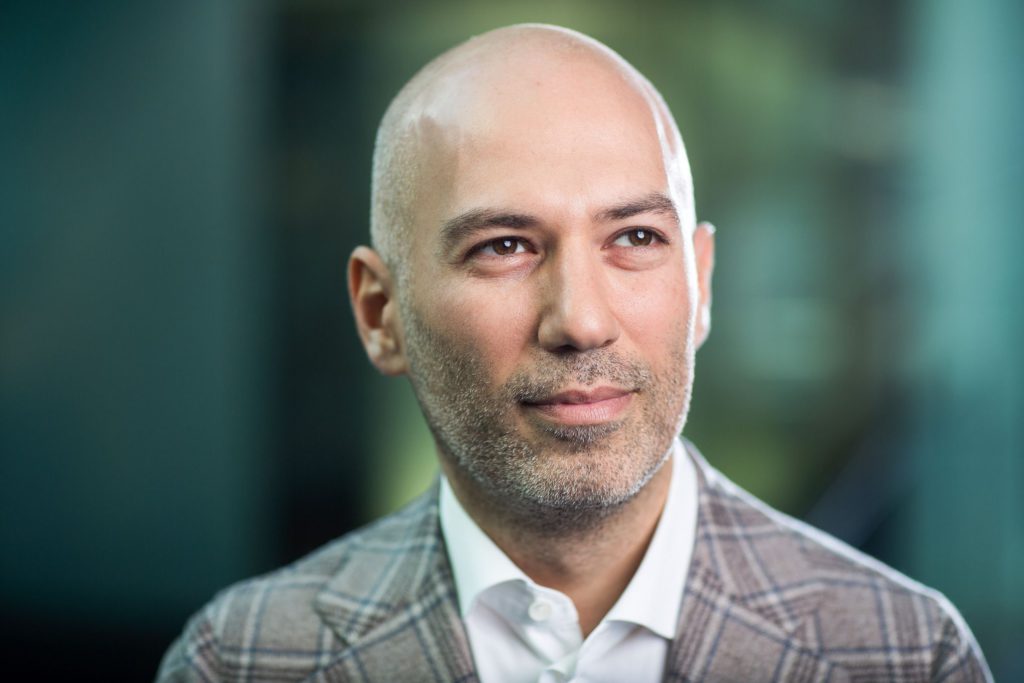
Russian Mogul’s EV Startup Struggles One Year After SPAC Deal

(Bloomberg) — There was so much going for Arrival Ltd. when Denis Sverdlov was preparing to take the maker of electric vans and buses public a year ago.

The Russian founder and chief executive officer of the mostly U.K.-based manufacturer had brokered a partnership to jointly develop vehicles with Hyundai Motor Co. and Kia Corp., and lined up a major order from United Parcel Service Inc. All three invested before BlackRock Inc. put in more money. Then a special purpose acquisition company came calling.

“It’s an opportunity, but it’s also a huge responsibility,” Sverdlov said of Arrival’s listing on the Nasdaq during a March 2021 virtual opening-bell ceremony. “I know we’re ready for it.”

But the more than $13 billion market capitalization Arrival debuted with was its high-water mark. The company’s valuation plunged to just below $2 billion by late January, after it pushed back production plans and told investors to no longer rely on the forecasts it made during the SPAC merger. Sverdlov, 43, took time out of an earnings call this week to, in his words, “address any concerns related to my nationality.”

The former Russian deputy minister for communications and mass media said he no longer has any form of connection with the government. He left the country in 2013 and two years later moved his family two London, where he founded Arrival. The company doesn’t source any parts from Russia and doesn’t expect the war in Ukraine to materially affect its business.

Rewriting Rulebook

Arrival’s slick-looking prototypes, built-in-house autonomous robots and radical approach to manufacturing made for one of the more promising pitches during the SPAC boom of the last several years. Now that many of the companies that went public via reverse mergers — including several EV producers — are struggling to live up to bold projections, having backlogs of non-binding orders is no longer enough. Vehicles need to start rolling off assembly lines.

“What we’re doing is extremely challenging,” Arrival President Avinash Rugoobur said in an interview. “We are changing the rulebook of the industry. We’re talking about small, agile production facilities that are low capex, that are building clean vehicles. You could not get more opposite from where the industry is.”

Whereas other post-SPAC-merger EV companies including Nikola Corp., Lordstown Motors Corp. and Canoo Inc. lost founders soon after their listings, Sverdlov is staying put. He built his initial fortune in Russia’s broadband industry and co-founded Yota Devices, the maker of a dual-screen smartphone.

High-Profile Hires

Sverdlov has assembled a star-studded team at Arrival. Rugoobur, 40, was head of strategy and mergers and acquisitions at General Motors Co.-backed self-driving company Cruise. Michael Ableson, CEO of Arrival’s automotive operations, was vice president of global strategy and oversaw EV charging and infrastructure for GM.

Ableson provided a tour of Arrival’s first factory in Bicester, England, a couple hours’ drive northwest of London, in early February. Rather than run conveyor belt assembly lines, the company breaks up manufacturing processes into what it refers to as tech cells. Its proprietary square-shaped industrial autonomous robots, which can each move as much as 2 metric tons, transport vehicle structures from cell to cell.

“We have confidence in the processes, we’ve done a lot of simulation, and you can see, the hardware is going in place now,” Ableson said. “It won’t be long and they’ll all be in motion.”

Bus Setback

Arrival’s progress since that tour has been mixed. 

On the one hand, the company began assembling the skateboard-like architectures that will underpin the vans it builds in Bicester. But it’s no longer planning to make buses at another factory in Rock Hill, South Carolina, in the second quarter, which was the plan as of late last year. The facility will instead start up at an unspecified later date. 

The first buses will go into production in the U.K. during the second half of this year. FirstGroup Plc, the country’s second-largest regional bus operator, is expecting to start public road trials with Arrival buses before the end of the month and has sought government funding to add almost 200 of the vehicles to its fleet.

The slip in Arrival’s production schedule announced is less drastic than what it disclosed in November. 

In addition to scrapping long-term forecasts, Sverdlov cautioned that the size of the business would be defined by the number of low-cost, highly automated microfactories the company deploys, and the amount of capital it has access to. He dialed back the initial amount of production planned for Arrival’s first three plants, delayed a fourth by a year due to cash constraints, and raised $648 million through a share offering and convertible green bond issue.

Modules and Materials

Arrival’s big bet is on being able to make its $905 million cash balance go a long way. It’s using the same battery modules, screens and other common components across its vans, buses and a car purpose-built for ride-hailing it’s developing with Uber Technologies Inc.

The company’s products will also share a unique approach to materials. 

Building steel and aluminum-bodied vehicles requires putting in presses and making massive investments in tooling and paint shops. Arrival is working with thermoplastics and composites that don’t corrode, are recyclable and mimic the stiffness and strength of metals. Rather than relaying on heavy presses and steel dies for stamping, the company uses vacuums and heat to mold lighter and cheaper panels.

Execution Time

Arrival believes the innovations it’s pioneering will enable the company to construct microfactories in six months or less, much faster than the years-long process it can take to get a traditional auto plant up and running. Executives also think they can can spool up new sites at a fraction of the cost.

The company hasn’t lost faith in its approach, though it’s starting up cautiously. Each of Arrival’s microfactories will initially operate on one shift and won’t reach full capacity until early next year. The company expects to deliver 400 to 600 vans to customers by year-end.

Those plans depend on Arrival successfully certifying its vehicles for road use. The company expects to sew up this process with its bus in the coming weeks and with its van in the second quarter.

“This turning point — from research and development, to production, to entering into service — is crucial,” said Franck Dessenis, vice president of Arrival’s bus program. “You move from ‘let’s find the next big idea,’ to ‘let’s execute.’”

More stories like this are available on bloomberg.com

©2022 Bloomberg L.P.

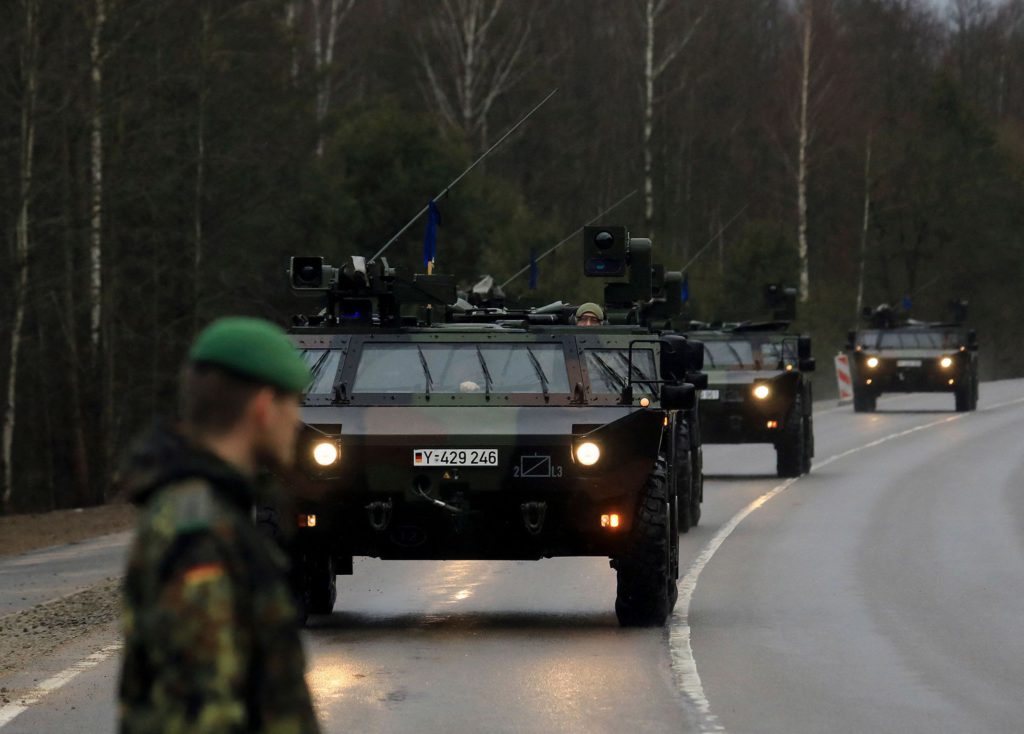
Banks Change Course on Weapons Finance as Defense Spending Soars

(Bloomberg) — After years spent treating weapons manufacturers with caution, bankers in Europe are now positioning themselves for closer relations with the defense industry.

Russia’s war on Ukraine has led Germany — Europe’s biggest economy — to abandon its decades-old aversion to military spending, and instead embrace what Chancellor Olaf Scholz has called a “new era” of investment. For banks and asset managers, the development means a group of clients that until recently had been kept at arm’s length is now being invited to seek financing. 

SEB AB, one of Sweden’s biggest banks, said this week it’s reversing a ban on investing in weapons as it adjusts its sustainability policy to match Europe’s new geopolitical reality. And Commerzbank AG signaled it’s keen to channel capital into arms manufacturers.

“It is clear that there will now be more investments in the defense industry here in Germany, and they’re all our clients,” Manfred Knof, the chief executive of Commerzbank, told analysts and investors this week. “This is definitely a good basis. We know them, they know us and I’m sure they will talk to us for further investments.”

Read More: Germany to Boost Military Spending in Latest Historic Shift 

Just two months ago, weapons manufacturers were still struggling to get financing due to their near-pariah status in a world increasingly dominated by environmental, social and governance considerations. 

Weapons Lobby

Rheinmetall AG CEO Armin Papperger told local media in January that his firm had been cut off from credit by German lenders LBBW and BayernLB, due to their ESG concerns. ASD, an umbrella organization for defense lobbies across 17 European countries, is aware of similar examples across the EU, according to its secretary general Jan Pie. 

But the European response to the war in Ukraine has changed everything. After Scholz’s Feb. 27 pledge to ramp up spending, German defense stocks saw steep gains. 

At the same time, weapons lobbyists are actively trying to shape a future stage of Europe’s ESG rules, a so-called social taxonomy. And there are signs the EU is listening. In a policy paper last month, the bloc spoke of the need to ensure that “initiatives on sustainable finance remain consistent with European Union efforts to facilitate the European defense industry’s sufficient access to finance and investment.”

The Economic Council, a German lobby group for small and mid-sized businesses, says the EU has now decided to delay the social taxonomy, citing unnamed officials. It says the delay was the result of an intense lobby effort. A European Commission spokesperson declined to comment. 

But there’s little appetite in the commission to press ahead with a social taxonomy as the EU’s executive arm continues to field scathing criticism for adding gas and nuclear to the green taxonomy, according to a diplomat familiar with the process who asked not to be identified revealing behind-the-scenes concerns.

ESG Concerns

Talk of labeling weapons as sustainable assets has alarmed and bewildered many in the ESG industry. According to Util, a company that crunches big data to measure the environmental and social impact of businesses and investment decisions, the debate is misguided.

“Categorizing weapons manufacturers as ESG-positive is a misrepresentation of the facts,” said Patrick Wood Uribe, CEO at Util. “Their purpose is warfare, which —- setting aside a wealth of important moral questions -— has no clear positive social outcomes.”

An analysis by Util of 120 million peer-reviewed texts showed that the defense industry “is responsible for many of the inventions that improve our living standards, as well as entire industries and millions of jobs in biotechnology and pharmaceuticals, electronics and telecommunications,” he said. But, “on the other hand, the industry has been and continues to be responsible for millions of deaths.”

SEB said its change in policy, based on a view that “investments in the defense industry are of key importance to uphold and defend democracy, freedom, stability and human rights,” only affects certain funds. It also noted that some investors have made clear they won’t touch such assets, and underlined its intention to avoid all weapons that violate international conventions.

Whatever happens with Europe’s social taxonomy, Knof of Commerzbank says Germany is witnessing a “fundamental change” in policy. 

“We are at the side of our customers — the German defense corporates,” he said, “We’re supporting them.”

(Adds comment from EU commission in 10th paragraph; a previous version corrected the name of a German lobby group in the 6th paragraph)

More stories like this are available on bloomberg.com

©2022 Bloomberg L.P.

Close Bitnami banner
Bitnami