Bloomberg

Russia’s Crypto Volumes Are Stalling Across the Major Exchanges

(Bloomberg) — The Russians-are-evading-sanctions-via-crypto narrative looks off the mark.

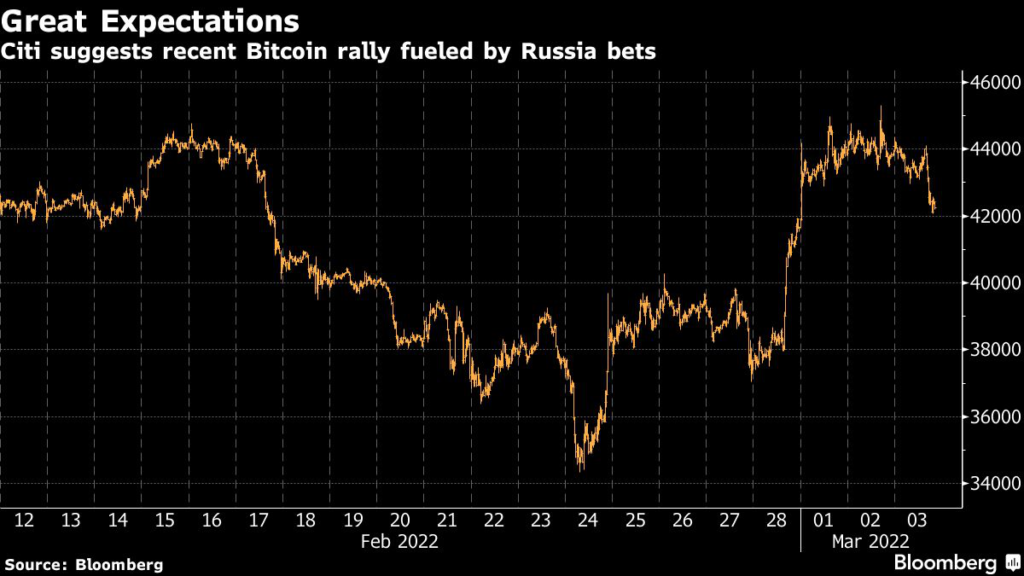
As the world’s largest digital currency rallied 12% Monday, expectations of surging demand from Russia-based investors was cited by some in the industry as the proximate cause. 

But recent blockchain data suggest residents in the sanction-hit nation have been in no hurry to trade crypto on major exchanges. Ruble-denominated crypto activity was just $34.1 million on March 3, according to Chainalysis. That’s down significantly from a recent peak at $70.7 million on Feb 24 — and the $158 million record back in May 20 2021.

“This is a fraction of the volume that was seen during the all-time highs of Russian crypto trading volume reached May 2021,” said Madeleine Kennedy, senior director of communications at Chainalysis 

Citigroup Inc. also estimates actual Bitcoin buying from the nation was just 210 BTC on average per day in the past week, versus a total daily volume that tends to range between $20 billion and $40 billion. 

While Russians may still be trading on a peer-to-peer basis, large volumes should still be visible on the blockchain. That suggests the Bitcoin rally over the past week to above $45,000, as Moscow stepped up its invasion of Ukraine, has little to do with the nation’s buying power in practice. 

“Russian volumes have been relatively small so far, suggesting that the price action is more due to investors positioning for an expected uptick in demand from Russia, rather than Russian demand itself,” according to Citi analysts including Alexander Saunders in a Wednesday report. “It will take meaningful capital flight to move the needle.”

Regulated exchanges can still provide services to Russia-based users outside the ever-expanding list of sanctioned entities. 

“As if yet, we haven’t seen evidence of large-scale sanctions evasion by sanctioned Russian entities,” Chainalysis’ Kennedy said. “If the do attempt to use crypto, it would be very difficult for them to do this undetected at scale.”

Bitcoin was 4.6% lower in New York trading Thursday at $42,065.

More stories like this are available on bloomberg.com

©2022 Bloomberg L.P.

Amazon Union Has Green Light to Hold Second NYC Election

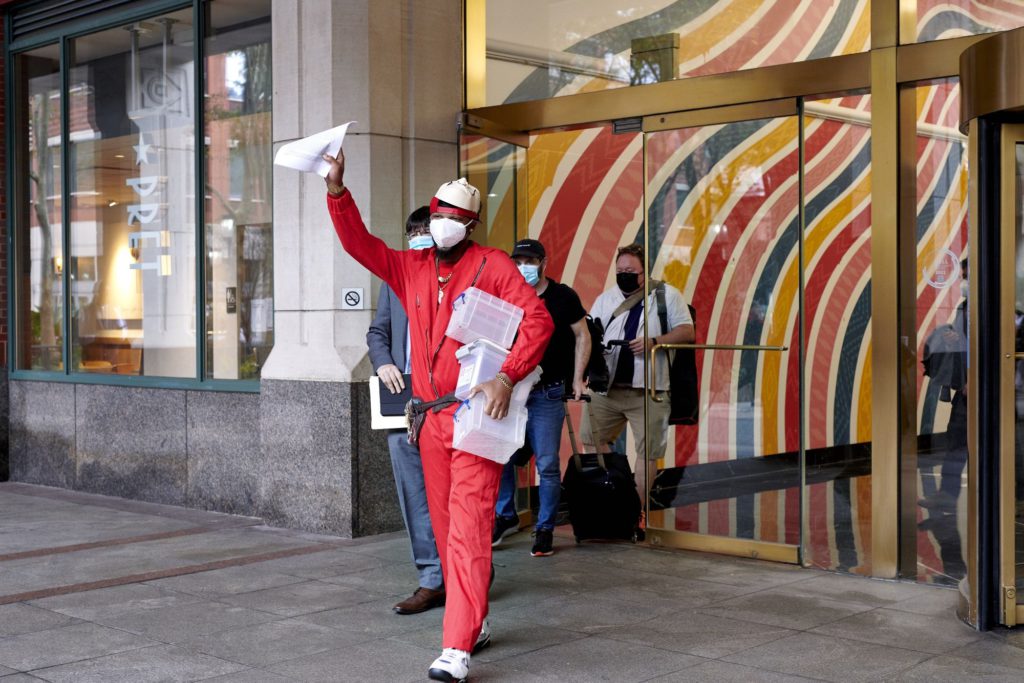
(Bloomberg) — Amazon.com Inc. workers at a second facility in New York have won approval to hold a union election.

The upstart Amazon Labor Union has gathered enough signatures from employees at the LDJ5 warehouse in Staten Island to proceed with a vote, according to a National Labor Relations Board spokesperson. 

The union previously won approval to hold an election at the nearby JFK8 fulfillment center, where voting will run from March 25 to March 30. 

The NLRB said that if Amazon and the ALU fail to agree on which job roles should be included in the proposed bargaining unit at the second Staten Island facility, each party will have a chance to air their concerns at a hearing. After that, an NLRB official will decide when the election can proceed. 

“We look forward to having our employees’ voices heard,” Amazon spokesperson Kelly Nantel said in a statement. “Our focus remains on working directly with our team to make Amazon a great place to work.” The company on Thursday announced a partnership with the City University of New York that will cover tuition and some fees for qualifying hourly employees. The new benefit could help the company lure front-line workers in a tight labor market and boost its image as a good employer.

ALU leader Christian Smalls and his allies face long odds. Amid fierce opposition from Amazon, the far more established Retail, Wholesale and Department Store Union lost an election last year at a fulfillment center in Bessemer, Alabama. After the union appealed the outcome, the labor board ordered a fresh election, which is now underway. But it’s far from assured the RWDSU will prevail this time.

Still, the successful petition for a second election in New York is a coup for Smalls and his group, who lack prior union organizing experience. Smalls worked at Amazon for more than four years before being fired in 2020 for what the company said was a violation of safety guidelines. Smalls said he was protesting Amazon’s Covid-19 policies. 

Last week, Smalls was arrested at the JFK8 facility and charged with trespassing, resisting arrest and obstructing governmental administration. Two workers were also charged with obstructing governmental administration. Smalls said he was delivering food to workers, but Nantel said he had “repeatedly trespassed despite multiple warnings.” 

(Updates with Amazon education initiative.)

More stories like this are available on bloomberg.com

©2022 Bloomberg L.P.

Ukraine’s Crypto Army Is Both Inspiration and Cautionary Tale

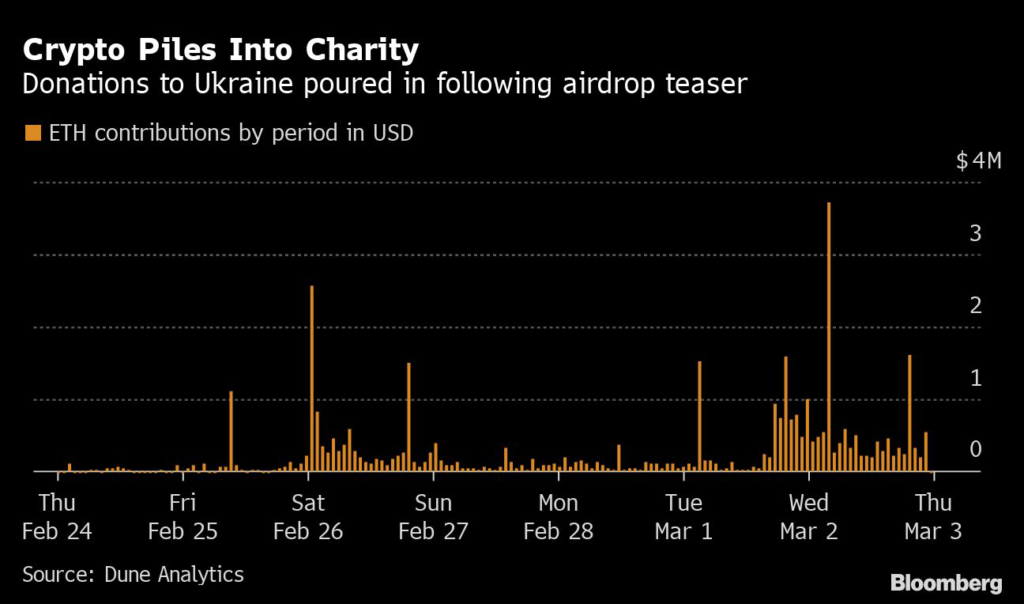
(Bloomberg) — Donations to the Ukrainian government and associated charitable organizations are skyrocketing as the fighting has intensified against invading Russian forces. Cryptocurrencies have figured conspicuously in the effort, billed as a new and welcome resource for the country in a time of crisis. But Ukraine’s journey into the cryptoverse has had its bumps, serving as much of a cautionary tale as an inspiration.

The Ukrainian government has established multiple digital wallets to receive donations in a variety of cryptocurrencies from Bitcoin to Dogecoin, while other non-governmental bodies also have their own wallets to procure donations for the country’s armed forces. The process of tracking just how much has been donated is tough, though, despite crypto’s professed transparent nature. Bloomberg verified more than $28.5 million in donations to Ukraine’s government as of Thursday morning, but other sources such as blockchain analytics firm Elliptic puts the total closer to $43 million. The amount is but a drop in the ocean, however, with Ukraine’s 2021 defense budget estimated at $4 billion.

To those on the ground, assistance is vital no matter what form it comes in. For some Ukrainians abroad, crypto is where they feel they can contribute the most to aid the fight in their homeland. And Ukraine’s success in raising money and commanding the attention of crypto’s masses has been nothing to sniff at. But the process hasn’t been without snarls: Ministers and donors alike have had to navigate a range of pitfalls including a failed project, a lack of spending power and rampant scams. 

Some of its ideas have been good in theory, if not a little unorthodox. A promise by the Ukrainian government on Wednesday to reward crypto donors with a so-called “airdrop” — a process where early backers are given free tokens to help jump start a project — saw donations to its affiliated crypto addresses soar. People rushed to part with their tokens ahead of a cutoff point at which a record would be taken of the donations made so far, effectively gamifying the humanitarian push by inviting in those who could make a quick buck off the resulting rewards.

But the airdrop was canceled a day later, following a spoof scam in which the government’s Ethereum address appeared to be distributing reward tokens to individual crypto addresses hours ahead of schedule. Jess Symington, research lead at Elliptic, said the hacker had sent 7 billion newly minted tokens to Ukraine’s Ethereum address that contained a permission allowing them to control the tokens from whichever wallet received them — meaning that any tokens then sent from the Ukraine address would convincingly appear to have been transferred by the government itself.

The airdrop incident is only one example of how the state’s use of cryptocurrencies has resulted in an uptick in scams during the fundraising process, as incredibly adept digital attackers target people’s goodwill in seeking to do what they can to help the cause.

“The major peril that we’re seeing is just an unbelievable number of scams,” Symington said in an interview. “We’re seeing people screenshot Ukrainian government tweets with the addresses and just photoshop on their own addresses. We’re seeing people say, ‘I’m raising money, here’s my address’, and it’s obviously their personal address. We’re just seeing a huge number of scams.”

Aside from the figures, information about how the Ukrainian government spends the crypto it has received has been extremely limited, their hands tied by the restricted number of ways it can utilize the tokens for aid. Donations received to its Ethereum address have largely been transferred to a local crypto exchange for conversion into fiat currency, while non-governmental crypto organizations established to garner additional funds are sitting on piles of tokens with few ways to redistribute them. 

Aid for Ukraine, a Ukrainian government-affiliated decentralized autonomous organization set up by local web3 firm Everstake and Solana co-founder Anatoly Yakovenko, said it has partnered with crypto exchange FTX in a bid to ease the process of disseminating crypto donations. Everstake Chief Executive Sergey Vasylchuk said the project is also working with the Ukrainian central bank to develop a bridge that would allow the bank to directly convert cryptoassets raised by the DAO for government use.

“Not everyone is willing to or can deal with crypto,” Vasylchuk said in an interview on Wednesday. “Buying like two or ten night-vision goggles is nothing, but in order to do something serious costs serious money. That’s why we need to build this unlimited gateway to help.”

Of course, some of these issues are a luxury that only those not living in a war zone have time to contemplate. Vasylchuk flew to Florida two days before Russia’s full-scale invasion began, but his parents and siblings remain in Ukraine. In a tearful conversation, he highlighted what might be the most important thing for outsiders to remember: At the end of the day, glitches and a lack of clarity around crypto donations and how they might be used is unimportant in the context of warfare, bombed homes and families squatting in underground bunkers.

“You cannot be so calm, you cannot think about the transparency or about the proper use of these funds. Right now we need to resist,” he said. “It is just a question of survival.”

For sure, the Ukrainian state’s approach has been a masterclass in what a digital-first, crypto-native strategy can do for a country in its time of need. But it’s also a lesson in what problems the crypto ecosystem still has to solve before it can become the global payments savior its adherents say it is destined to be.

(Updates to include contextual information in the second paragraph)

More stories like this are available on bloomberg.com

©2022 Bloomberg L.P.

What It’s Like to Visit Las Vegas Right Now

(Bloomberg) — On a recent Saturday morning in Las Vegas, customers waited as long as a half-hour to get their coffee fix at the Starbucks at the Mandalay Bay resort. By midday there were lines to get into the Louis Vuitton and Gucci stores at the Crystals mall. A queue of about 50 people waited to ride the gondolas at the Venetian resort.Visitors to Las Vegas these days can expect to see a city that’s largely open for pleasure, although not that busy for conventioneers traveling midweek. Crowds regularly swarm the city on weekends when leisure travelers pack the casinos, restaurants, and showrooms, and hotel prices almost exceed those before the pandemic.

It’s best to book as much as 90 days early to get the best room rate. That’ll also make it easier to get a spot in one of the Strip’s more popular eateries, such as Lago at the Bellagio, Carbone at the Aria Resort, or Mizumi, the Japanese seafood house with a view of the waterfall at the Wynn Las Vegas.Yet convention attendance last year was only one-third of its 2019 levels, and turnout for recent events such as the Consumer Electronics Show in January has been weak. That’s lead to some downright steals from Sunday to Thursday. On those days, rooms at the $4.3 billion Resorts World, which opened on the north end of the Strip last year, were recently going for $89 a night. Older properties such as the MGM Grand can be had for $61. 

Those quiet midweek windows are among the few lingering effects of the pandemic that travelers will notice. The plastic dividers that separated patrons at card tables and slot machines for months after the casinos first reopened in 2020 have been removed. Hand sanitizers are still omnipresent, but rules requiring that masks be worn indoors were lifted just before Super Bowl weekend. 

One week later, over the long Presidents Day weekend, masks were by far the exception to the rule in hotels and casinos all over the gambling mecca. The five-star Four Seasons Hotel Las Vegas told guests upon arrival that a face covering was optional, though many of its staff appeared to be wearing them. 

Despite the looser rules, Nevada has seen a significant decline in cases since the omicron peak in mid-January. In terms of vaccines, the state ranks slightly below the national average, with about 151 doses doled out for every 100 residents, according to the Bloomberg Covid Vaccine Tracker. 

All that means it’s now as easy to live large in Sin City as it used to be. But you’ll still need an updated guide on what to see and do.

The Dining Scene

The hottest trend in town is supper clubs, an old school Vegas tradition that’s seen a resurgence in recent years. Examples include the Mayfair at the Bellagio, which serves $88 Waygu prime rib, slow roasted for seven hours to make it tender and juicy, along with a high-energy group of dancers and singers who move through the room.

Delilah, a supper club at the Wynn, serves uni and black truffle shooters and fish and chips made with potato-encrusted Dover sole. While you’re eating, there’s live music, DJs and jazz on Sunday nights, all in an over-the-top art deco setting. Recent surprise performances have included Drake, Dave Chappelle, John Fogerty, 50 Cent, Doja Cat, and Tiffany Haddish.

Ross Mollison, whose company, Spiegelworld, now runs three shows in Vegas featuring acrobats, ribald jokes, and the like, last year opened Superfrico, a restaurant at the Cosmopolitan featuring what he calls an “Italian American Psychedelic” menu. That means appetizers such as polenta with Fresno chile jam and calamari with tangerine honey and grilled scallions. Diners can then segue to the theater next door to see Opium, a space-themed, adults-only show that includes jugglers, a sword swallower, and acrobats in neon costumes. Its bar serves “spocktails” like a peach-infused French 75 that’s garnished with Pop Rocks.

“People, especially in Vegas, I think they want to keep moving,” Mollison says. “You’ve got this great energy in the restaurant, and they’re feeding into each other.”

Culture Makes a Comeback

Shows are reopening, but there are still caveats that require careful planning. Some productions operate at reduced hours, meaning dark nights early in the week or fewer nightly performances—mostly because of the lack of convention traffic.

While Adele postponed her residency at Caesars Palace’s Colosseum in January after reporting that half of her crew had Covid, plenty of other headliners are scheduled. Lady Gaga is playing at the Park MGM beginning in April, and Billie Eilish is at T-Mobile Arena on April 1. Those shows currently require proof of vaccination or a recent negative Covid test, but not masks.

Rules vary by event, however. At Allegiant Stadium, for example, you need a vaccine or negative test to enter but don’t normally have to wear a mask; the four shows by South Korean boy-band sensation BTS that sold-out in presale this week will require still require them. Bruno Mars and Anderson .Paak, playing together at the Dolby Live theater through May 29, are not requiring vaccinations or tests. Neither is Katy Perry, who’s at Resorts World starting in March.

Here are more options, depending on your comfort levels right now.

If you’re still Covid-wary: Vegas may be best known for its indoor pursuits, but it also makes a great home base for outdoor explorations. Nature lovers should take the scenic drive at Red Rock Canyon National Conservation Area, about 25 miles west of the Strip, where they can choose from a number of hiking trails, viewing petroglyphs carved in the rock walls or seasonal waterfalls at Ice Box Canyon. A quirkier experience is the Neon Museum, an outdoor space less than a mile north of downtown that’s a “neon boneyard” of signs from hotels and casinos throughout the city’s history. The $20 attraction opens at 2 p.m., but it’s best seen at night. 

If you need a gentle reentry: Many of the pools at resorts, which are often closed in the winter, will begin reopening in mid-March. Some, including those at the Venetian and Park MGM, let you sit in lounges right in the water. Resorts World features five pools, from a kid-friendly family one to a VIP deck with a stunning view of the skyline to the south. Avoid any major DJ-led parties and you should be able to find some privacy.

Las Vegas also has no shortage of restaurants with outdoor tables that allow you take in the action of those walking and driving on the Strip. At the Venetian resort, Lavo is known for its one-pound beef, sausage, and veal meatball. Simon Painter, a producer with Cirque du Soleil, prefers to kick back and eat oysters at Mon Ami Gabi, the French bistro at the Paris Las Vegas, where he can enjoy the Bellagio fountains from across the street. “It’s just a lovely place to sit,” he says. “It’s the first place I ever went in Las Vegas.”

If you want to pretend the pandemic never happened: Sports is a big thing in Vegas nowadays. The city now has pro hockey and football teams, playing in the new T-Mobile Arena and Allegiant Stadium. A number of high-profile events this spring, such as the PAC-12 college basketball tournament in March and the NFL Draft in April, are sure to turn out crowds.

It’s all created a lot of energy, particularly at nearby properties such as Park MGM and Mandalay Bay, which host outdoor “tailgate” parties on the streets leading to the stadiums before big games with food trucks and beer gardens. The $1 billion Circa, a 777-room resort that opened downtown in 2020, features a rooftop pool deck with a 143-foot TV screen. Think of a giant pool party for sports fans.

If sports don’t happen to be your thing, try Cirque du Soleil. The Canadian circus troupe is unveiling its first new Vegas show in three years at the New York-New York casino in May, Mad Apple. It will be a salute to Manhattan with dancers spinning on a taxicab and musicians performing the works of Billy Joel, George Gershwin, and Run-D.M.C.—though the show is also reported to take cues from the nightlife heyday of Studio 54. 

Getting Around

Little has changed in terms of navigating the Strip, besides the masks being required on public transit, as in other U.S. cities. But one thing is good to note: If you’re driving, most of the casinos now charge for parking, with some making exceptions for guests and customer loyalty club members. Rare exceptions include the Venetian and Resorts World, where parking is still free.

The Lingering Covid Etiquette

The old motto “What happens in Vegas stays in Vegas” feels somewhat disingenuous when germs have all the potential to follow you back home. But as long as you’re here, anyway, there’s little concern over any of that. This is a town full of gamblers, after all.

(Adds Allegiant Stadium/BTS requirements in 15th paragraph. A previous update corrected the spelling of performer names at Delilah supper club.)

More stories like this are available on bloomberg.com

©2022 Bloomberg L.P.

‘Batman’ Looks Buff With Weekend Forecast of Up to $150 Million

(Bloomberg) — “The Batman,” a reboot of the Warner Bros. superhero franchise, is looking at box-office sales of up to $150 million in its domestic opening this weekend, delivering a likely shot in the arm for the still-struggling theaters.

That forecast comes from researcher Boxoffice Pro. The Hollywood Stock Exchange, another website, puts weekend sales at $131 million. Estimates from other sources run from $95 million to $115 million.

The film, from AT&T Inc.’s WarnerMedia, features former “Twilight” heartthrob Robert Pattinson in the title role, battling bad guys in Gotham City. It’s the first live-action film to focus exclusively on Batman since the end of the Christopher Nolan-directed trilogy 10 years ago.

Theaters have been starved for new content with studios reluctant to release films with coronavirus fears still keeping moviegoers away. Another superhero feature, “Spider-Man: No Way Home,” became the pandemic era’s biggest hit after its December release. That film opened with sales of $260.1 million.

But pictures aimed at older adults and families with young children have been box-office disappointments.

AMC Entertainment Holdings Inc., the world’s largest theater chain, said it will charge a higher price for “Batman” tickets than for other movies playing at the same time, a new approach for U.S. theaters.

(Updates with ‘Spider-Man’ opening sales in fourth paragraph.)

More stories like this are available on bloomberg.com

©2022 Bloomberg L.P.

American Farmers Are Set to Plant More Corn as War in Ukraine Threatens Supply

(Bloomberg) — American farmers are set to plant more corn than last year, thanks in part to price increases caused by Russia’s attack on Ukraine, according to analytics firm Gro Intelligence. 

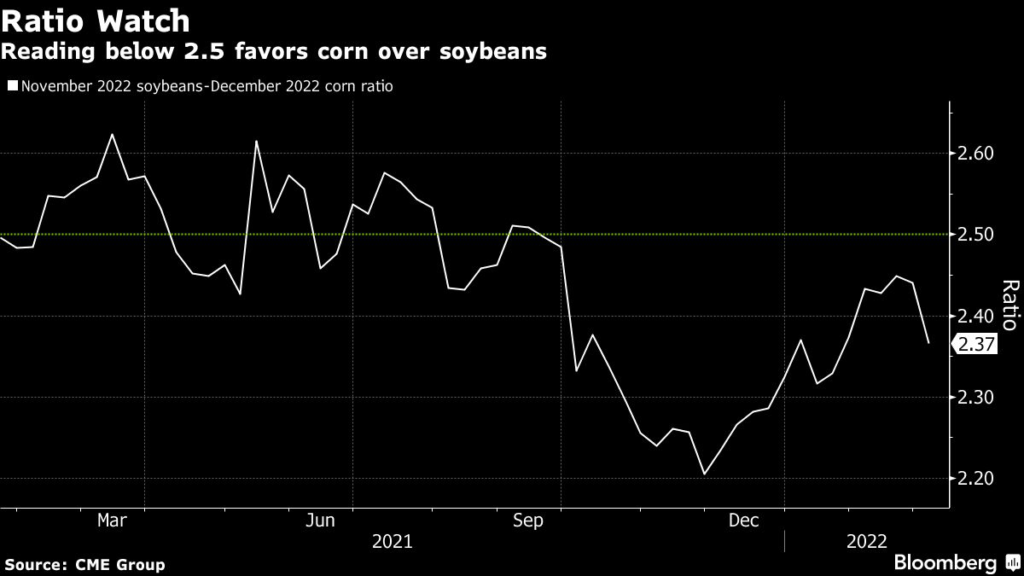
Corn acres will rise to 95 million, up from 93.4 million last year and soybeans will decline, according to the group’s AI-driven modeling. The figures come ahead of the U.S. Department of Agriculture planting estimates, which are due in a report at the end of this month. 

Soaring crop prices amid the war are likely already having an impact on plantings and motivating farmers to increase acres, Gro Intelligence senior analyst Jonathan Haines said in an interview. Corn futures in Chicago are trading at the highest since 2012, and is outperforming soybeans this year.

The forecasts go against expectations that surging fertilizer prices will lead farmers to reduce sowing of chemically reliant corn. A bigger U.S. harvest could help boost world grain supplies as drought puts Brazilian crops at risk and Russia’s attack on Ukraine threatens to severely disrupt Black Sea trade, which makes up nearly a fifth of global shipments of the grain. 

READ MORE: China Snaps Up U.S. Corn and Soybeans as Ukraine War Roils Trade

Acres for both U.S. spring wheat, which is used in pizza dough and bagels, and durum, prized for making high-quality pasta, are seen rising by a combined 855,000 acres. Cotton plantings are also expected to increase. 

Gro uses a wide range of data to come up with its estimates, and unlike the USDA, doesn’t survey farmers. 

More stories like this are available on bloomberg.com

©2022 Bloomberg L.P.

More Organizations Are Cutting Ties With Russia. Here’s a Running List

(Bloomberg) — With war escalating in Ukraine, sports and entertainment organizations have been stepping up the culture ban against Russia.

Here is a running list of what’s been affected.

Olympics

Following the Feb. 24 invasion, the International Olympic Committee issued a statement calling on sports organizations to cancel events in Russia and Belarus. Since then, the two nations have been shut out of most of the top tournaments in the world, including the Winter Paralympics in Beijing, which run March 4 through March 13. The IOC on March 2 approved Russian and Belarussian athletes to participate under a neutral flag, but it reversed that decision on March 3 after member nations protested.

Soccer

FIFA has banned Russia from competing in the World Cup. The European football governing body, UEFA, has moved the May 28 Champions League finals from Saint Petersburg to Paris. And England’s Football Association has said it won’t be playing Russia for the foreseeable future.

Under threat of sanctions for close ties to Russian President Vladimir Putin, Russian billionaire Roman Abramovich is selling Chelsea FC. In a statement on the English Premier League team’s website, Abramovich said he will be donating all net proceeds from the sale to the victims of the war in Ukraine.

Manchester United, another English Premier League team, has dropped Russian airline Aeroflot as its sponsor.

Figure Skating

The International Skating Union has banned Russian and Belarussian athletes from competing in the World Championships and other international skating competitions, putting Olympians Anna Shcherbakova , Alexandra Trusova and Kamila Valieva at risk of losing their standings in the world rankings.

Hockey

The International Ice Hockey Federation has banned Russia and Belarus from its world championships and other events. The National Hockey League is suspending business partnerships, pausing Russian-language social and digital media sites, and discontinuing any consideration of Russia and Belarus as locations for future NHL competitions.

Skiing

The International Ski Federation has banned Russian and Belarussian athletes from participating in FIS competitions, and is moving World Cup events to locations outside of Russia.

Auto Racing

Russian driver Nikita Mazepin is being allowed to race in Formula 1, but only under a neutral flag. Mazepin’s father is a Russian billionaire with a majority stake in Uralkali, a sponsor of the team. The Haas team has removed sponsor decals from its race car.

The Russian Grand Prix scheduled for Sept. 23 has been canceled.

Tennis

The Russian Tennis Federation and the Belarus Tennis Federation have been suspended for all international tennis events. Russian tennis players including top-ranked Daniil Medvedev can continue to play, but only under a neutral flag. Rising tennis star Andrey Rublev has been one of the Russian athletes protesting the invasion writing “No War Please” on a TV camera at the Dubai Championships.

The ATP Challenger tournament that was scheduled to take place on Feb. 28 in Moscow was canceled.

Martial Arts

World Taekwondo has stripped Putin of his honorary black belt. The International Judo Federation has suspended Putin as honorary president. And the International Mixed Martial Arts Federation has suspended Russian MMA Union membership.

Other Sports

Sports federations from basketball to volleyball have also banned the two nations.  

Video Games

Electronic Arts Inc. is removing Russian and Belarussian teams from its NHL 22 video games, and Russian teams from FIFA 22.

Film Studios

Walt Disney Co., Sony Corp., and AT&T Inc.’s WarnerMedia have paused the theatrical release of films in Russia including Pixar’s “Turning Red,” Sony’s “Morbius,” and Warner Bros.’ “The Batman.” Paramount Pictures said it would delay the Russian debuts of its films “The Lost City” and “Sonic the Hedgehog 2.” Universal Pictures, a unit of Comcast Corp., joined in the suspensions on March 1.

In a statement, Disney said, “We will make future business decisions based on the evolving situation. In the meantime, given the scale of the emerging refugee crisis, we are working with our NGO partners to provide urgent aid and other humanitarian assistance to refugees.”

The Cannes Film Festival is blocking Russian delegations from attending its festivities in May.

Television

Netflix Inc. has paused all projects and acquisitions from Russia, including four Russian originals in production, according to Variety. The streaming platform has also said it will not be carrying required Russian news channels on its local language service in Russia. National Association of Broadcasters has asked U.S. companies to cease carrying Russian state-owned media. Roku and DirecTV have dropped the Russian news network RT.

The National Association of Television Programming Executives has banned Russian companies from participating in its international television sales market this June.

The Eurovision Song Contest, the international songwriting competition that drew 183 million viewers last year, is barring Russian acts from participating.

Live Performances

New York’s Carnegie Hall replaced Russian conductor Valery Gergiev and pianist Denis Matsuev in a Feb. 25 performance with the Vienna Philharmonic. Both artists signed an open letter supporting Russia’s 2014 annexation of Crimea, according to the New York Times. Gergiev has since been fired as chief conductor of the Munich Philharmonic.

New York’s Metropolitan Opera said it will no longer engage with artists or institutions that support Putin or that are supported by him until the invasion of Ukraine stops. In the U.K., the Royal Opera House has canceled summer performances of the Bolshoi Ballet.

Acts including Twenty One Pilots, The Killers and Green Day have canceled upcoming concerts in Russia.

(An earlier version corrected a company name under Auto Racing and a conductor’s name under Live Performances.)

More stories like this are available on bloomberg.com

©2022 Bloomberg L.P.

Ukraine Update: U.S. Sanctions Putin’s Spokesman and Tycoons

(Bloomberg) — The U.S. said it would sanction eight wealthy Russians and their families, including Vladimir Putin’s press secretary, and limit the travel of 19 others and 47 of their family, as the West works to raise pressure on the Russian president and those closest to him. 

Russia countered claims by U.S. and European officials that its attack on Ukraine is bogged down amid tough resistance, with Putin saying the military operation “is going according to plan.” 

Putin remained undeterred, telling France’s Emmanuel Macron on Thursday that he plans to fulfill the goals of his invasion, including removing the government in Kyiv.  Russian troops have advanced on the southeast city of Mariupol, although Ukraine still has control there, a senior U.S. defense official said. 

Ukrainian President Volodymyr Zelenskiy again appealed to Putin to meet with him. “I have to talk to Putin, the world has to talk to Putin, because there is no other ways to stop this war,” he said.

More than a million refugees are fleeing to neighboring countries, according to the United Nations, adding to the humanitarian crisis that is also occurring inside Ukraine. 

Key Developments

  • Biden’s Tough Sanctions Create Worry That Putin Lacks an Exit
  • Russian Assault Shows No Letup as Putin’s War Enters Second Week
  • What Russia Invasion, Sanctions Mean for Global Economy
  • Russian Fleet Approach Has Ukraine’s Port City of Odesa Bracing
  • Ukraine Sees $15 Billion in Aid Coming as War Wrecks Economy
  • Russian Banker’s London Broker Faces Collapse on Russia Ties 

All times CET:

Putin’s Spokesman Sanctioned Along With Wealthy Russians (8:04 p.m.)

Dmitry Peskov, Putin’s press secretary, was among those sanctioned by the Biden administration Thursday, as the U.S. and its allies seek to raise pressure on the elites around the Russian president.

The other sanctioned Russians include: Nikolay Tokarev and his wife and daughter; Boris Rotenberg and his wife and sons; Arkady Rotenberg and his sons and daughter; Sergey Chemezov and his wife, son and stepdaughter; Igor Shuvalov and his wife, son, daughter and companies connected to them; Yevgeny Prigozhin and his wife, daughter and son; and Alisher Usmanov, as well as his superyacht and private plane.

“The United States and governments all over the world will work to identify and freeze the assets Russian elites and their family members hold in our respective jurisdictions – their yachts, luxury apartments, money, and other ill-gotten gains,” the White House said in a statement.

Rally in Oil Eases; Gold and Dollar Advance (7:59 p.m.)

The rally in oil eased on Thursday, with crude experiencing an extraordinary run of volatility since Putin’s invasion of Ukraine unleashed a new wave of uncertainty into global markets. West Texas Intermediate topped $116 before pulling back. Stocks struggled to find direction, with investors weighing the economic impacts of the war in Ukraine. Both the dollar and gold advanced.

Italy’s Generali Winds Down Russian Business (7:54 p.m.)

Italian insurer Assicurazioni Generali SpA is winding down its Europ Assistance operations in Russia, quitting the board of Ingosstrakh Insurance Co. and closing its Moscow representative office.

Generali owns a 38.5% stake in Ingosstrakh, a Russian-based insurer that has billionaire Oleg Deripaska as a shareholder. The insurer provides life and non-life products as well as mortgage loans and savings and retirement plans.

White House Rebuffs Call to Ban Russian Oil (7:36 p.m.)

The White House again rebuffed a call to ban Russian oil from the U.S., this time from House Speaker Nancy Pelosi, one of President Joe Biden’s closest allies.

“We don’t have a strategic interest in reducing the global supply of energy, and that would raise prices at the gas pump for the American people around the world, because it would reduce the supply available,” White House Press Secretary Jen Psaki told reporters at a briefing Thursday. “That is certainly a big factor for the president.”

Russian oil made up only about 3% of all crude imports in the U.S. last year. “Ban it. Ban the oil coming from Russia,” Pelosi told reporters earlier Thursday, making her the highest-ranking Democrat to endorse the move.


Nike Pauses Operations in Russia; Halts Online Sales, Stores (7:32 p.m.)

Nike Inc. will pause operations in Russia, including halting e-commerce sales and temporarily closing company-owned and operated shops in the country. Store employees will continue to receive their paychecks during the closures.

“We are deeply troubled by the devastating crisis in Ukraine and our thoughts are with all those impacted, including our employees, partners and their families in the region,” Nike said in a statement, adding that it will donate $1 million to humanitarian relief efforts.

Earlier this week, Nike’s website in Russia began flashing a message telling customers it couldn’t guarantee the delivery of products.

Russian-Ukrainian Progress Seen on Humanitarian Corridors (7:20 p.m.)

Russian and Ukrainian negotiators agreed to hold a third round of talks after suggesting they made some progress on establishing humanitarian corridors to evacuate civilians.

Russian negotiator Leonid Slutsky said the third round of talks will take place “in the nearest future,” while Mykhailo Podolyak, an adviser to President Zelenskiy’s chief of staff, lamented in a posting on Twitter that “we did not yet get the results that we hoped for.” 

Slutsky said more meetings are necessary – and a deal may be ratified at the highest level. The two teams met at a location in the Bialowieza Forest on the Poland-Belarus border.

U.S. Says Quad Promises Humanitarian Aid (6:54 p.m.)

U.S. President Joe Biden spoke with the other three leaders of the Quad — Australia, India and Japan — and agreed to set up a new line of communication to deliver humanitarian help to Ukraine, according to a White House statement. 

Garland Vows ‘No Stone Unturned’ on Crimes Against Ukraine (6:50 p.m.)

U.S. Attorney General Merrick Garland said the Justice Department and international allies “will leave no stone unturned in our efforts to investigate, arrest and prosecute those whose criminal acts enable the Russian government to continue its unjust war against Ukraine.”

A veteran prosecutor for the U.S. attorney’s office in Manhattan, Andrew Adams, has been tapped to lead a new task force targeting the assets of wealthy Russians who violate U.S. sanctions, Garland said in a speech before a lawyer’s conference on Thursday.

Putin Says Ukraine Operation ‘Is Going Strictly on Schedule’ (6:30 p.m.)

“All the goals that have been set are being attained,” Putin told top officials in televised comments to a meeting of his Security Council. Reiterating his view that Russians and Ukrainians are “one people,” Putin claimed his forces are fighting “neo-Nazis” and forces from outside Ukraine. 

Ukraine, which has committed its army to the battle, and its allies have charged Russia with targeting cities and civilians.

Zelenskiy said Thursday he feared Putin had broader goals than Ukraine. If “God forbid, Russia takes Ukraine,” then next will be Latvia, Lithuania, Estonia, Moldova, Georgia, and Poland, he told foreign reporters in Kyiv. “And they won’t stop until they reach Berlin,” he said.

Oil Company Lukoil Calls for Diplomatic End to ‘Conflict’  (6:15 p.m.)

Lukoil PJSC, Russia’s second-largest oil producer, called for the “fast resolution of the military conflict” in Ukraine by diplomatic means, saying in a statement on its website “we fully support its resolution through negotiations.”

Lukoil’s statement follows an exodus of international companies from Russia, including the departure of energy giants BP and Shell from joint ventures with Russian state-run oil companies.

BOE Won’t Publish Data on Russian Ruble Exchange Rate (6:00 p.m.)

The Bank of England has joined the European Central Bank in stopping publication of data on ruble exchange rates against the dollar and the pound.

U.S. Readies New Sanctions on Russian Tycoons (5:22 p.m.)

The sanctions will be in keeping with measures the European Union imposed earlier, said people familiar with the plans, but will be broader, prohibiting travel to the U.S. and targeting their families to prevent them from transferring assets to spouses or children.

EU Seeks to Suspend Russia’s Most-Favored Nation WTO Status (4:31 p.m.)

The EU is seeking to remove Russia’s most-favored nation status at the World Trade Organization, a move that could further hit 95 billion euros ($105 billion) of Moscow’s exports to the bloc with tariffs. The European Commission, the EU’s executive arm, is discussing the possibility with member states, according to commission spokeswoman Miriam Garcia Ferrer.

Latvia, Lithuania Have Seen Surge in Cyber Attacks in Last Week (4:20 p.m.) 

Cyber attacks targeting state institutions, critical infrastructure and service providers have picked up since the middle of last week, Baiba Kaskina, director of Latvia’s cyber security unit said in an interview with Latvian TV. Some of the attacks have been successful but without serious consequences, Kaskina said. 

Lithuanian Energy Minister Dainius Kreivys told a press conference that there’s been a “a substantial increase” of cyber attacks on the country’s energy industry. Estonia’s cyber defense unit said state institutions saw an increase in scanning of their internet systems.

Ruble Sinks to Another Record Low (3:44 p.m.)

The ruble sank to a record low against the dollar in Moscow trading, dropping for a fourth day after ratings services lowered Russia’s credit score deep into junk territory. Russia’s equity and bond markets are still closed, and currency trading is going ahead in a shortened daily session.

The ruble was down almost 10% at 117.2275 per dollar in Moscow, to reach its longest run of declines since August and the weakest intraday level since at least 2003 in Moscow. In offshore trading the ruble was 2.3% lower at 104.6355.


EU Ministers Dampen Expectations for Economic Aid Package (3:30 p.m.)

There may be little political appetite to fund a new economic aid program for Europe, Finnish Finance Minister Annika Saarikko and Eurogroup President Paschal Donohoe signaled after meeting in Helsinki, even as the European Commission is working on a contingency package to cushion the impact of sanctions and the ongoing war on EU economy. 

“Now is not yet the time to talk about how to mitigate the economic impacts of sanctions on member states, but it’s time to send a message that we are, if needed, ready for even stronger sanctions,” Saarikko told reporters in Helsinki.

Putin Tells Macron Russia Will Fulfill Goals in Ukraine (3:30 p.m.)

Putin told Macron he planned to fulfill his goals on Ukraine, Interfax reported, citing the Kremlin’s press service.

Macron spoke to Putin at the Russian leader’s request, according to an official in Macron’s office. Putin told him that everything was going according to his plan in Ukraine and that things will get worse. Putin also denied Russia had bombed Kyiv or hurt civilians, while Macron condemned his actions, the official said.

Estonian Vessel Sinks Off Ukrainian Coast (2:40 p.m.)

An Estonian-owned cargo ship, the Helt, sank off the Ukrainian coast near the port city of Odesa, the Foreign Ministry in Tallinn confirmed. It now appears that all six crew members, none of whom were Estonian citizens, were rescued. 

The Helt went off-radar at 12:18 p.m. local time after it was fired upon and was breeched below the water line, according to a Facebook post by the Ukrainian Sea Ports Authority.

U.S. Oil Refiners Would Back Russian Import Ban (3:22 p.m.)

U.S. lawmakers seeking a ban on Russian oil imports have found an unlikely ally in American refiners, who say they support the idea as long as it doesn’t ensnare cargoes now in en route.

The American Fuel and Petrochemical Manufacturers “fully supports the suspension of all future purchases of crude oil and petroleum products from Russia,” the trade group said in a letter to lawmakers. The declaration could buttress congressional efforts to outlaw Russian oil imports, which made up about 3% of the foreign crude brought into the U.S. last year.  

Germany Mulls More Coal Use to End Russian Energy Reliance

Ukraine Plans Another Auction of War Bonds (3:10 p.m.)

Ukraine plans a second auction of war bonds to help fund resistance to Russia’s invasion, according to a person familiar with the matter. The government will use its regular Tuesday auction slot, and the proceeds will go to “priority humanitarian aid needs,” which include clothes and footwear, blankets, and hospital beds, according to a document seen by Bloomberg News. They’ll also fund protective gear such as helmets and bulletproof vests.

Ukraine raised 8.1 billion hryvnia ($277 million) in the first such sale earlier this week. That event drew global attention as people other than professional investors sought to buy the debt to show support for the country. 

Poland Plans to Raise Defense Spending to 3% of GDP (2:26 p.m.)

Poland wants to raise its defense spending to 3% of economic output in 2023 and will start a “very expensive” program to expand and re-arm its military over the next five years, the country’s de facto leader Jaroslaw Kaczynski told parliament in Warsaw. 

The nation’s $600 billion economy is already spending more on defense than the NATO’s target of 2% of GDP. The program will include the creation of a voluntary military force that would increase army personnel to about 300,000, Kaczynski said.

Russia Seeks to Weaken Ukraine Morale: Intelligence Report (2:26 p.m.)

Moscow has drawn up plans for ways to break morale in order to discourage Ukrainian from fighting back as and when cities fall under the Kremlin’s control, a European intelligence official said.

That strategy includes crackdowns on protests, detention of opponents, and potentially carrying out public executions, the official said on the condition of anonymity. So far civilians in Ukraine as well as its military have put up strong resistance, including arming themselves as volunteer forces.

Oil, Gas Prices Swing Wildly; Aluminum, Wheat Soar (2:10 p.m.) 

Oil extended a period of extreme volatility, with international Brent nearing $120 a barrel at one point, while European natural gas retreated after hitting a record high. Aluminum powered through to unprecedented levels and wheat extended its rally to the highest since 2008. 

Russia’s growing isolation is choking a major global source of energy, metals and crops, sparking fears of prolonged shortages and sharper global inflation. While there are no sanctions on energy, traders and shippers are increasingly reluctant to deal with Russian supply or with its companies. 

Sanctioned Billionaire Says ‘Iron Curtain’ Has Fallen (2:05 p.m.) 

An “Iron Curtain” has fallen on Russia and the country faces a severe crisis for at least three years, billionaire Oleg Deripaska said at the Krasnoyarsk Economic Forum on Thursday. 

Deripaska, who’s been sanctioned by the U.S. since 2018, said the first step to getting out of the current crisis is peace. 

Russia’s economic outlook has grown increasingly dire in the last week, as the ruble crashed, inflation and interest rates jumped and foreign companies vowed to stop doing business in the country.

Second Round of Ukrainian-Russian Talks Starting Soon (1:35 p.m.) 

A second round of talks between Russian and Ukrainian negotiators is set to get under way as soon as 3 p.m. CET. Mykhailo Podolyak, an adviser to President Volodymyr Zelenskiy’s chief of staff, was shown in a tweet strapped into a helicopter with a party ally. 

The discussions are planned at a location in the Bialowieza Forest on the Poland-Belarus border. A first round of talks, where the Russians laid out their demands for Ukrainian “neutrality,” bore little fruit.

Biden Asks Congress for $10 Billion in Ukraine Funding (1:20 p.m.) 

The White House asked Congress for about $10 billion in emergency funding for Ukraine, to be used to address the mounting humanitarian crisis as well as assist its defense against Russia. Of that, $4.8 billion would go to the Pentagon and $5 billion to the State Department.

The funds were part of a $32.5 billion funding request; the balance would be for domestic coronavirus efforts. Negotiations continue on how to operate the federal government past March 11, when current funding is set to lapse.

Ukraine Central Bank Delays Decision as Attack Continues (1:02 p.m.)

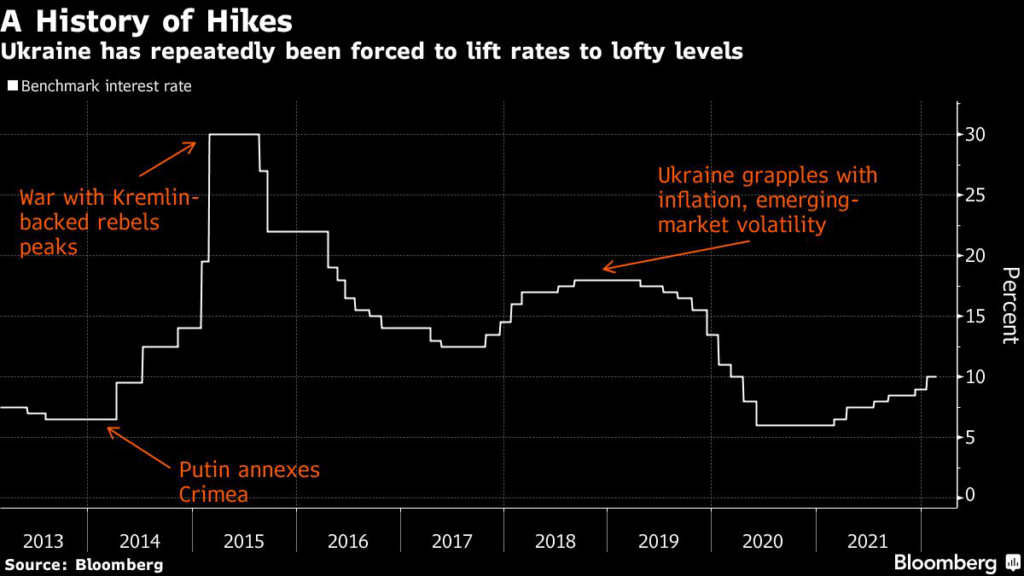
Ukraine’s central bank delayed a scheduled decision on borrowing costs, with the key rate staying at 10% for now.

The National Bank of Ukraine said it remains committed to inflation targeting and it will resume regular monetary policy meetings once the economy normalizes. 

Japan to Freeze Oligarchs’ Assets (12:31 p.m.) 

Prime Minister Fumio Kishida said Japan would freeze the assets of oligarchs in his country as Tokyo stepped up its penalties on Russia. The premier said it was “outrageous” for Vladimir Putin to order Russia’s strategic nuclear forces to be put on higher alert, adding that the use, or even the threat, of using nuclear weapons was unforgivable.  

Finnish President Niinisto to Meet Biden on Friday (12:15 p.m.)

Finnish President Sauli Niinisto will visit President Joe Biden and U.S. lawmakers in Washington on Friday, just as the debate on joining NATO has intensified in the Nordic country after its neighbor Russia invaded Ukraine.

The attack has prompted a historic shift in Finns’ attitudes on joining the North Atlantic Treaty Organization, with a majority now supporting the idea. Niinisto and Biden are scheduled to discuss the invasion and its impact on European security. 

VW Stops Making Cars in Russia (11:47 a.m.)

Volkswagen AG said it would stop producing vehicles in Russia and exporting to that market until further notice because of the invasion of Ukraine.

The German carmaker joins an exodus of companies from Russia, reversing three decades of investment by Western and other foreign businesses there following the collapse of the Soviet Union in 1991. 

Firms ranging from energy giants Exxon Mobil and Shell to fashion retailers Burberry and H&M have announced they are curtailing operations or leaving entirely. Ikea said Thursday it would pause all operations in Russia and Belarus, affecting about 15,000 employees.

French Customs Takes Yacht Owned by Rosneft CEO (11:25 a.m.)

French customs officials have taken control of a giant yacht owned by Rosneft Chief Executive Officer Igor Sechin as part of EU sanctions against Russia, French Finance Minister Bruno Le Maire said. 

The Amore Vero was confiscated overnight in the Mediterranean port of La Ciotat on the French Cote d’Azur as it was preparing an urgent departure, the ministry said.

EU Expects Membership Requests From Moldova, Georgia (11:13 a.m.)

Georgia and Moldova are expected to send membership requests to the EU imminently, according to an EU official.

The EU is already in the process of moving forward on an application from Ukraine, a topic the 27 leaders will discuss next week at an informal summit in Paris, said the official, who asked not to be identified because the talks are private. Moldova may submit the request Thursday, the official said.

EU Figures Float Special Budget Leeway for Defense Spending (11:01 a.m.)

European Commissioner for Economy Paolo Gentiloni and Hungarian Prime Minister Viktor Orban suggested giving special consideration to defense spending under European Union rules that limit public finance deficits.

Gentiloni told the German Handelsblatt newspaper he was “open to thinking about also giving special consideration in the debt rules to investments in Europe’s autonomy. This can also include certain defense expenditures.” He said a specific proposal hadn’t yet been agreed.

Orban said Russia’s war on Ukraine made clear that “much more” needs to be spent on the continent’s militaries and that shouldn’t be included in the current deficit ceiling of 3% of gross domestic product. 

Ukraine Calls for Russia’s Suspension From WTO (10:49 a.m.)

Ukraine urged all members of the World Trade Organization to suspend Russia from participating in the Geneva-based trade body in response to its “unprovoked and unjustified” attack, according to a letter seen by Bloomberg. 

Zelenskiy Addresses Nation (10:15 a.m.)

Overwhelming UN Vote Puts Pressure on China (9:27 a.m.)

The United Nations passed a resolution condemning Russia’s invasion of Ukraine by an overwhelming vote, casting a spotlight on President Xi Jinping’s reluctance to take a stance against Moscow, after China abstained.

EU to Offer Residence, Job Rights to Ukrainians (8:42 a.m.)

Ukrainians fleeing to the European Union will be granted full access to the bloc and receive residence permits as well as access to education and jobs as part of a plan expected to be implemented as soon as Thursday.

European member states will consider activating the so-called temporary protection directive that will allow Ukrainians to stay in the EU beyond 90 days, a move expected to be overwhelmingly adopted, according to a senior official at the European Commission.

Switzerland is also weighing offering temporary residence in the country to Ukrainians.

More Than 1 Million People Have Fled Ukraine: UNHCR (8:36 a.m.)

Russia’s invasion has forced 1,002,860 people to flee Ukraine to neighboring countries, the UN refugee agency said Thursday, in what is poised to become the biggest humanitarian crisis in Europe since World War II.

It said more than half a million people had fled to Poland, while 139,686 had gone to Hungary, 97,827 to Moldova and 72,200 to Slovakia. Romania had taken in 51,261 the UNHCR said, while 47,800 people had departed for Russia.

More stories like this are available on bloomberg.com

©2022 Bloomberg L.P.

Tech CEO Defends Himself Against Employee Criticism That He Was Soft on Russia

(Bloomberg) — Under fire from employees in Ukraine for not speaking out against Russia’s invasion, the chief executive officer of a U.S. tech firm defended himself Thursday, saying he had to choose his words carefully to protect employees in region.

Epam Systems Inc., a Pennsylvania-based company with a large workforce in Ukraine, and its chief executive officer, Arkadiy Dobkin, had been criticized for failing to publicly condemn Russia and for not doing enough to support Ukraine’s defense.

In an interview with Bloomberg News, Dobkin said he had been clear in internal town hall meetings that “Russian aggression” was to blame for the conflict. But he said that he had to be careful with his public statements as he does not want to jeopardize the safety of his employees based in Russia and Belarus.

“We are an international company,” he said. “When you make a statement you can endanger people in Belarus and Russia who could be arrested.”

“We are trying to work with this. We understand the emotions,” Dobkin said, adding, “It is difficult to navigate.”

Epam employs more than 58,000 people, with 14,000 of them in Ukraine and more than 18,000 staff in Belarus and Russia, according to company filings with the U.S. Securities and Exchange Commission. Epam’s Russian operation accounts for about 2% to 3% of Epam’s overall revenue and mostly works for Western clients, according to Dobkin. 

Dobkin said the invasion of Ukraine would transform his company, though he said it wasn’t yet clear how that would unfold.

“We know that we will be a very different company 12 months from now,” Dobkin said. “We have a significant employee base in the region, and we don’t know what will happen. We are working on a transformation effort right now, but it’s difficult because we don’t know the level of transformation.”

He declined to comment on whether the company was weighing closing its Russian operation, “but we have a pretty broad number of alternatives on the table.”

Dobkin said his company was in the process of moving employees out of Ukraine into neighboring countries and had spent more than $50 million in the last six days relocating staff and supporting humanitarian efforts related to the conflict.

So far, the company has moved about 10% of its Ukrainian staff out of the country and has relocated hundreds more employees and their families to safer parts of Ukraine, an Epam spokeswoman said. Depending on the course the conflict takes, Dobkin that the company’s workforce in the region could be “much smaller” in the aftermath.

“It is a big crisis, definitely,” he said. Dobkin was born in Belarus, obtained a degree from Belarusian National Technical University and started his first private software company in Minsk, according to the company’s website and the Philadelphia Inquirer.

Dobkin reached out on Thursday after Bloomberg published an article detailing a backlash among employees and others to the company’s position on Ukraine, and to a LinkedIn post by Dobkin that many criticized as being soft on Russia. Neither Dobkin nor an Epam representative responded to a request for comment on that article prior to its publication.

In addition to the internal tension, Epam’s management has struggled with business pressures. On Monday, Epam plunged 46% after the company withdrew its first quarter and 2022 guidance, citing “heightened uncertainties” from Russia’s invasion of Ukraine.

The tensions at Epam have unfolded as many other companies, including Apple Inc., Boeing Co., and BP Plc, have taken steps to curb business ties with Russia.

Mykola Klymenko is among the employees that criticized Dobkin, saying he is disappointed that the CEO hadn’t taken a firmer stance against Russia. Klymenko said he is a lead software engineer at the company.

“He supports Ukraine but, at the same time, he doesn’t want to blame Russia,” Klymenko said in a message to Bloomberg. “It’s bad because Russians are doing horrible things, and I expected more from him. When all companies help the army and end business in Russia, he still tries to balance.”

A contract senior software engineer, Maksym Chernikov, said he had been blocked from accessing Epam’s computer systems on Monday after sending out a companywide email calling for Epam’s leadership to support a makeshift Ukrainian “cyber army” that is waging cyberattacks on Russian government agencies and corporations.

Chernikov gave management a deadline to respond. “Now time is not money, but lives,” he wrote in his email, which was reviewed by Bloomberg News. “After that, we will be forced to act on our own.”

Dobkin said he viewed the message as a violation of company rules and an effort to “blackmail” him into taking a certain course of action. He said he had since talked to Chernikov, whom he said he hasn’t fired. 

Chernikov confirmed that he talked to Dobkin on Wednesday but declined further comment.

(Adds background on Dobkin in 12th paragraph)

More stories like this are available on bloomberg.com

©2022 Bloomberg L.P.
Car Safety Ratings May Get Boost for Driver-Assistance Technology

(Bloomberg) — The U.S. government’s annual safety ratings of cars may soon give them credit for having driver-assistance systems, the latest indication that the once-futuristic technology is becoming mainstream.

The U.S. Department of Transportation proposed on Thursday that lane-keeping support, automatic emergency braking, blind spot detection and blind spot intervention be incorporated into its Five-Star Safety Ratings program for new cars. 

The move comes on the heels of the department’s release of data Wednesday showing 38,824 people died in traffic crashes nationwide in 2020. The agency said it marked the highest number of fatalities since 2007. 

“There’s a crisis on America’s roadways,” U.S. Transportation Secretary Pete Buttigieg said in a statement. “These important changes will help save lives on our roadways by ensuring that consumers have the information they need about the latest safety technologies when they buy a new vehicle.” 

The National Highway Traffic Safety Administration, a unit of DOT, has issued ratings measuring auto safety on a five-star scale since 1993. Automakers that receive a high rating frequently tout that fact in commercial advertising. 

The proposed changes to the ratings system are subject to public comment for the next 60 days.

NHTSA said it would also study the potential addition of other emerging vehicle technologies related to driver distraction, such as alcohol detection, seat belt interlocks, intelligent speed assist, driver monitoring systems and rear seat child reminder assist. 

Providing a crash avoidance rating on the window sticker on new and used vehicles is also under consideration, NHTSA said.

More stories like this are available on bloomberg.com

©2022 Bloomberg L.P.
Close Bitnami banner
Bitnami