Bloomberg

Ex-Fox News Producer Charged With Violating Russia Sanctions

(Bloomberg) — A former Fox News producer was arrested and charged with sanctions violations for allegedly working for Russian business tycoon Konstantin Malofeyev.

Jack Hanick, 71, was arrested in London Feb. 3 and charged with violating sanctions imposed against Malofeyev and others after Russia’s 2014 takeover of Crimea from Ukraine, Manhattan U.S. Attorney Damian Williams said in a statement Thursday. Hanick, a U.S. citizen, also was accused of making false statements to the FBI.

Hanick’s LinkedIn profile says he worked for Fox News for 15 years, from its start in 1996 until 2011. Prosecutors claim he then worked as a television producer for Malofeyev from 2013 to 2017, helping set up a Russian cable network. Malofeyev owns Tsargrad TV, a conservative, pro-Orthodox-Christian channel that has supported Russian President Vladimir Putin. Hanick also worked for Malofeyev on projects to set up a Greek television network and to buy a Bulgarian network, according to the U.S.

Hanick is the first person charged with violating sanctions put in place in response to Russia’s 2014 undermining of democratic processes and institutions in Ukraine, according to the statement. The U.S. is seeking to extradite Hanick. 

In targeting Malofeyev for sanctions in 2014, the Treasury Department’s Office of Foreign Assets Control said he was “one of the main sources of financing for Russians promoting separatism in Crimea.”

Lawyers for Hanick didn’t immediately respond to emails seeking comment on the charges. If convicted Hanick faces up to 20 years for violating sanctions and five years for making false statements.

Some of the allegations contained in the indictment against Hanick are taken from an unpublished memoir investigators obtained by getting a warrant to search his email. 

Russia faced new sanctions after starting its invasion of Ukraine more than a week ago. On Wednesday, U.S. Attorney General Merrick Garland announced the launch of Task Force KleptoCapture, set up to enforce sanctions, export restrictions and economic measures imposed in response to the invasion.

Charges in the indictment show the FBI’s criminal investigation of Hanick is at least a year old.

The case is 21-cr-00676, U.S. District Court, Southern District of New York (Manhattan). 

(Updates with background.)

More stories like this are available on bloomberg.com

©2022 Bloomberg L.P.

Stock Trader’s Guide to China’s Weeklong Political Meeting

(Bloomberg) — Any policy signals on China’s battered property and tech sectors will be keenly watched by equity investors as they turn their focus to the nation’s top political meeting that starts Saturday.

Relief for the real estate sector, which has been dragged by slumping sales and an unprecedented cash squeeze, will be on the top of the agenda for traders. They’ll also be on the lookout for any further fallout from the yearlong crackdown on the nation’s tech sector.

The timing of the National People’s Congress comes as China’s economic outlook is cloudy at best. Stocks onshore are still reeling from a $1.2 trillion market rout following regulatory curbs and as financial risks from the property sector continue to mount. Meanwhile, surging global inflation, a divergent U.S. monetary policy and the war in Ukraine are further complicating decision making in Beijing.

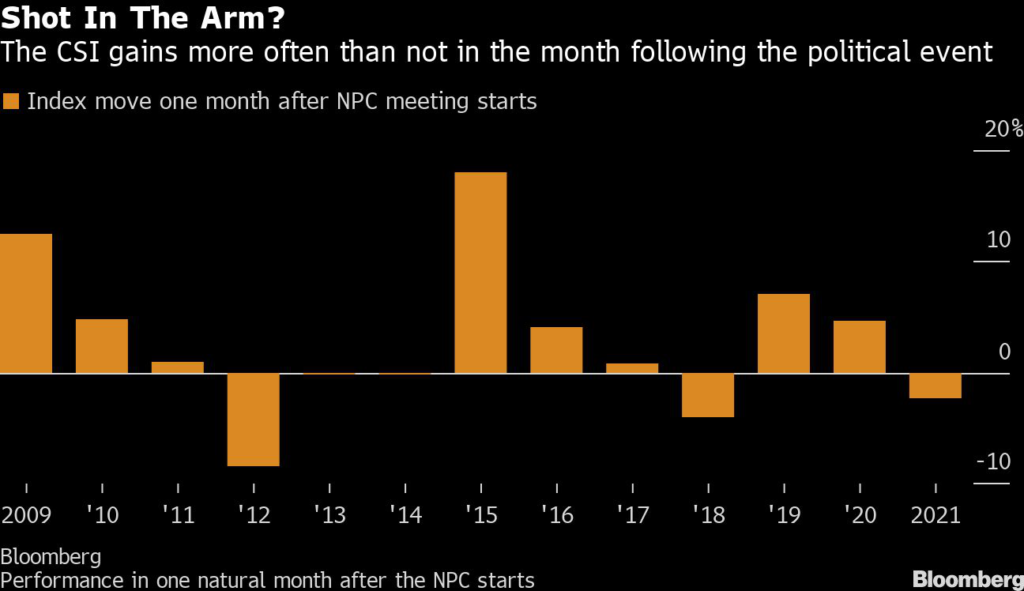
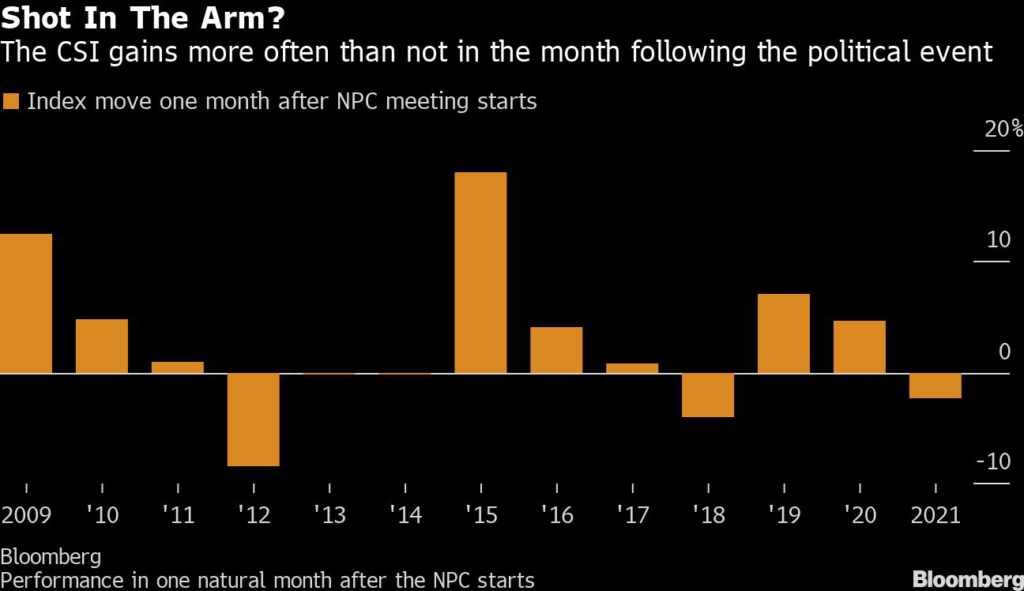
Still, many expect stability and even a bounce for equities, at least in the short term. China’s CSI 300 Index rose an average 2.6% in the month following the political gathering over the past 13 years, according to Bloomberg-compiled data. Traders say that the event, where around 3,000 delegates meet in Beijing to set economic policies for the year, could be the much needed catalyst to spur sentiment

“Capital market performance around the meetings could be relatively positive, and a bottom for earnings growth may emerge as early as the first quarter,” wrote China International Capital Corp. analysts including Wang Hanfeng in a Feb. 27 note. Investors should monitor fresh signals on monetary policy, fiscal spending, tax reduction, affordable housing and infrastructure investment, they added.

Here are the key areas to watch: 

Property Woes

Investors are grappling with whether Beijing will loosen its grip on the property sector. In recent weeks, authorities have pushed banks to lower mortgage rates and cut down payments for home buyers. At the same time, officials also warned against speculation, suggesting they don’t want to see another surge in home prices.

UBS AG economists including Ning Zhang said the NPC may offer more reprieve for the industry, including a targeted approach to local property easing and possibly delaying the implementation of a property tax. 

While distressed and typically smaller developers may continue to struggle, such policy fine-tuning is expected to benefit their larger and financially healthier peers such as Poly Developments and Holdings Group Co. (+9.5% YTD), China Vanke Co. (+1% YTD in H.K.) and China Resources Land Ltd. (+16% YTD)

Big Tech

Beijing’s yearlong sweeping crackdown has erased some $1.5 trillion from the nation’s technology stocks, with the Hang Seng Tech Index trading at less than half the value of its February 2021 peak. 

The sector suffered another wave of selling last week, after an official call for food-delivery platforms to cut fees and warnings against metaverse-oriented fundraising rekindled concerns about how far the regulatory assault will go. 

According to economists at Societe Generale SA, Beijing may feel the need to loosen its grip as the impact on employment of the tightened regulations is looking severe enough. 

A softer tone on curbing the expansion of private capital may offer a much-needed boost to stocks such as Tencent Holdings Ltd. (-5.5% YTD), Meituan (-23% YTD) as well as tech firms that have recently reported consensus-beating earnings like NetEase Inc. (-9.6% YTD) and Baidu Inc. (+10% YTD)

Digital Economy

China’s latest plan to build computing hubs and data center clusters is another big step in its pursuit of a digitalized economy and technological self-reliance.

The initiative is part of a concept of so-called “new infrastructure” and has already sent shares of service providers Nanjing Canatal Data-Centre Environmental Tech Co. (+80% YTD) and MCC Meili Cloud Computing Industry Investment Co. (+126% YTD) soaring since the official announcement. 

Some investors also view the ban on several Russian banks from using the SWIFT messaging system as aiding companies linked to China’s own cross-border payment system, including Brilliance Technology Co. (+19% YTD) and Shenzhen Forms Syntron Information Co. (+30% YTD)

Infrastructure Spending

Traders hope that Beijing will resort to its old trick of building its way out of an economic slowdown. A gauge of infrastructure stocks rallied to an almost three-year high last month, driven by bets on construction firms, telecom operators and waste treatment companies. 

The government’s budget deficit target and any fresh instructions on local authorities to use sales of more special bonds to fund new projects will be closely watched. 

Some of the best performers this year include Chongqing Construction Engineering Group Corp. (+26% YTD), China Communications Construction Co. (+16% YTD in China) and ARTS Group Co. (-7.1% YTD), with investors watching if the trade still has legs. 

Energy 

As Beijing seeks to strike a balance between economic growth and ambitious environmental goals, traders are looking for signs of further relaxations on the use of traditional energy sources like coal while continuing to encourage developing greener solutions such as solar power. 

As the overall policy focus is on growth, “a repeat of policy-driven power shortages as we saw in the third and fourth quarters will be quite unlikely this year,” Goldman Sachs Group Inc. analysts including Maggie Wei wrote in a note. 

A more tolerant stance may bode well for hydro and wind power generators, such as China Three Gorges Renewables Group Co. (-6.1% YTD) and China Power International Development Ltd. (-15% YTD), according to China Galaxy Securities Co. 

More stories like this are available on bloomberg.com

©2022 Bloomberg L.P.

Trader Guide to Reading Policy Signals From China Congress Meet

(Bloomberg) — Any policy signals on China’s battered property and tech sectors will be keenly watched by equity investors as they turn their focus to the nation’s top political meeting that starts Saturday.

Relief for the real estate sector, which has been dragged by slumping sales and an unprecedented cash squeeze, will be on the top of the agenda for traders. They’ll also be on the lookout for any further fallout from the yearlong crackdown on the nation’s tech sector.

The timing of the National People’s Congress comes as China’s economic outlook is cloudy at best. Stocks onshore are still reeling from a $1.2 trillion market rout following regulatory curbs and as financial risks from the property sector continue to mount. Meanwhile, surging global inflation, a divergent U.S. monetary policy and the war in Ukraine are further complicating decision making in Beijing.

Still, many expect stability and even a bounce for equities, at least in the short term. China’s CSI 300 Index rose an average 2.6% in the month following the political gathering over the past 13 years, according to Bloomberg-compiled data. Traders say that the event, where around 3,000 delegates meet in Beijing to set economic policies for the year, could be the much needed catalyst to spur sentiment

“Capital market performance around the meetings could be relatively positive, and a bottom for earnings growth may emerge as early as the first quarter,” wrote China International Capital Corp. analysts including Wang Hanfeng in a Feb. 27 note. Investors should monitor fresh signals on monetary policy, fiscal spending, tax reduction, affordable housing and infrastructure investment, they added.

Here are the key areas to watch: 

Property Woes

Investors are grappling with whether Beijing will loosen its grip on the property sector. In recent weeks, authorities have pushed banks to lower mortgage rates and cut down payments for home buyers. At the same time, officials also warned against speculation, suggesting they don’t want to see another surge in home prices.

UBS AG economists including Ning Zhang said the NPC may offer more reprieve for the industry, including a targeted approach to local property easing and possibly delaying the implementation of a property tax. 

While distressed and typically smaller developers may continue to struggle, such policy fine-tuning is expected to benefit their larger and financially healthier peers such as Poly Developments and Holdings Group Co. (+9.5% YTD), China Vanke Co. (+1% YTD in H.K.) and China Resources Land Ltd. (+16% YTD)

Big Tech

Beijing’s yearlong sweeping crackdown has erased some $1.5 trillion from the nation’s technology stocks, with the Hang Seng Tech Index trading at less than half the value of its February 2021 peak. 

The sector suffered another wave of selling last week, after an official call for food-delivery platforms to cut fees and warnings against metaverse-oriented fundraising rekindled concerns about how far the regulatory assault will go. 

According to economists at Societe Generale SA, Beijing may feel the need to loosen its grip as the impact on employment of the tightened regulations is looking severe enough. 

A softer tone on curbing the expansion of private capital may offer a much-needed boost to stocks such as Tencent Holdings Ltd. (-5.5% YTD), Meituan (-23% YTD) as well as tech firms that have recently reported consensus-beating earnings like NetEase Inc. (-9.6% YTD) and Baidu Inc. (+10% YTD)

Digital Economy

China’s latest plan to build computing hubs and data center clusters is another big step in its pursuit of a digitalized economy and technological self-reliance.

The initiative is part of a concept of so-called “new infrastructure” and has already sent shares of service providers Nanjing Canatal Data-Centre Environmental Tech Co. (+80% YTD) and MCC Meili Cloud Computing Industry Investment Co. (+126% YTD) soaring since the official announcement. 

Some investors also view the ban on several Russian banks from using the SWIFT messaging system as aiding companies linked to China’s own cross-border payment system, including Brilliance Technology Co. (+19% YTD) and Shenzhen Forms Syntron Information Co. (+30% YTD)

Infrastructure Spending

Traders hope that Beijing will resort to its old trick of building its way out of an economic slowdown. A gauge of infrastructure stocks rallied to an almost three-year high last month, driven by bets on construction firms, telecom operators and waste treatment companies. 

The government’s budget deficit target and any fresh instructions on local authorities to use sales of more special bonds to fund new projects will be closely watched. 

Some of the best performers this year include Chongqing Construction Engineering Group Corp. (+26% YTD), China Communications Construction Co. (+16% YTD in China) and ARTS Group Co. (-7.1% YTD), with investors watching if the trade still has legs. 

Energy 

As Beijing seeks to strike a balance between economic growth and ambitious environmental goals, traders are looking for signs of further relaxations on the use of traditional energy sources like coal while continuing to encourage developing greener solutions such as solar power. 

As the overall policy focus is on growth, “a repeat of policy-driven power shortages as we saw in the third and fourth quarters will be quite unlikely this year,” Goldman Sachs Group Inc. analysts including Maggie Wei wrote in a note. 

A more tolerant stance may bode well for hydro and wind power generators, such as China Three Gorges Renewables Group Co. (-6.1% YTD) and China Power International Development Ltd. (-15% YTD), according to China Galaxy Securities Co. 

More stories like this are available on bloomberg.com

©2022 Bloomberg L.P.

Seizing Assets of Russia’s Elite Is Far Trickier Than Sanctions

(Bloomberg) — Politicians around the world have made a show of talking tough about taking away the comforts of Russia’s wealthy elite after the country’s invasion of Ukraine. Yet actually seizing those assets will be much more difficult.

There are layers of shell companies and vast troves of wealth hidden in tax havens. Elites might transfer assets to relatives or, in the case of superyachts and private jets, park them in out-of-reach jurisdictions. Cryptocurrencies further complicate the global hunt. 

The key difference, according to lawyers, economists and ex-government officials interviewed by Bloomberg, is that sanctions can be passed relatively quickly, while seizure is a more drastic step that involves a potentially lengthy legal process.

Still, the level of cooperation signaled by governments is unprecedented, with parallel sanctions coming down in the European Union, U.K. and U.S. 

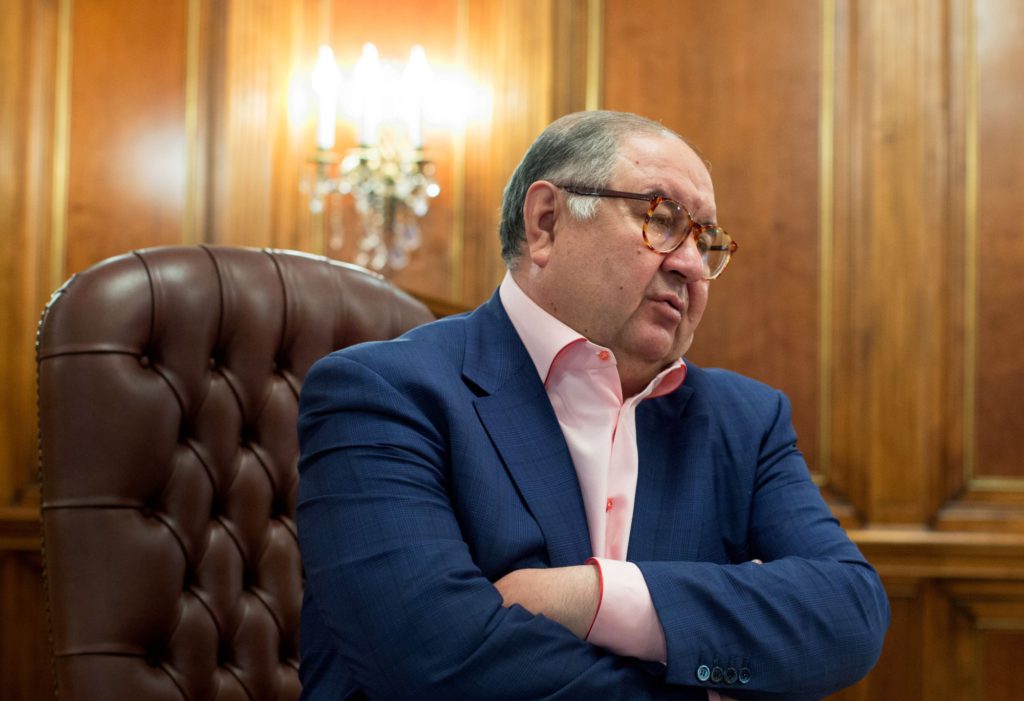
President Joe Biden’s administration said Thursday it would sanction eight wealthy Russians and their families, including billionaire Alisher Usmanov, after unveiling a unit called “KleptoCapture,” which will complement a transatlantic task force. 

Whether the moves turn out to be largely symbolic or something more will depend on several critical factors. Here are some of them. 

Property Rights

Taking assets is especially tricky when dealing with Russia, where tycoons amassed the foundation for their wealth decades ago and have reinvested proceeds from Soviet privatizations into legitimate businesses.

Seizures demand a civil or criminal legal process that needs court approval, said Alex Iftimie, a partner at Morrison & Foerster and a former senior national security official at the Justice Department.

A common basis is violating money-laundering laws. In the pursuit of Russian wealth, efforts to seize assets will likely involve gathering information from other countries, according to Anders Aslund, a professor at Georgetown University who has written about the effectiveness of past rounds of sanctions against Russia.

Property rights in the U.S., U.K. and elsewhere are the foundation for legal challenges to seizing assets.

“You’ve got to be very, very clear on what those assets are. Are they proceeds of a crime? If so, what is the crime?” said Justine Walker, global head of sanctions, compliance and risk at ACAMS, a trade organization for specialists in detecting financial crimes. 

Even for assets frozen under sanctions, not seized, individuals can appeal to be delisted or sue to be unblocked, said Ori Lev, a partner at Mayer Brown who formerly led the enforcement division of the Treasury’s office of foreign assets control.

Still, courts have held that individuals without a U.S. presence don’t have due process rights under the Constitution, Lev said.

Concerns over due process can be addressed by limiting asset seizures to people connected to Putin and maintaining a “high threshold” for targets, said Gabriel Zucman, a University of California at Berkeley economics professor who researches wealth, inequality and tax havens.

Blocking Boats

Two brushes with superyachts in the EU this week illustrate how sanctions don’t go as far as seizures.

In France, customs officials blocked Rosneft Chief Executive Officer Igor Sechin’s superyacht from an urgent departure from the Mediterranean port of La Ciotat, near Marseille, according to the French Finance Ministry. 

Sechin was sanctioned by the bloc on Monday. However, the asset has not been seized by the state.

In Germany, Usmanov’s superyacht is docked in Hamburg and will need an export waiver to depart. A local ministry said “no yacht leaves port that is not allowed to do so.”

Meanwhile, many Russian-owned luxury yachts are out of reach of countries that have imposed penalties. Among those vessels cruising around the Maldives right now is the 465-foot Nord, owned by Alexey Mordashov, a steel billionaire who was sanctioned by the EU on Monday.

Shell Game

Superyachts and private jets are one thing. Other forms of wealth — bank accounts, trust funds, or apartments cocooned inside a series of offshore companies — are less conspicuous. 

“Regulators that need to track down assets and transactions en masse may be overwhelmed by their volume,” said Yuliya Guseva, a professor at Rutgers Law School.

One formidable obstacle: shell corporations.

“It’s quick and easy to set up companies and to combine hundreds of such companies into complex networks across the globe, often in highly secretive offshore jurisdictions,” said Rebecca Lee, chief impact officer at OpenCorporates, which maintains a global database of corporations. “It is often impossible” to find out who has ultimate control, she said.

There’s precedent for Russian elites to evade sanctions this way.

Shell companies linked to Arkady and Boris Rotenberg, two brothers close to Putin, transferred more than $120 million to Russia during a four-day window in 2014 after the annexation of Crimea, according to a 2020 report by the U.S. Senate’s Permanent Subcommittee on Investigations. 

The brothers, who were again sanctioned by the U.S. on Thursday, also used an intermediary to buy art for companies they owned or funded, according to the report. The purchases, at auction houses and through private dealers in New York, amounted to $18.4 million. 

“The targeted individuals use sophisticated ways to hide their assets,” Lev said. “The international, multilateral approach to this can only increase its effectiveness.”

Cryptocurrency Challenges

Cryptocurrencies further complicate the effort to enforce sanctions. They bypass traditional financial institutions, giving criminals and those suspected of wrongdoing a new way to conceal the illicit origins of funds. 

“We are at a crossroads with cryptocurrency, and frankly we need to focus on a new category of crime and that’s the use of cryptocurrency to conduct criminal activity,” Deputy Attorney General Lisa Monaco said Wednesday on Bloomberg TV.

Law enforcement agencies have recently scored wins in tracking down crypto wealth. Still, it took the U.S. more than five years to seize the $3.6 billion in Bitcoin stolen during a hack of the Bitfinex currency exchange. 

Speeding Up 

To exert pressure on Putin, governments will have to act fast. To some experts, the cooperation through a transatlantic task force is reason to think potential seizures will be swifter this time around. 

The authority asserted by the Justice Department to muster resources of other government branches will also help ensure the effort doesn’t get mired in court fights, Iftimie said.

“The wheels of justice turn slowly, so the key with this task force is to serve as an accelerant,” he said.

So-called asset reshuffling by targeted Russian tycoons can be a potential issue, Zucman said. That could be addressed by pushing offshore centers to join the effort. Switzerland, which has long been attractive for wealthy Russians because of its discretion and light-touch regulation, has already followed in the EU’s footsteps. Monaco has also adopted sanctions.

“If avenues are closed off in the U.K., and the U.S., even Switzerland, Singapore, where is the money going to go?” said Justyna Gudzowska, director of illicit finance policy at the Sentry, an organization that investigates global networks that benefit from conflict and kleptocracy. “It’s going to go to the weakest link.”

More stories like this are available on bloomberg.com

©2022 Bloomberg L.P.

NFT Mania Show Signs of Cooling as Average Price and Sales Decline

(Bloomberg) — While anecdotal evidence that the NFT market is beginning to cool abounds, there are no bigger red flags that what’s going on with sales and prices. 

The average selling price of a nonfungible token has declined to under $2,000, compared with an all-time high of almost $6,900 on Jan. 2, according to industry data tracker NonFungible. The daily total sales average was about $26.2 million on March 3, the data show. The tally was $160.2 million on Jan. 31. Since Feb. 24, when Russia attacked Ukraine, the average selling price has dropped by about 30%. 

Nonfungible tokens — most often digital art such as cartoonish-looking apes and penguins — saw their daily average price last year go from $128 to nearly $4,000, according to NonFungible. OpenSea, the biggest NFT marketplace, recorded its best month ever in January.

Since then, prices have steadily retreated as concern about an easing of pandemic era stimulus and geopolitical tensions weighed on the entire crypto market. The decline has only accelerated since Russia invaded Ukraine. 

“What I would say is the last week or so has seen a significant decline — perhaps as much as 40% — in floor prices for the most desirable NFTs,” said Aaron Brown, a crypto investor who writes for Bloomberg Opinion.

Another possible contributor to the decline is the likelihood of increased regulation. The U.S. Securities and Exchange Commission is scrutinizing creators of NFTs and the marketplaces where they trade to determine if some of the assets run afoul of the agency’s rules, Bloomberg reported Wednesday.

Sales of some of the most popular brands are falling fast. NBA Top Shot’s are down 26% in the past week, while Axie Infinity’s are down 15%, according to data tracker DappRadar. While those flagship NFT sales are off, the decline isn’t across the board. Sales of Bored Ape Yacht Club NFTs are up 59% in the past seven days, while CryptoPunk sales are up 118%, DappRadar data show.

Many NFT marketplaces have experienced trading-volume declines. OpenSea’s trading volume is down 30% in the last seven days, per DappRadar. Rival platform LooksRare’s volume is down 16%. Even popular game Axie Infinity’s volume is down 21%, per DappRadar.

“Trading volumes are down in general, but the demand measured by the number of unique traders and sales count is increasing,” said Pedro Herrera, senior data analyst at DappRadar. “So while we’re seeing less volume, there’s more activity, even though Ukraine’s conflict is definitely driving away the attention from trading.”  

More stories like this are available on bloomberg.com

©2022 Bloomberg L.P.

Rivian Hits Record Low After Admitting ‘Mistake’ on Price Hikes

(Bloomberg) — Rivian Automotive Inc. dropped to a record low after the electric-vehicle maker rolled back price increases on its debut cars for existing customers, marking an embarrassing about-face as it ramps up production and seeks to win over more buyers.

The automaker was hit by customer cancellations this week after it raised the sticker prices of its battery-electric R1T pickup by 17% and its R1S SUV by 20%, citing higher input costs and a shortage of semiconductors. 

Rivian declined to specify how many cancellations it received.

“As we worked to update pricing to reflect these cost increases, we wrongly decided to make these changes apply to all future deliveries, including pre-existing configured preorders,” Chief Executive Officer R.J. Scaringe said in a letter to customers Thursday. “We made a mistake in how we approached our pricing changes, and what is important now is that we fix it.”

Rivian said it would honor the original price for customers who placed preorders prior to March 1, when the increase was announced. Buyers who subsequently canceled will be allowed to reinstate orders at the original price, timing and configuration.

Share Drop

The reversal roiled Rivian’s stock, which closed down 4.9% Thursday to a fresh low of $50.91. That followed a 13.5% slide the day prior, driven by Rivian’s late-Tuesday decision to raise prices. The autos sector suffered broad declines amid concerns over supply-chain disruption following Russia’s invasion of Ukraine.

Rivian’s initial public offering in November was the sixth-biggest in U.S. history as investors bet its bulkier, tech-packed vehicles would help it challenge Tesla Inc. and legacy automakers in the growing EV field. The company went public at $78 a share and quickly hit a high of about $172, with its market capitalization topping $100 billion for a short time.

The roll-back on pricing could cost Rivian around $850 million in future revenues, assuming cancellations, RBC Capital Markets analyst Joseph Spak wrote in a note to clients on Thursday.  Spak, who has a neutral rating and $116 price target on the stock, said the higher prices going forward could make it more difficult for the startup to attract new consumers.

“The thesis had been that Rivian could sell whatever it could make, but there may now be some more holes in that,” Spak wrote.

Preorder customers of the debut spec R1T with a quad-motor, all-wheel drive and a large battery pack will pay the original $67,500 cost. With the increases, new customers who didn’t place an order before March 1 will pay around $79,500. The R1S with the same specifications will go back to around $70,000 for early customers and rise to $84,500 for new buyers.

More stories like this are available on bloomberg.com

©2022 Bloomberg L.P.
Gap Sees Profitability Improving Following Holiday Sales Miss

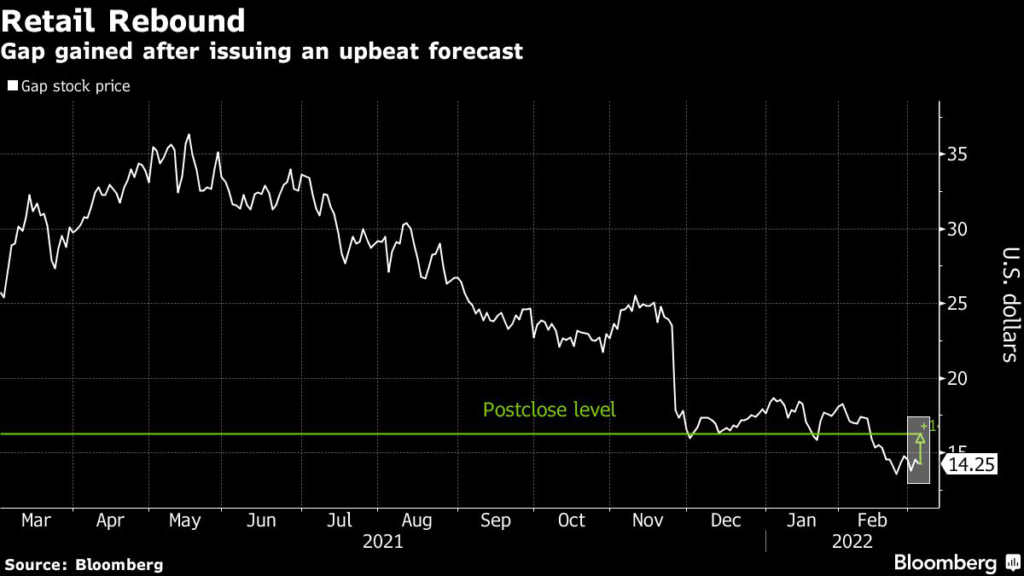
(Bloomberg) — Gap Inc. gave an optimistic projection for the current year, saying its strategic moves are starting to pay off, even though the apparel maker’s fourth-quarter results missed estimates on several key measures. The shares rose in late trading. 

  • For the current fiscal year, which ends in January, the retailer is projecting earnings per share in the range of $1.95 to $2.15, above the $1.68 average estimate from analysts surveyed by Bloomberg. It sees operating margin as high as 6.8%, also surpassing the average estimate.
  • Gap’s overall same-store sales rose 3% in the quarter ended Jan. 29. That’s below the average estimate of 4% from analysts surveyed by Bloomberg. Gross margin of 33.7% also fell short of expectations.
  • See more details.

Key Insights 

  • Chief Executive Officer Sonia Syngal said that the company is addressing “near-term disruption from the acute headwinds that muted our fourth-quarter performance.” She added Gap is confident in its ability to execute its strategy, which includes investing to bolster customer-loyalty programs and using artificial intelligence to “accelerate profitable growth.”
  • Sportswear chain Athleta posted the strongest performance among Gap’s portfolio of brands, and it’s expected to meet its target of $2 billion in sales this fiscal year. Things weren’t so pretty at Banana Republic and the Gap brand, however, with sales falling 11% and 13%, respectively, compared to 2019. Old Navy, plagued by supply-chain issues in the quarter, posted same-store sales that were flat compared to 2019, before the pandemic disrupted the company’s business.
  • Last month, Gap moved forward with releasing products from its partnership with artist Kanye West. Executives have said that the line has already brought the retailer new first-time shoppers. Investors will be listening for more details on the upcoming call with analysts.
  • In an illustration of where the company’s priorities lie, Gap plans to open about 30 to 40 stores for both Athleta and Old Navy this year. It also expects to shutter about 50 to 60 Gap and Banana Republic stores in North America.

Market Reaction 

  • Gap shares rose as much as 12% in after-market trading on Thursday. The stock has fallen 19% this year through Thursday’s close — nearly twice as much as the the S&P Midcap Retailing Index.

More stories like this are available on bloomberg.com

©2022 Bloomberg L.P.
Honda Joins Ford by Selling Green Debt in Electric Cars Push

(Bloomberg) — Honda Motor Co. raised $2.75 billion in bonds meant to benefit the environment for the first time, joining its competitor Ford Motor Co. in tapping the booming world of sustainable finance to fund a transition to electric vehicles.

The Tokyo-based automaker sold dollar-denominated green bonds in three parts, according to a person with knowledge of the matter. The longest portion of the offering, a 10-year security, yields 1.12 percentage points above Treasuries after an initially discussed level of as high as 1.4 percentage points, said the person, who asked not to be identified as the details are private. 

It marks the company’s first green bond deal, a company spokeswoman said last week. The offering is one of the largest green bonds to be issued by a corporation in the U.S. high-grade market, according to data compiled by Bloomberg.

Honda intends to allocate an amount equal to the net proceeds from the note issuance to a range of new eligible green projects that includes manufacturing electric cars, solar and wind along with investments in recycling used vehicle parts, according to a bond prospectus. Ford sold $2.5 billion of debut green bonds in November as it transitions to making electric vehicles, the largest ever such offering from a U.S. corporation.

“I do think we’ll see more automotive green bonds,” said Anne van Riel, head of sustainable finance capital markets for the Americas at BNP Paribas SA, which helped manage Ford’s green bond sale.

Read more: Ford Breaks Green Bond Record With $2.5 Billion Debut Sale

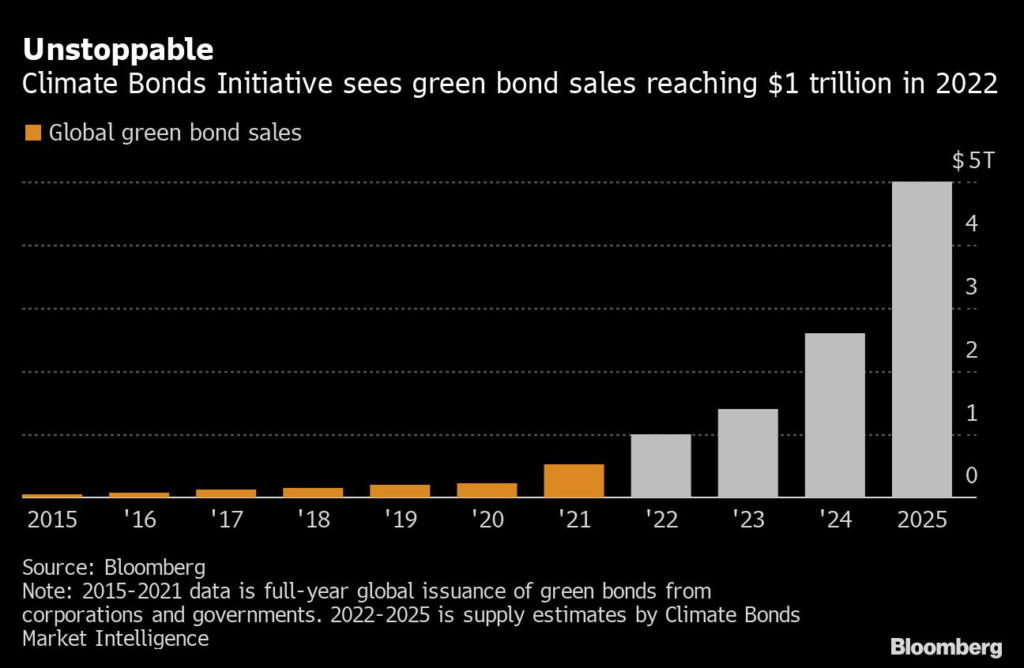
Companies and governments are rushing to the green bond market to finance all kinds of environmentally-friendly initiatives. Global sales of green bonds hit a record $513 billion last year, according to data compiled by Bloomberg. Climate Bonds Initiative estimates annual sales could reach fresh highs of between $900 billion and $1 trillion by the end of this year and as much as $5 trillion by 2025.


Maturing Market

More sectors participating in the green bond market in a “more robust manner” is a sign of a maturing market, according to Stephen Liberatore, head of ESG and Impact for Global Fixed Income at investment management firm Nuveen, which oversees $1.3 trillion globally. Liberatore, who manages about $18 billion in sustainable assets, including green, social and sustainability bonds, expects more automakers to follow.

“As someone who’s investing in this space, the deeper and wider opportunity set is a real big positive especially as an active total return portfolio manager,” Liberatore said in a video interview on Thursday. “These are the types of things we really want to see.”

Honda, which is halting exports of cars and motorcycles to Russia, was the first of Japan’s automakers to state publicly it will phase out sales of gasoline-powered cars completely. The firm set 2040 as the goal, giving newly minted Chief Executive Officer Toshihiro Mibe a once-in-a-career chance to put his stamp on a firm that can trace its lineage back 84 years.

JPMorgan Chase & Co., Bank of America Corp., Citigroup Inc. and Morgan Stanley managed the bond sale, the person said.

(Updates with pricing details in second paragraph, Anne van Riel’s comment in fifth paragraph.)

More stories like this are available on bloomberg.com

©2022 Bloomberg L.P.
Snowflake Plunges on Projection for Slowing Revenue Growth

(Bloomberg) — Snowflake Inc., a software company that helps businesses organize data in the cloud, dropped the most ever in a single day Thursday after projecting that annual product sales growth would slow from its previous triple-digit-percentage pace.

Executives said improvements to the company’s data storage and analysis products will let customers get the same results by spending less, which will hurt revenue in the short term, but attract more clients in the future. 

“The full-year impact of that next year is quite significant,” Chief Executive Officer Frank Slootman said on a conference call Wednesday after the results were released. But “when customers see their performance per credit get cheaper, they realize they can do other things cheaper in Snowflake and they move more data into us to run more queries.”

Product sales will increase as much as 67% to $1.9 billion in the current year, the company said in a statement. While in line with estimates, the forecast represents a significant decline in Snowflake’s revenue growth, which has more than doubled year-over-year in each of the past six quarters.

Snowflake’s stock fell 15% to $224.02 Thursday in New York, the biggest plunge since the company began public trading on Sept. 16, 2020. The shares have dropped 34% this year.

Snowflake earns revenue when customers store data and run queries on its platform, which is different from other software vendors that charge a monthly subscription cost. As a result of that consumption model, some early users are often surprised to get much bigger bills from Snowflake than they anticipated. Recognizing that, Snowflake has worked to improve the efficiency of its platform to help reduce costs for customers.

Those product enhancements are expected to result in a $97 million revenue hit in the year ahead, executives said on the call.

The outlook suggests Snowflake may also be getting hurt by the rising competition in the data storage and analytics sector. Product revenue makes up almost 95% of the company’s total sales.

The forecast “could be due to saturation of new customer additions at large companies,” said Mandeep Singh, an analyst at Bloomberg Intelligence. Snowflake is likely to move toward finding ways to sell to midsized companies, he added.

Snowflake gained prominence by taking the on-premises data warehouse and moving it to the cloud. However, its initial public offering, which was the largest in the U.S. in 2020, and subsequent success have led to a rush of investment in the sector, including into startups such as Databricks Inc. and Starburst Data Inc. that are trying to eliminate the need for Snowflake’s core offering.

But Snowflake is also adding features, like improved analytic capabilities to review corporate data to help predict future behavior, which is ramping up competition in a sector long-dominated by legacy vendors like Oracle Corp.  

Notably, Snowflake continues to drive additional spending from existing users. Its net revenue retention rate was 178% in the quarter, significantly above the industry average. That figure, however, is expected to drop in the coming quarters, partially a result of the product enhancements.

Fiscal fourth-quarter revenue doubled to $383.8 million. Analysts, on average, estimated $372 million. The company’s net loss narrowed to $132.1 million, or 43 cents a share, from a loss of $198.9 million, or 70 cents, in the period a year earlier.

Snowflake also agreed to acquire Streamlit, a company that helps developers build and share data applications, in a stock-and-cash deal for $800 million, executives said on the call. 

Executives said Streamlit could help in Snowflake’s push to add features to its platform to attract more data scientists, like supporting Python, a popular programming language. Bloomberg Beta, the venture capital arm of Bloomberg LP, is an investor in Streamlit.

The focus is on “driving workloads from the developer to Snowflake,” Slootman said.

(Updates shares in first and fifth paragraphs.)

More stories like this are available on bloomberg.com

©2022 Bloomberg L.P.

U.S. Sanctions Usmanov, Prigozhin Among Russian Elites

(Bloomberg) — The Biden administration moved to sanction eight wealthy Russians and their families and impose visa restrictions on several dozen others as the U.S. and its allies seek to raise pressure on the elites around President Vladimir Putin in response to the invasion of Ukraine.

The sanctioned Russians include: Alisher Usmanov, as well as his superyacht and private plane; Nikolay Tokarev and his wife and daughter; Boris Rotenberg and his wife and sons; Arkady Rotenberg and his sons and daughter; Sergey Chemezov and his wife, son and stepdaughter; Igor Shuvalov and his wife, son, daughter and companies connected to them; Yevgeny Prigozhin and his wife, daughter and son; and Dmitry Peskov, Putin’s press secretary.

“We continue to impose very severe economic sanctions on Putin and all those folks around him, choking off access to technology as well as cutting off access to the global financial system,” President Joe Biden said Thursday. “It’s had a profound impact already.”

Prigozhin, sometimes called “Putin’s chef,” was already under U.S. sanctions for his alleged role leading the Internet Research Agency, which American authorities have said was a troll farm responsible for interfering in the 2016 U.S. election to try to benefit Donald Trump’s campaign.

An additional 19 Russians and 47 of their family members will be subject to U.S. visa restrictions. They weren’t identified in the statement.

The sanctions are in keeping with measures the European Union imposed on Feb. 28, according to people familiar with the plans who asked not to be identified in advance of the announcement.

But the U.S. restrictions are broader, prohibiting the tycoons’ travel to the U.S. and also targeting their families to prevent them from transferring assets to spouses or children, a tactic that’s been used in the past to evade sanctions.

The moves are the latest effort by the administration to turn the screws on Putin and his inner circle following Russia’s invasion of Ukraine last week. On Wednesday, the U.S Justice Department announced a task force to enforce sanctions and export restrictions and to seize luxury assets belonging to Russia’s wealthiest citizens.

The administration believes that if the tycoons are put under financial strain, they may distance themselves from Putin and possibly pressure him to stop the war in Ukraine. 

Earlier this week, Europe announced sanctions on several wealthy Russians including metals tycoon Usmanov, Alfa Group owners Mikhail Fridman and Petr Aven, plus Alexey Mordashov, who controls a major steel company. Some had already been under sanction over Russia’s invasion of Crimea in 2014. 

French authorities said they stopped Rosneft chief executive officer Igor Sechin’s superyacht from leaving port on the Cote D’Azur on Thursday. Usmanov and others have lambasted the sanctions as unfair and illegal.

There is no discussion in the U.S. and EU about what Russian oligarchs or officials would need to do in order to be removed from sanctions lists, according to two senior Western officials. A senior Biden administration official said the U.S. is focused on holding what it regards as a kleptocracy to account for the Ukraine invasion. 

The business leaders and other elites targeted with sanctions and travel restrictions are part of the Russian regime and play an important role in the Russian state, a senior EU official said.

The U.S. government is working with Europe and the U.K. to identify, hunt down and seize assets, the U.S. official said.

The U.S. on Feb. 24 announced sanctions against Putin, his foreign minister, some national security aides and top executives of some of Russia’s biggest banks and state-owned entities, as well as Sechin. But it had so far held off imposing sanctions on the broader circle of billionaires who accumulated vast wealth by snapping up privatized Russian companies for bottom-basement prices in the years after the collapse of the Soviet Union. 

Many of those oligarchs had thrown in their lot with Putin in recent years. But several have offered hints in recent days that they’re looking to distance themselves from the war, though none have condemned Putin directly.

(Updates with comment from Western officials in 12th paragraph. A previous version was corrected to remove erroneous information about Usmanov’s yacht)

More stories like this are available on bloomberg.com

©2022 Bloomberg L.P.

Close Bitnami banner
Bitnami