Bloomberg

U.K. Asks Meta and TikTok to Block RT and Sputnik After EU Ban

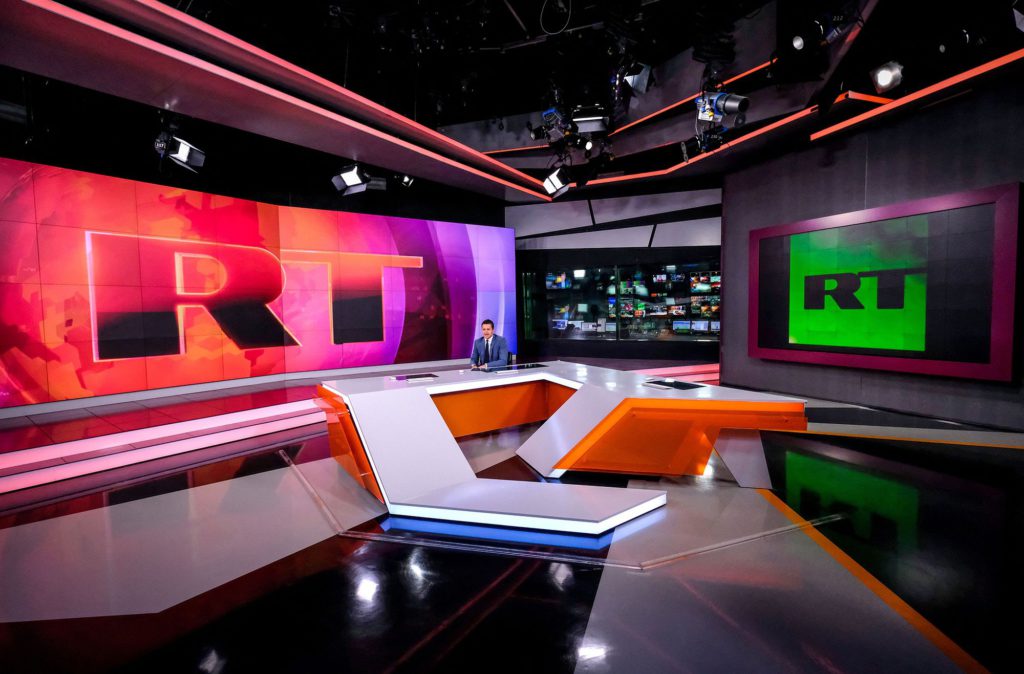
(Bloomberg) — The U.K. has asked Facebook owner Meta Platforms Inc., Twitter Inc. and ByteDance Ltd’s TikTok to ban Russian news channel RT while the U.K. regulator considers whether to sanction the broadcaster.

British Culture Secretary Nadine Dorries made the request Thursday, a day after the European Union officially banned broadcasts, app downloads and sharing content on social media from RT as well as Sputnik within the bloc. EU officials said its measures were needed to counter the destabilizing impact of propaganda concerning Russia’s invasion of Ukraine aired by both services.

The U.K. has lagged behind the EU in censoring Russian state media. Dorries last week wrote to regulator Ofcom to urge them to consider the position of RT, formerly called Russia Today. The watchdog has opened 27 investigations into RT’s impartiality in the past four days. 

“Given the exceptional and intolerable nature of the current situation, and in parallel to the work Ofcom is doing, I want to urge you to do everything you can to apply the approach you are taking across the EU to block access both to RT and to Sputnik’s online output (including the latter’s radio and audio services) on your U.K. services,” Dorries wrote to all three companies, according to a letter seen by Bloomberg.

The measures from the EU effectively barred the channel from reaching many televisions in the U.K. because RT was broadcasting over satellites owned by SES SA, which is based in Luxembourg. However, RT content is still available on both TikTok and Meta’s Facebook and Instagram in the U.K.

Representatives for Meta, Twitter and TikTok didn’t respond to requests for comment.  

Dorries praised the EU’s actions but was challenged by lawmakers in Parliament on Thursday, who asked her why the U.K.’s government hasn’t simply banned RT itself.

Dorries replied that it’s not a political decision and reiterated that it was a matter for Ofcom.

More stories like this are available on bloomberg.com

©2022 Bloomberg L.P.
South African Treasury Warns Self-Enrichment Culture Eroding State

(Bloomberg) — A culture of self-enrichment among some South African politicians and public servants is putting the country’s democracy and post-apartheid promises of creating a better life for all at risk, according to the most-senior official at the National Treasury. “We have to remind our leaders — and I’m speaking as a South African — …

South African Treasury Warns Self-Enrichment Culture Eroding State Read More »

Overwhelming UN Vote Makes China’s Ukraine Balancing Act Harder

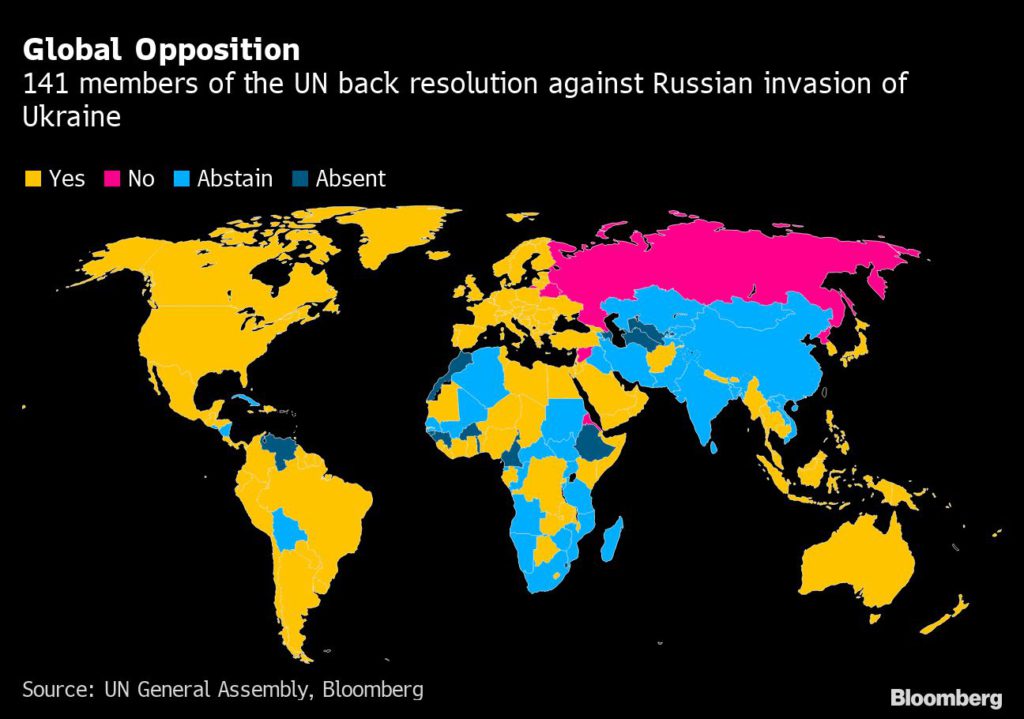
(Bloomberg) — An overwhelming vote by the United Nations on a resolution condemning Russia’s invasion of Ukraine may increase the pressure on China to take a clearer position on the issue.  The UN General Assembly passed the measure urging Russia to immediately halt its “aggression” by a vote of 141 to 5 in an emergency …

Overwhelming UN Vote Makes China’s Ukraine Balancing Act Harder Read More »

Norway, U.K. Invest $39 Million in South Africa Renewable Energy

(Bloomberg) — Norway and the U.K. will spend 600 million rand ($39 million) developing renewable-energy projects in South Africa to help fund the nation’s transition from coal-fired power generation to clean fuels. The countries’ development-finance institutions will help Black-owned renewables company H1 Capital build 2,400 megawatts of new wind and solar plants, according to a …

Norway, U.K. Invest $39 Million in South Africa Renewable Energy Read More »

Africa’s Biggest Pay-TV Provider Stops Showing Russia State News

(Bloomberg) — MultiChoice Group Ltd., Africa’s biggest pay-TV provider, stopped showing the Russia Today news channel after European Union sanctions against the country stopped the global distributor from providing the broadcast. Russia Today, owned by the Russian government, won’t be shown until further notice, Johannesburg-based MultiChoice said in a statement. Other TV providers, including Britain’s …

Africa’s Biggest Pay-TV Provider Stops Showing Russia State News Read More »

Amazon Labor Union Has Green Light to Hold Second NYC Election

(Bloomberg) — Amazon.com Inc. workers at a second facility in New York have won approval to hold a union election.

The upstart Amazon Labor Union has gathered enough signatures from employees at the LDJ5 warehouse in Staten Island to proceed with a vote, according to a National Labor Relations Board spokesperson. 

The union previously won approval to hold an election at the nearby JFK8 fulfillment center, where voting will run from March 25 to March 30. A union election is also underway at an Amazon warehouse in Alabama — a do-over after the Retail, Wholesale and Department Store Union contested its loss last year.

The NLRB said that if Amazon and the ALU fail to agree on which job roles should be included in the proposed bargaining unit at the second Staten Island facility, each party will have a chance to air their concerns at a hearing. After that, an NLRB official will decide when the election can proceed. 

While triggering a vote requires only 30% support of a facility’s workers, the union must win a majority of ballots to prevail in an election.

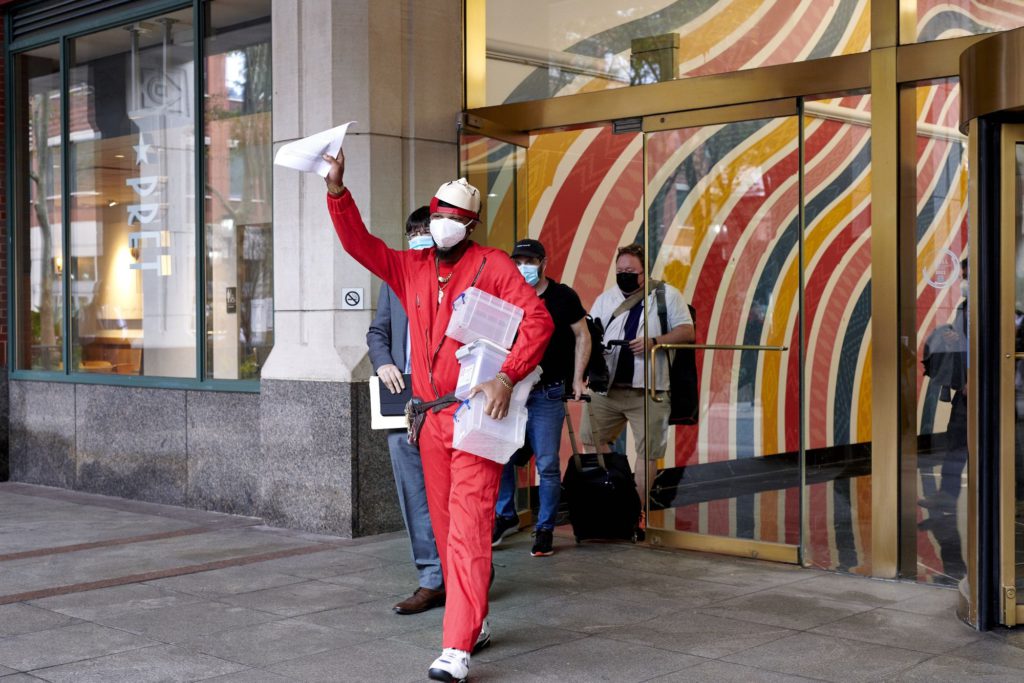
The successful petition for a second election in New York is a coup for ALU leader Christian Smalls and his group, who lack prior union organizing experience. Smalls worked at Amazon for more than four years before being fired in 2020 for what the company said was a violation of safety guidelines. Smalls said he was protesting Amazon’s Covid-19 policies. Last week, Smalls was arrested and charged with trespassing while delivering food to workers at the JFK8 facility. 

“We look forward to having our employees’ voices heard,” Amazon spokesperson Kelly Nantel said in a statement. “Our focus remains on working directly with our team to make Amazon a great place to work.”

(Updates with NLRB, Amazon comment.)

More stories like this are available on bloomberg.com

©2022 Bloomberg L.P.
World Mobile Bets on Africa, Where Alphabet’s Loon Balloons Failed

(Bloomberg) — World Mobile Group plans to start commercial operations of connecting rural communities in Africa using balloons from June, as it seeks to succeed where Alphabet Inc.’s Loon project failed.

The London-based operator seeks to use a lower-cost model and sees its first project of $250 million in Tanzania able to connect millions of people across the vast East African country. Most of the money will go to buying equipment and paying for spectrum, according to its founder and chief executive officer, Micky Watkins, who said a mass-piloting phase commences this month ahead of the commercial roll-out. 

World Mobile said it’s banking on its unique approach of deploying a mix of low and high altitude aerial platforms to get more flexibility in providing coverage. Some initiatives with similar objectives have run into headwinds in the past. Google parent Alphabet in January 2021 shut down Loon, a project to beam internet service from high-altitude balloons, after the unit failed to develop a viable business model.

Using 20-meter-long and four-meter-wide balloons with capacity to provide signals covering a range of about 43.5 miles, World Mobile expects to provide connectivity at a cost 12 times lower than traditional operators. 

The network “can be deployed very quickly into rural areas,” Watkins said in an interview. “We have also created an operating system that allows people to control, run and operate this network.”

While announcing the end of its project, Loon said it hadn’t found a way to get the costs low enough to build a long-term, sustainable business. What World Mobile says is doing differently is not to rely only on high-altitude platforms, but also use those nearer to the ground in a hybrid design that will offer greater efficiency.

About 37% of the world’s population — or almost 3 billion people — have never used the internet, International Communication Union said in November. Most of them live in developing countries.

World Mobile is also moving to expand in East Africa, having begun installing the first 30 to 40 so-called air nodes in Kenya, with commercial operations expected to start next year, according to Watkins.

The company’s advisers include Andrew Bartley, who previously served as a chief investment officer at the International Finance Corp.  and Charles Njoroge, formerly the head of Kenya’s telecommunications regulator. The company’s funding efforts, during July to August, helped it raise $42 million from a public and private token sale. 

More stories like this are available on bloomberg.com

©2022 Bloomberg L.P.

China Says Domestic Bitcoin Trading Plummets After Crackdown

(Bloomberg) — China’s central bank said Thursday that Bitcoin transactions originating from the country have plummeted to 10% from 90% of the total worldwide.  

The decline is in part due to Beijing’s intensifying crackdown on cryptocurrency trading and mining over the last decade. The country banned trading in Bitcoin as early as 2013, and outlawed centralized crypto exchanges in 2017. The nation’s supreme court threatened those involved in fundraising through crypto sales with up to 10-year jail sentences last month.

China used to be the world’s cryptocurrency hub. Major crypto exchanges such as Huobi were founded in China, while the Bitcoin miners in the country mined the vast majority of new coins.

The crackdown is also part of China’s efforts to restore order in its domestic financial market, according to the statement from the People’s Bank of China. Virtual currency trading is among a variety of illegal financial activities listed by the central bank, including online peer-to-peer lending and fundraising from the public without licenses.

The announcement also comes on the heels of international financial regulators’ discussion on how to prevent Russia from circumventing sanctions using cryptocurrency. The U.S. is prodding exchanges to thwart crypto use by sanctioned Russians.

More stories like this are available on bloomberg.com

©2022 Bloomberg L.P.

Best Buy Climbs After Unveiling Upgraded Long-Term Forecast

(Bloomberg) — Best Buy Co. jumped after unveiling an upgraded long-term forecast spurred by investments in a membership program, remodeled stores and new services in areas such as health care and digital advertising.

Operating profit will amount to 6.3% to 6.8% of sales in fiscal 2025 and revenue will rise to as much as $56.5 billion, the electronics retailer said in a statement Thursday as it reported earnings. That easily surpassed Best Buy’s pre-pandemic outlook and the expectations of Wall Street analysts, who had been predicting an operating margin of less than 6% on sales below $54 billion. 

With the improved forecast, Best Buy took a step toward soothing investor fears that it would struggle to build on a surge in demand during the coronavirus pandemic. While the company acknowledged a looming sales slowdown this year and profit pressure from investments in its new services, it said it’s positioned for a long-term expansion that will push results “well beyond” what it reported last year. 

“We do not believe for a minute that we hit our peak revenue and margin this past year,” Chief Executive Officer Corie Barry said in a presentation to investors and analysts. 

The shares jumped 8.5% to $109.42 at 9:48 a.m. in New York, the biggest intraday gain in six months. In the 12 months through Wednesday, Best Buy shares had fallen 1.6% compared with a 7.5% gain in an S&P 500 index of consumer discretionary companies. 

Best Buy’s previous earnings report, in November, had prompted the biggest rout in the shares since the start of the pandemic.

Limited ‘Downside’

“We remain hold-rated but the stock seems fairly washed out at current levels, likely reducing incremental downside potential,” Truist Securities analyst Scot Ciccarelli wrote in a note to clients.

Adjusted earnings fell to $2.73 a share in the fourth quarter, Best Buy said. Analysts had been expecting $2.72. Sales slipped 3.4% to $16.4 billion. Analysts had predicted $16.6 billion.

During the current fiscal year, which ends in early 2023, adjusted earnings will be no more than $9.15 a share, the company said. That compared with the $9.36 average of analyst estimates.

“We expect sales growth and earnings to look different” this year, Chief Financial Officer Matt Bilunas said in the statement. He said the two biggest variables in this year’s forecast “are the short-term industry decline as we lap high growth and government stimulus, and the investment in our new membership program.” 

Totaltech, the company’s membership program, will help drive “meaningful growth,” as will Best Buy Health, an initiative to provide technologies to assist in the care of older people, Bilunas said. 

Capital expenditures will range between $1 billion and $1.2 billion in the next three years, compared with less than $750 million during the last three, he said. 

(Updates with CEO comment in fourth paragraph.)

More stories like this are available on bloomberg.com

©2022 Bloomberg L.P.
Grab Loss Swells on Spending to Lure Drivers, Customers

(Bloomberg) — Grab Holdings Inc., Southeast Asia’s ride-hailing and delivery giant, reported a wider loss after the company spent more on incentives to lure drivers and customers as the pandemic eases.

The Singapore-based company’s net loss almost doubled to $1.1 billion for the quarter ended Dec. 31, also hurt by non-cash interest costs and expenses related to its public listing, it said on Thursday. Analysts estimated a loss of $645 million on average. Revenue fell 44% to $122 million, affected by the incentives offered to users and drivers.

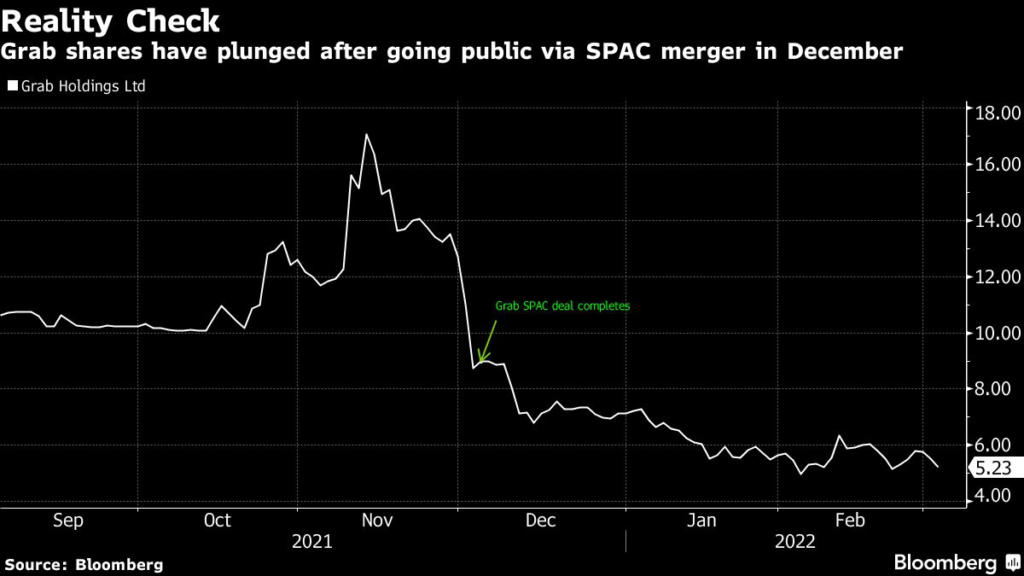
Grab — which counts SoftBank Group Corp. and Uber Technologies Inc. as its two biggest shareholders — has struggled to gain a steady footing since it became a publicly listed company in the U.S. through a deal with a blank-check company in December. Its shares have lost about half their value since, wiping more than $15 billion from its market capitalization.

Grab has racked up losses since its founding and has yet to prove it can reach profitability. Its fortunes have ebbed and flowed along with Covid-19 infection rates and restrictions, which affect demand for rides and meal deliveries.

In all of 2021, its loss widened to $3.4 billion from $2.6 billion the previous year. Gross merchandise value, the sum of transactions across its platforms, totaled $16.1 billion, compared with its projection of $15 billion to $15.5 billion.

Key Insights

  • Grab is trying to capture broader opportunities in the food services market to drive user growth. The online grocery market in Southeast Asia is expected to almost triple to $11.9 billion in 2025 from $4.1 billion in 2020, according to Euromonitor International.
  • Average spend per user — GMV per monthly transaction user — on Grab platform grew 23% in the fourth quarter from a year earlier.
  • Yet the growth isn’t yet translating to earnings. Revenue booked from delivery last quarter was just $1 million. Grab deducts incentives that it offers to drivers and consumers from sales, and its quarterly revenue number fluctuates wildly depending on how much it spends on such efforts. It spent $443.3 million on delivery incentives in the quarter, almost double from a year earlier.
  • Grab is also facing growing competition, including from Sea Ltd., Southeast Asia’s biggest internet company. More directly, its Indonesian ride-hailing rival, Gojek, merged with e-commerce provider PT Tokopedia to become GoTo. The combined entity is preparing for an initial public offering at home and in the U.S. this year.

Get More

  • Grab expects first-quarter deliveries GMV of $2.4 billion to $2.5 billion
  • Grab expects first-quarter mobility GMV of $750 million to $800 million
  • Company sees GMV growth from the second quarter through fourth quarter expanding by 30% to 35% year-on-year, subject to shifts in the pandemic
  • Grab said it’s “progressing towards” breakeven in food delivery segment adjusted Ebitda by the first half of 2023 and in deliveries segment by the end of 2023
  • Revenue from delivery business multiplied to $148 million in 2021
  • Revenue from mobility business rose 4% to $456 million last year
  • Full-year revenue from financial services rose to $37 million

Market Reaction 

  • Grab shares dropped about 9% in New York premarket trading. They’ve lost 27% this year.

(Updates with incentive spending in third bullet.)

More stories like this are available on bloomberg.com

©2022 Bloomberg L.P.

Close Bitnami banner
Bitnami