Bloomberg

Taiwan Scrambles to Restore Power After Widespread Blackouts

(Bloomberg) — Taiwan saw regional blackouts across the island Thursday in the latest sign its creaking electrical grid is struggling to meet rising demands for power from its technology manufacturers. 

A failure at the Hsinta coal-fired power plant in Kaohsiung led to a power outage in southern Taiwan Thursday morning. That triggered blackouts in parts of central and northern Taiwan, including the capital Taipei, according to statements from the state-run Taiwan Power Co. The electricity provider said power supply had been restored to more than 4 million households, over 80% of those affected, as of 3 p.m. but local media reported rolling blackouts were still occurring through the south.

While parts of the chip-making hub of Hsinchu were also impacted, the Hsinchu Science Park said its power supply remained normal. A representative for Taiwan Semiconductor Manufacturing Co. said it had not been affected, while ASE Technology Holding Co. said the impact was limited and that power supplies were gradually resuming. United Microelectronics Corp. said its facilities in southern Taiwan were also coming back online. 

Steelmaker China Steel Corp. also halted some production at its Kaohsiung factory due to the blackout, Taipei-based Apple Daily reported, citing the company.

“Initial investigation of the power outage shows that it’s due to tripping off of equipment, but it also highlights the dilemma and fragility that northern Taiwan needs to rely on the south for power supply,” said cabinet spokesman Lo Ping-cheng.

He added in a separate statement later that the incident was caused by human error and Minister of Economic Affairs Wang Mei-Hua asked for disciplinary action over the power outage.

The resilience of Taiwan’s power grid has become an increasing global concern in recent years. Home to TSMC, the world’s largest contract chipmaker, Taiwan plays a key role in the world’s supply of computer chips, and a few hours without electricity is enough to disrupt global supply chains. A worldwide shortage of semiconductors has heightened concerns, triggering a scramble among major companies, from consumer electronics brands to automakers, to secure scarce supplies.

The government’s aggressive push into renewable energy and phaseout of nuclear power coincides with a surge in demand as more manufacturers build plants at home rather than overseas. The latest power-hungry chipmaking equipment used by the likes of TSMC for their cutting-edge semiconductors are also an increasing burden on the grid. 

Human Error and Shaky Grid Spark New Global-Chip Supply Concerns

The aging Hsinta plant was at the center of two outages in the space of a matter of days in May last year. Millions of households and nearly half of Taiwan’s industrial parks were affected by insufficient supply and rolling blackouts.

The reliability of power was one of the main concerns raised by companies in the American Chamber of Commerce in Taiwan’s business climate survey for 2022 released in January. Energy sufficiency was the No. 1 issue the government should be focusing on, ahead of Covid-19 and cross-strait relations, according to members’ responses. 

(Updates with cabinet spokesman’s comment in sixth paragraph)

More stories like this are available on bloomberg.com

©2022 Bloomberg L.P.

Ukraine Cancels Planned Crypto ‘Airdrop’ Rewards for Donations

(Bloomberg) —

Ukraine has scrapped a plan to reward people who donated to its fight against a Russian invasion with newly created crypto assets, following complications with the project.

The official verified Twitter account for Ukraine said on Wednesday it planned to issue a so-called “airdrop”, a common tool for early-stage crypto platforms to attract users by offering free tokens to jump start a project. But a day later, Ukraine’s Vice Prime Minister Mykhailo Federov said in a tweet that the nation had decided to cancel the project. The tweet wasn’t independently verified by Bloomberg News. 

“Every day there are more and more people willing to help Ukraine to fight back the aggression,” Federov said in a tweet from his personal verified Twitter account on Thursday. He added that Ukraine will announce a drop of nonfungible tokens to support the Ukrainian Armed Forces soon, but that it has no plans to issue any fungible tokens such as cryptocurrencies.

The project’s cancellation followed rife speculation that Ukraine had begun its airdrop hours ahead of schedule on Thursday, after a tracker of its Ethereum wallet showed the creation of 7 billion newly-minted tokens and transactions distributing those tokens to individual addresses. Analysts at crypto research platform and news service The Block later suggested the transactions had been spoofed by an outside third party.

Airdrops have been previously utilized by companies and some governments to boost mass adoption beyond the private sector. El Salvador last year rewarded its citizens with $30 in Bitcoin as an incentive for adopting its state-sponsored Chivo wallet. The move was part of the country’s adoption of Bitcoin as legal tender, a process which has been beset by controversy. 

Crypto addresses affiliated with the Ukrainian government and various charitable organizations had received more than $33 million in cryptocurrency donations as of Wednesday, according to data compiled by Bloomberg.   

More stories like this are available on bloomberg.com

©2022 Bloomberg L.P.

Grab Loss Swells as Pandemic Hampers Ride-Hailing Demand

(Bloomberg) — Grab Holdings Inc., Southeast Asia’s ride-hailing and delivery giant, reported mounting losses as the pandemic depressed demand for mobility services.

The Singapore-based company’s net loss almost doubled to $1.1 billion for the quarter ended Dec. 31, according to its statement on Thursday. Analysts estimated a loss of 645 million on average. Revenue declined 44% to $122 million as Grab spent on driver incentives.

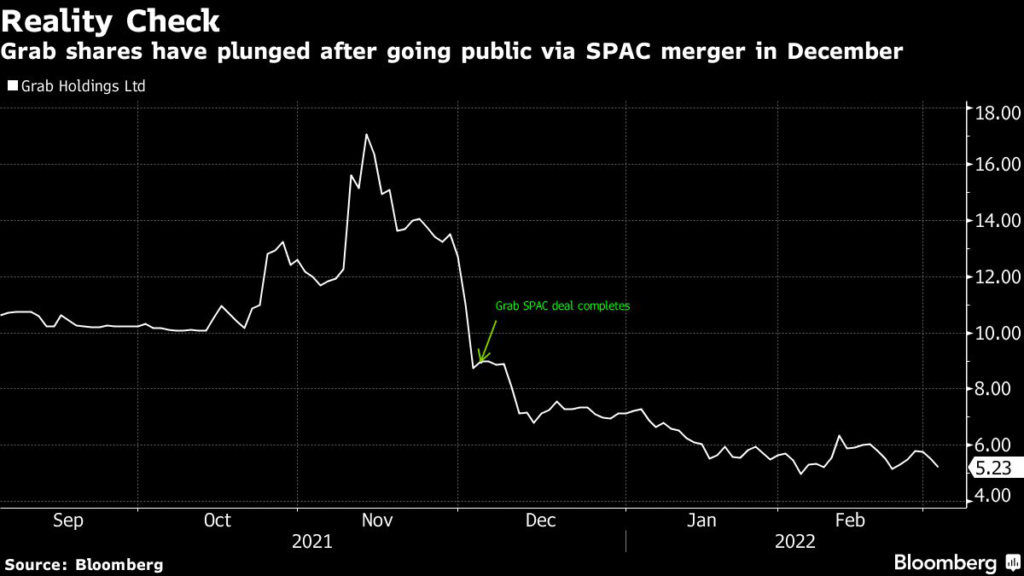
Grab — which counts SoftBank Group Corp. and Uber Technologies Inc. as its two biggest shareholders — has struggled to gain a steady footing since it became a publicly listed company in the U.S. through a deal with a blank-check company in December. Its shares have lost about half their value since, wiping more than $15 billion from its market capitalization.

Grab has racked up losses since its founding and has yet to prove it can reach profitability. Its fortunes have ebbed and flowed along with Covid-19 infection rates and restrictions, which affect demand for rides and meal deliveries.

In all of 2021, its loss widened to $3.4 billion from $2.6 billion the previous year. Gross merchandise value, the sum of transactions across its platforms, totaled $16.1 billion, compared with its projection of $15 billion to $15.5 billion.

Key Insights

  • Grab is trying to capture broader opportunities in the food services market to drive user growth. The online grocery market in Southeast Asia is expected to almost triple to $11.9 billion in 2025 from $4.1 billion in 2020, according to Euromonitor International.
  • Average spend per user — GMV per monthly transaction user — on Grab platform grew 23% in the fourth quarter from a year earlier
  • Grab is facing growing competition in the region, including from Sea Ltd., Southeast Asia’s biggest internet company. More directly, its Indonesian ride-hailing rival, Gojek, merged with e-commerce provider PT Tokopedia to become GoTo. The combined entity is preparing for an initial public offering at home and in the U.S. this year.

Get More

  • Grab expects first-quarter deliveries GMV of $2.4 billion to $2.5 billion
  • Grab expects first-quarter mobility GMV of $750 million to $800 million
  • Company sees GMV growth from the second quarter through fourth quarter expanding by 30% to 35% year-on-year, subject to shifts in the pandemic
  • Grab said it’s “progressing towards” breakeven in food delivery segment adjusted Ebitda by the first half of 2023 and in deliveries segment by the end of 2023
  • Revenue from delivery business multiplied to $148 million in 2021
  • Revenue from mobility business rose 4% to $456 million last year
  • Full-year revenue from financial services rose to $37 million

Market Reaction 

  • Grab shares dropped 5.3% to $5.23 in New York trading on Wednesday. They’ve lost 27% this year.

More stories like this are available on bloomberg.com

©2022 Bloomberg L.P.

A $5 Million Russian IOU Is Suddenly a Market Moment

(Bloomberg) — A Russian telecommunications company will be the first to answer a pressing question from global investors: will Russian companies continue servicing their foreign-currency bonds.

Search engine Yandex NV, the group’s entity based in The Netherlands, is due to pay a $4.7 million coupon on Thursday for a $1.25 billion bond due 2025, according to Bloomberg calculations. It’s the first foreign-currency coupon payment by a company headquartered in Russia since sweeping sanctions and capital controls raised fears among bondholders that corporates won’t be able to service their debts. The debt has lost more than half its value in the past week, according to TRACE pricing.

How that coupon payment unfolds will set a precedent for investors holding foreign-currency bonds issued by Russian companies based abroad, amid uncertainty over whether they can meet their debt obligations as they navigate a series of sanctions and capital controls. A spokesperson for the company said on Monday that it has enough liquidity outside of Russia to settle its coupon payments, but didn’t respond to requests for comment thereafter.

“The Yandex payment is crucial – every single coupon paid shows us the willingness of Russian corporates to remain current on their payments” said Jean Dominique Butikofer, head of emerging markets fixed income at Voya Investment Management. “We navigate on a day-by-day basis as sanctions, amendments and implementations change so fast.”

More than 90% of the $18 billion corporate Eurobonds due this year were issued by units or SPVs outside of Russia, according to data compiled by Bloomberg. So are three quarters of the issuers that have coupon payments due.

State-controlled energy giant Gazprom PJSC is already in the process of settling a $1.3 billion debt due on March 7, issued by Gaz Capital SA, a SPV incorporated in Luxembourg. State oil producer Rosneft PJSC’s $2 billion bond, issued from an Ireland-based entity, matures on March 6. 

“A lot of these Russian corporates may have U.S. dollars deposited in banks outside Russia and the latest news flow indicates willingness from Russian corporates to serve their debt for now,” said Voya’s Butikofer. 

A $9 Billion Bond Problem Is Coming for Russian Issuers (1)

Cash piles

That most of the issuing bodies are based outside of Russia may ease some of the concern international investors had that a wave of defaults is imminent after Russia’s major banks were cut out of the SWIFT international messaging system. Fitch Ratings estimates that most companies with foreign-currency notes due over the next year can repay with available cash on their balance sheets, according to a report dated Feb. 23 but emailed to Bloomberg on Monday.

That’s because their lesson from sanctions imposed on Russia since 2014 involved building huge cash piles in case they’re locked out of financial markets at short notice, according to Fitch.

That said, if the current restrictions on money transfers drag on, and Russian companies are shut out of the financial system for long, then new issues may emerge. Raising debt in rubles to refinance foreign currency notes is a costly and impractical option, given the depreciation of the currency and the difficulty of finding a clearing house or a bank that can transfer the funds.

But also, as Marc Ostwald, chief economist for ADM ISI said on Wednesday, corporates will do what Russian President Vladimir Putin will tell them to do. And given the pace at which relations between Russia and U.S. and its allies have deteriorated, it’s anyone’s guess what Putin’s next move will be.

“We are in gray territory, surrounded by restrictions of all sorts,” said Cristian Maggio, head of portfolio strategy at TD Securities. “Investors will likely not move a finger until all this is clear to avoid being prosecuted later for violation of international bans and sanctions on Russia.”

More stories like this are available on bloomberg.com

©2022 Bloomberg L.P.

Finnish Utility Halts All New Investments in Russia

(Bloomberg) — Finland’s Fortum Oyj will stop all new investment projects and cut the number of its power plants in Russia, pulling back just as it looks to bolster energy generation at home. 

The utility is following global energy giants from BP Plc to Exxon Mobil Corp. in retreating from Russia after President Vladimir Putin’s invasion of Ukraine. While Fortum isn’t exiting entirely, the move marks a significant retrenchment for a company that earns about a fifth of its operating income in the country.

“Business as usual cannot continue,” Chief Executive Officer Markus Rauramo said Thursday. “We have stopped all new investment projects in Russia until further notice and we will continue to reduce our thermal exposure” there.

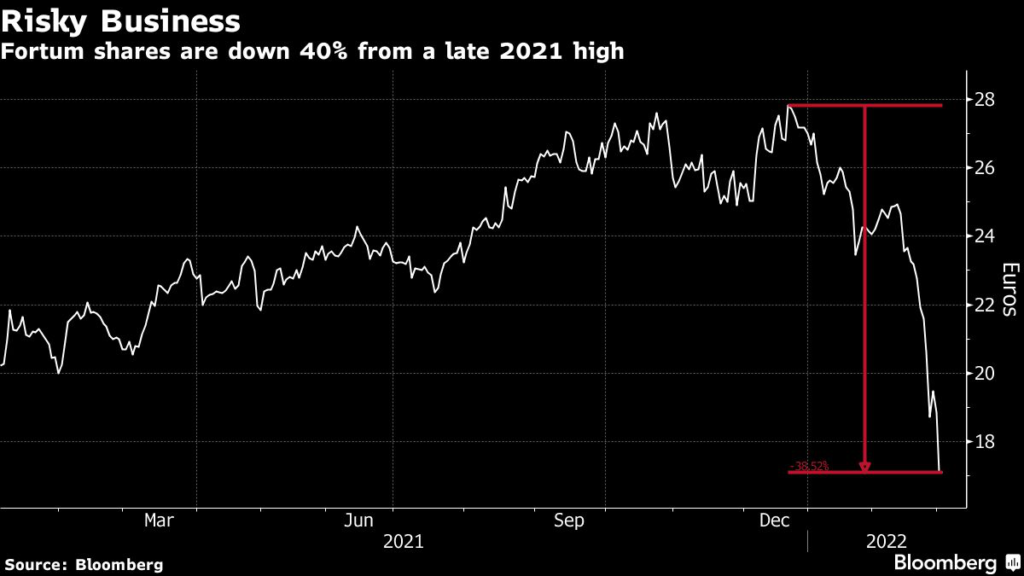
The Russian generating assets of Fortum and its Uniper SE unit — and exposure to the Nord Stream 2 pipeline project — carry a book value of about 5.5 billion euros ($6.1 billion), a statement showed. That’s about a third of Fortum’s market capitalization. 

The company’s shares dropped as much as 4.8%, and traded down 4.6% at 16.32 euros as of 1:23 p.m. in Helsinki.

Russia’s war in Ukraine has jolted the European energy landscape, pushing many nations to reassess their reliance on Russian supplies. Industrial powerhouse Germany has said it could delay it’s exit from coal, while rapidly scaling up renewables and reviving plans to import liquefied natural gas. 

Soaring fossil fuel prices and rising demand for clean energy have also prompted some governments to turn to nuclear power, with countries such as Germany softening their opposition to the sector while others like Finland actively seek to expand atomic output.

Extending Nuclear

Fortum said Thursday it would apply for an extension to run its two Loviisa reactors on Finland’s south coast until 2050 and invest 1 billion euros in the project. Another big reactor at the Olkiluoto plant in the southwest is due to come online this year, helping to boost the nation’s energy independence. 

Read more: Fortum Seeks to Operate Loviisa Nuclear Power Plant Until 2050

“Continuing production in Loviisa is above all an investment in securing the supply of clean domestic electricity,” Rauramo said in a separate statement. “The economic, political and societal aspects were factored into our decision.”

Fortum was formed in 1998 from the merger of two state-owned power and oil companies in Finland. That year, it bought a stake in Russian utility OAO Lenenergo and further acquisitions since then have boosted the company’s market share. It now owns 12 power stations in Russia — including five plants held by Uniper — and employs 7,000 people there. Fortum also owns the nation’s largest wind and solar portfolio.

Fortum and Uniper are unlikely to exit Russia completely in the near term, given their “significant exposure,” said Patricio Alvarez, an analyst at Bloomberg Intelligence in London. Yet the decision to halt new investments “may mark the start of a longer-term exodus.”

The Finnish company also reported fourth-quarter earnings on Thursday that beat analyst estimates. For more on the results, click here.

(Updates shares in fifth paragraph.)

More stories like this are available on bloomberg.com

©2022 Bloomberg L.P.

Bulls Resurface as Nasdaq Less Frothy, Rates Cool

(Bloomberg) — With an escalating war in Europe, one could expect investors to be avoiding risk everywhere. Not so, as the rally in U.S. technology stocks over the past week indicates.

The Nasdaq 100 Index has jumped 5.4% since Russia invaded Ukraine as investors dialed back their expectations for Federal Reserve interest rate increases and after much of the pandemic period froth had been wiped out. Fearing the economic damage from the war, traders have already ruled out an aggressive half-point rate hike this month, a view encouraged Wednesday by Fed Chair Jerome Powell.

Citigroup Inc. strategists upgraded technology stocks to overweight Thursday, saying growth stocks have been “more resilient.” Indeed, big technology stocks such as Apple Inc. and Google owner Alphabet Inc. have fallen less than the S&P 500 Index’s 8% drop this year. 

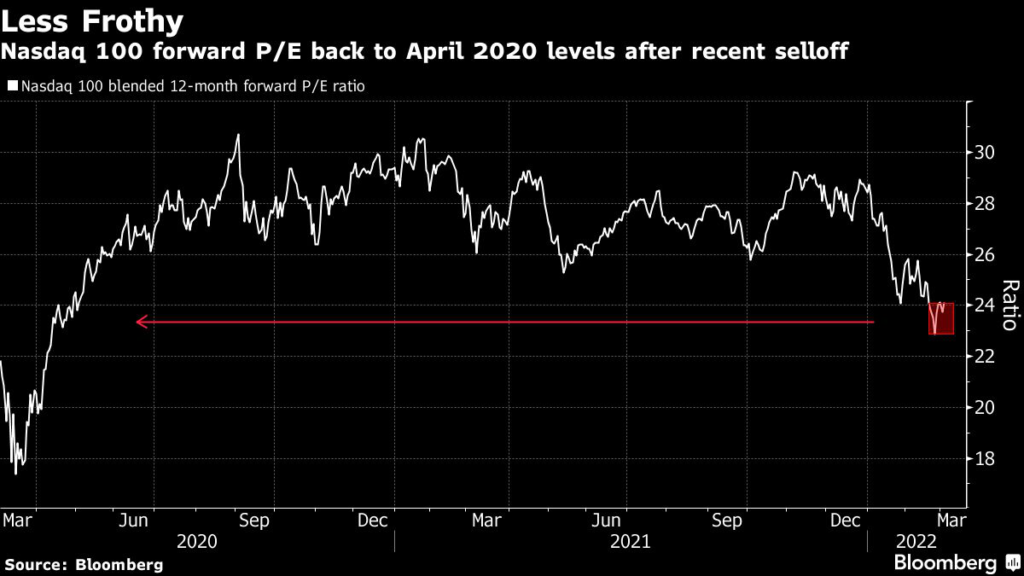
The Nasdaq 100 had narrowly escaped entering a bear market last month, when expectations for a faster rate-hike path from the Fed crushed high-growth stocks. The selloff since early December has pushed the index’s valuation to 24 times forward earnings, a level last seen before the pandemic-led boom.

Mark Stoeckle, chief executive of Adams Funds, said some companies with solid balance sheets are now trading at attractive points. 

“Three investors I know put money to work last Thursday using a 18-month time frame as their rationale,” he said.

Tech Chart of the Day

As the Nasdaq 100 sank almost 20% from its November peak, analysts didn’t reduce their stock price targets for the companies in the index at the same pace. Now, even after the bounce of the past week, the targets imply a 25% rise for the shares in aggregate over the next year — the biggest forecast gain since the peak of the pandemic. 

Top Tech Stories

  • Peloton co-founder John Foley, who stepped down as chief executive officer last month, sold about $50 million of stock in the company to MSD Partners, a firm that manages money for billionaire Michael Dell
  • Snowflake plunged almost 22% in premarket trading after projecting that annual product sales growth would slow from its previous triple-digit-percentage pace
  • WeDoctor, one of China’s leading online health-care platforms, is laying off a substantial chunk of its workforce after plans for an initial public offering were disrupted, according to people familiar with the matter
  • The Russian government is “throttling Twitter, Facebook, and Instagram platforms that tens of millions of Russia’s citizens rely on to access independent information and opinions and to connect with each other and the outside world,” the U.S. State Department says in a statement
  • Coupang, South Korea’s leading e-commerce company, reported a wider loss in the fourth quarter as the company continued to aggressively spend on infrastructure and services in the face of intensifying competition

More stories like this are available on bloomberg.com

©2022 Bloomberg L.P.

Biden Says the Union Is Strong. Back Home in Scranton, the Mood Is Dour

(Bloomberg) — President Joe Biden declared Tuesday that the state of the union is strong. In his hometown of Scranton, Pennsylvania, the view is gloomier.

The city looks like a success story. It’s experienced a recent economic turnaround thanks in part to the growth of e-commerce outfits like Amazon.com Inc. and Chewy Inc., a pet supplies company with a distribution center in the area. 

Yet locals say something about the nation doesn’t work any more — inflation is soaring, wages aren’t keeping up, labor shortages appear everywhere, government is dysfunctional and the American dream seems just out of reach.

“If you put your fingers on the pulse of America, it’s not healthy,” said Shane Cawley, a local ironworker who introduced Biden on his last visit to Scranton in October. 

The actual mood in America? “Scared, desperate,” Cawley said. Inflation is “out of control” and Americans are increasingly frustrated with a bitterly divided political class, he said. “Not just frustrated. Angry, straight angry.”

America’s been in the dumps before. President Jimmy Carter declared the nation to be suffering a “crisis of confidence” in a 1979 speech, the year before he was defeated for re-election, remarks that came to be known as the “malaise speech” even though he never used the word. In January, Vice President Kamala Harris invoked the term herself, saying in a PBS NewsHour interview that “everybody is frustrated” with the pandemic and “there is a level of malaise” in the country. 

Whatever the diagnosis, the U.S. public is in a sour mood — and Biden, as president, is bearing the blame. His approval rating has slid steadily since August, after the chaotic withdrawal from Afghanistan, to just 41% on average, according to an analysis of polls by FiveThirtyEight. 

National surveys of the nation’s attitude reveal a country at wit’s end. Nerves are frayed and patience is exhausted after two years of a pandemic that has only sharpened partisan divides. While people tend to be more optimistic about their own lives and communities, inflation has become the overriding economic concern of most Americans, eclipsing Biden’s progress restoring jobs and growing output. Russia’s invasion of Ukraine and fear the conflict could widen is only adding to American anxiety. 

“The state of the union is: on the precipice of a mental health crisis, if we haven’t already tipped,” said Vaile Wright, a psychologist and senior director of health care innovation at the American Psychological Association. The group’s members have reported a surge in demand for their care, particularly for anxiety, depression and trauma. Biden nodded at the issue himself in his State of the Union address. “I know you’re tired, frustrated, and exhausted,” he said, urging Congress to expand access to mental health care “especially among our children, whose lives and education have been turned upside down” by the pandemic.

Read more: Biden Unity Plea Collides With Reality of Bitterly Divided U.S.

Pennsylvania Senator Bob Casey, a Biden ally who’s also a Scranton native, said that he expects the national mood to improve by the fall as the pandemic recedes. In an unexpected move, Biden called for Americans to return to their offices and resume more normal lifestyles in his State of the Union address.

“There’s no question that when you have inflation like we’ve seen, that that’s going to be a burden,” Casey acknowledged in an interview. “I do think that we will be in a different place in November — late October, early November — than we are now, at least on one important indicator for a lot of people, and that’s Covid itself.”

Midterm U.S. elections are Nov. 8, and Republicans already expect to win control of at least one chamber of Congress.

The stress is evident in Scranton, a city the president cites often in speeches. Its economic slump when Biden was a child led his family to relocate to Delaware. Scranton and communities like it, particularly in the South, Midwest and Appalachia regions, routinely score low on the Gallup National Health and Well-Being Index, which tracks economic opportunity, health care access and other lifestyle measures. 

At a recent event in the city with Casey, local officials thanked the Democrat for $2.1 million headed their way for transit projects, thanks to Biden’s infrastructure law. But they said they need more funding for operating expenses, as it’s getting harder to hire and keep bus drivers.

The city of 76,000 sits at an interstate highway crossroads in northeast Pennsylvania, nestled among hills whose coal fueled Scranton’s growth before the sector collapsed more than half a century ago. It’s reinvented itself as a logistics center, business that accelerated when the pandemic fueled a boom in online shopping.

Local employers now offer signing bonuses and hourly wages topping $20 an hour. This year, Scranton officially shed its “distressed” financial status with the state for the first time in decades. 

And yet the outlook among many in Scranton about the state of the country is grim. Eric Pusey, a pharmacist in the area, said that without the Paycheck Protection Program, enacted under former President Donald Trump and extended under Biden, “we would not have survived, there’s no question about that.” But now, inflation and staffing shortages have small businesses struggling to simply survive, he said. “I think the state of the union is a disaster.”

Before the pandemic, Kathleen Pearage’s day care centers had waiting lists because of a lack of space. Now, her constraint is staffing — parents find themselves on waiting lists because she can’t hire enough workers. Grants and government funding kept her business afloat through the pandemic, she said, but the money is poised to run out.

The current circumstances, she said, are “probably the worst, most-rough time we have ever experienced.” 

Biden has proposed new federal support for child care that would subsidize costs for parents while raising pay for caregivers, a plan Pearage welcomes. But it stalled last year along with the rest of the president’s “Build Back Better” agenda after congressional Democrats couldn’t reach agreement on the legislation.

Pearage’s confidence the bill will ever pass is shaky. “I don’t know that he has the support to be able to pull off what needs to happen,” she said.

Cawley, the ironworker, was looking forward to the child-care measure as well. He and his wife are expecting their fourth child this year, which will push daycare costs for his three youngest children to about $650 a week, he estimated.

“It seems like right now, with the political climate, that there’s no common ground that we can meet on,” he said.

Representative Matt Cartwright, a Democrat who represents the city and was one of a handful of lawmakers in his party who won re-election in 2020 in a district Trump carried, said he’d like to see Biden boast more about policies that are largely popular, despite the failure of Build Back Better.

“The funny part about Build Back Better is that everything in there, people like. If you go through the details of what’s in that, people want all of it,” he added. “Maybe the answer is: do these things one at a time.”

Ukraine is a mild concern in Scranton. People interviewed for this story said generally that they think Biden could be tougher on Russia, but also that the war is not for the U.S. to fight. But across the city, inflation is top of mind. 

Rising prices are “killing all of us — from a labor standpoint to, in our industry, lumber and plywoods,” said Pat Fricchione, chief executive officer of Simplex Industries Inc., a homebuilder in Scranton that saw its business surge as people fled larger cities during the pandemic.

“There’s such a scarcity of labor,” he said. “Now, all of a sudden, in order to attract new employees, everyone has to pay more. So, that obviously has fueled the fire as far as inflation.”

Read more: Inflation Pain Means Biden Gets No Credit for Roaring EconomyLocally, there’s no sign of imminent relief.

Joe Fasula, co-owner of the Gerrity’s Grocery Store chain, said his stores are still receiving 90-day notices of supplier price hikes — a signal that prices will continue to climb for months. 

“If inflation keeps going, and if we see that wages do not keep pace — which they’re not — at some point people are going to hit a wall financially,” he said. Bob Durkin, head of the local Chamber of Commerce, pointed to the government’s pandemic relief spending as a factor.“It’s not going to be you know, the 1970s — I can’t believe that,” he said. “But it has to have been affected by the infusion of money that went into this economy short-term.”

Biden himself has become a flashpoint in the city. He won the county that includes Scranton by 8 points in 2020, and flipping Pennsylvania from Trump was key to his victory over the former president.

But residents disagree on whether Scranton is truly his hometown — “I don’t think the general population looks at him that way,” Fasula said — and a move last year to rename a major street for the president was protested by some business owners. It succeeded anyway.

Communities like Scranton are on the front lines of a demographic shift that poses risks to Democrats, as the party bleeds support outside large urban areas and among White voters. Biden hasn’t lost the town. Cawley says he’d consider voting for him again, especially if Trump is the Republican nominee in 2024. 

“I legitimately believe he wants to help and do some real good and make some real change. And it’s not easy,” he said. 


More stories like this are available on bloomberg.com

©2022 Bloomberg L.P.

PBOC Says Number of High-Risk Banks to Fall as It Cracks Down

(Bloomberg) — The People’s Bank of China said it expects the number of high-risk banks to continue to decline in coming years, vowing to persist with its campaign to curb financial risks in the economy.

By 2025, the number of lenders in the “high-risk” category in the PBOC’s quarterly reviews will likely drop below 200 from 316 in the fourth quarter of 2021, the central bank said in a statement Thursday. At the peak in the third quarter of 2019, there were 649 banks listed in the category, according to the statement. 

High-risk banks accounted for only 1.04% of overall assets in the banking industry last year, indicating the sector’s stability, the PBOC said. China had 4,398 banking institutions in the last quarterly review, it said.

The PBOC reiterated it will prevent any systemic financial risks from happening and “defuse bombs with precision.”

The central bank said it curbed speculation in cryptocurrency trading within the country, with the share of onshore Bitcoin trading volume in the world plummeting to 10% from over 90% in the past.

Companies have learned market principles from high-profile bankruptcies in recent years such as those of Baoshang Bank Co. and HNA Group Co., and compliance with laws and regulations is the mainstream practice now, the PBOC said. 

More stories like this are available on bloomberg.com

©2022 Bloomberg L.P.
U.K.’s OneWeb Axes Satellite Launches in Standoff With Russia

(Bloomberg) — U.K.-backed satellite venture OneWeb Ltd suspended all launches from a Russia-controlled launchpad as it refused to comply with demands from Kremlin space agency Roscosmos, it said in a statement Thursday. 

Russia had said it wouldn’t let OneWeb proceed with a launch scheduled for Saturday at Kazakhstan’s Baikonur Cosmodrome unless the U.K. sold its stake in the low-earth orbit satellite startup and guaranteed the system would never be used for military applications. The government along with India’s Bharti Global acquired OneWeb in 2020. 

A spokesman for OneWeb didn’t immediately answer follow-up questions about what will happen to the 36 satellites on site in Kazakhstan, about back-up plans for future launches, or about the scale of any potential losses if the satellites prove impossible to retrieve.

Roscosmos previously said the satellites “will remain there until the situation is resolved”, according to the Russian Tass news agency.

In a Tweet, U.K. Business Secretary Kwasi Kwarteng said he supported the decision and that “in light of Russia’s illegal and unprovoked invasion of Ukraine, we are reviewing our participation in all further projects involving Russian collaboration.”

In a separate statement Thursday, U.K. Chancellor Rishi Sunak said Russian companies in aviation and space will be barred from using U.K. insurance services. 

More stories like this are available on bloomberg.com

©2022 Bloomberg L.P.

Amazon Seeks to Bury Legal Battle Over Indian Partner’s Assets

(Bloomberg) — Amazon.com Inc. and its sparring partner Future Retail Ltd. will hold talks to resolve a dispute over the sale of the latter’s assets to Reliance Industries Ltd., a move that could end a bitter litigation that delayed payments to bondholders and deepened losses for Future’s former-billionaire founder.

During a Supreme Court hearing Thursday, Future’s lawyers agreed to a suggestion from Amazon’s lawyer to explore an out-of-court resolution. Reliance will be included in the talks.

“Nobody is winning in all this,” Future Retail’s lawyer Harish Salve said. “It will be in everybody’s interest to resolve.”

The battle between Amazon and Reliance to dominate India’s billion-plus-people retail market intensified after cash-strapped Future Retail sought to sell some of its assets, including stores and warehouses, to Reliance in a $3.4 billion deal. Amazon said the transaction violates its contract with another Future group firm. 

As a fallout of the litigation that’s played out in multiple courts in India and Singapore, Amazon faced actions by Indian regulators and an anti-money laundering probe, while Future missed debt obligations, faces prospects of bankruptcy, and its founder Kishore Biyani accrued losses.

Reliance meanwhile has begun taking over 200 stores from the struggling Future Group by renegotiating leases with the landlords and transferring 30,000 workers from the Future Retail and Future Lifestyle operations, according to a local media report on Sunday. 

The Supreme Court on Thursday adjourned hearing on the case to give time for talks and asked both sides to report progress on March 15.

More stories like this are available on bloomberg.com

©2022 Bloomberg L.P.
Close Bitnami banner
Bitnami