Bloomberg

SEC Chief Takes to Twitter to Issue New Warning on Greenwashing

(Bloomberg) — U.S. Securities and Exchange Commission Chair Gary Gensler is making it clear he’s skeptical the hundreds of investment funds that tout ESG credentials are as green or socially conscious as advertised. 

On Tuesday, The Wall Street regulator posted a video on Twitter that highlights some of his top concerns. Gensler pointed out that there’s no industry consensus on what environmental, social and governance investing means. He questioned whether firms are adhering to a 1940 law that requires fund names to match what they invest in. And he noted that unlike many high-yield bond funds, ESG offerings don’t publish debt ratings that back up their labels. 

“When I think about these questions, I’m reminded of walking down the aisle of a grocery store and seeing a product like fat-free milk,” Gensler said. “In that case, you can see objective figures, like grams of fat, which are detailed on a nutrition label. Investors should be able to drill down and see the ingredients underlying these funds.” 

The video is Gensler’s latest attempt to clamp down on so-called greenwashing, in which money managers improperly market funds as ESG. He reiterated that the SEC is working on a rule that would force firms to disclose the criteria and underlying data they rely on in labeling funds ESG. 

More stories like this are available on bloomberg.com

©2022 Bloomberg L.P.

Record Lead Times Show More U.S. Inflation in Supply-Chain Mess

(Bloomberg) — The supply squeeze on the U.S. economy tightened further in February, indicating scant relief for domestic producers and pointing to persistent inflationary pressures.

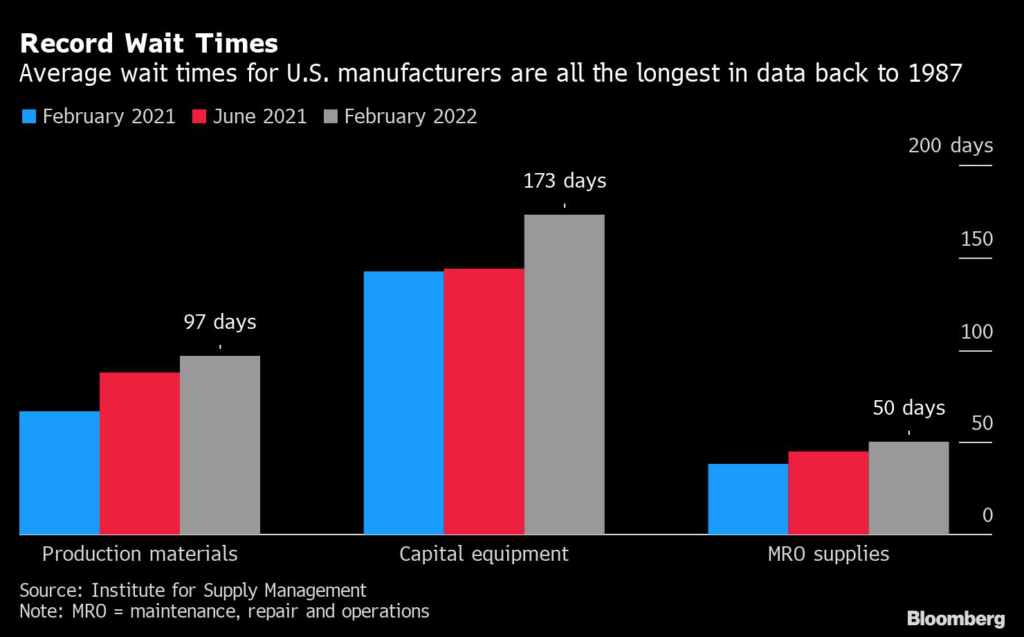
The Institute for Supply Management’s latest survey of purchasing managers showed the average lead times for production materials, capital equipment and supplies all reached the highest records back to 1987, according to a report Tuesday.

What took 67 days a year ago, the average wait time for materials used in the manufacturing process is now a whopping 97 days. Wait times for capital equipment are also a month longer than they were in February 2021, the data showed.

“Improving supply chains are key to slowing inflation through this year, but businesses are still complaining about not being able to fully meet demand,” Will Compernolle, senior economist at FHN Financial, said in a note.

The pickup in lead times is worrisome for economists betting that supply chains will get back in order this year and alleviate decades-high inflation. Demand is still high, so the delays risk keeping prices elevated for that much longer.

The ISM’s measure of order backlogs jumped by 8.6 points in February, the largest monthly advance in 11 years. The purchasing managers group’s overall index of manufacturing activity climbed last month as new orders growth strengthened.

Persistent shipping challenges, pandemic-related production interruptions in export-driven economies like China, transportation delays and labor-supply constraints in the U.S. remain hurdles for faster production growth at domestic manufacturers.

One computer and electronic products industry purchasing manager said the “electronic supply chain is still a mess,” the ISM survey showed. Another purchaser in the textiles industry said they are “expecting a year of strong demand, higher prices and continued supply chain challenges.”  

More stories like this are available on bloomberg.com

©2022 Bloomberg L.P.

Ukraine Raises  Equivalent of $277 Million  From Sale of War Bonds  

(Bloomberg) — Ukraine raised 8.1 billion hryvnia ($277 million) in a sale of war bonds, its latest fundraising effort to tap into the global support for the country in its fight against Russia’s invasion.

The country also paid about $300 million of bond interest to international investors due Tuesday, honoring its financial commitments amid a devastating conflict. Yuriy Butsa, Ukraine’s debt chief, said that the government is looking at other fundraising options, including foreign currency issuance, and is in talks with the IMF and World Bank for emergency help. 

“We had an investor call yesterday, and we see a lot of requests of how funds can support us,” he said in an interview on Bloomberg Television. “We’re looking at ways to attract not only in local currency, but also in dollars, euros.”

The war bonds are one of a number of crowdfunding measures by Ukraine to raise money for both its armed forces and civilians as the country faces down a vastly bigger military force. The individual bonds yield 11% and had a par value of 1,000 hryvnia — about $33. 

Ukraine’s central bank set up a special account last week where people around the world can donate, and the government shared details of crypto addresses to raise funds in Bitcoin and other digital tokens. 

By Tuesday morning, those accounts had received more than $17 million, according to blockchain analytics firm Elliptic. Including NGOs providing support to the military, total donations amount to $24.6 million, it said.

Tough Sanctions

The various funding campaigns are piggy backing on the global condemnation of Russian President Vladimir Putin’s invasion of its neighbor. 

Foreign governments have ramped up sanctions, cut banks out of the crucial SWIFT messaging system and closed airspace to Russian aircraft. FIFA, international soccer’s governing association, banned Russia’s national and club teams from all competitions.

Support for Ukraine has also been driven by revulsion at civilian deaths, including a number of children. Many have also rallied around President Volodymyr Zelenskiy, who’s been hailed as a wartime hero at home and elsewhere for his resistance to the Russian invasion.

Buying Ukraine’s war bonds on Tuesday wasn’t easy for fund managers, given technical difficulties around the sale. Concerns over the settlement process for the bonds and the lack of information meant that some international bond funds remained on the sidelines.

Other money managers have been looking at Ukraine’s other outstanding bonds as inexpensive, but high-risk investment. Gianni Za, head of asset management at AZ Swiss & Partners SA, said he’s been considering the January 2030 debt, but wants to see better news on the conflict before buying.

“Ukrainian bonds are attractive in our view,” said Alberto Gallo, a portfolio manager at Algebris UK Ltd. He said that Russia will remain isolated from financial markets, Ukraine could align itself closer to Europe. “Many companies have very low leverage and some even survived the last crisis without any restructuring.”

A recovery is still a long way away. Most of Ukraine’s government bonds, already trading at some of their lowest prices ever, dropped further on Tuesday.

(Adds details from interview with Ukraine’s debt chief)

More stories like this are available on bloomberg.com

©2022 Bloomberg L.P.

Crypto Hedge Fund Pantera Enters Africa With Valr Exchange Backing

(Bloomberg) — Pantera Capital backed African crypto exchange VALR.com in its latest funding round, valuing the company at $240 million in the U.S. group’s first foray into the continent.  VALR.com raised $50 million, the largest amount by a crypto firm in Africa to date, according to Chief Executive Officer Farzam Ehsani. The money will be …

Crypto Hedge Fund Pantera Enters Africa With Valr Exchange Backing Read More »

Best South African Factory Mood in 15 Years Faces Mounting Risks

(Bloomberg) — A gauge measuring South African manufacturing sentiment rose to the highest level in almost 15 years in February, though its advance may be short-lived, with input costs likely to increase because of high international oil prices and the war in Ukraine. Absa Group Ltd.’s purchasing managers’ index, compiled by the Bureau for Economic …

Best South African Factory Mood in 15 Years Faces Mounting Risks Read More »

How the Russian Oligarch Crackdown Threatens London’s Luxury Housing Boom

(Bloomberg) — Billionaires the world over have flocked to London in recent decades, lured by its abundant luxury real estate and a long tradition of servicing the ultra-rich. The relationship between the city and the super-wealthy is under increasing strain though. The government is poised to propose new anti-money laundering laws, empowering regulators to identify …

How the Russian Oligarch Crackdown Threatens London’s Luxury Housing Boom Read More »

SPACs Emerge as Safety Play for Creditors Wary of PE Ownership

(Bloomberg) — No question about it, parts of the blank-check world are rife with sketchy accounting and gut-wrenching stock drops. Nevertheless, lenders to a business run by private equity might find they’re better off if it’s merged with a SPAC. 

That’s what some credit investors and analysts are concluding after poring over potential deals that would combine PE-owned companies with a special-purpose acquisition company.

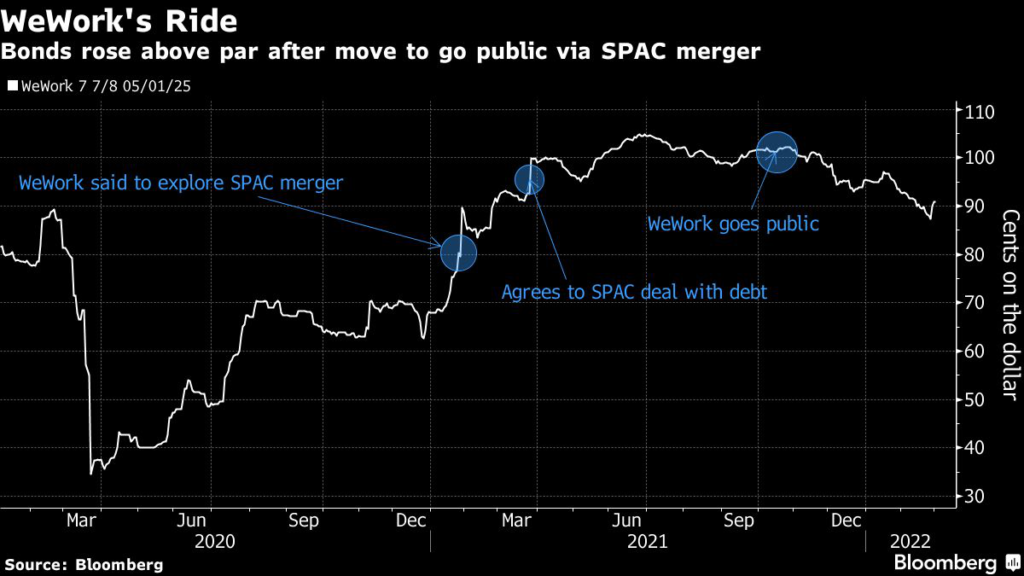
Bondholders of WeWork Inc. earned a paper profit of 20% last year, showing the kinds of gains that are possible. More might be in the wings, with BC Partners-backed PetSmart Inc. and Warburg Pincus’s Allied Universal reportedly eyeing SPAC tie-ups.

The attraction is twofold: a private company gets cash from selling itself to a SPAC, thus improving its creditworthiness, and the sale diminishes control of PE owners, a sector with a reputation for maneuvers that weaken protection for creditors.

“It’s probably better for bondholders,” said Ross Hallock, head of high-yield research at Covenant Review. The bigger equity cushion created by the cash helps, and “public companies typically don’t take actions that are detrimental to creditors to the same extent as private equity sponsored-backed companies do.”

In these cases, the risk of private equity ownership is theoretical — no one is suggesting the PE firms in those deals have done anything to hurt creditors. Representatives for the firms, the SPACs and their targets declined to comment.

Some of the SPACs themselves are backed by PE firms, like the blank-check company controlled by KKR reportedly seeking to buy PetSmart. The deal for Warburg’s Allied Universal could involve two SPACs also controlled by Warburg, as well as a SPAC backed by property billionaire Barry Sternlicht. KKR and Sternlicht’s vehicle declined to comment. 

Hard Data  

SPACs are called blank checks because they raise cash from investors through an initial public offering with the goal of buying a private business that’s not yet identified. At first glance, they might seem an unlikely source of comfort to credit investors, who prefer hard data about cash flow over gauzy promises of future profits.

Some SPACs have suffered recently in part because of concerns about the quality of the companies they’ve targeted. An index of SPACs that completed mergers is down more than 60% over the past year. 

But back when the WeWork deal surfaced in January 2021, unsecured bonds for the office-sharing company soared from less than 80 cents on the dollar to full face value in less than three months. (They’ve pulled back since then amid recent market turmoil.) Some of Allied’s secured notes and unsecured junk bonds rose after news of its potential deal broke earlier in February; PetSmart’s bonds also posted modest gains following the January disclosure.

Track Records

What’s more, some of targets have track records or hard assets. PetSmart is the biggest pet retailer with about 1,650 stores in North America. Allied says its security business generates global revenue of $18 billion from about 85 countries. WeWork’s troubled history includes its disastrous over-expansion, but the overhauled business has about 912,000 workstations across 38 countries.

“The SPAC’s cash can be used for a combination of growth capital and to de-lever the target’s balance sheet, which is generally beneficial in cases when the target is being sold by a private-equity firm, which typically manage their companies with high leverage,” said Michael Broudo, an event-driven equities analyst at Oppenheimer & Co.

Data-center firm Cyxtera Technologies Inc., which went public via a SPAC, did just that when it used a chunk of the $493 million raised through its merger to pay down existing debt. Cyxtera carried about $900 million in long-term debt as of Sept. 30, down from about $1.31 billion at the end of 2020.

It helps that publicly traded companies are often held to a higher standard than those that operate in the shadows of the private arena, analysts and investors said.

“You’ve got public market investors that place a value on a daily basis,” said John McClain, a high-yield portfolio manager at Brandywine Global Investment Management. “There is intraday mark-to-market as opposed to private equity mark-to-make-believe.”

Cashing Out 

Sometimes bondholders can redeem notes at a premium to current prices if a change of control clause is breached. While the structure of some SPAC mergers make that unlikely for cases like Allied, Hallock sees benefits from the public market regardless because of the added cash cushion.

How much cash a merger brings is less certain than it was at the height of the SPAC bubble. That’s because SPACs permit holders to redeem their shares if they don’t like the target that management picks.

Some short-term investors are using this to make a quick buck by buying the shares at a discount to the redemption price and turning them in after a deal is announced. This leaves less capital for the merged company, and with enthusiasm for SPACs waning, redemption rates in February were hovering near 90%, according to analytics firm Boardroom Alpha. 

For blank-check investors looking at PE-backed firms, it’s buyer beware, according to Brandywine’s McClain. 

“If you’re an investor staring across the table from private equity trying to go public via SPAC, you certainly should have a lot of questions and want to dig into the disclosures,” he said.

More stories like this are available on bloomberg.com

©2022 Bloomberg L.P.

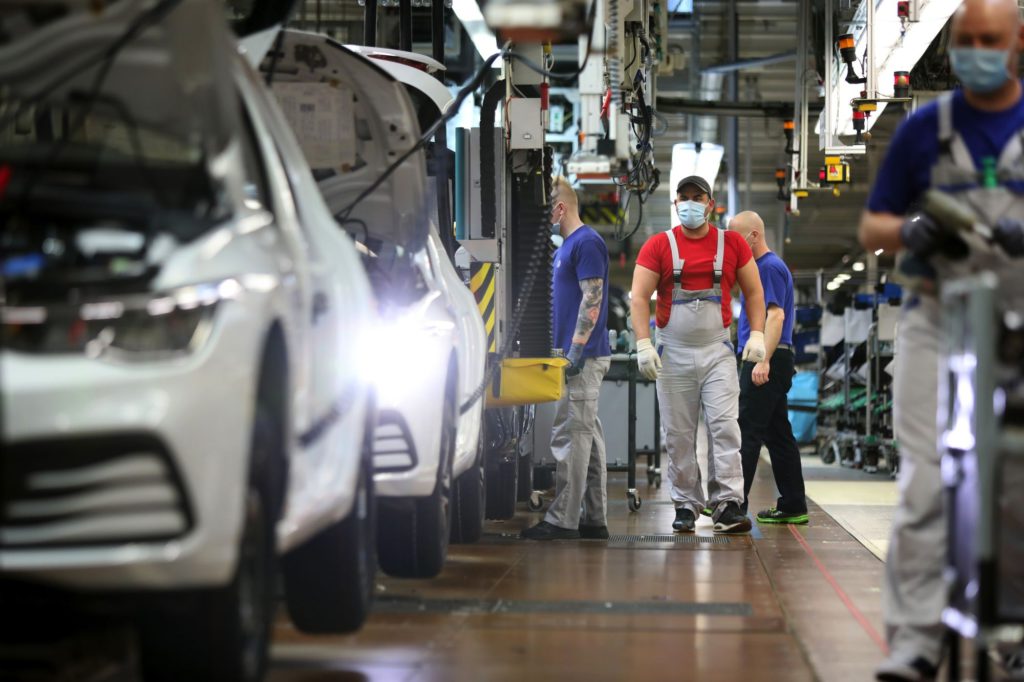
VW Readies for More Disruption on Parts Shortages From Ukraine

(Bloomberg) — Volkswagen AG expects to temporarily idle more plants, including its main Wolfsburg factory, as fallout from shortages of key parts from suppliers in Ukraine is spreading.

From next week, some production lines in Wolfsburg — the world’s largest car plant — will be suspended before a broader shutdown the following week, Volkswagen said Tuesday. 

Other sites to be affected include Emden and Hanover, where VW makes commercial vehicles, as well as component factories. There may be further cuts to production, the company said. Europe’s biggest automaker had last week already halted production in Zwickau and Dresden at plants that make electric cars because of shortages of parts including cable sets. 

Russia’s invasion is sparking repercussions for manufacturers already facing significant parts bottlenecks and fallout from the coronavirus pandemic. Even before these latest supply-chain setbacks, automakers had been forced to curb production over the past year because of a chronic shortage of computer chips.

On Tuesday, VW’s Russia unit also suspended deliveries of vehicles to dealers until further notice as sanctions imposed on the nation take effect. 

More stories like this are available on bloomberg.com

©2022 Bloomberg L.P.

Stellantis Targets Double-Digit Margins in Costly EV Shift

(Bloomberg) — Stellantis NV set a goal to maintain double-digit returns through the end of the decade by cutting costs and deriving extra revenue from new services as the automaker speeds up its electrification push. 

Adjusted operating income margin will exceed 12% by the end of the decade, while net revenues are set to double to 300 billion euros ($334 billion), Stellantis said Tuesday. The carmaker last week reported an 11.8% return for 2021 after getting past supply snarls and labor shortages with production of more profitable vehicles.

“We’ll continue to be the most efficient automaker with respect to capital spending,” Chief Executive Officer Carlos Tavares said during a presentation in the Netherlands. Competitors who don’t make the transition will fail, he said.

The plan comes a little over a year after the mega-merger between Fiat Chrysler and PSA Group to form a sprawling manufacturer across 14 brands with nameplates like Jeep, Ram and Fiat to add scale in the EV and autonomous driving shift. Since then, Stellantis has faced head on unprecedented shortages of semiconductors and remaining challenges from the pandemic.

Efforts across engineering, supply chain and purchasing teams are wringing costs from operations to make the company 30% more efficient on capital expenditures and development spending than the rest of the industry, Tavares said. He’s also trying to drive down distribution costs by 40% by digitizing sales and marketing operations.

Extra Revenue

Tavares has mapped out a push to plow 30 billion euros into electric cars and software. He seeks to introduce more than 75 fully-electric models by 2030 with annual sales of 5 million vehicles. While the carmaker is spending big on the rollout, it’s pledging to maintain strong returns, relying on extra revenue from software and services as well as premium vehicles.

Stellantis will lean on partnerships with Foxconn Technology Group, Waymo and BMW AG and has said it plans to generate about 20 billion euros in extra revenue from software-driven features in its vehicles by the end of the decade.

After early successes to deliver on a promise for synergies of 5 billion euros as part of the merger, Tavares said the manufacturer will achieve the goal in 2024, more than one year ahead of schedule.

Stellantis also upped a target for EV sales, planning to switch all deliveries to plug-in hybrids and battery-powered cars in Europe by 2030, up from a previous goal of more than 70%. For the U.S., the manufacturer now targets half of all sales to be electric, compared with more than 40% before.

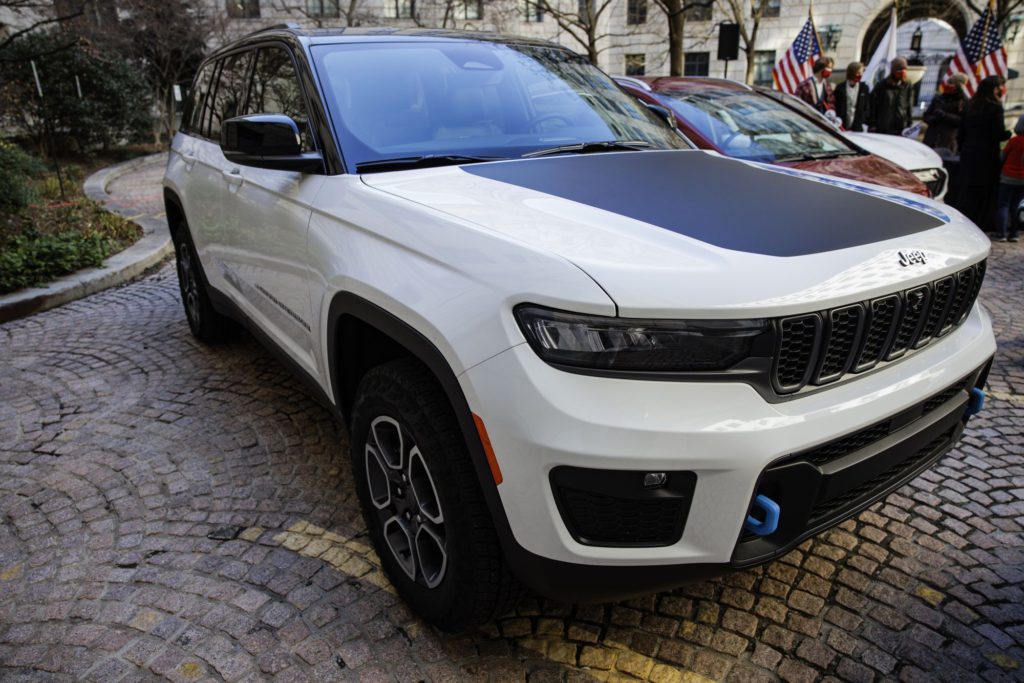
The Jeep maker teased an image of the first fully-electric Jeep sport utility vehicle, due to be released in the first half of next year. It’s planning to develop an electric off-road SUV and a lifestyle family utility vehicle.

The electric Ram pickup will come in 2024 and be able to compete with models from Ford Motor Co. and Tesla Inc. on range, towing, payload, and charging time, Tavares said. The potential for the Ram brand beyond North America is “enormous,” the CEO said.

China Reboot

Stellantis is working to improve business in China, where both PSA and FCA lost money before the merger, by cutting capacity and relying on what Tavares is calling an “asset-light” strategy. 

The carmaker will boost utilization at a single plant — its JV with Guangzhou Automobile Group Co. — and rely on imports of brands including Jeep and Maserati vehicles. Stellantis is waiting for Chinese officials to sign off on a plan to increase the company’s stake in the venture to 75% from 50%, the CEO said.

Stellantis Reboot in China Sparks Conflict With Local Partner

“There is nothing wrong about having a highly profitable” business of importing completely built cars, Tavares said. “We are trying to set up a business model that carries the lessons we have learned the hard way.”

(Updates with CEO comment in third, details on China strategy from 12th paragraph.)

More stories like this are available on bloomberg.com

©2022 Bloomberg L.P.
Close Bitnami banner
Bitnami