Bloomberg

Commerzbank Raises Payout Promise as Revamp Gathers Speed

(Bloomberg) — Commerzbank AG raised the prospect of higher shareholder payouts and lifted a key profit target as the turnaround under Chief Executive Officer Manfred Knof gathers pace.

The German lender on Tuesday said it may pay out as much as 5 billion euros ($5.6 billion) to shareholders until 2024, compared with up to 3 billion euros promised last year. By then, the return on tangible equity, a measure of profitability, is expected to exceed the 7% the lender had previously targeted.

“The good progress of our transformation and our strong customer business provide us with a tailwind,” Knof said in the release. “In view of the positive expectations for the coming years, we aim to return more capital to our shareholders than previously planned.”

Knof last year unveiled an ambitious cost-cutting program that’s set to run until the end of 2024. The first year went better than initially planned amid soaring income at its online broker and falling credit provisions, though Russia’s invasion of Ukraine has cast uncertainty over the European banking sector as it digests the impact of sanctions and higher energy prices. 

Commerzbank hasn’t included any fallout from the crisis into its financial planning, though it said it’s exposure to Russia and Ukraine overall is “manageable.” The lender has a net exposure to Russia of 1.3 billion euros, equivalent to 0.4% of Commerzbank’s total exposure. Its net exposure to Ukraine is less than 0.1 billion euros.

Knof’s higher profitability target reflects an improved revenue outlook, with Commerzbank predicting the top line will grow to 9.1 billion euros by 2024, compared with 8.7 billion euros targeted previously. Most of the additional growth is to come from the Polish subsidiary mBank, where higher interest rates are already helping lift income from lending.

The new targets don’t yet factor in potential increases in euro-area interest rates, which would lead to “substantial additional revenues,” Commerzbank said.

With inflation accelerating, Commerzbank also raised its cost target slightly, to 5.4 billion euros from 5.3 billion euros.


(Updates with details from the release from fifth paragraph)

More stories like this are available on bloomberg.com

©2022 Bloomberg L.P.

Waymo and Cruise Lead the Way in Electrifying Autonomous Vehicles

(Bloomberg) —

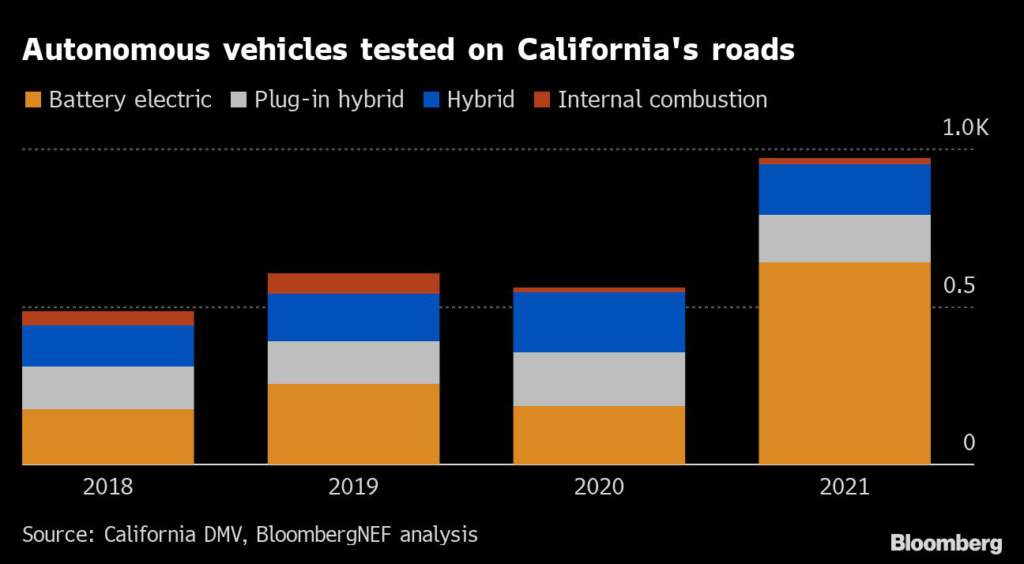
Autonomous vehicles are mostly electric so far. That’s one of the main conclusions of BloombergNEF’s just-published annual report analyzing the state of AV testing programs in the U.S. and China.

California still is by far the largest autonomous vehicle test bed in the world, and 81% of the almost 1,000 AVs operating in the state last year either were fully electric or plug-in hybrid. That’s a big jump from 2020, when only 63% were plug-in vehicles. Non plug-in hybrids represented about 17% of the AV fleet last year, and traditional combustion engines were negligible at just 2%.

Those EVs are also traveling more miles than their ICE counterparts. The plug-in share of total miles traveled by AVs in California came in at 87% last year, up from 81% in 2020. Battery-electric vehicles alone accounted for 78% of total miles driven, largely due to Waymo’s fleet of Jaguar I-Paces and Cruise’s Chevrolet Bolts.

Outside of Cruise and Waymo, the vehicle drivetrain mix includes Zoox’s fleet of Toyota Highlanders, which are are mix of internal combustion and hybrid, as well as the popular Lincoln MKZ used by China-based AV developers like Didi, Pony.ai, Baidu, and WeRide.

AV test programs in Shanghai and Beijing are starting to catch up to California. Autonomous vehicles in those two Chinese cities racked up a total of 2.1 million miles in 2021, compared to 4 million in California. The total in China more than doubled from the previous year and incorporate a broader array of vehicle types, including street-cleaning vehicles and heavy trucks handling shipping containers at ports. The exact winning business models for AVs still aren’t clear, but passenger vehicles are among the most difficult applications to solve, and other vehicle types stand a better chance of reaching commercialization sooner.

Regardless of the vehicle segment, the drivetrain that autonomous vehicles use really matters if AVs are to deliver on the lofty promises that have been made in recent years. If AVs run on internal combustion engines, or even if they were to transition to EVs slower than the broader automotive market, any local air quality benefits would be eliminated, and hitting climate targets would become more difficult.

Autonomous vehicle developers are acutely aware of the regulatory hurdles that could arise if the public turns against the technology. There are already well-founded concerns that AVs could clog up urban streets, and developers are keen to ensure they’re at least not contributing to worsening air quality.

There are many important caveats on anything to do with autonomous vehicle testing data. It’s early days still and disclosures are patchy, so it’s best not to read too much into what’s happening. But the links between EVs and autonomous vehicles early on are encouraging.

More stories like this are available on bloomberg.com

©2022 Bloomberg L.P.

Cheap South African Solar Projects Challenged by Cost Surge

(Bloomberg) — Solar projects in South Africa’s latest renewable power procurement round may have difficulty reaching financial close due to issues including rising supply chain costs, according to people familiar with the details. Some of the bids are experiencing trouble ahead of a deadline to complete financing arrangements, according to the people who asked not …

Cheap South African Solar Projects Challenged by Cost Surge Read More »

Hong Kong’s Death Rate Is One of World’s Highest: Virus Update

(Bloomberg) — Hong Kong’s Covid-19 fatality rate is now the highest in the developed world amid a wave of deaths among its under-vaccinated elderly population, ramping up pressure on officials to get the outbreak under control.

The banking regulator in Hong Kong is lobbying the government to shorten the strict hotel quarantine placed on incoming travelers, seeking to reduce the hotel quarantine to 7 days, followed by another week of isolation from home.

Hong Kong plans a lockdown to underpin a mandatory Covid-19 testing drive this month, according to local media. Japan ended a ban on new entry by foreigners and eased quarantine rules.

Key Developments:

  • Virus Tracker: Cases exceed 436 million; deaths top 5.9 million
  • Vaccine Tracker: More than 10.7 billion doses administered
  • Coronavirus Daily: Are you ready for normal life?
  • Hong Kong’s isolation plan crumbles as infections soar
  • Hong Kong deaths among worst on at-risk elderly

Lobbying for Shorter Quarantine (5:35 p.m. HK)

Hong Kong’s banking regulator told finance executives in recent weeks that it’s lobbying the government to shorten the strict hotel quarantine placed on incoming travelers as it seeks to prop up confidence in the city’s status as a financial hub. 

Hong Kong Monetary Authority told a group of banks that it will start engaging with the government to reduce the hotel quarantine to 7 days from 14 days, followed by another week of isolation from home, said people familiar with the talks, asking not to be identified because the meetings were private.

Hong Kong’s Record Death Rate (4:46 p.m. HK)

Hong Kong’s Covid-19 fatality rate is now the highest in the developed world. The financial hub averaged eight deaths per 1 million people in the 10 days through Monday, the most among advanced economies, according to Bloomberg calculations based on Johns Hopkins University data. 

Hong Kong reported a record of 117 new deaths Tuesday. Most of the fatalities during the current wave have been elderly people, and 91% of those who died weren’t double vaccinated, according to government data released Sunday. 

Japan Opens to Newcomers (2:23 p.m. HK)

Japan ended a ban on new entry by foreigners and eased quarantine rules as of Tuesday.

New foreign entrants except for tourists will be admitted, with a cap of 5,000 arrivals a day, from 3,500. Japan also scrapped the quarantine period for those who have had a booster shot and have entered from countries unlisted by the government, and lowered it to three days for those who came from places on the list.

U.S. Warns on Travel to Vietnam (1:39 p.m. HK)

The U.S. State Department raised its travel advisory for Vietnam to the highest level in response to recent surges in Covid-19 infections. Vietnam is ranked as level 4, which means Americans should avoid all travel there, according to a statement. Vietnam on Monday reported 94,385 new cases.

Singapore Eyes Key Case Report (11:44 a.m. HK)

Singapore’s case count has fallen for six straight days, increasing the focus on a report Tuesday that could signal whether omicron infections in the city-state have peaked.

Tuesdays tend to be Singapore’s biggest caseload each week, owing in part to weekend catch-ups and people testing at the start of the week. The past two weeks have seen cases drop before a Tuesday spike, delaying a potential reopening.

Singapore plans to substantially ease restrictions once the current wave peaks.

China Health Expert Sees Opening Up (11:38 a.m. HK)

One of China’s top health experts raised the possibility that China could follow western nations and attempt to live with Covid-19, a rarely voiced view in the country as it persists with its Covid-Zero strategy.

“At an appropriate timing in the near future, China will surely present its version of the roadmap for co-existing with the virus,” Zeng Guang, former chief epidemiologist of Chinese Center for Disease Control and Prevention, said on his social media account. 

Virus Fears Wane, NYT Says (10:29 a.m. HK)

Americans are less worried about catching and spreading Covid-19 compared with six months ago, according to a new poll by The Associated Press-NORC Center for Public Affairs Research, the New York Times reported.

Support is also decreasing for mask mandates, which are easing across much of the U.S., the poll found, according to the NYT.

Hong Kong Weighs Public Transport Halt (10:04 a.m. HK)

Hong Kong is weighing whether to halt public transport during a lockdown or allow residents who test negative with rapid screening kits to leave their homes, the South China Morning Post reported, citing unidentified people.

The government is considering a number of options about the lockdown, including whether it should be citywide or done on a rolling basis, according to the report.

Thailand Cuts Second Visitor Test (9:06 a.m. HK)

Vaccinated foreign visitors to Thailand will no longer be required to take a second RT-PCR test after arrival from Tuesday as the nation woos tourists. The insurance requirement for Thai visas has also been lowered to $20,000 from $50,000.

From Tuesday, authorities will start distributing free rapid antigen test kits through 2,000 centers nationwide amid a health ministry warning that daily cases could spike to 100,000 by mid-April. New infections fell to 20,420 on Tuesday.

Malaysia to Exempt Some Travelers From Test (8:29 a.m. HK)

Malaysia will relax coronavirus testing requirements for some travelers starting Thursday, Health Minister Khairy Jamaluddin said in a statement.

The exemption applies to those arriving in Malaysia via the vaccinated travel lane with Singapore, the Langkawi travel bubble, and short-term business travel via one-stop centers, he said.

More stories like this are available on bloomberg.com

©2022 Bloomberg L.P.

Bitcoin Advances in Tentative Comeback as Haven Asset

(Bloomberg) — Bitcoin advanced amid mounting signs that the war in Ukraine is bolstering demand for cryptocurrencies. 

The largest cryptocurrency rose 4.3% to $43,453 at 10:50 a.m. in London, gaining along with other major digital tokens. A fresh wave of turbulence hit global markets on Tuesday as the conflict in Ukraine intensified amid mounting penalties against Russia, as stocks in Europe fell along with U.S. equity futures.

Bitcoin’s outperformance amid the volatility has some bulls pointing to a break from the narrative that crypto is just another risk asset. Adam Farthing, chief risk officer for Japan at crypto trading firm B2C2, said Bitcoin could “de-link from risk” and start trading more like a hedge to geopolitical instability and inflation.

“Bitcoin saw a significant upward move today as it appears to have slightly regained its safe haven status while the Russia-Ukraine conflict continues to intensify,” said Walid Koudmani, an analyst at XTB Market.

Trading volumes in Bitcoin using the ruble have surged to the highest level since May, suggesting Russians are potentially moving their money into crypto as the ruble plunges to a record low.

Read more: Bitcoin Volume Spikes in Russia and Ukraine as Sanctions Hit

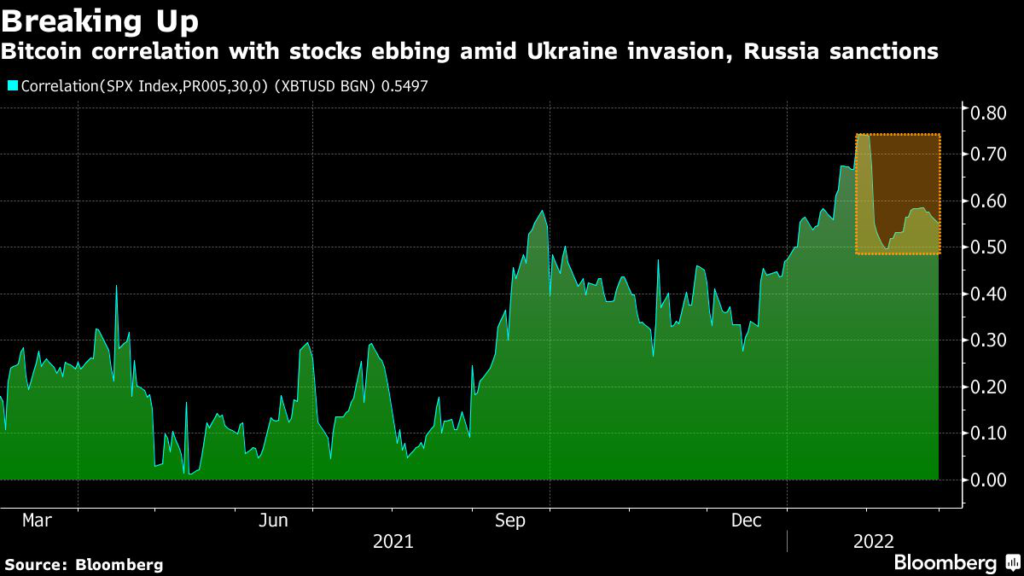
While still elevated at 0.55, Bitcoin’s correlation with the S&P 500 has come off after surpassing 0.7 earlier this year, data compiled by Bloomberg show. A correlation of 1 means two assets move perfectly in tandem, while a zero correlation displays their fluctuations are wholly independent.  

“While it remains to be seen if this move will continue, it certainly seems to have changed the sentiment around Bitcoin for the time being and could spark renewed interest in cryptocurrencies as markets attempt to recover from this extreme uncertainty brought by the conflict,” Koudmani said.

More stories like this are available on bloomberg.com

©2022 Bloomberg L.P.

Mastercard, Visa Block Some Russian Activity Due to Sanctions

(Bloomberg) — Mastercard Inc. and Visa Inc. have blocked certain Russian activity from their payment networks to comply with international sanctions. 

The U.S. companies did not name the affected customers, but cited efforts around the world to isolate Russia from the financial system in the wake of its invasion of Ukraine.  

“Visa is taking prompt action to ensure compliance with applicable sanctions, and is prepared to comply with additional sanctions that may be implemented,” the firm said in a statement Tuesday. 

“As a result of sanction orders, we have blocked multiple financial institutions from the Mastercard payment network.  We will continue to work with regulators in the days ahead to abide fully by our compliance obligations as they evolve,” Mastercard said late Monday.

The U.S., European Union and U.K. are among those deploying sweeping sanctions against Russia’s economy and wealthy individuals in response to its invasion of Ukraine. They include excluding some Russian banks from the SWIFT messaging system that facilitates trillions of dollars worth of transactions.

More stories like this are available on bloomberg.com

©2022 Bloomberg L.P.
Cartier Sues Tiffany for ‘High Jewellry’ Trade Secrets Thefts

(Bloomberg) — Cartier sued Tiffany & Co., claiming its competitor in the luxury jewelry space stole trade secrets about some of its most exclusive products with the help of a former employee. Cartier, a division of Richemont North America Inc., sued Tiffany and Megan Marino, a former “junior manager” at Cartier in New York state …

Cartier Sues Tiffany for ‘High Jewellry’ Trade Secrets Thefts Read More »

Tencent Jumps on Report of Chinese Billionaire’s Big Buy Order

(Bloomberg) — Tencent Holdings Ltd. rallied Tuesday in Hong Kong, after a state-run newspaper reported that a mainland billionaire investor has placed heavy orders for the Chinese tech giant’s U.S.-listed shares. 

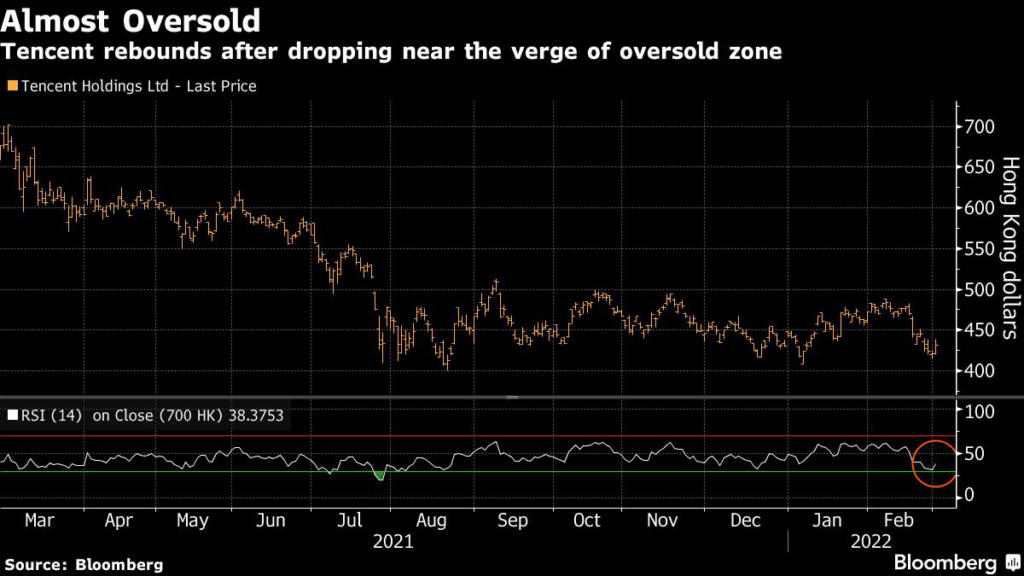
The internet and video gaming firm rose as much as 4.2% in the Asian financial hub, before finishing up 2.3% and marking its best closing performance since Feb. 9. 

The gains reversed a three-day losing streak that brought the stock to the verge of oversold territory amid a global selloff in risky assets following Russia’s invasion of Ukraine. Tencent shares also came under pressure last week after Beijing’s fresh scrutiny of rival Alibaba Group Holding Ltd.’s fintech arm rekindled concerns about a wider tech industry crackdown. 

Strong buying emerged after the Shanghai Securities Journal reported late Monday that Duan Yongping, a billionaire entrepreneur dubbed China’s Warren Buffet by local media, has placed orders for more than $5 million of Tencent’s New York-traded shares. The report cited Duan’s posting on a domestic social media platform that showed records of his buy order. 

It’s not the first time for Duan to boost his investment in Tencent. According to the report, he bought the stock in August, when it slumped to a near 13-month low. It’s unclear whether his latest attempted purchases had gone through. 

Calls to Duan’s office went unanswered. 

Mainland Traders Lift Tencent, Meituan Stakes to 7-Month Highs

Despite Tencent’s 0.7% loss in Hong Kong Monday, mainland investors were net buyers of the stock via a trading link with the Shenzhen bourse, a channel widely considered more popular among retail investors. Before last week’s stretch of weakness, onshore investors had boosted their stakes in beaten-down Tencent and delivery giant Meituan to the highest level in more than seven months. 

More stories like this are available on bloomberg.com

©2022 Bloomberg L.P.

Baidu’s Sales Beat After Cloud Arm Offsets China Slowdown

(Bloomberg) — Baidu Inc.’s revenue beat estimates after efforts to monetize artificial intelligence technology helped offset losses in ad sales triggered by China’s economic slowdown.

Revenue for the December quarter came in at 33.1 billion yuan ($5.2 billion), compared with the 32.2 billion yuan average estimate. Revenue from non-advertising businesses, including its cloud segment, surged 63% in the three months, versus growth of just 1% in online marketing.

China’s internet search leader is in the midst of a transition from an online marketing company to a hard-tech supplier in arenas from self-driving vehicles to the cloud and chips. The country’s weakening economy, coupled with Beijing’s crackdown on private sectors from education to property, has hammered Baidu’s core search-advertising division, while the commercialization of its AI tech needs time.

Net income plunged to 1.7 billion yuan from 5.17 billion yuan a year earlier, underscoring the challenges for the internet giant. 

“The weakness in China’s economy has negative impacts on its short-term growth,” TH Capital analyst Tian X. Hou said in a note before the results. “However, looking beyond the current quarter, we believe BIDU’s autonomous EV initiatives are likely to bring new growth and better valuation to the stock.”

Baidu is planning to mass-produce its electric vehicles in 2023, with a prototype to be unveiled next month. It’s also testing a driverless ride-hailing service in big cities like Beijing and Guangzhou, while expanding a nascent chip business beyond just in-house applications. Those efforts coincide with President Xi Jinping’s call to make China self-sufficient in key technologies, at a time when his administration has grown weary of a decade of heady expansion in consumer internet.

While Baidu isn’t a major target of China’s tech crackdown, regulatory uncertainties as well as intensifying competition with online content hubs offered by the likes of Tencent Holdings Ltd. and ByteDance Ltd. could weaken the prospects for Baidu’s search-feed app and Netflix-style offshoot IQiyi Inc. In December, the streaming service raised subscription fees by up to 20% after user growth plateaued.

IQiyi reported flat but better than expected revenue, and predicted it would reach break-even on a non-GAAP operating income basis in fiscal 2022.

(Updates with details on revenue growth from the second paragraph)

More stories like this are available on bloomberg.com

©2022 Bloomberg L.P.

The Coder Supply Chain Runs Through Ukraine

(Bloomberg) — The maps that connect Lyft Inc. customers with their nearest driver, the grammar software that tells you when to use “whom” instead of “who” and the targeting system that helps players of the newest Assassin’s Creed video game aim a weapon, all owe a debt of gratitude to programmers in Ukraine. The country is among the largest exporters of information-technology services in Europe, known for its well-educated and affordable labor market.

There are roughly 250,000 technology professionals in the country. Russia’s invasion of Ukraine imperils many of their lives. It has also disrupted projects at a raft of global tech companies and startups. Employers are now arranging escape plans for their workers in Ukraine and setting aside financial aid. Apple Inc. and Google have outposts there, as does France’s Ubisoft Entertainment SA and Israel’s Wix.com Ltd.

For many international companies, Vitaly Sedler is their envoy to Ukraine. Sedler started the outsourcing firm Intellias 20 years ago in the western city of Lviv. It employs about 2,000 engineers in Ukraine today. “Engineering talent in the country is very strong,” said Sedler. Coders make $3,000 to $4,000 a month, he says, far exceeding the national average but paltry by the standards of Silicon Valley or other Western cities.

Ukrainian code can be found almost anywhere in the world. It’s on Wall Street (Citigroup Inc. and JPMorgan Chase & Co.) and in international banks (Barclays Plc, Credit Suisse Group AG, Deutsche Bank AG and UBS Group AG). It’s in manufacturers of airplanes (Boeing Co.), cars (Daimler AG and BMW), mobile networks (BT), and phones (Samsung), said Anurag Srivastava, a London-based vice president at research firm Everest Group Inc. “Clients are anxiously asking how bad it’s going to be, how long the crisis could last, and what action they should take,” he said. Everest isn’t especially optimistic: It elevated the risk rating of doing business in Ukraine to high, from medium.

The conflict is already impacting work at companies that rely heavily on teams in Ukraine. Omio, a German travel search startup, has about 15% of its engineering workforce there. “I surely can anticipate a slowdown on certain projects,” said Tomas Vocetka, the chief technology officer. “The shortage of talent will increase in Europe.”

Ukraine’s tech industry began to flourish after gaining independence in 1991, said Nataly Veremeeva, director of the local organization TechUkraine. It focused on outsourcing from the beginning, but in recent years has become more advanced and spun out an increasing number of start-ups. Ukraine-founded companies that do well tend not to stay, whether to pursue financial opportunities or talent pools elsewhere.

GitLab Inc., a computer code repository that went public on the Nasdaq in October, and Grammarly Inc., which makes a typing assistant recently valued by investors at $13 billion, each started in Ukraine before their global-minded leaders decamped for San Francisco. Nearly half of Grammarly’s more than 600 employees are still based in Ukraine, a spokeswoman said. “While we hope for the best, we have also prepared for the worst,” Brad Hoover, the chief executive officer, wrote in a Linkedin post.

Oleksii Shaldenko, a founder of the online video startup Wantent, awoke the morning of Feb. 24 to the sound of explosions. Wantent, which sells software to local and international broadcasters and streaming companies, is based in Kyiv, but many of its dozen or so employees had spent the last two weeks dispersed in other Ukrainian cities in anticipation of a Russian attack. Shaldenko spent part of that day searching for underground hideouts in the region with several members of his team. “One of the terrifying moments is checking the bomb shelter—terrifying because it’s real now,” he said. Shaldenko has spent the past four days in one, he said: “I could not imagine that in the peacetime of 2022, war would come to our country.”

More stories like this are available on bloomberg.com

©2022 Bloomberg L.P.
Close Bitnami banner
Bitnami