Bloomberg

VMware Declines After Forecast Falls Short of Estimates

(Bloomberg) — VMware Inc. shares declined after the company gave forecasts for sales and profit in the current quarter that fell short of analysts’ projections.

Earnings, excluding some items, will be $1.56 a share on revenue of $3.19 billion in the three months ending in April, the company said Thursday in a statement. Analysts, on average, projected profit of $1.65 on sales of $3.23 billion, according to data compiled by Bloomberg.

VMware rose to prominence by providing tools that help corporate tech leaders gain efficiencies from their on-premises data centers. However, like other software vendors, the company is pivoting to a subscription model as cloud infrastructure becomes increasingly more common. That transition has become more critical as businesses increasingly look to move some operations to the internet, while still running others locally on servers, a system commonly referred to as “hybrid cloud.”  

VMware effectively operates as the glue that can help companies run those on-premises applications more easily in the cloud. But the company has struggled to grow its software-as-a-service offering at the pace Wall Street wants.

The company said subscription and software-as-a-service revenue jumped 23% to $868 million in the fiscal fourth quarter while total sales increased 7% to $3.53 billion. Profit, excluding certain items, was $2.02 a share in the period ended Jan. 28. Both topped analysts’ estimates.

“As we look to our next fiscal year, we remain focused on accelerating growth of our subscription & SaaS portfolio and scaling our multicloud platform enabling us to deliver long-term revenue and profit growth,” Chief Financial Officer Zane Row said in the statement.

The results reported Thursday reflected the software vendor’s first full quarter as an independent company since spinning off from Dell Technologies Inc. last year. 

VMware’s stock declined about 6% in extended trading after closing at $118.12 in New York. The shares has fallen about 30% from a high of $167.06 in October.

More stories like this are available on bloomberg.com

©2022 Bloomberg L.P.

Biden Deflects Democrats’ Pleas to Boot Russia From Swift

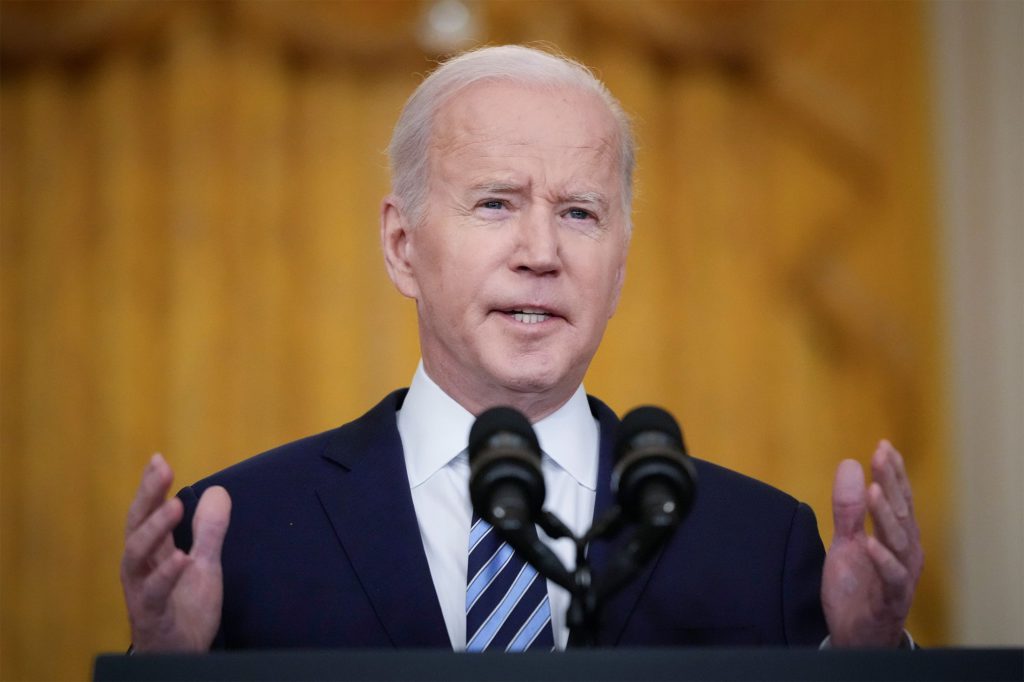
(Bloomberg) — President Joe Biden said booting Russia from the critical Swift global financial messaging system is off the table for now even as leaders in his own party urge him to take a step that would carry significant consequences for European nations, many of which oppose the move.

In explaining his decision, Biden said the U.S. move Thursday to sanction Sberbank — Russia’s largest lender — and four other financial institutions would potentially have more impact on Russia than barring the country’s banks from Swift, essentially the Gmail of global banking. 

“It is always an option, but right now that’s not the position the rest of Europe wishes to take,” Biden said. 

The consensus among member nations is that they don’t want to expel Russia from Swift amid concerns that if adversaries are kicked out, they could break off to develop their own version, according to a person familiar with the matter, who spoke on condition of anonymity.

Biden’s Own Aides Feared His Sanctions Wouldn’t Stop Putin

Swift has blocked access to a nation just once in its history: In 2012, with the help of an EU directive, it blocked Iran to help avoid a potential nuclear conflict.

In Washington, Republicans and Democrats alike are reaching for the most dire economic tools to use against Russia following Vladimir Putin’s invasion of Ukraine. 

Biden’s Inner Circle Feared Sanctions Wouldn’t Stop Putin 

Hours after Biden spoke, Senate Foreign Relations Chairman Bob Menendez pushed the president to “impose maximum costs on Putin,” including removing Russian banks from the Swift system.  

“Congress and the Biden administration must not shy away from any options,” the New Jersey Democrat said in a statement.

Senator Bob Casey and Representative Adam Schiff, both Democrats, said before Biden’s remarks Thursday they’d support the move. 

Senate Minority Leader Mitch McConnell, a Republican, also called for the use of all available sanctions, though didn’t mention Swift by name. Other key Senate Republicans, including Lindsey Graham and Pat Toomey, made similar statements. 

“The sanctions imposed on Russian banks, while welcome, may not isolate the Russian financial system from international activity,” said Toomey, the Banking Committee’s top Republican. “That’s why the U.S. should impose crippling sanctions on Russia’s oil and gas sector and Iran-style secondary sanctions on Russian banks that force the world to choose between doing business with Russia or the United States.”

Biden Ramps Up Russia Sanctions as West Fears Fall of Kyiv 

Ukrainian Foreign Minister Dmytro Kuleba has renewed calls to cut off Russia from Swift and U.K. Prime Minister Boris Johnson pushed for that step on a call earlier with Group of Seven leaders, according to his spokesman Max Blain.

Swift — which stands for the Society for Worldwide Interbank Financial Telecommunication — is overseen by the National Bank of Belgium and central bank representatives from the U.S., U.K., EU, Japan, Russia, China and others. It delivers secure messages among more than 11,000 financial institutions and companies, in over 200 countries and territories.

U.S. officials have also shied away from the idea of kicking Russia out of Swift because of the potential fallout it would have on European banks and companies, as well as ordinary Russian citizens.

Casey said he hopes Russia is barred from Swift on Thursday.

“If it’s not today, I’m willing to listen to arguments about when it should be imposed, but that’s the kind of sanction that could really have a substantial impact, and they have to be hit hard,” he said. 

All About Swift, One Possible Path to Sanction Russia: QuickTake

Some experts argue that sanctioning individual banks achieves the same effect in a more targeted way.

“If you would bar Russian institutions from Swift, they could still transact with the West by other means but if you designate banks by name, that’s a far more effective way of punishing Russia,” said Daniel Tannebaum, head of sanctions at Oliver Wyman in New York. 

“Everyone views Swift as this silver bullet but the other point to bear in mind is there’s never been a 100% embargo on any country. So if you’re a legitimate company doing legitimate business with Russia, if you remove Swift from a country, those companies won’t be able to get paid.”

Senate Banking Chairman Sherrod Brown predicted the economic impact will be much more dramatic on Europe than in the United States on things like energy prices, but the United States will feel some economic hit.

“I think the markets understand it,” Brown said in an interview on Bloomberg Television’s “Balance of Power With David Westin.” “I think American consumers will mostly understand, but the president has an obligation to lay it out. This is a hit to the world economy. It can be softened because our economy is so strong.”

(Adds details on Biden’s sanctions announcement)

More stories like this are available on bloomberg.com

©2022 Bloomberg L.P.

Chipmakers Downplay Fears Ukraine Crisis Will Worsen Shortages

(Bloomberg) — With the semiconductor industry stretched thin by the pandemic and an unprecedented surge in demand, chipmakers had a reassuring message Thursday: The crisis in Ukraine is unlikely to make shortages worse. 

Russia is a small market for the chip industry and its invasion of Ukraine doesn’t represent a threat to chip supply, the Semiconductor Industry Association said Thursday. U.S. and allied sanctions against Russia also are unlikely to have a significant effect on industry sales, the group said. 

“While the impact of the new rules to Russia could be significant, Russia is not a significant direct consumer of semiconductors, accounting for less than 0.1% of global chip purchases,” SIA Chief Executive Officer John Neuffer said in a statement. “In addition, the semiconductor industry has a diverse set of suppliers of key materials and gases, so we do not believe there are immediate supply disruption risks related to Russia and Ukraine.”

Ukraine’s status as a major producer of neon has sparked concerns because the gas is used in semiconductor manufacturing. But chip companies, which were alerted to this possible chokepoint in 2014 when Russia annexed Crimea, have diversified their suppliers since then. 

Some individual companies also issued statements aimed at calming customers. 

“We do not anticipate any impact on our supply chain,” Intel said. “Our strategy of having a diverse, global supply chain minimizes our risk of potential local interruptions.”

GlobalFoundries Inc., the U.S.’s largest provider of outsourced chipmaking, said having plants around the world — with their own local suppliers — helps mitigate risk. The company has factories in upstate New York, Singapore, and Dresden, Germany. 

“At GlobalFoundries, we do not anticipate a direct risk,” the company said in a statement. “We are not totally immune to global shortages, but our footprint provides us with more insulation.”

More stories like this are available on bloomberg.com

©2022 Bloomberg L.P.
Bitcoin’s Equity Correlation Rises as Crisis Whipsaws Crypto Market

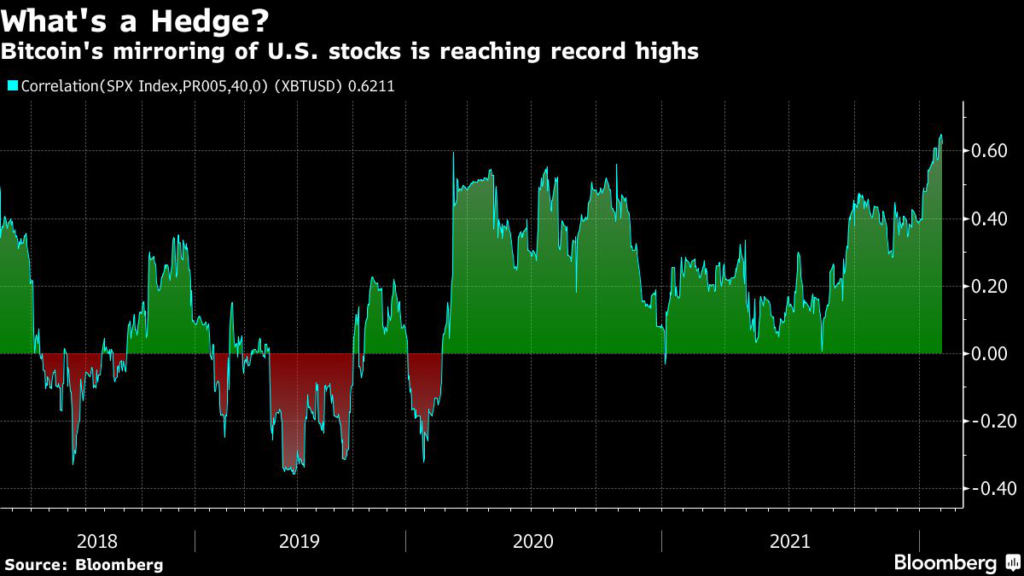
(Bloomberg) — Bitcoin’s correlation to stocks continued to strengthen as the largest cryptocurrency rebounded along other risk assets as fast-moving developments related to Russia’s invasion of Ukraine whipsawed investors.

The largest digital currency fluctuated in a range of about 14% on Thursday. A 60-day correlation between the digital token and S&P 500 currently stands at 0.6, out of a highest possible score of 1, indicating similar behavior.

“Crypto is slowly becoming a more institutional market,” Callie Cox, U.S. investment analyst at eToro, said by phone. “It’s gone from this speculative asset to an investment vehicle.”   

Markets rebounded in U.S. afternoon trading when President Joe Biden announced stiff sanctions on Russia over its invasion of Ukraine. 

Earlier, Bitcoin fell while gold was rising as investors sought traditional refuges, undercutting the often-touted argument from advocates that the cryptocurrency is now a digital version of the long-time haven asset.   

More stories like this are available on bloomberg.com

©2022 Bloomberg L.P.
Google Faces Sanctions Dilemma With Pro-Russia YouTube Channels

(Bloomberg) — With sanctions on Russia ramping up following its invasion of Ukraine, Google’s YouTube is under pressure to remove or cut commercial ties with some of its most prolific pro-Russian channels.

The online video giant has a massive reach in Russia and has long been a popular platform for both government critics and state-backed media. But now officials in the U.S., the U.K. and Europe are discussing restrictions that could target groups and people with huge audiences on the platform, creating a dilemma for the Alphabet Inc.-owned business. 

European Union sanctions, for instance, would target Vladimir Solovyov, a TV and radio journalist behind a YouTube channel with more than 1 million subscribers. An EU report issued on Wednesday said that “Solovyov is known for his extremely hostile attitude toward Ukraine and praise of the Russian government.” A four-hour video livestream published overnight on his YouTube channel about the Russian military attacks had over 2.7 million views within its first nine hours. That video also ran advertisements, at least for U.S. viewers.

Representatives for YouTube didn’t immediately respond to requests for comment.

Earlier this week, President Joe Biden banned the supply of “goods, services or technology” to entities operating in Ukraine’s separatist Donetsk and Luhansk regions. One TV network connected to the Donetsk separatists has more than 200,000 subscribers on YouTube and has published over 25 videos about the Ukraine conflict in the past day. 

YouTube has ad partnerships with companies and figures in Russia that have been included on lesser sanction restrictions, according to Omelas, a geopolitical analysis firm. Those ties don’t break existing laws, but they show how deep Google’s commercial relationship is with groups close to Russia’s government, said Ben Dubow, an Omelas co-founder. 

“At this point, they haven’t done anything illegal,” Dubow said of Google, where he previously worked. “But to expand their market into Russia, they’ve gotten into bed with really, really shady characters.”

Google is already facing a nest of political problems in Russia. In December, a Russian court ruled that the company had to pay fines that doubled every day after YouTube blocked an account owned by a sanctioned ally of President Vladimir Putin. Earlier in the year, Google removed videos and apps from Russia’s opposition figures after facing pressure from Russia’s government. 

Sergei Hovyadinov, a former lawyer for Google in Russia and Eastern Europe, said that Russia’s telecom laws effectively force large tech platforms — including YouTube and Facebook — to comply with state requests to remove or reinstate content. “We are dealing with a very robust Russian propaganda machine,” he said.

YouTube labels videos from channels with state funding, including Solovyov’s account. The company added the disclaimer in 2018 after facing political scrutiny over the popularity of Russia Today on its platform. 

“Kremlin and pro-Kremlin media is more dominant on YouTube than on Russian airways,” Dubow said. Channels tied to the Russian government or its affiliates have gotten more than 80 billion views, according to Omelas. 

YouTube has previously argued that its platform is a vital outlet for critics of the government in Russia, where the state has close ties to broadcast media. In September, after YouTube removed videos from Russia’s opposition leaders, Chief Executive Officer Susan Wojcicki said that the company held free speech as a “core value” in the country. 

More stories like this are available on bloomberg.com

©2022 Bloomberg L.P.

Digital Sleuths Track Clues in Hacks on Ukrainian Government, Banks

(Bloomberg) — As missiles landed in Ukraine on Thursday morning, the country’s cybersecurity defenders were already hard at work. Prior to the Russian military invasion, hackers had launched a series of attacks aimed at disrupting Ukrainian government websites as well as banking, defense, and aviation services.

Ukraine’s State Service of Special Communication and Information Protection said it had observed on Wednesday phishing attacks on public authorities and critical infrastructure, as well as attempts to penetrate private sector networks. It said it had “unambiguously” identified Russian special services as being behind some of the efforts. 

Specialists working for Ukraine’s government worked overnight to assist some of the affected companies and government departments, according to two people involved in the work.

Researchers at the cybersecurity firm ESET LLC said they identified more than three Ukrainian organizations that were targeted on Wednesday with a destructive malware, named “HermeticWiper,” designed to corrupt computers and render them inoperable. The malware had infected a few hundred computers at those organizations, according to Jean-Ian Boutin, ESET’s head of threat research.

“This was not a widespread attack. They pinpointed specific organizations and then went in and deployed the malware,” said Boutin, who declined to name the specific organizations affected. “The fact that this happened a few hours before the full-scale invasion, it leads us to believe these organizations were targeted for a reason.”

EXPLAINER: Cyberwar, How Nations Attack Without Bullets or Bombs

The hacking tool is also capable of wiping data from affected devices, a similar capability to hacking tools that Microsoft Corp. detected in malware used against Ukrainian agencies in January.

Researchers at Symantec, a division of Broadcom Software, said that they had identified HermeticWiper malware on Wednesday targeting organizations in the financial, defense, aviation, and IT services sectors. In some cases, they said, hackers had simultaneously deployed ransomware on computers to trick victims into believing they were being extorted by criminals, when in fact the only goal was to sabotage computers.

Vikram Thakur, technical director at Symantec, said the company had identified three organizations that were hacked. One organization in Ukraine had about 50 computers infected with the destructive malware, he said. Two companies in Latvia and Lithuania – each with strong links to Ukraine and its government – had dozens of their computers breached.

There were signs the attacks had been planned several months ago, Thakur said.

Evidence suggested the Lithuanian organization had been hacked in November 2021, he said, meaning the hackers may have been waiting patiently inside its systems to activate their malware in a coordinated attack.

“The service that these organizations provide is of high value to the Ukrainian government,” Thakur said. “Targeting them is probably intended to cause longer-term disruption.”

The malware’s code was digitally signed with a certificate issued last year to a company named Hermetica Digital Ltd., according to several cybersecurity companies including ESET and Symantec. The firm shares a registered office in Nicosia, Cyprus with an art and cakes business, according to company records. Hermetica Digital couldn’t be reached for comment.

Thakur said he believed the company’s code signing certificate may have been leaked or stolen as it had previously been used to sign other files, almost all of which were unrelated to the hacking campaign in Ukraine. Researchers at cybersecurity firm SentinelOne Inc. wrote in a blog post that it was possible that the attackers had “used a shell company or appropriated a defunct company to issue this digital certificate.”

Some cybersecurity experts said the malware was basic and unsophisticated, which they warned could be a sign that worse is yet to come.

“As a nation-state sponsored group you don’t always want to use your heaviest machinery at first,” said Amit Serper, director of security research at Akamai Technologies Inc. “If all you want to do is corrupt some drives and make computers not work, there is no need to use the best weapons in your arsenal. Something quick and dirty that gets the job done will have the same effect.”

“It is quite an ominous sign,” said Serper. “But they are already bombarding buildings with rockets. So some malware that corrupts computers is maybe not the most ominous thing that is going on here.”

The Russian government has consistently denied involvement in malicious cyber activity.


More stories like this are available on bloomberg.com

©2022 Bloomberg L.P.
Biden Spares Russia’s Crucial Energy Exports From Sanctions

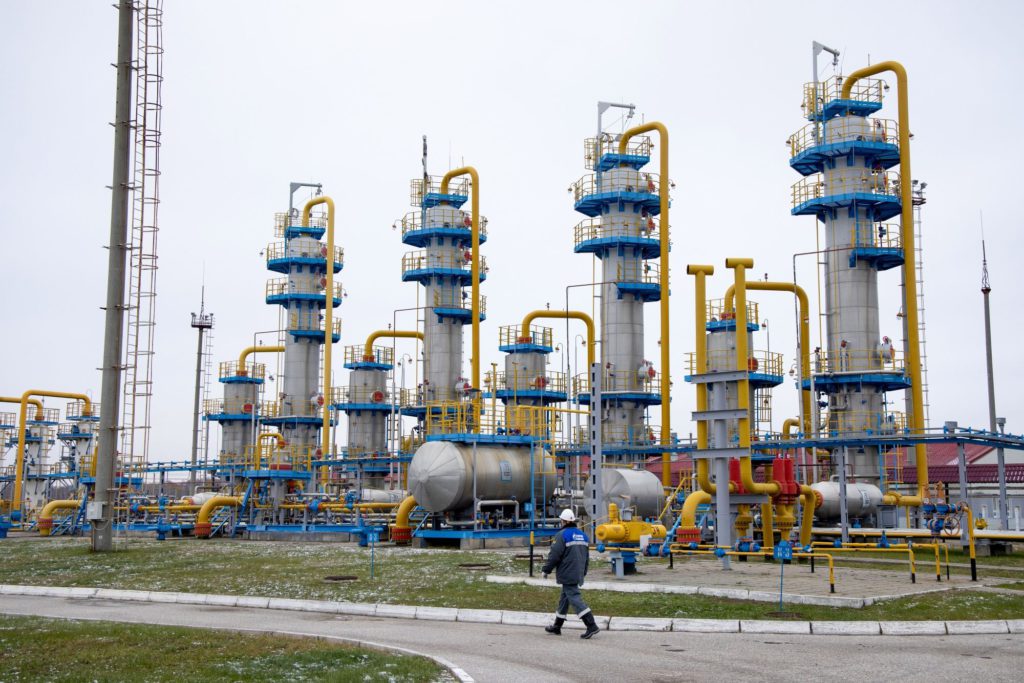
(Bloomberg) — Russian energy exports escaped sanctions from the U.S. as President Joe Biden toughens restrictions on the country while avoiding measures that could send oil prices surging even further, worsen Europe’s gas shortage and make gasoline more expensive for Americans.

Harsher sanctions announced by Biden on Thursday following the invasion of Ukraine included blocking major Russian banks and cutting off the country from semiconductors and advanced technology, but purchasing and selling Russian energy supplies are still allowed. 

“In our sanctions package, we specifically designed energy payments to continue. We are closely monitoring energy supplies for any disruption,” Biden said from the East Room of the White House. “We have been coordinating with major oil-producing and consuming countries toward our common interest to secure global energy supplies.”

Russia is a major exporter of energy and raw materials that the world badly needs at a time when shortages of everything from wheat and crop fertilizers to natural gas and aluminum are stoking inflation, forcing central banks to weigh the need to hike interest rates against the risk of economic slowdown. The U.S., Saudi Arabia and Russia are the world’s biggest oil producers. 

Also See: Millions of Barrels of Russian Oil, Products Head for U.S. Ports

Biden also raised the prospect for the U.S. to release more oil from its strategic reserves in coordination with other nations, in order to quell rising energy prices. The U.S. will release additional supplies as conditions warrant, Biden said. That would build on a release of 50 million barrels the U.S. authorized last year. 

Energy supplies around the world have failed to keep pace with a vigorous recovery in demand after the worst of the pandemic.

Earlier, oil prices topped $100 a barrel in New York on fears that additional escalation could lead to sanctions impacting the energy market or supply disruptions. Europe relies on the nation for about a quarter of its oil and a third of its gas. 

Also See: Biden Team to Hold Off on Russia Sanctions Hitting Aluminum

After the announcement of new sanctions, oil prices cooled to eliminate almost all of their gains. West Texas Intermediate traded near $93 a barrel at 2:54 p.m. in New York, down from earlier highs above a $100. 

Energy traders were looking to see if sanctions would target their crude supplies, said Ed Moya, Oanda’s senior market analyst for the Americas. When that didn’t occur and the U.S. announced it could tap strategic reserves as needed, it allowed prices to drop, he said.

More stories like this are available on bloomberg.com

©2022 Bloomberg L.P.

Western Allies See Kyiv Falling Within Hours: Ukraine Update

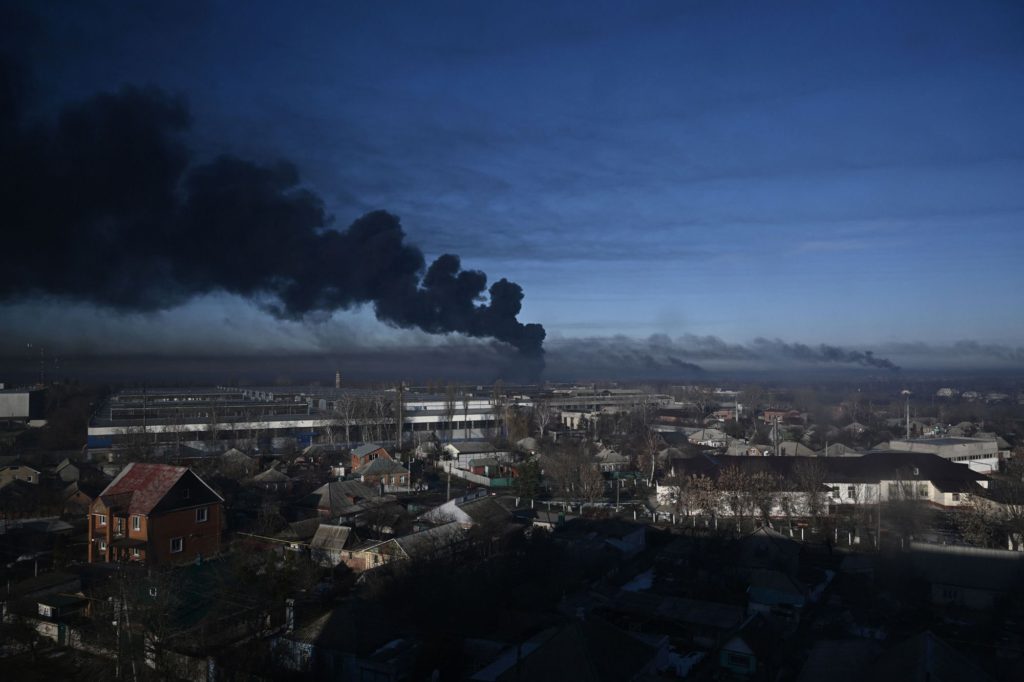
(Bloomberg) — Western allies see Kyiv, the Ukraine capital, poised to fall within hours to Russian forces. U.S. President Joe Biden announced additional sanctions on Russia as Western countries grappled with how to respond. That’s as fighting continues in Ukraine with Russian troops attacking from the north, south and east. The U.K. unveiled penalties including …

Western Allies See Kyiv Falling Within Hours: Ukraine Update Read More »

India’s Economic Recovery Slowed on Virus Wave, Indicators Show

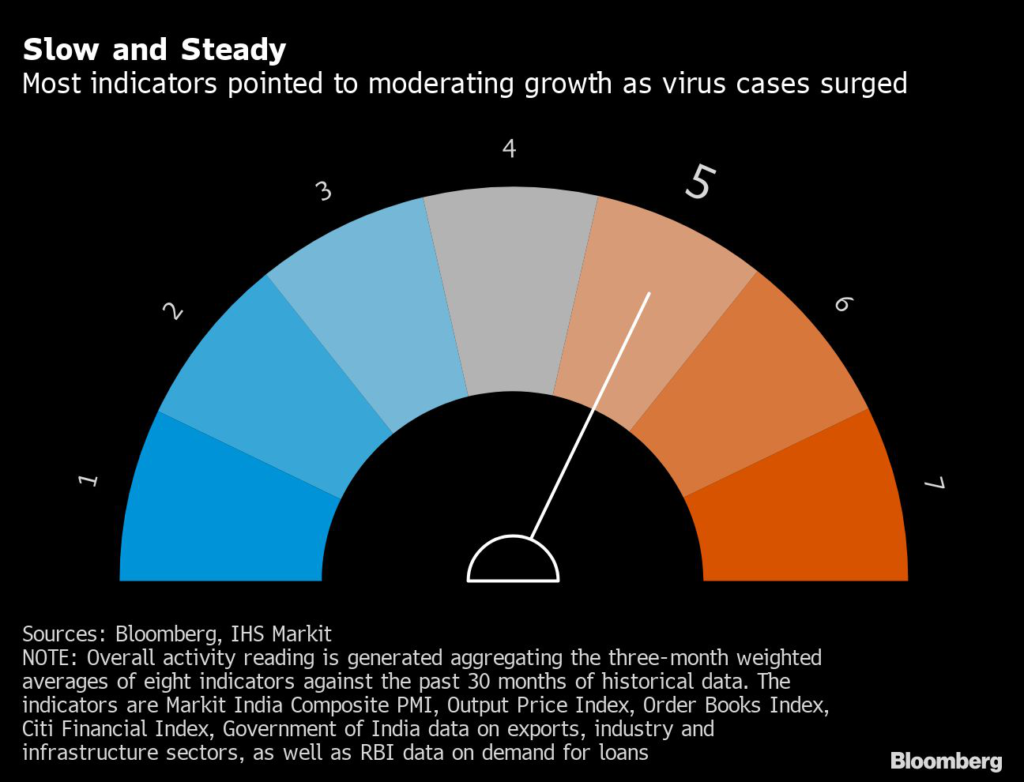
(Bloomberg) — India’s economic activity showed mixed signals in January, with most indicators pointing to a moderation in growth after a surge in omicron cases brought back some of the pandemic-related restrictions.

While five of the eight high-frequency indicators compiled by Bloomberg News came in weak last month, the rest signaled a steady recovery. A three-month weighted average view of the readings, however, helped keep the needle on a dial measuring the so-called ‘Animal Spirits’ unchanged at 5 for a seventh month. 

As omicron cases took off in January, fiscal and monetary policy makers remained accommodative to support the economy’s recovery this month. While gross domestic product data for the October-December period is due Monday, authorities will probably look to get the latest pulse check from leading indicators such as purchasing managers’ surveys next week.

Below are details of the dashboard. (For an alternative gauge of growth trends, follow Bloomberg Economics’ monthly GDP tracker — a weighted index of 11 indicators.)

Business Activity

IHS Markit’s PMIs showed activity at Indian factories and services companies expanded in January, albeit at a slower pace, as new order inflows weakened. That pulled the composite index down toward the 50 dividing line between expansion and contraction. 

Exports

Exports growth moderated to 25% in January from a year ago, slowing from the 39% pace seen in December. Imports also slowed to 23.5% from 38.5% as gold purchases dropped, helping narrow the trade deficit to $17 billion. 

Consumer Activity

Passenger vehicle sales fell for a fifth straight month, declining more than 10% in January, but industry associations are optimistic given an easing shortage of semi-conductor chips that hurt production. In other signs of consumer activity, bank credit growth slowed to 8.21% at the end of January from 9.2% in December-end. Liquidity conditions continue to remain in surplus.

Industrial Activity

Factory output growth eased to a 10-month low of 0.4% in December from a year earlier as manufacturing contracted. Output of eight infrastructure industries, which makes up 40% of the industrial production index, improved to 3.8% in December from 3.4% in November. Both reports are published with a one-month lag.

More stories like this are available on bloomberg.com

©2022 Bloomberg L.P.
Musk, Tesla Denied Hearing Over Alleged SEC ‘Harassment’

(Bloomberg) — Elon Musk and Tesla Inc. were denied a court hearing on their claims that the SEC is targeting them with an “unrelenting investigation” in retaliation for criticisms of the government.

U.S. District Judge Alison Nathan on Thursday said it wasn’t clear what the company and its chief executive officer were asking for in a Feb. 17 letter complaining that they were being targeted with “endless probes” by the regulator. 

Musk and Tesla accused the Securities of Exchange Commission of using their settlements of suits over a series of 2018 tweets by Musk to “muzzle and harass” him and the company. They asked for a court conference on the regulator’s alleged failure to distribute $40 million in settlement funds while spending “energy and resources investigating Mr. Musk’s and Tesla’s compliance with the consent decree by issuing subpoenas unilaterally, without court approval.

The SEC denied the claims in a letter to the judge, saying that agency enforcement staff has been in touch with Musk and Tesla, seeking to address concerns over their compliance with the settlements. 

“The defendants’ precise application to the Court is unclear,” Nathan said in a two-page order denying the request on Thursday, suggesting that they file a proper request with the court if they seek relief from the court.

The dispute is the latest in a continuing battle between the SEC and Musk over his Twitter posts claiming he had the funding and investor support to take the company private at $420 a share. The SEC alleged the tweets were false, and while Musk and Tesla didn’t admit wrongdoing in the accord, the agency set up a “fair fund,” with $20 million each from Musk and Tesla, to compensate company investors.

It was reported on Thursday that the SEC was investigating share sales last year by Musk and his brother Kimbal. 

The cases are U.S. Securities and Exchange Commission v. Musk, 18-cv-08865; U.S. Securities and Exchange Commission v. Tesla, 18-cv-08947, U.S. District Court, Southern District of New York (Manhattan).

(Updates with SEC investigation into Musk stock sales. A previous version of this story corrected a reference to the number of SEC suits in third paragraph)

More stories like this are available on bloomberg.com

©2022 Bloomberg L.P.
Close Bitnami banner
Bitnami