(Bloomberg) — Western allies see Kyiv, the Ukraine capital, poised to fall within hours to Russian forces. U.S. President Joe Biden announced additional sanctions on Russia as Western countries grappled with how to respond. That’s as fighting continued in Ukraine with Russian troops attacking from the north, south and east.
The U.K. unveiled penalties including an asset freeze on major banks. Russian President Vladimir Putin spoke with tycoons and urged them to back him as nations tighten the economic screws.
The government in Kyiv declared martial law and President Volodymyr Zelenskiy called on citizens to take up arms. A senior Russian lawmaker said Moscow aims to ensure a pro-Moscow government, pushing out U.S. influence. Russian military vehicles moved into the northern region that includes the capital and Ukrainian Prime Minister Denys Shmyhal said Russian troops had seized the Chernobyl nuclear power plant.
The war has upended markets, with the ruble and Russian stocks sinking while oil and gold soared.
Key Developments
- Biden Ratchets Up Russia Sanctions as West Fears Fall of Kyiv
- Biden’s Inner Circle Feared Sanctions Wouldn’t Stop Putin
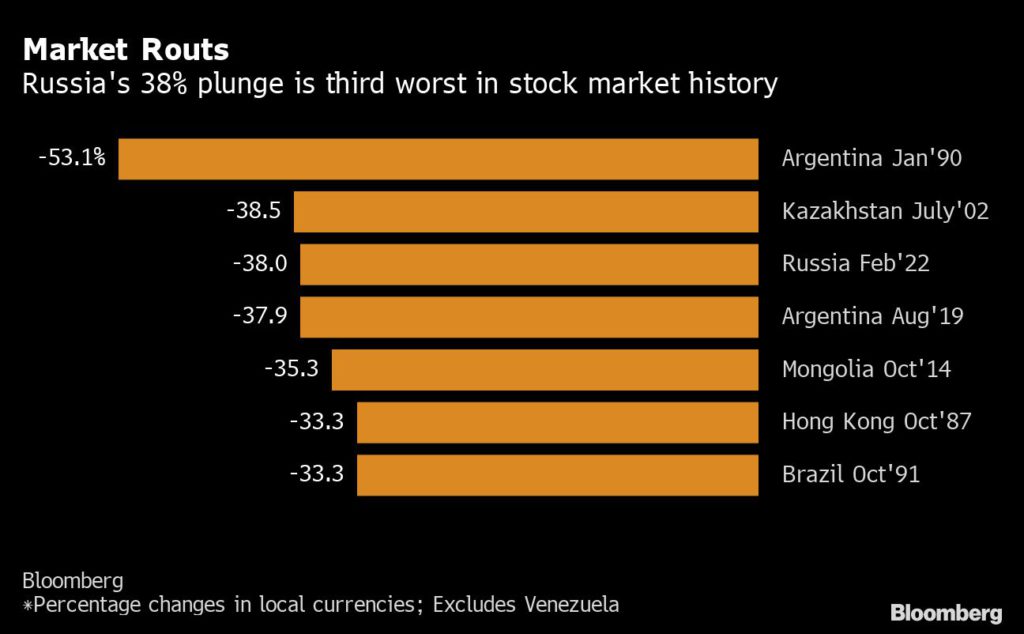
- Russian Stocks Suffer Third-Worst Rout in History of Markets
- Russia Hits Ukraine by Air, Land in Bid to Grab Quick Victory
- European Energy Prices Soar After Russia Attacks Ukraine Targets
- Ukraine Debt Swaps Signal 80% Chance of Default as Stress Mounts
- Oil Soars to $105 as Russia Attacks Targets Across Ukraine
All times CET:
U.S. Expands Flight Restrictions Around Ukraine (8:37 p.m.)
The U.S. is expanding its restrictions on flights above war-torn Ukraine and nearby nations.
The Federal Aviation Administration on Thursday said in an emailed statement that all of Ukraine and Belarus, along with a western portion of Russia, are off-limits for U.S.-registered airlines and pilots.
The U.S. had posted notices on flight restrictions imposed by Ukraine and other nations, but hadn’t issued any of its own directives amid the recent turmoil. The FAA has for years restricted flights over eastern Ukraine as a result of fighting there.
Biden Won’t Rule Out Sanctioning Putin Personally (8:34 p.m.)
The idea of sanctioning Russia’s Putin personally was “not a bluff” and remains “on the table” as the U.S. ratchets up its response to the invasion of Ukraine, Biden said in his appearance at the White House on Thursday.
But the U.S. leader also conceded that even the sweeping sanctions targeting Russia’s financial sector imposed Thursday would take time to have an impact, and that he didn’t believe their announcement would cause Putin to stand down his invasion.
“They are profound sanctions – let’s have a conversation in another month or so to see if they’re working,” Biden said.
Pentagon Sending 7,000 Service Members to Germany (8:15 p.m.)
The U.S. is sending about 7,000 additional service members to Germany.
The armored brigade combat team, with associated capabilities, is aimed at reassuring NATO allies and deterring Russian aggression and will depart for the assignment in coming days, according to a senior defense official.
Biden Says He’ll Try to Shield Americans on Energy Prices (8:12 p.m.)
Biden said he’s seeking to shield Americans from higher energy costs by exempting energy payments from sanctions and through a potential additional release of emergency crude stockpiles.
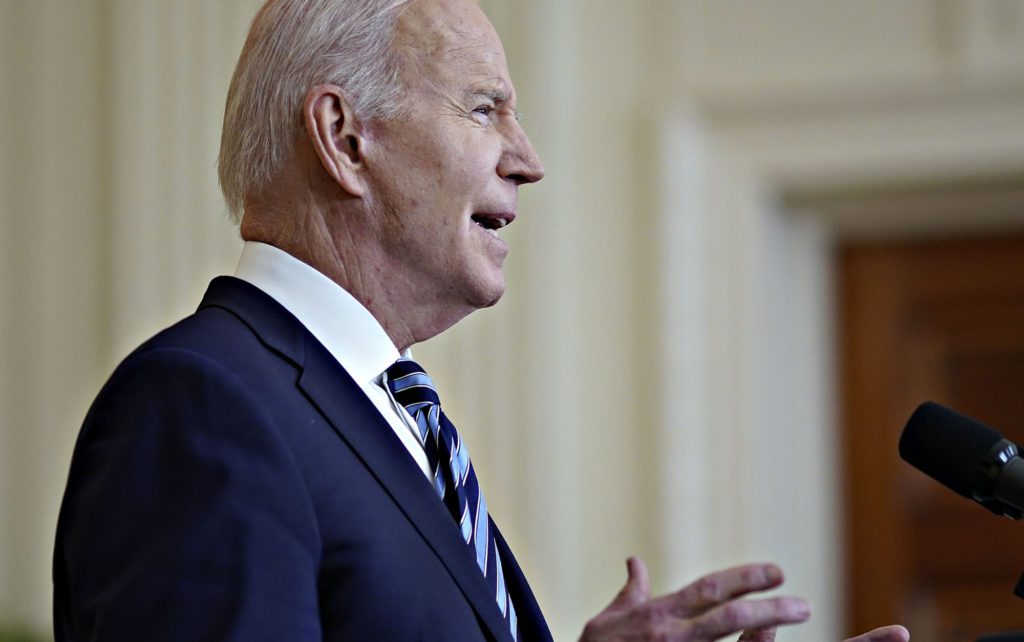
“I will do everything in my power to limit the pain the American people are feeling at the gas pump. This is critical to me,” Biden said in his address from the White House. “But this aggression cannot go on. If it did, the consequences for America would be much worse.”
The U.S. already authorized the release of 50 million barrels of crude from the U.S. Strategic Petroleum Reserve last year. Biden said the U.S. will release additional supplies as conditions warrant, and is “actively working with countries around the world” on a potential collective discharge of emergency supplies. He also warned U.S. oil and gas companies not to “exploit this moment to hike their prices, to raise profits.”
Western Allies See Kyiv Falling to Russian Forces Within Hours (7:54 p.m.)
Kyiv may fall to Russian forces within hours as Ukraine’s air defenses have been effectively eliminated, according to a senior Western intelligence official.
Russian troops are advancing toward Ukraine down both sides of the Dnieper river and look set to take the capital, the official said.
Biden Imposes Sanctions, Export Controls on Russia (7:50 p.m.)
Biden denounced Russia’s “brutal assault” in a “premeditated attack” on Ukraine in a speech Thursday from the East Room of the White House and said he would impose a “severe cost on the Russian economy.”
The U.S. is implementing export controls designed to cut Russia off from semiconductors and other advanced technology crucial to the military, biotechnology, and aerospace industries. Rules allow the U.S. to restrict exports to Russia from anywhere in the world using American technology, including software.
Biden also announced that the U.S. would be sanctioning Sberbank – Russia’s largest lender – and four other financial institutions that represent an estimated $1 trillion in assets, as well as a broad swath of Russian elites and their family members. The sanctions didn’t appear targeted at Russian energy, aluminum, and wheat industries after the White House said it hoped to minimize the impact of the penalties on American consumers.
EU Close to Limiting Russia’s Access to Financial Markets (7:30 p.m.)
EU leaders are discussing a sanctions plan Thursday night that would restrict Russia’s access to Europe’s financial sector, as well as key technologies, according to people familiar with the matter.
The draft proposals, which EU leaders are expected to green-light as part of a sanctions package at their emergency summit, would also broaden sanctions on individuals, as well as criteria to target wealthy Russian oligarchs, and to tighten visa rules for diplomats, making asset freezes and travel bans more effective. The proposals are still subject to change.
Ukraine Says Russia Troops Seize Chernobyl Power Plant Site (7:11 p.m.)
The Prime Minister made the announcement in a televised briefing, saying Russian troops had taken control of the zone and the nuclear power plant.
The facility is located about 80 miles (129km) north of Kyiv, several miles south of the Belarus border. Holding Chernobyl would provide Russian troops a staging point that couldn’t be shelled.
U.K. Reveals Russia Sanctions, Pushes to Eject it From SWIFT (6:21 p.m.)
Prime minister Boris Johnson unveiled a tough package of penalties including an asset freeze against all major Russian banks and a plan to ban Russian companies from raising finance on U.K. markets.
The sanctions involve an immediate ban on the export of dual-use civilian and military items to Russia, and a plan to limit the amount that Russian nationals can deposit in U.K. banks.
Johnson pushed for Russia to be ejected from the international Swift payments system on a call earlier with Group of Seven leaders, according to his spokesman Max Blain. “Nothing is off the table,” Johnson said in the House of Commons, when discussing Swift. Some nations in Europe have been highly cautious about doing so, given the economic and financial impact it would cause their companies and economies in turn.
Putin Warns West Not to Push Russia Out of Global Economy (6:10 p.m.)
Russia remains part of the world economy and “for as long as it remains a part, we are not going to damage the system in which we feel we’re” involved, Putin told a meeting with billionaires and heads of leading Russian businesses. “Our partners should understand this and not set themselves the task of pushing us out of this system.”
He urged Russian businesses to work “in solidarity” with the government against the impact of international sanctions, saying he’d been obliged to invade Ukraine because the West hadn’t “given a millimeter” in response to Russia’s demands for security guarantees.
While he’s sought to argue the invasion was a response to NATO breaching Russia’s “red lines,” the U.S. had warned for months that Putin was preparing for a potential assault with his military buildup near Ukraine’s borders, and NATO says it is a defensive alliance that poses no threat to Russia.
U.S. Spies Bought Time by Getting Russian Invasion Right (5:34 p.m)
It failed to prevent a war, but almost everything the U.S. said Russia would do in Ukraine has come to pass.
As Alberto Nardelli, Jennifer Jacobs and Kitty Donaldson report, the intelligence that President Joe Biden made public in a highly unusual process gave the world a preview of Russian President Vladimir Putin’s true intentions, robbing him of the element of surprise.
It also gave the U.S. time to rally support from its allies on sanctions that in normal circumstances would have taken months to hash out.
EU Countries Shun World Cup Qualifiers in Russia (5:23 p.m.)
The football associations of Poland, Sweden and the Czech Republic condemned Moscow’s invasion of Ukraine and said they would refuse to play World Cup qualifier matches scheduled in Russia for March, according to a statement.
The countries said they expect the global football association FIFA and its European equivalent UEFA to present alternative options. Poland was to vie for qualification at the Qatar World Cup against Russia on March 24 in Moscow. The winner would face Sweden or the Czech Republic on March 29.
Calls Mount to Ban Russia From Swift (5:10 p.m.)
Ukrainian Foreign Minister Dmytro Kuleba renewed calls to cut off Russia from the Swift international payments system, and the Financial Times reported that U.K. Prime Minister Boris Johnson is also pushing hard for that step.
The move, which would limit Russia’s access to the broader financial world, remains unlikely because some European countries worry it would hurt them more than it would hurt Putin.
Zelenskiy Says Troops Fighting Hard in East (5:04 p.m.)
In televised comments, Zelenskiy said Ukraine’s military is operating “excellently” in the Donbas region and “reliably controls” the second-largest city of Kharkiv. There’s a “fierce” battle in the Kherson region with Russian troops that are pressing north into Ukraine from Crimea, which Moscow annexed in 2014, he said.
Zelenskiy said the army was blocking Russian airborne troops at the airport in Hostomel, about 30 km (18 miles) northwest of Kyiv.
Russia Used 75 Bombers, More Than 100 Missiles (4:57 p.m.)
The initial wave of Russia’s attack on Ukraine involved 75 heavy and medium bombers and more than 100 missiles of various types, according to a U.S. defense official who briefed reporters.
The Russian attack appears designed to seize key population areas, including Kharkiv, and invading forces have so far not been seen in western Ukraine, according to the official, who added that the goal appears to be the decapitation of Ukraine’s government.
The official didn’t announce any new U.S. troop movements in Europe, but said that six F-35 jets will arrive in Estonia, Lithuania and Romania today. Their deployment was previously announced.
ECB’s Lagarde, EU Finance Chiefs to Brief on Friday (4:37 p.m.)
European Central Bank President Christine Lagarde and finance chiefs will hold a news conference Friday afternoon after a meeting in Paris where they’ll address the economic impact of Russia’s invasion of Ukraine.
Her comments will be closely watched by investors trying to gauge how the crisis will affect the ECB’s plans to gradually exit stimulus measures and move toward rate hikes. Austrian Governing Council member Robert Holzmann told Bloomberg News earlier that the conflict may slow the ECB’s action.
EU finance ministers rewrote their agenda for the previously scheduled Paris meeting to focus on the Ukraine crisis.
Police Close Moscow Square Where Anti-War Rally Planned (4:34 p.m.)
Police blocked access to Moscow’s central Pushkinskaya Square, where Russian anti-war protesters planned a rally. Demonstrations against the action in Ukraine have been largely muted and authorities have taken an increasingly hard line against dissent over the last year.
A handful of Russian celebrities, including TV anchor Maksim Galkin and rock star Zemfira Ramazanova, criticized the military intervention on social media, while 200 journalists, including from state-controlled Tass and RT, signed a petition condemning the attack. More than 960 protesters in 44 cities around Russia were detained, according to OVD-Info, an independent human-rights monitoring group the government has labeled a “foreign agent.”
Turkish Ship Hit by Shell in Black Sea (4:22 p.m.)
The Yasa Jupiter, a Marshall Island-flagged ship owned by Istanbul-based YA-SA Holding, was slightly damaged by a shell after unloading coal at the Ukrainian port of Odesa, the company said.
No one was injured, it said. It was unclear whether the ship was deliberately targeted or who fired the shell, and the ship is heading under its own power to the closest port for a damage assessment, YA-SA Holding said.
U.S. Equities Plunge With Nasdaq Entering Bear Market (4:10 p.m.)
U.S stocks followed global equities lower at the open of New York trading as the attack by Russia cast a pall over global markets.
The S&P 500 and Nasdaq 100 slid, with the latter entering a bear market. The Stoxx 600 Europe index shed 3.6% and Asian equities fell to the lowest since 2020. Meanwhile, Russian shares slumped the most on record after a trading suspension ended.
EU Will Call for New Sanctions Against Belarus (3:55 p.m.)
EU leaders will call for a third package of sanctions to be prepared, this one to target Belarus for its involvement in the invasion of Ukraine, according to draft conclusions prepared for the Thursday that could still be changed.
The EU already has an array of sanctions against the country over human rights abuses and the use of migrants to stage what Brussels has called a hybrid attack aimed at destabilizing the bloc’s border. Lithuanian President Gitanas Nauseda said earlier Thursday he’ll call for sanctions on Belarus at the summit because “aggression is taking place from the territory of this country.”
Russian Invasion Upends Air Travel, Stokes Fear for Staff (3:51 p.m.)
Air travel has been scrambled across much of eastern Europe, with the European Union Aviation Safety Agency imposing flight bans above Ukraine and areas across its northern, southern and eastern borders.
Airlines were also giving large swaths of Russia a wide berth almost as far north as Moscow, after EASA warned that mid-range missiles could pose a threat there.
Wizz Air, one of the few foreign airlines with bases in Ukraine, was extracting four planes and staff from Lviv and Kyiv. Airline-tracking website FlightRadar24 showed a LOT Polish Airlines service bound for Kyiv turning back to Warsaw, while an Air Moldova flight from Tel Aviv was rerouted to Romania.
U.S. Unlikely to Target Russian Oil, Gas Sector: Ex-Official (3:40 p.m.)
The Biden administration, fearful of doing anything to increase already skyrocketing oil and gasoline prices, is unlikely to directly sanction Russia’s oil and natural gas sector, according to Bob McNally, a former White House official who is president of consultant Rapidan Energy Group.
“I expect stringent sanctions, but nothing on energy — bankers, ships and oligarchs,” McNally said in an interview. “They don’t want to add upward pressure on oil prices — they are absolutely terrified.”
Russia’s Attack Still Rattling Markets (3:30 p.m.)
In Ukraine, stress on the debt markets deepened, with credit-default swaps signaling an 80% chance of default within five years.
European gas prices extended gains, with benchmark Dutch gas futures soaring as much as 47%, the most since at least 2005. German power for March jumped as much as 42%. Oil also surged, with Brent futures trading as high as $105 a barrel.
Ukrainian Commodities Trade Thrown Into Chaos (3:01 p.m.)
Commodity exports from Ukraine have been disrupted as the invasion closes ports and railways. Egypt, the biggest wheat importer and a large consumer of Russian and Ukrainian wheat, canceled an auction after receiving one offer.
Ukrainian iron ore miner Ferrexpo Plc said the government had suspended rail transportation, while steel giant ArcelorMittal said it slowed production to a “technical minimum” and stopped output from its underground iron ore operations.
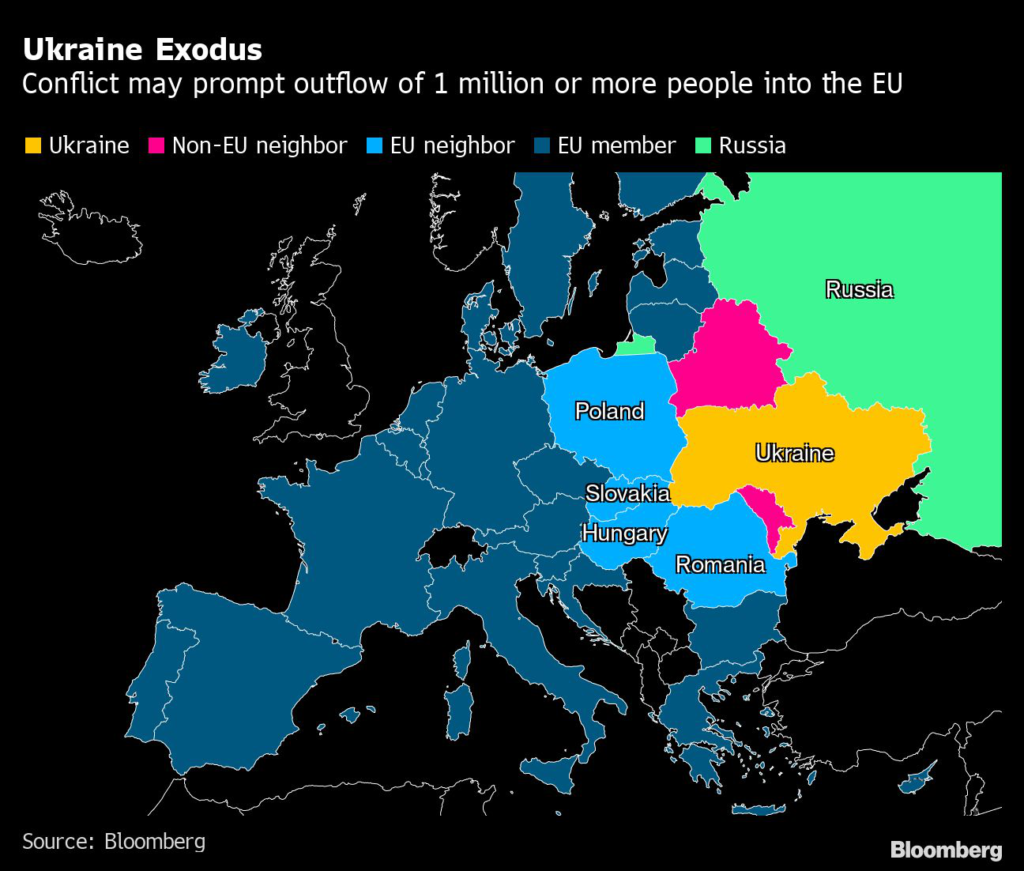
Traffic in Border Region Ticks Up as EU Braces for Refugee Influx (2:47 p.m.)
EU member states bordering Ukraine registered an increase of traffic across the border as the bloc braces for what could be an exodus of over a million refugees. Poland, Slovakia, Hungary and Romania have said they’re prepared for the influx.
Polish officials in recent weeks have spoken of more than a million migrants, while others put the number much higher. Hungary’s Viktor Orban, a champion of anti-immigration policies who faces re-election in April, says his country will also take in those fleeing war.
Romania Says Russia Blocks Ships Heading to Ukraine (2:32 p.m.)
A Russian military vessel in international waters in the Black Sea is currently diverting or stopping commercial ships heading toward Ukrainian ports, according to Romania’s Naval Force.
Russia Aims for Destruction of Ukraine Forces: Analyst (2:02 p.m.)
Russia’s invasion is following an early progression many military analysts had predicted, with an intense barrage of missile attacks launched from afar to destroy Ukraine’s airfields, air defenses and control systems.
Read more: Vladimir Putin’s Televised Address on Ukraine
It appears that Putin has opted for a large campaign aimed at achieving regime change, rather than a more limited take over of the separatist Donbas territories he has recognized as independent.
Yet taking — rather than merely threatening — Kyiv, a city of 2.8 million, would risk months of urban warfare and require all the manpower Russia has available.
Scenes From Ukraine as Russia Launches Attacks: Photos
Top Officials to Brief U.S. Lawmakers (1:58 p.m)
Secretary of State Antony Blinken, Treasury Secretary Janet Yellen, Pentagon chief Lloyd Austin, and Joint Chiefs of Staff Chairman General Mark Milley are expected to brief all House members via a call at 6:30pm in Washington, according to a person familiar with a plan.
Macron Says Sanctions Will Match Russia’s Actions (1:45 p.m.)
Those penalties will be military and economic, and will touch on energy, French President Emmanuel Macron said in a televised speech, adding that decisions will be taken after talks with allies at the upcoming Group of Seven, European Union and NATO summits.
Ukraine Reports Heavy Fighting at Airport Near Kyiv (1:32 p.m.)
There’s heavy fighting at Hostomel airport, about 35 km (21 miles) northwest of the capital, Kyiv, Ukrainian presidential adviser Mykhaylo Podolyak said.
Russia’s attack on the airport may be aimed at bringing in airborne troops and an assault on the government administration, he added.
One of Russia’s goals “is to remove top authorities,” Podolyak said, advising journalists to leave the presidential office in downtown Kyiv.
U.S. Suspends Diplomatic Presence in Ukraine (1:13 p.m.)
The U.S. has removed all State Department personnel from Ukraine and suspended its diplomatic presence and consular operations in the country, a U.S. official said. Several other countries, including Croatia, said they plan to keep some embassy staff in Kyiv.
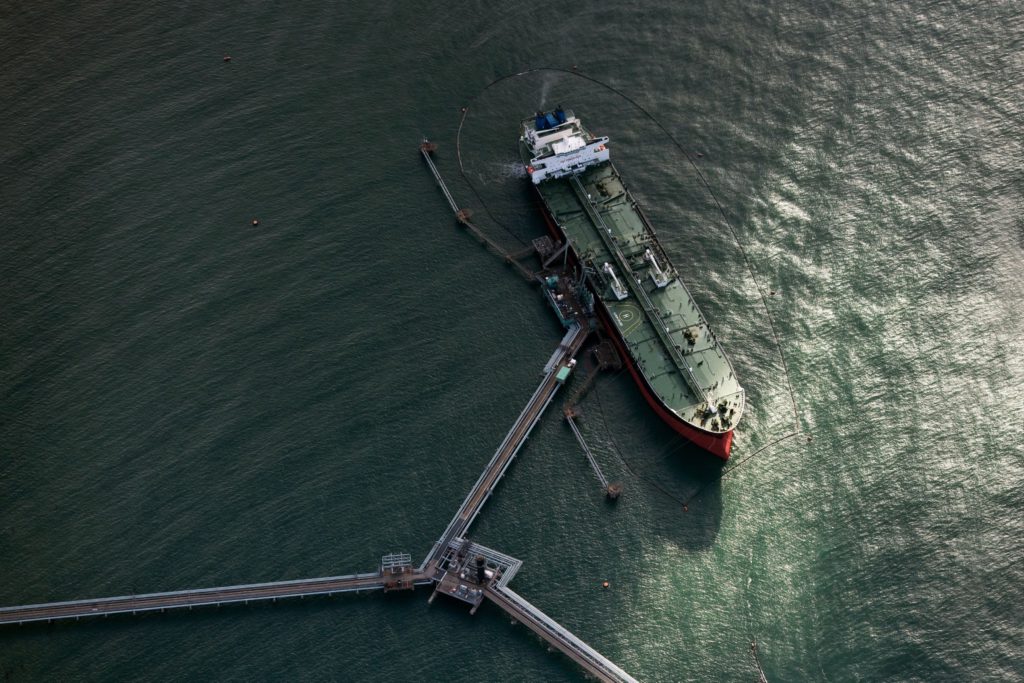
Tanker Owners Avoid Russian Crude (12:55 p.m.)
Oil tanker owners immediately became reluctant to ship Russian crude while they wait to see what sanctions the West might impose.
Russia relies on tankers to handle about two thirds of its crude exports, meaning that any prolonged disruption to shipping would be more serious.
Ukraine Grain and Metal Exports in Chaos as Rail and Ports Close
Russian Military Advances Into Kyiv Region, Ukraine Says (12:30 p.m.)
Russian military vehicles breached Ukraine’s Kyiv region, the Ukrainian border guard service said. The Russians crossed via the border with Belarus, about 100 miles (160 km) from Kyiv.
“Border guards and soldiers are fighting,” according to the Ukrainian statement. The service said its units were also being shelled by multiple rocket launcher systems in the Zhytomyr region west of Kyiv.
Kremlin Won’t Comment on Timing, Goals (12:05 p.m. CET)
Kremlin spokesman Dmitry Peskov declined to comment on key questions about Russia’s operation in Ukraine. He refused to elaborate on how long it will last, whether troops will move into the entire country, and whether Moscow aims to install a new government.
On his daily news call, Peskov said only that Russia’s aims are to “liberate Ukraine and neutralize its military potential.”
Asked about potential international isolation resulting from the move, Peskov said it was “impossible to close off a country like Russia with an Iron Curtain.”
Oil Jumps Above $105 Over Fears of Disruption (11:55 a.m.)
Russia is a key producer of both crude and refined products, with Europe relying on the nation for about a quarter of its oil.
OPEC and its allies have a regular meeting scheduled on March 2 to decide on output levels for April. As of Wednesday, delegates from some of the biggest members were saying that triple-digit oil wouldn’t cause them to pump faster. But the group will be under pressure to ensure that prices don’t rise to levels that will start destroying demand.
Wave of Iranian Oil May Flood Asia If Nuclear Deal Reached
NATO to Discuss Reaction at Friday Summit (11:46 a.m.)
NATO leaders will hold a virtual summit on Friday to discuss the alliance’s reaction to the invasion, an official said.
The alliance said it continues to deploy additional land and air forces to member countries near Ukraine, along with more naval assets, to bolster defense and deterrence. Baltic nations and Poland had asked NATO for additional support in the wake of Russia’s invasion of Ukraine.
Ukraine Breaks Ties With Russia as Casualties Mount (11:12 a.m.)
Ukraine has cut diplomatic ties with Russia and will not give up its independence, Zelenskiy said in a televised briefing from Kyiv.
Zelenskiy said Ukrainian forces were defending themselves, and Russia was unable to break through the line of contact in Ukraine’s east.
Battles are taking place inside Ukraine, including near the second-largest city, Kharkiv, and near Kherson in the south, according to the president’s spokesman, Oleksiy Arestovych, who added that several dozen Ukrainian soldiers had been killed, and the government will arm anyone prepared to defend the country.
EU Envoys Agree to Finalize New Russia Sanctions (11:07 a.m.)
EU ambassadors unanimously backed a broad Russia sanctions package that had been drafted in the event of a Ukraine invasion, a senior diplomat told Bloomberg News. European leaders will discuss ways to toughen the package when they meet Thursday evening.
The measures include sanctions targeting Russia’s economy and financial sector, restrictions on exports of tech goods and a curb issuing Russian diplomatic visas, the diplomat said.
U.S., EU Vow Swift Riposte, China Restrained on Russia: Reaction
Russian Forces Cross Into Ukraine From Crimea (10:18 a.m.)
Security camera footage shows a line of Russian military vehicles crossing into Ukraine from Russian-annexed Crimea, AP reported.
The movement came as Russian media reported Sergei Aksenov, the head of Crimea, ordered his government to prepare to reopen the Northern Crimean Canal. Ukraine cut the waterway off after Russia annexed Crimea in 2014, causing severe water shortages for the territory’s agriculture.
Ukraine’s border service also said attackers are trying to seize Ukraine’s Zmiinyi island on the Black Sea, roughly 100 km (60 miles) from Odessa, and are calling on Ukrainian troops to surrender.
EU May Consider Sanctioning Putin Personally (10:00 a.m.)
The EU may discuss measures to sanction Putin individually as a way to toughen the measures being considered, said diplomats who asked not to be identified talking about confidential preparations.
Such a move would be mostly symbolic, since Putin’s wealth is something of a mystery. Officially, he owns hardly any assets. His annual income is about 10 million rubles ($116,400) and he owns three cars and an apartment, according to his latest financial disclosure.
The option of targeting Putin individually isn’t in the package already prepared by the EU, but could materialize if there’s enough political agreement, one of the diplomats said.
Russia Seeks Pro-Moscow Govt in Ukraine: Legislator (9:45 am CET)
Russia aims to ensure that a new government in Ukraine is friendly to Moscow and free of U.S. influence, according to a senior legislator from the ruling party.
“We will insist that the government that comes to power will be one that stands for constructive relations with our country,” Vyacheslav Nikonov, first deputy chairman of the International Affairs Committee in the State Duma, told state television. “Everything necessary for that will be done.”
U.S. influence in Kyiv, under which he said the country had become “anti-Russia,” will be removed, Nikonov said.
Nord Stream 2 Opening ‘Unlikely in Medium Term’ (8:25 a.m.)
German Economy Minister Robert Habeck said he can’t see the Nord Stream 2 gas pipeline going into operation “in the medium term.”
Germany this week suspended the certification process for the link, which was built to transport Russian gas to Germany’s north coast alongside an existing pipeline. The U.S. — which has warned Europe about being too dependent on Russia for energy supplies — also imposed sanctions on Nord Stream 2 and its executives.
China Doesn’t Condemn Attack, Calls for Restraint (8:58 a.m.)
Beijing urged restraint by “all parties” and repeated criticism that the U.S. was to blame for “hyping” the prospect of war in Eastern Europe.
China didn’t wish to see what happened and urged all parties to give peace a chance, Foreign Ministry spokesperson Hua Chunying said at a regular briefing. Still, she noted that Russia’s Defense Ministry said it will not attack any cities while adding that Russia is independent and can set strategy based on its own interests.
Hua also reiterated that China and Russia were strategic partners, and trade would continue as normal.
Russia Claims It Knocked Out Airbases (8:10 a.m.)
Russia subdued Ukrainian air defenses and knocked out the country’s military airbases, Interfax reported, citing the Defense Ministry.
Ukraine Says Gas Flowing Normally Despite Crisis (7:55 a.m)
Ukrainian state company Naftogaz says all the facilities of its gas transportation system are operating as usual so far and that natural gas is being supplied in the required amounts. Oil transportation pipelines are also operating as normal.
Ukraine Imposes Martial Law as Russia Attacks: President (6:15 a.m.)
“Russia has attacked our military infrastructure and our border guards,” Zelenskiy said in a video posted on his telegram channel. “In many cities explosions were heard. We are imposing martial law across the entire territory of our state.”
The Ukrainian leader urged people to stay calm and remain at home if possible, saying “we are working, the army is working.”
Russia Says Targets Ukraine Military Infrastructure: Tass (5:59 a.m.)
Russia’s Defense Ministry said it’s using “high-precision” weapons to target Ukrainian military infrastructure, Tass reported.
Russian forces are using aircraft, artillery and missiles to destroy Ukraine’s air force, military airfields and anti-aircraft systems, the ministry said, in the first official Russian confirmation that its operations extend beyond Donbas.
More stories like this are available on bloomberg.com
©2022 Bloomberg L.P.