Bloomberg

Apple Prefers Fine to Obeying Antitrust Order, Vestager Says

(Bloomberg) — Apple Inc. and other tech giants are opting to pay fines rather than comply with orders they don’t like, the European Union’s antitrust chief warned.

“Some gatekeepers may be tempted to play for time or try to circumvent the rules,” Margrethe Vestager said in an online speech at a U.S. awards ceremony. 

“Apple’s conduct in the Netherlands these days may be an example,” she said. The iPhone maker “essentially prefers paying periodic fines rather than comply” with a Dutch antitrust order to offer alternative app payments. A new EU law imposing curbs on big tech behavior should help tackle the problem, she added in the speech, delivered Tuesday.

Apple Gets Fifth Dutch Antitrust Fine Over App Payments

Apple is waging a global battle over fees for downloads and content on smartphones and tablets. The EU is separately probing Apple over curbs that hamper Spotify Technology SA and other music streaming services from taking payments outside the app store.

Apple has now been fined 25 million euros ($28 million) by Dutch antitrust regulators for not fully complying with a December order to offer payments outside the app store to dating app providers. 

The Cupertino-based company is challenging the Dutch decision and said earlier this month that changes it was making to set up a separate payment mechanism for dating apps in the Netherlands satisfied legal obligations in the country.

The Authority for Consumers & Markets insists Apple isn’t complying with the order. It has levied a series of weekly fines and earlier this week criticized Apple’s offer as not serious and too difficult for developers.

(Updates with Apple comment in sixth paragraph)

More stories like this are available on bloomberg.com

©2022 Bloomberg L.P.

MercadoLibre Beats Revenue Estimates, Gains Market Share in Brazil

(Bloomberg) — Latin American e-commerce retailer MercadoLibre Inc. grew its revenue more than expected and gained market share in Brazil even as Asian players continue to strengthen their footprint in the company’s largest market. 

MercadoLibre posted a net revenue of $2.1 billion in the fourth quarter, a 61% increase from a year earlier and slightly above analyst estimate of $2 billion, according to a statement Tuesday. The company reported gross merchandise volume of $8 billion, roughly in line with expectations, fueled by growth in Brazil, where firms including Sea Ltd.’s Shopee e-commerce platform have been building up their local operations.

“We’ve gained share in Brazil, even with the Asian players,” said Andre Chaves, a senior vice president at the Buenos Aires-based firm, in an interview. “We look at competition carefully and we try to learn, but that shouldn’t change our strategy. Everything in the quarter points to a sustainable growth path.”

Despite strong revenues, MercadoLibre posted a net loss per share of 0.92 cents on the dollar, below analyst expectations of gains of 0.73 cents per share. The results reflect that the fourth quarter is a time of year that concentrates high sales volume but also high expenses, such as marketing, discounts and rebates, Chaves said. 

“We share this with our sellers but we have to put some of the investments ourselves.”

Read More: MercadoLibre Is Changing the Way Latin Americans Shop—and Pay

The firm’s credit portfolio grew to over $1.7 billion in the third quarter, up from $1.1 billion in the previous three months, while non-performing loans improved at a moment when investors are concerned about potential deterioration in credit quality in Brazil amid rising inflation and rates. The company is managing default risk levels in its credit book “very closely,” Chief Financial Officer Pedro Arnt said in the company’s earnings call.

MercadoLibre acquired Brazilian logistics firm Kangu last year and recently announced the purchase of stakes in two crypto firms. Chaves declined to comment on possible merger targets and on how the company may further incorporate crypto functionalities in its back-end or its user-facing products. 

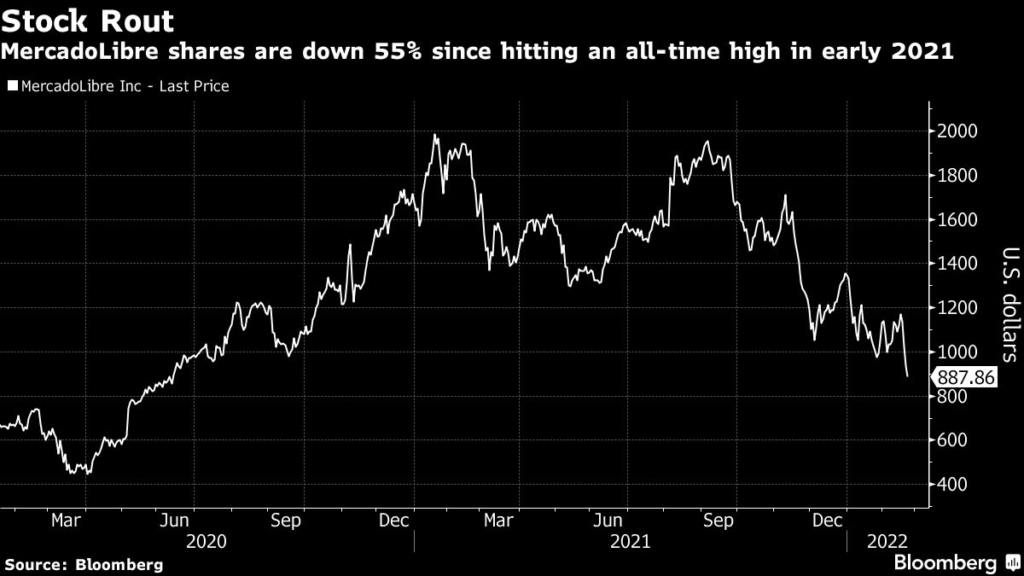
Shares in MercadoLibre rose as much as 12% in New York on Wednesday, and analysts wrote that they continue to hold a positive view on the company following the revenue beat. The stock is down 53% since peaking in January of 2021, battered by rising U.S. rates and fears over fierce competition. MercadoLibre has 24 buy-equivalent recommendations from analysts, five holds and no sell, Bloomberg data show. 

Non-performing loans remain under control even as the company scales up its credit business, while e-commerce continues its monetization trajectory, Itau BBA analysts led by Thiago Macruz wrote in a report dated Feb. 22. “We expect a nice rebound over the next couple of trading sessions, given that the company’s story remains rock-solid.”

Other key points from the earnings call:

  • MercadoLibre is “encouraged” by the number of Brazilian users transacting with crypto through the company’s digital wallet
  • The company will continue to invest in key areas that are part of its strategy including logistics, category expansion, roll-out of fintech products and credit
  • The advertising business relative to total gross merchandise value has crossed the 1% mark, a milestone for the company
    • It’s a high-margin business and MercadoLibre has seen good progress on that front so far

(Updates stock move starting in eighth paragraph.)

More stories like this are available on bloomberg.com

©2022 Bloomberg L.P.

Standard General’s Kim Makes Biggest Bet Yet on TV Stations

(Bloomberg) — After twice being rebuffed in his bid to compel Tegna Inc. to sell itself, Standard General’s Soo Kim can claim victory with a deal to buy the media company for $5.4 billion. 

The agreement comes on the heels of another Standard General proposal last month to acquire the remaining shares the firm didn’t already own in the casino and entertainment company, Bally’s Corp., in a deal valued at about $1.6 billion.

The back-to-back moves are helping to cement the reputation of Kim, 47, as a turnaround expert who can spot and hopefully restructure those increasingly rare gems — undervalued companies. 

His firm was a major player in the bankruptcy restructurings of American Apparel, Radio Shack and Young Broadcasting, which was later merged with Media General Inc.

Whether he’ll succeed with Tegna remains to be seen. 

Spun off from Gannett Co. in 2015, Tegna owns 64 television stations in Denver, Seattle, Minneapolis and 48 other U.S. markets, as well as media properties such as the True Crime Network. The broadcaster at first managed to fight off Standard General as it unsuccessfully mounted two boardroom battles aimed at pushing the company to sell.

The proxy fights grew nasty at times, with Standard General accusing Tegna of fostering a culture of racial bias at its stations. Last March, the hedge fund also called for an investigation into a 2014 incident when Tegna Chief Executive Officer Dave Lougee mistook a Black media executive for a valet at a business luncheon. Lougee later apologized.

Kim said purchases like that of Tegna are what can be expected from the hedge fund in the future. In an interview, he said his firm is focused on mature, small-to-mid-sized companies that have plenty of upside that the market is overlooking.

“People have said valuations are high in the public markets. But not in the space I look,” Kim said. “It’s an interesting scenario where valuations are reasonable — if not cheap — for companies that I understand and businesses that require some change. I actually think it’s a wonderful time to invest.”

Apollo Global Management, which is financing Standard General’s takeover of Tegna, itself was close to buying the broadcaster in early 2020 before the pandemic upended the market and its plans.

Last summer, after losing his second proxy fight at Tegna, Kim reached out to Apollo to see if they might work together on a deal. At the time, rumors were circulating that media mogul Byron Allen was also kicking the tires. Apollo and Standard General agreed to join forces.

Kim said the negotiations teetered on the brink of falling apart several times before they managed to get the deal across the line last weekend. 

The sticking points included who would assume the regulatory risk, the size of the termination fee, the deal’s structure and even who would be involved as buyers, people familiar with the matter told Bloomberg News.

Apollo’s majority ownership stake in competitor Cox Media Group gave rise to antitrust concerns if the private equity giant were to have control of both companies. As a result, the deal was structured in a way that will see Standard General hold substantially all the voting shares in the company while Apollo and its affiliates will receive preferred shares with no voting rights. 

After the deal closes, possibly in the second half of this year, Cox Media Group will acquire Tegna’s stations in Austin, Dallas and Houston, Texas.

Standard General is far from a household name. But Kim has been a rising star in the hedge fund industry since co-founding Standard General 15 years ago.

He was born in South Korea before moving to Queens, New York, with his family when he was five. He attended Princeton University and cut his teeth on Wall Street on the trading desk at Bankers Trust Co.

Kim eventually moved to Och-Ziff Capital Management, where he was part of the team that launched its fixed-income business. From there, he co-founded the credit hedge fund, Cyrus Capital Partners, in 2005 before leaving to co-found Standard General two years later.

He acknowledges the difficulties ahead for Tegna. “Tegna is running smoothly from some perspectives but the reality is that the whole business needs to change somewhat and continue to evolve because a lot fewer people get their news from television.”

Steven Cahall, an analyst with Wells Fargo Securities, said the deal should be a win-win for Apollo and Standard General. He said broadcast assets have great free cash flows, which make them attractive to both strategic and financial buyers. 

Apollo, meanwhile, was believed to be looking for a bigger station group as a partner for some of its legacy broadcast assets, Cahall said. “This deal seems to give everyone what they want.”

Deborah McDermott, Standard Media Group CEO, will become Tegna’s new CEO. She was on Standard General’s slate of director nominees during its first proxy battle with Tegna in 2020. Kim, who will become chairman, has a long history of working with McDermott dating back to her days as head of Young Broadcasting.

“Sometimes people go into acquisitions and crash and burn,” McDermott said. “We go in and look for the best out of that organization and blend the people who are there and find the best in it and fix the other stuff.”

Standard General’s offer for Tegna is a 39% premium to where the stock was trading before rumors of the deal broke last fall.

Kim’s approach at Bally’s isn’t that different. His offer to buy the casino operator’s shares came at about a 30% premium. Standard General is already Bally’s largest shareholder with a 21% stake in the company, and Kim has grown the business through acquisitions as its chairman.

Bally’s, which has a market value of roughly $1.9 billion, said Tuesday it had created a special board committee and hired financial and legal advisers to evaluate the non-binding proposal.

“Bally’s and Tegna have one very common denominator, which is their core businesses throw off a lot of earnings today. Whether it’s gaming or TV, they’re both license driven and there’s limited competition in every market,” Kim said. “But both of them face a little bit of uncertainty due to the internet.”

Tegna shares were nearly flat Wednesday at $22.43 while shares in Bally’s were up 1.3% at $25.72. 

For Bally’s, it’s an aging customer base and online gaming, he said. For Tegna, it’s that those in the younger generation aren’t watching the 11 p.m. news the way their parents did, he said.

“So, how do these very strong but old franchises actually survive in the internet era?” Kim asked. “We think that injecting a level of technology and evolution into the business will be amazing.”

(Updates with shares starting in the third to last paragraph)

More stories like this are available on bloomberg.com

©2022 Bloomberg L.P.

Activision Undergoes Executive Shakeup at Its Division That Makes Candy Crush

(Bloomberg) — Two of the top executives at Activision Blizzard Inc.’s King division will depart, resulting in a reshuffle at the Candy Crush developer ahead of a sale to Microsoft Corp.

King President Humam Sakhnini and Chief Creative Officer Sebastian Knutsson are both leaving, the company said in a statement Wednesday. Tjodolf Sommestad, the chief development officer, will succeed Sakhnini as president.

Candy Crush, a series of mobile games in which players match colorful sweets, is a significant part of Activision’s business. The King division generated revenue of $2.58 billion in 2021, and Microsoft cited the mobile business as a justification for spending $69 billion to acquire Activision. The deal is expected to be finalized by the summer of 2023, pending regulatory approval.

The leadership change at King is likely to add turbulence at a company in transition. Beyond the sale, Activision faces lawsuits alleging sexual harassment and discrimination. It has delayed multiple big games, including an entry in its biggest franchise: Next year will be the first without a mainline Call of Duty release in about two decades.

Knutsson helped found the company in Stockholm in 2003. Sakhnini was named president in 2019. Both said they were resigning to spend more time with their families, they told employees during a virtual meeting, according to a person who attended. Sakhnini said that when he moved to London for the job, he told his family they’d only be there for a few years before returning to California, said the attendee, who asked not to be identified because the meeting was private.

(Updates with context in the fourth paragraph.)

More stories like this are available on bloomberg.com

©2022 Bloomberg L.P.
Intel Chip Challenges Reign of China’s Bitcoin-Mining Firms

(Bloomberg) — Intel Corp.’s new Bitcoin mining chip may turn out to be the first major challenger to the Chinese rig manufacturers that have dominated the market for years. 

The Santa Clara, California-based chip making giant unveiled its crypto mining initiative earlier this month and the first generation BonanzaMine chip in January. Jack Dorsey’s digital payment company Block Inc., and two mining firms Griid Infrastructure and Argo Blockchain will receive the first batch of the chips later this year.

Chinese manufacturers Bitmain and MicroBT have a lion’s share of the Bitcoin mining hardware market due to the proprietary technology they use to make their high-performing chips. Few competitors appear to have been able to make a chip that can match them until now.

Bitcoin mining, which is earning rewards in Bitcoin by using computers to secure the cryptocurrency’s network, has become a lucrative business amid the surge in the price of Bitcoin in recent years, enriching the rig makers along the way. The mining industry raked in $15 billion in revenue in 2021, more than double the previous year, according to research from The Block. 

Intel’s entry could weaken the Chinese manufacturers’ pricing power and offer better maintenance services given the company’s close proximity to the miners in North America, industry participants said. The region dethroned China as the world’s Bitcoin mining hub as Beijing banned crypto mining last May.

“Having a U.S.-based manufacturer with the size, scale and credibility like Intel is fantastic for the entire crypto industry,” said Dave Perrill, chief executive of Eden Prairie, Minnesota-based Compute North, which provides Bitcoin miners with data centers to operate their machines. “Competition is a good thing.”      

Shares of Intel rose about 1% to $45.08 as of 10:34 a.m. in New York. They’ve dropped 26% in the past year.    

One chief reason for miners to welcome a competitor like Intel is the current pricing model and purchasing terms, which are set by the top manufacturers, burden their buyers with varying financial risks and operational costs. A fixed price, which will be offered by Intel, provides more predictability.

The manufacturers make pre-orders of their latest models available for buyers before they have the inventory. However, the buyers won’t know the actual price until the manufacturers ship the machines and they are given a price range, said Nick Hansen, chief executive of Seattle-based mining pool and hardware brokerage company Luxor.

Prices of pre-ordered machines are updated everyday within that range based on the manufacturers’ internal pricing models. Bitcoin’s spot price and the payback period, which is the time needed to break even, are key factors in these models, Hansen said.

The internal pricing models could strain Bitcoin miners’ cash flow and pose even more risks when the miners face a potential shakeout during bear markets as the pricing models give great weight to the Bitcoin price.

“Our customers want clarity,” Perrill said. “They want to know that next week Bitcoin mining machines’ prices are not going to shift by 50% given the volatility of the Bitcoin market.”

Another reason Chinese makers do not sell machines at a fixed price is they do not have much control over its suppliers’ pricing, therefore these companies have less control over the final price for its mining machines, said Lei Tong, head of lending at Hong Kong-based Babel Finance, which provides lending services for Bitcoin miners.

The 25% tariff imposed on imported mining machines from China adds more cost to the buyers, which could also be a significant factor for miners to make purchases. Unlike Bitmain and MicroBT, Intel has more control over its suppliers’ pricing due to the company’s influence and scale in the semiconductor industry, Tong said.

Some miners in North America also expect a domestic mining machine provider to have better maintenance services.

“Being located here gives a lot of advantages to Intel in the domestic market,” Perrill said. “Things like warranty claims, repair and how to handle the e-waste are really tipped in Intel’s favor.”

Better maintenance can slow mining machines’ depreciation and save operational cost for mining companies. Maintenance services become even more important when miners use certain models of mining machines that have more quality issues, Tong said.

“The biggest thing for us is what happens to older grade machines,” Perrill said. “My hope is that Intel brings a more enterprise grade approach to this business, manages and configures millions of computers at scale.”

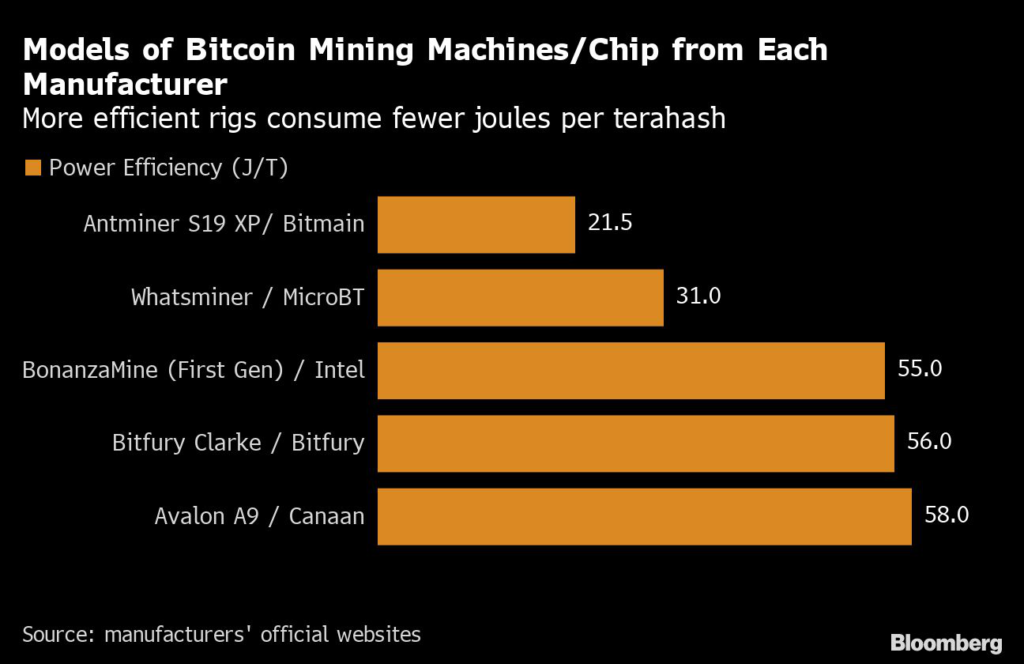
Details on Intel’s second generation chip, such as power efficiency and pricing, are yet to be available and some miners are skeptical of the significance of Intel’s entry to the industry. Intel revealed its first generation chip has the power efficiency of 55 joules per terahash falling far behind Bitmain’s latest model, according to Intel’s paper submitted to the International Solid-State Circuits Conference. The details on its second generation product, which is what the buyers are purchasing, will be released at a later time, a spokesperson from Intel told Bloomberg.

Power efficiency is arguably the most important specification for miners to gauge the profitability of a Bitcoin mining machine, Tong said. High power efficiency chips can save energy cost, which is one of the biggest costs for Bitcoin miners.

There are two things that determine a manufacturer’s ability to mass produce a chip. One is the chip’s design, while the other is whether it has a reliable supply chain for the components. 

“It could take a few years for Intel to catch up with Bitmain on all fronts,” Tong said. “But Intel’s entry is definitely a good thing for the industry.”

(Updates to include the share price. An earlier version corrected the spelling of Eden Prairie and of Lei Tong’s name.)

More stories like this are available on bloomberg.com

©2022 Bloomberg L.P.
This Solar Startup’s Boss Could Make More Than Goldman Sachs’s CEO

(Bloomberg) — A solar-power startup little known outside of the energy industry gave its chief executive officer a bigger pay package last year than banking giant Goldman Sachs Group Inc. lavished on its own leader. It’s also in excess of what Chevron Corp. and NextEra Energy Inc. are paying their top executives this year.

Heliogen Inc., based in Pasadena, California, provided chief executive officer Bill T. Gross with compensation worth $37 million for 2021, according to a filing last month after it went public in late December.

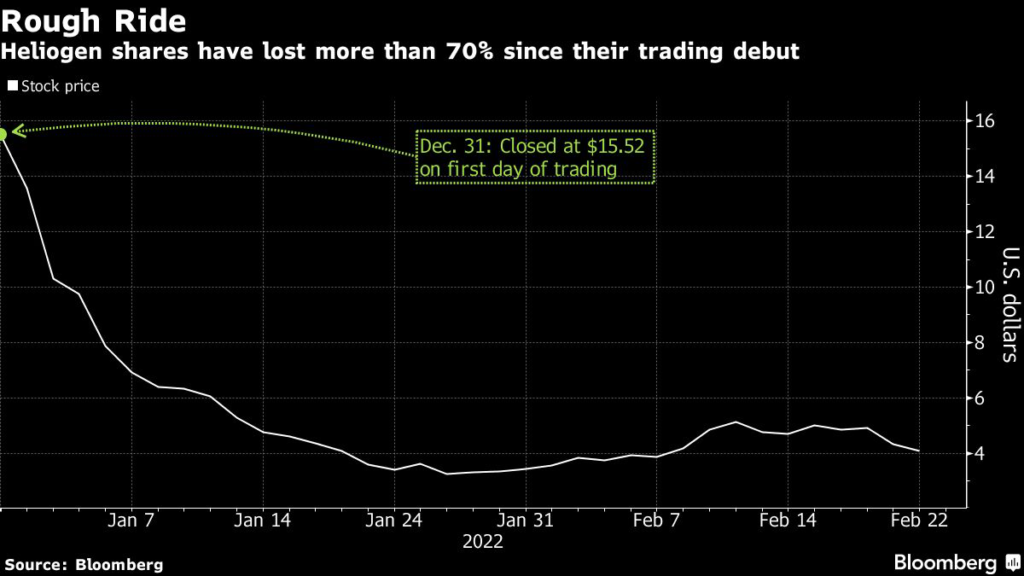
Gross’s award, however, comes with a catch: It almost entirely consists of options that vest over four years and will be valueless unless he helps lift the company’s stock price back above $9. The shares closed at $4.07 on Tuesday.

“Those options aren’t worth a penny if the stock doesn’t go up,” said Steven Hall of executive compensation consulting firm Steven Hall & Partners.

Heliogen and its investors are betting on a high-risk, high-reward corner of the energy market. The company uses artificial intelligence to constantly adjust mirrors that focus sunlight on a small spot, generating heat that according to Heliogen can top 1,000 degrees Celsius (1,832 degrees Fahrenheit). It may be a way to cut fossil-fuel use — and carbon emissions — in heavy industries that require extreme heat, such as making steel and cement. The process could also be used to generate power or create low-cost hydrogen fuel.

Gross — not to be confused with the bond investor Bill H. Gross — has a long record as an entrepreneur, with both successes and failures to his name. In 1996, he founded tech incubator Idealab, which birthed many early e-commerce companies such as EToys Inc. and CarsDirect.com. Now he’s more focused on climate and energy, although Idealab is still going. Heliogen sprang from it, as did another company he helped found, Energy Vault Holdings Inc., which uses gravity to store large amounts of power.

Heliogen attracted big-name backers, such as Bill Gates, before going public via a special purpose acquisition company. But earlier generations of such “concentrated solar” plants — ones that focused on generating electricity rather than heat — underwhelmed markets. They proved more expensive and difficult to build than photovoltaic solar plants, which use the same kinds of solar panels found on home rooftops.

Heliogen shares have tumbled by 74% since its trading debut on the final day of December amid a broader selloff in SPACs. The company’s current market capitalization is just $746 million through Tuesday.

By comparison, Goldman Sachs has a market cap of $120.3 billion, and NextEra, the largest U.S. renewable energy company, is valued at $144.8 billion. 

While Heliogen’s board may have provided Gross with a sizable pay package in 2021, it has no plans to give him future equity grants, a company spokesperson said. “We are proud that Mr. Gross’s four-year equity compensation package is aligned with our shareholders’ interests.” 

Since the dollar value of Gross’s stock options depends on Heliogen’s share price, they wouldn’t have any current value even if he could exercise them. That, in theory, incentivizes him to stay on as CEO and chart a successful path.

Including his 2021 compensation and previous awards, Gross owns Heliogen shares and options that would be worth more than $115 million if all his time-based holdings vest and the stock rises back to roughly where it opened at $10, according to Bloomberg calculations. Most of that is from stock options Heliogen granted Gross prior to the 2021 award.

Comparisons of Heliogen’s CEO pay with its energy sector peers Chevron and NextEra are based on Bloomberg calculations of the two firms’ disclosed pay components for 2022, as they have not yet released their 2021 compensation.

Unlike in technology or finance, the energy industry isn’t known for awarding leaders lavish pay. None of the 100 top-paid executives in the U.S. are currently from the sector, according to Bloomberg data. That’s despite the fact that energy companies have been among the best-performing stocks in the S&P 500 Index this year.

But the tide may be changing. Some alternative-energy companies have begun dangling huge potential payouts in front of their CEOs as an incentive to expand quickly and grab market share as the industry takes momentum from fossil fuels. Among recent standouts is the solid-state battery startup QuantumScape Corp., which in December awarded its CEO Jagdeep Singh stock options that could potentially be worth as much as $2.3 billion. 

More stories like this are available on bloomberg.com

©2022 Bloomberg L.P.
FOMO May Lift Megacap Stocks When the Market Turns

(Bloomberg) — In this year’s technology stock slump, fund managers have cut their ownership of marquee names such as Apple Inc. and Amazon.com Inc. to below their weight in benchmark indexes. Bulls couldn’t be happier.

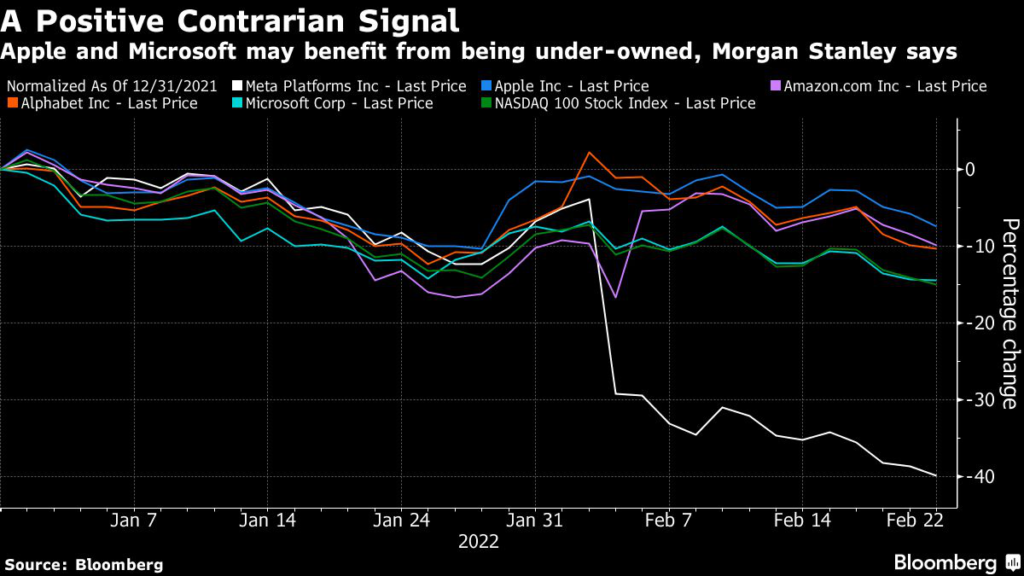
The data is a reason to be slightly more bullish on big tech, according to Morgan Stanley, as stocks with relatively low institutional ownership tend to gain over the next quarter. The thinking is that bearishness is a contrarian buy signal: Investors will come rushing back in at the first sign of a stabilization or recovery in share prices, out of fear of underperforming the market.

“Investors have both the means and the opportunity to buy tech today,” said Ben Laidler, global market strategist at brokerage eToro. The strongest tech names are now cheaper and offer stronger than expected profit growth, he said.

In the top 100 actively managed institutional portfolios, five bellwether companies — Apple, Amazon.com, Microsoft Corp. Alphabet Inc. and Meta Platforms Inc. — are all under-owned relative to their weight in the S&P 500, Morgan Stanley analysts including Katy Huberty found in a review of regulatory filings. Funds on average hold 0.8 percentage point less of the stocks than their weighting in the benchmark, the firm said. 

Morgan Stanley’s findings add to the evidence that investors are sitting on plenty of fuel to drive a rebound in big tech. A Bank of America Corp. survey of fund managers this month found that their allocation to the sector has dropped to its lowest since August 2006.

The sector has been pressured by rising interest rates as investors priced in tighter monetary policy from the Federal Reserve, with the tech-heavy Nasdaq 100 Index down 14% this year. While Facebook parent Meta is by far the worst performer among the big names, crashing in the wake of a disappointing earnings report, the weakness has been widespread. Microsoft is down 14% this year, while Alphabet is down nearly 10%.

The group rose on Wednesday, with Apple up 0.4%, Microsoft gaining 0.6%, Amazon up 0.2%, and Alphabet up 0.9%. Meta gained 1.2%. 

“Sentiment is clearly negative, but following this across-the-board selloff, we are significantly more upbeat about the opportunities in the group,” said David Katz, chief investment officer at Matrix Asset Advisors. He named Apple, Microsoft, Alphabet, and Meta as names with strong prospects that look oversold.

Plenty of investors will look at the data and decide it’s still not worth the risk to invest in some of these companies, such as Meta, given the challenges they’re facing. And Morgan Stanley points out that it’s only megacap tech that’s underowned; funds are overweight the rest of big-cap tech by 0.3 percentage points on average.

Getting the timing right might be tricky too. Savita Subramanian, head of U.S. equity and quantitative strategy at BofA Securities, said this week she’s hesitant about the sector, writing that it was in “growth purgatory,” as opposed to a “dirt cheap, buy everything” environment. 

In a report Tuesday, she posed the question of when investors should buy all of tech, and answered by saying they should wait until “everyone stops asking” when to buy. 

“Before that it might be a falling knife or dead money,” she wrote.

Tech Chart of the Day

The NYSE Fang+ Index, home to the likes of Apple, Amazon and Alibaba Group Holding Ltd., is nearing a 10% drop for the month. If losses hold, it will be the biggest monthly decline since March 2020, when Covid-19 wreaked havoc in financial markets.

Top Tech Stories

  • Alibaba faces a wild ride over the next few days, with options pricing pointing to huge swings in the stock as investors brace for a drop in earnings and further regulatory scrutiny
    • Alibaba discussed raising at least $1 billion for Lazada before calling off negotiations with potential investors when talks bogged down over the Southeast Asian online mall’s valuation
  • Lenovo quarterly earnings beat analysts’ estimates after the world’s largest maker of personal computers maintained its lead over HP Inc. during the year-end holiday season
  • Activision will delay a Call of Duty game that had been planned for next year, the first time the franchise will be without an annual mainline release in nearly two decades, according to people familiar with the plan
  • Hong Kong is considering easing some listing requirements for large, advanced technology firms that are currently not eligible in an effort to help them meet capital needs for research and development, according to the city’s top financial official
  • Micron Technology, the biggest maker of computer memory chips in the U.S., said some of the gases used in the production of chips comes from Ukraine, which the U.S. says Russia is invading


(Updates prices to reflect market open.)

More stories like this are available on bloomberg.com

©2022 Bloomberg L.P.

Highlights of South Africa’s 2022 Annual Budget

Below are the highlights of South Africa’s 2022 annual budget released by Finance Minister Enoch Godongwana in Cape Town on Wednesday. The budget continues last year’s shift to more market-friendly policies, with windfall revenue partly from a commodities boom used to reduce taxes and the deficit Forecasts The consolidated budget shortfall is forecast at 5.7% …

Highlights of South Africa’s 2022 Annual Budget Read More »

Winners and Losers: Who Pays and Who Gains in South Africa’s Budget

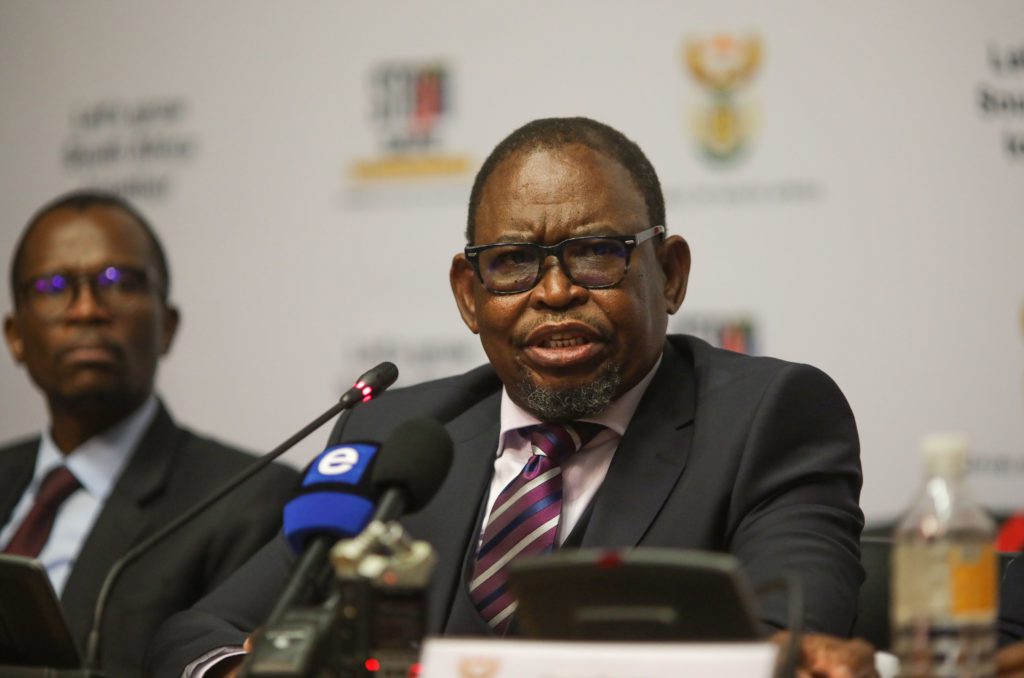
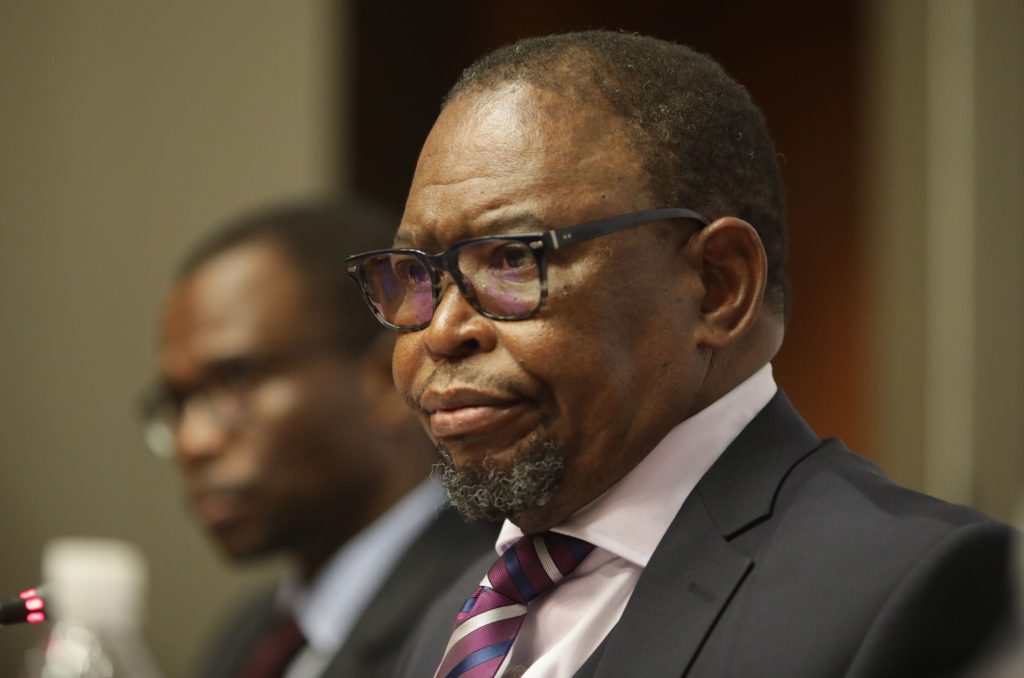
(Bloomberg) — South Africa’s Finance Minister Enoch Godongwana, six months into the job, presented a budget that backs up President Cyril Ramaphosa’s focus on businesses in a bid to add jobs.  The minister announced some tax relief to boost investment and consumer spending, which should help stimulate the economy. However, he had to balance that …

Winners and Losers: Who Pays and Who Gains in South Africa’s Budget Read More »

Aramco Closes $15.5 Billion BlackRock-Led Gas Pipeline Deal

(Bloomberg) — Saudi Aramco closed a deal to sell a stake in its natural-gas pipelines for $15.5 billion and entered into a pact with BlackRock Inc. to explore low carbon energy projects.

An investor group, led by BlackRock, acquired a 49% stake in Aramco Gas Pipelines Co. in a lease and leaseback deal in December, according to a statement. The consortium also comprised Keppel Infrastructure Trust, Silk Road Fund, China Merchants Capital, and Saudi Arabia’s state-owned Hassana Investment Co.

BlackRock’s investment comes even as Chief Executive Officer Larry Fink puts pressure on firms to boost environmental, social and governance, or ESG, standards. Gas is a cleaner fuel than crude oil but still contributes to heating the plant.

“Getting to a net zero world will not happen overnight,” Fink said in the statement. “It requires us to shift the energy mix in incremental steps to achieve a green energy future. Bold, forward-thinking incumbents like Aramco have the technical expertise and capital to play a crucial role in this transformation.”

The 20-year arrangement “represents further progress in Aramco’s portfolio optimization program and highlights the strong investment opportunities presented by Aramco’s significant infrastructure assets,” according to the statement.

  • BlackRock Co-Leads $15.5 Billion Aramco Gas Pipelines Deal

The deal is part of Saudi Arabia’s drive to sell assets and use the money to fund new industries from artificial intelligence to electric vehicles, while also increasing output of both oil and gas. In a similarly-structured transaction in April, Aramco sold a $12.4 billion stake related to its oil pipelines to investors including Washington-based EIG.

More stories like this are available on bloomberg.com

©2022 Bloomberg L.P.
Close Bitnami banner
Bitnami