Bloomberg

South Africa Extends Incentives Period to Cut Carbon Emissions

(Bloomberg) — South Africa will extend the first phase of its carbon tax by three years, enabling companies to continue benefiting from tax‐free allowances and revenue‐recycling initiatives as the country prepares to accelerate its transition toward a zero-emissions economy by 2050. Other measures to encourage a move away from carbon emissions, such as an energy‐efficiency‐savings …

South Africa Extends Incentives Period to Cut Carbon Emissions Read More »

South Africa’s Godongwana Cuts Taxes, Debt With Revenue Windfall

(Bloomberg) — South Africa cut corporate taxes and set more ambitious targets for reducing debt, after a surge in commodity prices led to higher-than-expected tax income. Finance Minister Enoch Godongwana announced a 1 percentage point reduction in the company tax rate to 27% from April and stuck to pledges to rein in pay for civil …

South Africa’s Godongwana Cuts Taxes, Debt With Revenue Windfall Read More »

Banks That Stuck With Russia Face Their Biggest Test of Nerve

(Bloomberg) — Russia’s annexation of Crimea in 2014 was the moment when many global banks sharply cut their exposure to Vladimir Putin’s regime. But firms from some European nations weren’t put off for long.

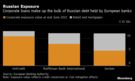
Enticed by the profits on offer, lenders from Italy and Austria have actually increased their combined business in Russia since the start of 2015, according to data from the Bank for International Settlements compiled by Bloomberg Intelligence. French banks have reduced their Russian loans over the same period, but Societe Generale SA still has a significant presence in the country.

Italy’s UniCredit SpA and Austria’s Raiffeisen Bank International AG are the other European banks with the biggest Russian operations. Between 2017 and the first half of 2021, Raiffeisen and SocGen increased their loans to Russian retail and corporate clients, while UniCredit lowered them slightly.

After Putin this week recognized two self-proclaimed separatist republics in eastern Ukraine, those local businesses of SocGen, UniCredit and Raiffeisen look increasingly exposed to the knock-on effects of financial retaliation. On Tuesday President Joe Biden unveiled measures targeting two of Russia’s largest financial institutions, VEB.RF and its military bank. The Kremlin denies it has plans to invade Ukraine.

Previous decisions by Deutsche Bank AG, Finland’s Nordea Bank Abp and others to retrench in Russia may have been prudent. Deutsche Bank’s credit exposure there was 7.9 billion euros ($9 billion) in 2012 but that had fallen almost 70% by the end of 2016 after it shuttered a securities unit amid a money-laundering scandal. Morgan Stanley gave up its Russian banking license in 2019.

“Putin has laid a marker down,” said Jon Corzine, who ran Goldman Sachs Group Inc. until 1999, became a U.S. senator and now runs a hedge fund. “That will make it very difficult to have any confidence in doing any serious business there for a very long period of time for most U.S. and western investors.”

SocGen boss Frederic Oudea told staff on Friday that U.S. banks had approached his firm for possible help managing Russian financial transactions in the event of fresh sanctions, according to Bloomberg News. But his comments came before Putin’s dramatic escalation on Monday.

Read More: Wall Street Firms Approach SocGen to Manage Russia Transactions

At least two Wall Street banks have poured cold water on the idea that they’d seek a workaround to any Russia bar, according to people familiar with the firms who preferred to remain anonymous. Most large U.S. lenders have only a small exposure to Russia now so the direct effect of sanctions would be limited, the people said.

Of greater concern will be the broader impact of the crisis on financial markets and any harm to trading. Investment banks are worried about the effect of sanctions on futures linked to Russian oil and gas, or credit-default swaps on Russian debt, according to Danforth Newcomb, counsel at law firm Shearman & Sterling. Several senior bankers say there’s fear, too, about retaliatory cyberattacks on U.S. finance firms by Kremlin-linked hackers.

Firms whose wealth managers have dealings with Russian elites and family members will worry more about a potential next tranche of sanctions that targets private banks. “We have exercised a lot of care and diligence on on-boarding Russian entities and Russian clients,” Barclays Plc’s chief executive officer, C.S. Venkatakrishnan, said on Wednesday.

Direct Presence

Citigroup Inc. is the New York bank with the largest Russian direct presence. However, its $5.5 billion worth of loans, investment securities and other assets tied to the country were just 0.3% of the group total at the end of the third quarter, and it plans to exit retail banking there.

The Russian businesses of SocGen, UniCredit and Raiffeisen are much bigger, European Banking Authority data show.

Russia’s chief attraction is the profit on offer, especially for European firms whose margins have been squeezed elsewhere. At the December unveiling of CEO Andrea Orcel’s new strategy for UniCredit, the bank said Eastern Europe, including Russia, would have the highest profitability of any of its regions. Orcel, who has 4,000 staff in Russia, did due diligence on taking over Russian lender Otkritie Bank FC but the Ukraine situation made it untenable.

In a 2019 presentation SocGen highlighted Russia’s attractions as a fast-growing market for retail and digital banking, where revenues were expanding by 9% a year. This could all be made moot by political risk.

Austria’s Raiffeisen leans heavily on Russia. It has about 11.6 billion euros of its loans there (11% of its total) and makes more than 30% of its pretax profit there, Bloomberg Intelligence says. Shares in Raiffeisen, which has set aside money for Russian loans going bad, have dropped more than 13% this week.

UniCredit’s and SocGen’s loans to Russia represent less than 2% of their books, limiting risk. While the European Central Bank has urged lenders to prepare for the crisis fallout, it acknowledges that European banks’ retail operations in Russia and Ukraine often rely on local funding, making them less vulnerable to cross-border retaliatory measures.

Nevertheless, the ECB is working with lenders active in Russia to assess risks to their liquidity, loan books, trading and currency positions as well as their ability to keep operations running, according to people familiar. The regulator’s most pressing challenge is making sure banks properly enforce sanctions.

SocGen, which operates in Russia through its Rosbank PJSC unit, has got this kind of thing wrong before. In 2018 it had to pay $1.3 billion for violating U.S. sanctions laws against Cuba, Iran and Sudan. It isn’t alone. Since late 2009, 11 major European banks have paid more than $19.6 billion in fines and settlements with U.S. authorities over sanctions violations and weak money-laundering controls, according to Bloomberg Intelligence.

For now the European lenders appear sanguine about the first wave of new sanctions. One bank executive said his international firm has seen an increase in Russian deposits as clients move funds from state-owned banks.

SocGen said it “continues to operate in a normal manner within the existing oversight framework.” UniCredit is assessing the new sanctions. “We’ve gone through a number of successive iterations of sanctions and ups and downs,” Orcel said last month.

Raiffeisen CEO Johann Strobl was even more phlegmatic on his bank’s February earnings call: “We have, over the years, unfortunately got quite a lot of experience how to deal with sanctions.”

(Updates with details of ECB’s risk assessments in fifth from last paragraph.)

More stories like this are available on bloomberg.com

©2022 Bloomberg L.P.

EU Unveils Rules to Force Firms to Share Product Usage Data

(Bloomberg) — The European Union unveiled new rules that will make it easier for users to transfer data generated from products like Amazon.com Inc.’s Alexa or a Tesla Inc. vehicle.

The European Commission’s Data Act will set rules on how companies can access so-called non-personal data, or data that does not contain any information that identifies an individual. The proposal will impact a wide variety of sources, including information collected in machinery and connected devices, such as smart home appliances. 

For example, under the new rules, the driver of a car could request that any data generated on the performance of the vehicle be sent to a repair shop of their choice. This could help customers get cheaper services rather than being obligated to go directly to the car company, according to the commission.

Cloud service companies such as Amazon and Microsoft Corp. will also be forced to make it easier to switch between providers. 

The proposal will help smaller businesses so “they don’t have all their data sucked away from them by big companies,” Thierry Breton, the EU’s internal market chief, said at a press conference on Wednesday. It will give users more control of their data so it’s not “held captive by a given supplier,” he said.

The commission’s competition chief, Margrethe Vestager, added that “it also boosts competition by allowing more companies to offer their services.”

The proposal will now go to EU countries and the European Parliament for approval but could take years to go into effect. 

Companies are already concerned that the new rules would hurt non-EU businesses and make data flows with the EU more difficult. Very large tech companies like Google are unlikely to benefit from the easing of data transfers, according to the proposal.

“The Data Act will serve the EU’s digital ambitions if it protects confidential business information, treats all companies equally, and avoids creating new data flow restrictions,” said Alexandre Roure, public policy director at ​​the Computer and Communications Industry Association.

The proposal also lays out news rules stating:

  • Companies are prohibited from unfair contracts that inhibit sharing data with smaller companies
  • Companies must make data available to the public sector in emergencies
  • Firms must allow users of connected devices access to data generated by them

European regulators have been steadily laying down stricter rules over how companies handle user data. The Irish data protection authority is currently considering the legality of a contract that allows firms to ship vast amounts of commercial data across the Atlantic.

The Data Act will also ask firms to introduce safeguards to stop non-EU governments from accessing data, and force firms to allow users to transfer data between cloud providers at no additional cost.

“Regulation should not institute conflicts of laws nor create obstacles to data transfers,” Emilie Petras-Sohie, IBM Europe’s senior legal and policy manager, said in a statement. “And cloud switching requirements should strike the right balance between avoiding vendor lock-in and allowing cloud providers to offer innovative services.”

(Updates with quotes in fifth, sixth paragraphs.)

More stories like this are available on bloomberg.com

©2022 Bloomberg L.P.

Microsoft Wants to Secure All Your Clouds, Including Amazon and Google

(Bloomberg) — Microsoft Corp. is expanding its product for finding and monitoring security weak spots in cloud-computing to include rival Alphabet Inc.’s Google Cloud Platform.

Microsoft Defender for Cloud will include support for Google Cloud starting Wednesday, three months after adding support for Amazon’s market leading products. Microsoft, which sells the rival Azure, used open programming interfaces to hook into its competitors’ products, Google Cloud and Amazon Web Services and provide its cybersecurity services.

Customers increasingly use multiple cloud platforms and have different products to secure and monitor them.  There are so many different products from cybersecurity companies, as well as Microsoft, Amazon and Google, that it can be difficult for security professionals to keep track of them. Hackers can target their attacks at the seams of different cybersecurity products, said Vasu Jakkal, Microsoft vice president of security, compliance and identity, in an interview.With damaging cyberattacks on the rise, Microsoft is hoping to make it simpler and better protect customers. 

“Today most of our customers have AWS and they have Azure and they have Google Cloud and they have different workloads around and then they have security solutions which are native to each of these,” she said. “Think about the security practitioners sitting in a Security Operations Center looking at these alerts in this pane of glass — they’re dealing with three if not more.”

While Microsoft didn’t work directly with its competitors  to build the product, the company generally views security as an area where it wants to work with rivals to secure mutual customers, Jakkal said. In a recent Microsoft survey, 83% of business leaders listed “managing multicloud complexity as their biggest pain point in 2022.” 

Microsoft is trying to bulk up its security software business along with tracking attacks and helping customers respond. Last year, the software giant acquired several smaller security firms, and the company said last month that it had amassed $15 billion in security software sales in 2021, up almost 45% from a year earlier. Microsoft last year named former Amazon.com Inc. cloud executive Charlie Bell to oversee its security efforts, and said it had 3,500 employees working to safeguard customers “from the chip to the cloud.”


More stories like this are available on bloomberg.com

©2022 Bloomberg L.P.

Zoom Unveils New Call Center Product After Failed Five9 Deal

(Bloomberg) — Zoom Video Communications Inc. unveiled an updated product aimed at enhancing customer support for businesses after a failed $14.7 billion bid last year for now rival call center software vendor Five9 Inc. 

The release of Zoom Contact Center on Wednesday is the latest move by the company to expand beyond its video conferencing platform that surged in use during the pandemic and helped solidify Zoom as one of the most well-known names in enterprise software. However, investors remain concerned over how the company plans to capitalize on the huge growth in sales. 

The updated call center product propels Zoom further into a highly competitive market focused on helping businesses connect with customers across different channels — from phone calls with a live agent to web-based chat tools — and ultimately provide more tailored service. 

“The big value is the way it will work in conjunction with our other services,” said Chief Product Officer Oded Gal. “Moving forward, the idea is to expand the services that we provide in these companies so they can rely on us for more.” 

Zoom is counting on its reputation as a top video conferencing software provider as a differentiator. The revamped call center product infuses its signature technology alongside more standard features, like an agent assistance dashboard to help support specialists respond to customer inquiries and improved routing to help funnel calls to the most appropriate experts, the San Jose, California-based company said in a statement. For example, video-based support could prove a key lifeline if an individual has an urgent medical question. 

“We’re not going to support only the vanilla use cases for contact centers, like a support agent or a sales call. If you think about a tele-health use case, it is a type of contact center,” said Gal.

While it has been diversifying its product portfolio, Zoom has struggled to convince Wall Street it can sustain the momentum gained during the initial period of the pandemic when businesses relied on the vendor to buttress an overnight pivot to a remote workforce. 

The stock has been on a near constant decline after reaching a high of $568.34 in October 2020. The shares closed at $126.61 Tuesday in New York and have dropped 31% this year. 

The updated customer service product was called the Zoom Video Engagement Center while it was in development. Future releases will include text and web chat capabilities, as well as integrations with other standalone applications, like customer relationship management software, which other vendors already provide. At launch, the call center product will support as many as 50 agents, which will likely preclude most large organizations from switching immediately. Notably, Zoom said it will continue to uphold existing partnerships with call center software vendors like Genesys Cloud Services Inc. 

Alongside the call center product, Zoom has also seen momentum for its cloud-based replacement to landline telephones. While the company doesn’t break out specific sales figures for Zoom Phone, Chief Financial Officer Kelly Steckelberg previously told analysts that revenue grew triple-digits year-over-year in the three months through October. And in anticipation of the evolving hybrid work model, Zoom has also introduced products tailored to helping businesses bridge the communications gap between in-office employees and those that continue to work remotely, like Zoom Rooms. 

Collectively, the products push Zoom toward its vision as a one-stop shop for key consumer and employee communications tools.

More stories like this are available on bloomberg.com

©2022 Bloomberg L.P.
Crypto Industry Masters Washington’s ‘Revolving Door’ as Its Influence Grows

(Bloomberg) — People are increasingly moving between jobs in crypto and the government agencies that police the industry, raising potential conflicts of interest that could undermine efforts to rein in the sector, according to a watchdog group. 

There have been nearly 240 instances of crypto’s so-called revolving door, where employees leave the government for the private sector and vice versa, according to a new report by the Tech Transparency Project. 

Dozens of former top officials from the Securities and Exchange Commission to the White House are now employed by or are working on behalf of companies such as Coinbase Global Inc., Binance Holdings Ltd., and Ripple Labs Inc., the analysis found. Key instances of people taking jobs in government include five individuals who left Circle Internet Financial to join the Federal Reserve Bank of Boston, which has taken a leading role as officials weigh a central bank digital currency. 

“The hiring binge creates a risk that the industry will undermine the foundational rules that will govern” the industry, the report’s authors wrote. “Faced with mounting legal and regulatory pressure in Washington, the cryptocurrency industry has turbocharged its D.C. lobbying machine.” 

Employing former regulators has been common for years on Wall Street and in other industries, and another sign of crypto’s maturing influence in Washington. Digital asset companies are bracing for an onslaught of regulatory and enforcement actions, pouring money into lobbying efforts to curb new rules. 

By hiring political insiders, crypto firms could avoid tougher regulation, the report said. Some 32 former White House officials have left to work in the industry and there are at least 78 examples of people moving between agencies that directly regulate finance companies.  

Circle, which issues the second-largest stablecoin, is seeking regulatory approval for a number of things including a bank charter. The Boston Fed recently published research about a possible U.S. digital dollar. 

A spokesman for the Boston Fed said it has been important to bring on talented technology experts from multiple organizations and a Binance representative said it was “paramount that we tapped the brightest and most experienced compliance professionals on the planet.” Circle said its alumni network includes people in public service like other companies. 

The report analyzed data from 2012 to 2021, including positions at regulators, the White House and Congress. Researchers at TTP, which is part of a larger group, Campaign for Accountability, based their calculations on crypto firm employees as well as lawyers, lobbyists and others working on behalf of companies.  

More stories like this are available on bloomberg.com

©2022 Bloomberg L.P.

South Africa Slows a Carbon-Tax Rollout That Eskom Feared

(Bloomberg) — Sign up to our Next Africa newsletter and follow Bloomberg Africa on Twitter

South Africa will extend the first phase of its carbon tax plan by three years, which could delay an increase in rates for companies including its coal-reliant state power utility.

Eskom Holdings SOC Ltd. has estimated an annual carbon-tax bill of around 11.5 billion rand ($763 million) when exemptions run out at what was supposed to be the start of the program’s planned second phase in 2023. The initial period will now be extended to the end of 2025, according to the budget review presented by Finance Minister Enoch Godongwana on Wednesday.

“The transitional support measures afforded to companies in the first phase, such as significant tax-free allowances” will continue, the National Treasury said in the budget document. Those will be gradually reduced through the four years from 2026.

The delay in implementing higher charges jars with South Africa’s adoption of a significantly lower carbon emission target ahead of last year’s COP26 climate conference and its ambition to reach net-zero status by 2050. Still, it may lead to a reduction in Eskom’s proposed increase in power prices, which could curb inflation.

The projected cost of the carbon tax accounted for a significant share of Eskom’s proposed 21% tariff increase for 2022-2023, according to a recent presentation by the company. The company didn’t immediately respond to a request for comment. Eskom accounts for about two fifths of South Africa’s emissions of climate-warming gases and the country is the world’s 12th biggest emitter.

Carbon Price

The government proposed an increase in the carbon price of at least $1 every year to reach $20 per ton of carbon dioxide equivalent by 2026, with costs to climb more rapidly thereafter. By 2030 it is expected to be $30 per ton and as much as $120 after 2050.

The National Treasury also made the following proposals:

  • A carbon budgeting system will become mandatory from Jan. 1 and emissions that exceed the budget will be penalized
  • A carbon offset allowance will be increased by 5% from January 2026 to encourage investments in such projects
  • A plastic bag levy to be increased by 12% and the government will investigate plastic tax and a duty on single‐use plastics
  • A vehicle-emissions tax rate and levy on incandescent light bulbs will be increased
  • Measures to regulate electricity-intensive crypto mining, which is environmentally harmful, are being considered


More stories like this are available on bloomberg.com

©2022 Bloomberg L.P.

Porsche IPO Prospect Lifts Volkswagen Investors’ Spirts

(Bloomberg) —

Finally.

This sums up how Volkswagen investors seem to be reacting to Europe’s biggest carmaker announcing it’s preparing an initial public offering of Porsche. Speculation that VW would list its most lucrative asset has been swirling for years, but progress toward this actually taking place sent preference shares rising the most since December. The stock is adding to those gains Wednesday.

The IPO could come as soon as the second half of the year, people familiar with the deliberations told my colleagues Christoph Rauwald and Monica Raymunt. Bloomberg Intelligence estimates Porsche could be worth as much as 85 billion euros ($96 billion), generating significant value for shareholders thanks to top-tier margins and popular electric offerings.

The initiative is code-named “Phoenix,” the people said, a nod to the immortal bird in Greek mythology that regenerates and rises from the ashes of its predecessor. That’s pretty fitting, since the powerful Porsche-Piech family that partly controls VW more than a decade ago tried to have Porsche take over the far-larger manufacturer, only for VW to then turn the tables and gobble up the maker of the 911 sports car.

The move to set Porsche free again is a sign of the upheaval that has gripped the auto industry as it speeds toward electrification. Several carmakers and parts suppliers are considering structural shake-ups to excite investors.

Ford is looking at ways to separate its EV operations from the company’s legacy internal combustion engine business, Bloomberg reported last week. Daimler spun off its trucks business last year to allow Mercedes-Benz to better focus on electrifying its passenger cars. Aptiv has undergone a dramatic reinvention since the auto supplier spun off by pre-bankruptcy General Motors went through its own restructuring. It’s emerged as a Wall Street darling positioned to support electrification and advanced driver assistance systems.

VW Chief Executive Officer Herbert Diess has tried for years to untangle the company’s convoluted conglomerate structure, arguing a lack of agility is impeding efforts to catch up with and eventually bypass Tesla on EVs, software and self-driving technology.

Diess created considerable excitement last March by detailing a massive EV and battery-making push, but those efforts have sputtered somewhat. VW has had a tough time sourcing enough semiconductors, which has hampered output. On the electric front, the Tesla Model 3 and Renault Zoe both outsold VW’s ID.3 and ID.4 models in Europe last year. 

On top of that, the IPO of VW’s Traton truckmaking unit fizzled largely due to infighting and a limited free float, while an attempt to separate the Lamborghini supercar and Ducati motorcycle brands didn’t pass muster.

Porsche presents a golden opportunity for Diess to change the narrative. The division sold more cars than ever in 2021, with sales of the fully electric Taycan more than doubling and overtaking the iconic 911 for the first time. The brand will have five versions of the Taycan on offer from mid-March and plans to introduce a battery-powered version of the Macan compact SUV in 2023.

Of course, a Porsche IPO won’t be a walk in the park. VW’s 20-member supervisory board is composed of factions notorious for conflicting interests. Worker representatives, who account for half the seats, are often aligned with two officials from the German state of Lower Saxony who tend to want to protect jobs. Pleasing the powerful Porsche-Piech clan while making sure that losing its prime asset won’t turn VW into a “bad bank” of sorts will be a difficult tightrope for Diess to walk.

For the time being, at least, the advanced negotiations VW and its top investor are having are reason for optimism.

“We think a Porsche IPO, which has been a hot topic of discussion for years, is now more of a possibility of actually happening than ever before,” RBC analyst Tom Narayan said in a note.

More stories like this are available on bloomberg.com

©2022 Bloomberg L.P.

Porsche IPO Prospect Lifts Volkswagen Investors’ Spirits

(Bloomberg) —

Finally.

This sums up how Volkswagen investors seem to be reacting to Europe’s biggest carmaker announcing it’s preparing an initial public offering of Porsche. Speculation that VW would list its most lucrative asset has been swirling for years, but progress toward this actually taking place sent preference shares rising the most since December. The stock is adding to those gains Wednesday.

The IPO could come as soon as the second half of the year, people familiar with the deliberations told my colleagues Christoph Rauwald and Monica Raymunt. Bloomberg Intelligence estimates Porsche could be worth as much as 85 billion euros ($96 billion), generating significant value for shareholders thanks to top-tier margins and popular electric offerings.

The initiative is code-named “Phoenix,” the people said, a nod to the immortal bird in Greek mythology that regenerates and rises from the ashes of its predecessor. That’s pretty fitting, since the powerful Porsche-Piech family that partly controls VW more than a decade ago tried to have Porsche take over the far-larger manufacturer, only for VW to then turn the tables and gobble up the maker of the 911 sports car.

The move to set Porsche free again is a sign of the upheaval that has gripped the auto industry as it speeds toward electrification. Several carmakers and parts suppliers are considering structural shake-ups to excite investors.

Ford is looking at ways to separate its EV operations from the company’s legacy internal combustion engine business, Bloomberg reported last week. Daimler spun off its trucks business last year to allow Mercedes-Benz to better focus on electrifying its passenger cars. Aptiv has undergone a dramatic reinvention since the auto supplier spun off by pre-bankruptcy General Motors went through its own restructuring. It’s emerged as a Wall Street darling positioned to support electrification and advanced driver assistance systems.

VW Chief Executive Officer Herbert Diess has tried for years to untangle the company’s convoluted conglomerate structure, arguing a lack of agility is impeding efforts to catch up with and eventually bypass Tesla on EVs, software and self-driving technology.

Diess created considerable excitement last March by detailing a massive EV and battery-making push, but those efforts have sputtered somewhat. VW has had a tough time sourcing enough semiconductors, which has hampered output. On the electric front, the Tesla Model 3 and Renault Zoe both outsold VW’s ID.3 and ID.4 models in Europe last year. 

On top of that, the IPO of VW’s Traton truckmaking unit fizzled largely due to infighting and a limited free float, while an attempt to separate the Lamborghini supercar and Ducati motorcycle brands didn’t pass muster.

Porsche presents a golden opportunity for Diess to change the narrative. The division sold more cars than ever in 2021, with sales of the fully electric Taycan more than doubling and overtaking the iconic 911 for the first time. The brand will have five versions of the Taycan on offer from mid-March and plans to introduce a battery-powered version of the Macan compact SUV in 2023.

Of course, a Porsche IPO won’t be a walk in the park. VW’s 20-member supervisory board is composed of factions notorious for conflicting interests. Worker representatives, who account for half the seats, are often aligned with two officials from the German state of Lower Saxony who tend to want to protect jobs. Pleasing the powerful Porsche-Piech clan while making sure that losing its prime asset won’t turn VW into a “bad bank” of sorts will be a difficult tightrope for Diess to walk.

For the time being, at least, the advanced negotiations VW and its top investor are having are reason for optimism.

“We think a Porsche IPO, which has been a hot topic of discussion for years, is now more of a possibility of actually happening than ever before,” RBC analyst Tom Narayan said in a note.

More stories like this are available on bloomberg.com

©2022 Bloomberg L.P.

Close Bitnami banner
Bitnami