Bloomberg

Grubhub Is Launching a Rapid Delivery Service in Partnership With Startup Buyk

(Bloomberg) — Grubhub is launching a new rapid delivery service, joining rival DoorDash Inc. in the competitive race to get products to people’s doors in record time.

The Just Eat Takeaway.com NV subsidiary is teaming up with quick commerce startup Buyk to offer grocery and convenience items as well as Buyk’s private label products from Grubhub’s marketplace with delivery promised in 15 minutes or less.

The service will start in more than 30 locations in New York and Chicago and Buyk, which employs couriers on a full-time basis, will handle picking, packing and delivery of orders, the companies said Wednesday.

“We interviewed a lot of instant grocery convenience players,” Grubhub Chief Operating Officer Eric Ferguson said in an interview. “Our large goal was to find one that resonated with our diners but also one that’s best-in-class from a logistics perspective.”

The partnership, which is not exclusive, is one of several ways Grubhub is looking to cut down delivery times and break into new categories, Ferguson said.

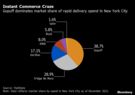
The pandemic turbocharged demand for delivery of everything from restaurant meals to groceries and redefined consumers expectations for convenience. A crop of ultrafast grocers including Gopuff, Gorillas, JOKR and Fridge No More, ferry goods to doorsteps in as little as 10 minutes by relying on a network of warehouses, or dark stores, that carry a limited number of items for a smaller delivery radius. In the last year, New York City has become the epicenter of competition in rapid delivery with Gopuff leading the sector with 39% share, according to market intelligence firm YipitData.

The competition has spurred food-delivery incumbents like Grubhub to build ultrafast services of their own. In December, DoorDash opened a dark store for a pilot in New York. 

Buyk, whose founders also started Samokat, one of the largest instant grocery-delivery services in Russia, launched in the U.S. in June. The majority of its 38 dark stores are in New York, but the startup expanded to Chicago this year. 

Buyk will benefit from the partnership by capturing Grubhub’s millions of users to sell its range of private label products, which rolled out in January. Instant commerce rival Gopuff also offers its own brand of food and other household goods.

“Our private label is doing phenomenally well,” said Buyk Chief Executive Officer James Walker. “What Grubhub does is give us greater exposure to their network and customers.”

More stories like this are available on bloomberg.com

©2022 Bloomberg L.P.
Target to Test Starbucks Coffee Option in Curbside Pickup Lanes

(Bloomberg) — Target Corp. asked shoppers how it could improve its curbside-pickup option, and their response was clear: We want coffee. 

To that end, the retailer will start offering Starbucks Corp. products later this year for customers of its “Drive Up” service. A test is likely to begin this fall in Target’s hometown of Minneapolis and a second city that executives are still choosing. That will be followed by a broader rollout. 

“What they told us was that the No. 1 thing they wanted was Starbucks,” said Mark Schindele, Target’s chief stores officer, in an interview. 

The move is part of Target’s efforts to expand its same-day services centered around stores, which have helped the company’s digital sales more than double during the last two years. Customers using services such as curbside pickup, in-store pickup and same-day delivery with Shipt spend on average four times as much as store-only shoppers, Target said. 

Customers using the Drive Up service will now also be able to return items starting later this year with the Target app, according to a company statement Wednesday. 

As part of a longstanding partnership, Target has offered Starbucks drinks and cafe areas in its stores for years. Target employees will start testing curbside-pickup orders of Starbucks products this summer before the formal rollout, Schindele said.  

“Many of our Drive Up guest are parents, they may have their kids in the car, they may not have time, maybe they’re on their way to the kids’ soccer game,” he said. “They’ve told us, ‘You would make our lives easier if you do this.’”

More stories like this are available on bloomberg.com

©2022 Bloomberg L.P.

Target Bets on Bringing You Coffee With Your Groceries

(Bloomberg) — Target Corp. asked shoppers how it could improve its curbside-pickup option, and their response was clear: We want coffee. 

To that end, the retailer will start offering Starbucks Corp. products later this year for customers of its “Drive Up” service. A test is likely to begin this fall in Target’s hometown of Minneapolis and a second city that executives are still choosing. That will be followed by a broader rollout. 

“What they told us was that the No. 1 thing they wanted was Starbucks,” said Mark Schindele, Target’s chief stores officer, in an interview. 

The move is part of Target’s efforts to expand its same-day services centered around stores, which have helped the company’s digital sales more than double during the last two years. Customers using services such as curbside pickup, in-store pickup and same-day delivery with Shipt spend on average four times as much as store-only shoppers, Target said. 

Customers using the Drive Up service will now also be able to return items starting later this year with the Target app, according to a company statement Wednesday. 

As part of a longstanding partnership, Target has offered Starbucks drinks and cafe areas in its stores for years. Target employees will start testing curbside-pickup orders of Starbucks products this summer before the formal rollout, Schindele said.  

“Many of our Drive Up guest are parents, they may have their kids in the car, they may not have time, maybe they’re on their way to the kids’ soccer game,” he said. “They’ve told us, ‘You would make our lives easier if you do this.’”

More stories like this are available on bloomberg.com

©2022 Bloomberg L.P.

OpenSea NFT Heist Likely Triggers Drop in Activity

(Bloomberg) — Activity on OpenSea, the world’s largest marketplace for digital collectibles, likely dropped precipitously after a phishing attack that saw traders lose as much as an estimated $3 million.

Trading in nonfungible tokens plummeted in recent days, according to data provider DappRadar. OpenSea’s seven-day trading volume was down 37% as of Tuesday, DappRadar found. 

An unidentified hacker stole 254 tokens from OpenSea users by sending a malicious email asking to transfer their assets to a new contract. Around 17 traders signed the contract, which effectively acted as a blank check, giving the hacker access to all of the NFTs stored on their wallet. 

Some of those assets have since been sold, netting the perpetrator a hefty gain. Devin Finzer, OpenSea’s chief executive officer, valued the total amount stolen at $1.7 million on Sunday, but researchers since have valued the pile at anywhere between $2 million and $3 million. Among the stolen NFTs included four Bored Apes, three of which were later sold on rival platform LooksRare for a combined $667,000, according to data from blockchain security service PeckShield.

The number of traders using OpenSea dropped by 19%, to about 227,272 over the seven days ended Tuesday, per DappRadar. Over that period, trading volume on LooksRare plunged nearly 65%, while volume on BloctoBay rose by more than 215%, according to DappRadar.

OpenSea disputed the data provided by DappRadar, adding in a statement: “For more accurate and complete data, please refer to Dune Analytics.”

OpenSea said on Monday that the attacker’s crypto wallet has gone quiet since the theft, with no transaction activity spotted in the last 24 hours. 

The marketplace’s Chief Technology Officer Nadav Hollander said the incident demonstrated a need for more awareness about the security issues surrounding off-chain signatures among NFT traders. There were no flaws found in ongoing contract migration by OpenSea that could have caused the attack, but the process opened a window of opportunity for the perpetrator to fool their victims by closely mimicking OpenSea’s communications on the matter.

“Education on not sharing seed phrases or submitting unknown transactions has become more widespread in our space. However, signing off-chain messages requires equal consideration,” said Hollander.   

(Clarifies company comment in the eighth paragraph. An earlier update corrected the spelling of Nadav Hollander’s name.)

More stories like this are available on bloomberg.com

©2022 Bloomberg L.P.
EU Unveils Rules to Force Firms to Hand Over Product Usage Data

(Bloomberg) — The European Union unveiled new rules that will make it easier for users to transfer data generated from products like Amazon.com Inc.’s Alexa or a Tesla Inc. vehicle.

The European Commission’s Data Act will set rules on how companies can access so-called non-personal data, or data that does not contain any information that identifies an individual. The proposal will impact a wide variety of sources, including information collected in machinery and connected devices, such as smart home appliances. 

For example, under the new rules, the driver of a car could request that any data generated on the performance of the vehicle be sent to a repair shop of their choice. This could help customers get cheaper services rather than being obligated to go directly to the car company, according to the commission.

Cloud service companies such as Amazon and Microsoft Corp. will also be forced to make it easier to switch between providers. 

“We want to give consumers and companies even more control over what can be done with their data,” Margrethe Vestager, the commission’s competition chief, said in a statement on Wednesday. 

The proposal will now go to EU countries and the European Parliament for approval but could take years to go into effect. 

Companies are already concerned that the new rules would hurt non-EU businesses and make data flows with the EU more difficult. Very large tech companies like Google are unlikely to benefit from the easing of data transfers, according to the proposal.

“The Data Act will serve the EU’s digital ambitions if it protects confidential business information, treats all companies equally, and avoids creating new data flow restrictions,” said Alexandre Roure, public policy director at ​​the Computer and Communications Industry Association.

The proposal also lays out news rules stating:

  • Companies are prohibited from unfair contracts that inhibit sharing data with smaller companies
  • Companies must make data available to the public sector in emergencies
  • Firms must allow users of connected devices access to data generated by them

European regulators have been steadily laying down stricter rules over how companies handle user data. The Irish data protection authority is currently considering the legality of a contract that allows firms to ship vast amounts of commercial data across the Atlantic.

The Data Act will also ask firms to introduce safeguards to stop non-EU governments from accessing data, and force firms to allow users to transfer data between cloud providers at no additional cost.

“Regulation should not institute conflicts of laws nor create obstacles to data transfers,” Emilie Petras-Sohie, IBM Europe’s senior legal and policy manager, said in a statement. “And cloud switching requirements should strike the right balance between avoiding vendor lock-in and allowing cloud providers to offer innovative services.”

More stories like this are available on bloomberg.com

©2022 Bloomberg L.P.

Five Charts That Show What to Expect From South Africa’s Budget

(Bloomberg) — South African Finance Minister Enoch Godongwana’s efforts to stabilize public finances may be strained by an expansion of the social-welfare net and additional support for the debt-laden state power company when he presents his first annual budget on Wednesday. While higher commodity prices have boosted tax collection and given the former labor unionist …

Five Charts That Show What to Expect From South Africa’s Budget Read More »

South Africa’s Harmony Gold, Naspers Chip In to Fund Political Parties

(Bloomberg) — Some unlikely corporate donors have stumped up to help fund South Africa’s cash-strapped political parties, disclosures released by the Electoral Commission of South Africa show.  Harmony Gold Mining Co. gave 1.1 million rand ($72,000) to the Economic Freedom Fighters, which advocates the nationalization of all mines and land. The nation’s top producer of …

South Africa’s Harmony Gold, Naspers Chip In to Fund Political Parties Read More »

Eskom Considers Selling Assets as Bailout Prospects Fade

(Bloomberg) — Eskom Holdings SOC Ltd., South Africa’s indebted power utility, is considering selling distribution assets as prospects of the government taking over about half of its 392 billion rand ($26 billion) obligations dim, people with knowledge of the matter said.  State-owned Eskom, which supplies almost all of South Africa’s power, has said that it …

Eskom Considers Selling Assets as Bailout Prospects Fade Read More »

Close Bitnami banner
Bitnami