

Bloomberg

Expedia CEO Predicts the ‘Busiest Travel Season Ever’ This Summer

(Bloomberg) — Expedia Group Chief Executive Officer Peter Kern believes that 2023 will be the year that we stop predicting a travel recovery and actually start enjoying it.

But before then, he forecasts something bolder: “Summer 2022 will be the busiest travel season ever,” he tells Bloomberg, speaking over Zoom from his home in Wyoming.

“We’ve been talking about pent-up demand for a long time, but until now there have been too many restrictions in place for people to do too much with it,” he explains. With Europe expected to relax restrictions, mask mandates falling even in liberal U.S. states, and borders reopening in parts of the world such as Australia that had not yet welcomed back international tourism, many pandemic-era travel barriers will start to recede.

It’s not just the ease of travel that will portend its comeback; it’s the combination of high volumes and high prices.

“Airlines are expecting to be back to historic levels by August,” Kern continues. “And yes, prices will be high. But at this point, I think people are willing to pay whatever the hell it takes to get away and go to a place they want to go.” After all, he explains, a part of pent-up demand is pent-up savings—people tired of spending on material home goods are ready to shell out for experiences, be it in cash or loyalty points that have been gathering dust since 2020.

As for where they might be going, Kern is looking at cities. “People are tired of going to national parks. They want to go to New York and go to a Broadway show,” he says, adding that cities in Europe with loads of cultural attractions and dining options—think Florence, Paris, London—will also sustain enormous demand.

Bold Claims Across the Industry

Kern isn’t the only one who sees a big summer season. On Feb. 9, the World Travel & Tourism Council (WTTC) updated its economic modeling with predictions that U.S. travel and tourism would exceed pre-pandemic levels by 6.2%, accounting for almost $2 trillion in U.S. gross domestic product. In Europe, the council’s data shows that summer 2022 bookings have already surpassed 2021 levels by at least 80%.

Misty Ewing Belles, vice president of travel agent consortium Virtuoso, has seen that firsthand, telling Bloomberg this week that summer bookings are already accelerating, bucking the trend of last-minute travel that dominated the past two years of pandemic uncertainty. In the U.K., where vaccinated travelers no longer need to provide pre-arrival Covid-19 test results, Ryanair’s Michael O’Leary recently said that he expected summer 2022 to yield 115% of the passenger volumes that the airline recorded pre-pandemic, in 2019.

For parts of the world where movement was more limited in 2021, travelers are especially keen to make up for lost time. According to Expedia data, nearly a third of Australians have at least three trips planned for 2022.

Summer Highs

Kern says that summer is traditionally the busiest and most profitable season for Expedia, as well as for the broader travel industry, by a “meaningful” margin. And while he’s made similar claims in previous pandemic cycles, there are reasons to believe 2022 will be different.

As more governments shift to treating the pandemic as endemic, he says, the rise and fall of restrictions—and changing entry rules—ought to become simpler. As a result, Kern expects that any future wave of infections would hamper tourism less as governments and their citizens become “increasingly numb” to combating the pandemic. “With each wave that comes up, they’re asking, ‘How big of a fight am I going to start this time?’”

Just like last year, when European governments felt the pressure to save their busy summer seasons by reopening borders with testing and vaccine requirements just ahead of Memorial Day in the U.S. (May 30 this year), it’s once again expected that governments will do whatever it takes to ensure that summer travel goes off without a hitch. The European Union’s talks of reducing restrictions in recent weeks, for instance, has had the strategic advantage of help to inspire the confidence of airlines that have yet to reintroduce their long-haul transatlantic routes. Encouraging them to add that capacity before too many travelers set their summer plans in stone could help normalize prices and see international travel rebounding.  

And the fact that many workers remain flexible in their schedules—though constrained to their kids’ school vacations—means that taking extended time off during summer holidays should hold wide appeal.

“You could go through that whole thesis about how people are working from anywhere and untethering from the traditional calendar,” Kern says, taking direct aim at his rival, Airbnb’s Brian Chesky. “But in the summertime kids are out of school and the weather is good, so everybody goes everywhere—summer will always be summer.”

The Caveats

Kern is quick to caution that this doesn’t mean the travel industry will recover evenly. The cruise business, for instance, will take longer to recover than hotels or airlines, simply because of how long it has shouldered heavy restrictions from the Centers for Disease Control. Regionally speaking, Asia and Latin America are unlikely to see strong bounce-backs in 2022, because of both tighter lockdowns and higher ongoing caseloads, he says. Business travel is still lagging significantly.

Families with kids under 5 and immunodeficiencies will likely also travel differently, he says: “They’ll make some different decisions, maybe they’ll rent a VRBO at the beach instead of going to Paris and walking around. But, you know, people are eager to go somewhere. So I think people will find a way to get around.”

Asked if there’s anything else that might threaten his vision of a golden summer, Kern sticks to his convictions: “We’re pretty leaned in.”

More stories like this are available on bloomberg.com

©2022 Bloomberg L.P.
Twitter CEO’s Paternity Leave Sparks Question of How Much Is Enough

(Bloomberg) — When Twitter Inc. head Parag Agrawal said this week that he’ll take “a few weeks” off following the birth of his second child, he was praised for breaking a taboo surrounding top executives and paternity leave. Others said his plans don’t go far enough.In a sign of how quickly norms are evolving at U.S. companies, the big question sparked …

Twitter CEO’s Paternity Leave Sparks Question of How Much Is Enough Read More »

China’s New Policy Shaves $26 Billion Off Meituan’s Market Value

(Bloomberg) — Meituan tumbled the most in nearly seven months after China issued new guidelines asking for food delivery platforms to cut fees, showing that investor angst over the nation’s tech giants remains high. 

Shares of the food delivery giant sank 15%, wiping out $26 billion in its market value, after the government asked platforms to cut charges for restaurants to reduce business costs. The move caused a broad selloff in tech shares, with the Hang Seng Tech Index closing 3.2% lower while the benchmark Hang Seng Index dropped 1.9%. 

Online food delivery platforms were also told to give preferential fees to restaurants in regions hit by the pandemic, according to a statement by the National Development and Reform Commission on Friday. 

Investors remain wary about China’s once-mighty tech sector after Beijing’s yearlong regulatory crackdown wiped off some $1.5 trillion in market value in the Hang Seng Tech Index. Driven by its “common prosperity” campaign, Beijing has vowed to tighten oversight on everything from anti-monopolistic practices as well as cybersecurity. 

The new policy will likely spook investors, who have started to dip their toes back into the tech sector due to attractive valuations, with the Hang Seng Tech Index trading at its cheapest-ever valuation since its inception in July 2020. Even though many investors agree that the worst of the clampdown may be behind, any sudden initiatives could mean volatility for tech stocks ahead. 

“The knee-jerk reaction shows market fears over China’s regulatory tightening haven’t been completely eradicated,” says Daniel So, a strategist at CMB International Securities. “Overall, the market is expecting more granular regulatory measures to be rolled out this year even though the worst of crackdowns should be over.”

Just how far-reaching China’s continued clampdown on the profitability of some of the biggest tech firms will be on full display in coming weeks they release earnings. 

The delivery business and fees from restaurants are a main part of Meituan’s revenues, according to Stanley Chan, an analyst at Emperor Securities. That means the rules add uncertainty to the company’s financials. 

Friday’s selloff extended losses in the Hang Seng Tech Index to nearly 50% from its February 2021 high. Meituan shares have lost nearly 60% in the past 12 months. The spread on its dollar bond due 2030 widened 14 basis points to 317 basis points, poised for the highest-ever level, according to Bloomberg-compiled data.

(Updates throughout)

More stories like this are available on bloomberg.com

©2022 Bloomberg L.P.

China Wipes $26 Billion Off Meituan’s Value With New Fee Policy

(Bloomberg) — Meituan tumbled the most in nearly seven months after China issued new guidelines asking for food delivery platforms to cut fees, showing that investor angst over the nation’s tech giants remains high. 

Shares of the food delivery giant sank 15%, wiping out $26 billion in its market value, after the government asked platforms to cut charges for restaurants to reduce business costs. The move caused a broad selloff in tech shares, with the Hang Seng Tech Index closing 3.2% lower while the benchmark Hang Seng Index dropped 1.9%. 

Online food delivery platforms were also told to give preferential fees to restaurants in regions hit by the pandemic, according to a statement by the National Development and Reform Commission on Friday. 

Investors remain wary about China’s once-mighty tech sector after Beijing’s yearlong regulatory crackdown wiped off some $1.5 trillion in market value in the Hang Seng Tech Index. Driven by its “common prosperity” campaign, Beijing has vowed to tighten oversight on everything from anti-monopolistic practices as well as cybersecurity.

China Stuns Investors With Another Blow to Big Tech: Street Wrap

The new policy will likely spook investors, who have started to dip their toes back into the tech sector due to attractive valuations, with the Hang Seng Tech Index trading at its cheapest-ever valuation since its inception in July 2020. Even though many investors agree that the worst of the clampdown may be behind, any sudden initiatives could mean volatility for tech stocks ahead. 

“The knee-jerk reaction shows market fears over China’s regulatory tightening haven’t been completely eradicated,” said Daniel So, a strategist at CMB International Securities. “Overall, the market is expecting more granular regulatory measures to be rolled out this year even though the worst of crackdowns should be over.”

Just how far-reaching China’s continued clampdown has been on the profitability of some of the biggest tech firms will be on full display in the coming weeks as they release earnings. 

The delivery business and fees from restaurants are a main part of Meituan’s revenues, according to Stanley Chan, an analyst at Emperor Securities. That means the rules add uncertainty to the company’s financials. 

Friday’s selloff extended losses in the Hang Seng Tech Index to nearly 50% from its February 2021 high. Meituan shares have lost nearly 60% in the past 12 months. The spread on its dollar bond due 2030 widened 14 basis points to 317 basis points, poised for the highest-ever level, according to Bloomberg-compiled data.

(Updates throughout)

More stories like this are available on bloomberg.com

©2022 Bloomberg L.P.

Meta, Google Face Data Doomsday as Key EU Decision Looms

(Bloomberg) — Meta Platforms Inc.’s stark warning of a retreat from Europe may just be the start, as one of the region’s top privacy watchdogs prepares a decision that could paralyze transatlantic data flows and risk billions in revenue for tech giants.

The Irish data protection authority, which polices the Silicon Valley tech giants that have flocked to the nation, is soon to weigh in on the legality of so-called standard contractual clauses used by Meta, Alphabet Inc.’s Google and others to legally transfer swathes of user data to the U.S. for processing.

Privacy experts say the imminent decision could eliminate one of the only remaining options for Meta and potentially thousands of other companies that rely on shipping vast amounts of commercial data across the Atlantic.

The Irish authority already cast doubt on the legality of the SCCs in an interim opinion, saying they failed a key test of protecting European citizens from the prying eyes of U.S. agencies. 

Such is the tension around the ruling, that Meta warned in its latest annual report that it will “likely be unable” to offer services including Facebook and Instagram in the EU if it’s unable to use SCCs.

Facebook produced $8.2 billion in revenue in Europe over the last quarter of 2021, about a quarter of global revenue. While the U.K. will count for a significant portion of that and will not be impacted by the ruling on SCCs, the region is a serious money maker for Meta, beaten only by its home market of the U.S. and Canada.

There is no easy work-around. Storing data in Europe may not be feasible for any service based on customer interactions across the world, from gaming to video streaming, because European data rules follow a person’s information, no matter where it is. 

Meta’s business model, like that of Alphabet’s Google, relies on collecting enough data to discern what users might be interested in or want to purchase, and to serve them relevant ads. The company is already hampered by Europe’s privacy rules and a ban on SCCs would likely make its business model more expensive and less effective to run.

“What’s at stake here are the entire data transfers to the U.S. and the services that depend on them,” said Johannes Caspar, an academic who recently stepped down as one of Germany’s top data protection regulators. 

Despite its latest comments in its annual report that it would “likely be unable” to offer Facebook and Instagram in Europe if regulators ruled that SCCs were unfeasible, Meta has also stated — most recently in a blog post that it’s “absolutely not threatening to leave Europe,” a plea that Nick Clegg, now Meta’s leading policy executive, originally made in Sept. 2020.

“Ongoing uncertainty over data transfers is impacting a large number of businesses and organizations in Europe and in the U.S.,” a Meta spokesperson said in an emailed comment.

“The simple reality is that we all rely on data transfers to operate global services. We need a long-term solution to EU-U.S. data transfers to keep people and economies connected and protect transatlantic trade,” they said. 

Google pointed to a January blog post by Kent Walker, its head of global affairs which called for a rapid end to the impasse over a replacement to a EU-U.S. privacy pact that was struck down by the EU’s top court in 2020 over longstanding fears that citizens’ data wasn’t safe from American surveillance.

“The stakes are too high — and international trade between Europe and the U.S. too important to the livelihoods of millions of people — to fail at finding a prompt solution to this imminent problem,” he said.

The controversy over data transfers stretches back to 2013, when Edward Snowden exposed the extent of spying by the U.S. National Security Agency.

A surprise 2020 ruling by the EU’s highest court toppled the so-called Privacy Shield, a trans-Atlantic transfer pact, over longstanding fears that citizens’ data wasn’t safe from American surveillance.

But while the separate, contract-based system was upheld, the EU Court of Justice’s doubts about American data protection already made this a shaky alternative too.

“For many companies it is virtually impossible to fully comply” with the 2020 EU court ruling, said Tom De Cordier, a technology and data protection lawyer at CMS DeBacker in Brussels. “So, often it is a matter of mitigating your data compliance risks rather than trying to be 100% compliant.”

Should the Irish authority double down on its interim opinion over the contractual clauses, the doomsday scenario for Meta and its rivals of a tech blackout has started to emerge.

The Irish authority’s decision “could now be a precedent which will cause the whole situation to slide,” said Caspar. “It’s up to politicians in the U.S. to avoid plunging their tech industry into chaos.”

(Updates with Meta comment from 11th paragraph.)

More stories like this are available on bloomberg.com

©2022 Bloomberg L.P.

Six Countries in Africa to Get mRNA Vaccine Technology From WHO

(Bloomberg) —

The World Health Organization said six countries in Africa will be given technology to produce mRNA Covid-19 vaccines as part of its vaccine hub program that bypasses major pharmaceutical producers of the doses including Moderna Inc. and Pfizer Inc.

Egypt, Kenya, Nigeria, Senegal, South Africa and Tunisia were approved as the first recipients of the initiative, which aims to give countries in Africa the tools and know-how to produce their own shots, the WHO said.

The WHO’s mRNA vaccine hub plans to produce doses on its own using a recipe formulated from publicly available information of existing shots. The African continent has lagged inoculation rates in Europe and North America as poorer countries have struggled to secure doses and rich nations have hoarded the jabs.

The vaccines that will be produced under the Africa mRNA hub program have yet to be approved by health officials, a process that could take more than a year. The WHO has said the program could be expanded beyond Covid-19 shots to give countries in Africa the ability to produce their own medicines without relying on big pharmaceutical firms in Europe and the U.S.

The recipients were unveiled at an event on Friday in Brussels that included WHO officials, South African president Cyril Ramaphosa, as well as French President Emmanuel Macron and Ursula von der Leyen, president of the European Commission.

“The COVID-19 pandemic has shown that reliance on a few companies to supply global public goods is limiting, and dangerous,” WHO Director-General Tedros Adhanom Ghebreyesus said in a statement.

Vaccine makers have faced criticism from public health officials and some government leaders for not sharing their formulas and patent protections to get more people vaccinated against the virus, which has killed more than 5 million people. 

More stories like this are available on bloomberg.com

©2022 Bloomberg L.P.
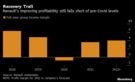
Renault Edges Up Margin Goal as Chip Woes Still Crimp Output

(Bloomberg) — Renault SA raised its forecast for return on sales even as the struggling French carmaker warned semiconductor shortages would continue to curb vehicle production in the coming months.

The automaker predicted an operating margin of at least 4% this year, according to a statement Friday. The goal remains relatively cautious after the same measure came in at 3.6% during 2021.

The muted target could stem from Renault’s forecast that chip constraints will remain a major roadblock that is expected to shave production by 300,000 vehicles this year compared with around 500,000 in 2021. The supply snarls will come mostly in the first half along with higher costs of raw materials, it said. 

Renault, pledging to only offer EVs in Europe by the end of the decade as part of its main brand, is seeking to turn around a business that has been lagging rivals Volkswagen AG and Stellantis NV due to a reliance on the European market and on Japanese partner Nissan Motor Co., which is also emerging from a difficult period. The manufacturer is counting on a series of new models including EVs such as the Megane E-Tech crossover. 

As part of the shift to electric cars, the carmaker is weighing to bundle its combustion-engine technology, hybrid engines and transmissions based outside of France into a single entity, the company said. 

Renault rose as much as 2.9% in early Paris trading, valuing the company at 11.1 billion euros ($12.6 billion). 

Renault swung to net income of 888 million euros last year from a record 8 billion-euro loss in 2020, according to the statement. That compares with an average analyst estimate of 110 million euros compiled by Bloomberg. 

Nissan contributed 380 million euros to Renault’s bottom line after being responsible for much of the French carmaker’s record loss in 2020.

“We are achieving one of fastest turnarounds in the history of automotive industry,” Chief Executive Officer Luca de Meo said in on a call with analysts. “Renault is back. We are determined not to go back to the past.” 

De Meo also pledged to drive cost reductions beyond 2 billion euros already achieved and to push further into the popular SUV segment. The carmaker’s plan to improve margins and cut costs unveiled at the start of last year underwhelmed investors. The carmaker had targeted an operating margin of at least 5% by mid-decade compared with a 4.8% return in 2019. 

New CFO

Separately, the company announced Friday that Chief Financial Officer Clotilde Delbos will step aside to helm Mobilize, Renault’s mobility, energy and data unit. Delbos, who took over as interim CEO during the fallout from the shock departure of long-time leader Carlos Ghosn, will be replaced by Thierry Pieton. 

Renault sold 2.7 million vehicles worldwide last year, 4.5% less than in 2020. The company took a 4 billion-euro French state-backed loan to survive the worst of the pandemic and later sold its stake in Daimler for 1.14 billion euros to safeguard its credit ratings.

It plans to make an early repayment of 1 billion euros of the loan this year on top of the 1 billion-euro mandatory annual reimbursement, according to the statement, adding that the loan will be fully reimbursed by the end of 2023 at the latest.

Automotive operational free cash flow was 1.3 billion, better than the negative 70 million euros in the first half. Renault is forecasting at least 1 billion euros this year. 

(Updates with CEO comment, CFO change, share price)

More stories like this are available on bloomberg.com

©2022 Bloomberg L.P.
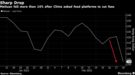
Meituan Tumbles After China Asks Delivery Platforms to Cut Fees

(Bloomberg) — Meituan shares sank as much as 18% after China issued new guidelines asking food delivery platforms to cut fees for restaurants to reduce business costs.

The food delivery giant’s stock fell by the most since July, dragging down the Hang Seng Tech Index, which tumbled as much as 3.6%. The broader Hang Seng Index fell as much as 1.9%.

Online food delivery platforms were also told to give preferential fees to restaurants in regions hit by the pandemic, according to a statement by the National Development and Reform Commission on Friday. 

The new policy comes as investors remain jittery over China’s tech sector following Beijing’s yearlong regulatory crackdowns on private enterprise. 

“The knee-jerk reaction shows market fears over China’s regulatory tightening haven’t been completely eradicated,” says Daniel So, a strategist at CMB International Securities. “Overall, the market is expecting more granular regulatory measures to be rolled out this year even though the worst of crackdowns should be over.” 

(Updates throughout)

More stories like this are available on bloomberg.com

©2022 Bloomberg L.P.
China Builders Miss More Deadlines as Yango Skips Payments

(Bloomberg) — China’s troubled developers have given off more signs of strains this week, as one of the nation’s 20 largest builders failed to make two dollar-bond interest payments. 

Yango Group Co., a Shanghai-based developer that operates in more than 100 cities across the country, didn’t make a combined $27.3 million of interest payments initially due Jan. 15 by a 30-day grace period, according to a Shenzhen stock exchange filing. The company, whose 2021 contracted sales were 19th highest according to China Real Estate Information Corp., said it is facing a temporary cash flow issue and plans to hold a bondholder meeting.

The missed coupons come two months after parent Fujian Yango Group Co. said it failed to pay interest a dollar bond.

Chinese developers continued to be under pressure following record defaults last year amid government clampdown on excessive borrowing, which have helped to drag down primary issuance in Asia to its weakest annual start since 2019. Despite Beijing’s plan to garner support from bad-debt managers to aid the sector and easing property-loan curbs, many builders continue to struggle amid slumping new-home sales while investor confidence wanes. 

Yango Justice International Ltd., the Yango Group unit which issued the two dollar bonds with the missed coupons, received bondholder approval in November to exchange three other notes amid efforts to extend maturities. The new bond, due in September, was indicated down 2.1 cents on the dollar at 14.3 cents, according to Bloomberg-compiled prices. 

Yango Group, which didn’t respond to Bloomberg requests for comment Friday, recently won bondholder approval to extend the interest payment for an onshore note by six months, according to a local media report. The firm has $846 million of dollar-bond interest and maturities coming due the rest of this year, according to Bloomberg-compiled data.

(Adds bond prices and background starting in the fifth paragraph.)

More stories like this are available on bloomberg.com

©2022 Bloomberg L.P.

Renault Lifts Profit Margin Goal as Supply Woes Still Dog Output

(Bloomberg) — Renault SA raised its forecast for return on sales even as the struggling French carmaker warned semiconductor shortages would continue to curb vehicle production in the coming months.

The automaker predicted an operating margin of at least 4% this year, according to a statement Friday. The goal remains relatively cautious after the same measure came in at 3.6% during 2021.

The muted target could stem from Renault’s forecast that chip constraints will remain a major roadblock that is expected to shave production by 300,000 vehicles this year compared with around 500,000 in 2021. The supply snarls will come mostly in the first half along with higher costs of raw materials, it said. 

Renault, pledging to only offer EVs in Europe by the end of the decade as part of its main brand, is seeking to turn around a business that has been lagging rivals Volkswagen AG and Stellantis NV due to a reliance on the European market and on Japanese partner Nissan Motor Co., which is also emerging from a difficult period. The manufacturer is counting on a series of new models including EVs such as the Megane E-Tech crossover. 

As part of the shift to electric cars, the carmaker is weighing to bundle its combustion-engine technology, hybrid engines and transmissions based outside of France into a single entity, the company said. 

Renault swung to net income of 888 million euros ($1 billion) last year from a record 8 billion-euro loss in 2020, according to the statement. That compares with an average analyst estimate of 110 million euros compiled by Bloomberg. 

Nissan contributed 380 million euros to Renault’s bottom line after being responsible for much of the French carmaker’s record loss in 2020.

“Renault Group largely exceeded its 2021 financial targets despite the impact of semiconductor shortages and rising raw material prices,” Chief Executive Officer Luca de Meo said in the statement. “This reflects the sustained pace of the in-depth transformation of the group.”

De Meo’s turnaround plan unveiled at the start of last year underwhelmed investors. The carmaker had targeted an operating margin of at least 5% by mid-decade compared with a 4.8% return in 2019. 

Renault sold 2.7 million vehicles worldwide last year, 4.5% less than in 2020. The company took a 4 billion-euro French state-backed loan to survive the worst of the pandemic and later sold its stake in Daimler for 1.14 billion euros to safeguard its credit ratings.

It plans to make an early repayment of 1 billion euros of the loan this year on top of the 1 billion-euro mandatory annual reimbursement, according to the statement, adding that the loan will be fully reimbursed by the end of 2023 at the latest.

Automotive operational free cash flow was 1.3 billion, better than the negative 70 million euros in the first half. Renault is forecasting at least 1 billion euros this year. 

More stories like this are available on bloomberg.com

©2022 Bloomberg L.P.

Close Bitnami banner
Bitnami