

Bloomberg

World Bank Arm’s Lending to Xinjiang-Linked Firms Questioned

(Bloomberg) — A U.S. think tank has linked some $486 million in direct loans and investments from an arm of the World Bank to four Chinese companies it says benefit from state-sponsored forced labor programs in Xinjiang.

In the report dated Wednesday, the Atlantic Council named Chenguang Biotech Group Co., Camel Group Co., Jointown Pharmaceutical Group Co. and Century Sunshine Group Holdings Ltd. as getting backing from the International Finance Corp.

The firms “recruited workers through overtly racist/discriminatory hiring practices,” subjected minorities to Communist Party indoctrination and “contributed to the destruction of cultural heritage,” the report said, citing sources including corporate documents and stories in state media.

The Atlantic Council said these and other problems violated the IFC’s own Performance Standards, and called on the development bank to divest from corporate investments in Xinjiang.

A spokesperson for the Washington-based IFC said in an emailed statement that it took allegations of forced labor and poor treatment of vulnerable groups very seriously.

“We do not tolerate discrimination or forced labor under any circumstances,” the spokesperson said. “Whenever such serious allegations are brought to our attention, we work to verify and address them with our clients with urgency.”  

A spokesperson for Jointown Pharmaceutical told Bloomberg News by phone Thursday the report was completely groundless. Representatives for the other three companies did not immediately respond to requests for comment.

Chinese Foreign Ministry spokesman Wang Wenbin described the Atlantic Council report as “completely unfounded and maliciously fabricated,” when asked about it later at a regular press briefing in Beijing.

“The Chinese government attaches high importance to protecting human rights and workers’ rights,” he said.

Why the Beijing Winter Olympics Are Facing Cold Winds: QuickTake

The U.S. is leading a diplomatic boycott of the Beijing Winter Olympics — resulting in some nations declining to send senior government officials to the event — citing what it says are “ongoing genocide and crimes against humanity in Xinjiang, and other human rights abuses.”

Beijing denies those charges, calling the allegations of genocide in the western region “the lie of the century.”

(Updates with International Finance Corp. statement starting in fifth paragraph.)

More stories like this are available on bloomberg.com

©2022 Bloomberg L.P.

Palantir Falls the Most in Nearly a Year on Sustained Losses

(Bloomberg) — Palantir Technologies Inc. shares fell the most in almost a year after the data software company reported financial results that illustrated a continued lack of net profit.

The stock declined as much as 14% in intraday trading Thursday. Palantir shares have lost about half their value over the past 12 months.

The net loss was 8 cents a share in the fourth quarter. Adjusted earnings were 2 cents a share, short of analysts’ expectations. Net income is “within eyesight,” Chief Executive Officer Alex Karp assured analysts in a conference call, but he didn’t provide a date.

Pandemic-related restrictions are hampering the business, particularly in Europe. The region needs “to reopen,” Palantir Chief Operating Officer Shyam Sankar said in an interview with Bloomberg. “We need to work on Europe,” he said.

The number of business customers tripled last year to 147, but most of that came from the U.S. Sankar said he expects to add at least 175 salespeople this year, with many focusing on European businesses.

Karp started Palantir with the tech mogul Peter Thiel almost two decades ago to sell software to U.S. government agencies and their allies. The company has worked furiously in recent years, especially during the past year, to bring on more corporate customers. It has added hundreds of salespeople, simplified its software products and even spun up a program to take equity stakes in small startups that agree to be customers. 

Palantir grew revenue 41% to $1.5 billion in 2021, beating the 40% rate it pledged late last year. Still, Palantir’s government business is larger and growing faster than its commercial segment, a dynamic that has concerned investors since Palantir went public in 2020. Revenue last year from government customers increased 47% to $897 million while commercial increased 34% to $645 million.

Deals with biotech startup Dewpoint Therapeutics Inc. and pipeline operator Kinder Morgan Inc. contributed to total fourth-quarter revenue of $433 million.

Palantir said it will deliver a 23% adjusted operating margin on $443 million in revenue during the quarter ending in March, falling short of an average of analysts’ estimates compiled by Bloomberg. The company said it expects its operating margin to increase to 27% in the fiscal 2022.

The company’s sometimes-controversial government work remains core to its future operations. Along with assisting more than a dozen governments in battling the Covid-19 pandemic, the software is used to power military operations.

“We are not ambivalent about the side we have chosen when it comes to supporting the defense of the United States,” wrote Karp, in his annual letter to shareholders. “Everything we have accomplished, and everything we have built, has been made possible by the country in which our company was founded.”

Continuing to expand its commercial segment is critical to sustaining the 30% annual revenue growth Palantir promised investors when it went public, according to Mandeep Singh, an analyst at Bloomberg Intelligence.

(Updates with reporting starting in first paragraph.)

More stories like this are available on bloomberg.com

©2022 Bloomberg L.P.
Nvidia Underwhelms in First Results Since Scrapping Arm Deal

(Bloomberg) — Nvidia Corp. tumbled 7% Thursday morning in New York after the most valuable U.S. chipmaker failed to impress investors with its latest forecast. 

Though the company topped Wall Street estimates with its fourth-quarter results — and projected strong growth for the current period — the share decline is a sign of Wall Street’s lofty expectations after Nvidia walked away from a $40 billion acquisition of Arm Ltd. earlier this month. 

Chief Executive Officer and co-founder Jensen Huang has turned a niche business — graphics cards for gamers — into a chip empire worth more than $600 billion. But investors have high hopes for the company, and even a record-setting quarter can leave them underwhelmed.

In the “weird world” of Nvidia, investors’ expectations are always different than the consensus estimate, Vital Knowledge analyst Adam Crisafulli said in a note. Investors may have been looking for more upside, but within the next day or so, they’ll probably come back to the realization that Nvidia has “some of the best fundamental prospects in tech,” he said.

There were some weak spots last quarter. Sales of Nvidia’s auto chips were lower than projected. And its adjusted gross margin came in at 67% — shy of the 67.1% analysts estimated and below what some chipmakers have reported recently. Analog Devices Inc. had a margin of 72% when it delivered its quarterly results earlier Wednesday.

Supply constraints also are weighing on Nvidia’s data-center chip business, but the situation is improving, Huang said in a conference call with analysts. Companies like Nvidia that rely on outsourced chip manufacturing need to change the way they work with suppliers, Huang said. Making supply plans one quarter in advance doesn’t work at a time when the industry is expanding rapidly, he said. 

“We all have to recognize that the market size, our market footprint, is much larger than it used to be,” he said in an interview. “We have to plan with a much larger horizon.” 

Nvidia is bouncing back from its failed attempt to acquire Arm, a deal that faced regulatory opposition around the world. It terminated the transaction on Feb. 8 and expects to write off $1.36 billion this quarter to account for prepayments it pledged to Arm’s owner, SoftBank Group Corp. Huang said Wednesday that he gave the deal his “best shot.”

Nvidia had touted the purchase as a chance to expand its reach into many devices, including smartphones.

But even without Arm, Nvidia has been growing more quickly than projected. Revenue in the fiscal first quarter will be about $8.1 billion, the company said Wednesday. That compares with a $7.2 billion average analyst estimate, according to data compiled by Bloomberg.

Huang said that Nvidia will increase the number of Arm-based processors it makes, and the current Grace model is only the beginning. He remains convinced that the technology, increasingly a rival to Intel Corp.’s X86, will carve out a bigger role for itself in computing. Arm chips are already pervasive in power-constrained technologies, such as smartphones.

Nvidia’s stock, which ended 2015 at $8.24, closed at $265.11 on Wednesday. But the shares have taken a hit lately, part of a broader decline for semiconductor stocks. They’re down almost 10% this year.

The Santa Clara, California-based company has pushed into the booming field of artificial intelligence computing, where its processors are used to handle an ever-growing flood of data. That’s turned Nvidia’s products into essential equipment for data centers, rather than just gaming computers.

Nvidia posted sales of $7.64 billion in the fourth fiscal quarter, topping the $7.4 billion average prediction from analysts. Earnings came in at $1.32 a share, excluding some items, compared with an estimate of $1.22.

Revenue in Nvidia’s data-center business rose 71% in the fourth quarter to $3.26 billion, ahead of the $3.2 billion estimated by analysts. Its main gaming business generated sales of $3.42 billion, compared with an estimate of $3.36 billion.

More stories like this are available on bloomberg.com

©2022 Bloomberg L.P.

‘Candy Bomber’ of Berlin Blockade, Gail Halvorsen, Dies at 101

(Bloomberg) — Gail Halvorsen, the U.S. military pilot who brought joy to Berlin’s children by dropping candy in tiny handkerchief parachutes from his plane when the Soviet Union blockaded the divided city during the Cold War, has died. He was 101. 

He died Wednesday evening at Utah Valley Hospital in Provo, Utah, after a long illness, surrounded by most of his children, according to a Facebook post by his educational foundation. 

Halvorsen was a pilot in the U.S. Army Air Corps — forerunner to the Air Force — during the Second World War, ferrying transport planes in England, Italy, and North Africa. He remained in the military after the war ended in 1945 and was stationed at Brookley Air Force Base in Mobile, Alabama, flying C-74 Globemaster and C-54 Skymaster transports stateside.

In 1948, the newly rechristened U.S. Air Force had a renewed need for pilots in Germany, where the Soviet Union under Joseph Stalin had implemented a blockade of West Berlin. The German capital, divided into zones occupied by the U.S., the U.K., France and the Soviet Union, was sealed off when Stalin blocked ground transportation into the Allied sectors of the city. 

Flying the C-54 Skymaster, Halvorsen participated in the joint U.S.-U.K. effort known as the Berlin Airlift, which for almost a year delivered food and fuel to Berlin airfields from Allied bases in western Germany. 

‘Like a Moonscape’

On Halvorsen’s first flight into Berlin’s Tempelhof Air Base, he delivered 20,000 pounds of flour while taking careful note of the war-torn city. “It looked like a moonscape,” he recalled in an interview with Military History magazine. “I wondered how 2 million people could live in a place so totally devastated.”

It was an additional, self-assigned mission that made Halvorsen famous.

On an off day, he hitched a ride on a transport flight to Berlin so he could shoot some footage with his movie camera. After landing at Tempelhof, he walked over to a group of about 30 German children who were watching all the activity through a fence.

“They came right up to the barbed wire and spoke to me in English,” he recalled. “Those kids were giving me a lecture, telling me, ‘Don’t give up on us. If we lose our freedom, we’ll never get it back.’ American-style freedom was their dream.”

Sticks of Gum

Their words left a mark on Halvorsen, as did the way they meticulously divided and shared two sticks of gum he gave them. He vowed to return with enough for all, to be delivered from the air. They’d know the plane was his because he’d wiggle the wings.

“My copilot and engineer gave me their candy rations — big double handfuls of Hershey, Mounds and Baby Ruth bars and Wrigley’s gum,” he recalled in the interview. “Three weeks we did it, three parachutes each time. The crowd got big.”

Soon, thank-you letters began to arrive in the barracks, addressed to “Uncle Wiggly Wings.” He feared the worst when photos of his plane made front-page news in local newspapers, which led to him being called in to explain his actions to his army superiors.

Instead of being penalized, he was ordered to drop even more sweet treats as his commanders realized the goodwill that Halvorsen was generating in East and West Berlin and at home in the U.S., where donations of candies and handkerchiefs were organized. 

‘Candy Bomber’

Operation Little Vittles, as the drop of gum and chocolate bars came to be known, turned into a diplomatic coup, altering Germans’ perceptions of Americans and paving the way for future humanitarian airlifts. Halvorsen became known as the “Candy Bomber” and “Der Schokoladen Flieger” — “the Chocolate Flyer.”

In 1974, Halvorsen was awarded the Grand Cross of the Order of Merit of the Federal Republic of Germany for his kind deeds.

Gail Seymour Halvorsen was born on Oct. 10, 1920, in Salt Lake City. He grew up on farms in Utah and Idaho.

He was awarded a private pilot’s license as part of a civilian training program in 1941 before joining the U.S. Army Air Corps the following year. Halvorsen trained as a fighter pilot before transferring to air-transport assignments in the South Atlantic during the war.

Space Programs

Returning to the U.S. after the Berlin Airlift, he earned bachelor’s and master’s degrees in aeronautical engineering from the University of Florida.

His later work included assignments at the Air Force Space Systems Division in Inglewood, California, where he worked on the Titan III launch vehicle, and at Vandenberg Air Force Base in California, where he commanded satellite launch operations.

He also returned to Germany, and to Tempelhof, as commander of the 7350th Air Base Group, before retiring in 1974. He was an assistant dean at Brigham Young University from 1978 to 1988.

Halvorsen married his first wife, the former Alta Jolley of Utah, in 1949. She died in 1999. They had five children. He later married his childhood sweetheart, Lorraine Pace.

More stories like this are available on bloomberg.com

©2022 Bloomberg L.P.
Sequoia Capital to Create Crypto Fund of as Much as $600 Million

(Bloomberg) — Sequoia Capital is launching a cryptocurrency-focused fund of as much as $600 million — the latest sign of venture capital enthusiasm for crypto startups, despite ongoing regulatory uncertainty and market volatility.

“We have a long-term view on crypto that it’s a megatrend over the next 20 years,” said Sequoia Partner Shaun Maguire. “It’s the future of money.”

Sequoia’s move to create a standalone crypto fund is a break from tradition — the 50-year-old firm has never before carved out a specific sector fund — but it was widely expected. The change comes after a broader revamp of the firm’s structure, allowing it greater flexibility to hold positions in public companies and the ability to work around rules that cap venture investments in crypto at just 20% of a fund.

Sequoia, which has embraced the world of crypto, is hardly the only venture firm to do so. Global investors plowed more than $21 billion into the sector in 2021 —  more than in every year over the past decade combined, according to research firm CB Insights. 

In announcing the crypto fund Thursday, Sequoia said it would be one of three new sub funds at the firm, under the broader umbrella of the Sequoia Capital Fund. The new funds will use capital already committed by Sequoia’s existing limited partners, rather than new funding. Sequoia said that its limited partners — a group that includes university endowments and pension funds —  support the changes, electing to roll in 95% of eligible balances into the firm’s new structure. Those limited partners can now decide whether they want to allocate their money to one or more of the sub funds.  

Sequoia Partner Michelle Bailhe said the sometimes wild price fluctuations in Bitcoin, Ethereum and other coins didn’t concern her or others at Sequoia because “we’re investing on a 30-year horizon. We’re not an arbitrage firm.”

Lower valuations for startups could be appealing for the firm, according to its partners. “If we’re in a bear market, we could invest [the crypto fund] in under a year,” Maguire said. 

The other smaller funds created alongside the crypto investment vehicle are Sequoia’s Ecosystem Fund and Expansion Fund. As much as $950 million will go to the Ecosystem Fund, focused on companies connected to Sequoia, and where the firm will delegate “Scouts,” or third-party investors (including founders and other venture firms) to make investments on its behalf. Sequoia’s Expansion Fund will be as large as $3.5 billion and will fund U.S. and European growth-stage companies. Both the Ecosystem and Expansion funds will back a range of technologies, including crypto.

More stories like this are available on bloomberg.com

©2022 Bloomberg L.P.
Cybersecurity Stocks Provide a Haven During Technology Selloff

(Bloomberg) — Many of the tech sector’s lockdown winners have long surrendered their outsize pandemic gains, but cybersecurity stocks aren’t among them.

The resilience in Zscaler Inc., Crowdstrike Holdings Inc. and Fortinet Inc. is a display of bright growth prospects for these firms amid simmering geopolitical tensions, more employees adopting hybrid working models and the ongoing digital shift, analysts say. Zscaler has fallen 25% from a November peak, but remains up more than 300% over the past two years, while Crowdstrike and Fortinet are still up more than 160%.

That’s in stark contrast to meltdowns seen in Peloton Interactive Inc., PayPal Holdings Inc. and Netflix Inc., which have posted declines of between 43% and 81% from record highs after people chose to go back socializing rather than spend hours online.

“The need for security is different than any other pandemic play,” said Hilary Frisch, an analyst at ClearBridge Investments LLC.

“Anytime there is a new threat announced, or there’s a hack or ransomware attack, that’s effectively an advertisement for cybersecurity as something that companies and other organizations need to be investing in,” said Frisch, who is “heavily invested” in the space and prefers Palo Alto Networks Inc., Datadog Inc., Fortinet and Splunk Inc.

Indeed, Fortinet, a maker of network-security systems, demonstrated this month that sales growth remains strong, helping support its shares amid pressure from higher interest rates.

Even though such stocks aren’t fully immune to fears about Federal Reserve tightening that’s weighed on those with high valuations, a Nasdaq index of cybersecurity related firms has outperformed the Nasdaq 100 Index by two percentage points so far this year. That’s despite boasting a price-to-projected earnings ratio that’s more than 40% richer.

“We have witnessed a cybersecurity earnings season so far that is robust across the board,” said Wedbush Securities analyst Daniel Ives. “While the Fed driven risk-off environment remains, the underlying growth stories around cyber security are unmatched to what we have seen the last decade.”

Tech Chart of the Day

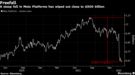
Facebook-owner Meta Platforms Inc. is close to wiping out $500 billion in market capitalization from its September record. The social media giant has lost more than a third of its market value this year as poor earnings and questions over its strategic shift to the metaverse has prompted investors to dump the stock. It was valued at more than $1 trillion at peak.

Top Tech Stories

  • Amazon.com Inc. has agreed to accept Visa’s cards across its global network, settling a feud that threatened to damage the financial giant’s business and disrupt e-commerce payments
  • Nvidia Corp., which walked away from a $40 billion acquisition of Arm earlier this month, failed to impress investors with its latest forecast, a sign of the lofty expectations for the most valuable U.S. chipmaker
  • Intel Corp. Chief Executive Officer Pat Gelsinger, who took the job in February 2021, gives himself an A- grade for his first year running the chipmaker. Investors are proving to be tougher graders
  • Elon Musk waded further into the political controversy over vaccine mandates that’s gripped Canada for weeks, tweeting a meme making a satirical comparison between Prime Minister Justin Trudeau and Adolf Hitler
  • ElasticRun, an e-commerce startup that provides supply chain and credit services to India’s mom-and-pop shops, or kiranas, raised $330 million in a funding round led by SoftBank Vision Fund 2 and Goldman Sachs Group Inc.

(Updates chart.)

More stories like this are available on bloomberg.com

©2022 Bloomberg L.P.

Walmart Bucks Supply-Chain Snarls With Upbeat Annual Outlook

(Bloomberg) — Walmart Inc. surpassed Wall Street’s quarterly profit expectations and unveiled an upbeat sales outlook for the current fiscal year despite persistent cost pressures and flagging consumer sentiment.

Comparable sales at U.S. Walmart stores will gain “slightly above 3%” excluding fuel during the current fiscal year, which ends in early 2023, the retailer said in a statement Thursday as it reported earnings. That tops the 2.7% average gain expected by analysts. 

The results underscore Walmart’s efforts to navigate scarce transportation capacity, a labor squeeze and rising fuel costs that are combining with robust demand to spur the fastest growth in U.S. consumer prices in four decades. U.S. retail sales in January rose the most in 10 months, signaling resilient demand despite surging inflation and the weakest consumer confidence in a decade.

Walmart Chief Financial Officer Brett Biggs said on a conference call with analysts that the company expects U.S. consumers to remain in a “generally favorable economic position throughout the year.”

The shares rose 1.9% at 9:36 a.m. New York time even as the broader market slumped. Walmart had fallen 7.7% this year through Wednesday, compared with a 2.4% drop in an S&P index of consumer staples companies. Last year, the shares dramatically underperformed retail stock indexes and rivals such as Target Corp. and Costco Wholesale Corp. 

The results show how investors are rewarding companies that can navigate rising inflation and supply-chain pressures. They are likely to be seen as a bellwether as other large U.S. retailers prepare to release earnings. Home Depot Inc., Macy’s Inc. and Lowe’s Cos. report next week, followed the week after by Target, Costco and Best Buy Co. 

Walmart’s adjusted earnings climbed to $1.53 a share in the fiscal fourth quarter, which ended in late January. That topped the $1.51 average of analyst estimates compiled by Bloomberg. Revenue rose 0.5% to $152.9 billion, while Wall Street had expected $151.7 billion.

The Bentonville, Arkansas-based retailer, which for decades has based its strategy on everyday low prices, is vying for more customers as the rising inflation rate prompts shoppers to look harder for bargains. But higher costs for merchandise, transportation and labor pose a growing threat to profitability. 

That’s raising the stakes as Walmart and other retailers decide how much vendor price increases they will pass along to consumers. Last quarter, comparable sales at Walmart’s U.S. stores rose 5.6% with market share gains in the grocery business, while analysts had predicted 5.5%. 

Walmart is also trying to develop businesses in digital advertising, financial services and health care, and it’s investing heavily in e-commerce. The company is planning capital expenditures in the current fiscal year to be at the upper end of 2.5% to 3% of net sales with a focus on supply chain, automation, customer-facing initiatives and technology.

Walmart’s U.S. e-commerce sales, a closely watched metric, rose 1% in the fourth quarter while analysts were looking for a 2.2% gain. Online sales got a substantial boost during pandemic lockdowns, but demand has been slowing as shoppers venture back into stores. 

To further boost its e-commerce business, the retailer last year debuted Walmart+, an online subscription offering, to compete with Amazon.com Inc.’s Prime program. Walmart has said little about the initiative’s performance, even downplaying its importance. 

(Updates with CFO comment in fourth paragraph, shares in fifth.)

More stories like this are available on bloomberg.com

©2022 Bloomberg L.P.

Fed Needs to Hike to Slow Inflation Without Recession, Credit Suisse Says

(Bloomberg) — The Federal Reserve needs to deliver a Volcker-style shock to drive down asset prices if it wants to slow inflation without causing a recession, according to Credit Suisse Group AG strategist Zoltan Pozsar.

Policy makers should stoke volatility to set off corrections in assets including stocks, houses and Bitcoin, deterring early retirement and driving people into the workforce, Pozsar wrote in a note to clients. His comments harked back to the way Paul Volcker broke the back of inflation in the 1980s with massive rate increases.

The difference this time is policy makers need to bring “about more supply of labor, not less demand for it,” and slow inflation in services which is driven up mainly by higher housing costs and the availability of workers, Pozsar said. The key to turning those drivers around is to tighten financial conditions by increasing longer-term borrowing costs that underpin asset valuations, the influential analyst said. 

“Maybe the Fed should hike 50 basis points in March, put an end to press conferences, and sell $50 billion of 10-year notes the next day,” Pozsar wrote.

It’s a view that shines the spotlight on the windfall that years of quantitative easing has had for capital owners, a policy that critics say has inflated asset prices and contributed to rising inequality. Since the wake of the global financial crisis, the Fed’s balance sheet has grown four-and-a-half-fold to almost $9 trillion.

Policy Headwinds

Fed Chairman Jerome Powell has pledged to bring under control the strongest inflation in four decades. Yet the pace of rate increases required, according to market pricing, would make a severe slowdown in the economy all too likely. 

Complicating the picture further is that goods prices have turned into a sustained source of price pressures, Pozsar said. Meanwhile, the Fed’s updated dual mandate calls for it to avoid creating recessions and yet it can only rein in goods costs through rapid interest-rate hikes that will curb demand.

Despite the aggressive positioning in the market — bond traders are now pricing in just over six 25-basis-point hikes this year — long-term borrowing costs have not moved up enough. In particular, mortgage rates need to get noticeably higher, Pozsar said. 

The average 30-year U.S. mortgage rate climbed almost 1 percentage point this year to 4.23%, according to Bankrate.com, which is still about half a point below its peak in 2018.

Redistribution

In the minutes of the Jan. 25-26 Federal Open Market Committee meeting, released Wednesday, a few participants noted that asset valuations were “elevated across a range of markets” and raised concern that a major realignment of asset prices could contribute to a future downturn.

The U.S. central bank is currently set to phase out its asset-purchase program in mid-2022 under a plan announced at the start of November to slow buying by $15 billion a month. 

Signs are growing that market is also getting nervous. The yield curve — a broad measure the expected trajectory of borrowing costs — has narrowed to levels levels last seen since the pandemic first hit, with rates traders wagering the Fed will have to cut rates again in 2024. 

Yet Pozsar maintains that the Fed can steepen the slope by driving up term premia instead — the technical term for the extra yield investors demand to hold longer-date notes — without killing growth.

“The decisions of central bankers are always redistributive,” he said. “For decades, redistribution went from labor to capital. Maybe it’s time to go the other way next.”

(Updates throughout.)

More stories like this are available on bloomberg.com

©2022 Bloomberg L.P.

Nissan’s Latest U.S. Push: Building 2 New EV Models in Mississippi by 2025

(Bloomberg) — Nissan Motor Co. will build two battery-electric vehicles for the U.S. market at a plant in Mississippi, marking the Japanese automaker’s deepest North America move to date in to a growing field of consumer EVs.

The plug-in battery-powered models — one under the Nissan nameplate and one for Infiniti — will start production in 2025, the Yokohama, Japan-based automaker said Thursday. Nissan plans to invest $500 million for technology needed for EV-specific assembly lines at the plant in Canton, which is just north of the state capital in Jackson.

“Today’s announcement is the first of several new investments that will drive the EV revolution in the United States,” Nissan Chief Operating Officer Ashwani Gupta said in a statement.

Competition in the EV market is intensifying with U.S. legacy automakers Ford Motor Co. and General Motors Co., as well as global giants such as Volkswagen AG and Toyota Motor Corp., pledging billions of dollars to catch market incumbent Tesla Inc. Alongside factory capacity and new models, there’s a rush to secure battery-cell supply and varying deadlines to comply with global emissions and clean-energy targets.

Nissan’s stock is up about 9.5% year-to-date in Japan, after declining less than 1% for 2021.

In November, Nissan pledged to invest 2 trillion yen ($17.4 billion) over the next five years to electrify more of its lineup globally. The target includes 15 new electric vehicles and an aim of more than 50% electrified sales by fiscal 2030. Its U.S. goal is a bit more modest, aiming for 40% of sales being fully electric by the end of this decade alongside other hybrid models.

Nissan was an early-mover in the electrification movement, introducing the world’s first mass-produced battery-electric vehicle, the Nissan Leaf, in 2010. While the plug-in is a top-seller globally, its been outsold and displaced in recent years by cars from Tesla, which didn’t start producing its first mass-model vehicle until 2017.

Leaf sales in the U.S. rose 48.9% in 2021 to 14,239 units. Tesla, which doesn’t break out sales by region, delivered almost 940,000 EVs to customers globally. The EV is just a small fraction of the automaker’s U.S. footprint: Nissan sold almost 1 million vehicles in the U.S. last year, a gain of 8.7% from 2020. 

Nissan, along with industry peers in Japan, endured a tough 2021 with a shortage of semiconductors hampering growth and profitability.

As part of the investment, Nissan will retrain almost 2,000 workers. The plant currently employs 5,000 people and has produced more than 5 million vehicles since opening in 2003.

More stories like this are available on bloomberg.com

©2022 Bloomberg L.P.

Palantir Plunges After Earnings, Outlook Spook Investors

(Bloomberg) — Palantir Technologies Inc. shares tumbled in New York after the data software company announced earnings that illustrated continued lack of profits, despite an operating margin forecast showing slight improvement this year. 

The stock fell as much as 11% during premarket trading on Thursday. Palantir shares have lost almost half their value over the past 12 months.

“We need to work on Europe,” Palantir Chief Operating Officer Shyam Sankar said during an interview with Bloomberg. The region needed “to re-open” from Covid-19 restrictions, he added. Sankar said he expects to add about 175 salespeople this year, with many focusing on European commercial clients.

Peter Thiel and Alex Karp started Palantir almost two decades ago to sell software to U.S. government agencies and their allies. The company has worked furiously in recent years, especially during the past year, to bring on more corporate customers. It has added hundreds of salespeople, simplified its software products and even spun up a program to take equity stakes in small startups that agree to be customers. 

Key Takeaways:

  • Palantir said it will deliver a 23% adjusted operating margin on $443 million in revenue during the quarter ending in March, falling short of average analyst estimates of 26.6% compiled by Bloomberg.
  • Losses decreased to $59 million in the fourth quarter, from $91 million in the previous period.
  • The company said it expects its operating margin to increase to 27% for the fiscal 2022.
  • Adjusted earnings were 2 cents per share in the fourth quarter, short of analysts’ expectations of 3 cents. The net loss was 8 cents a share.
  • Net income is “within sight,” Karp said on a conference call with analysts, without providing a date.
  • Total full-year revenue increased 41% to $1.5 billion in 2021 in line with estimates.
  • Government business increased 47% to $897 million while commercial business increased 34% to $645 million.
  • Although the number of commercial customers tripled during 2021 to 147, most of that came from U.S. customers.
  • Revenue growth last year was 41%, beating the 40% rate it pledged late last year.
  • Deals with biotech startup Dewpoint Therapeutics Inc. and pipeline operator Kinder Morgan Inc. contributed to total fourth-quarter revenue of $433 million.

Palantir’s sometimes-controversial government work remains core to the company’s future operations. Along with assisting more than a dozen governments in battling the Covid-19 pandemic, the software is used to power military operations.

“We are not ambivalent about the side we have chosen when it comes to supporting the defense of the United States,” wrote Karp, Palantir’s chief executive officer, in his annual letter to shareholders. “Everything we have accomplished, and everything we have built, has been made possible by the country in which our company was founded.”

Continuing to expand its commercial segment is critical to sustaining the 30% annual revenue growth Palantir promised investors when it went public, according to Mandeep Singh, an analyst at Bloomberg Intelligence.

(Updates with CEO comment in Key Takeaways.)

More stories like this are available on bloomberg.com

©2022 Bloomberg L.P.

Close Bitnami banner
Bitnami