Bloomberg

FTX US Donated $1 Million to a Super-PAC Aligned With Mitch McConnell in October

(Bloomberg) — FTX US, a part of Sam Bankman-Fried’s crypto empire that catered to American customers, contributed to a super-PAC fighting for control of the Senate in the midterm election just days before the company’s collapse. 

The Senate Leadership Fund, which is aligned with Senate Republican Leader Mitch McConnell and was the top spender in the 2022 midterms, received the $1 million donation on Oct. 27, according to its most recent filing with the Federal Election Commission. Only a couple of weeks later, more than a 100 FTX-related companies, including the US arm, filed for bankruptcy, and Bankman-Fried resigned as head of the corporate group. 

The contributor listed on the FEC donation report is West Realm Shires Services Inc. and FTX US is its commercial name. 

The Senate Leadership Fund did not immediately respond to a request for comment. The super-PAC spent $239 million in the midterms on behalf of Republican candidates, according to OpenSecrets, which tracks money in politics.  

While several members of Congress, including Illinois Senator Richard Durbin, a Democrat, and Republican Representative Kevin Hern of Oklahoma have said they would return donations from FTX executives or give the money to charities, there isn’t a requirement in election law for committees to return donations to companies that go bankrupt.

FTX US also gave $750,000 to the Congressional Leadership Fund and $150,000 to the American Patriots PAC, both of which supported House Republican candidates. It gave $100,000 to the Alabama Conservatives Fund, which backed Republican Katie Britt’s successful run for the state’s open Senate seat.

Individual executives at the broader FTX company have given far more money. Bankman-Fried emerged as major donor to Democratic candidates leading up to the Nov. 8 midterm elections, donating most of the $39.4 million that he gave to them, FEC records show. One of his top lieutenants, Ryan Salame, gave $23.6 million — mostly to Republicans.

As Congress weighs bills that would regulate digital currencies, the crypto industry became a major player in the 2022 election cycle, with industry players donating $84.1 million through mid-October. But most of that amount, some 84%, came from Bankman-Fried and other FTX executives. Committees in the House and Senate have scheduled hearings next month on the firm’s collapse, with Bankman-Fried as a potential witness.

–With assistance from Allyson Versprille.

More stories like this are available on bloomberg.com

©2022 Bloomberg L.P.

Stocks End Winning Week With Rate Outlook in Focus: Markets Wrap

(Bloomberg) — US stocks ended Friday little changed as investors assessed prospects for less-aggressive central bank tightening and weighed China’s latest move to stimulate its economy. 

The S&P 500 wavered for most of Friday’s shortened trading session. But its weekly gain of 1.5% took the index to the highest level since early September. The Nasdaq 100 also eked out a gain for the week, despite dropping on Friday. Most Treasuries erased early losses.

“It’s a slow day with US market holiday,” said Marija Veitmane, senior multi-asset strategist at State Street Global Markets. “We’re seeing a bit of profit taking and position adjustment post a strong risk rally last week.”

Sentiment was boosted this week after the Federal Reserve’s Nov. 1-2 meeting minutes showed most officials backing slowing the pace of interest-rate hikes. Since the Fed’s latest meeting, investors have parsed a bevy of economic data that somewhat eased inflation concerns, further strengthening the case for smaller rate hikes.

All eyes will be on the jobs report next week and on Fed Chair Jerome Powell and New York Fed President John Williams, who are among central bank officials scheduled to speak. Both officials will make clear that a tight labor market and elevated services inflation will keep the Fed hiking for longer, strategists with TD Securities wrote in a note.

“As markets welcome the prospect of smaller hikes, we expect them to counter that by emphasizing the need to reach an appropriately higher terminal rate,” they said.

Trading on Monday will also hinge on Black Friday sales and further information on the virus outbreak in China, said Julian Emanuel, Evercore ISI’s chief equity and quantitative strategist.

China’s central bank on Friday cut the amount of cash lenders must hold in reserve for the second time this year, an escalation of support for an economy racked by surging Covid cases and a continued property downturn. US-listed Chinese stocks fell and posted their first weekly decline this month.

“How effective that will prove to be when cities are seeing restrictions and effective lockdowns reimposed is hard to say,” said Craig Erlam, senior market analyst at Oanda. “But combined with other measures to boost the property market and ease Covid curbs, the cut could be supportive over the medium term when growth remains highly uncertain.”

European Union diplomats, meanwhile, won’t meet on Friday or over the weekend to discuss the oil-price cap as divisions within the bloc remain entrenched, according to people familiar with the matter. Oil suffered a third weekly loss. 

Some of the main moves in markets:

Stocks

  • Futures on the S&P 500 were little changed as of 1 p.m. New York time
  • Futures on the Dow Jones Industrial Average rose 0.4%
  • The MSCI World index rose 0.4%

Currencies

  • The Bloomberg Dollar Spot Index rose 0.1%
  • The euro was little changed at $1.0404
  • The British pound fell 0.2% to $1.2093
  • The Japanese yen fell 0.4% to 139.13 per dollar

Cryptocurrencies

  • Bitcoin fell 0.3% to $16,501.34
  • Ether fell 0.4% to $1,190.77

Bonds

  • The yield on 10-year Treasuries was little changed at 3.70%
  • Germany’s 10-year yield advanced 12 basis points to 1.97%
  • Britain’s 10-year yield advanced eight basis points to 3.12%

Commodities

  • West Texas Intermediate crude fell 1.4% to $76.83 a barrel
  • Gold futures rose 0.4% to $1,767.70 an ounce

This story was produced with the assistance of Bloomberg Automation.

–With assistance from Brett Miller, Natalia Kniazhevich, Isabelle Lee and Vildana Hajric.

More stories like this are available on bloomberg.com

©2022 Bloomberg L.P.

Trudeau Defends Emergency Edict Used to End Trucker Convoy

(Bloomberg) — Prime Minister Justin Trudeau defended his decision to invoke emergency powers to quell a trucker-convoy protest in February, arguing during public testimony the move was aimed at staving off the threat of violence.

Speaking on Friday at a televised public inquiry into the government’s decision, Trudeau cited the “weaponization” of vehicles by protesters, and what he said was the use of children as human shields. He also said weapons were found at one of the sites, and there were people in the convoy promoting ideologically motivated extremism.

The anti-government protests gridlocked Canada’s capital city and blockaded US border crossings.

“The fact that there was not yet any serious violence that had been noted was obviously a good thing but we could not say that there was no potential for threats of serious violence,” said Trudeau.

The prime minister is the final witness in the six-week hearing that’s seen almost every senior federal government official appear, along with police officers, mayors and the convoy organizers. The inquiry was mandated by the prime minister’s emergency edict itself.

Hundreds of semi-trucks and other vehicles arrived in Ottawa on the last weekend in January to protest vaccine mandates and other public health restrictions enacted during the Covid-19 pandemic. The inquiry has heard Ottawa police expected the trucks to leave after the weekend, but instead the protesters dug in and raised millions of dollars — some in Bitcoin — through online fundraising platforms including GiveSendGo.

The protests soon spread to other locations. One offshoot shut down the Ambassador Bridge from Windsor, Ontario into Detroit, a critical trade link for the North American automotive industry. Another in Alberta blocked a US border crossing used primarily by the agriculture and other commodities sectors.

Invoking the Emergencies Act on Feb. 14 gave Trudeau’s government the power to order banks to freeze the accounts of people and companies participating in the protests, and to compel towing companies to help clear out the blockades.

Trudeau said on Friday that there was a consensus in his cabinet and within the public service to invoke the act.

The prime minister denied the move was an overreach of executive powers, citing how parliament actually backed his decision in a subsequent vote. Trudeau also said that he isn’t worried the invocation is creating a low bar for future governments to use emergency powers, citing checks and balances in the system including the requirement for public inquiries.

“I am absolutely absolutely serene and confident that I made the right choice,” he said.

Trudeau is the only prime minister to use the emergency legislation since its creation in 1988. The closest parallel in modern Canadian history was the so-called October Crisis of 1970, when his father Pierre Trudeau effectively declared martial law in response to kidnappings by Quebec separatists.

The commission has heard conflicting testimony about whether police believed the emergency powers were necessary to clear the streets. But it has also heard that Trudeau’s national security adviser Jody Thomas, the head of Canada’s intelligence agency David Vigneault and other top government officials advised him to invoke the legislation.

Finance Minister Chrystia Freeland and Michael Sabia — a former pension, telecommunications and rail executive who is the top civil servant in her department — both took the stand recently. They testified that the border blockades risked severely harming Canada’s reputation as a reliable trade partner at a time when the country was already battling US protectionism in the auto sector.

Freeland testified Thursday about her conversations with US officials, including Brian Deese, the head of the National Economic Council, and said she strongly felt Canada was facing “economic jeopardy” if the border wasn’t reopened quickly. 

“I could see, really for the first time ever, the Americans having this amber light flashing in Canada — and this amber light said to them, you know what, the Canadian supply chain could be a vulnerability,” Freeland told the inquiry. 

Both Freeland and Sabia said they were focused on finding tools that could be enacted immediately to end the blockades, and that’s what led them to believe the emergency powers were necessary. 

(Updates with Trudeau comments throughout)

More stories like this are available on bloomberg.com

©2022 Bloomberg L.P.

Activision Sinks on Concern US Will Block Microsoft’s $69 Billion Deal

(Bloomberg) — Activision Blizzard Inc. shares sank further away from Microsoft Corp.’s proposed takeover price as investors grow concerned that the US antitrust regulators will block the $69 billion deal.   

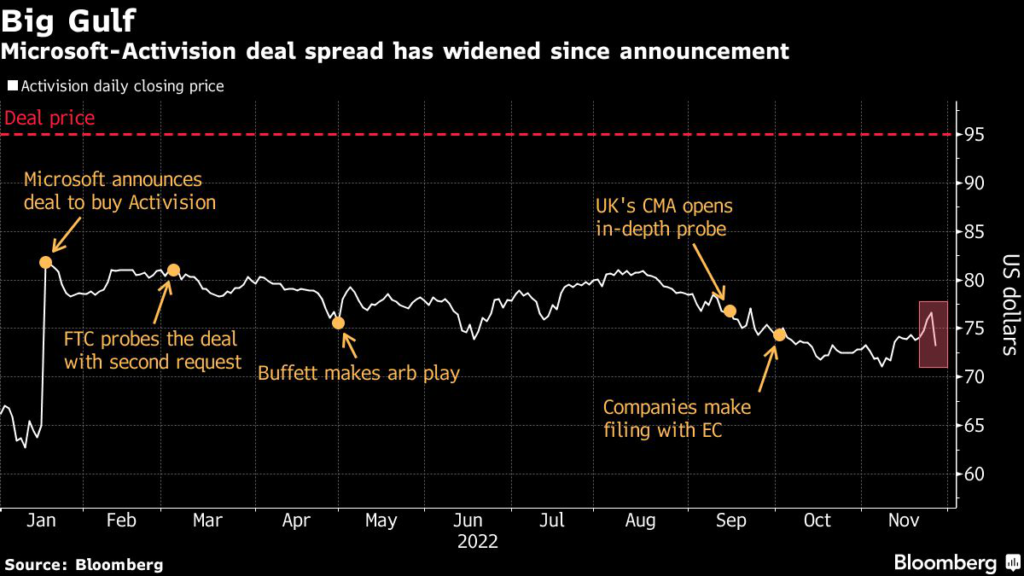
The videogame-maker’s stock fell 4.1% to $73.47 on Friday, while Microsoft Corp is offering $95 a share for the company. After the market closed Wednesday, Politico reported that the US Federal Trade Commission is likely to file an antitrust lawsuit to block the sale.

“An FTC block has been mostly, but not entirely, priced into the spread,” said Aaron Glick, a merger arbitrage specialist at Cowen & Co. “Many investors were holding out hope that Microsoft’s goodwill on the Hill would lead the FTC to clear the deal.”

The market is pricing in roughly 40% odds of the deal successfully closing, based on the assumption that the stock would be trading at $60 should it fail, Glick said.

Since the takeover deal was announced in January, the gap between Activision’s trading price and Microsoft’s all-cash bid has been widening, driven by heightened antitrust scrutiny in the US and Europe, as well as its sheer transaction size and long closing process. A broad slump in the technology industry also pushed investors to price in a greater downside risk if the deal fails. 

The companies have said they expect to close the deal in the first half of 2023.

–With assistance from Subrat Patnaik.

(Updates stock move at close in the second paragraph)

More stories like this are available on bloomberg.com

©2022 Bloomberg L.P.

Deep Discounts Fail to Lure Crowds: Black Friday Update

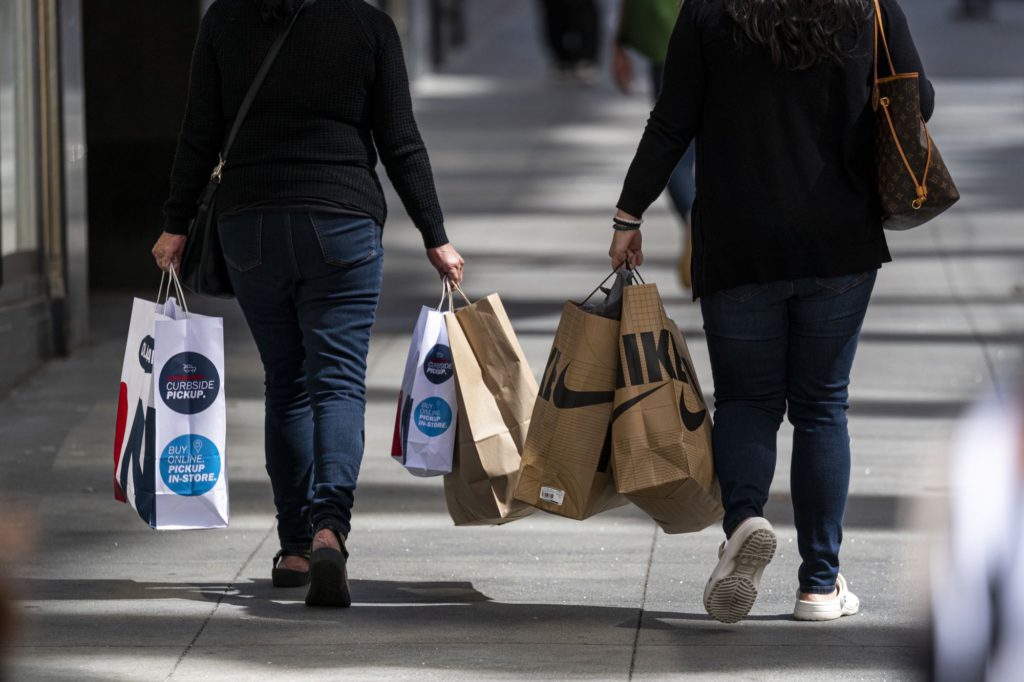
(Bloomberg) — US retailers are bracing for a slower-than-normal Black Friday as high inflation and sagging consumer sentiment erode Americans’ demand for material goods. 

Bloomberg News will be following the latest developments as information becomes available throughout the day. All time stamps reflect the US East Coast. 

In Westchester, ‘Not That Different Than Usual’ (12:55 p.m.)

The Target store in Mount Vernon, New York, had discounts on items such as hair accessories, off 30%, and winter boots for women, off 40%. There were markdowns on electronics, too: A 55-inch Samsung TV was discounted to $350 from $630. But the store was only about twice as busy as usual, and most shoppers were only walking out with a modest amount of purchases.

“The sales are OK. It’s not that different than usual,” said Cynthia Carroll, 58, who was with a relative who had bought a gift for her: a Cuisinart AirFryer toaster that was discounted to $159 from $229.

A Bed Bath & Beyond store in the same complex advertised discounts of 40% to 75%, but the occasion was a going-out-of-business sale, not Black Friday. Most of the store’s shelves were already barren, and no holiday music accompanied the deliberations on discounted sheet sets and picture frames.

Salesforce’s Garf: Inflation Boosting Sales Total (12:55 p.m.)

The 9% boost in online sales in the US on Thanksgiving Day, reported by Salesforce, is largely fueled by the highest inflation in decades, said Rob Garf, vice president of retail at the company.

“People are just plainly buying less products because their dollar isn’t going as far as it used to,” Garf said.

As the rising cost of fuel and groceries makes many consumers more cautious to significantly boost spending, they’re seeking — and finding — major discounts. On Thanksgiving Day, the deepest price cuts were on home appliances and apparel, according to Salesforce. 

Also making an appearance at the top of the list were high-end handbags, which Salesforce said were seeing an average discount rate of 30%. That’s notable because high-end brands have largely refrained from major markdowns in the past two years given robust demand. 

‘Feels Like a Normal Day’ in Chicago (12:14 p.m.)

At a Target store on Chicago’s North Side, the parking lot was barely half full at about 9 a.m. local time. Shoppers were greeted with $3 ornaments and discounted Christmas trees when entering, and the store seemed calm and relatively quiet.

“It feels like a normal day,” said Miguel Martinez, 35, who said he woke up early and decided to come check out the Black Friday deals with his 12-year-old daughter, Jaylen. He described the discounts as “pretty good,” and pointed to a couple of Amazon Echo Dot smart speakers that he picked up for $13 from the electronics department.

In his cart, Martinez also had toys for friends and family, including Nerf guns and a Disney Encanto doll. Martinez, a warehouse supervisor, said inflation has made him cut back on certain things for himself like cable TV and Netflix in recent months to afford presents for his four children. “I really do it for the kids,” he said.

In Target’s toy department, Therese Pociask, 60, was shopping for her own small home day-care center, and also for gifts for her nieces and nephews. In her cart were an Epsom-salt gift pack, Fujifilm Instax camera film, three stuffed dinosaurs and a puzzle.

“I’m looking for sales and deals,” she said. “This one is pretty good,” she said pointing to a buy-one-get-one-50%-off toy discount.

“I’m trying not to cut back,” Pociask said of the holidays this year. She’s planning to spend about $2,000 — about the same as last year — in total for all her family and the day-care, but says inflation is making it tough to get all her shopping done without overspending.

“I’m trying to stay within my budget, but I’m finding I have to spend more for it to look the same,” she said.

Deals Sweeter This Year Than Last, Salesforce Says (12:14 p.m.) 

Consumers are finding better deals this shopping season than last year, according to data from Salesforce Inc.

The average consumer discount rate for Thanksgiving Day shoppers online in the US was 31%, Salesforce says. That’s 7% higher than 2021, when retailers didn’t have to put as many items on sale because demand was strong and a lot of merchandise was held up at snarled ports.

But this year’s Thanksgiving Day discounts — which set the stage for better promotions on Black Friday and over the weekend — are still slightly lower than 2019 levels, when the average rate was 33%, according to Salesforce.

After a couple of abnormal years, the start to this holiday season shows that trends are normalizing in terms of discount levels and timing. 

Last year, US consumers shopped relatively earlier on concerns that supply-chain problems would lead to a lack of merchandise. “We questioned whether the consumer would be reconditioned to buy early and what the data show us so far is that consumers have snapped back,” said Rob Garf, vice president of retail at Salesforce. “Life somewhat feels normal again and shopping also feels somewhat normal again.”

Thinner Black Friday Crowds Seen Going Forward (12:14 p.m.)

While the pandemic impact may be waning, there still seems to be a notable lack of crowds at many stores.  

While traffic levels seem higher than a year earlier, “we think the historic raucous atmosphere of Black Friday may be in the past,” writes Piper Sandler analyst Edward Yruma in a research note, who says this is his team’s 18th year of “multistate” Black Friday store visits.

The relative calm may be attributed to promotions that “definitely shifted” to earlier in the year on the heels of Amazon’s October Prime Early Access Sale. Additionally, both Walmart and Target have run “aggressive promotions” throughout November and other apparel retailers began promotions earlier in the week, he said.

While in-store traffic has improved from the pandemic-related slowdowns in 2020 and 2021, it hasn’t returned to previous levels. 

One Mom Seeks Shoes and Cologne at a Quiet Macy’s in Connecticut (11:55 a.m.)

The Macy’s in Stamford, Connecticut, was neat and orderly — maybe a little too neat and orderly on a day associated with shopping chaos. The furniture section was nearly deserted, though there were more shoppers looking at shoes.

Kris Adler, a mother of two teenage sons in her mid-fifties, said she was looking for “festive shoes” for herself, and eyed a black, high-top sparkly sneaker. Her sons had already provided her with a list of mostly sporting equipment and cologne, she said. “The young men are big on cologne,” she told Bloomberg. She came shopping thanks to the 13-year-old who knew the schedules and wanted something to do, she said. “Some algorithm on whatever platform he’s using — somebody got him,” she said.

Discounts throughout the store varied, with racks of kids clothing marked down 60%, though the Adidas track suits had only 25% off.

At the checkout line in the toys section, where there was no wait, the teller said the store had prepared for more shoppers, and thanked this reporter for coming.

Beware Retail Industry Stocks, Analyst Says (11:05 a.m.)

One purchase investors should think twice about during the holidays is retail stocks, says Michael Baker, an analyst at D.A. Davidson.

Don’t get him wrong, he’s bullish on the sector for 2023. But “retail almost always underperforms from the day after Thanksgiving through year end,” he said in a note to clients. “From a tactical perspective, we advise shorter-term caution on the group.”

Going back to 2010, retailer shares on average have been little changed during the holiday season, while the S&P 500 has climbed 1.8%, Baker said. And retail industry shares have lagged nine of the last 12 years. The worst performers tend to have the highest holiday exposure such as Best Buy Co. and Dick’s Sporting Goods Inc. By contrast, Lowe’s Cos. and Home Depot Inc. have been safer bets during this time of the year, he said.

In a separate report, Cowen & Co. analyst Oliver Chen named Macy’s Inc., Walmart Inc. and Ulta Beauty Inc. as his “top Black Friday holiday stocks.” Each will benefit from product diversification and value positioning, he said.

Consumers Likely to Shop Later, Cowen Says (11:01 a.m.)

US shoppers will probably return to one of their pre-pandemic habits this year: procrastination. That’s according to Oliver Chen, a retail analyst at Cowen & Co., and there’s good reason for it given the industry backdrop.

Amid last year’s supply-chain snarls, the fear of finding empty shelves prompted many consumers to stock up on holiday merchandise early in the season. Now, many retailers are struggling to pare bloated inventories, and that’s pushing them to return to pre-pandemic discounting levels. Shoppers, meanwhile, are struggling to keep up with inflation.

As a result, more US consumers will take a wait-and-see approach this year in hopes that retail prices will get even lower as Christmas gets closer, Chen said. There’s also a calendar effect, with an extra Saturday between Thanksgiving and Christmas. He predicts a holiday sales increase of 5% to 7%, down from last year’s gain of almost 14%. The five-year average is 6.7%, Chen said, citing National Retail Federation data.

Shopify Sees Bigger Thanksgiving Gain Than Adobe (9:40 a.m.) 

Data from software provider Shopify Inc., which powers e-commerce platforms for small businesses, show that the average spend per cart on Thanksgiving Day was 3.8% higher than last year. That might not point to higher sales volumes, but instead increases in prices due to higher inflation. 

The Shopify data also showed an increase in the number of sales made on cell phones rather than on desktops, suggesting that more consumers were looking for deals while away from their desks. The apparel and accessories category was the top seller in the US yesterday, followed by health and beauty, Shopify found.

Thanksgiving Sales Rise 2.9%, Adobe Says (9:40 a.m.)

Online sales climbed 2.9% to $5.29 billion on Thanksgiving Day, Adobe Analytics said Friday. That’s slightly ahead of Adobe’s estimate for the overall holiday season, which the company sees expanding 2.5% from last year. On Black Friday itself, Adobe predicts only a 1% increase in online sales, to $9 billion.

Taking a step back, these numbers — which aren’t adjusted for inflation — show the challenge facing retailers. The US consumer price index climbed 7.7% during the 12 months ending in October. So with e-commerce rising in the low single digits, unit sales are probably down.

Salesforce, using a different methodology, reported a more robust 9% gain in online sales to $7.5 billion. Activity jumped between 6 p.m. and 10 p.m. Eastern time and 78% of traffic came through mobile phones, suggesting that people did a lot of shopping from the couch after their Thanksgiving meals.

UK Deliveries Crunched by Postal Strike (9:40 a.m.) 

One of the challenges for UK retailers this Black Friday will be how to deliver gifts bought online. UK postal workers at Royal Mail are striking over pay and conditions on Nov. 24 and 25 with further walkouts planned in the leadup to Christmas, the busiest time of year.

Amazon.com Inc., a big discounter for Black Friday, is making deliveries using e-bikes in key British cities to reduce its emissions. The online behemoth has opened e-bike delivery hubs in Manchester and London in time for the discount event. Amazon is investing £300 million ($362 million) over five years to reduce its transport emissions in the UK.

Retailers are seeking to ease the load on warehouse staff at the busiest time of year. UK electronics retailer Currys Plc has spent more than £250,000 on “robotic exoskeleton suits” to help warehouse workers spread the weight of lifting heavy loads and prevent injuries. Currys says its distribution site in Newark, England, will deliver 8.7 million units of stock this Black Friday period, with the retailer offering as much as £500 off televisions.

Pitney Bowes Says Gen Z More Likely to Buy Online (8:26 a.m.) 

Half of Gen Z consumers who participated in a Pitney Bowes survey say they’ll be shopping online more this season during Black Friday and Cyber Monday than they did last year. Across age groups, one in four consumers plan to shop online more this year.

Younger consumers are more comfortable with online shopping, Pitney Bowes said in a separate report. And Gen Z is more likely to purchase from digital brands that don’t have physical stores and advertise on Instagram and TikTok.

With inflation putting the squeeze on holiday budgets, many consumers are looking online for deals. As retailers try to offload a glut of inventory, promotions won’t be hard to find.

Hot Wheels, Paw Patrol Are Top Sellers (8:26 a.m.) 

In addition to tracking online sales totals, Adobe Analytics has been keeping an eye on hot sellers during the first three weeks of November. The list includes some perennial favorites such as air fryers, smart speakers and Apple iPads. The Nintendo Switch is the top-selling gaming console, while brisk-selling toys include Hot Wheels and Paw Patrol. Among categories, kitchenware sales are up 155% from October, which is a relief for retailers since home goods have been slumping this year. Also rising: buy-now-pay-later options, as shoppers’ savings accounts dwindle and inflation takes a toll.

Inditex Workers Start the Holiday Season With a Strike (8:11 a.m.)

Inditex, the owner of the Zara fashion chain, is facing two days of strikes in its home market as the holiday shopping season begins. As many as 13 shops closed on Thursday in the Spanish province of A Coruña, in Galicia, as workers walked off their jobs to demand a €440 ($458) monthly pay increase for staff earning €1,058. Unions are expected to shut most of the 44 Inditex-owned shops in the province, including a five-floor flagship Zara store in the center of A Coruña city.

The protest highlights growing demands from workers for wage increases in the face of soaring prices. In spite of the cost-of-living crisis, Inditex has been able to pass on costs to shoppers and posted its biggest profit margins in seven years in September.

Fewer Gifts Expected Amid High Inflation (7:34 a.m.)

Inflation, not the Grinch, is stealing Christmas this year. More than half (51%) of the 1,000-plus respondents to a RetailMeNot holiday trends survey say they’re coping with sky-high inflation this year by purchasing fewer gifts.

Polled shoppers plan to spend $725 for the holidays — 8% less than last year. More than a third (36%) say they’re going to use more coupons to manage higher prices. And 22% say they’re going to purchase more used items.

RetailMeNot’s data also show that 53% of respondents plan to shop on Black Friday and 55% will shop Cyber Monday. Many consumers have already started, with 52% taking advantage of pre-Black Friday deals.

E-Commerce Growth Seen Slowing (7:34 a.m.)

Retailers’ digital sales remain higher than in 2019, but growth has decelerated from the past two years, said David Bassuk, global co-head of the retail practice at consulting firm AlixPartners. Consumers are still using online channels to get a sense for what deals are available, but that won’t be the only option this year.

“The stores are back,” Bassuk said. “The importance of the sales associate in the store is increasing once again.”

Black Friday Minus Thanksgiving: UK Stays Active (7:02 a.m.)

With inflation running at the highest in more than four decades in the UK, shoppers are actively looking for bargains this Black Friday. Almost 70% of British shoppers plan to participate in the discount event imported from the US, up from 57% last year, according to McKinsey & Co. Online searches for Black Friday sales have risen by a quarter since last year.

With most people in the UK not celebrating Thanksgiving, Black Friday has morphed into a weeklong and in some cases a monthlong event. It started even earlier than normal this year as retailers try to encourage shoppers to spend. British department store John Lewis Partnership Plc and drugstore chain Boots both offered deals from the start of the month. 

Adobe Sees 2.5% Growth — Without Inflation (12:01 a.m.)

A key question this Black Friday will be how much higher prices are contributing to better sales numbers.

Overall spending this holiday season is seen growing 2.5% from a year ago, compared with 8.6% last year and a whopping 32% in 2020, according to data from Adobe Inc. Those figures aren’t adjusted for inflation, meaning that sales could be down by volume given that consumer prices are up 7.7% from a year ago.

Telsey Sees Profits Amid Discounts as Key (12:01 a.m.) 

Success for retailers this holiday season will be determined by which companies can maintain their discounts and still come out profitable, said Dana Telsey, chief executive officer of Telsey Advisory Group, in a Nov. 23 interview on Bloomberg Television. There’s still more inventory “to get through as we enter the holiday season, which is going to lead to good deals and good values for the consumer,” she said.

Telsey also said that brick-and-mortar sales are likely to get a big boost this year because “we have not had this type of in-person shopping for two years during the holiday season” due to Covid-19.

–With assistance from Deena Shanker, Tonya Garcia, Daniela Sirtori-Cortina, Clara Hernanz Lizarraga, Olivia Rockeman, Katie Linsell, Brendan Case, Janet Freund and Leslie Patton.

(An earlier version corrected a month in the introduction.)

More stories like this are available on bloomberg.com

©2022 Bloomberg L.P.

Bitwise Files for Bitcoin Futures ETF Despite Crypto ‘Dark Days’

(Bloomberg) — Historic turmoil in cryptocurrency markets sparked by FTX’s implosion hasn’t stopped one funds issuer from moving forward on a new investment product tied to Bitcoin. 

Bitwise on Wednesday filed an application to launch the Bitcoin Strategy Optimum Yield ETF, which would trade under the ticker BITC. The fund would offer managed exposure to Bitcoin futures contracts traded on the CME, and investments in short-term debt securities, according to the filing. It would not hold the token directly as the US Securities and Exchange Commission has yet to approve such a product.

The filing did not specify how much the fund would charge in management fees. 

“This is as much a signal as a filing — Bitwise is telling their clients and the rest of the world that despite the dark days, Bitcoin is alive and well and they still believe in the future,” said Eric Balchunas at Bloomberg Intelligence.

The crypto market is currently undergoing one of its most turbulent stretches, with the sudden downfall of the once-darling FTX digital-assets exchange wreaking havoc for other industry players who had already been rocked by several crises earlier in the year. Prices for all manner of tokens, including Bitcoin and Ether — the two largest by market value — have dropped. Bitcoin was trading around $16,500 on Friday, down from nearly $69,000 about a year ago. Ether hovered around $1,180, having traded above $4,000 in December of last year. 

Listen to “Bloomberg Crypto” podcast: Assessing BITO One Year In (Podcast)

BITC’s strategy, according to the filing, is designed such that instead of its futures contracts automatically rolling into the next-available contract based on a predefined schedule, it would roll into the one that “exhibits the highest implied roll yield under current market conditions.” 

US investors got their first Bitcoin futures ETF last year, when ProShares launched its Bitcoin Strategy ETF (ticker BITO). That fund has closely tracked the price of Bitcoin this year, with each down roughly 64% since the start of 2022. 

From Bloomberg Intelligence: What the Crypto Crash Means for ETFs (Podcast)

More stories like this are available on bloomberg.com

©2022 Bloomberg L.P.
Aveva Investors Back Schneider’s $11.9 Billion Takeover

(Bloomberg) — Aveva Group Plc shareholders backed a £9.9 billion ($11.9 billion) buyout offer from Schneider Electric SE, after a prolonged battle from investors who wanted a higher price for the UK software company. 

Some 83% of investors voted in favor, according to a company statement on Friday, giving a green light for French industrial conglomerate Schneider to buy the roughly 41% of Aveva it doesn’t already own. The acquisition now faces a final court hearing in the first quarter of 2023, after which the deal would conclude.

Aveva shares rose 0.3% to £31.91 in London, while Schneider dropped 0.3% to 142.32 euros at the close of trading in Paris.

Schneider’s offer is a 47% premium to Aveva’s share price on Aug. 23, the day before Bloomberg News first reported on a possible bid. Earlier in November, Schneider upped that bid by 4% to £32.25 per share, after claims from some investors that its initial offer was opportunistic in the wake of a rout in technology stock. Aveva stock had declined 47% in the 12 months before Bloomberg reported that Schneider was weighing the buyout.

Schneider, which already owns about 59% of Aveva, had said the latest price will be its final offer unless a rival bidder emerges. Hedge fund Davidson Kempner Capital Management, which was building a stake in Aveva, as well as M&G and Canada’s Mawer Investment Managementwere among the shareholders who resisted the deal at the previous price.

Cambridge, England-based Aveva provides software tools for utilities, oil and gas producers, transportation firms and other companies, according to its website. Schneider took control of the group after agreeing in 2017 to combine its own industrial software business with the British company’s. Aveva has since bulked up further through acquisitions, buying SoftBank Group Corp.-backed industrial software maker Osisoft in 2020 at a valuation of $5 billion including debt.

(Updates with closing shares. A previous update corrected the value of the premium.)

More stories like this are available on bloomberg.com

©2022 Bloomberg L.P.

Amazon Likely to Settle EU Antitrust Cases by the End of Year

(Bloomberg) — Amazon.com Inc. is poised to settle European antitrust probes over how the U.S. ecommerce giant uses rivals’ sales data and whether it unfairly favors its own products. 

The European Commission is likely to accept Amazon’s binding proposals by the end of the year — that includes a commitment to stop using data on independent sellers on its marketplace for its competing retail business — according to people familiar with the matter.

A deal would relieve some of the regulatory pressure Amazon has faced over accusations it has become too dominant a force in European ecommerce. It’s still subject to scrutiny from Germany’s Federal Cartel Office and the UK’s competition watchdog.

The company’s settlement offer also promises “to apply equal treatment to all sellers when ranking their offers for the purposes of the selection of the winner” for a “buy box,” where Amazon highlights sellers of a particular product.

While the settlement is expected to be rubber stamped next month, the timing could be pushed into next year the people said, who asked not to be identified because the negotiations are private.

Spokespeople for the commission and Amazon declined to comment.

Amazon has previously said that while it disagrees with some of the conclusions made by the bloc it has “engaged constructively with the commission to address their concerns and preserve our ability to serve European customers.”

Amazon Antitrust Offer Gets Guarded Welcome From EU’s Vestager

More stories like this are available on bloomberg.com

©2022 Bloomberg L.P.
Nigerian Startup to Raise $100 Million in EV Push

(Bloomberg) — Metro Africa Xpress Inc., -a Nigerian vehicle subscription startup, plans to raise $100 million to deploy electric vehicles in 10 African countries as demand for cheap, low-emissions transport increases. 

The company, backed by private-equity firm Lightrock LLP, expects to raise the funds by “the end of 2023,” enabling it to operate in countries including Cameroon, Uganda and Egypt, David Hoyme, director of international expansion, said in an interview. The firm currently has operations in Nigeria and Ghana.

The cost of owning EVs is cheaper than vehicles that use internal combustion engines. In Kenya, it costs 67% less, according to McKinsey & Co. Still, in a continent that largely depends on second-hand vehicles and suffers chronic power shortages, building an electric vehicle ecosystem may be challenging.

Max, as the company is known, raised $31 million last year. Hoyme, who previously worked at Goldman Sachs Group Inc. and Eventide Asset Management, plans to take advantage of his experience in negotiating partnerships to grow the company, he said.

Founded in 2015, the firm has a vehicle fleet — mainly three-wheeler rickshaws and sedans — of 9,000, of which just about 5% are electric. It plans to grow the proportion of electric vehicles to 70% by 2026, Hoyme said.

The Nigerian startup has partnerships with vehicle producers such as Yamaha Corp. and ride-hailing platform Bolt Technology OU as well as lenders. It is exploring further agreements that will help increase the supply of EV components including batteries to ease the adoption and expansion of the transport model on the continent, Hoyme said.


(Corrects description of startup in headline and lead)

More stories like this are available on bloomberg.com

©2022 Bloomberg L.P.
Twitter Chaos Leaves UK Regulator With Nobody to Meet

(Bloomberg) — As the UK regulator prepares to implement sweeping online safety rules in the UK, its directors spent last week in the US meeting executives from the world’s biggest web platforms, including Meta Platforms Inc., Alphabet Inc. and Bytedance Ltd’s TikTok.

There was one conspicuous omission: Elon Musk’s Twitter Inc. A scheduled meeting fell through after all the representatives in touch with Ofcom left Twitter, according to two people familiar with the matter, who asked not to be named because the plans were private.

Musk has instigated a dramatic restructuring that initially cut the firm’s headcount in half and triggered others to quit, including head of trust and safety Yoel Roth. 

“We met with a range of platforms in the US, but Twitter wasn’t among them for this trip,” an Ofcom spokesman said by phone. The two sides couldn’t make the diaries work, he said in a follow-up email.

EXPLAINER: How EU Could Frustrate Musk’s Plans for Twitter

Despite the sudden departures, engagement between Ofcom and Twitter hasn’t stopped entirely, one of the people said. 

Twitter did not immediately respond to a request for comment.

It’s the latest sign of how Musk’s Twitter takeover has interrupted important activity at the company at a time when it’s attracting regulatory scrutiny.

During the US trip, Ofcom’s Chief Executive Officer Melanie Dawes and director of online content Kevin Bakhurst met a wide range of firms that might be subject to the UK’s Online Safety Bill, expected to come into force next year. Meetings included Reddit, Inc., Snap Inc., Roblox, Vimeo, Pinterest, Patreon, Eventbrite and Tripadvisor, the regulator said in a post on LinkedIn on Wednesday. 

The bill has not been finalized yet but will require companies that host user-generated content to show how they protect users or face large fines.

Bakhurst had previously expressed concerns about Twitter’s job cuts.

“The company seems to be losing some of the most important and talented people — including in content moderation and public policy,” he tweeted earlier this month. “Online safety regulation is coming in the UK and the EU. I don’t understand the strategy.”

More stories like this are available on bloomberg.com

©2022 Bloomberg L.P.
Close Bitnami banner
Bitnami