Bloomberg

US Stocks Fluctuate as Traders Mull Rates, China: Markets Wrap

(Bloomberg) — US stocks fluctuated in subdued trading as investors assessed prospects for less-aggressive central bank tightening and weighed China’s latest move to stimulate its economy. 

The S&P 500 wavered. The market is running into resistance near the S&P 500’s 200 day moving average, resulting in some choppiness during Friday’s session, said Julian Emanuel, Evercore ISI’s chief equity and quantitative strategist.

The tech-heavy Nasdaq 100 dropped, but pared earlier losses. The dollar strengthened and Treasury yields rose. The Stoxx 600 Index is on course for a sixth week of gains, its longest winning streak in a year. 

“It’s a slow day with US market holiday,” said Marija Veitmane, senior multiasset strategist at State Street Global Markets. “We’re seeing a bit of profit taking and position adjustment post a strong risk rally last week.”

US stocks are still poised to end the holiday-shortened trading week higher after recent commentary from Federal Reserve officials that supported the case for a slower pace of interest-rate increases. Fed minutes published Wednesday showed that officials concluded the central bank should soon moderate the pace of rate hikes to mitigate overtightening risks.

“Central bankers continue to push the hawkish narrative, though the minutes, released Wednesday, point to even the Fed being near to the end of their planned hiking,” said Peter Tchir of Academy Securities.

All eyes will be on the jobs report next week and on Fed Chair Jerome Powell and New York Fed President John Williams, who are among central bank officials scheduled to speak. Both officials will make clear that a tight labor market and elevated services inflation will keep the Fed hiking for longer, strategists with TD Securities wrote in a note.

“As markets welcome the prospect of smaller hikes, we expect them to counter that by emphasizing the need to reach an appropriately higher terminal rate,” they said.

Trading on Monday will also hinge on Black Friday sales and further information on the virus outbreak in China, Evercore ISI’s Emanuel said.


China’s central bank on Friday cut the amount of cash lenders must hold in reserve for the second time this year, an escalation of support for an economy racked by surging Covid cases and a continued property downturn. US-listed Chinese stocks fell and are set for their first weekly decline in four weeks.

“How effective that will prove to be when cities are seeing restrictions and effective lockdowns reimposed is hard to say,” said Craig Erlam, senior market analyst at Oanda. “But combined with other measures to boost the property market and ease Covid curbs, the cut could be supportive over the medium term when growth remains highly uncertain.”

Oil recouped some of its third weekly loss as the European Union weighed a higher-than-expected price cap on flows of Russian crude and slowdown concerns threaten the outlook for energy demand. Gold is poised for a modest weekly gain.

Some of the main moves in markets:

Stocks

  • Futures on the S&P 500 were little changed as of 10:30 a.m. New York time
  • Futures on the Dow Jones Industrial Average rose 0.4%
  • The Stoxx Europe 600 fell 0.2%
  • The MSCI World index rose 0.4%

Currencies

  • The Bloomberg Dollar Spot Index rose 0.3%
  • The euro fell 0.2% to $1.0389
  • The British pound fell 0.4% to $1.2070
  • The Japanese yen fell 0.5% to 139.29 per dollar

Cryptocurrencies

  • Bitcoin fell 0.2% to $16,518.55
  • Ether fell 0.5% to $1,189.82

Bonds

  • The yield on 10-year Treasuries advanced three basis points to 3.72%
  • Germany’s 10-year yield advanced 13 basis points to 1.98%
  • Britain’s 10-year yield advanced eight basis points to 3.12%

Commodities

  • West Texas Intermediate crude rose 0.2% to $78.11 a barrel
  • Gold futures rose 0.3% to $1,764.90 an ounce

This story was produced with the assistance of Bloomberg Automation.

–With assistance from Brett Miller, Natalia Kniazhevich, Isabelle Lee and Vildana Hajric.

More stories like this are available on bloomberg.com

©2022 Bloomberg L.P.

World’s Biggest Nuclear-Fusion Project Faces Delays as Component Cracks

(Bloomberg) — Cracks in a key silver-lined component are creating new delays and cost overruns in the $23 billion project to prove whether nuclear fusion can generate limitless clean energy.

The International Thermonuclear Experimental Reactor, or ITER, under construction in southern France is being funded by the European Union and countries including China, India, Japan, Russia and South Korea. The world’s biggest experiment aims to show that mimicking the power that makes stars shine can produce clean energy that could help slow global warming on Earth.

But new ITER Director-General Pietro Barabaschi warned members this week the project faces problems that are potentially “extensive,” along with new requirements for time and money that “will not be insignificant.” 

The project has been plagued by unexpected challenges over the past 12 months. Just as it started sorting out logistics disrupted by the pandemic, Moscow’s invasion of Ukraine complicated the supply of critical components manufactured in Russia. In May, the project’s long-time chief Bernard Bigot died. The first task of his replacement, the Italian engineer Barabaschi, has been to investigate problems that will prevent the reactor from starting up in 2025. 

At issue are two South Korean-made components: thermal shields built by SFA Engineering Corp. and vacuum vessel sectors made by Hyundai Heavy Industries Co. Neither company responded to Bloomberg requests for comment outside of business hours. 

The thermal shield, which is lined with 5 tons of pure silver and designed to contain heat 10 times hotter than the sun, showed cracks along cooling pipes, ITER reported. The vacuum vessel sectors, each weighing the equivalent of 300 cars and as tall as a telephone pole, show slight differences in manufacturing that complicates the welding process used to put them together. 

So far, ITER’s governing board has taken the setbacks in its stride. At an extraordinary meeting convened this month, it ordered Barabaschi to come up with a new budget and time line to be presented next year. 

“What was remarkable at the ITER council was the lack of finger pointing,” ITER spokesman Laban Coblentz said Friday in an interview. “It has been a very solutions-oriented discussion.”

More than 10 kilometers (6.2 miles) of pipe will need to be ripped out and reassembled on site, with engineers forced to figure out new ways of putting together the dizzyingly complex reactor. More than a million individual pieces have been commissioned to go into the project, which ITER figured was close to 70% complete before the defects were discovered. 

The delay at ITER will give a new generation of closely held fusion startups time to catch up. Bill Gates, Jeff Bezos and Peter Thiel are among a group of billionaires pursuing fusion privately. The National Academies of Science this year called on the US to accelerate plans to build a pilot fusion reactor capable of generating electricity by 2035. 

“Companies have been learning enormously from this first-of-its kind project,” said ITER’s Coblentz, dismissing suggestions that the delays could dampen enthusiasm. “The goal here isn’t to build just a single machine but to show that fusion power is feasible and to make that happen.”

More stories like this are available on bloomberg.com

©2022 Bloomberg L.P.

Thanksgiving Online Spending Increased: Black Friday Update

(Bloomberg) — US retailers are bracing for a slower-than-normal Black Friday as high inflation and sagging consumer sentiment erode Americans’ demand for material goods. 

Bloomberg News will be following the latest developments as information becomes available throughout the day. All time stamps reflect the US East Coast. 

Shopify Sees Bigger Thanksgiving Gain Than Adobe (9:40 a.m.) 

Data from software provider Shopify Inc., which powers e-commerce platforms for small businesses, show that the average spend per cart on Thanksgiving Day was 3.8% higher than last year. That might not point to higher sales volumes, but instead increases in prices due to higher inflation. 

The Shopify data also showed an increase in the number of sales made on cell phones rather than on desktops, suggesting that more consumers were looking for deals while away from their desks. The apparel and accessories category was the top seller in the US yesterday, followed by health and beauty, Shopify found.

Thanksgiving Sales Rise 2.9%, Adobe Says (9:40 a.m.)

Online sales climbed 2.9% to $5.29 billion on Thanksgiving Day, Adobe Analytics said Friday. That’s slightly ahead of Adobe’s estimate for the overall holiday season, which the company sees expanding 2.5% from last year. On Black Friday itself, Adobe predicts only a 1% increase in online sales, to $9 billion.

Taking a step back, these numbers — which aren’t adjusted for inflation — show the challenge facing retailers. The US consumer price index climbed 7.7% during the 12 months ending in October. So with e-commerce rising in the low single digits, unit sales are probably down.

Salesforce Inc., using a different methodology, reported a more robust 9% gain in online sales to $7.5 billion. Activity jumped between 6 p.m. and 10 p.m. Eastern time and 78% of traffic came through mobile phones, suggesting that people did a lot of shopping from the couch after their Thanksgiving meals.

UK Deliveries Crunched by Postal Strike (9:40 a.m.) 

One of the challenges for UK retailers this Black Friday will be how to deliver gifts bought online. UK postal workers at Royal Mail are striking over pay and conditions on Nov. 24 and 25 with further walkouts planned in the leadup to Christmas, the busiest time of year.

Amazon.com Inc., a big discounter for Black Friday, is making deliveries using e-bikes in key British cities to reduce its emissions. The online behemoth has opened e-bike delivery hubs in Manchester and London in time for the discount event. Amazon is investing £300 million ($362 million) over five years to reduce its transport emissions in the UK.

Retailers are seeking to ease the load on warehouse staff at the busiest time of year. UK electronics retailer Currys Plc has spent more than £250,000 on “robotic exoskeleton suits” to help warehouse workers spread the weight of lifting heavy loads and prevent injuries. Currys says its distribution site in Newark, England, will deliver 8.7 million units of stock this Black Friday period, with the retailer offering as much as £500 off televisions.

Pitney Bowes Says Gen Z More Likely to Buy Online (8:26 a.m.) 

Half of Gen Z consumers who participated in a Pitney Bowes survey say they’ll be shopping online more this season during Black Friday and Cyber Monday than they did last year. Across age groups, one in four consumers plan to shop online more this year.

Younger consumers are more comfortable with online shopping, Pitney Bowes said in a separate report. And Gen Z is more likely to purchase from digital brands that don’t have physical stores and advertise on Instagram and TikTok.

With inflation putting the squeeze on holiday budgets, many consumers are looking online for deals. As retailers try to offload a glut of inventory, promotions won’t be hard to find.

Hot Wheels, Paw Patrol Are Top Sellers (8:26 a.m.) 

In addition to tracking online sales totals, Adobe Analytics has been keeping an eye on hot sellers during the first three weeks of November. The list includes some perennial favorites such as air fryers, smart speakers and Apple iPads. The Nintendo Switch is the top-selling gaming console, while brisk-selling toys include Hot Wheels and Paw Patrol. Among categories, kitchenware sales are up 155% from October, which is a relief for retailers since home goods have been slumping this year. Also rising: buy-now-pay-later options, as shoppers’ savings accounts dwindle and inflation takes a toll.

Inditex Workers Start the Holiday Season With a Strike (8:11 a.m.)

Inditex, the owner of the Zara fashion chain, is facing two days of strikes in its home market as the holiday shopping season begins. As many as 13 shops closed on Thursday in the Spanish province of A Coruña, in Galicia, as workers walked off their jobs to demand a €440 ($458) monthly pay increase for staff earning €1,058. Unions are expected to shut most of the 44 Inditex-owned shops in the province, including a five-floor flagship Zara store in the center of A Coruña city.

The protest highlights growing demands from workers for wage increases in the face of soaring prices. In spite of the cost-of-living crisis, Inditex has been able to pass on costs to shoppers and posted its biggest profit margins in seven years in September.

Fewer Gifts Expected Amid High Inflation (7:34 a.m.)

Inflation, not the Grinch, is stealing Christmas this year. More than half (51%) of the 1,000-plus respondents to a RetailMeNot holiday trends survey say they’re coping with sky-high inflation this year by purchasing fewer gifts.

Polled shoppers plan to spend $725 for the holidays — 8% less than last year. More than a third (36%) say they’re going to use more coupons to manage higher prices. And 22% say they’re going to purchase more used items.

RetailMeNot’s data also show that 53% of respondents plan to shop on Black Friday and 55% will shop Cyber Monday. Many consumers have already started, with 52% taking advantage of pre-Black Friday deals.

E-Commerce Growth Seen Slowing (7:34 a.m.)

Retailers’ digital sales remain higher than in 2019, but growth has decelerated from the past two years, said David Bassuk, global co-head of the retail practice at consulting firm AlixPartners. Consumers are still using online channels to get a sense for what deals are available, but that won’t be the only option this year.

“The stores are back,” Bassuk said. “The importance of the sales associate in the store is increasing once again.”

Black Friday Minus Thanksgiving: UK Stays Active (7:02 a.m.)

With inflation running at the highest in more than four decades in the UK, shoppers are actively looking for bargains this Black Friday. Almost 70% of British shoppers plan to participate in the discount event imported from the US, up from 57% last year, according to McKinsey & Co. Online searches for Black Friday sales have risen by a quarter since last year.

With most people in the UK not celebrating Thanksgiving, Black Friday has morphed into a weeklong and in some cases a monthlong event. It started even earlier than normal this year as retailers try to encourage shoppers to spend. British department store John Lewis Partnership Plc and drugstore chain Boots both offered deals from the start of the month. 

Adobe Sees 2.5% Growth — Without Inflation (12:01 a.m.)

A key question this Black Friday will be how much higher prices are contributing to better sales numbers.

Overall spending this holiday season is seen growing 2.5% from a year ago, compared with 8.6% last year and a whopping 32% in 2020, according to data from Adobe Inc. Those figures aren’t adjusted for inflation, meaning that sales could be down by volume given that consumer prices are up 7.7% from a year ago.

Telsey Sees Profits Amid Discounts as Key (12:01 a.m.) 

Success for retailers this holiday season will be determined by which companies can maintain their discounts and still come out profitable, said Dana Telsey, chief executive officer of Telsey Advisory Group, in a Nov. 23 interview on Bloomberg Television. There’s still more inventory “to get through as we enter the holiday season, which is going to lead to good deals and good values for the consumer,” she said.

Telsey also said that brick-and-mortar sales are likely to get a big boost this year because “we have not had this type of in-person shopping for two years during the holiday season” due to Covid-19.

–With assistance from Tonya Garcia, Daniela Sirtori-Cortina and Clara Hernanz Lizarraga.

(An earlier version corrected a month in the introduction.)

More stories like this are available on bloomberg.com

©2022 Bloomberg L.P.

Tiantian Kullander, Co-Founder of Crypto Firm Amber, Dies at 30

(Bloomberg) — Tiantian Kullander, the former Morgan Stanley trader who co-founded digital-asset trading platform Amber Group, has died. He was 30.

Kullander “passed away unexpectedly in his sleep” on Nov. 23, Amber said in a statement on its website on Friday. “He led by example with his intellect, generosity, humility, diligence and creativity,” the firm said. 

The crypto entrepreneur, nicknamed “TT,” started Amber in 2017 together with a group of former finance professionals, including Goldman Sachs Group Inc. and Morgan Stanley alumni. The company, whose backers include Singaporean state investment company Temasek Holdings Pte, is in talks to raise about $100 million, Bloomberg News reported earlier this month.  

Five of Amber’s founders — Kullander, Michael Wu, Wayne Huo, Tony He and Luke Li — previously worked together on Morgan Stanley’s fixed-income trading floor in Hong Kong. 

Kullander is survived by his wife and son, according to the statement.

–With assistance from Alfred Cang.

More stories like this are available on bloomberg.com

©2022 Bloomberg L.P.

Crypto Crisis Shrinks ETF Assets in Market That Embraced Them

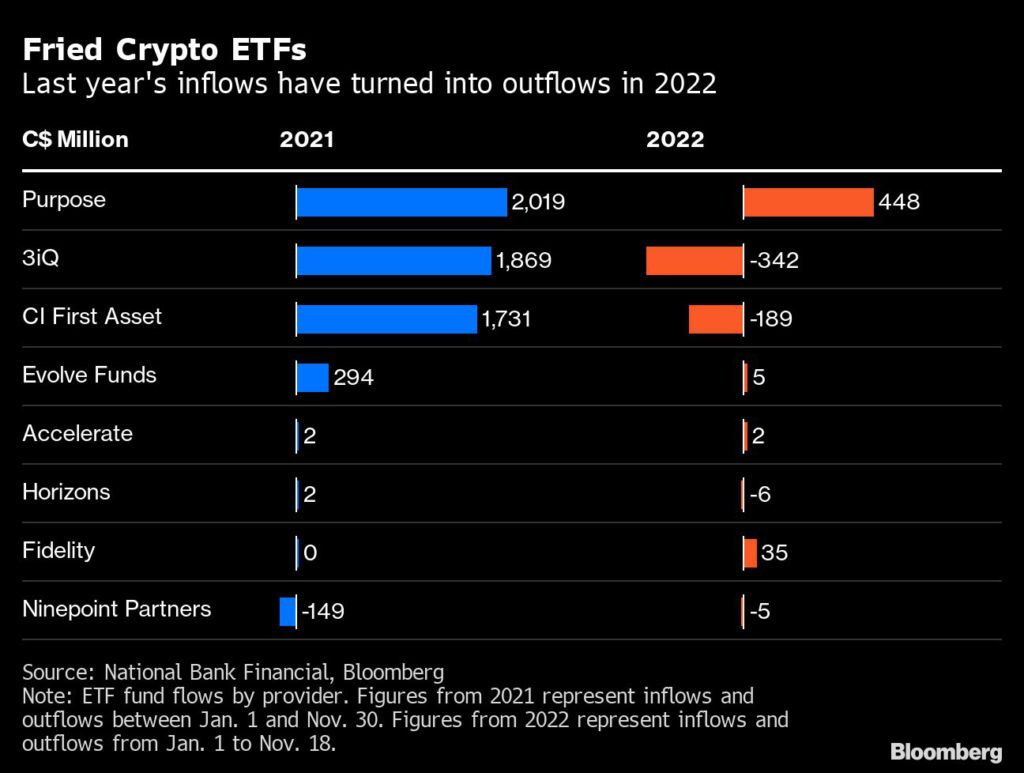
(Bloomberg) — Retail investors in Canada were quick to put money into cryptocurrency exchange-traded funds after regulators allowed a proliferation of products that track Bitcoin, Ether and other digital assets. They’ve lost most of it in a year. 

Canadian-traded crypto ETFs had just C$1.64 billion ($1.22 billion) in assets under management as of Nov. 18, according to calculations from National Bank of Canada analyst Daniel Straus. That’s down more than three-quarters from the C$7.3 billion value in those funds on Nov. 30 last year. 

The collapse of Sam Bankman-Fried’s FTX, on the heels of other bankruptcies in the sector, has dealt a debilitating blow to confidence in digital assets. Other large crypto firms have been shaken as contagion spreads: Genesis Global, a US cryptocurrency broker, is seeking emergency funding to stay afloat, while BlockFi Inc. is also said to be in dire financial straits. 

Wall Street Beat: Why the Genesis Contagion Matters After FTX 

“The effect of FTX has likely led to a lengthening of what would be considered a crypto winter, a period of people’s lack of focus on the space or lack of trust in the space,” Som Seif, chief executive officer of Purpose Investments Inc., said in an interview. 

In a measure of how swiftly the market has changed for risk assets, a single money-market ETF managed by CI Financial Corp. now has more in assets than all the crypto ETFs listed in Canada combined. The CI fund applies the simplest investment strategy imaginable: it puts the cash into interest-paying savings accounts at commercial banks.

The vast majority of the decline in ETFs assets has come from the falling price of Bitcoin and other holdings, not from outflows, which have been small. Crypto ETFs saw C$51 million of outflows year-to-date as of Nov. 18, according to data from Straus — though C$20 million of that came in those first 18 days of this month.

Canada has pushed further than the US in allowing regulated crypto-related products. Cryptocurrencies are classified as commodities for tax purposes, and many coins and tokens are classified as securities. The regulator stepped up its efforts after QuadrigaCX, the country’s largest crypto exchange at the time, collapsed in 2019 and was later ruled to be a fraud and a Ponzi scheme perpetrated by its founder. 

“Firms like FTX are one of the reasons regulators in Canada accepted our exchange-traded products,” 3iQ Corp. Chief Executive Officer Fred Pye said in an interview.    

Still, Canadian crypto-trading platforms and exchange-traded funds tend to hold their assets with custodians in the US, such as Gemini and Coinbase. “Hopefully, this is the impetus for Canada to look at these type of situations and think, ‘Hey, maybe we should onshore these assets now,’” said Dustin Plett, an executive at Paradiso Ventures Inc., a Canadian digital-asset custodian that does business under the name Balance. 

Seif’s Purpose Investments, which launched the first directly backed Bitcoin exchange-traded fund in North America last year, expects demand to rebound over the next several months. “Long-term fundamentally, I continue to believe that more and more individuals and institutions will want to access crypto and the return streams of them,” he said.  

More stories like this are available on bloomberg.com

©2022 Bloomberg L.P.

Aveva Investors Back Schneider Electric’s $11.9 Billion Takeover

(Bloomberg) — Aveva Group Plc shareholders backed a £9.9 billion ($11.9 billion) buyout offer from Schneider Electric SE, after a prolonged battle from investors who wanted a higher price for the UK software company. 

Some 83% of investors voted in favor, according to a company statement on Friday, giving a green light for French industrial conglomerate Schneider to buy the roughly 41% of Aveva it doesn’t already own. The acquisition now faces a final court hearing in the first quarter of 2023, after which the deal would conclude.

Schneider’s offer is a 41% premium to Aveva’s share price on Aug. 23, the day before Bloomberg News first reported on a possible bid. Earlier in November, Schneider upped that bid by 4% to £32.25 per share, after claims from some investors that its initial offer was opportunistic in the wake of a rout in technology stock. Aveva stock had declined 47% in the 12 months before Bloomberg reported that Schneider was weighing the buyout.

Cambridge, England-based Aveva provides software tools for utilities, oil and gas producers, transportation firms and other companies, according to its website. Schneider took control of the group after agreeing in 2017 to combine its own industrial software business with the British company’s. Aveva has since bulked up further through acquisitions, buying SoftBank Group Corp.-backed industrial software maker Osisoft in 2020 at a valuation of $5 billion including debt.

More stories like this are available on bloomberg.com

©2022 Bloomberg L.P.

Amitabh Bachchan Wins Court Order for His Personality Rights

(Bloomberg) — Bollywood actor Amitabh Bachchan won interim protection of his personality and celebrity rights from the Delhi High Court Friday.

The court barred not just identified entities from using Bachchan’s persona, without his consent, but also passed a John Doe order, or an order against world-at-large, from infringing his personality rights.

The lawsuit before the court flagged Bachchan’s name, voice, images, pictures, likeness and his “unique style of dialogue delivery” among the traits which fall under legal protection. Counsel for the actor told the court that mobile applications, telephone numbers and websites had mushroomed that monetized his images or likeness without permission.

“Personality right is a strong right to enforce for persons with high level of identifiability and strength of association,” said Eashan Ghosh, a lawyer specializing in intellectual property rights. “Both these factors hold true for Amitabh Bachchan.”

The victory for one of Bollywood’s biggest stars — whose baritone voice and salt-and-pepper hair is recognized all over India — opens the door for similar cases. Personality or celebrity rights are rights against unauthorized commercial use of one’s persona and have not been codified under any law in India.

The court asked the Indian government’s Department of Telecommunications and telephone service providers to take down web links and take action against parties identified in the case. 

More stories like this are available on bloomberg.com

©2022 Bloomberg L.P.

Aveva Shareholders Vote to Accept Schneider Electric Takeover

(Bloomberg) — Aveva Group Plc shareholders voted in favor of Schneider Electric SE’s offer for the UK software company. 

Schneider increased its bid to £32.25 per share earlier this month, valuing Aveva at £9.86 billion ($11.9 billion). Aveva said Friday 83% of shareholders voted in favor.

Schneider, which already owns about 59% of Aveva, had said the latest price will be its final offer unless a rival bidder emerges. The French industrial conglomerate was battling claims from some investors that its bid was opportunistic after a rout in technology stocks this year.

Hedge fund Davidson Kempner Capital Management, which was building a stake in Aveva, as well as M&G and Canada’s Mawer Investment Management, were among the shareholders who resisted the deal at the previous price.


More stories like this are available on bloomberg.com

©2022 Bloomberg L.P.
Putin Ally Kudrin to Take Yandex Role After President Approves

(Bloomberg) — Alexei Kudrin, a longtime ally of Vladimir Putin, is expected to take a senior role in a restructuring of Yandex NV after winning the Russian president’s blessing to leave government service amid an overhaul of the country’s most prominent technology company following sanctions imposed over Putin’s war in Ukraine.

Kudrin, a former finance minister who’s worked with Putin since the 1990s and won a reputation as a relative economic liberal, is expected to handle the restructuring and sale of Yandex’s main businesses to a Russian investor and may get options for as much as 5% of that company, they said. Some international businesses would be spun off into a new entity with no ties to Russia.

The Russian leader signed off Kudrin leaving his current job as head of a government auditing organization in a meeting with him late Thursday, according to people familiar with the situation who spoke on condition of anonymity to discuss matters that aren’t public. Under the agreement with Putin, Kudrin’s planned role would help protect Yandex from pressure inside Russia and ensure it remained in private hands and under the control of management, they said. 

The deal would mark the end of Yandex’s ambitions to be a global technology player, which have been decimated by the war and the international isolation of Russia that it brought.

The company said on Friday that its board will consider “options to restructure the group’s ownership and governance in light of the current geopolitical environment”. Those options include development of the international divisions of certain services, like self-driving technologies, independently from Russia. Yandex N.V. may divest ownership and control of all other businesses in the Yandex Group, including transferring certain elements of governance to management, according to the statement. The board also expects Yandex to be renamed, with the business to be divested retaining exclusive rights for the use of the Yandex brand.

Yandex, which now controls over 60% of the Russian search market and also includes technology services ranging from ride-hailing to e-commerce, has come under intense pressure both in Russia and abroad since the Feb. 24 invasion. Founder Arkady Volozh resigned as the company’s chief executive officer after the European Union sanctioned him in June for Yandex’s role promoting Russian state media’s version of the war. NASDAQ has indefinitely suspended trading in the company’s shares, once among Russia’s most popular issues among foreign investors.

Volozh, who moved to Israel in 2014, has sought to give up his Yandex stake – his family trust controls 8.5% of its equity and 45% of voting rights, though he transferred those to the board after he was sanctioned –  in exchange for the Kremlin’s informal permission to allow him to keep intellectual property needed to develop some businesses abroad, according to people familiar with his thinking. 

More than 10% of Yandex’s 19,000 employees have left Russia since the invasion as part of a wave of emigration among professionals who oppose the war. People from this group could become the core of an international entity that would split from the Russia-focused company and develop its most-promising projects, including its self-driving vehicle and cloud-computing divisions, the people said. 

A spokesman for Kudrin at the Audit Chamber, the agency he currently heads, didn’t respond to a request for comment. A Yandex spokesman declined to comment. Kremlin spokesman Dmitry Peskov said he couldn’t confirm or deny whether Putin met Kudrin Thursday.

Even amid the government crackdown and international sanctions on Russia, Yandex has continued to post strong results, in part because it faced less domestic competition from companies like Google. Revenue rose 46% in the third quarter from a year earlier to 133 billion rubles ($1.9 billion), driven by growth in its search engine, mobility and e-commerce businesses.

However, its financial performance belies the turbulence the company is going through as the Kremlin expands its control over the internet and the West is increasingly suspicious of Russia. Yandex declined to provide any guidance on its outlook in its most recent results, citing uncertainty over the geopolitical situation. 

(Adds Yandex statement on restructiring options in fifth paragrath)

More stories like this are available on bloomberg.com

©2022 Bloomberg L.P.

Bankruptcy Whisperer Trades Courtroom for Boardrooms in Distress

(Bloomberg) — Education technology company Zovio Inc. was bleeding cash and facing a debilitating court loss this year when Jon Henes, a veteran restructuring lawyer, arrived on the scene. This time, though, he wasn’t giving legal advice.

Instead he acted more like a bankruptcy whisperer, staying in the background and helping Zovio’s chief executive officer persuade the board of directors to sell everything, pay off debt and shutter the publicly traded company without filing an expensive Chapter 11 case. If the strategy works, shareholders will probably get nothing, but employees will keep their jobs and services for tens of thousands of students will continue.

“I was getting lots of calls from firms that help you go into bankruptcy,” said Zovio CEO Randy Hendricks, who hired Henes. “In this situation I thought that was just lose, lose, lose.”

Henes’s new venture, C Street Advisory Group, is not a typical corporate communication firm: Henes has far more experience giving legal advice to troubled, debt-laden companies than writing press releases or chatting up reporters. He ended a nearly 20-year-career at legal behemoth Kirkland & Ellis last year to found the company, which helps set strategies on everything from bankruptcy to brand management and then sells those policies to worried shareholders, creditors and the public.

Henes’ background makes C Street unusually well-positioned to help Zovio, and similar engagements could follow. As interest rates surge and a potential recession pushes more companies into distress, experts expect debt default rates to rise in the coming year, with an increase in bankruptcies to follow.

Next Steps 

Politics inspired Henes to get into communication. In 2019, Henes’s oldest son got him involved in Kamala Harris’s presidential bid. Eventually he became the California Democrat’s national finance chair, helping her campaign raise $40 million. 

“I saw the power of communication and became fascinated,” Henes said in an interview. “Then Covid hit and I, like so many others, thought about my life, my career and my next steps.”

Before that, he spent 25 years restructuring financially distressed companies. In one case, he helped set a record for the fastest Chapter 11 bankruptcy in US history — Fullbeauty Brands Inc. entered and exited court protection in less than a day. 

The new venture signed 25 clients in its first year. His biggest client is the bankrupt crypto lender Celsius Network LLC, where C Street is handling public relations after it became one of the first large digital asset companies to collapse into bankruptcy court amid falling prices for cryptocurrencies. 

Zovio Maneuver

In the Zovio engagement, Henes joined Hendricks during board meetings, answering questions about the bankruptcy process and the benefits of avoiding it. The company had tried, and failed, to sell itself as a going concern, Hendricks said. In five years, the company’s cash hoard had fallen from more than $300 million at the end of 2016 to about $28 million, according to regulatory filings.

With advice from Henes, Hendricks formed a strategy to take out a short-term loan and then sell each of Zovio’s three divisions as separate businesses. Two of those sales have gone through and the final business may be sold by the end of the year, Hendricks said. Shareholders may not get anything back afterward, but the company has protected its employees and customers, who are mostly students, by ensuring that the businesses were sold to buyers that wanted to keep the operations going, Hendricks said.

The entire process cost far less than if Zovio had hired a law firm, restructuring adviser and investment banker to do the same thing as part of a Chapter 11 case, Hendricks said. Filing bankruptcy would also have disrupted the tutoring and other services that Zovio provided to thousands of students.

“He is passionate and truly wants to help people find creative solutions,” said bankruptcy lawyer Joshua Sussberg, who worked with Henes for 15 years at Kirkland & Ellis. “Jon is calm and steady, and serves as a great resource to management teams because he has a tremendous amount of experience.”

More stories like this are available on bloomberg.com

©2022 Bloomberg L.P.

Close Bitnami banner
Bitnami
