Bloomberg

UK and Singapore Agree to Foster More Post-Brexit Fintech Links

(Bloomberg) — The UK and Singapore have agreed to encourage closer ties between fintech companies in the two jurisdictions.

Policy makers from both nations will meet regularly with the fintech sector to work to remove regulatory barriers to trade, according to an emailed statement on a new memorandum of understanding on Friday.

The partnership will “deliver a strengthened framework for vital regulatory and policy discussions between the two countries,” Janine Hirt, chief executive officer of trade body Innovate Finance, said in the statement.

The agreement is part of the UK’s drive to bolster its vibrant fintech industry in the wake of Brexit as the European Union pushes to bring more elements of traditional finance into the bloc.

More stories like this are available on bloomberg.com

©2022 Bloomberg L.P.

Stocks Waver as Traders Mull Rates, China Stimulus: Markets Wrap

(Bloomberg) — US equity futures and European stocks fluctuated in subdued trading as investors assessed prospects for less-aggressive central bank tightening and weighed China’s latest move to stimulate its economy as Covid-19 infections rise.

S&P 500 contracts inched higher before an abbreviated Thanksgiving weekend cash trading session on Wall Street. Those on the tech-heavy Nasdaq 100 were slightly lower. Energy companies climbed in premarket as oil prices clawed back some of their weekly decline. Apple Inc. slipped after a report that production of iPhones in November could fall by at least 30% at a Chinese plant where worker protests have disrupted operations.

European energy stocks were higher too, helping to keep the Stoxx 600 Index on course for a sixth week of gains, the longest winning streak in a year. Credit Suisse Group AG fell to a fresh record low in the wake of massive outflows the bank reported this week.

The dollar strengthened after three straight days of losses. Treasury yields ticked higher. 

US stocks are poised to end the shortened trading week higher, rising after recent commentary from Federal Reserve officials that supported the case for a slower pace of interest-rate increases. Fed minutes published Wednesday showed that officials concluded the central bank should soon moderate the pace of rate hikes to mitigate overtightening risks.

Oil recouped some of its third weekly loss as the European Union weighed a higher-than-expected price cap on flows of Russian crude and slowdown concerns threaten the outlook for energy demand. Gold was poised for a modest weekly gain.

China’s central bank on Friday cut the amount of cash lenders must hold in reserve for the second time this year, an escalation of support for an economy racked by surging Covid cases and a continued property downturn. 

“How effective that will prove to be when cities are seeing restrictions and effective lockdowns reimposed is hard to say,” said Craig Erlam, senior market analyst at Oanda. “But combined with other measures to boost the property market and ease Covid curbs, the cut could be supportive over the medium term when growth remains highly uncertain.”

Meanwhile, JPMorgan Chase & Co. quantitative strategist Khuram Chaudhry said the recent rebound in European equities driven by expectations of peaking inflation and bond yields is nothing but a bear market rally and that investors are “jumping the gun.” He forecasts euro-area equities will eventually recover “later in 2023.”


Some of the main moves in markets:

Stocks

  • Futures on the S&P 500 rose 0.1% as of 7:41 a.m. New York time
  • Futures on the Nasdaq 100 fell 0.2%
  • Futures on the Dow Jones Industrial Average rose 0.2%
  • The Stoxx Europe 600 was little changed
  • The MSCI World index fell 0.1%

Currencies

  • The Bloomberg Dollar Spot Index rose 0.2%
  • The euro fell 0.2% to $1.0389
  • The British pound fell 0.2% to $1.2092
  • The Japanese yen fell 0.6% to 139.32 per dollar

Cryptocurrencies

  • Bitcoin was little changed at $16,527.08
  • Ether fell 0.2% to $1,193.45

Bonds

  • The yield on 10-year Treasuries advanced two basis points to 3.72%
  • Germany’s 10-year yield advanced 10 basis points to 1.95%
  • Britain’s 10-year yield advanced five basis points to 3.09%

Commodities

  • West Texas Intermediate crude rose 2.3% to $79.70 a barrel
  • Gold futures rose 0.3% to $1,766.50 an ounce

This story was produced with the assistance of Bloomberg Automation.

–With assistance from Brett Miller.

More stories like this are available on bloomberg.com

©2022 Bloomberg L.P.

High Inflation to Tamp Down Gift Giving: Black Friday Update

(Bloomberg) — US retailers are bracing for a slower-than-normal Black Friday as high inflation and sagging consumer sentiment erode Americans’ demand for material goods. 

After adjusting for inflation, seasonal sales are likely to fall 1.2%, the first decline since 2009, according to S&P Global Market Intelligence. At the same time, there’s a lot of nuance to be gleaned from companies’ earnings reports in recent weeks. It’s clear that shoppers are willing to fork out cash, if the price is right. A buildup of inventory has forced companies into widespread markdowns — a move that hurts profits but appears to be drawing in discount-hunting consumers.

At the same time, companies from Nordstrom Inc. to Kohl’s Corp. have noted weaker performance in late October and earlier November. If that trend continues, a stock rally that has bolstered the industry in recent weeks could prove short-lived. 

Bloomberg News will be following the latest developments as information becomes available throughout the day. All time stamps reflect the US East Coast. 

Fewer Gifts Expected Amid High Inflation (7:34 a.m.)

Inflation, not the Grinch, is stealing Christmas this year. More than half (51%) of the 1,000-plus respondents to a RetailMeNot holiday trends survey say they’re coping with sky-high inflation this year by purchasing fewer gifts.

Polled shoppers plan to spend $725 for the holidays — 8% less than last year. More than a third (36%) say they’re going to use more coupons to manage higher prices. And 22% say they’re going to purchase more used items.

RetailMeNot’s data also show that 53% of respondents plan to shop on Black Friday and 55% will shop Cyber Monday. Many consumers have already started, with 52% taking advantage of pre-Black Friday deals.

E-Commerce Growth Seen Slowing (7:34 a.m.)

Retailers’ digital sales remain higher than in 2019, but growth has decelerated from the past two years, said David Bassuk, global co-head of the retail practice at consulting firm AlixPartners. Consumers are still using online channels to get a sense for what deals are available, but that won’t be the only option this year.

“The stores are back,” Bassuk said. “The importance of the sales associate in the store is increasing once again.”

Black Friday Minus Thanksgiving: UK Stays Active (7:02 a.m.)

With inflation running at the highest in more than four decades in the UK, shoppers are actively looking for bargains this Black Friday. Almost 70% of British shoppers plan to participate in the discount event imported from the US, up from 57% last year, according to McKinsey & Co. Online searches for Black Friday sales have risen by a quarter since last year.

With most people in the UK not celebrating Thanksgiving, Black Friday has morphed into a weeklong and in some cases a monthlong event. It started even earlier than normal this year as retailers try to encourage shoppers to spend. British department store John Lewis Partnership Plc and drugstore chain Boots both offered deals from the start of the month. 

Adobe Sees 2.5% Growth — Without Inflation (12:01 a.m.)

A key question this Black Friday will be how much higher prices are contributing to better sales numbers.

Overall spending this holiday season is seen growing 2.5% from a year ago, compared with 8.6% last year and a whopping 32% in 2020, according to data from Adobe Inc. Those figures aren’t adjusted for inflation, meaning that sales could be down by volume given that consumer prices are up 7.7% from a year ago.

Telsey Sees Profits Amid Discounts as Key (12:01 a.m.) 

Success for retailers this holiday season will be determined by which companies can maintain their discounts and still come out profitable, said Dana Telsey, chief executive officer of Telsey Advisory Group, in a Nov. 23 interview on Bloomberg Television. There’s still more inventory “to get through as we enter the holiday season, which is going to lead to good deals and good values for the consumer,” she said.

Telsey also said that brick-and-mortar sales are likely to get a big boost this year because “we have not had this type of in-person shopping for two years during the holiday season” due to Covid-19.

–With assistance from Tonya Garcia, Daniela Sirtori-Cortina and Katie Linsell.

(An earlier version corrected a month in the introduction.)

More stories like this are available on bloomberg.com

©2022 Bloomberg L.P.

A Winter of Strikes Threatens to Ruin Britain’s Christmas Cheer

(Bloomberg) — Office workers in London have been looking forward to their first Christmas parties with colleagues for three years — but now many are at risk of being canceled.

While Covid restrictions played the Grinch in 2020 and 2021, this year a wave of strikes is threatening to wreck the festive season. Rail staff have announced two clusters of industrial action before and after the Christmas-New Year period, alongside walkouts by postal workers, nurses, bus drivers and thousands of other people refusing to accept pay offers while inflation stands above 11%.

“That was the one week everyone needed,” said pub chain boss Sam Pearman, referring to four days of train strikes scheduled for mid-December. His pubs across upmarket areas of London such as Belgravia and Mayfair “will definitely see cancellations.”

Pearman’s pubs, run under the Cubitt House brand, started receiving phone calls from worried customers as soon as the latest strike dates were announced earlier this week. British bars and restaurants are already fearing the worst, with UKHospitality, the industry body, estimating £1.5 billion ($1.8 billion) in lost sales and subsequent knock-on impacts from the train strikes.

“The loss of takings will be devastating,” said UKHospitality’s Chief Executive Officer Kate Nicholls, adding that some bars and restaurants make a third of their annual profit in the five weeks around Christmas. 

The sector, along with retail, has been squeezed by the UK’s high level of inflation, low consumer confidence, the start of a likely recession and an extremely tight labor market. Fewer people are now expected to travel into town and city centers to enjoy a day out and do their Christmas shopping, according to the British Retail Consortium.

Today’s strike at London Underground stations has already affected the capital, while train drivers stage another walkout tomorrow.

Neither is online retail immune from the strikes, some of which have been going on for months. A long-running dispute between Royal Mail, a part of International Distributions Services Plc, has led to postal workers targeting Black Friday as well as a stretch of days ahead of Christmas when many people expect presents to arrive.

Read More: Amazon Faces Black Friday Protests, Strikes in 40 Countries

The prospect of widespread travel chaos and public discontent prompted Transport Secretary Mark Harper to meet a senior union boss Thursday. While Mick Lynch, general secretary of the National Union of Rail, Maritime and Transport Workers, described the meeting as “positive,” he is still holding out for a better deal with the UK’s train companies.

The RMT’s latest plans include a ban on working overtime for more than two weeks over Christmas, a threat that will almost certainly lead to further train cancellations and in some cases disrupt passengers more than scheduled strikes.

“It is shameful that the RMT continues to consider strikes as a legitimate weapon wielded with such cynical timing,” said Richard Burge, chief executive of the London Chamber of Commerce and Industry. Still, Burge also blamed the government and train companies for failing to find a resolution.

Buses across London will also be affected throughout December with workers at Abellio and Metroline coordinating action through the Unite union.

Transport will face further disruption from a protest by civil servants, who are set to announce strike dates. Passport and border checks could be affected.

–With assistance from Sabah Meddings.

More stories like this are available on bloomberg.com

©2022 Bloomberg L.P.

Citi Sees World Cup Fans’ Food Orders Boosting Delivery Firms

(Bloomberg) — UK football fans watching the World Cup from the comfort of their sofas could boost delivery firms such as Just Eat Takeaway.com NV and Deliveroo Plc, as many opt to order in food, according to Citigroup Inc. analysts.

The World Cup should support orders for food delivery in the fourth quarter, “at least in the UK market, with the vast majority of people indicating that they’ll watch most matches from home and a high proportion planning to order takeaway,” analysts led by Catherine O’Neill wrote in a report. Other European countries should see similar trends too, they said.

O’Neill referenced a recent Bloomberg Intelligence survey of 650 British respondents, which found that more than three quarters of those planning to watch some World Cup matches would mainly tune in from home. Of that number, about 57% said they’d be munching on takeaway food as they enjoy the sporting spectacle.

The survey results show the World Cup may fuel food delivery orders, especially for Just Eat and Deliveroo, which have large exposure to European markets, according to Citigroup. Wall Street analysts have anticipated a tough quarter for both firms, with their orders predicted to decline as consumers assailed by a cost-of-living crisis rein in spending.

The impact of the World Cup on competitor Delivery Hero SE looks more nuanced, with Latin American clients often choosing to fire up their barbecues at home while they watch sports, the analysts said. 

However, its Middle East and North Africa arm might benefit with the event being held in Qatar. The company has assumed no material top-line boost from the World Cup, the analysts said.

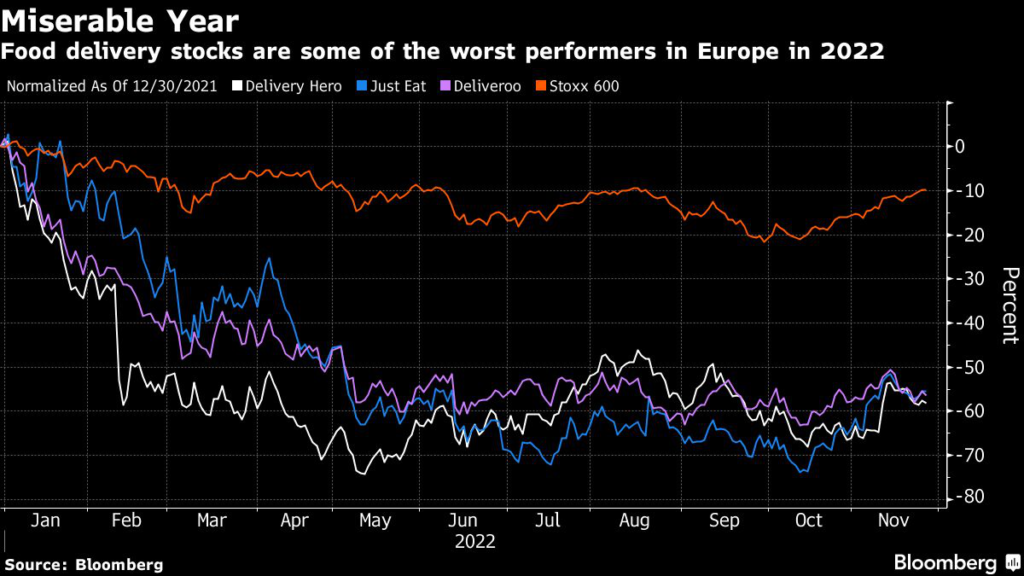
Food delivery stocks have been some of the worst performers in Europe this year, with investors turned off by their steep losses at a time when borrowing costs are soaring.

Meanwhile, their growth has suffered as pandemic-fueled sales faded and the companies pared back promotions. Shares of Just Eat, Delivery Hero and Deliveroo are all down by more than half this year.

More stories like this are available on bloomberg.com

©2022 Bloomberg L.P.

Trudeau Set to Defend Emergency Edict Used to End Trucker Convoy

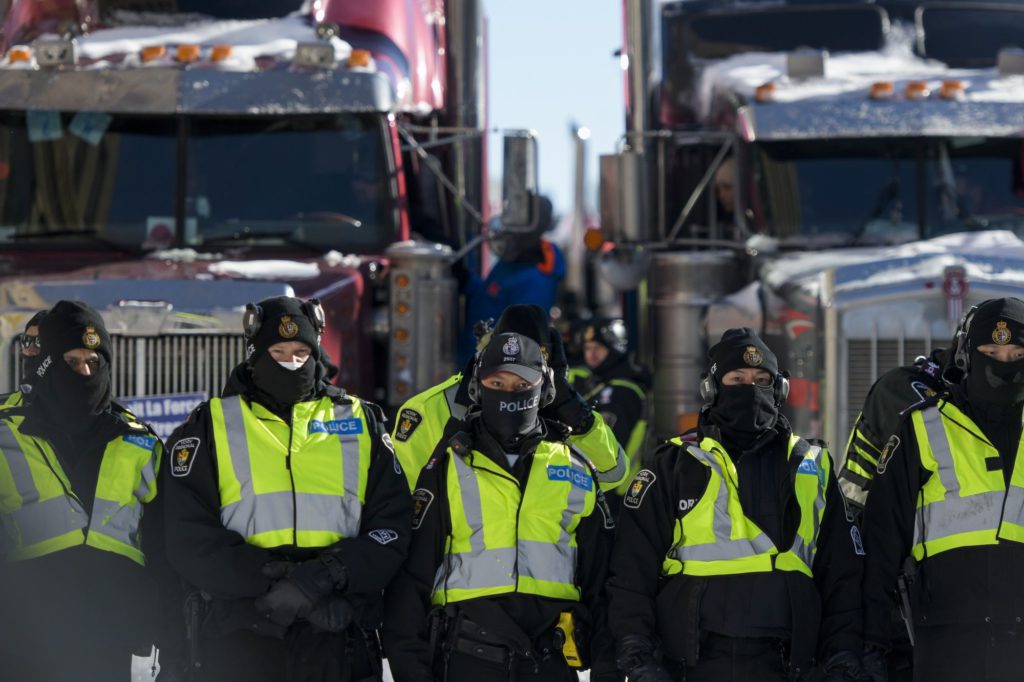
(Bloomberg) — Prime Minister Justin Trudeau is set to take the stand at a public inquiry into his decision to invoke emergency powers to quell a trucker-convoy protest that gridlocked Canada’s capital city and blockaded US border crossings.

Trudeau’s testimony Friday comes on the final day of the six-week hearing that’s seen almost every senior federal government official appear, along with police officers, mayors and the convoy organizers. The inquiry was mandated by the prime minister’s emergency edict itself.

Hundreds of semi-trucks and other vehicles arrived in Ottawa on the last weekend in January to protest vaccine mandates and other public health restrictions enacted during the Covid-19 pandemic. The inquiry has heard Ottawa police expected the trucks to leave after the weekend, but instead the protesters dug in and raised millions of dollars — some in Bitcoin — through online fundraising platforms including GiveSendGo.

The protests soon spread to other locations. One offshoot shut down the Ambassador Bridge from Windsor, Ontario into Detroit, a critical trade link for the North American automotive industry. Another in Alberta blocked a US border crossing used primarily by the agriculture and other commodities sectors.

Invoking the Emergencies Act on Feb. 14 gave Trudeau’s government the power to order banks to freeze the accounts of people and companies participating in the protests, and to compel towing companies to help clear out the blockades.

Trudeau is the only prime minister to use the emergency legislation since its creation in 1988. The closest parallel in modern Canadian history was the so-called October Crisis of 1970, when his father Pierre Trudeau effectively declared martial law in response to kidnappings by Quebec separatists.

The commission has heard conflicting testimony about whether police believed the emergency powers were necessary to clear the streets. But it has also heard that Trudeau’s national security adviser Jody Thomas, the head of Canada’s intelligence agency David Vigneault and other top government officials advised him to invoke the legislation.

Finance Minister Chrystia Freeland and Michael Sabia — a former pension, telecommunications and rail executive who is the top civil servant in her department — both took the stand recently. They testified that the border blockades risked severely harming Canada’s reputation as a reliable trade partner at a time when the country was already battling US protectionism in the auto sector.

Freeland testified Thursday about her conversations with US officials, including Brian Deese, the head of the National Economic Council, and said she strongly felt Canada was facing “economic jeopardy” if the border wasn’t reopened quickly. 

“I could see, really for the first time ever, the Americans having this amber light flashing in Canada — and this amber light said to them, you know what, the Canadian supply chain could be a vulnerability,” Freeland told the inquiry. 

Both Freeland and Sabia said they were focused on finding tools that could be enacted immediately to end the blockades, and that’s what led them to believe the emergency powers were necessary. 

More stories like this are available on bloomberg.com

©2022 Bloomberg L.P.

The UK Car Industry’s Prospects Go From Bad to Worse

(Bloomberg) —

The UK is on course to botch the shift away from the combustion engine and end up a carmaking minnow.

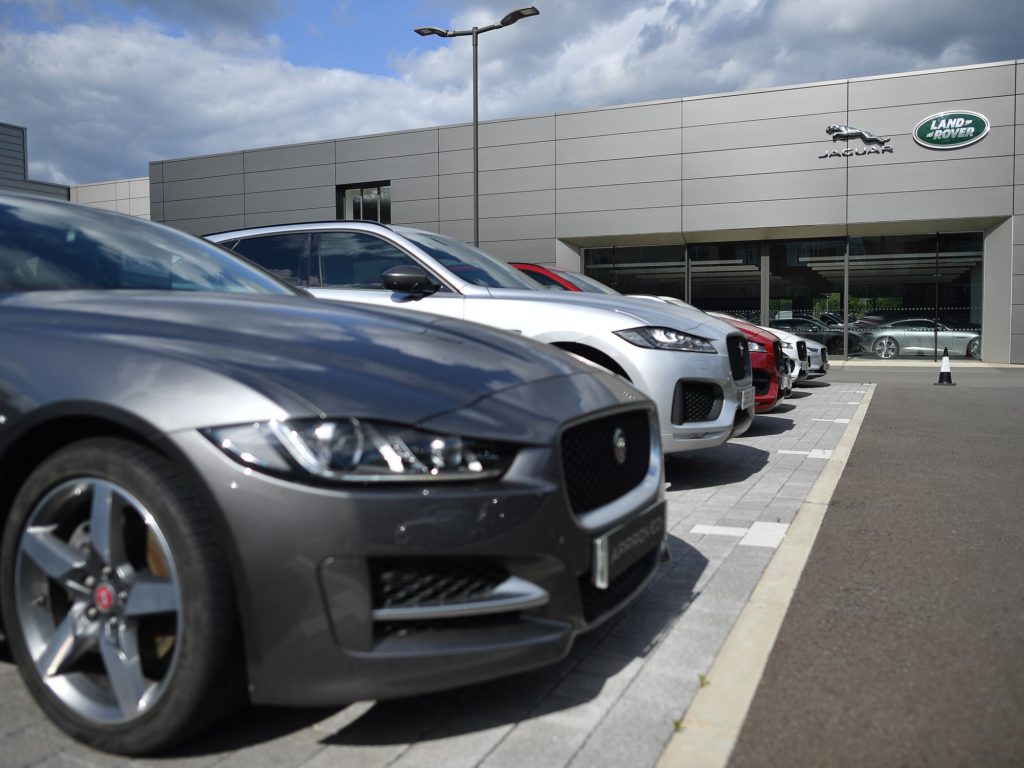
This week, mostly UK-based electric-van startup Arrival announced its CEO and president were stepping down. Last week, the CEO of Britain’s biggest auto manufacturer, Jaguar Land Rover, resigned after making little headway on an all-electric shift announced almost two years ago. And Britishvolt, the company thought to be the country’s best hope for a homegrown EV battery maker, is struggling to stay afloat.

It’s a bleak picture in stark contrast with the US, where car and battery manufacturers are being wooed with billions of dollars as President Joe Biden challenges China’s dominance of the global EV supply chain. That effort has gotten the attention of German Chancellor Olaf Scholz and French President Emmanuel Macron, who are hatching plans to promote and protect their car companies and suppliers.

Prime Minister Rishi Sunak has less room to open up the wallet and support what’s left of the UK’s auto manufacturing base. Chancellor of the Exchequer Jeremy Hunt last week unveiled a £55 billion ($66.7 billion) set of tax hikes and spending cuts that a free market think tank called a “recipe for managed decline.” Included within that: a plan to start subjecting EVs to road taxes in the coming years.

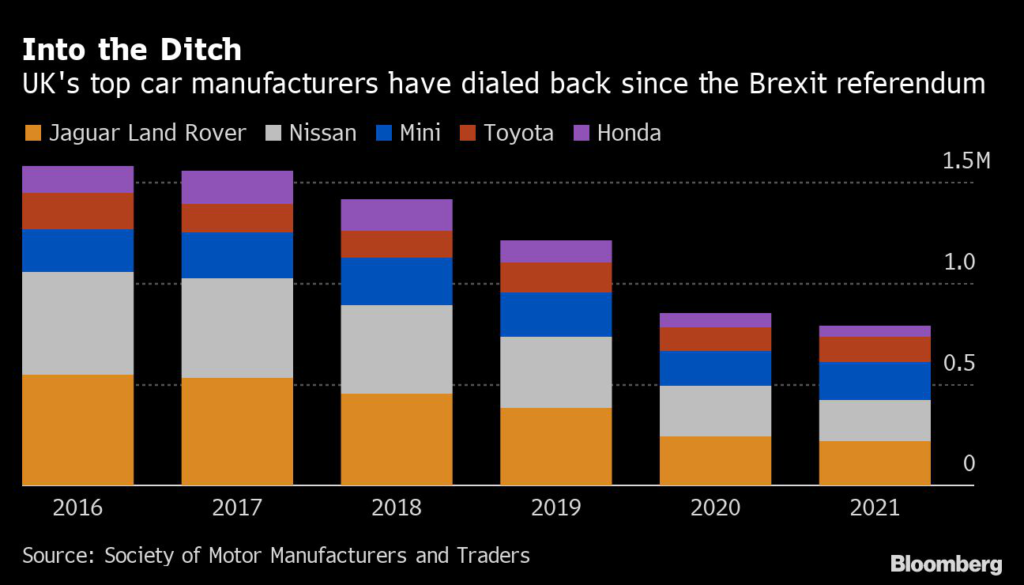
The UK’s austerity push adds insult to injury caused by Brexit, which plunged the country into a prolonged period of uncertainty and delayed automotive investment. During the 12 months leading up to the 2016 referendum, Britain churned out nearly 1.7 million cars. In the past year, carmakers have produced less than half that.

“We’re witnessing a slow-motion car crash of the UK auto industry,” said David Bailey, a business economics professor at the University of Birmingham. “Britain used to have an industrial strategy, but now the government seems to be standing on the sidelines.”

The UK’s struggle to modernize its auto industry threatens thousands of industrial jobs as the transformation redraws the map of where cars are manufactured. BMW last month said it will move production of electric Mini hatchbacks from Oxford, England, to China. Honda closed its car factory in Swindon last year, leaving Britain with just four mass manufacturers: JLR, Nissan, BMW and Toyota.

The UK used to boast the world’s second-biggest auto manufacturing base in the 1950s. It’s since dropped to 18th place, behind the likes of Canada and Slovakia. ​​​​Local demand isn’t a reason to stick around — companies are on course for their worst year of sales in the market since 1982.

Even more worrisome is the UK’s lack of a substantive battery supply chain needed to support mass manufacturing of EVs. The country has just one reasonably sized cell plant in operation, owned by China’s Envision Group, and has failed to attract investment in additional large-scale facilities.

Britishvolt had been at the center of plans for a factory in the north of England to provide batteries for millions of electric cars. But the startup backed by mining giant Glencore is now looking for funds to keep going beyond early December.

The less than three-year-old company’s struggles pose a chicken-and-egg dilemma. Carmakers in the UK are going to be reluctant to build new factories or retool existing ones unless they can source battery cells nearby. Battery manufacturers, in turn, are unwilling or unable to invest without predictable customer demand or sizable government aid.

Unlike its Swedish rival Northvolt, which has signed some $55 billion in contracts with leading automakers, Britishvolt hasn’t secured large-scale orders. While the company has signed outline agreements with Aston Martin and Lotus, neither of the two small-volume manufacturers have made firm commitments.

The UK isn’t at risk of total car industry collapse. Volkswagen-owned Bentley is spending £2.5 billion to modernize its factory in Crewe, England, and electrify its entire lineup by the end of the decade. Nissan has committed to making battery cars at its Sunderland plant, creating 1,650 jobs. Stellantis is investing £100 million to retool its 60-year-old Vauxhall factory near Liverpool to make electric vans.

Britishvolt’s site in Blyth is a great fit for a battery factory because of its ample space and access to clean energy. The company has held discussions about selling the site, according to people familiar with the matter.

The UK needs to move fast if it wants to reverse the downward spiral it’s on. Toyota, which makes engines and Corollas in the UK, has not yet started to retool its two local plants for the electric age. Large battery factories have been announced or opened this year from Italy and Spain to Sweden, near the Arctic Circle. Bloomberg reported in May that JLR had been looking to continental Europe for supplies.

“The UK is already behind other regions in the EV shift and is playing catch-up,” Bailey said. “If all production decisions go in the right direction, output could recover. But that will require a much more collaborative industrial policy approach from the government.”

–With assistance from Siddharth Philip.

More stories like this are available on bloomberg.com

©2022 Bloomberg L.P.

Capturing Carbon With Giant Algae Ponds in the Middle of the Desert

(Bloomberg) — In a London laboratory, Raffael Jovine opened a small incubator to check on his seawater creations. Seven flasks of light green liquid sat on a tray beneath a bright light. Inside the lab’s five other incubators, which look like minifridges, there were more flasks kept under different lamps, at different temperatures, with various nutrients piped into the mixture. 

It’s all meant to replicate the conditions 2,000 miles away in a Moroccan desert, by the Atlantic coast, where Jovine’s company, Brilliant Planet, is planning to build giant ponds of algae to rid the world of tons of carbon dioxide.  

The lab is where the startup tracks how quickly its biological invention can grow in the desert. “We’re algae whisperers,” explained Jovine, a molecular biochemist and Brilliant Planet’s chief scientist. “We need to really know what the algae like. That’s the whole secret.”

A growing list of companies are searching for viable ways to capture carbon from the atmosphere and sequester it for good. There’s a critical need—the International Energy Agency  has estimated some 7.6 billion metric tons of emissions must be eliminated to reach 2050 climate goals. And there’s a growing market for the service, particularly as businesses search for alternatives to shoddy carbon offsets. Brilliant Planet believes there are enough companies willing to pay a premium for offsets linked to ambitious carbon removal projects like its algae ponds. 

Several of these removal projects have turned to the ocean, where organisms grows very fast and absorb carbon dioxide very efficiently. Seaweed has been used to revive coastal areas and sink carbon down to the the ocean floor. But there are credible concerns about the feasibility and ecological impact of these tactics. 

Rather than working in the oceans, Brilliant Planet is trying to recreate an ocean phenomenon—algae blooms—on land. Actually, in barren deserts, where there’s little economic or ecological activity to disrupt.

To engineer its blooms in Morocco, the startup takes variants of algae, plucked from the sea nearby, and stores them in small containers at its facility. Then the site pumps in a select amount of nutrient-rich water from deep in the ocean to spur rapid algae growth. If the process works as intended, the algae expands within a month to fill sixteen ponds at the site, each holding over three million gallons of seawater mixture—a giant surface devoted to photosynthesis.

From there, Brilliant Planet harvests the bloom with a filtering system and dries out the carbon-loaded material in the sun. That biomass is then buried a few meters in the ground, where, in theory, it’s stored away for millennia.

Jovine patented the algae growth process more than a decade ago and started the company in 2013. At that time, financial interest hadn’t caught up with the science. Earlier efforts to turn lab-grown algae into profitable biofuels had gone bust. 

“If you wanted investors to run away as quickly as possible, all you needed to say was, ‘Algae in the desert in Morocco,’” recalled Jovine. 

But rising interest in carbon removal technologies and corporate demand for offsets has changed that. Mona Alsubaei, an investor with Union Square Ventures, which backed Brilliant Planet earlier this year, was drawn to the startup’s method for permanently burying carbon biomass in the desert. She also liked the economics. “Their approach is much cheaper than direct-air capture,” Alsubaei said. Several startups are building large, expensive plants designed to filter carbon out of the air.  

Brilliant Planet has raised $26.7 million from Union Square Ventures, Toyota Ventures, and other investors and grants. The startup is set to bring in more money next year to fund expansion from its seven-acre Moroccan facility to an adjacent space 10 times larger.

It has identified roughly 300,000 square miles of space around the globe with the right conditions—flat desert land near windy coastlines—to host its algae pools, which could suck 3 billion metric tons of carbon out a year, according to the company’s calculations.

To date, seaweed harvesting hasn’t had nearly that sort of impact. Recent research in Current Biology found all the aquaculture efforts currently in place “extremely unlikely” to offset ongoing pollution from the agriculture industry. Also, many sequestration projects struggle to bury carbon they extract without using hefty resources, said Halley Froehlich, an assistant professor at the University of California, Santa Barbara, who worked on the Current Biology paper. “Ultimately, what we find is it actually creates more emissions, not less,” she said.

Adam Taylor, Brilliant Planet’s chief executive officer, said his company avoids this problem through its methods. It uses the sun to dry its algae before burying it in the shallow ground, instead of relying on industrial dryers or dump trucks. Emissions from the process are “close to negligible,” Taylor added. The company is currently in the process of getting its methods certified by a third party.

Even if it can remove its targeted amount of carbon, a bigger challenge will be finding a steady flow of customers. To start, Brilliant Planet will tap the voluntary carbon market, going after companies willing to shell out around $100 for a ton of removed carbon. Taylor said the company has a few dozen “high priority customers” lined up, although he declined to name them. While some major companies have pledged to pay for “high-quality” offsets, many continue to operate in the existing carbon markets, which have yet to certify methods like seawater capture.

Still, Brilliant Planet is counting on an expanding market. Initially, the company planned to sell its harvested algae as food, such as egg white substitute or vegan caviar, setting up locations in South Africa and Oman to grow algae for this purpose. Taylor and Jovine decided to abandon this effort, and the locations, because of high logistical costs. For now, they’re focused on the ponds in Morocco.

“It’s hard enough getting one site done,” said Jovine. “We’re just still a startup.”

More stories like this are available on bloomberg.com

©2022 Bloomberg L.P.

Climate Change Is Causing Narwhals to Change Migration Patterns

(Bloomberg) — Scientists have found that narwhals are altering their steadfast migration patterns in response to climate change, offering some hope that the tusked whales and other species may be able to adapt to a rapidly warming Arctic.

Researchers analyzed satellite tracking data from 40 narwhals that had been tagged between 1997 and 2018. They determined that with sea ice forming later in the year due to rising temperatures, the ice-dependent whales have delayed migrating to their deep-ocean winter feeding grounds by 10 days per decade. The marine mammals are also taking longer to make the 900-mile (1,500-kilometer) journey from the coastal areas of the Canadian Arctic where they spend the summer.

“The fact that narwhals are changing their behavior over what we assume are individual lifetimes could be an indicator that potentially these other animals might be able to leverage behavioral changes to bolster themselves against the effects of climate change,” said Courtney Shuert, a post-doctoral fellow at the University of British Columbia and lead author of the peer-reviewed study published in the Proceedings of the National Academy of Sciences last month.

The long-term success of this kind of adaptation may depend on how fast humans reduce greenhouse gas emissions that are melting the Arctic. 

“The rate of climate change is almost impossible for species to adapt to through mechanisms of evolution,” said Shuert.

For narwhals, climate change poses an extinction-level threat due to the loss of sea ice on which they depend for food and protection. As ice disappears, predatory orcas have expanded their range further into the Arctic while huge ships ply now-open Arctic waters. Warming seas also endanger narwhal’s preferred prey — polar cod, Arctic cod and halibut — which thrive in a narrow temperature range.

Known as the unicorns of the sea for their single, long spiraled tusk, narwhals are estimated to live as long as 100 years or more. But they’re very particular about where they live and where they travel. Researchers demonstrated in a 2020 paper published in the journal Scientific Reports that narwhals have a “narrow thermal preference,” with a small rise in ocean temperature reducing their abundance.

Research has shown that narwhals in the past resolutely stuck to the same migratory routes and schedules throughout their lives, according to scientists.  The whales, which can dive to depths of more than a mile hunting for prey, spend their winters in the deep ocean. They prefer areas where ice covers more than 95% of the sea but contains fissures that allow them to surface to breathe.

When that ice cover breaks up in the spring and exposes narwhals to predators, they migrate to coastal areas because, scientists believe, shallower bays and fjords there give them refuge while rearing young.

When the weather starts to turn colder in September, narwhals depart before “fast ice” can form in their summer grounds. Fast ice is attached to land and can block their migratory routes, suffocating them under a frozen expanse with no openings to the surface.

But as the Arctic Ocean warms and delays ice formation, narwhals are lingering longer in the summer and taking more time to reach their winter habitat, according to the satellite tracking data analyzed by Shuert and her colleagues. How the whales know to postpone their journey and what they’re doing during their extended summer sojourn remains largely unknown.

“We can’t really say for sure exactly what they’re sensing on a day-to-day basis,” said Shuert. “They’re very intelligent animals, and some of the data suggests that they’re probably sensing the environment that they’re in currently plus have a memory of past events, such as if the spring ice breakup was really early that year.”

She said it’s possible that narwhals spend the extra time exploring new areas for prey.

Determining the impact of a decline in winter ice on narwhals remains difficult due to the limits of satellite tag technology. Narwhals are captured and tagged in shallower areas but by the time they reach their winter grounds, the tags’ batteries typically have died, according to Shuert.

If narwhals overstay their summer break, the paper states, they could risk being entombed by a sudden formation of ice triggered by climate-driven temperature swings. A 2011 study published in the journal Polar Biology documented four instances between 2008 and 2010 where hundreds of narwhals died after being trapped by ice when temperatures quickly plunged.

Mads Peter Heide-Jørgensen, a co-author of the 2011 paper and a professor at the Greenland Institute of Natural Resources, said no entrapments, which typically are discovered in remote areas by Inuit hunters, have been found over the past decade.

“If the ice is generally disappearing (not just less predictable), then there should be less ice entrapments,” Heide-Jørgensen, a veteran narwhal researcher who is also an author of the new migration paper, said in an email.

Ship collisions pose a mortal danger to whales worldwide but Heide-Jørgensen said narwhals are at less at risk than other species. “There is generally more ship traffic all over the Arctic but the risk for collisions with narwhals is small as narwhals react at long distance to ship noise,” he said.

More stories like this are available on bloomberg.com

©2022 Bloomberg L.P.
Jaguar Land Rover Cuts UK Production on Chip Shortages

(Bloomberg) — Jaguar Land Rover is reducing vehicle output in the UK through March, as the carmaker prioritizes making higher-margin models because of semiconductor shortages, according to a person familiar with the matter.

The loss-making manufacturer, owned by India’s Tata Motors Ltd., will cut production of the Range Rover Velar and Jaguar F-Pace models that are made in Solihull, while ramping up output of its most lucrative models, the Range Rover and Range Rover Sport, the person said asking not to be identified discussing operational issues. 

JLR may also reduce production at its Halewood plant where it makes the more affordable Evoque and Discovery Sport models, though a final decision hasn’t been made, the person said.

“We continue to actively manage the operational patterns of our manufacturing plants whilst the industry experiences ongoing global semiconductor supply chain disruption,” a Jaguar Land Rover spokesman said in an email. “Demand for our vehicles remains strong.”

The company expects rising deliveries during JLR’s fiscal second half, which runs through March, the spokesman said, as new agreements with semiconductor partners take effect. 

Production at JLR’s Nitra plant in Slovakia, where the carmaker makes the best-selling Defender SUV, is unaffected, the person said. JLR doesn’t plan to cut any jobs at its UK plants as a result of the reduced production as it plans to ramp back up when chip supplies normalize, the person said.

Semiconductor shortages have left customers for the latest generation Range Rovers waiting more than a year for their vehicles, with sales suspended for some variants. In the quarter ended September, the carmaker reported deliveries to dealerships that trailed guidance by 17%. Earlier this month, JLR Chief Executive Officer Thierry Bollore resigned from the luxury carmaker just two years after he took on the role. 

The Guardian newspaper first reported the carmaker’s plans to reduce UK production. 

More stories like this are available on bloomberg.com

©2022 Bloomberg L.P.

Close Bitnami banner
Bitnami