
Bloomberg

Hong Kong ‘Overwhelmed’; Microsoft Back to Office: Virus Update

(Bloomberg) — Hong Kong’s leader said a growing outbreak of the omicron variant has “overwhelmed” the city’s government, but denied she planned to impose a total lockdown like those in mainland Chinese cities. 

The Asian financial hub is currently searching for more hotels to use as isolation facilities and will also start using housing estates to hold people who test positive for the virus. “We cannot surrender to the virus,” Chief Executive Carrie Lam told a regular news briefing. “This is not an option.”

Microsoft Corp. told many U.S. employees to begin returning to their offices starting Feb. 28 in a fresh attempt to get operations back to normal as Covid cases abate. In September, Microsoft scrapped a goal of reopening on Oct. 4 when the delta variant was raging, even before the omicron variant hit.

Canadian Prime Minister Justin Trudeau invoked sweeping emergency powers to quell protests against vaccine mandates and other Covid restrictions, including measures to choke off the flow of money to demonstrators.  

Key Developments:

  • Virus Tracker: Cases pass 413.2 million; deaths top 5.8 million
  • Vaccine Tracker: More than 10.4 billion doses administered
  • Here’s what the pandemic has in store for the world next
  • In Canada, frustrations linger even as bridge reopens to traffic
  • Covid dating tips for Valentine’s Day
  • Why China is sticking with its Covid-zero strategy: QuickTake

Hong Kong ‘Overwhelmed’ by Omicron Outbreak (10 a.m. HK) 

Hong Kong’s leader said a growing outbreak of the omicron variant has overwhelmed the city’s government, even as she pledged to continue trying to bring Covid cases back down to zero. 

“The scale and speed of the spread of the virus has overwhelmed our capacity in the fight against the pandemic,” Chief Executive Carrie Lam said Tuesday at a regular news briefing. “The situation is very serious.” Still, Lam said she had no plans for full lockdown like those imposed on mainland cities. 

Lam added city officials “have the will” to maintain a “dynamic zero” strategy of no infections as it struggles to contain a growing outbreak of the omicron variant. Lam said she had asked mainland China for help with testing. “We cannot surrender to the virus,” Lam said. “This is not an option.”

One Chinese City Locks Down, Another Lifts (9:45 a.m. HK) 

China continues to battle Covid flareups as Manzhouli, a city of 300,000 people in Inner Mongolia bordering Russia, said it would enter lockdown after five people tested positive for Covid.

Suzhou, a city near Shanghai in eastern China, also found 12 Covid infections, mostly at the city’s industrial park. A wafer factory run by Taiwan’s United Microelectronics Corp. had to suspend production in the city after employees tested positive. 

Meanwhile, the southwestern border city of Baise started to lift lockdown restrictions Tuesday after its omicron-led cluster outbreak appeared to come under control. The city of 3.6 million residents near Vietnam entered lockdown last week. China reported 47 Covid infections overall on Tuesday, with 28 of them in the northeastern coastal city of Huludao.

Biden’s Global Vaccine Push Falters (9:20 a.m. HK)

U.S. President Joe Biden’s effort to vaccinate the world against Covid-19 is falling short, with the globe not on pace to meet a 2021 goal of vaccinating 70% of the world population by later this year, Secretary of State Antony Blinken acknowledged at a virtual meeting with other countries. Only about 54% of the global population is vaccinated so far. 

Singapore Eyes Easing, Commits to Reopening (8:24 a.m. HK)

Singapore will be able to ease virus restrictions more once the current omicron wave has peaked and starts to subside, health minister Ong Ye Kung said Monday in a response to questions in parliament. Hospital bed numbers are probably the biggest constraint now, he said, adding that the healthcare system is able to handle the current wave.

Separately, the South East Asian nation remains committed to reopening its borders and extending its vaccinated travel lane arrangements with other countries, deputy prime minister Heng Swee Keat said Monday at the Singapore Airshow.

Japan to Ease Business Travel Requirements (7:30 a.m. HK) 

Japan’s government will ease requirements for business travelers to the country, no longer requiring them to submit a detailed itinerary of their trip prior to arrival, the Nikkei reported. The requirement, which was in place before the current border controls that effectively halted business travel were implemented, won’t be reinstated after the curbs are eased from March. The move was among measures that companies had criticized for adding excessive paperwork. 

Most Japanese want to keep strict virus border controls, according to a poll, even as the country prepares to ease one of the most stringent policies in the developed world.

Separately, the government is considering extending Covid-19 measures in Osaka and some other prefectures beyond Feb. 20 when they are set to expire, broadcaster NHK reported. However, it is considering lifting measures for some areas, including Okinawa, where new Covid cases have eased. 

Microsoft Returning to Office on Feb. 28 (7:20 a.m. HK)

Microsoft Corp. told many U.S. employees to begin returning to their offices starting Feb. 28, making a fresh attempt to get the software maker’s operations back to normal as Covid-19 cases abate. 

In September, Microsoft scrapped a goal of reopening on Oct. 4 because Covid-19’s delta variant was raging. That was followed by the even-more-contagious omicron variant.  

The Redmond, Washington-based company, which has said it will remain a flexible workplace, has told employees that they’ll be able to work from home up to half the week without discussing it with managers.

California to Keep School Mask Mandate For Now (6 a.m. HK)

California plans to keep its mask mandate for schools in place for now, but officials said they may soon announce a timeline for ending the requirement. The most-populous state will reassess the mandate on Feb. 28 and could announce then when it will be lifted. 

“Masking requirements were never put in place to be there forever,”  Mark Ghaly, California’s secretary of health and human services, said at a briefing. “It’s not a question of if — it’s a question of when.”

Pernod Ricard Asks H.K. Execs to Relocate (5:45 a.m. HK) 

Pernod Ricard has asked top executives from its Hong Kong office to relocate temporarily to avoid strict Covid-19 curbs, as China prepares to take a greater role in the city’s response to the Omicron wave, the Financial Times reported. Dubai is being considered as one temporary solution. 

Indonesia May Lift All Quarantine Requirements (4:30 a.m. HK)

 Indonesia is considering lifting all quarantine requirements for inbound travelers in April, as Covid-19 hospitalizations and fatality rates remain under control despite a resurgence in cases.

In the mean time, the required quarantine period is reduced to three days from five for incoming travelers who have received a third dose of vaccines starting next week, Luhut Panjaitan, the cabinet minister in charge of the pandemic response in Java and Bali, said in his weekly briefing on Monday. PCR testing requirement will remain in place for those arriving travelers. 

CDC Raises Travel Alert for South Korea (3:20 p.m. NY)

The U.S. Centers for Disease Control and Prevention raised its travel health advisory on South Korea to “very high.” 

“If you must travel to South Korea, make sure you are vaccinated and up to date with your COVID-19 vaccines before travel,” the agency said on its website,

Washington to Lift Mask Mandate, Mayor Says (12:01 p.m. NY)

Washington will lift its mask mandate in certain settings beginning March 1, Mayor Muriel Bowser said. The nation’s capital will no longer require face coverings in restaurants, bars, gyms and similar indoor venues. However, masks still will be required in schools, health-care facilities and on public transit.

Italy’s Mandatory Vaccination Starts Tuesday (11:50 a.m. NY)

Italy’s vaccination mandate for about 8.8 million workers over 50 will kick off on Tuesday. Workers in the private and public sector will be required to show their so-called super green pass to prove their vaccination, or face fines for up to 1,500 euros ($1,695). Until Monday, proof of a negative test was enough to enter workplaces. More than 91% of people over 50 are partly vaccinated, leaving more than 1 million of the 50-59 age group without any vaccination.

Ontario Plans to Drop Restrictions Next Month (9:50 a.m. NY)

Ontario Premier Doug Ford said Canada’s largest province will drop many of its pandemic-fighting measures next month as cases and hospitalizations decline.  

Proof-of-vaccination requirements and capacity limits in indoor public settings are among the measures that will be dropped as of March 1 if the health-system continues to improve, Ford said Monday. Masking requirements will remain in place, the province said.

The move to end the measures comes against a backdrop of protests, initially against Covid-19 vaccine mandates, that have spread across Canada and hit Ontario especially hard. Demonstrations have shut down parts of Canada’s capital city of Ottawa for more than two weeks, and protesters had blockaded a bridge that serves as the country’s largest trade artery with the U.S. for about a week through yesterday.

U.K. to Give Details on Vaccinations for Kids (7:05 a.m. NY)

The U.K. will set out “more details” on its vaccination strategy for 5-to-11 year-olds next week, as part of its planned “Living with Covid” strategy, Prime Minister Boris Johnson’s spokesman, Max Blain, told reporters on Monday.

At present, only children in clinical risk groups in that age bracket are entitled to vaccination, following advice in December from the government’s Joint Committee on Vaccination and Immunisation. The JCVI has since provided the government with advice for those not at risk, which ministers are now considering, Blain said.

More stories like this are available on bloomberg.com

©2022 Bloomberg L.P.
Space Debris Heading for Moon Isn’t Elon Musk’s, It’s Chinese, Astronomer Says

(Bloomberg) — An astronomer who claimed a piece of one of Elon Musk’s Falcon 9 booster rockets was going to slam into the moon in March has admitted making a mistake — he now says the hunk of space junk belongs to a Chinese rocket.

Bill Gray set the astronomy world abuzz when he made a very specific prediction about a moon impact on March 4, 2022.

While Gray has slightly tweaked his calculations to put the impact a few kilometers away from the original impact spot, he now thinks the “long cylinder, spinning slowly” is not part of a Space Exploration Technologies Corp. booster, but belongs to a Chinese rocket sent to the moon in October 2014.

In an amended blog post at the weekend, Gray, of Project Pluto, which supplies software to amateur and professional astronomers, wrote: “We now know that this object is not actually the SpaceX booster: that was a misidentification, by me.”

And in a fresh post entitled “Corrected identification of object about to hit the moon,” he wrote: “Back in March 2015, I (mis)identified this object as 2015-007B, the second stage of the DSCOVR spacecraft. We now have good evidence that it is actually 2014-065B, the booster for the Chang’e 5-T1 lunar mission. (It will, however, still hit the moon within a few kilometers of the predicted spot on 2022 March 4 at 12:25 UTC, within a few seconds of the predicted time.)”

So if it isn’t a part of Elon’s rocket, where did that end up?

“I wish I had a good answer,” Gray wrote. “But I strongly suspect that no one does. I don’t think SpaceX knows. If they did they could have raised their hand in the last couple of weeks and said ‘That’s not our rocket stage hitting the moon.’”

Gray said his best guess is that the booster followed the DSCVR weather satellite launched by the Falcon 9 on its million-mile journey into deep space, and is now probably in an orbit around the sun.

More stories like this are available on bloomberg.com

©2022 Bloomberg L.P.

PBOC’s Mu Says Digital Yuan Has Small Impact on Financial System

(Bloomberg) — China’s digital yuan has had a very small impact on the financial sector so far, according to the central bank’s head of its digital currency unit.

The balance in e-CNY wallets is about 470 million yuan ($73.9 million), compared with M0 money supply, which refers to cash in circulation, of 8.6 trillion yuan, Mu Changchun, head of the Digital Currency Institute at the People’s Bank of China, said in an online forum hosted by the Atlantic Council.

There’s no negative impact to the financial system so far, Mu said, adding that he doesn’t expect the e-CNY will have a significant “negative disintermediation effect” in the sector. The digital yuan will also further enhance financial inclusion, he said.

Other highlights of his speech:

  • E-CNY makes financial services more accessible to people in remote areas, and allows foreign visitors who don’t have bank accounts to enjoy the benefit of mobile payment
  • E-CNY is designed to pay no interest, to reduce competition with bank deposits
  • The e-CNY adopts a two-tier system, meaning the PBOC first issues e-CNY to commercial banks, which then distribute it to the public. This design helps keep commercial banks in the loop
  • Have to strike a balance between anonymity and combating criminal activities
  • There are four tiers of e-CNY wallets, each with different levels of anonymity and balance limits
  • China’s personal information protection law stipulates that telecommunication networks cannot provide users’ identities to third parties, so the wallets opened with only mobile numbers are anonymous to the PBOC
  • Will continue to advance e-CNY pilots with no timetable for official launch, and users only account for a small percentage of the population so far compared with other payment platforms
  • PBOC proposed three principles for cross-border use of central bank digital currencies: no disruption, compliance, interoperability
  • For future cross-border transaction, all e-CNY will be converted to foreign currencies before being sent to a foreign country, to minimize risks such as currency substitution

More stories like this are available on bloomberg.com

©2022 Bloomberg L.P.

Uber Settles Waymo Litigation in Saga That Drew in Thiel, Trump

(Bloomberg) — Uber Technologies Inc. is close to paying a final price for its troubled recruitment of a star driverless car engineer away from Google.

The ride-hailing firm, which recruited Anthony Levandowski in 2016 from Alphabet Inc.’s self-driving car program, has entered into a global settlement requiring it to pay a “substantial portion” of the $120 million Google clawed back from the engineer, court records show.

The precise sum Uber will pay Google isn’t disclosed in a court filing detailing the deal. But the payment is a central feature of the agreement, which if approved by a judge, would finally resolve a saga of avarice and betrayal that left all involved looking bad.

The fight over Levandowski’s talents started with then-Uber CEO Travis Kalanick and Google co-founder Larry Page, moving to a high-stakes trade secrets trial between Uber and Waymo, followed by a successful criminal prosecution of the engineer. By the end, venture capitalist Peter Thiel and even then-President Donald Trump were drawn in.

Read More: Ex-Google Engineer Levandowski’s Jump to Uber Ends in Prison

“There is very significant business justification for the payment to Google,” the parties said in the filing. Uber’s payment of “a substantial portion” of Google’s claim against Levandowski “is the key to the resolution of the case.”

José Castañeda, a Google spokesperson, said “we can confirm that this matter has been resolved.” 

Uber declined to comment, as did Levandowski’s lawyer. 

The settlement ends a three-way fight between Google, Uber and Levandowski. In 2020, the engineer was ordered to spend 18 months in prison after he pleaded guilty to a single count of trade secret theft from Google as he defected to Uber. It was one of the highest-profile criminal cases to hit Silicon Valley, preceded by the high-stakes civil case resolved mid-trial in 2018 by Uber agreeing to pay Alphabet Inc.’s self-driving company, Waymo, about $245 million in closely held stock.

Last year, just minutes before Levandowski was due to appear before the judge who had sentenced him, his lawyers filed with the court a pardon from Trump. The pardon was supported by Thiel, among others.

Read More: Pardon Aside, Judge Says Silicon Valley Prosecution Was ‘Strong’

While Levandowski had been spared incarceration, Google had separately won a judgment reclaiming a $120 million bonus it paid him. With interest and attorneys’ fees added, the sum totaled $180 million and forced Levandowski to file for bankruptcy.

The global settlement also requires Levandowski to pay Google $25 million. In a letter to the judge who handled his criminal case, Levandowski said his legal battles had been a “grueling lesson in humility.” 

More stories like this are available on bloomberg.com

©2022 Bloomberg L.P.

Indonesia’s Akulaku Lands $100 Million from Top Thai Lender

(Bloomberg) — Akulaku Inc., an Indonesian online lender backed by Jack Ma’s Ant Group Co., has pulled in $100 million from one of Thailand’s biggest lenders to expand its business in Southeast Asia.

The capital raise from Siam Commercial Bank Plc. follows a $125 million funding in 2021 co-led by Hong Kong multi-asset investment firm Silverhorn Group, Akulaku said in a statement Tuesday. It will allow the Jakarta-based company to “further expand the geographic reach” of its offerings across Southeast Asia, Chief Executive Officer William Li said in the statement.

Southeast Asia, a region with about 650 million people, has seen a rush of fundraisings and startup deals as companies move to expand aggressively and win over consumers in one of the world’s fastest growing digital markets. The region’s internet economy is set to double to $363 billion by 2025, research from Google, Temasek and Bain & Co. shows.

Akulaku, as part of its expansion efforts, is weighing a U.S. listing via a merger with a blank-check company that could value the combined entity at about $2 billion, people with knowledge of the matter said last month. The fintech firm is also set to participate in a planned rights issue by Bank Neo Commerce in the second quarter.

More stories like this are available on bloomberg.com

©2022 Bloomberg L.P.

‘Death on the Nile’ Tops Box Office Over Slow Super Bowl Weekend

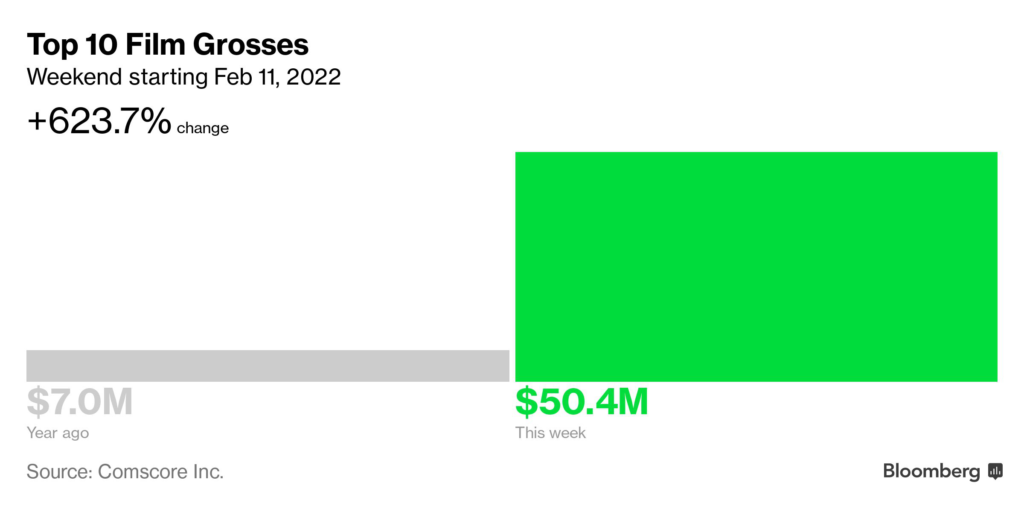
(Bloomberg) — “Death on the Nile” bumped “Jackass Forever” from the top of the domestic box office over a slow weekend when Americans were more focused on the Super Bowl.

The picture, from Walt Disney Co.’s 20th Century Studios, generated $12.9 million in U.S. and Canadian ticket sales, according to data from Comscore Inc. That trailed a forecast of $14.5 million from researcher Boxoffice Pro. The movie took in less than half the $28.7 million that its predecessor, 2017’s “Murder on the Orient Express,” generated in its opening weekend five years ago. 

“Jackass Forever,” from ViacomCBS Inc.’s Paramount Pictures, fell to second place with $8.1 million in domestic box office receipts in its sophomore weekend. 

Key Insights 

  • “Death on the Nile” returns Kenneth Branagh to the role of Agatha Christie’s Belgian detective Hercule Poirot. Branagh directed the film, which also features Gal Gadot, Armie Hammer, Letitia Wright and Russell Brand. About 65% of critics recommended it on review aggregator site Rotten Tomatoes.
  • The film likely appeals to an older audience that has tended to stay away from theaters during the pandemic. “Jackass Forever,” on the other hand, targets a younger audience that may have been distracted this weekend by the build-up to Sunday’s Super Bowl.
  • Two other pictures made their debuts this week. “Marry Me,” a romantic comedy starring Jennifer Lopez and Owen Wilson from Comcast Corp.’s Universal Pictures, looked to get out ahead of Valentine’s Day. “Blacklight” is an action-thriller distributed by independent Briarcliff Entertainment. It stars Liam Neeson.

Get More

See the schedule for upcoming releases.


(Updates with Monday Comscore numbers.)

More stories like this are available on bloomberg.com

©2022 Bloomberg L.P.

Peloton’s Supply-Chain and Business Chiefs Exit in Shake-Up

(Bloomberg) — Peloton Interactive Inc.’s sweeping overhaul, which brought new management and layoffs to the fitness company last week, included the departures of executives running operations, its supply chain and other functions, according to people with knowledge of the matter. 

Mariana Garavaglia, the company’s operations chief, left Peloton and took a new role Monday at the 3D printing company Relativity Space. Brad Olson, chief business officer, and Jon Adee, who oversaw Peloton’s supply chain, also have stepped down, said the people, who asked not to be identified because the changes weren’t announced publicly.

The departures show the extent of Peloton’s shake-up, which some investors hope will make the company more enticing to a suitor. The new chief executive officer, Spotify Technology SA veteran Barry McCarthy, has said that he’s focused on turning around the business and not looking to sell it.

Olson was responsible for business development, subscriptions and program management across the company, according to his LinkedIn profile. Adee, meanwhile, ran the company’s supply chain, which came under fire over the past year as Peloton miscalculated demand. 

Garavaglia was in charge of human resources, enterprise systems and customer support. Her new job will be chief business and people officer at Relativity Space, a Long Beach, California-based company that 3D-prints rockets.

When announcing the layoffs — and his own departure as CEO — Peloton co-founder John Foley said the changes would affect “every level of the organization, including within our leadership team.”

More stories like this are available on bloomberg.com

©2022 Bloomberg L.P.

BlockFi’s Plans to Register with SEC Augurs New Era for Crypto

(Bloomberg) — Crypto proponents have argued for years that regulators shouldn’t apply decades-old rules to the burgeoning asset class. But in a move with sweeping implications for the industry, at least one prominent company is now planning to register its offerings with the Securities and Exchange Commission. 

BlockFi Inc. announced on Monday that it’d seek SEC approval for accounts that pay clients high yields for lending out their crypto as part of a record $100 million settlement with federal and state securities watchdogs. The plan would give the Jersey City, New Jersey-based firm the first SEC sanctioned product of its kind, immediately adding pressure on competitors to follow suit.

Companies offering digital-asset lending have attracted tens of billions of dollars in deposits by promising yields that far exceed those available through traditional savings accounts. The SEC under Chair Gary Gensler has frequently warned crypto platforms that they likely need to be registered with the agency or face the prospect of sanctions by the regulator. 

Kristin Smith, the executive director of the Blockchain Association, said her trade group is “committed to working with Washington to establish common-sense guardrails for industry in which to operate.” She called the BlockFi settlement “a step forward toward that goal.”

The SEC and state investigators had been probing whether the accounts offered by BlockFi are akin to securities that should be registered with regulators. Executives at BlockFi have said they are able to pay such high yields to customers because institutional investors will pay them even more to borrow the deposits. Unlike bank accounts, the crypto-interest accounts aren’t federally insured — something the regulator also warned investors about on Monday. 

As part of the agreement announced by the SEC, current BlockFi customers can continue to earn interest on their existing investments, but the company must not sell the products to new American clients. The company has 60 days to seek to comply with SEC regulations and it’s also seeking to register a new crypto-lending product that will satisfy the agency’s rules.

Zac Prince, chief executive officer of BlockFi, said the company would work with the regulator to comply with its rules. “We intend for BlockFi Yield to be a new, SEC-registered crypto interest-bearing security, which will allow clients to earn interest on their crypto assets,” he said in a statement after the deal was announced. 

Gensler, the SEC chair, said the settlement “makes clear that crypto markets must comply with time-tested securities laws.” He added that the agreement showed “the commission’s willingness to work with crypto platforms to determine how they can come into compliance with those laws.” 

BlockFi agreed to pay a $50 million fine to the SEC and another $50 million to various states. It’s among several companies, including Celsius Network and Gemini Trust Co., that have become wildly popular with retail investors for paying yields that sometimes exceed 10%. The SEC is also scrutinizing Celsius, Gemini and Voyager Digital Ltd. over similar issues, Bloomberg reported in January.

At the time, a Gemini spokeswoman said the company was cooperating with an “industry-wide inquiry” into crypto-yield products. Celsius said it was working with regulators to “operate in full compliance with the law” and a Voyager spokesman said it was routine to be in ongoing communications with watchdogs. The SEC hasn’t accused any of the companies of wrongdoing.

When asked Monday about the implications of BlockFi’s settlement on its business, Gemini declined to comment. Celsius and Voyager didn’t immediately respond to requests for comment.

More stories like this are available on bloomberg.com

©2022 Bloomberg L.P.

Man Charged in $4.5 Billion Crypto Scam Denied Bail by Judge

(Bloomberg) — A judge in Washington D.C. denied bail to a man charged with trying to launder billions of dollars worth of Bitcoin stolen in a 2016 hack of the Bitfinex cryptocurrency exchange, while allowing his wife to remain free before trial.

U.S. District Judge Beryl Howell in Washington Monday overturned a New York judge’s ruling granting bail to the man, Ilya Lichtenstein, 34, while upholding a decision that allowed his wife, Heather Morgan, 31, to remain free pending trial.

Lichtenstein and Morgan are accused of conspiring to launder 119,754 Bitcoin — now valued at $3.6 billion — stolen during a 2016 Bitfinex heist. The value of the all the stolen Bitcoin has risen to about $4.5 billion.

The couple’s bail was temporarily put on hold by a Washington judge after the U.S. filed an emergency request to review a New York judge’s decision allowing them to remain at home with electronic monitoring and bonds totaling $8 million.

Howell said the motivation for both to flee “has increased exponentially.” They have resources the government hasn’t been able to seize and skills that could help them escape, she said. 

But she added that “the evidence strongly suggests that Mr. Lichtenstein has more facility and skill” than Morgan and there is no indication that she had any access to the stolen cryptocurrency until it had been removed from the digital wallet that was allegedly controlled by her husband.

(Updates with judge’s ruling in sixth paragraph.)

More stories like this are available on bloomberg.com

©2022 Bloomberg L.P.

Trudeau Enlists Banks to Help Stop Protests in Emergency Move

(Bloomberg) — Canadian Prime Minister Justin Trudeau invoked sweeping emergency powers Monday to quell protests against vaccine mandates and other Covid-19 restrictions, including measures to choke off the flow of money to demonstrators. 

Banks and financial institutions will be required to review their relationships with anyone involved in an illegal blockade and report them. They’ll have the authority to stop providing services to those suspected of using their accounts to help the protesters and to freeze accounts without getting a court order. 

The government is also broadening its anti-money-laundering rules to cover crowdsourcing sites such as GoFundMe that have been used to funnel donations to them, as well as cryptocurrency platforms. 

“This is about following the money. This is about stopping the financing of these illegal blockades,” Finance Minister Chrystia Freeland said at a news conference in Ottawa. 

Owners of trucks that are being used in the protests will see their corporate accounts frozen and their insurance suspended, she warned. “Send your semi-trailers home. The Canadian economy needs them to do legitimate work,” she said.

Border Blockades

Protests that began with a trucker convoy to Ottawa more than two weeks ago have gridlocked Canada’s capital city and expanded to border crossings, including the bridge that carries a quarter of Canada’s commerce with the U.S., its largest trading partner. That span — between Windsor, Ontario and Detroit — was reopened to traffic late Sunday night.

The Royal Canadian Mounted Police also announced arrests Monday at an offshoot demonstration in western Canada, seizing a cache of weapons at a border blockade in southern Alberta.

Trudeau said federal government is stepping in because local police authorities have had difficulty enforcing the law. 

“This is not a peaceful protest,” he said. The emergency law “is about keeping Canadians safe, protecting people’s jobs and restoring confidence in our institutions.”

Trudeau’s use of the federal Emergencies Act echoes the famous move by his father, Pierre Trudeau, in 1970 to effectively declare martial law in response to kidnappings by Quebec separatists. But the legislation being used now isn’t as aggressive in scope, and Trudeau said there are no plans to call in the military. 

The determination with which protesters have chosen to wreak havoc — albeit so far in mainly non-violent ways — has rattled a nation unaccustomed to public rancor. Many Canadians are still trying to come to grips with it all. 

FIRST WORD: Canada Orders Banks to Freeze Funds Supporting Blockades

Some are blaming Trudeau for using vaccines as a wedge issue and galvanizing the demonstrators by calling them “a small fringe minority.” Others say he took too long to crack down on them. 

“In waiting this long, they’ve deepened skepticism among Canadians of various political stripes about their willingness and ability to act,” Wesley Wark, a senior fellow at the Center for International Governance Innovation, said in an interview. “The lawlessness of the protest, certainly in Ottawa, has grown. The protesters have been emboldened by their apparent success.”

Using the emergencies act gives the federal government the right to ban public assembly in certain locations and to requisition property it deems necessary for managing the situation.

The act also allows the government to order towing companies to provide their services to clear blockades, and to impose emergency fines or imprisonment for violating orders. The law has never been used since coming into effect in 1988 and is meant for an “urgent and critical situation, temporary in nature, that endangers the lives, health or safety of Canadians,” according to a government memo.

About 400 semis and other vehicles remain embedded on Ottawa’s streets. The local police force has shown little appetite for a crackdown despite repeated lawbreaking by the protesters, including violation of a court injunction against using the deafening air horns.

Last week, the Ontario provincial government enacted emergency orders that included fines of up to C$100,000 ($78,500) and a year in jail for people who continue to block roads, bridges and other infrastructure. But Ottawa’s police chief has said he needs more resources before he can carry out enforcement operations. 

At another blockade in Coutts, Alberta, police arrested 11 people “said to have a willingness to use force” if any attempts were made to disrupt their demonstration. Weapons including more than a dozen long guns, handguns, body armor, a “large quantity” of ammunition and high-capacity magazines were seized, according to an RCMP news release.

(Updates with new information from the first paragraph)

More stories like this are available on bloomberg.com

©2022 Bloomberg L.P.

Close Bitnami banner
Bitnami