Bloomberg

U.S. Electric Mail Truck Push Stalls Without More Funding

(Bloomberg) —

We all know the tribulations of the U.S. Postal Service. It’s losing billions of dollars a year, even as it’s delivering record numbers of packages, to say nothing of mail-in ballots, while struggling with Covid-related absences. Ben Franklin would be awed.

Then there’s something else that’s hardly classified information: the woeful state of the agency’s delivery vehicles. The USPS operates a fleet of 228,000 trucks and vans, one of the world’s largest. Many of them have been on the road for more than a quarter of a century and lack basic safety functions such as automatic brakes and driver air bags. And their fuel efficiency is at a level that keeps climate activists awake at night. They get about 10 miles per gallon of gas — worse than a Humvee.

The slow-moving USPS is finally remedying this. Last year, it awarded a 10-year contract worth an estimated $11.3 billion to Oshkosh Corp. to furnish as many as 165,000 new vehicles. They’re rather cute and sparked a social media sensation when the Postal Service posted their preliminary images. The agency’s initial order includes 5,000 electric ones. 

Sounds encouraging. But not as far as the White House is concerned. The Biden administration has scolded the USPS for not ordering more EVs. “The Postal Service’s proposal as currently crafted represents a crucial lost opportunity to more rapidly reduce the carbon footprint of one of the largest government fleets in the world,” Vicki Arroyo, the EPA’s associate administrator for policy, wrote to U.S. Postmaster General Louis DeJoy earlier this month.

And that’s not to mention the consternation on Capitol Hill. Gerry Connolly, a senior House Democrat, has called for DeJoy, a Republican, to resign because of the paucity of his agency’s EV order.

Arroyo, at least, has a point. Given the leisurely pace of the Postal Service’s fleet replacement efforts, the trucks and vans it purchases now are likely to be in use for decades. Does it make sense for letter carriers to be piloting carbon emitting trucks in 2050? Not if the U.S. is expected to reach its goal of net zero emissions the same year.

DeJoy, however, has pushed back and he, too, makes sense. He says the USPS, which is supposed to be self-supporting, doesn’t have the money currently to buy more EVs. But as he has put it more than once, the agency would be happy to upgrade its order “should additional funding become available.”

The irony perhaps is that the White House and its congressional allies did try to make $6 billion available in the sprawling $2 trillion Build Back Better bill for electric postal vehicles and charging infrastructure. But after month of tortured negotiations, they couldn’t  round up enough votes from their own party members to pass it. With the midterm elections approaching, it may be too late.

After Build Back Better’s apparent collapse, it seems a tad hypocritical for Democrats to beat up on DeJoy for not embarking on an EV spree.  Then again, the situation isn’t as dire as the postmaster general’s critics would have people  believe.

As the USPS noted in its press releases announcing the Oshkosh deal, whether they are gas powered or run on batteries, the next generation of postal vehicles are being designed so they can be retrofitted to keep up with the latest in EV technology. Because who knows what will be available when these trucks and vans finally roll out — and who knows when Congress will get around to funding them?Devin Leonard is a senior writer for Bloomberg News and the author of  Neither Snow Nor Rain: A History of the United States Postal Service.

More stories like this are available on bloomberg.com

©2022 Bloomberg L.P.

EU Eyes €20 Billion for Plan to Take On China in Africa

(Bloomberg) —

The European Union is working on a 20 billion-euro ($22.7 billion) financing package to support African transport networks, as well as energy, digital, education and health projects to counter China’s reach in the continent.

Member states, however, have yet to commit to financing the infrastructure plans, according to officials familiar with the discussions.

The bloc’s plan includes strategic corridors, international submarine cables, new energy interconnections and investments in renewable sources in Senegal, Cote d’Ivoire, Egypt, Morocco and Kenya, according to a draft of the package seen by Bloomberg.

The investment is aimed at underpinning the new partnership that the EU and Africa want to seal at a Feb. 17-18 summit in Brussels. 

African leaders have prioritized roads, railways and bridges. But some EU governments face national budgetary constraints that make it hard for them to pledge significant funding ahead of the meeting, while others, including Germany, remain skeptical about the readiness of some of the proposals, officials added.

The EU list includes about 60 projects meant to relaunch the relationship, after months of tensions over vaccine supplies and patents, as well as travel restrictions aimed at stemming the Covid-19 pandemic.

Most of the funds in the EU’s plan would go to the Global Gateway, Europe’s initiative to rival China’s massive investment plan in the continent. The bloc is seeking to mobilize 150 billion euros by 2027 from various sources.

The EU offers “quantitative and qualitative advancements on infrastructure financing,” according to the document. The bloc promises “substantial funding” to invest in projects and for technical assistance to identify new ones. The EU also wants to attract private money by using public funds as guarantees and involving African development banks.

Belt and Road

Beijing promised in 2018 around $60 billion in loans over a three-year period to finance roads and bridges in Africa. But China’s Belt and Road plan has been controversial from the outset due to corruption and debt sustainability challenges faced by host governments.

The EU has picked projects focused on key trade areas selected by African nations according to their level of readiness, their potential impact and the possibility of attracting member states’ money and private funding, an EU official said. The list includes the Dakar-Abidjan corridor in West Africa; the Libreville-Kribi-Douala-N’Djamena area that links Gabon, Cameroon and Chad; and the area between Mombasa and Kisangani in Kenya and Democratic Republic of Congo.

The trading bloc wants to show that they are putting money behind their promises by offering a solid package during the summit. But the commission has been struggling to bring member states on board in spite of intense discussions. Two thirds of the financing should come from national coffers, the commission has told national capitals.

Europe will also propose building an international submarine fiber cable to connect the EU with Africa along the Atlantic coast, and fostering access to clean energy pools across the continent. 

The EU will also offer new security cooperation. As part of more comprehensive effort to support African armed forces, European countries would deliver military equipment in the coming months “including material designed to deliver lethal force,” according to the draft text.

Migration will be another top issue during the summit next week. EU countries will mobilize 4.4 billion euros to fight human traffickers, enforce voluntary and forced returns, and strengthen border management. One of the European demands is to secure a bigger role for its border agency, Frontex, in African nations.

More stories like this are available on bloomberg.com

©2022 Bloomberg L.P.

China Approves Pfizer Pill; Boost for U.K. Travel: Virus Update

(Bloomberg) — China granted emergency approval for Pfizer’s Covid-19 pill, in a sign the country could open up further to foreign treatments for the virus. Japan will ease its strict border controls, starting with foreign workers and students, the Nikkei reported.

U.K. travel firms get a much-needed boost starting this weekend as thousands of vaccinated Britons head to continental Europe for the mid-term school break, kicking off what could be a bumper year for travel.

Goldman Sachs Group Inc. dropped mask mandates amid an easing up in Covid-19 cases that’s paved the way for Wall Street staff to return to offices. 

The premier of Canada’s biggest province declared a state of emergency, warning protesters choking off traffic at a key U.S. border crossing they face stiff punishment if they don’t leave. Ontario’s Superior Court granted an injunction barring protesters from blocking the crossing.

Key Developments:

  • Virus Tracker: Cases top 408 million; deaths pass 5.8 million
  • Vaccine Tracker: More than 10.3 billion shots administered
  • Mask guidelines around U.S. ease, bringing confusion and relief
  • Wall Street bosses push ‘live with it’ mindset in office return
  • The Era of Pandemic Restrictions Is Fast Coming to an End
  • Why China is sticking with its Covid-zero strategy: QuickTake

Hong Kong to Report Record Infections (1:20 p.m. HK)

Hong Kong will report a record of about 1,510 daily virus cases on Saturday, local media reported, as city officials prepare to meet mainland counterparts in China to discuss ways of combating a worsening outbreak that is straining healthcare resources. The city reported a 1,325 daily inflections on Friday, its previous highest tally. 

U.K. Travel Firms Get a Boost (1 p.m. HK)

U.K. travel firms get a much-needed boost starting this weekend as thousands of vaccinated Britons head to continental Europe for the mid-term school break, kicking off what could be a bumper year for travel.

Eurostar International Ltd. expects the biggest leap in customer numbers since October over the 10 days through Feb. 20, with more than 125,000 people booked to board its Channel Tunnel express trains, surpassing the total for the whole of January. Many of the nine daily services from London to Paris are sold out.

The U.K. arm of TUI AG, Europe’s biggest tour operator, said booking levels for its flight and hotel packages are comparable to 2019 levels.

Hong Kong Bank Branches Shuttered (12:12 p.m. HK)

Hong Kong’s banks will suspend operations at one in every four branches in the city after a number of employees were infected, the South China Morning Post reported.

HSBC Holdings Plc, Standard Chartered and Bank of China and another 13 major lenders will close a total of 276 branches, the newspaper said. The closures started last week and will continue Monday. 

China Has More Infections at Olympics (1105 a.m. HK)

China reported four Covid infections among Olympic athletes and team officials. Total Covid infections among people involved with the Beijing Winter Olympics since Jan. 4 rose to 498, according to Bloomberg calculations based on official data.

Japan to Ease Border Controls: Nikkei (10:49 a.m. HK)

Japan will ease its strict border controls, beginning with foreign workers and students, the Nikkei reported. The government will start accepting more than 1,000 people a day this month and will gradually raise the cap to several thousand.

The controls, put in place in late November as the omicron variant started to spread, are by far the strictest among the Group of Seven nations. 

Germany Reports 209,789 New Cases (10:18 a.m. HK)

Germany reported 209,789 new Covid-19 cases, down from 240,172 the day before. New deaths associated with the virus rose by 198, bringing the total to 119,877.

Singapore Air Hires Cabin Crew Again (10:10 a.m. HK)

Singapore Airlines Ltd. resumed recruitment of cabin crew, ending a two-year hiring freeze, Channel News Asia reported. The airline plans to increase capacity as travel demand picks up, it said.

China Approves Pfizer’s Virus Pill (9:44 a.m. HK)

China granted emergency approval for Pfizer’s Covid-19 pill, in a sign the country could open up to foreign treatments for the virus. 

Paxlovid’s import registration was approved on Friday, the National Medical Products Administration said. The Chinese regulator asked for further research results to be submitted in a timely manner.

It’s China’s first approval for a foreign Covid-19 drug. The mRNA Covid vaccine co-developed by Pfizer and BioNTech, for which China’s Shanghai Fosun Pharmaceutical Group Co. secured rights for the Greater China region, has yet to be approved in China.

Thailand Keeps Curbs With Cases at 5-Month High (9:35 a.m. HK)

Thailand’s new Covid-19 infections surged to a five-month high, prompting the government to keep containment measures in Bangkok and other areas to curb the outbreak.

The number of cases rose to 16,330, the highest single-day tally since Aug. 29, according to government data. The country also reported 25 new deaths in the past 24 hours, taking total fatalities to 22,387. 

Prime Minister Prayuth Chan-Ocha asked Bangkok and nine other provinces with the highest number of daily infections to take steps to contain the outbreak, Taweesilp Visanuyothin, a spokesman for the Covid panel, said yesterday. 

Walmart Drops Mask Rule for Vaccinated Workers (8:10 a.m. HK)

Walmart will no longer require fully vaccinated employees to wear masks unless required by state or local rules. 

In addition, a policy allowing five extra days of paid time off for workers testing positive for Covid-19 will end March 31 as planned, Walmart said in a memo to employees Friday. Daily health screenings will no longer be needed for workers, except in California, New York and Virginia, which have state requirements.  

The changes by Walmart represent a step away from pandemic-era rules as governments across the U.S. lift mask mandates for indoor spaces. The Bentonville, Arkansas-based retailer is the largest U.S. private-sector employer, with about 1.6 million employees in the country. 

Ontario Court Ruling Aims at Ending Blockade (6:20 a.m. HK)

Ontario’s Superior Court granted an injunction barring protesters from blocking the Ambassador Bridge connecting Detroit with Windsor, Ontario. The injunction that aims to end the blockade will take effect at 7 p.m. local time, Chief Justice Geoffrey B. Morawetz said in a court proceeding.

The court plans to resume late Friday to work out the details and specific wording of the injunction.

The Ambassador Bridge has been largely closed since Monday night. The conduit carries about one quarter of the commercial trade between the U.S. and Canada. 

Canada Bridge Blockade Defies Court Injunction: Protest Update

JPMorgan, Goldman Drop Mask Mandates (5:05 a.m. HK)

JPMorgan Chase and Goldman Sachs  dropped mask mandates amid an easing up in Covid-19 cases that’s paved the way for Wall Street staff to return to offices. 

JPMorgan said in a memo to employees that masks are now “completely voluntary” for vaccinated staff in its U.S. buildings, unless more stringent local restrictions are in place. Goldman Sachs similarly removed a mandate, a spokeswoman for the bank said.

Boris Johnson Gets Police Questionnaire (4:45 p.m. NY)

Boris Johnson received a legal form from U.K. police investigating allegations he attended parties with government officials that broke national lockdown rules during the coronavirus pandemic.

Officers from the Metropolitan Police, whose commissioner Cressida Dick quit suddenly this week, sent a legal questionnaire to the prime minister and dozens of officials as part of the investigation. Johnson has maintained he didn’t break any rules at the Downing Street gatherings.

Adams Defends NY’s Termination Notices (4:03 p.m. NY)

New York City Mayor Eric Adams defended the decision to issue termination notices to unvaccinated city workers on Friday in light of protests and backlash from municipal worker groups.

More than two dozen unions this week sued over the Feb. 11 vaccine deadline for municipal workers to get vaccinated, including the Police Benevolent Association, the United Federation of Teachers and the Uniformed Fire Officers Association.  

Jobs are at risk for about 3,000 workers who took unpaid leave instead of getting vaccinated when the city’s mandate took effect in October, as well as about 1,000 recent hires who haven’t submitted documentation of their second shots.

Vaccine for U.S. Kids Under 5 Delayed (3:45 p.m. NY)

A Covid-19 vaccine for children under age 5 is unlikely to be cleared for use in the U.S. until the spring after federal regulators opted to postpone a review scheduled for next week to wait for more data.

Food and Drug Administration advisers had been planning to consider a two-dose regimen of Pfizer Inc.’s shot on Tuesday. The delay is to allow the company and its partner BioNTech SE to gather and evaluate more information on the impact of a third dose, agency officials said Friday in a statement.

New Eli Lilly Antibody Cleared by U.S. (3:35 p.m. NY)

The Food and Drug Administration on Friday granted an emergency authorization for use of bebtelovimab in patients 12 and older with confirmed Covid-19 who are at high risk of progressing to severe disease, and for whom other treatment options aren’t accessible or clinically appropriate.

U.S. regulators cleared a new Eli Lilly & Co. monoclonal antibody for patients at high risk of mild to moderate Covid-19, after a similar therapy developed by the company turned out to be ineffective against the omicron variant.

Macron Calls for Order (2:19 p.m. NY)

President Emmanuel Macron called for order as protesters against France’s Covid-19 vaccine passes headed toward Paris to attempt to blockade the capital, inspired by Canada’s “freedom convoys.”

Police set up barricades and armored vehicles at some Paris intersections, including along the Champs-Elysees. Tractors and water cannon were also deployed.

Meantime, France is lifting some travel restrictions imposed to counter the omicron variant of the coronavirus, the French Prime Minister’s office said in an emailed statement. Starting Saturday, vaccinated travelers won’t need to take a test to enter France, regardless of the country of origin. 

Belgium to Lift Most Restrictions (11:40 a.m. NY)

Belgium agreed to loosen most of the virus restrictions it introduced late last year now that all but one of the indicators used to monitor the surge of the omicron variant show that the outbreak is past its peak.

Starting on Feb. 18, the requirement to work from home four days a week will disappear and become a recommendation, Prime Minister Alexander De Croo said Friday. At that time, nightclubs will also reopen, pubs and restaurants won’t face a mandatory closing hour or table limits, and a ban on events with moving crowds will subside, along with the obligation for children younger than 12 to wear masks.

Judge Blocks Biden Contractor Mandate (11:38 a.m. NY)

An Arizona judge issued a final judgment in a challenge to President Joe Biden’s executive order requiring Covid-19 vaccines for federal contractor workers, shielding the state’s employees and companies that do business with the government from the mandate.

Judge Michael Liburdi of the U.S. District Court for the District of Arizona in Phoenix on Thursday granted a permanent injunction against the executive order, after a previous order from January that temporarily blocked its enforcement and didn’t define its full scope. Arizona Attorney General Mark Brnovich sued over the vaccine requirement, saying it exceeded the scope of executive power.

Dutch Nightclubs to Defy Restrictions (11:15 a.m. NY)

Nightclubs in the Netherlands are planning to open their doors to the public on Saturday night in defiance of Covid-19 restrictions.

“The Night Rises” campaign was launched to protest government rules that force bars, clubs and cafes to shut at 10 p.m. Clubs taking part in the movement are estimated to have sold around 20,000 tickets, according to Dutch news agency ANP. 

Ontario Declares Emergency Over Protests (10:59 a.m. NY)

The premier of Canada’s biggest province declared a state of emergency, warning protesters choking off traffic at a key U.S. border crossing they face stiff punishment if they don’t leave.

Ontario Premier Doug Ford, in a news conference Friday alongside his solicitor general, said the government is enacting new powers to end the blockade, including issuing fines of up to C$100,000 ($78,800) and jail time. 

“We will also provide additional authority to consider taking away the personal and commercial licenses of anyone who doesn’t comply with these orders.,” Ford said, according to prepared remarks.

More stories like this are available on bloomberg.com

©2022 Bloomberg L.P.

Biden, Putin to Talk Saturday With Tensions High: Ukraine Update

(Bloomberg) — Presidents Joe Biden and Vladimir Putin will speak Saturday as tensions soar over the Ukraine crisis, according to a U.S. official. The U.S. said intelligence indicates Russia may attack Ukraine before the Olympics end on Feb. 20. Russia has said it has no intention of invading.

Russia pushed back after NATO and the European Union said they’d only provide a collective response to its proposals on a regional security framework. Moscow had been seeking individual replies from each member nation of the EU.

Western allies are seeking to show unity in the face of Russia’s military buildup near the Ukraine border, bolstering NATO’s eastern flank with added troops and threatening joint sanctions against Moscow if it were to invade Ukraine. Biden said conditions in the region could “go crazy quickly” as he urged Americans to leave Ukraine, and he held a call Friday with other leaders to discuss the tensions.

Key Developments

  • U.S. Sees China Watching Ukraine Showdown as a Proxy for Taiwan
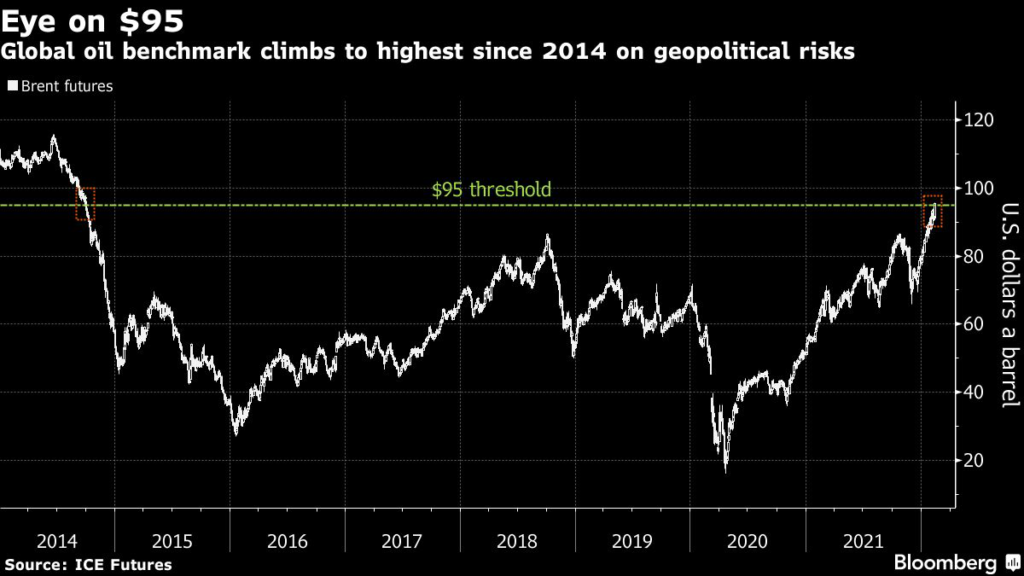
  • Oil Surges to $95 as Ukraine Tensions Stoke Supply Concerns
  • Russia Starts Major Military Drills in Belarus as NATO Watches
  • Russia and Europe Are Vital to Each Other When It Comes to Oil
  • What we know so far about potential U.S.-EU sanctions on Russia
  • Where Military Forces Are Assembling Around Russia and Ukraine

All times CET.

Japan, South Korea, New Zealand Urge Their Citizens to Leave (3 a.m.)

Japan, South Korea and New Zealand are also asking their nationals in Ukraine to leave the country. Japan’s foreign ministry elevated its travel warning to the highest level. South Korea will ban travel to Ukraine effective from Sunday. New Zealand said its citizens should leave immediately as the security situation there could change “at short notice.”

Biden, Putin to Speak on Saturday (10:10 p.m.)

The U.S. and Russian leaders will speak on Saturday, according to officials from both countries. Biden may do the call from the presidential retreat at Camp David, Maryland, where he departed the White House for on Friday afternoon.

The call will take place Saturday morning, according to a U.S. official. It will be the first direct conversation between the two leaders since Dec. 30. 

EU Isn’t Joining Nations Urging Evacuation From Ukraine (9:34 p.m.)

The European Union is “not evacuating” Ukraine, said spokesman Peter Stano. “For the time being, the non-essential staff has been given the opportunity to telework from outside the country,” he added.

Some EU member states, such as the Netherlands, have advised their citizens to leave but also said they’re not evacuating diplomats. Greece has advised its citizens in Ukraine to contact the Greek Embassy, but it isn’t advising at the moment to leave the country, according to an EU diplomat.

The U.K. Foreign Office said that it “now advises against all travel to Ukraine. British nationals in Ukraine should leave now while commercial means are still available.” Israel is evacuating the families of its diplomats from Kyiv, Israeli reporter Barak Ravid said in a tweet. 

Biden told NBC News in an interview excerpt that aired Thursday that “American citizens should leave now” because “things could go crazy quickly.”

U.S. Sending 3,000 More Troops to Poland as Tensions Rise (9:05 p.m.)

The Pentagon is sending 3,000 more troops from the U.S. to Poland, according to a U.S. defense official, as part of the effort to bolster the American and NATO presence in Europe as tensions with Russia build over Ukraine. U.S. officials have said the troops are there for defensive purposes only and wouldn’t go into Ukraine.

The Defense Department also said that General Mark Milley, chairman of the Joint Chiefs, spoke by phone with his Russian counterpart, General Valery Gerasimov. They agreed to keep the discussion private as has been past practice, according to Colonel Dave Butler, spokesman for the Joint Chiefs.

Oil Surges, Markets Shaken by Ukraine Tensions (9:11 p.m.)

 Brent oil soared to $95 a barrel for the first time since 2014 as the tensions with Russia over its military buildup near Ukraine intensified concern about tight global supplies. 

The global benchmark jumped as much as 4.7%, while U.S. prices also climbed. Any Russian move against Ukraine could not only disrupt crude supplies but also could spark retaliatory sanctions by the U.S.

The S&P 500 slid 2% and the Nasdaq 100 dropped more than 2%. U.S. bond yields plunged, with rates on the 10-year note falling as much as 10 basis points to 1.93% as traders sought safe havens.


U.S. Warns of Potential Russia Attack on Ukraine Within Days (8:20 p.m.)

National Security Adviser Jake Sullivan said the U.S. believes Russian President Vladimir Putin could order an attack on Ukraine before the Olympics end on Feb. 20.

“We continue to see signs of Russian escalation, including new forces arriving at the Ukrainian border,” Sullivan told reporters at the White House. “I will not comment on the details of our intelligence information, but I do want to be clear, it could begin during the Olympics despite a lot of speculation that it will only happen after the Olympics.”

The actions by Russia could include causing a provocation in the Donbas region, where Ukraine’s military has been fighting for years against separatists backed by Moscow, or attacking the country’s capital, Kyiv, officials familiar with the matter said. They said any action could start as soon as Tuesday.

He said Americans in Ukraine should leave “as soon as possible and in any event in the next 24 to 48 hours.”

Sullivan added that the U.S. still doesn’t know Putin’s final intentions on Ukraine.

U.K.’s Wallace Meets Russia Counterparts, Says Talks Constructive (5:55 p.m.)

U.K. Defense Secretary Ben Wallace said he received fresh assurances Russia won’t invade Ukraine, having held talks Friday with Defense Minister Sergei Shoigu and Chief of the Russian General Staff Valery Gerasimov in Moscow. Still, Russian forces have the capability to attack Ukraine “at any time,” he told reporters.

The talks with Shoigu were constructive and frank, Wallace said. “He is a professional, he is a very experienced minister, as is General Gerasimov. And when they say to me they are not going to invade Ukraine we will take that seriously. But as I have also said, we will look at the actions that accompany it.”

Russia Navy Exercises Cause Unease Among Grain Shippers (3:31 p.m.)

Ukraine’s grain shippers echoed assurances from the economy ministry that Russian naval drills shouldn’t block access to the nation’s ports, but warned that the uncertainty risks deterring some vessel owners. 

Moscow will begin full-scale naval exercises in the Black Sea on Sunday, after announcing the start of drills on Thursday. That unnerved commodity markets as Ukraine is the world’s No. 2 grain shipper. 

The drills, to take place in blocks of international waters as well as those claimed since 2014 by Russia along the coast of Crimea, should leave space for ships to reach ports such as Odessa and Chornomorsk via the 12 mile (19.3-kilometer) territorial waters of Romania and Ukraine. But the exercises have further fueled market fears that Russia’s military buildup could yet spiral into a conflict, said Mykola Horbachov, president of Ukraine’s Grain Association.

Ukraine Grain Shippers Say Russian Drills Risk Deterring Vessels

Russia Says Can’t Accept EU, NATO Answers (1:42 p.m.) 

Russia said it won’t accept the collective response of NATO and the European Union to its proposals on European security.

The demand for the respect of the principle of “indivisible security” in Europe was made in a letter sent by Foreign Minister Sergei Lavrov to his counterparts in 37 countries in Europe and North America, the Foreign Ministry said in a website statement.

Instead of individual answers, Russia has received letters from NATO chief Jens Stoltenberg and the EU’s foreign policy chief, said the ministry, which added that it is “waiting for a detailed response to the question we posed from every addressee.”

NATO Chief Cites Potential for Hybrid Attack on Ukraine Government (11:31 a.m.)

NATO Secretary General Jens Stoltenberg cited the “real risk” of conflict as Russia’s military buildup continues. The military alliance chief said potential scenarios include hybrid warfare or attempts to bring down Ukraine’s government. 

“There’s a risk for a full-fledged invasion, but there’s also a risk for other types of aggressive actions, including attempts to topple the government in Kyiv, hybrid cyberattacks, and many other types of Russian aggression,” Stoltenberg told reporters in Romania at an air base near the Black Sea. 

Speaking alongside Romanian President Klaus Iohannis, Stoltenberg said allies would seek an expanded presence on NATO’s southeastern flank, including battalion-sized battle groups in Romania and elsewhere.

Blinken Says Asia is Watching Ukraine Tension (10:11 a.m.) 

U.S. Secretary of State Antony Blinken said the world’s response to the Ukraine crisis was being watched by “others,” in a pointed reference to China’s territorial claims in Asia. 

Blinken said countries shouldn’t change the borders of other nations by force or dictate to another government. If these actions are allowed it affects basic principles established after two World Wars and the Cold War, he added in remarks to reporters after meeting with Quad foreign ministers in Melbourne.  

Russia Duma Mulls Appeal To Recognize Donbas Separatists (6:53 a.m.) 

The lower house of Russia’s parliament will start talks on a proposal to formally recognize separatist authorities in Ukraine’s Donbas, a move that, if approved, could hamper peace efforts and fuel tensions.

Speaker Vyacheslav Volodin said the State Duma’s council will decide Monday how to proceed with a proposal made in January to vote on an appeal to President Vladimir Putin to recognize the so-called People’s Republics in Donetsk and Luhansk.

Russia has supported the breakaway quasi-states militarily and financially since their formation in 2014, though officially it denies that and backs a peace plan that calls for their reintegration into Ukraine. Recognition could complicate efforts to implement that pact and potentially pave the way for Moscow to openly supply more weapons to the republics, something the ruling party has already proposed. The timeline for any possible moves toward recognition remains unclear. 

More stories like this are available on bloomberg.com

©2022 Bloomberg L.P.

China Approves Pfizer Pill; Banks Ease Mask Rules: Virus Update

(Bloomberg) — China granted emergency approval for Pfizer’s Covid-19 pill, in a sign the country could open up further to foreign treatments for the virus. Japan will ease its strict border controls, starting with foreign workers and students, the Nikkei reported.

Goldman Sachs Group Inc. dropped mask mandates amid an easing up in Covid-19 cases that’s paved the way for Wall Street staff to return to offices. 

The premier of Canada’s biggest province declared a state of emergency, warning protesters choking off traffic at a key U.S. border crossing they face stiff punishment if they don’t leave. Ontario’s Superior Court granted an injunction barring protesters from blocking the crossing.

New York City Mayor Eric Adams defended the decision to issue termination notices to unvaccinated city workers. Boris Johnson received a legal form from U.K. police investigating allegations he attended parties that broke lockdown rules.

Key Developments:

  • Virus Tracker: Cases top 408 million; deaths pass 5.8 million
  • Vaccine Tracker: More than 10.3 billion shots administered
  • Mask guidelines around U.S. ease, bringing confusion and relief
  • Wall Street bosses push ‘live with it’ mindset in office return
  • Hong Kong risks everything with ‘impossible’ Covid-zero goal
  • Why China is sticking with its Covid-zero strategy: QuickTake

China Has More Olympic Infections (1105 a.m. HK)

China reported four Covid infections among Olympic athletes and team officials. Total Covid infections among people involved with the Beijing Winter Olympics since Jan. 4 rose to 498, according to Bloomberg calculations based on official data.

Japan to Ease Border Controls: Nikkei (10:49 a.m. HK)

Japan will ease its strict border controls, beginning with foreign workers and students, the Nikkei reported. The government will start accepting more than 1,000 people a day this month and will gradually raise the cap to several thousand.

The controls, put in place in late November as the omicron variant started to spread, are by far the strictest among the Group of Seven nations. 

Germany Reports 209,789 New Cases (10:18 a.m. HK)

Germany reported 209,789 new Covid-19 cases, down from 240,172 the day before. New deaths associated with the virus rose by 198, bringing the total to 119,877.

China Approves Pfizer’s Virus Pill (9:44 a.m. HK)

China granted emergency approval for Pfizer’s Covid-19 pill, in a sign the country could open up to foreign treatments for the virus. 

Paxlovid’s import registration was approved on Friday, the National Medical Products Administration said. The Chinese regulator asked for further research results to be submitted in a timely manner.

It’s China’s first approval for a foreign Covid-19 drug. The mRNA Covid vaccine co-developed by Pfizer and BioNTech, for which China’s Shanghai Fosun Pharmaceutical Group Co. secured rights for the Greater China region, has yet to be approved in China.

Thailand Keeps Curbs With Cases at 5-Month High (9:35 a.m. HK)

Thailand’s new Covid-19 infections surged to a five-month high, prompting the government to keep containment measures in Bangkok and other areas to curb the outbreak.

The number of cases rose to 16,330, the highest single-day tally since Aug. 29, according to government data. The country also reported 25 new deaths in the past 24 hours, taking total fatalities to 22,387. 

Prime Minister Prayuth Chan-Ocha asked Bangkok and nine other provinces with the highest number of daily infections to take steps to contain the outbreak, Taweesilp Visanuyothin, a spokesman for the Covid panel, said yesterday. 

Walmart Drops Mask Rule for Vaccinated Workers (8:10 a.m. HK)

Walmart will no longer require fully vaccinated employees to wear masks unless required by state or local rules. 

In addition, a policy allowing five extra days of paid time off for workers testing positive for Covid-19 will end March 31 as planned, Walmart said in a memo to employees Friday. Daily health screenings will no longer be needed for workers, except in California, New York and Virginia, which have state requirements.  

The changes by Walmart represent a step away from pandemic-era rules as governments across the U.S. lift mask mandates for indoor spaces. The Bentonville, Arkansas-based retailer is the largest U.S. private-sector employer, with about 1.6 million employees in the country. 

Ontario Court Ruling Aims at Ending Blockade (6:20 a.m. HK)

Ontario’s Superior Court granted an injunction barring protesters from blocking the Ambassador Bridge connecting Detroit with Windsor, Ontario. The injunction that aims to end the blockade will take effect at 7 p.m. local time, Chief Justice Geoffrey B. Morawetz said in a court proceeding.

The court plans to resume late Friday to work out the details and specific wording of the injunction.

The Ambassador Bridge has been largely closed since Monday night. The conduit carries about one quarter of the commercial trade between the U.S. and Canada. 

Canada Bridge Blockade Defies Court Injunction: Protest Update

JPMorgan, Goldman Drop Mask Mandates (5:05 a.m. HK)

JPMorgan Chase and Goldman Sachs  dropped mask mandates amid an easing up in Covid-19 cases that’s paved the way for Wall Street staff to return to offices. 

JPMorgan said in a memo to employees that masks are now “completely voluntary” for vaccinated staff in its U.S. buildings, unless more stringent local restrictions are in place. Goldman Sachs similarly removed a mandate, a spokeswoman for the bank said.

Boris Johnson Gets Police Questionnaire (4:45 p.m. NY)

Boris Johnson received a legal form from U.K. police investigating allegations he attended parties with government officials that broke national lockdown rules during the coronavirus pandemic.

Officers from the Metropolitan Police, whose commissioner Cressida Dick quit suddenly this week, sent a legal questionnaire to the prime minister and dozens of officials as part of the investigation. Johnson has maintained he didn’t break any rules at the Downing Street gatherings.

Adams Defends NY’s Termination Notices (4:03 p.m. NY)

New York City Mayor Eric Adams defended the decision to issue termination notices to unvaccinated city workers on Friday in light of protests and backlash from municipal worker groups.

More than two dozen unions this week sued over the Feb. 11 vaccine deadline for municipal workers to get vaccinated, including the Police Benevolent Association, the United Federation of Teachers and the Uniformed Fire Officers Association.  

Jobs are at risk for about 3,000 workers who took unpaid leave instead of getting vaccinated when the city’s mandate took effect in October, as well as about 1,000 recent hires who haven’t submitted documentation of their second shots.

Vaccine for U.S. Kids Under 5 Delayed (3:45 p.m. NY)

A Covid-19 vaccine for children under age 5 is unlikely to be cleared for use in the U.S. until the spring after federal regulators opted to postpone a review scheduled for next week to wait for more data.

Food and Drug Administration advisers had been planning to consider a two-dose regimen of Pfizer Inc.’s shot on Tuesday. The delay is to allow the company and its partner BioNTech SE to gather and evaluate more information on the impact of a third dose, agency officials said Friday in a statement.

New Eli Lilly Antibody Cleared by U.S. (3:35 p.m. NY)

The Food and Drug Administration on Friday granted an emergency authorization for use of bebtelovimab in patients 12 and older with confirmed Covid-19 who are at high risk of progressing to severe disease, and for whom other treatment options aren’t accessible or clinically appropriate.

U.S. regulators cleared a new Eli Lilly & Co. monoclonal antibody for patients at high risk of mild to moderate Covid-19, after a similar therapy developed by the company turned out to be ineffective against the omicron variant.

Macron Calls for Order (2:19 p.m. NY)

President Emmanuel Macron called for order as protesters against France’s Covid-19 vaccine passes headed toward Paris to attempt to blockade the capital, inspired by Canada’s “freedom convoys.”

Police set up barricades and armored vehicles at some Paris intersections, including along the Champs-Elysees. Tractors and water cannon were also deployed.

Meantime, France is lifting some travel restrictions imposed to counter the omicron variant of the coronavirus, the French Prime Minister’s office said in an emailed statement. Starting Saturday, vaccinated travelers won’t need to take a test to enter France, regardless of the country of origin. 

Belgium to Lift Most Restrictions (11:40 a.m. NY)

Belgium agreed to loosen most of the virus restrictions it introduced late last year now that all but one of the indicators used to monitor the surge of the omicron variant show that the outbreak is past its peak.

Starting on Feb. 18, the requirement to work from home four days a week will disappear and become a recommendation, Prime Minister Alexander De Croo said Friday. At that time, nightclubs will also reopen, pubs and restaurants won’t face a mandatory closing hour or table limits, and a ban on events with moving crowds will subside, along with the obligation for children younger than 12 to wear masks.

Judge Blocks Biden Contractor Mandate (11:38 a.m. NY)

An Arizona judge issued a final judgment in a challenge to President Joe Biden’s executive order requiring Covid-19 vaccines for federal contractor workers, shielding the state’s employees and companies that do business with the government from the mandate.

Judge Michael Liburdi of the U.S. District Court for the District of Arizona in Phoenix on Thursday granted a permanent injunction against the executive order, after a previous order from January that temporarily blocked its enforcement and didn’t define its full scope. Arizona Attorney General Mark Brnovich sued over the vaccine requirement, saying it exceeded the scope of executive power.

The mandate, which was set to take effect in January, would apply to federal contractors — roughly a fifth of the U.S. workforce — and includes companies such as Lockheed Martin Corp., Microsoft Corp., Alphabet Inc.‘s Google, and General Motors Co.

Dutch Nightclubs to Defy Restrictions (11:15 a.m. NY)

Nightclubs in the Netherlands are planning to open their doors to the public on Saturday night in defiance of Covid-19 restrictions.

“The Night Rises” campaign was launched to protest government rules that force bars, clubs and cafes to shut at 10 p.m. Clubs taking part in the movement are estimated to have sold around 20,000 tickets, according to Dutch news agency ANP. 

Ontario Declares Emergency Over Protests (10:59 a.m. NY)

The premier of Canada’s biggest province declared a state of emergency, warning protesters choking off traffic at a key U.S. border crossing they face stiff punishment if they don’t leave.

Ontario Premier Doug Ford, in a news conference Friday alongside his solicitor general, said the government is enacting new powers to end the blockade, including issuing fines of up to C$100,000 ($78,800) and jail time. 

“We will also provide additional authority to consider taking away the personal and commercial licenses of anyone who doesn’t comply with these orders.,” Ford said, according to prepared remarks.

More stories like this are available on bloomberg.com

©2022 Bloomberg L.P.
H.K. Banks to Suspend Operations at Quarter of Branches

(Bloomberg) — Hong Kong’s banks will suspend operations at one in every four branches in the city after a number of employees were infected with Covid, the South China Morning Post reported.

HSBC Holdings Plc, Standard Chartered and Bank of China and another 13 major lenders will close a total of 276 branches, the South China Morning Post reported. The closures started last week and will continue Monday, according to the newspaper. 

The move is a precautionary measure to “safeguard the health and safety of the bank’s employees and customers, while balancing the need to ensure normal banking services to the community,” an unidentified HSBC spokesman told the Post. Customers are advised to “take advantage” of HSBC’s digital banking services and automatic teller machines, the newspaper cited the spokesman as saying. 

The latest outbreak in Hong Kong, its biggest ever, comes after months of no community transmission, and is straining health-care resources and threatening Hong Kong’s Covid Zero strategy. Officials are set to meet with mainland authorities this weekend to request urgent help after the city posted more than 1,000 daily cases for the first time on Wednesday. 

This isn’t the first time banks operating in the city have chosen to close amid a worsening covid outbreak in the Asian financial center. Last March, HSBC closed its main branch after three people working in the building tested positive for Covid-19.


More stories like this are available on bloomberg.com

©2022 Bloomberg L.P.

IBM Emails Show Millennial Workers Favored Over ‘Dinobabies’

(Bloomberg) — IBM executives discussed in emails how to force out older workers and derided them as “Dinobabies” who should be made an “Extinct species,” according to a court filing in an age discrimination case against the company.

The communications show “highly incriminating animus” against older employees by officials who at the time were in the company’s “highest ranks,” according to the filing Friday.

The partially redacted filing says the emails surfaced in separate arbitration proceedings but it doesn’t reveal the identities of the company officials or indicate when they were speaking. A judge has ordered the release of versions of the underlying documents.

In one email chain, an International Business Machines Corp. official described a plan to “accelerate change by inviting the ‘dinobabies’ (new species) to leave” and turn them into an “Extinct species,” according to the filing. Company officials also complained about IBM’s “dated maternal workforce” that “must change,” and discussed frustration that IBM had a much lower share of millennials in its workforce than a competitor, but said its share would increase following layoffs, according to the filing.

An IBM spokesperson said in a statement that the company never engaged in systematic age discrimination and it terminated employees because of changing business conditions, not because of their age. In 2020, the median age of IBM’s U.S. workforce was 48, the same as it was in 2010, according to the statement.

The spokesperson also said the language cited in the emails “is not consistent with the respect IBM has for its employees and as the facts clearly show, it does not reflect company practices or policies.”

Read More: IBM Is Being Sued for Age Discrimination After Firing Thousands

The company faces age bias complaints in arbitration and court proceedings by former employees across the country. A former IBM vice president of human resources said in a court deposition in one of the cases that the company faced talent recruitment problems and determined one way to show millennials that IBM was not “an old fuddy duddy organization” was to make itself appear “as [a] cool, trendy organization.” 

Friday’s filing was submitted by Shannon Liss-Riordan, a lawyer who represents hundreds of workers suing the company.

“IBM has engaged in egregious age discrimination,” Liss-Riordan said in an interview Friday. “IBM has tried to use arbitration clauses to shield that evidence from the public and other employees who are trying to build their cases of discrimination.”

The case is Lohnn v. International Business Machines Corp., 21-cv-06379, U.S. District Court, Southern District of New York. 

(Updates with company statement about median age of employees.)

More stories like this are available on bloomberg.com

©2022 Bloomberg L.P.

Stellantis Recalls Plug-In Hybrid Minivans on Fire Risk

(Bloomberg) — Stellantis NV is recalling almost 20,000 plug-in hybrid Pacific minivans because of fire risk, the latest incident highlighting the potential hazards involved with the industry’s move toward electrified vehicles.

An internal investigation found 12 incidents of fires in vehicles from the 2017 and 2018 model years, the automaker said Friday in a statement. All of the minivans were parked and turned off, and 8 were charging when the fires occurred. Stellantis said it’s not aware of any related injuries or accidents.

“Stellantis is working to confirm the cause of the fires,” the company said in the statement. “The remedy, when developed, will be provided free of charge, and affected customers will be advised when they may schedule service.”

The voluntary recall includes 19,808 vehicles, mostly in the U.S. and Canada, with batteries made by an affiliate of LG Chem Ltd. 

LG Energy Solution Ltd., which was spun out of parent LG Chem in an initial public offering last month, said the automaker hasn’t established a cause for the fires. 

“There is no confirmed root cause of fires in the Stellantis vehicles that is subject to the recall, or proof directly linking to the battery,” the South Korean company said in an emailed statement. 

General Motors Co. reached an agreement with LG group companies in October to recover costs associated with an unrelated recall of batteries in its Chevrolet Bolt EV. The Detroit-based automaker had to recall all 143,000 Bolt and Bolt EUV models because of a manufacturing defect involving the battery that led to an increased fire risk.

(Updates with LG Chem affiliate’s comment from fifth paragraph.)

More stories like this are available on bloomberg.com

©2022 Bloomberg L.P.

Crypto Lender BlockFi to Pay $100 Million In Settlement with SEC, States

(Bloomberg) — BlockFi Inc. is poised to pay $100 million to settle allegations from the Securities and Exchange Commission and state regulators that it illegally offered a product that pays customers high interest rates to lend out their digital tokens, according to people familiar with the matter.

The penalties, which could be announced as soon as next week, are among the toughest levied on a cryptocurrency firm amid a U.S. clampdown on the industry. The SEC and state investigators have been probing whether the accounts offered by BlockFi are akin to securities that should be registered with regulators.

Scrutiny has been mounting on crypto-lenders, which have attracted tens of billions of dollars in deposits by promising yields that far exceed those available through traditional savings accounts. As part of its agreement with regulators, BlockFi will no longer be able to open new interest-yielding accounts for most Americans, the people said.

“We have been in productive ongoing dialogue with regulators at the federal and state level. We do not comment on market rumors,” said BlockFi spokesperson Madelyn McHugh. “We can confirm that clients’ assets are safeguarded on the BlockFi platform and BlockFi Interest Account clients will continue to earn crypto interest as they always have.”

An SEC spokesperson declined to comment.

SEC Chair Gary Gensler has been sounding the alarm on fast-growing crypto firms, arguing that some are offering financial services without adhering to benchmark investor-protection rules that banks, brokers and other long-established entities have long had to comply with. 

BlockFi, based in Jersey City, New Jersey, will pay a $50 million fine to the SEC and another $50 million to various states, said the people who asked not to be named because the deliberations are private. It’s among several companies, including Celsius Network and Gemini Trust Co., that have become wildly popular with retail investors for paying yields that sometimes exceed 10%.

Securities regulators from several states last year brought enforcement actions against BlockFi and Celsius over the accounts, arguing that the companies were selling unregistered securities with undisclosed risks. The SEC is also scrutinizing Celsius, Gemini and Voyager Digital Ltd. over similar issues, Bloomberg reported in January.

At the time, a Gemini spokeswoman said the company was cooperating with an “industry-wide inquiry” into crypto-yield products. Celsius said it was working with regulators to “operate in full compliance with the law” and a Voyager spokesman said it was routine to be in ongoing communications with watchdogs. The SEC hasn’t accused any of the companies of wrongdoing.

The SEC has separately warned Coinbase Global Inc., the biggest U.S. crypto exchange, that it would sue if the company moved forward with a lending product, prompting the company to suspend the project in September.

Executives at BlockFi have said they are able to pay such high yields to customers because institutional investors will pay them even more to borrow the deposits. Unlike bank accounts, the crypto-interest accounts aren’t federally insured.

Earlier this year, BlockFi said its Bermuda-based subsidiary would handle foreign clients. It also introduced a non-interest-paying crypto wallet and a new-interest product for accounts with at least $3 million in cryptocurrencies.

More stories like this are available on bloomberg.com

©2022 Bloomberg L.P.

Splunk Jumps on Report That Cisco Made $20 Billion-Plus Offer

(Bloomberg) — Splunk Inc. jumped as much as 16% in late trading on a report that Cisco Systems Inc. made an offer of more than $20 billion for the software company.

The shares climbed as high as $133.25 following the Wall Street Journal story, which cited unidentified people familiar with the situation. The stock had closed at $114.51 on Friday, down about 1% this year.

Cisco, which is set to report its latest results next week, has been expanding its software and services — an attempt to rely less on its hallmark networking hardware. The company gave a lackluster forecast for revenue in November, hurt by a shortage of components.

Cisco declined to comment, while Splunk didn’t immediately respond to a request for comment. 

Cisco has traditionally generated the bulk of its revenue from equipment that forms the backbone of computer networks, but that’s been changing. Revenue from subscriptions and software will reach 50% of Cisco’s total by fiscal 2025, the company predicted in September.

Cisco slipped in late trading, falling less than 1%. It was down 15% this year through the close.

More stories like this are available on bloomberg.com

©2022 Bloomberg L.P.

Close Bitnami banner
Bitnami