Bloomberg

Take-Two Misses Estimates as Market Awaits News on Next GTA

(Bloomberg) — Take-Two Interactive Inc. offered a forecast for revenue in the current quarter that missed analysts’ estimates, sending shares lower as investors await news on timing of the highly anticipated next installment of the Grand Theft Auto franchise.

Adjusted revenue will be $808 million to $858 million in the fiscal fourth quarter, Take-Two said in a statement on Monday, while earnings per share, excluding some costs will be 78 to 88 cents. Analysts had predicted revenue of $918 million and earnings per share of $1.15. The shares fell in extended trading.

Take-Two is the parent company of several video game labels including Rockstar and 2K Games. It operates the lucrative NBA 2K franchise as well as Grand Theft Auto Online, one of the world’s most popular video games. Last week, Rockstar said development of a new Grand Theft Auto game was “well underway,” sending the shares up 7.4%. The previous version of the title has sold more than 160 million units, making it one of the best-selling video games of all time.

But the New York-based company’s remastered versions of old Grand Theft Auto titles in November were a disappointment to fans and it delayed the release of Grand Theft Auto V for the PlayStation 5 and Xbox Series X to March. Take-Two has three other titles slated for release in the current period, including WWE 2K22, Tiny Tina’s Wonderlands and OlliOlli World.

In early January, Take-Two announced plans to purchase Zynga, a move to break into the fast-growing market for smartphone games and bring titles like Grand Theft Auto Online to mobile. The transaction is expected to make Take-Two a leader in the $93 billion global mobile-game market, with that sector expected to comprise more than half of net bookings in fiscal 2023, up from an estimated 12% in fiscal 2022, the company said at the time. It was the video game industry’s largest acquisition ever until a week later when Microsoft Corp. said it was buying Activision Blizzard Inc. for $69 billion. Take-Two has itself been mentioned by analysts as a potential acquisition target as the video game indstry is expected to undergo continued consolidation.

For the fiscal third quarter, Take-Two reported adjusted revenue of $866.12 million missing analysts’ estimates of $871.1 million. Earnings per share were $1.32, beating estimates of $1.12. Take-Two shares slid about 2% in extended trading after the results. They are down about 15% over the past year.

The company raised its outlook for fiscal year 2022, and now expects net bookings of $3.37 billion to $3.42 billion. Take-Two said it has “the strongest and most diverse pipeline” in the company’s history, including new intellectual properties as well as sequels to many beloved franchises.

More stories like this are available on bloomberg.com

©2022 Bloomberg L.P.

Cathie Wood Says People ‘Rebelling’ Against Rising Auto Prices

(Bloomberg) — Cathie Wood, the founder and CEO of Ark Investment Management, said Monday that consumers are starting to rebel against rising auto prices and warned that manufacturers could be stuck with a glut of inventory. 

“Auto manufacturers enjoyed pricing power during the COVID-related supply shock but may regret moves that, along with soaring oil prices, have accelerated the shift to electric vehicles,” she wrote in a tweet. “This inflation is transitory.”

Wood, who has previously said that companies “overreacted” to supply chain bottlenecks, retweeted a thread from ARK analyst Sam Korus in which he argued that auto demand may not be sustainable at current price levels. 

Read More: Ark’s Wood Says Companies ‘Overreacted’ to Supply Bottlenecks

More stories like this are available on bloomberg.com

©2022 Bloomberg L.P.

Motorola’s Chinese Rival Hytera Indicted Over Stolen Secrets

(Bloomberg) — Hytera Communications Corp., a Chinese technology company, was accused by U.S. prosecutors of stealing trade secrets for mobile radio technology developed by Motorola Solutions Inc.

Hytera recruited and hired Motorola employees to take proprietary information from internal databases from 2007 to 2020, according to a 21-count federal indictment unsealed Monday in Chicago. The names of others charged in the indictment remained sealed.

In 2020, Motorola won a $764.6 million civil court verdict against its Chinese rival after a jury concluded Hytera stole critical trade secrets for two-way radio technology used by school officials, utility workers and construction crews. 

Hytera denied stealing technology and said it developed its products on its own. It has appealed the verdict and accused Motorola of abusing its superior market power to hobble competition.

Read More: FCC Proposes Ban on Chinese Surveillance Cameras, Other Products

An arraignment date for the criminal case against Hytera hasn’t been set, the Department of Justice said in an emailed statement. 

U.S.-based representatives of Hytera didn’t respond to emails and a voicemail seeking comment on the indictment. 

Range of Secrets

The indictment accuses Hytera of stealing a broad range of secrets including source code, designs of operation architecture and security features. Hytera was a former distributor of Motorola radios until it began luring away former Motorola employees and developed a rival product.

Motorola said the charges “underscore the calculated and deliberate character of Hytera’s illegal activity directed at Motorola Solutions.”

The indictment “alleges that Hytera engaged in a decade-long criminal conspiracy to steal and use Motorola Solutions’ trade secrets and proprietary information in order to develop and sell digital mobile radios,” said Motorola Solutions General Counsel Mark Hacker. 

The Chicago-based company said it will continue to pursue civil litigation in multiple jurisdictions. It has filed lawsuits against Hytera in the U.S., China, Germany and Australia. Hytera has sued Motorola as well.

The criminal case is U.S. v. Hytera Communications Corp., 20-cr-688; the lead civil case is Motorola Solutions Inc. v. Hytera Communications Corp., 17-cv-1973; U.S. District Court, Northern District of Illinois (Chicago).

(Updates with comment from Motorola Solutions beginning in eighth paragraph.)

More stories like this are available on bloomberg.com

©2022 Bloomberg L.P.

Apple Buys Startup That Makes Music With Artificial Intelligence

(Bloomberg) — Apple Inc. acquired a startup called AI Music that uses artificial intelligence to generate tailor-made music, according to a person with knowledge of the matter, adding technology that could be used across its slate of audio offerings.

The purchase of AI Music, a London-based business founded in 2016, was completed in recent weeks. The company had about two dozen employees before the deal.

Technology developed by AI Music can create soundtracks using royalty-free music and artificial intelligence, according to a copy of its now-defunct website. The idea is to generate dynamic soundtracks that change based on user interaction. A song in a video game could change to fit the mood, for instance, or music during a workout could adapt to the user’s intensity.

On its LinkedIn page, AI Music said its goal is to “give consumers the power to choose the music they want, seamlessly edited to fit their needs or create dynamic solutions that adapt to fit their audiences.” The startup had earlier deals with advertising companies to create more engaging ads that played different music depending on the audience.

A representative of Cupertino, California-based Apple declined to comment. 

While relatively small, the deal is one of the tech giant’s few acquisitions in the past year. Apple’s last reported purchase was also for a music company: Primephonic. That startup ran a classical music streaming service that Apple intends to turn into an app tied to Apple Music this year. 

Apple dramatically slowed down its acquisition spending during 2021, devoting only $33 million to deal payments over the fiscal year, according to a filing in October. That’s down from $1.5 billion in 2020 and $624 million in 2019.

More stories like this are available on bloomberg.com

©2022 Bloomberg L.P.

Connecticut, N.J., Delaware to End Mask Mandates: Virus Update

(Bloomberg) — The governors of Connecticut, New Jersey and Delaware said Monday they were lifting their requirements that schoolchildren wear masks.

Canada’s capital city, Ottawa, remained under a state of emergency as police tried to rein in protests against vaccine mandates and Covid-19 restrictions.

More people are back in City of London offices than at any time since December, when the government told people to work from home to slow the spread of omicron. 

Australia will allow double-vaccinated visa holders to enter the country from Feb. 21, ending about two years of strict international border controls. HSBC Holdings Plc and other banks closed retail branches in Hong Kong as the Covid outbreak there grew. 

Key Developments:

  • Virus Tracker: Cases top 395 million; deaths pass 5.7 million
  • Vaccine Tracker: More than 10.2 billion shots administered
  • Beijing Olympics locks out omicron but internet is open
  • Covid rebellion brews in Canada, sending warning across globe
  • Is Covid becoming endemic? What would that mean?: QuickTake

Connecticut Ending State Mask Mandate (4:45 p.m NY)

Connecticut Governor Ned Lamont recommended the state end its mask mandate on Feb. 28. Mayors and school superintendents will be able to make decisions on masks themselves to reflect local conditions, Lamont said in a news conference on Monday

“We’re in a very different place than we were six months ago,” Lamont said.

Italy to End Outdoor Mask Mandate (11:20 a.m. NY)

Mandatory use of masks outdoors in Italy will end on Feb, 11, Health Undersecretary Andrea Costa told Ansa newswire on Monday. “This is a sign of hope for all Italians,” he said. According to the Italian government, 91.2% of citizens over 12 have received at least one dose of a vaccine.

Delaware to Lift Mask Mandates (10:30 a.m. NY)

Delaware will lift its public indoor mask mandate beginning Friday, Governor John Carney said in a tweet.


New Jersey to End Student Mask Rule (9:04 a.m. NY)

New Jersey school districts will be allowed to drop a mask mandate next month, Governor Phil Murphy is expected to announce Monday. The move will be effective March 7, with flexibility for districts to decide on their own requirements.

School mask mandates have become a hot-button issue across the U.S. Murphy made them a requirement last September when in-person lessons restarted statewide for the first time since the pandemic’s onset.

More City of London Workers Return to Offices (6:41 a.m. NY)

More people are back in City of London offices than at any time since December, when the government told people to work from home to slow the spread of omicron. 

Almost 70% of staff were back in the workplace in the financial district on Thursday, according to data compiled by Google.

In mid-December, the government advised employees to work from home if possible, and required people to wear masks in shops and on public transport. The restrictions were eased in January as cases began to fall.

Hong Kong Banks Close Branches (6:17 a.m. NY)

Major retail banks are changing operating hours and closing local branches in Hong Kong, according to The Standard, in response to a rapidly growing Covid outbreak that has the city reeling.

Bank of China Ltd. shut more than 50 branches temporarily and reduced operating hours for its remaining stores, and Hang Seng Bank Plc closed seven branches and 11 metro station offices until further notice. HSBC, Bank of East Asia, Chong Hing Bank, OCBC Wing Hang Bank and ICBC also announced closures.

Czech Republic to Ease Restrictions (06:10 a.m. NY)

The Czech Republic had 9,060 new coronavirus cases in 24 hours through Sunday, the lowest in about three weeks. The government plans to lift some measures this week, including a ban on non-vaccinated people using restaurants and some services. The mandatory bi-weekly testing at schools and work places will also be scrapped on Feb. 18.

Hong Kong Weighs Curbs as Cases Surge (6:09 p.m. HK)

Hong Kong Chief Executive Carrie Lam is set to discuss further restrictions at an Executive Council meeting on Tuesday after a record of 614 new coronavirus infections were reported, with cases doubling every three days. 

Potential measures include limiting numbers at restaurants and placing restrictions on religious venues, according to local media reports. The government may also lower the public gathering limit to two people in a return to one of the strictest anti-virus measures.

Germany Discusses Gradual Easing (4:49 p.m. HK)

Germany’s health minister expects Covid restrictions to be eased “long before Easter.” A gradual relaxation may be discussed at a summit between the state and federal governments on Feb. 16, Karl Lauterbach said on Bild TV late Sunday. 

The “specter” of Covid may subside by the fall, but only if a vaccination mandate is introduced, he said. Germany’s outbreak is at record levels, with more than 1,400 infections per 100,000 people over the past seven days.

Indonesia Tightens Restrictions (1:53 p.m. HK)

Indonesia has tightened mobility restrictions in Jakarta, Bandung and Bali to the second-highest level as omicron cases continue to spread rapidly. The restrictions, which include limiting capacity at public places and reducing operating hours for cafes and restaurants, will be implemented for one week. 

Australia to Reopen for Visa Holders (11:38 a.m. HK)

Australia will allow double-vaccinated visa holders to enter the country from Feb. 21, ending around two years of strict international border controls.

The announcement is the final step in a gradual unwinding of international restrictions, which kicked off in November. Still, Western Australia remains closed to the rest of the country, after delaying its domestic border reopening. 

The decision to allow vaccinated international arrivals comes as Covid infections, hospitalizations and intensive care admissions trend down in most parts of the country. 

Chinese City Locked Down (10:58 a.m. HK)

A southwestern Chinese border city was locked down after mass testing identified nearly 100 people with Covid, yet another outbreak that’s extending the country’s protracted battle to bring infections back to zero.

A total of 98 people tested positive on Sunday in Baise, a city of 3.6 million people next to Vietnam. Travel was banned within the city and to the rest of China and all residents were asked to stay at home.

China has no plans to adjust its policy for the time being, Wu Zunyou, chief epidemiologist with the Chinese Center for Disease Control and Prevention, told the Global Times. 

Protesters Cause Chaos in Australian Capital (10:46 a.m. HK)

A group of anti-vaccination demonstrators and conspiracy theorists blocked roads and targeted businesses in the Australian capital of Canberra ahead of the return of federal parliament on Tuesday.

Hundreds of cars and trucks waving Australian flags, military insignia and campaign banners for former U.S. President Donald Trump descended on the city over the past week to call for the end to vaccination requirements in businesses and places of employment.

Korea Cases Could Reach 170,000 (10:26 a.m. HK)

South Korea’s daily cases could increase to 130,000-170,000 at the end of February with the surge of the omicron variant, the Korea Disease Control and Prevention Agency said.

President Moon Jae-in said it’s a serious situation as it’s unclear when the wave will peak. 

Ottawa Declares Emergency as Protests Intensify (5 p.m. NY)

Canada’s capital declared a state of emergency Sunday as police struggled to rein in ongoing protests against vaccine mandates.

The demonstrations started in reaction to Canadian and U.S. laws that went into effect in January, requiring truckers crossing the border to be fully vaccinated. They have since morphed into a rally against Covid restrictions more broadly.

Ottawa Mayor Jim Watson said that they pose a “serious danger and threat to the safety and security of residents.”

More stories like this are available on bloomberg.com

©2022 Bloomberg L.P.

Peter Thiel to Leave Meta Board to Pursue Trump Agenda

(Bloomberg) — Peter Thiel, the tech investor and conservative provocateur who has advised Mark Zuckerberg for nearly two decades at Facebook parent Meta Platforms Inc., will step down from the company’s board after Meta’s annual shareholder meeting in May. 

Thiel, 54, who became a director in 2005 after an early investment in Facebook, plans to increase his political support of former President Donald Trump’s agenda during the 2022 election and doesn’t want his political activities to be a distraction for Facebook, according to a person close to Thiel.

His focus will be on backing Blake Masters, JD Vance and others who advance the Trump agenda, the person added, referring to Republican candidates for U.S. Senate. 

“Peter is truly an original thinker who you can bring your hardest problems and get unique suggestions,” Zuckerberg said in a statement. “He has served on our board for almost two decades, and we’ve always known that at some point he would devote his time to other interests.” 

Thiel helped elect Trump president in 2016 by donating money and speaking on his behalf at the Republican National Convention. When Trump became president, Thiel worked on his transition team while nominating colleagues to fill government positions, including former Thiel Capital Chief of Staff Michael Kratsios, who served as the chief technology officer of the White House until last year. Thiel has continued to support Trump while meeting with members of the Republican Party and members of the far-right in recent years.

Thiel’s departure will mark the end of one of the most productive — and harshly criticized — partnerships between a chief executive officer and an investor in all of business. Thiel has been a close adviser to Zuckerberg ever since the duo met through Napster co-founder Sean Parker, when Facebook was still just a social network for college campuses. Thiel was instrumental in shaping Zuckerberg’s ethos during the early days of Facebook and its relentless pursuit of growth. 

That relationship continued even as Thiel became more and more controversial in the technology industry, and became a frequent target for Facebook critics and unhappy employees.

Thiel, who is also a co-founder and chairman of Palantir Technologies Inc., was known to advise Zuckerberg on political issues. He was among those reportedly encouraging the CEO not to fact-check political advertisements in the run-up to the 2020 presidential election, a move that many believe benefited Trump. He also joined a dinner with Zuckerberg and Trump at the White House in 2019. 

Many Facebook employees were upset with Thiel’s role in backing Trump in 2016 given the former president’s stance on immigration, and allegations of sexism and racism against then-candidate Trump. But Zuckerberg defended Thiel and his role on Facebook’s board in an internal post to employees in October 2016. “We can’t create a culture that says it cares about diversity and then excludes almost half the country because they back a political candidate,” he wrote at the time. 

Thiel was one of the first venture capitalists to see the potential in Zuckerberg’s vision. He became the first outside investor in Facebook when he loaned the then-Harvard undergrad $500,000 in 2004.

The bet validated Thiel’s instincts and acclaim as an investor but it had the potential to be far more lucrative. He sold most of his stake in 2012 through a prearranged stock-trading plan at an average price of less than $20 a share.  

Those share sales generated more than $1.1 billion in proceeds for the billionaire, before taxes. Had he maintained his stake at its pre-IPO level however, his holding in Meta would now be worth ten times as much.

Masters, a former student of Thiel’s who co-wrote “Zero to One” with him, is running for Senate as a Republican from Arizona. Masters still oversees Thiel’s personal investment vehicle, Thiel Capital. 

Vance, who previously invested on behalf of Thiel, is running for the Senate as a Republican from Ohio who is a “conservative outsider.” Vance is best known for his 2016 memoir “Hillbilly Elegy” and is campaigning on promises to abolish the Bureau of Alcohol, Tobacco, Firearms and Explosives and push back against gun laws.

(Updates with Zuckerberg statement in fourth paragraph)

More stories like this are available on bloomberg.com

©2022 Bloomberg L.P.

Equitable Group to Buy Digital Rival Concentra Bank for $371 Million

(Bloomberg) — Equitable Group Inc., a  Canadian online banking firm, agreed to take over digital rival Concentra Bank for C$470 million ($371 million) to bulk up its assets and expand its business with credit unions.

Equitable is buying Credit Union Central of Saskatchewan’s 84% stake in Concentra, and also struck agreements with investors representing most of the remaining 16% of shares, according to a statement Monday. 

The deal expands Equitable’s personal banking portfolio by C$7.4 billion in loans and gives it a business that provides wholesale banking and trust services to 90% of Canadian credit unions outside of Quebec. Equitable was founded in 1970 as a trust company and now has 325,000 Canadian customers through its Equitable Bank subsidiary, which operates entirely online. 

The deal is “one of the most important and consequential” transactions in the company’s history and “accelerates our growth plan by several years,” Equitable Chief Executive Officer Andrew Moor said in the statement.

Equitable, based in Toronto, is financing the purchase through a fully committed credit facility and C$200 million of new equity raised through a bought deal. The transaction is expected to close in the second half of the year, subject to regulatory approvals.

More stories like this are available on bloomberg.com

©2022 Bloomberg L.P.
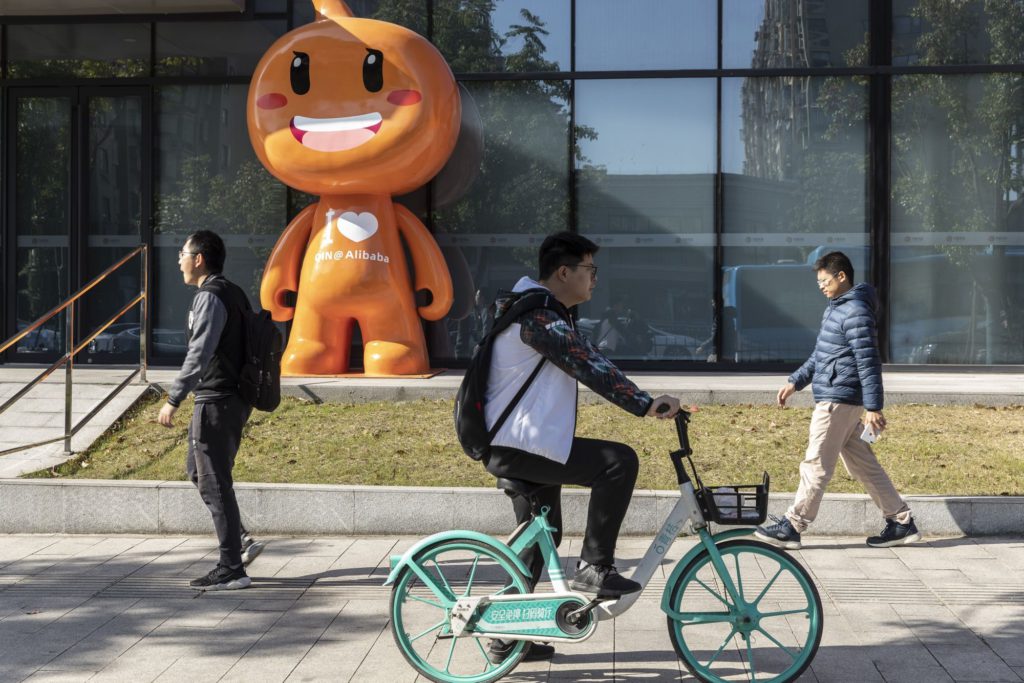
Alibaba Falls as Stock Filing Seen as Sign of SoftBank Sale

(Bloomberg) — Alibaba Group Holding Ltd. shares dropped 6.1% in U.S. trading on Monday after Citigroup Inc. analysts saw its additional American depositary share registration in the U.S. as a sign that SoftBank Group Corp. may sell part of its stake.

Analysts at JPMorgan Chase & Co also said in a note to clients that the further one billion ADS registration indicates some of the insiders, either management or early investor SoftBank, might dispose of Alibaba shares in the near future.

A potential stake sale by SoftBank, coupled with weak online consumption, will continue to weaken sentiment toward Alibaba’s shares, battered last year along with other Chinese technology peers by Beijing’s regulatory crackdowns. The stock is down 3.4% this year and more than 63% below its October 2020 highs.

SoftBank owns 5.39 billion ordinary Alibaba shares, equivalent to 673.76 million ADSs, or a 24.8% stake, according to Citi’s calculations. Masayoshi Son’s SoftBank has faced pressure from investors in recent months as the value of many portfolio companies, including Didi Global Inc., One 97 Communications Ltd. and DoorDash Inc. was dragged lower by the technology downturn.

Alibaba filed a form on Friday with the Securities and Exchange Commission of the U.S. to register an additional one billion ADSs, each representing eight ordinary shares. The filing will allow its stockholders whose shares have never been registered with the regulator to have the flexibility to sell stock, Citi said. The registration could also cover the company’s need to issue new shares for an employee equity incentive plan.

Led by Alibaba’s rout, the Nasdaq Golden Dragon China Index fell 1.9% on Monday after China shares overnight showed strong momentum following a week-long holiday. The gauge closed 8% higher last week, its biggest rally in about two months.

(Updated with share moves at close)

More stories like this are available on bloomberg.com

©2022 Bloomberg L.P.
WarnerMedia Hatched a Secret Plan to Profit HBO Max, Suit Says

(Bloomberg) — Village Roadshow Films Ltd. sued Warner Bros. claiming the entertainment giant is simultaneously releasing films in theaters and on WarnerMedia’s HBO Max service to drive subscription revenue for the streaming service, depriving the filmmaking company of theater revenue.

In the lawsuit filed Monday in state court in Los Angeles, Village Roadshow said it co-owns intellectual property rights on almost 100 films that it has paid Warner Bros. more than $4.5 billion to produce and distribute for 25 years.

It’s the latest battle between film producers and stars and distributors who are relying on new forms of revenue from streaming services. “Black Widow” star Scarlett Johansson sued Walt Disney Co. last year, claiming the release of the film on the Disney+ streaming service deprived her of theater revenue. She settled the suit in September.

WarnerMedia hatched a secret plan codenamed “Project Popcorn” to reduce box office and ancillary revenue from films to prop up HBO Max, which benefits only Warner Media, according to the complaint. Village Roadshow pointed specifically to the rush to release “The Matrix Resurrections” last year so HBO Max subscribers could watch it the same day it hit theaters.

Warner Bros. said in a statement that it has no doubt it’ll win the case.

“This is a frivolous attempt by Village Roadshow to avoid their contractual commitment to participate in the arbitration that we commenced against them last week,” Warner Bros. said.

Warner Bros. “sole purpose in moving the release date of ‘The Matrix Resurrection’ forward was to create a desperately needed wave of year-end HBO Max premium subscriptions from what it knew would be a blockbuster film, despite knowing full well that it would decimate the film’s box office revenue and deprive Village Roadshow of any economic up-side that Warner Bros. and its affiliates would enjoy,” according to the complaint.

Warner Bros. claims it released “The Matrix Resurrections” on HBO Max at the same time as in theaters because of the pandemic. But Village Roadshow says other films such as “Spiderman: No Way Home” were released only in theaters in late 2021 and broke box-office records. “Spiderman: No Way Home” sold almost $750 million worth of tickets in the U.S. and Canada since its release, and $1.8 billion internationally, according to BoxOffice Mojo.

“The Matrix Resurrections” on the other hand grossed $37 million in U.S. and Canadian theaters while the original “Matrix” took in $172 million in 1999.

Village Roadshow says it co-owns with Warner Bros. titles such as the The Matrix trilogy, Joker, the Ocean’s series, “Charlie and the Chocolate Factory” and “Edge of Tomorrow.” Its copyright ownership gives allows it co-create, co-invest the derivative rights to the franchise films, according to the complaint.

The case is Village Roadshow Films v. Warner Bros. Entertainment Inc., California Superior Court (Los Angeles)

(Updates with Warner statement)

More stories like this are available on bloomberg.com

©2022 Bloomberg L.P.

Metaverse ETF Price Battle Starts Early as Roundhill Cuts Costs

(Bloomberg) — A fee war is breaking out among exchange-traded funds jockeying to benefit from the push to create virtual worlds. 

The $856 million Roundhill Ball Metaverse ETF (ticker METV) cut its management fee to 0.59% from 0.75% on Friday, according to a statement Monday. That’s the lowest fee among the two other ETFs that track the metaverse, the Subversive Metaverse ETF (PUNK) and the Fount Metaverse ETF (MTVR), which hold less than $15 million in assets combined.

Roundhill’s reduction is the latest volley in a cost-cutting race across the ETF industry, even in less crowded corners seeking to be among the first seizing on new developments. It took one day for a similar spat to break out among U.S. Bitcoin derivative ETFs last year, while some of the biggest issuers are currently waging a war of tiny fee cuts in fixed-income funds. 

While METV is the oldest and by far the biggest metaverse-tracking ETF, competition is heating up. Both Fidelity Investment and Global X Funds have filed applications for metaverse products in the past two weeks. Neither filings have management fees listed yet.

“That was a pretty big jump,” said Athanasios Psarofagis, ETF analyst for Bloomberg Intelligence. “You’ve got PUNK now and Global X and Fidelity just filed too. So, it’s going to get competitive.” 

METV’s holdings consist primarily of software, Internet and semiconductor stocks, including Nvidia Corp., Microsoft Corp. and Meta Platforms Inc.

Assets in METV exploded after Meta changed its name from Facebook Inc. in October to signal its embrace of virtual reality. METV, which was trading under the ticker META at the time, saw hundreds of millions of dollars of inflows in the weeks that followed, leading some industry analysts to suggest the cash haul was a case of ticker confusion.

However, those assets have hung around. METV has only posted two days of net outflows since Facebook’s name change, data compiled by Bloomberg show. Even still, it’s unclear that the ETF — which launched last June — would have seen such strong growth without Meta’s name change, Psarofagis said. 

“They were definitely early and got the bump with the Meta change,” Psarofagis said. “I’m not sure they would have the same assets under management they do now without all that attention.”

More stories like this are available on bloomberg.com

©2022 Bloomberg L.P.

Close Bitnami banner
Bitnami