Bloomberg

YOLO Stock-Market Options Are All the Rage This Thanksgiving

(Bloomberg) — Bitcoin is off the table, stock markets are gutted and bond bulls are out to pasture. In these desperate times, could folks be left with nothing more exciting to talk about this Thanksgiving than the humble equity option?

Yes, says Scott Rubner, a managing director at Goldman Sachs Group Inc. In a recent note, the expert on money flows said retail investors are wading ever deeper into the short-term derivatives trade, reprising their behavior around this time last year.

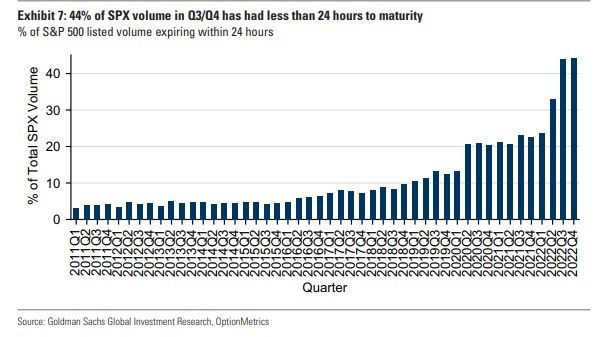
The tool of choice: Bullish contracts betting on the S&P 500 that mature in 24 hours — speculative activity that may ultimately help fuel a broad market rally over the next month. 

“I am preparing myself to get grilled by the Rubners at Thanksgiving on the worst performance of the 60/40 since 1900. I will counter with a year-end rally,” he wrote in a note to clients last week. “I expect YOLO ‘call options’ volumes to be massive” during this Thanksgiving week. 

Short-expiration options gained popularity among Reddit investors during the 2021 meme stock frenzy. This year, they’ve become more than a retail phenomenon as big money managers ride the investing vehicle to navigate market turbulence. 

Short-term contracts made up 44% of S&P 500’s total option trading in the third quarter, about doubling from six months ago, according to data compiled by Goldman’s derivatives strategists including Rocky Fishman. On Tuesday, the proportion increased to 50%, data compiled by Bloomberg show, as the S&P 500 climbed more than 1% to a two-month high.

While consensus holds that the 11-month bear market has yet to run its course, sentiment over the short term is less bleak. Citing everything from defensive investor positioning to seasonal patterns, Morgan Stanley strategist Mike Wilson has called for a year-end rally. The S&P 500 has already jumped 10% from its bear-market low reached in October. 

The way Rubner sees it, Friday’s $2.1 trillion options expiry opened the window for the S&P 500 to break out of its tight trading range in recent weeks. In this backdrop, he says, the retail army can launch “weaponized gamma” through options known as 0DTE, those with zero days to expiration. 

It’s a tactic favored by some traders who bet that, as the level of a stock or an index gets closer to an option’s strike price, dealers on the other side of the transaction will have to buy more and more of the underlying security to avoid unwanted market risk. 

“The lid on the topside gets removed,” Rubner wrote. “And the market is more freely to move.” 

More stories like this are available on bloomberg.com

©2022 Bloomberg L.P.

Private Equity Firms Keen to Return Cash Dump Discounted Stocks

(Bloomberg) — Private equity firms have been selling out of recently-listed stocks in Europe, swallowing steep discounts in volatile markets to allow them to recycle investor capital.

Hellman & Friedman and other backers of Allfunds Group Plc this week offloaded about €288 million ($295 million) of stock in the mutual fund distributor at a 37% discount to last year’s initial public offering price. About a week earlier, Nordic Capital sold half its stake in Cint Group AB at 19% lower than the Swedish software company’s value at IPO.

An even starker example came in October, when Chinese private equity firm Wise Road Capital sold shares in Alphawave IP Group Plc at a 76% discount to the semiconductor firm’s London IPO price. 

Sales of large blocks of shares are profit-taking events for a company’s early backers, making spates of transactions at such large discounts relatively rare. The recent round is reflective of the pressures facing some private equity firms in a market with rising inflation and higher interest rates. 

Buyout firms are having a tough time trying to exit their portfolio companies, as volatility spooks buyers and keeps the IPO markets shut. But they still need to find a way of returning money to their investors — or limited partners — if they want to convince them to back new funds. That’s leading them to sell some of their most liquid holdings in the stock market.

“PE firms have to deploy capital and distribute proceeds to their LPs,” Anu Sharma, head of investment banking in Europe, the Middle East and Africa at William Blair & Co., said in an interview. “In this environment, they are prioritizing businesses with good underlying fundamentals, such as high margins and growing cash flows.”

To be sure, it’s not just buyout firms that have been selling blocks of shares at discounts. European lender BNP Paribas SA also participated in the Allfunds placement, while smaller banking peer Intesa Sanpaolo SpA recently sold shares in Nexi SpA at a tighter 3% discount to the payment firm’s listing price.

More stories like this are available on bloomberg.com

©2022 Bloomberg L.P.

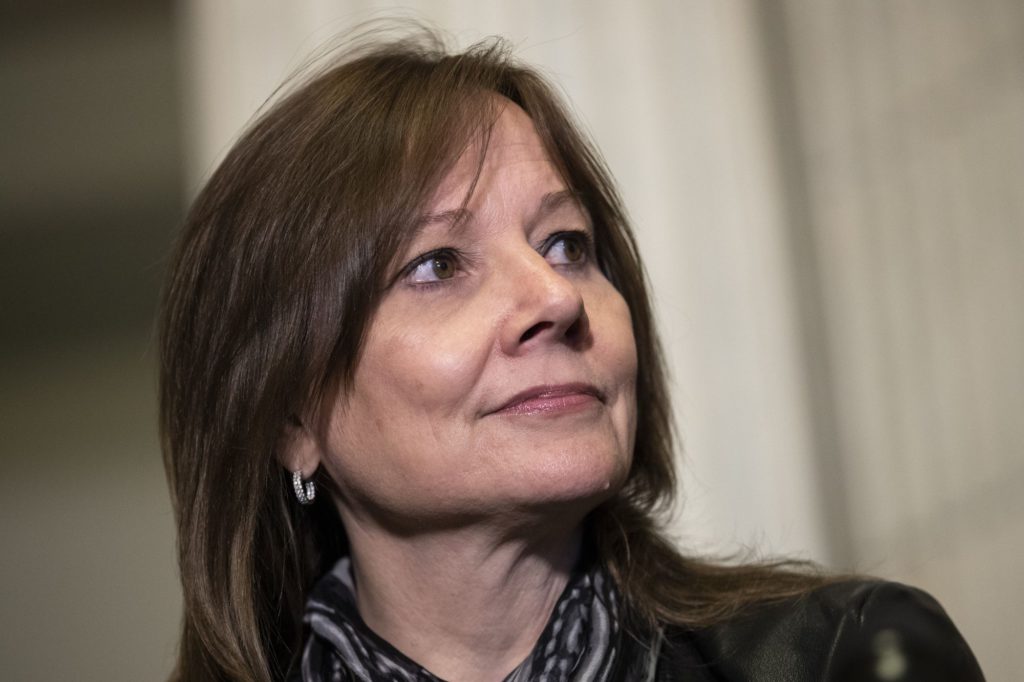
GM’s Barra Goes Quiet on Twitter Following Rival Musk’s Takeover

(Bloomberg) — General Motors Co. didn’t just halt Twitter advertising after Elon Musk bought the social network. The Detroit automaker’s chief executive officer and vehicle brands haven’t even tweeted since.

Mary Barra last posted on Oct. 27, the same day that Musk closed his $44 billion purchase, when GM’s leader retweeted a message from autonomous-vehicle startup Cruise LLC. Since then, Barra and GM’s consumer-vehicle brand accounts — including Chevrolet, Cadillac, Buick and GMC — have been conspicuously quiet.

The Twitter absence suggests GM’s retreat from the platform was more comprehensive than indicated when it joined other brands pausing advertising last month. The automaker said then that it would temporarily halt paid ads while trying to better understand the direction of the site under its new ownership.

See also: Musk Encourages Rival Automakers to Keep Advertising on Twitter

The complications for automakers on Twitter are heightened because Musk also runs Tesla Inc., the leading maker of electric vehicles. GM aims to make its entire lineup electric by 2035 and other companies are also racing to develop battery-powered vehicles. A Twitter pullback is giving companies time to assess content standards and use of advertising and customer data under Musk.

“With a competitor owning the platform, it’s important for us to ensure our advertising strategies and data can be safely managed,” GM said this week via email. It called Twitter “just one of many channels available” to share information and said it would “choose the channels and platforms that can be most effective at any point in time.”

The company didn’t address Barra’s Twitter absence. The CEO has remained active on other social media such as LinkedIn, putting up a year-in-review missive talking about GM’s all-electric future on Nov. 10.

Like Barra, R.J. Scaringe, the CEO of EV maker Rivian Automotive Inc., last tweeted on Oct. 27 and has been silent there since. Rivian declined to comment.

Still Active

GM hasn’t organized a total Twitter blackout, saying it would engage as necessary with customers. Company President Mark Reuss has continued to tweet, as have the automaker’s BrightDrop electric van business and Cruise, in which GM has a controlling stake. 

The self-driving company’s CEO, Kyle Vogt, put up a recent post announcing that it was starting to offer robotaxi rides during daytime hours in San Francisco. Cruise spokesman Aaron McLear said the business finds Twitter to be an effective away to communicate with users and people in the tech community.

Other major carmakers and industry leaders are still tweeting as well, including Ford Motor Co. CEO Jim Farley. Toyota Motor Corp., Honda Motor Co., Nissan Motor Co., BMW AG, Mercedes-Benz and Volkswagen Group all have used the platform since Musk took over.

–With assistance from Ed Ludlow.

More stories like this are available on bloomberg.com

©2022 Bloomberg L.P.

As Job Cuts Roil Silicon Valley, Workers Confront Post-Boom Reality

(Bloomberg) — When Ryan Stevens joined Meta Platforms Inc. as a product operations manager for WhatsApp in August of 2021, he was enticed by the opportunity to help shape a messaging app used daily by 2 billion people.

He also figured tending to a service that touches so many people would translate to a degree of job security. That belief shattered when Stevens awoke around 3 a.m. earlier this month to an email from Meta management, informing employees that layoffs were coming. After tossing and turning, Stevens, 39, received another missive at around 6 a.m.: He was one of more than 11,000 workers who had lost their jobs.

“I’m not excited to be part of such a large, immediate pool of laid-off people who are all looking for tech roles at the same time,” said Stevens, who lives in San Jose, California, with his wife and young child. “That gives me a lot of anxiety.” He believes the industry is in the midst of a cyclical reset and is open to focusing on something “a little smaller” until things pick up again. 

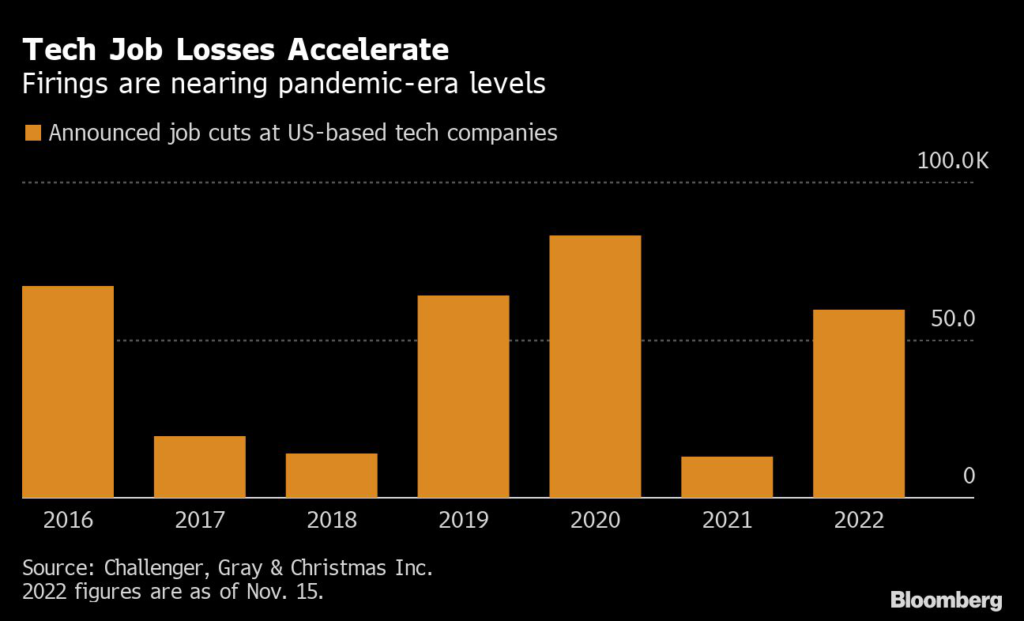
After years of exuberant growth and hiring, layoffs have burst the bubble of Silicon Valley inviolability. As of Nov. 15, tech companies had announced 31,200 job cuts so far this month, according to Challenger, Gray & Christmas Inc. The human-resources consulting firm says that’s the highest monthly total since September 2015, when a restructuring Hewlett-Packard said it would slash thousands of positions. Meta, Twitter Inc. and Amazon.com Inc. have all slashed their ranks, or said cuts are coming. On Tuesday, as this story was being prepared for publication, HP said it planned to cut as many as 6,000 positions over the next three years.

While tech workers lost their jobs during the early days of the pandemic, the subsequent boom benefited the industry. This time workers are bracing for a more enduring downturn. The accelerating layoffs have rattled a cohort who only months ago felt safe job-hopping in pursuit of better salaries and benefits. Now those who’ve been let go are anxious about re-entering a job market flooded with other recently terminated candidates even as the tech giants slow or freeze recruitment. 

“People are going to hire through this, but it’s not going to be quite as much as a candidate market as it was in 2021,” said Peter Walker, head of insights at Carta, a platform that manages equity for startups.

Unlike the dot-com bust of the early 2000s, when many nascent startups collapsed, this downturn has prompted now-mature firms to tighten their belts. When Meta slashed jobs earlier this month, the first major round of layoffs in its history, the company didn’t consult managers about which employees would be let go and left the decisions to the highest-levels of leadership, according to an internal memo. As a result, the company lost some top talent, including people who had been recently promoted and had received stellar performance reviews, according to one recently terminated employee.

Despite the chaotic nature of the layoffs, the worker said he thinks Meta is still not as lean as it needs to be. “If I had to make a bet,” he said, “I think there’s more pain to come.” The company declined to comment. 

The job cuts have left some workers struggling to identify safe ground. After joining Meta in January, Zoha Pajouhi, a machine-learning engineer, had a choice between working on the company’s efforts in augmented reality and virtual reality, a top priority for Chief Executive Officer Mark Zuckerberg, and working on recommendation algorithms for the Facebook app. She chose the latter, figuring the company would be unlikely to make cuts to its core business if times got hard. After losing her job earlier this month, Pajouhi, who lives in Kirkland, Washington, is second-guessing her decision.

As she ramps up her job search, she’s detecting a chill in the market. An engineer in a coveted field, she’d grown accustomed to regular approaches from recruiters. Since losing her job, she’s written recruiters who reached out to her previously, but they’ve been slow to respond. Those who have written back say they have few positions available.

As the tech layoffs accelerate, “we are all in the same boat and also kind of competing with each other,” Pajouhi said.

Some workers see their layoffs as an opportunity to work on a side passion. Brandon Harper launched a startup in January 2021 called Everloom, a family history and ancestry platform, built during nights and weekends while working as a senior marketing manager at Meta. Harper considered quitting to pursue the project full-time but, as a new father, decided it was too risky. Then, earlier this month, he lost his job at Meta.

Rather than looking for a new gig, Harper, 35, decided to focus on Everloom. To help pay the bills, he applied to Funded Not Fired. The program, started recently by the venture capital firm Day One Ventures, has pledged to give 20 laid-off tech workers $100,000 apiece to pursue their startup ideas. Day One says it has received 1,000 applications so far.

“When I was laid off it was kind of like, I don’t want to say it’s like a sign, but it sort of felt like, ‘I got some time and space here. Let’s see what I can do,’” said Harper, who has a 10-month-old son and lives San Francisco. “I’m excited about this next chapter.”

Other laid-off techies plan to look for new work but are determined to take their time finding the right fit. Marc Weil, an engineering manager, lost his job at Stripe Inc. earlier this month, about 19 months after joining the digital payments firm. Having received a generous severance package, Weil, who is 35 and lives in Boulder Creek, California, plans to “spend some time trying to find the next role instead of scrambling to find the next thing that just ticks boxes.”

A worker at Amazon recently lost their job because the team they worked for was eliminated. This person, who requested anonymity to avoid jeopardizing a severance package, has 60 days to find another position at the e-commerce giant. For the time being, the employee doesn’t plan to put much effort into finding a new job with Amazon or elsewhere.

“LinkedIn is a pit of despair right now,” the person said. “Job-seeking is not what I want to be doing. I just want to embrace the headspace of not having to work at Amazon any more.”

Recruiters say they see some bright spots in the hiring market. Laura LaBine, chief talent officer at LaBine & Associates, said she has been hearing from companies searching for engineers in biotech and life sciences, as well as analytics and data science.

Technical skills remain valuable in an economic downturn, said Neil Costa, founder and CEO of HireClix, a recruitment marketing agency. He’s representing a retailer that is trying to hire software engineers for its e-commerce business, and he sees an opportunity more broadly for smaller firms to scoop up talent.

Just over a week after losing his job as director of business development at artificial intelligence startup Artica, Brandon Moore had several interviews lined up. He’s optimistic that he’ll secure employment soon, but he questions whether the scale of layoffs underway in the Valley is necessary.

“The leaders of these businesses, they’re trying to send a message to the market that they’ll do whatever it takes to control the sliding stock prices that we are seeing,” said Moore, who is 36 and lives in Seattle. “But they hired all of these people for a reason initially, and they are just going to have to rehire.”

Stevens’ search is also well underway. As he hunts for his next job, he’s focused on finding a role that’s critical to the business.

“What is something I’m going to get involved in that is going to make me feel valued and make me feel like I’m having real impact with a company?” he said. “That’s really where my focus is right now.”

–With assistance from Jo Constantz, Spencer Soper and Alex Barinka.

More stories like this are available on bloomberg.com

©2022 Bloomberg L.P.

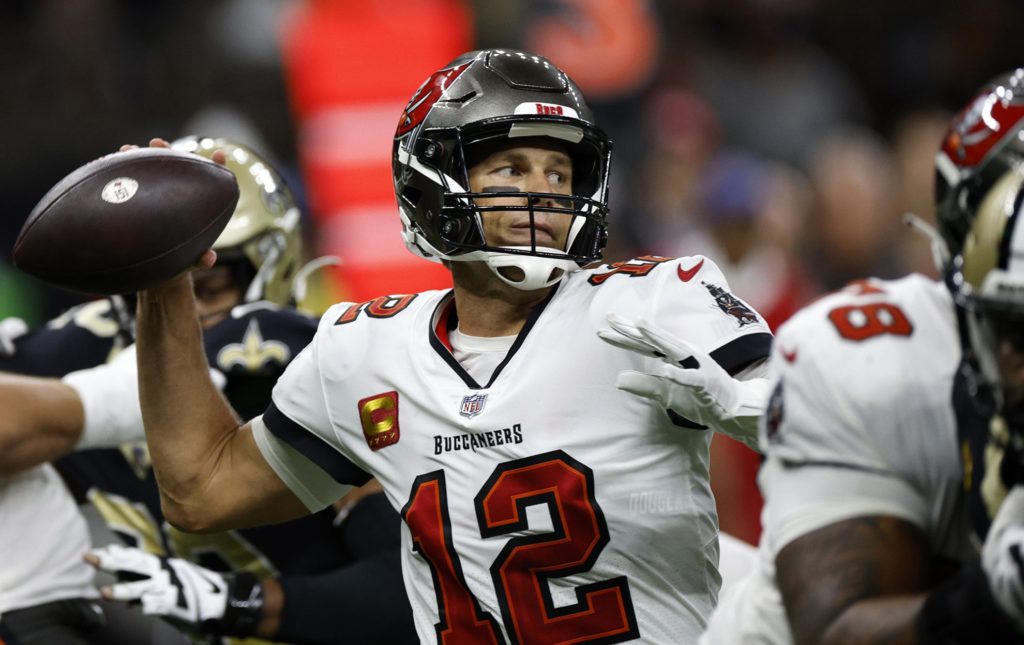
From Tom Brady to Shaq, FTX’s Celebrity Promoters May Be On the Hook for Damages

(Bloomberg) — FTX’s viral Super Bowl ad featured multiple versions of a deeply skeptical Larry David. In light of the cryptocurrency exchange’s collapse, his fellow celebrities might have done well to heed his advice.

The creator of Seinfeld and Curb Your Enthusiasm is among the slew of stars being sued for promoting FTX’s services and products. The lawsuits allege they lured unsophisticated investors into the debacle.


Legal experts say the celebrities’ prominence and wealth make them a juicy target for investors looking to recover some of their losses, with the company and co-founder Sam Bankman-Fried essentially broke. FTX put itself and more than 100 affiliates into bankruptcy proceedings this month, shielding them from suits. The promoters, who aren’t in bankruptcy court, have no such protection. 

“A lawsuit against celebrities will generate a ton of money, because they will all settle,” said John Reed Stark, former chief of the US Securities and Exchange Commission’s Office of Internet Enforcement. “It’s one thing to make your fans buy your T-shirt with your face on it. It’s another to tout something that causes them to lose their life savings.”

At least three lawsuits have been filed since FTX’s implosion, including one that seeks to represent “thousands, if not millions, of consumers nationwide.” Tom Brady, Gisele Bundchen, Stephen Curry, Shaquille O’Neal and businessman and TV personality Kevin O’Leary are also among the defendants.

The celebrities could be liable if the investors can prove they failed to disclose that they were being paid to promote the crypto exchange or had invested in the company, or were hawking unregistered securities. The pending lawsuits are in federal court in Miami and San Francisco.

The stars’ representatives didn’t respond to requests for comment on the lawsuits.

Read More: Sam Bankman-Fried Fooled the Crypto World and Maybe Even Himself

FTX’s sudden collapse cost US investors more than $11 billion, according to the Miami lawsuit filed Nov. 15. The platform, with 5 million users worldwide, traded more than $700 billion of crypto last year. 

“The celebrities’ liability hinges mainly on whether the products they promoted are securities,” said Shane Seppinni, who represents people suing over alleged corporate abuse and who isn’t involved in the FTX cases. If FTX’s yield-bearing accounts, which pay interest on crypto holdings, are found to be securities, “then the celebrities who promoted them could be on the hook for big damages,” he said.

To determine whether a given item constitutes a security, courts tend to fall back on the Howey Test. It gets its name from a 1946 Supreme Court decision defining a security as “an investment of money in a common enterprise with profits to come solely from the efforts of others.” If the item in question meets that definition, the court held, then it doesn’t matter “whether the enterprise is speculative or nonspeculative, or whether there is a sale of property with or without intrinsic value.” 

The Texas State Securities Board’s director of enforcement, Joseph Rotunda, filed a declaration last month that the yield-bearing accounts are an offering of unregistered securities. And promoting securities without disclosing the source, nature or amount of compensation would violate securities law. 

Read More: Tom Brady, Steph Curry Draw Texas’ Scrutiny Over FTX Plugs 

On Monday, Rotunda said his office was scrutinizing the payments the celebrities received and any disclosures made.

“We are taking a close look at them” as part of the regulator’s broader probe into FTX’s failure, he said.

Brady and Bundchen joined the company’s $20 million ad campaign in 2021 and made a commercial — “FTX. You In?” — showing them urging acquaintances to join up. They also took equity stakes in FTX Trading Ltd., according to the Miami complaint.

O’Leary, of ABC’s Shark Tank and CNBC’s Money Court, was both an investor in and a paid spokesman for FTX. He and tennis star Naomi Osaka, who has also been sued, both promoted FTX’s interest-bearing accounts, in which Elliott Lam, a Canadian living in Hong Kong, invested and lost $750,000, according to his proposed class action lawsuit in San Francisco.

Podcast: What Does FTX’s Fall Mean for the Future of Crypto? 

David’s comic persona and quirky role in the Super Bowl ad may prove oblique enough to beat the litigation, legal experts said. 

The commercial featured him as a skeptic of other inventions, such as the Sony Walkman and, earlier, the wheel. “Don’t be like Larry,” the ad cautioned. It made FTX one of the most retweeted brands during the game, lawyers for the investor in the Miami complaint said. 

But the only allegation about the comedian “is that Larry David appeared in a commercial,” said attorney Brian Levin. “I don’t see how that, in and of itself, would give rise to liability.”

Stark, the former SEC internet enforcement chief, finds “the irony” that David played characters in the ad who keep saying no — including to FTX — “glaring.” 

“There’s enough celebrities to choose from,” he said. “I’d probably leave him off, so as not to muddy the waters.”

Read More: Crypto’s $2 Trillion Wipeout Cuts a Path Through the C-Suite 

As the impact of FTX’s fall unfolds, more lawsuits are expected to roll in against Bankman-Fried and celebrity endorsers from the US and elsewhere, including South Korea, Singapore and Japan, where many of the investors are based, said attorney Demetri Bezaintes. The law firm that filed the Miami complaint filed another proposed class action suit in South Florida a week later.

This isn’t the first time celebrities have found themselves in hot water over crypto promotions. Kim Kardashian and Floyd Mayweather Jr. were sued in Los Angeles over their promotion of the EthereumMax token. In a tentative ruling on Nov. 7, the judge dismissed the lawsuit, saying the defendants hadn’t promoted the tokens as a security.

Kardashian agreed last month to pay $1.3 million, and not to tout digital assets for three years, to settle SEC claims that she broke the rules by promoting the token without disclosing that she was being paid. Mayweather and music producer DJ Khaled were accused of violating securities laws by failing to disclose payments they received to promote initial coin offerings on social media in 2018. Both settled with the SEC, with Mayweather paying more than $600,000 and Khaled dropping more than $150,000.

Read More

  • A Crypto Kid Had a $23,000-a-Month Condo. Then the Feds Came 
  • Bloomberg Opinion: Matt Levine Explains Crypto to You
  • Crypto Firm Genesis Said to Warn of Bankruptcy Without Funds 
  • Alameda Former Co-CEO Used Poker, Blackjack Strategies to Trade

–With assistance from Gerry Smith.

More stories like this are available on bloomberg.com

©2022 Bloomberg L.P.
China Tech Earnings Beat Fuels Upswing Optimism

(Bloomberg) — China’s beleaguered technology sector may have finally turned the corner, if earnings from top firms are anything to go by.

Market watchers are growing increasingly upbeat about the sector’s prospects after a slew of top-line beats by industry behemoths such as JD.com Inc. and Baidu Inc. The conviction is growing even as players like Alibaba Group Holding Ltd. continue to grapple with lackluster sales growth. Notably, Bank of America Corp.’s Michael Hartnett is positive on Chinese stocks, and the firm named selling US tech stocks as one of its top trades for 2023.

Investors are looking to unearth potential buys in the sector after the authorities rolled back some virus curbs and expectations grow that a regulatory crackdown may be drawing to an end. Still, China’s tech firms remain far from a one-way bet as a new wave of Covid cases threatens to derail a recovery in consumption and investment.

“On the fundamentals side, I do think the worst is probably behind” them, said Vivian Lin Thurston, portfolio manager at William Blair Investment Management. “The growth of those companies may not be as strong as we saw in the last decade, but it’s still very solid and probably more favorable than other sectors within China. The investment opportunities are very interesting and attractive.”

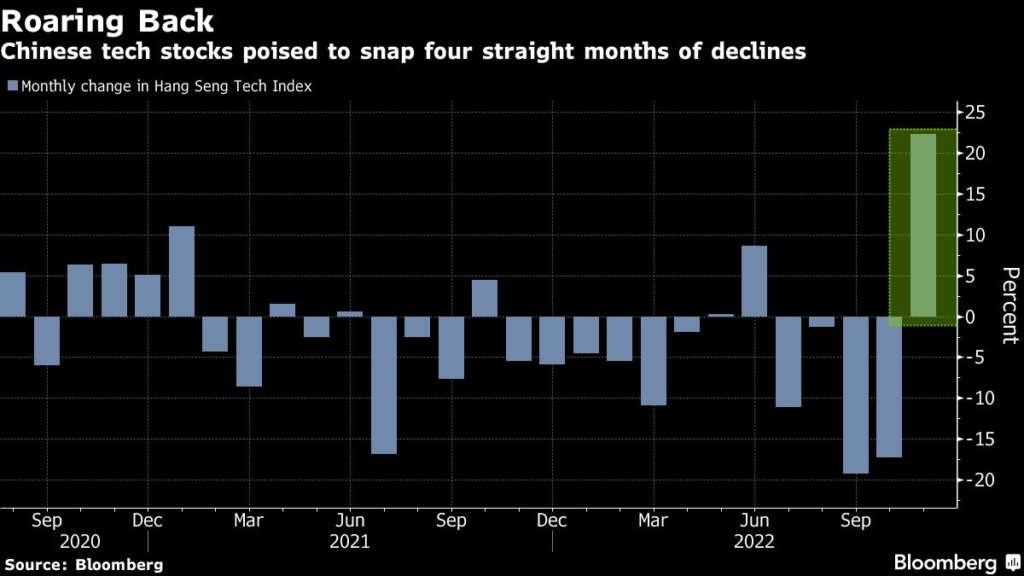
Optimists are calling a bottom in the sector after the Hang Seng Tech Index gained 25% so far this month, putting it on track for its first monthly advance since June. It rose 1.1% on Wednesday, though it remains down 37% for the year.

Among individual companies, US-listed shares of Baidu jumped 2.5% on Wednesday after the firm reported a surprise increase in revenue overnight. Similarly, Kuaishou Technology rallied 5.7% on the back of a better-than-expected sales report.

Of the 14 Hang Seng Tech member companies that have reported third-quarter results, nine posted sales that beat expectations.

Sentiment has improved amid speculation that a fine of more than $1 billion on Ant Group Co. may signal an end to the year-long crackdown on the sector. A loosening of some virus curbs has been another positive, as well as a thaw in US-China tensions and progress in US audits of Chinese firms. 

Tech shares are also looking attractive following a slump in their valuations. Tencent Holdings Ltd. and Alibaba, for instance, traded at just 15 times and 8.8 times their forward price-to-earnings ratio, respectively, heading into the earnings season.

‘Cost Discipline’

Cost controls and new growth engines are key to separating the winners from losers, market watchers said. 

“Some companies which had good cost discipline to face a slower economic growth environment resulted in good earnings growth,” said Pruksa Iamthongthong, senior investment director of Asian equities at abrdn. Firms with strong competitive advantages and better earnings visibility are best positioned for a recovery, she added.

Still, that’s not to say all the worries surrounding the sector have disappeared. A renewed surge in China’s Covid cases is fanning fears of stricter curbs while Beijing and Washington remain locked in a battle for leadership of the tech industry.

The Hang Seng Tech Index has retreated 5% this week to head for its first weekly drop since the end of October.

“I do feel that this sector has become more of a proxy of China macro and consumption stories,” said William Blair’s Thurston, adding that tech stocks may face more volatility in the near term depending on how China’s Covid situation evolves.


Tech Chart of the Day

Tesla Inc. has seen more than $524 billion in market value destroyed this year. The selloff in the electric-vehicle maker accelerated in November after Chief Executive Offer Elon Musk offloaded another chunk of his stake. The stock has slumped 25% this month, as of its most recent close, setting it up for its biggest monthly decline ever. Tesla has been facing a host of issues, from Musk’s shift in focus to turning around Twitter Inc. to China’s return to Covid Zero curbs. Shares in the company rose 2.9% on Wednesday, valuing the company at about $551 billion.

Top Tech Stories

  • Hundreds of workers at Apple Inc.’s main iPhone-making plant in China clashed with security personnel, as tensions boiled over after almost a month under tough restrictions intended to quash a Covid outbreak.
  • Walt Disney Co.’s Avatar sequel has been given a release date in China, according to people familiar with the matter, a boon in a key market for the entertainment giant as it looks to move beyond this week’s management upheaval.
  • Tesla’s Musk said he considers South Korea as a top candidate for investment, according to the office of President Yoon Suk Yeol.
  • HP Inc. will eliminate as many as 6,000 jobs over the next three years amid declining demand for personal computers that has cut into profits.
  • Prosus NV plans to sell the stock in Chinese firm Meituan that it will receive from partly owned internet giant Tencent Holdings Ltd. — boosting the e-commerce group’s cash pile as consumer spending weakens.
  • China’s purchases of machines to make computer chips fell 27% last month from a year earlier as the US imposed new, sweeping sanctions to try and derail the country’s chip ambitions.
  • Twitter CEO Musk is restoring a string of accounts previously suspended for harassing transgender people, rolling back protections for the LGBTQ community as the country confronts the aftermath of a shooting in a Colorado gay club that left five people dead and dozens wounded.

–With assistance from Subrat Patnaik, Ryan Vlastelica and Boris Korby.

(Updates to market open.)

More stories like this are available on bloomberg.com

©2022 Bloomberg L.P.

Galaxy Digital’s Novogratz Says Crypto Users Will Seek ‘Safe and Trusted’ Players

(Bloomberg) — Crypto billionaire Mike Novogratz said the “crisis of confidence” in the digital asset world will drive more cryptocurrency users to seek out institutional players like Fidelity Investments.

The founder of Galaxy Digital Holdings Ltd., a crypto financial services firm, told CNBC that more people will put their money in “safe and trusted custodians.”

“The big winners in this are going to be people like Fidelity who have just come out with their crypto product,” said Novogratz. He previously touted Fidelity’s involvement in the industry in September when Bitcoin had lost about half its value. The largest digital currency is now down 65% so far this year. 

He added that he sees a buying opportunity for crypto in the long run, but it will take the industry time to rebuild trust.

Galaxy Digital previously revealed a $76.8 million exposure to FTX.com. Other crypto-related firms have made similar disclosures amid the exchange’s unraveling.

Sam Bankman-Fried’s FTX empire filed for bankruptcy on Nov. 11. Court papers have shown that FTX-linked entities owed their 50 biggest unsecured creditors more than $3 billion. 

“We certainly have a crisis of confidence in this market,” Novogratz told CNBC. “We’re not out of the woods yet.” 

The FTX collapse adds to a growing tally of scandals to roil the crypto industry in recent months. Earlier this year, the TerraUSD meltdown put the focus on Novogratz, who had backed Terraform Labs, the company behind Terra and Luna. In the aftermath, Novogratz called it a “big idea that failed.”

More stories like this are available on bloomberg.com

©2022 Bloomberg L.P.
Microsoft Snaps Up Vast Amount of Clean Power for Irish Data Hub

(Bloomberg) — Microsoft Corp. agreed to buy a massive amount of clean energy to power a data center in Ireland.

Statkraft AS, Europe’s largest generator of renewables, will provide Microsoft with 366 megawatts of wind and solar energy, marking the supplier’s first power-purchase agreement in Ireland.

Big technology firms have faced mounting pressure to clean up their energy consumption, with regulators increasingly concerned about the vast quantities of electricity sucked up by large computing operations. Companies such as Microsoft have struggled in recent months to get planning permission for certain data centers, according to a Nov. 8 report by Bloomberg Intelligence.

The renewable power for Microsoft in Ireland will come from six projects — three wind and three solar — located across the country, Statkraft said Wednesday. The Norwegian company will fund and manage their construction, and the power-purchase agreement will start once the projects begin operating, it said, without giving a timeframe or disclosing financial terms.

More stories like this are available on bloomberg.com

©2022 Bloomberg L.P.
FTX Latest: Novogratz Says Bitcoin Here to Stay as Token Climbs

(Bloomberg) — Crypto markets have steadied as Bitcoin climbed for a second day, trading back above $16,000. Still, investors remain alert for contagion from FTX and long-term predictions for the coin differ wildly, underscoring the uncertainty that’s rife in the industry. 

Mike Novogratz, the CEO and founder of Galaxy Digital, said in an interview with CNBC on Wednesday that he still sees crypto as a long-term buying opportunity. And Ark Investment Management’s Cathie Wood is sticking to her bullish forecast of $1 million for Bitcoin by 2030.

Top partners at Sequoia Capital apologized to investors for backing FTX, whose bankruptcy had its first US court hearing. Former CEO Sam Bankman-Fried in a letter outlined a crash in collateral to $9 billion from $60 billion.

Key stories and developments:

  • FTX Flipped Jane Street’s Risk Obsession to Disastrous Effect
  • Cathie Wood Sticks to $1 Million Bitcoin Call as Others See Rout
  • What the FTX Collapse Suggests About Crypto and Risk
  • Sequoia Capital Says Sorry for FTX But Defends Vetting Process
  • New York Governor Hochul Signs Moratorium to Curb Crypto Mining

(Time references are New York unless otherwise stated.)

Novogratz Says ‘Bitcoin Is Not Going Away’ (8:48 a.m.)

Mike Novogratz, the CEO and founder of Galaxy Digital, tells CNBC in an interview that while there was a “bubble” in crypto assets this is a long-term buying opportunity because “Bitcoin is not going away.”

He says that what happened at FTX is an indictment of the company and other similar firms that are poorly run, however it is not an indictment of crypto itself. 

Serving Humble Pie This Thanksgiving (8:00 a.m.)

Polite company never talks politics or religion. This Thanksgiving, it might be wise to avoid crypto, too.

Last year’s digital asset investors basted themselves in Bitcoin riches. Then, the token traded just below the almost $69,000 all-time high set weeks earlier. By dessert time, the crypto hopefuls may have even sold the Baby Boomers on a token or two. 

This holiday season, the Bitcoin bulls have less to be grateful for. The largest digital asset has plummeted about 70% since last Turkey Day. That drop might annoy the guests who bought in, including the Baby Boomers persuaded by their younger relatives.

Jane Street Alums Ditched Wall Street Firm’s Risk Focus at FTX (7:49 a.m.) 

Jane Street Group is known among peers for its obsession with risk and preference for stealth. The more-than 2,000 employee powerhouse based in lower Manhattan digs into the health of trading partners, models potential catastrophes, autopsies losses and restricts staff from commenting publicly, because even that poses a danger.

The easiest way to describe the culture that Sam Bankman-Fried and a cadre of Jane Street alumni created at FTX: The opposite.

Crypto Crash Offers a Path to Recovery for Damaged Relationships (6:58 a.m.)

Devoting days and nights to a gamified digital economy left a mark on some people’s relationships, turning partners into crypto widows and widowers. 

Now they have some emotional work to do: in the aftermath of the digital-asset mayhem, believers are trying to heal what Bitcoin and Bored Ape obsessions did to intimacy.

Wild Divergence in Bitcoin Predictions Highlights Uncertainty (4:32 a.m.) 

Over the past few days, long-term targets for the world’s largest token by market value have ranged from $5,000 at strategists BCA Research Inc. to $1 million by 2030 for Ark Investment Management’s Cathie Wood. 

The cavernous spread reflects the gnarly question of what further contagion may or may not lie ahead following the evisceration of Sam Bankman-Fried’s FTX exchange and trading house Alameda Research, onetime crypto darlings.

El Salvador Closer to Issuing Bitcoin Bonds (12:05 p.m. HK)

The country’s presidency dispatched a digital-securities bill to lawmakers, taking the nation a step closer to raising $1 billion via the world’s first sovereign blockchain bond.

The legislation calls for a digital-assets commission and a Bitcoin Fund Management Agency to oversee crypto-related debt sales. The proposed blockchain bonds, with a minimum investment of just $100, are meant to help finance the construction of the Bitcoin City project.

New York Governor Signs Moratorium to Curb Crypto Mining (11:10 a.m. HK)

Kathy Hochul signed one of the most restrictive laws in the US on regulating cryptocurrency mining, with the bill triggering a two-year moratorium on new permits for crypto-mining companies.

“I will ensure that New York continues to be the center of financial innovation, while also taking important steps to prioritize the protection of the environment,” Hochul said in a statement.

Bankman-Fried Says Collateral Crashed by $51 Billion as FTX Fell (8:30 a.m. HK)

Bankman-Fried, disgraced founder of the now collapsed crypto exchange FTX and trading house Alameda Research, apologized to staff in a letter that outlined a crash in “collateral” to $9 billion from $60 billion.

“I didn’t mean for any of this to happen, and I would give anything to be able to go back and do things over again,” he wrote in the message sent to employees Tuesday and obtained by Bloomberg News.

Sequoia Capital Says Sorry for FTX But Defends Vetting Process (7:20 a.m. HK)

Top partners at the venture capital firm apologized to their investors in a conference call Tuesday for backing FTX, according to people familiar with the meeting.

Roelof Botha, the firm’s global leader, opened the call, and he and his colleagues were repentant for backing the company, with investments totaling $214 million in FTX.com and FTX.us across two funds. Alfred Lin, the partner who led the FTX deal, provided an update on the situation. Shaun Maguire, another partner who focuses on crypto, gave an overview of the sector.

Cathie Wood Holds On to $1 Million Target for Bitcoin (7:10 a.m. HK)

“Bitcoin is coming out of this smelling like a rose,” said the ARK Investment Management CEO as she defended her forecast.

Wood also said that crypto infrastructure is “working beautifully.” She added that digital-asset manager Grayscale Investments is now the crown jewel of Barry Silbert’s once-$10 billion Digital Currency Group conglomerate.

Crypto ATM Operator Coin Cloud Discussed Equity From Genesis (6:30 a.m. HK)

Genesis had provided an unsecured loan of around $100 million to Coin Cloud, according to people with knowledge of the situation. In the latest discussions, Genesis had considered injecting equity into Coin Cloud, said the people.

Coin Cloud recently hired advisers to help rework about $125 million of the ATM operator’s debt.

FTX Allowed to Hide Identity of 50 Biggest Creditors (5:40 a.m. HK)

US Bankruptcy Judge John Dorsey agreed to let FTX redact the names of the 50 biggest unsecured creditors owed a total of $3.1 billion. 

The US Bankruptcy Code normally requires the names be filed in documents available to the public. Representatives for FTX argued those creditors are also customers and disclosure would allow rivals to steal their business. 

More stories like this are available on bloomberg.com

©2022 Bloomberg L.P.
US Jobless Claims Hit Three-Month High as Labor Market Cools

(Bloomberg) — Applications for US unemployment benefits rose last week to a three-month high amid a wave of layoffs at technology companies, a sign of cooling in a tight labor market.

Initial unemployment claims increased by 17,000 to 240,000 in the week ended Nov. 19, Labor Department data showed Wednesday. The median estimate in a Bloomberg survey of economists called for 225,000.

Continuing claims, which include people who have already received unemployment benefits for a week or more, rose by 48,000 to 1.55 million in the week ended Nov. 12, the highest since March. That was also the sixth weekly increase in a row.

Economists have been watching continuing claims more closely in recent weeks because they have been warning indicators of recessions in the past. Although the gauge is up from lows in May this year, it’s still well below last year’s levels and historical averages.

The Federal Reserve has embarked on its most aggressive tightening campaign since the 1980s this year in an effort to tame the highest inflation in a generation. The steep interest-rate hikes have had an impact on sectors such as housing and construction, but overall the labor market has remained robust.

The list of high-profile technology companies announcing job cuts or hiring freezes has been growing, from Amazon.com Inc. to Facebook parent company Meta Inc. and personal-computer maker HP Inc., which said this week it would eliminate as many as 6,000 jobs. 

The mounting layoffs in the sector don’t necessarily portend weakness in the broader market because many tech companies had ramped up hiring during the pandemic-era e-commerce boom. Still, other industries aren’t immune. Even FedEx Corp. is furloughing workers in its freight unit ahead of what’s usually the busiest season of the year for the company.

What Bloomberg Economics Says…

“Initial jobless claims for the week ending Nov. 19 surged and continuing claims remained on a persistent uptrend, pointing at softening in the labor market. The 113,000 increase in continuing claims between the survey weeks for the November employment report is consistent with layoffs spreading in the technology industry, as hiring freezes and job cuts mount in select industries.”

–Eliza Winger, economist

To read the report, click here

The four-week moving average, which smooths out volatility from week to week, increased to 226,750.

On an unadjusted basis, initial claims rose by about 48,000 to almost 248,200 last week. The increases were spread across the states, with California, Illinois and Georgia among the largest ones.

The claims figures tend to be more volatile around US holidays. The latest data spanned the week between Veterans Day and Thanksgiving. 

(Adds economist’s comment.)

More stories like this are available on bloomberg.com

©2022 Bloomberg L.P.
Close Bitnami banner
Bitnami