Bloomberg

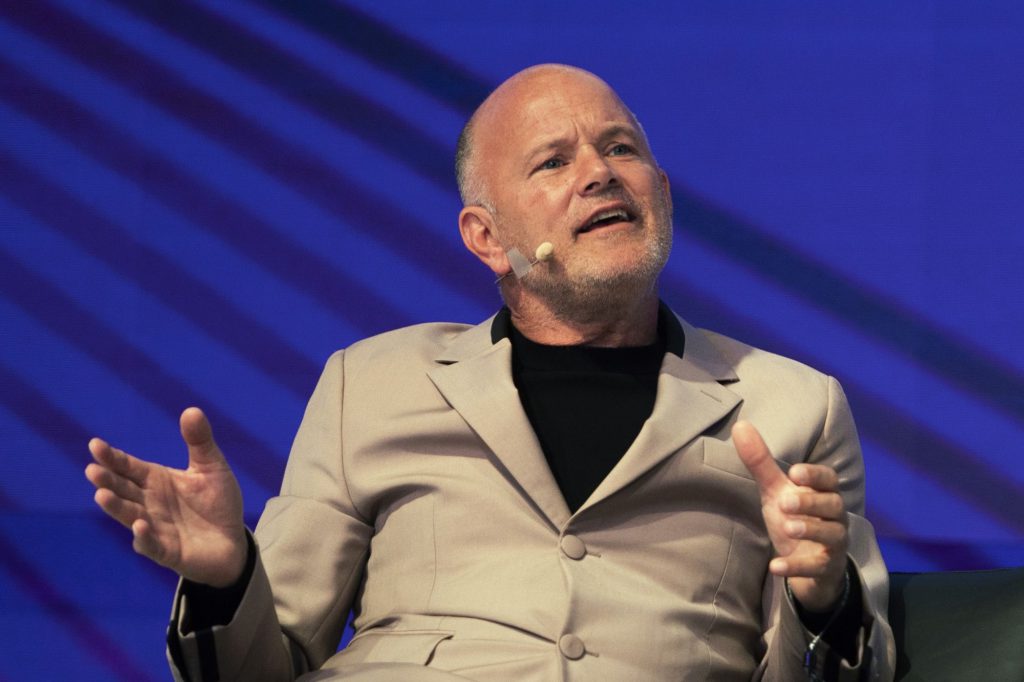
Mike Novogratz Calls Crypto a Long-Term Buying Opportunity 

(Bloomberg) — Mike Novogratz, the CEO and founder of Galaxy Digital, tells CNBC in an interview that while there was a “bubble” in crypto assets this is a long-term buying opportunity because “Bitcoin is not going away.”

He says that what happened at FTX is an indictment of the company and other similar firms that are poorly run, however it is not an indictment of crypto itself. Novogratz added that Bitcoin and blockchain are not going away because there are 150 million people who have decided to store some of their net worth in crypto.

He doesn’t see a “recovery” but a “grindout” of rebuilding trust with a lot of tokens likely to get “washed out.” However, the coins that have a purpose or that provide stability will survive and continue to grow.

More stories like this are available on bloomberg.com

©2022 Bloomberg L.P.

Crypto’s Collapse Leaves Investors With Less to Be Grateful for This Holiday Season

(Bloomberg) — Polite company never talks politics or religion. This Thanksgiving, it might be wise to avoid crypto, too.

Last year’s digital asset investors basted themselves in Bitcoin riches. Then, the token traded just below the almost $69,000 all-time high set weeks earlier. By dessert time, the crypto hopefuls may have even sold the Baby Boomers on a token or two. 

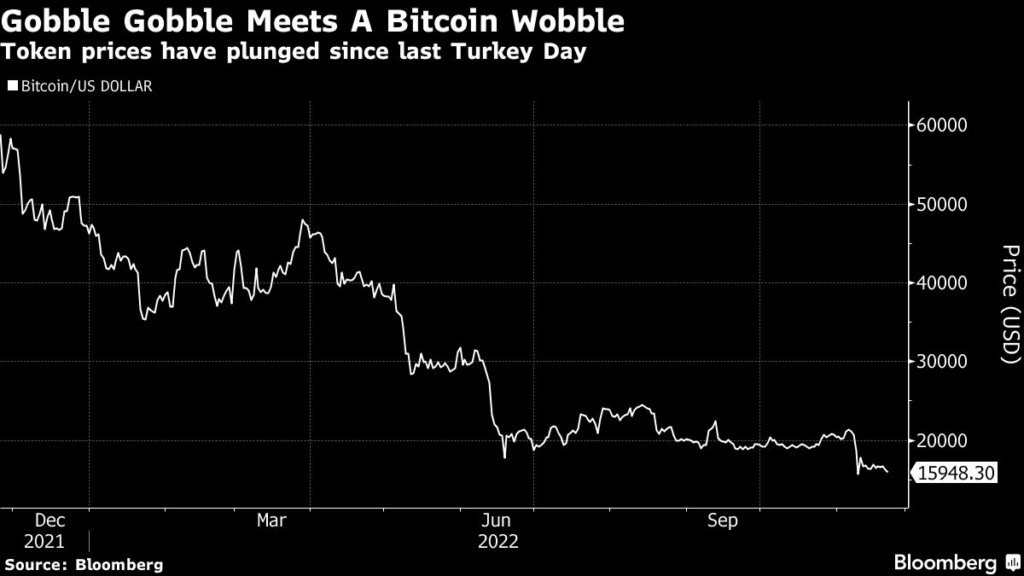
This holiday season, the Bitcoin bulls have less to be grateful for. The largest digital asset has plummeted about 70% since last Turkey Day. That drop might annoy the guests who bought in, including the Baby Boomers persuaded by their younger relatives.

“I can also see older folks saying ‘I told you so,’” said Todd Sohn, a 36-year-old managing director of technical strategy at Strategas Securities in New York.

During the pandemic, central banks flooded markets with liquidity. Flushed with added cash and plenty of free time, many Americans became enamored with cryptocurrencies. 

Younger Americans proved especially eager to invest in the non-traditional asset, even as mom and dad likely remained wary of the newfangled blockchain. Last holiday season, bullish investors likely sold their relatives on ‘Digital Gold’ and what they saw as a hedge against inflation. Niche tokens proliferated as prices rose ever higher–until they didn’t in the new year.

Unfortunately, Thanksgiving turkey had long gone cold by the time the crypto bubble truly burst. 

Now, people are going home for the holidays in a very different market. An array of scandal cooked up this year’s entrée of low token prices. What’s in it? Three ounces of meltdown from crypto lender Celsius Network Ltd., a dash of collapse in the Terra ecosystem, and — the secret ingredient — the fall of Sam Bankman-Fried’s FTX empire. 

Those disruptions have made way for some unpleasant dishes at the table. Bitcoin is down about 20% this month while Ether — the second largest token — has plunged close to 30%. 

The holiday season has also battered less popular tokens, from Solana to Dogecoin. Think of them as the green bean casserole and dressing–often on the table but not universally appealing. 

Well, this year, they’re burnt, perhaps inedible. The Bloomberg Galaxy Crypto Index measuring the largest cryptocurrencies, is down about 25% since the start of the month.

Even if crypto prices begin to recover, it might be wise to at least shy away from the subject of Bankman-Fried, the former crypto industry darling now shrouded in notoriety. FTX owes its 50 biggest unsecured creditors a total of $3.1 billion, and everyday traders are at risk of never retaining funds locked on the crypto exchange.  

It’s possible a dinner guest lost money, but even if nobody had funds on the platform, the subject still has its risks. Mentions of FTX might evoke a diatribe from grandpa about the scandals of yore, be it Enron or Lehman brothers. Older relatives, said Sohn, might be quick to point out that “history rhymes.”

But Bankman-Fried, Caroline Ellison, and company might show up for dinner no matter how hard guests try to keep them out. It’s “unavoidable,” wrote Nathan Batchelor, lead Bitcoin analyst for SIMETRI Research. “We are still only in the first innings.”

More than 130 entities tied to FTX.com, FTX US and trading firm Alameda Research Ltd. were listed in Chapter 11 bankruptcy filings this month. The fallout has dominated headlines in the weeks since as investors nervously watch other players in the digital asset space.

For families that have chatted crypto over the bull and bear cycles of the last few years, there could still be less at stake this Thanksgiving. Younger cousins who told relatives to buy Bitcoin in 2018 might have quadrupled grandpa’s investment by now, despite this year’s downturn. 

The dinner guests who first peddled crypto in 2021, however, might be in trouble. 

“If someone got their family in last year,” explains Quantum Economics Chief Executive Officer Mati Greenspan. “Everybody’s going to be pretty upset with that person.”

Sound like you? Maybe start prepping some Humble Pie. 

More stories like this are available on bloomberg.com

©2022 Bloomberg L.P.

EU Nations Advance €43 Billion Plan to Become Semiconductor Hub

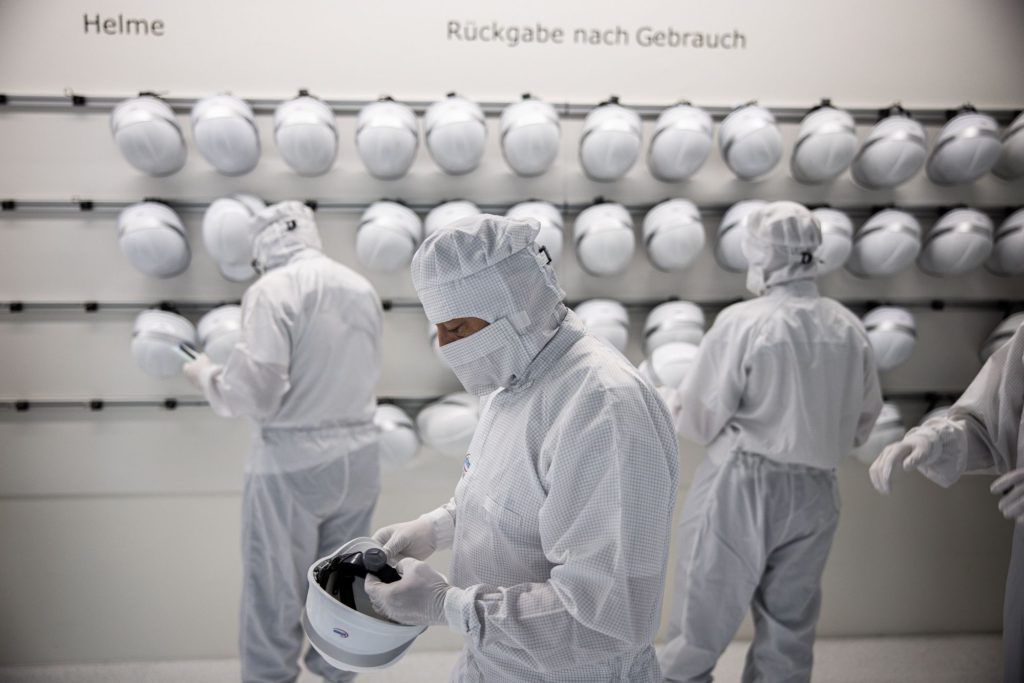
(Bloomberg) — European Union nations agreed to pursue a €43 billion ($44.4 billion) plan to jump-start the bloc’s semiconductor production, clearing a key hurdle in its plan to bolster high-tech industry.

The deal was backed Wednesday by EU ambassadors, according to people familiar with the matter. It would expand the scope of what chip plants are considered “first-of-a-kind” and qualify for state aid, but stops short of allowing all automotive chips to qualify for funds, which some countries had demanded earlier this fall. 

The latest version also adds more safeguards for when the EU’s executive arm can trigger an emergency and intervene in companies’ supply chains.

One of the most contentious issues has been the use of EU funds. Member states on Wednesday agreed not to reallocate €400 million of research funds for semiconductors after countries with small chip industries raised concerns that this money will only benefit big countries like Germany that have larger operations. Ambassadors want the commission to find the money elsewhere.

EU ministers are expected to rubber-stamp Wednesday’s deal at a meeting next month. The European Parliament needs to approve its own plan before the three institutions can negotiate a final agreement.

The EU has an ambitious goal of producing 20% of the world’s semiconductors by 2030. The European Commission announced a plan, called the EU Chips Act earlier this year, that anticipates around €43 billion going toward the semiconductor industry on the continent, including research and production.

While the plan won’t be finalized until next year, a number of companies have already announced new semiconductor manufacturing sites, including Intel Corp., GlobalFoundries Inc., STMicroelectronics NV and Infineon Technologies AG. 

More stories like this are available on bloomberg.com

©2022 Bloomberg L.P.

Buy Chinese Stocks and Sell Big US Tech Brands, BofA’s Hartnett Says

(Bloomberg) — The chorus of strategists turning bullish on Chinese stocks is getting louder by the day, with Bank of America Corp.’s Michael Hartnett the latest to recommend the nation’s equities as a top buy for 2023.

China’s economic reopening is set to boost equities as households have excess savings, strategists led by Hartnett wrote in a note dated Nov. 22, adding that the ending of Covid restrictions boosted stocks in the US and other countries. They also recommended selling US tech stocks among their top 10 trades for 2023.

Hartnett follows others on Wall Street who have recently turned positive on China. Citigroup Inc. said that Beijing’s pivot from Covid Zero, as well as supportive measures for the property sector, should lift company earnings, while Morgan Stanley raised its targets for the nation’s stock gauges.


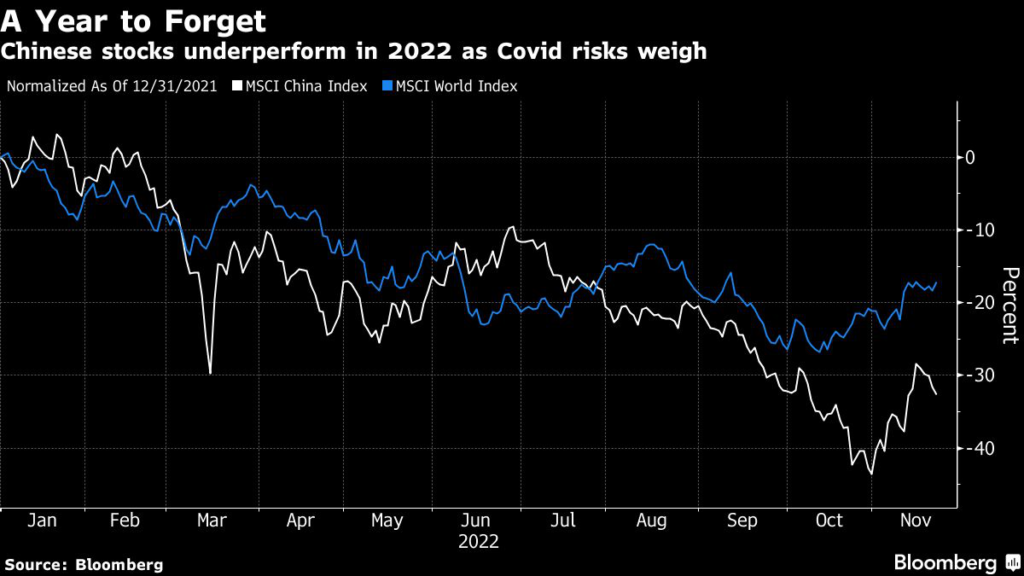
The calls come amid a sharp rebound for Chinese stocks, with the MSCI China Index up about 19% this month and the Hang Seng Index entering a bull market after surprise policy shifts from China’s government. Still, MSCI Inc.’s gauge remains down 33% this year, with investors put off by strict Covid measures and wary of President Xi Jinping’s vision for markets. Before this month, Chinese equities onshore and in Hong Kong had seen a $6 trillion selloff since their peak in February last year.

The Bank of America strategists also named selling US tech stocks as one of their top trades for 2023. Tech is still over-owned, even after a 28% slump for the Nasdaq 100 Index this year, they said. Heavyweight tech companies — valued on future earnings potential — will suffer as the era of easy monetary policy is over, while also facing risks from more regulation, according to Hartnett.

Analyst estimates also reflect an increasingly negative view on US tech. The sector is now expected to see earnings contract in 2023, down from expectations of 3.8% earnings per share growth as recently as mid-October, according to Gina Martin Adams, chief equity strategist at Bloomberg Intelligence. For the overall S&P 500, analysts expect 3.1% profit growth.

–With assistance from Michael Msika and Ksenia Galouchko.

More stories like this are available on bloomberg.com

©2022 Bloomberg L.P.

Elon Musk Makes Fun of Twitter T-Shirts Linked to BLM Protests

(Bloomberg) — Elon Musk is courting more controversy at Twitter Inc., posting a video making fun of old t-shirts at the social media service that date back to the early days of the Black Lives Matter movement.

Musk wrote that he found the shirts with #StayWoke printed in a closet at the company’s San Francisco headquarters. In a post he later deleted, he said the shirts stem from the protests in Ferguson, Missouri, that followed the 2014 fatal police shooting of 18-year-old Michael Brown.

Musk linked to a 2015 report by the US Justice Department on Brown’s death in the deleted post, writing that “‘Hands up don’t shoot’ was made up. The whole thing was a fiction.” In its 86-page report, the Justice Department said witnesses gave varying accounts of what Brown was doing with his hands as he moved toward Darren Wilson, the police officer who shot him.

The tweets risk further unsettling advertisers being pressured to stay away from Twitter due to concerns about hate speech and misinformation on the platform. Activists earlier this week renewed calls for a commercial boycott of the social media company after Musk reinstated former President Donald Trump’s account on the basis of a Twitter poll.


More stories like this are available on bloomberg.com

©2022 Bloomberg L.P.

In Brazil, a Central Bank Payment App is More Popular Than Any Card

(Bloomberg) — Brazilians are letting go of plastic cards and increasingly showing their mobile phones when shopping, as an instant payment app created by the central bank grows in popularity. 

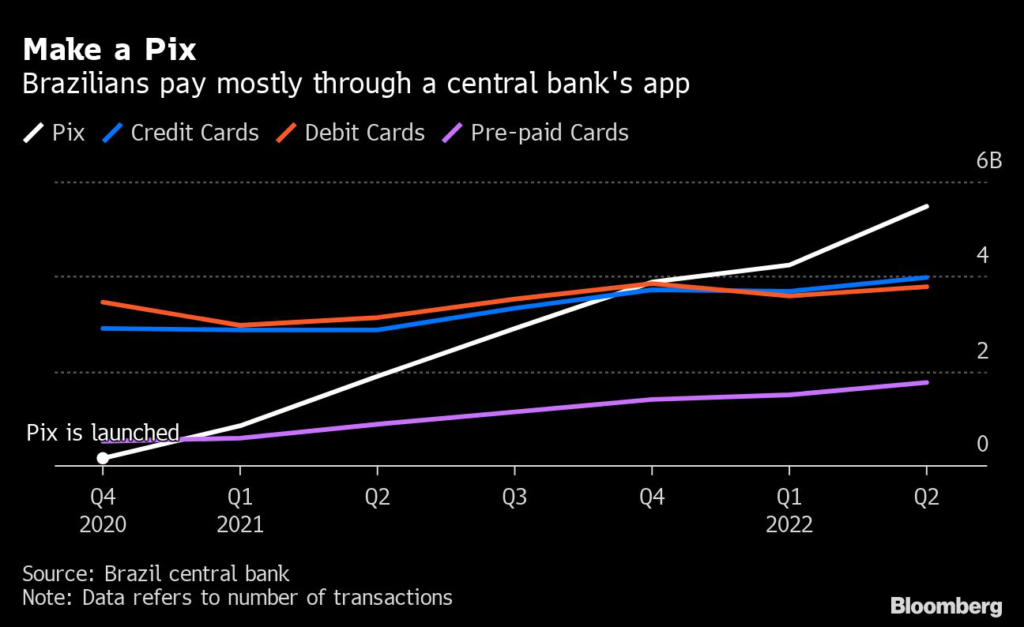
Cash transfers made through the so-called Pix platform surpassed credit card payments for the first time in the fourth quarter of 2021 and have continued to grow since, according to central bank data published Tuesday. 

In the second quarter of this year, more than 5.4 billion transactions were made through the platform that was launched two years ago, compared with nearly 4 billion for credit cards and 3.8 billion for debit cards. 

The Pix app allows anyone with a bank account to instantaneously send and receive Brazilian reais through a system that’s free and relatively easy to navigate. It is particularly important for small business owners who can cash their profits immediately, without having to wait for days until credit card purchases get cleared. Street vendors displaying QR codes directing customers to their Pix numbers have become a quite common scene in cities across Brazil.  

Read More: 110 Million Are Using Central Bank’s Mobile Money System

More than 127 million Brazilians now subscribe to Pix by providing either their mobile phone number, an email address, a tax id or even a random key. More than 10 million companies also use the platform. The central bank says the system was the main driver behind a 40% annual growth in the overall number of transactions done last year. Mobile phones, used by many either because of Pix or banking apps, became the main instrument to complete purchases, responding for 60% of all payments made last year. 

Pix became so popular that it was also thrown into an unexpected political battle this year, as President Jair Bolsonaro claimed it as one of his achievements during the presidential campaign. Central bank chief Roberto Campos Neto later explained the idea to develop such a system was long part of the innovation agenda sponsored by the now autonomous monetary authority. 

More stories like this are available on bloomberg.com

©2022 Bloomberg L.P.

Ukraine Latest: Blasts Heard Across Kyiv as Rocket Hits Facility

(Bloomberg) — A Russian missile hit an infrastructure facility in the capital, Kyiv, and explosions were heard in districts across the city, Mayor Vitali Klitschko said.

The European Parliament adopted a non-binding resolution to declare Russia a state sponsor of terrorism, a move that lawmakers hope will help leaders to be held accountable for war crimes. 

European Union ambassadors were meeting with the intention of approving a cap on Russian oil exports. The bloc watered down its latest sanctions proposal for the cap by delaying its full implementation and softening key shipping provisions.

(See RSAN on the Bloomberg Terminal for the Russian Sanctions Dashboard.)

Key Developments

  • EU Set to Soften Russian Oil Price Cap Plan Before Approval 
  • China Pauses Some Russian Oil Purchases Ahead of Price Cap
  • Europe Faces the First Test of Its Winter Energy Resilience
  • World’s Most-Crucial Fuel Heads for Shortage Touching Everything

On the Ground

Russian forces hit a maternity ward in the Zaporizhzhia region with missiles overnight, leaving one newborn baby dead, Governor Oleksandr Starukh said on Telegram. Ukraine said the eastern Front was at center of Russia’s attacks, especially in Bakhmut and Avdiyivka. Russian missile also hit infrastructure in the capital, Kyiv, according to Mayor Vitali Klitschko.

(All times CET)

Kyiv Mayor Says Russian Missile Hit Infrastructure Facility

A missile fired by Russian forces hit a piece infrastructure in Ukraine’s capital, Kyiv Mayor Vitali Klitschko said on Telegram, without elaborating.

Following blasts in Kyiv, power momentarily shut off in part of the city before coming back on, according to eye witnesses. Emergency services were deployed to the sites, Klitschko said.

European Parliament Declares Russia State Sponsor of Terrorism (12:44 p.m.)

The European Parliament adopted a non-binding resolution to declare Russia a state sponsor of terrorism, to pave the way for President Vladimir Putin and his government to be held accountable for war crimes before an international tribunal. 

The resolution calls on EU member states to swiftly complete work on a ninth sanctions package against Moscow. 

EBRD Helps to Shore Up Critical Industries (12:35 p.m.)

The European Bank for Reconstruction and Development is giving a €50 million guarantee to back lending to critical industries in Ukraine. The lender was issuing risk-sharing instruments to three local banks and a leasing company.

EU Considers Imposing Price Cap of $65-$70 on Russian Oil (11:10 a.m.)

The EU, in coordination with G-7 nations, is discussing capping the price of Russian crude oil at between $65 and $70 a barrel, according to people familiar with the matter. 

EU Considers Imposing Price Cap of $65-$70 on Russian Oil

Kyiv May Face Worst Winter Since WWII, Mayor Says (10:41 a.m.)

Kyiv authorities may have to evacuate parts of the city if the energy crisis worsens, Mayor Vitali Klitschko told Germany’s Bild newspaper.

The capital has to prepare for the worst scenario which would involve a wide-reaching blackout when temperatures drop further, Bild cited Klitschko as saying. “We won’t just take our things and flee to the West, like Putin wants,” he said. 

Germany Pledges Support Until War Ends (9:57 a.m.)

German Chancellor Olaf Scholz said his government will support the administration in Kyiv until Russia’s war is over. 

“We will stick to this course — in solidarity with our closest allies — until this senseless, brutal, criminal war ends,” he told the lower house of parliament in Berlin. “Russia must finally stop this war!” 

UK Delivers Helicopters, Pledges Artillery Rounds (9:10 a.m.)

The UK said it completed its first delivery of helicopters to Ukraine and pledged an additional 10,000 artillery rounds, the Ministry of Defence said.

An undisclosed number of Sea King helicopters has been delivered to Ukraine to provide search and rescue capability, according to a statement from the ministry. It comes after Britain’s Royal Navy provided 10 weeks of Sea King training for 10 Ukrainian crews in the UK.

NATO Allies Test Air and Missile Defense Capabilities (9:05 a.m.)

NATO allies are testing their air and missile defense capabilities in Romania on Wednesday, simulating an attack by a fighter jet and using a French MAMBA surface-based system to repel it.

The exercise comes a week after a missile landed on Polish soil, killing two, that was likely the result of Ukrainian forces fending off a barrage of missile attacks from Russia. NATO has said the incident was likely caused by Ukrainian missile defense.

Putin Meets Fertilizer Tycoon Mazepin (8:30 a.m.)

Russian President Vladimir Putin met with Dmitry Mazepin, an investor in the Uralchem-Uralkali fertilizer group, to discuss fertilizers shipments issues, state television reported. 

Mazepin asked the president to help to re-start ammonium fertilizer shipments via Ukraine’s Odesa port as part of a grain shipment deal that was extended last week. 

Aid Stations Being Readied Amid Blackout Threat (3 a.m.)

Ukraine’s government is preparing a network of emergency aid stations across the country to help citizens endure mass blackouts that could drag on for days if Russia continues large-scale attacks on the nation’s energy infrastructure. 

‘’All of us should be prepared for any scenarios. given what kind of terrorists are fighting against our people and what they are struggling to do,” President Volodymyr Zelenskiy said in his regular nightly address on Tuesday.

The aid stations will give people access to basic services including electricity, mobile networks, Internet access, water and first aid.

More stories like this are available on bloomberg.com

©2022 Bloomberg L.P.

FTX Latest: Bitcoin Climbs 2nd Day; Cathie Wood Sticks to Target

(Bloomberg) — Crypto markets have steadied as Bitcoin climbed for a second day, trading back above $16,000. Still, investors remain alert for contagion from FTX and long-term predictions for the coin differ wildly, underscoring the uncertainty that’s rife in the industry. Ark Investment Management’s Cathie Wood is sticking to her bullish forecast of $1 million for Bitcoin by 2030.

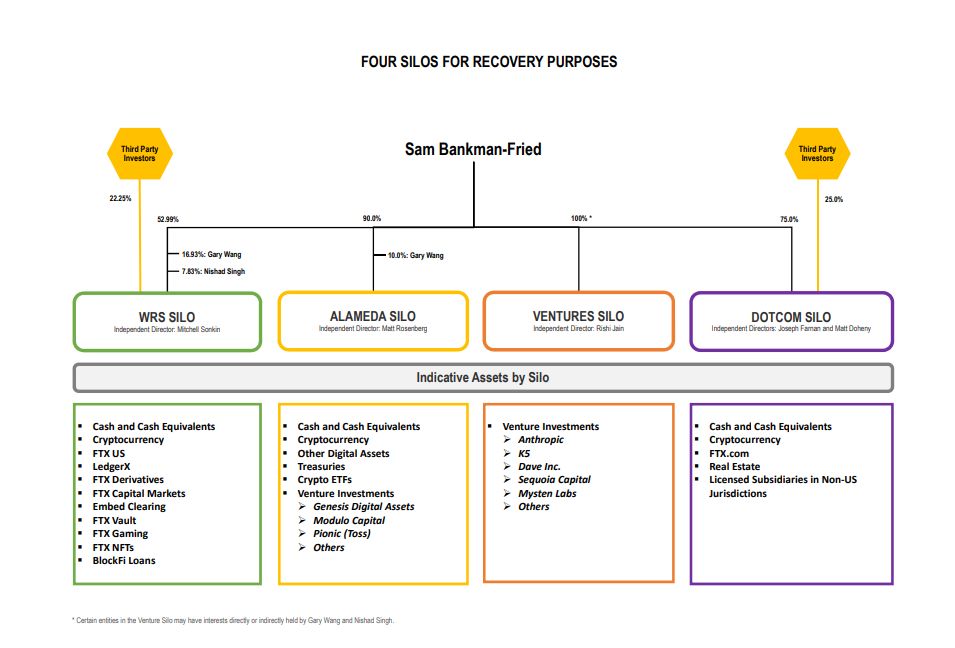
Top partners at Sequoia Capital apologized to investors for backing FTX, whose bankruptcy had its first US court hearing. Former CEO Sam Bankman-Fried in a letter outlined a crash in collateral to $9 billion from $60 billion.

New York Governor Kathy Hochul signed one of the most restrictive pieces of legislation in the US against crypto mining, citing environmental concerns. Meanwhile, crypto’s crash is helping degen couples rekindle their relationships. 

Key stories and developments:

  • FTX Flipped Jane Street’s Risk Obsession to Disastrous Effect
  • Cathie Wood Sticks to $1 Million Bitcoin Call as Others See Rout
  • What the FTX Collapse Suggests About Crypto and Risk
  • Sequoia Capital Says Sorry for FTX But Defends Vetting Process
  • New York Governor Hochul Signs Moratorium to Curb Crypto Mining

(Time references are New York unless otherwise stated.)

Crypto Crash Offers a Path to Recovery for Damaged Relationships (6:58 a.m.)

Devoting days and nights to a gamified digital economy left a mark on some people’s relationships, turning partners into crypto widows and widowers. 

Now they have some emotional work to do: in the aftermath of the digital-asset mayhem, believers are trying to heal what Bitcoin and Bored Ape obsessions did to intimacy.

Wild Divergence in Bitcoin Predictions Highlights Uncertainty (4:32 a.m.) 

Over the past few days, long-term targets for the world’s largest token by market value have ranged from $5,000 at strategists BCA Research Inc. to $1 million by 2030 for Ark Investment Management’s Cathie Wood. 

The cavernous spread reflects the gnarly question of what further contagion may or may not lie ahead following the evisceration of Sam Bankman-Fried’s FTX exchange and trading house Alameda Research, onetime crypto darlings.

El Salvador Closer to Issuing Bitcoin Bonds (12:05 p.m. HK)

The country’s presidency dispatched a digital-securities bill to lawmakers, taking the nation a step closer to raising $1 billion via the world’s first sovereign blockchain bond.

The legislation calls for a digital-assets commission and a Bitcoin Fund Management Agency to oversee crypto-related debt sales. The proposed blockchain bonds, with a minimum investment of just $100, are meant to help finance the construction of the Bitcoin City project.

New York Governor Signs Moratorium to Curb Crypto Mining (11:10 a.m. HK)

Kathy Hochul signed one of the most restrictive laws in the US on regulating cryptocurrency mining, with the bill triggering a two-year moratorium on new permits for crypto-mining companies.

“I will ensure that New York continues to be the center of financial innovation, while also taking important steps to prioritize the protection of the environment,” Hochul said in a statement.

Bankman-Fried Says Collateral Crashed by $51 Billion as FTX Fell (8:30 a.m. HK)

Bankman-Fried, disgraced founder of the now collapsed crypto exchange FTX and trading house Alameda Research, apologized to staff in a letter that outlined a crash in “collateral” to $9 billion from $60 billion.

“I didn’t mean for any of this to happen, and I would give anything to be able to go back and do things over again,” he wrote in the message sent to employees Tuesday and obtained by Bloomberg News.

Sequoia Capital Says Sorry for FTX But Defends Vetting Process (7:20 a.m. HK)

Top partners at the venture capital firm apologized to their investors in a conference call Tuesday for backing FTX, according to people familiar with the meeting.

Roelof Botha, the firm’s global leader, opened the call, and he and his colleagues were repentant for backing the company, with investments totaling $214 million in FTX.com and FTX.us across two funds. Alfred Lin, the partner who led the FTX deal, provided an update on the situation. Shaun Maguire, another partner who focuses on crypto, gave an overview of the sector.

Cathie Wood Holds On to $1 Million Target for Bitcoin (7:10 a.m. HK)

“Bitcoin is coming out of this smelling like a rose,” said the ARK Investment Management CEO as she defended her forecast.

Wood also said that crypto infrastructure is “working beautifully.” She added that digital-asset manager Grayscale Investments is now the crown jewel of Barry Silbert’s once-$10 billion Digital Currency Group conglomerate.

Crypto ATM Operator Coin Cloud Discussed Equity From Genesis (6:30 a.m. HK)

Genesis had provided an unsecured loan of around $100 million to Coin Cloud, according to people with knowledge of the situation. In the latest discussions, Genesis had considered injecting equity into Coin Cloud, said the people.

Coin Cloud recently hired advisers to help rework about $125 million of the ATM operator’s debt.

FTX Allowed to Hide Identity of 50 Biggest Creditors (5:40 a.m. HK)

US Bankruptcy Judge John Dorsey agreed to let FTX redact the names of the 50 biggest unsecured creditors owed a total of $3.1 billion. 

The US Bankruptcy Code normally requires the names be filed in documents available to the public. Representatives for FTX argued those creditors are also customers and disclosure would allow rivals to steal their business. 

Crypto Collapse Opens 1,350% Gap Between Stocks, Price Targets (3:25 p.m.)

Predicting the price of a stock a year from now is hard, even for Wall Street’s best analysts. But for investors who bought into the bullish expectations behind cryptocurrency-related stocks at the beginning of this year, those forecasts now look like pipe dreams.

For 10 crypto stocks tracked by Bloomberg, with at least three analyst price targets at the start of 2022, the average return needed to reach their 12-month price target from Jan. 1 is nearly 1,350%. To put that in perspective, it took Amazon.com Inc. more than eight years — from 2013 to its record high in late 2021 — to return investors that amount. 

Genesis Balance Sheet Reveals Web of Loans Across Silbert Empire (2:40 p.m.)

The troubled brokerage Genesis Global has $2.8 billion in outstanding loans on its balance sheet, with about 30% of its lending made to related parties including its parent company, Barry Silbert’s Digital Currency Group, according to people familiar with the matter.

Among them, a lending subsidiary named Genesis Global Capital had been lending money to Genesis Global Trading — the brokerage unit that has become a key counterparty to institutions across the crypto industry. In a letter to shareholders on Tuesday, Silbert said that intercompany loans were made “in the ordinary course of business.”

More stories like this are available on bloomberg.com

©2022 Bloomberg L.P.

US Futures Are Steady as Traders Await Fed Minutes: Markets Wrap

(Bloomberg) — US equity futures and European stocks were steady as investors looked forward to the release of policy minutes from the Federal Reserve’s latest meeting for potential signs that the pace of rate hikes may slow.

Contracts on the S&P 500 edged higher after the underlying gauge closed at its highest level since Mid-September on Tuesday, while those on the Nasdaq 100 gained 0.2%. The Stoxx Europe 600 crept to a fresh three-month high as travel and leisure and mining stocks gained. Credit Suisse Group AG shares dropped below their record closing low after the bank warned of a fourth-quarter loss. 

Manchester United Plc shares jumped in US premarket trading after the owners of the historic English football club said they were exploring options that could lead to a sale. Tesla Inc. gained after Citigroup Inc. upgraded the electric vehicle maker to neutral from sell. Market trading volumes are expected to be lighter, given the US Thanksgiving holiday on Thursday.  

Oil fell as the EU discussed imposing a price cap on Russian oil between $65 and $70 a barrel. A gauge of dollar strength erased earlier declines. Ten-year US Treasury yields rose by one basis point. 

The publication of minutes from the Fed’s Nov. 1-2 meeting — due at 2 p.m. in Washington — will be studied for how united policymakers were over a higher peak for interest rates than previously signaled in their inflation fight. Some investors anticipate that lower-than-estimated inflation figures could prompt the Fed to temper the size of its rate hikes as early as at next month’s gathering.

“Investors may be on the hunt for clues that they’ve acted prematurely, or that there’s actually more support for such a slowdown in tightening and less for a higher terminal rate than they previously thought,” said Craig Erlam, senior market analyst at Oanda Europe Ltd.

European investors digested data showing that private-sector activity in Germany and France — the euro area’s top two economies — contracted in November, painting a bleak picture for a region that may already be in recession. A separate survey showed that the UK economy is in recession, with the downturn expected to worsen into 2023.

Meanwhile, a gauge measuring Euro-area activity in manufacturing and services unexpectedly rose in November, signaling that businesses see tentative signs that the region’s economic slump may be easing as record inflation cools and expectations for future production improve. 

Bitcoin extended its rebound into a second session, topping the $16,000 level and prompting gains in cryptocurrency-exposed stocks in US premarket trading. Investors were still keeping an eye out for signs of any contagion from the collapse of Sam Bankman-Fried’s FTX empire.


Key events this week:

  • S&P Global PMIs: US, Euro area, UK, Wednesday
  • US MBA mortgage applications, durable goods, initial jobless claims, University of Michigan sentiment, new home sales, Wednesday
  • Minutes of the Federal Reserve’s Nov. 1-2 meeting, Wednesday
  • ECB publishes account of its October policy meeting, Thursday
  • US stock and bond markets are closed for the Thanksgiving holiday, Thursday
  • US stock and bond markets close early, Friday

Some of the main moves in markets:

Stocks

  • Futures on the S&P 500 rose 0.1% as of 7:15 a.m. New York time
  • Futures on the Nasdaq 100 rose 0.2%
  • Futures on the Dow Jones Industrial Average were little changed
  • The Stoxx Europe 600 rose 0.1%
  • The MSCI World index rose 0.1%

Currencies

  • The Bloomberg Dollar Spot Index was little changed
  • The euro rose 0.2% to $1.0324
  • The British pound rose 0.4% to $1.1931
  • The Japanese yen fell 0.1% to 141.43 per dollar

Cryptocurrencies

  • Bitcoin rose 2.7% to $16,560.28
  • Ether rose 4% to $1,174.95

Bonds

  • The yield on 10-year Treasuries advanced one basis point to 3.77%
  • Germany’s 10-year yield advanced two basis points to 2.00%
  • Britain’s 10-year yield declined three basis points to 3.11%

Commodities

  • West Texas Intermediate crude fell 2.1% to $79.25 a barrel
  • Gold futures were little changed

This story was produced with the assistance of Bloomberg Automation.

–With assistance from Richard Henderson.

More stories like this are available on bloomberg.com

©2022 Bloomberg L.P.
New York Governor Hochul Signs Moratorium to Curb Crypto Mining

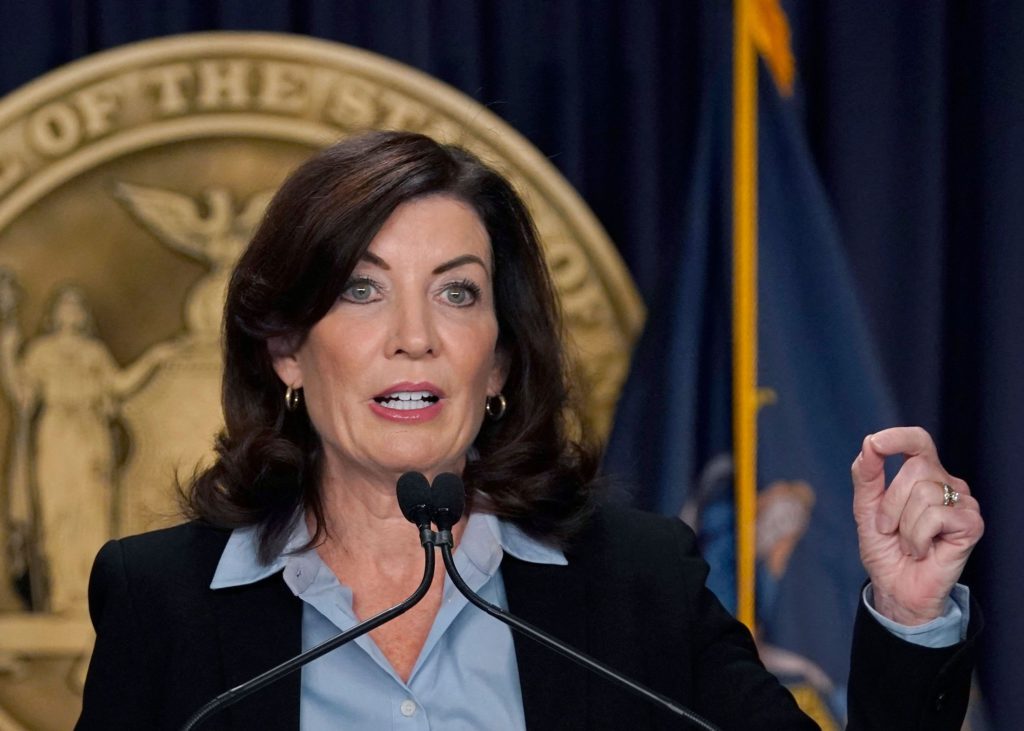
(Bloomberg) — New York Governor Kathy Hochul has signed one of the most restrictive laws in the US on regulating cryptocurrency mining, becoming the first state to impose such a ban.

The bill triggers a two-year moratorium on new permits for crypto-mining companies that are powered by fossil fuels and use proof-of-work authentication methods, with millions of computers, to validate transaction data. That earns the companies rewards in the form of the token from the blockchain network.

The Bitcoin network relies on proof-of-work authentication. Billions of dollars have been invested in Bitcoin mining operations and the energy consumption for such operations can equal that of an entire nation.

New York has become one of the biggest crypto-mining hubs after China banned crypto mining last May. Miners have flocked to the state because its low energy costs and cool climate induce higher productivity for the mining operations. But activists have increasingly highlighted the environmental costs of such activities. 

“I will ensure that New York continues to be the center of financial innovation, while also taking important steps to prioritize the protection of the environment,” Hochul said in a memo issued late Tuesday. “It is the first of its kind in the country and a key step for New York as we work to address the global climate crisis.”

How Serial Meltdowns Are Shaking Crypto’s Foundations: QuickTake

The two-year moratorium comes as the crypto industry faces more scrutiny from regulators following the bankruptcy of the crypto exchange FTX. The sudden fall of FTX has sent shock waves and fears of contagion through the crypto market, with Bitcoin temporarily falling below $16,000. 

The bill was approved in June by the state Senate but Hochul didn’t sign it until after the governor’s election was over. Facing fierce lobbying against the proposal from the cryptocurrency industry. Hochul had said during an October gubernatorial debate that she was “looking at that bill closely,” but didn’t outright say she would sign it.

Read More: NY Governor Hochul Urged to Sign Two-Year Crypto Mining Ban

Environmental groups praised Hochul’s decision to sign the bill. 

“For too long the state’s dramatically energy-intensive mining facilities, whose massive carbon footprints exacerbate climate change, have had little oversight,” said Richard Schrader, the New York Legislative and Policy Director for the Natural Resources Defense Council. “Not only does crypto take a toll on the environment, but communities in upstate New York could suffer as once-abandoned coal power plants come back from the dead as ‘zombie plants’ that mine crypto all day, every day.”

(Updates with comment from NRDC in last paragraph.)

More stories like this are available on bloomberg.com

©2022 Bloomberg L.P.
Close Bitnami banner
Bitnami