Bloomberg

Bankman-Fried Says Collateral Crashed by $51 Billion as FTX Fell

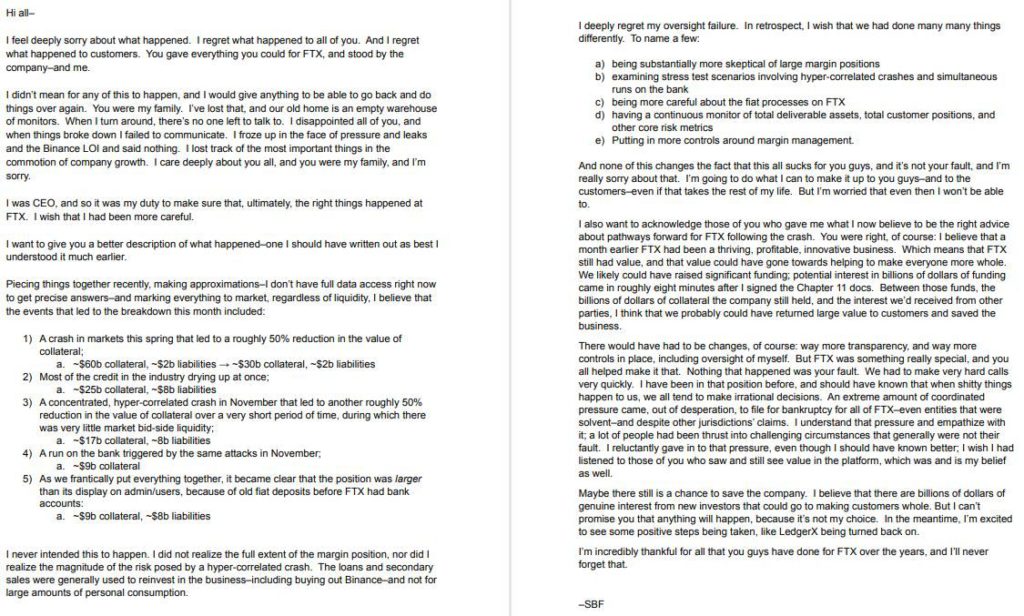
(Bloomberg) — Sam Bankman-Fried, disgraced founder of the now collapsed crypto exchange FTX and trading house Alameda Research, apologized to staff in a letter that outlined a crash in “collateral” to $9 billion from $60 billion.

“I didn’t mean for any of this to happen, and I would give anything to be able to go back and do things over again,” he wrote in the message sent to employees Tuesday and obtained by Bloomberg News.

A slide in digital-asset markets in spring roughly halved collateral to $30 billion, while liabilities were $2 billion, he said.

A combination of a credit squeeze, a further selloff in virtual coins and a “run on the bank” left collateral at $9 billion ahead of FTX’s Nov. 11 bankruptcy, he wrote. The estimate for liabilities had reached $8 billion by then, he said.

“I did not realize the full extent of the margin position, nor did I realize the magnitude of the risk posed by a hyper-correlated crash,” Bankman-Fried said. He didn’t give exact details on the makeup of the collateral or the liabilities.

FTX and Alameda Research, both onetime pillars of the crypto market, unraveled with astonishing speed this month. Flows of money between a tangled web of FTX-related entities are at the heart of whether the exchange misappropriated customer funds. 

The bankruptcy proceedings so far have painted a picture of a business with unusually lax documentation and financial controls, with payment requests approved by emojis in chatrooms and FTX funds used to buy homes and other personal items for employees and advisers. 

Bankman-Fried wrote that “potential interest in billions of dollars of funding came in roughly eight minutes after I signed the Chapter 11” documents. 

While he argued that could have helped save FTX and return “large value” to customers, the court filings point to a chaotic organization with deep problems.

Here’s a copy of Bankman-Fried’s letter:

For crypto market prices: CRYP; for top crypto news: TOP CRYPTO.

More stories like this are available on bloomberg.com

©2022 Bloomberg L.P.

Sequoia Capital Regrets Backing FTX But Defends Vetting Process

(Bloomberg) — Top partners at the powerful venture capital firm Sequoia Capital apologized to their investors in a conference call Tuesday for backing FTX, a pair of bankrupt cryptocurrency exchanges that had allegedly been mismanaged by Sam Bankman-Fried, according to people familiar with the meeting.

Roelof Botha, the firm’s global leader, opened the call, and he and his colleagues were repentant for backing the company, with investments totaling $214 million in FTX.com and FTX.us across two funds. Alfred Lin, the partner who led the FTX deal, provided an update on the situation. Shaun Maguire, another partner who focuses on crypto, gave an overview of the sector, which was roiled by the scandal.

FTX was a rare disaster for the storied venture firm, which has consistently remained a top VC since its founding in 1972. Sequoia told its investors two weeks ago it had written down the full value of its FTX investments.

A spokeswoman for Sequoia declined to comment on the conference call. The Wall Street Journal first reported details of the meeting on Tuesday.

The call was meant to reassure investors in Sequoia Capital, which provided $150 million via its Global Growth Fund III. The remainder came from the Sequoia Capital Global Equities fund, which operates separately.

Although partners on the call were conciliatory, they also defended the due diligence they conducted on the deal. They said staff reviewed financial statements and asked on multiple occasions about the relationship between FTX and Alameda Research, a trading firm that Bankman-Fried also founded and which reportedly borrowed and lost FTX customers’ money.

As recently as May, Sequoia was assured that FTX funds were not used to finance Alameda’s activities and that FTX and Alameda were separate entities, one of the people with knowledge of the call said. The partners said they believe they were misled.

Sequoia told its investors that when it initially backed FTX in July 2021, it had reviewed unaudited statements, the person said. In response to a question about audited versus unaudited statements, one of the partners suggested the firm might push its startups to use Big Four accounting firms in the future.

(Updates with additional reporting in the fifth paragraph.)

More stories like this are available on bloomberg.com

©2022 Bloomberg L.P.

China Blocks Viral WeChat Post Criticizing Tough Covid Policies

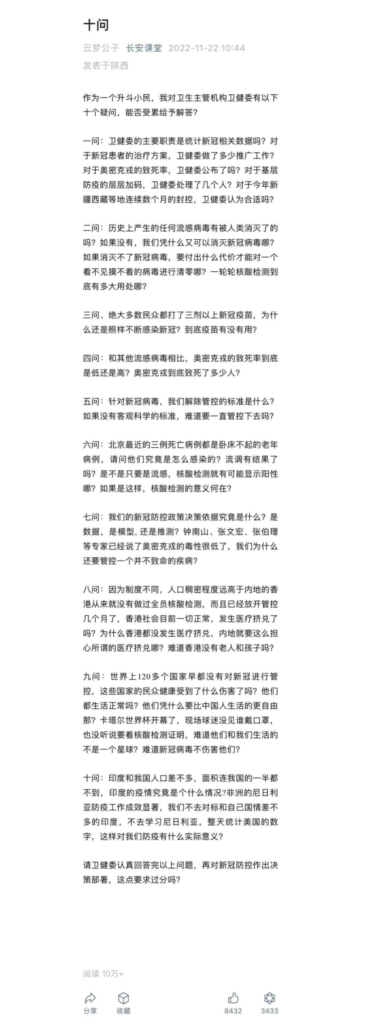
(Bloomberg) — A social media post that questioned China’s Covid policies was removed and the author blocked after it went viral on the country’s WeChat platform Tuesday — speaking to growing public concerns about Beijing’s stance, and the continuing sensitivities over criticism of its outlier approach. 

The post was removed after it garnered 100,000 hits, the maximum number publicly revealed on WeChat, the ubiquitous messaging app owned by China’s Tencent Holdings Ltd.

The unidentified author, whose WeChat account has now been blocked, raised a string of questions addressed to the country’s National Health Commission, including why China continues to impose such tough Covid restrictions when other parts of the world — including Hong Kong — enjoy conditions much closer to, if not matching, the pre-pandemic period.

“Audiences at the Qatar World Cup are not wearing masks or required to have PCR test results available with them — aren’t they on the same planet we live? Doesn’t the Covid virus hurt them?” the person asked.

Among other challenges laid down to the authorities:

  • Making public the fatality rates of Covid omicron variants
  • Comparing death rates with common influenza and explaining why Covid should be considered differently
  • Assessing the cost of continuing with the Covid Zero policy in the event the virus cannot be eliminated
  • Explaining the utility of continuing with multiple rounds of mass tests
  • Detailing the criteria for restrictions and controls to be removed, and stating whether the measures will remain indefinitely in the absence of scientific and objective standards
  • Spelling out what the concerns are on the mainland at a time when Hong Kong is in a near-normal state after easing curbs some months ago, without that city having suffered a run on its medical resources
  • Explaining why people keep getting infected after having being vaccinated, and stating clearly whether the vaccines are effective

The article was widely reposted by WeChat users before it was deleted. The account that carried it has been blocked, with a pop-up message saying that WeChat received complaints and determined the post “violated related rules.” 

The incident comes amid rising public discontent with China’s Covid approach, which remains highly restrictive despite orders this month from top leaders to make it more targeted. Officials have instead tightened controls in some areas, leading to reduced mobility as consumers stay at home. Economically important areas such as coastal Guangdong province, as well as cities including Chongqing and Beijing, are seeing a rapid rise in cases.

While ongoing Covid lockdowns are fueling public anger and protests, direct and detailed criticism of China’s strategy is rare in the country’s public forums, making this post and the fact it was so widely read before its removal significant. China’s internet and media is highly policed, and videos of demonstrations have been removed from platforms like WeChat in the past. 

More stories like this are available on bloomberg.com

©2022 Bloomberg L.P.

Twitter Restores Anti-Trans Accounts and Fuels Hate, Groups Say

(Bloomberg) — Twitter Inc. Chief Executive Officer Elon Musk is restoring a string of accounts previously suspended for harassing transgender people, rolling back protections for the LGBTQ community as the country confronts the aftermath of a shooting in a Colorado gay club that left five people dead and dozens wounded. 

Advocates say the shooting on Saturday highlights the potential real-world violence that can stem from rhetoric against the trans community. They noted that anti-trans abuse has been mounting on the platform since the shooting.

“Creating this environment of relentless attack and permissible hate, it results in the kinds of things we saw Saturday night in Colorado,” said Cathy Renna, spokeswoman for the National LGBTQ task force. “We cannot carefully step around the fact that you can draw a straight line between these things.” 

The accounts that were reinstated, before and after the shooting, include Christian news satire site Babylon Bee, writer James Lindsay and Canadian self-help author Jordan Peterson. The alleged shooter was charged Monday with murder and hate crimes.  

Musk had announced he planned to pare back some preexisting policies against targeting the LGBTQ community after he took control of Twitter last month. For instance, he specifically asked Twitter’s trust and safety team to review the company’s policy against “deadnaming,” the act of using the name that a transgender person was given at birth, Bloomberg News reported. 

Alejandra Caraballo, a clinical instructor at the Harvard Law School Cyberlaw Clinic, said the nightclub attack comes “at a time where anti-LGBTQ rhetoric is hitting a fever pitch.” 

Anti-LGBTQ activity including demonstrations and violence increased fourfold in the US in 2021 compared to 2020, according to the Armed Conflict Location & Event Data Project. Rhetoric against the trans community is escalating across the country, from online forums to Republican political campaigns. Over the past year, white nationalists have protested drag queen story hours and children’s hospitals have faced bomb threats over their transgender care. 

Musk himself has made derogatory remarks about the trans community. One of his daughters, who is transgender, said in a court filing that she doesn’t live with or “wish to be related to” Musk. Musk blamed their rift on “communism” within elite colleges in an interview with the Financial Times. “I have very good relationships with all the others,” Musk said, referring to his other children. “Can’t win them all.” Musk also previously tweeted that pronouns for trans people are a “nightmare.”

The Babylon Bee, which has almost 2 million followers, was locked out of its account in March over a tweet misidentifying the gender of US assistant secretary for health Rachel Levine, a transgender woman. Lindsay, the writer, was suspended in August for calling a Harvard professor a “child sexualization specialist” over her work advocating for the LGBTQ community. Lindsay popularized the epithet “Ok, Groomer” on Twitter, pushing the narrative that teaching children about LGBTQ equality is akin to pedophilia. 

The phrase “Ok, Groomer” was trending on Twitter on Monday as more accounts suspended for anti-trans harassment came back online. 

Peterson, a right-wing commentator, was locked out of his account earlier this year for using the incorrect name to refer to actor Elliot Page, the star of Jason Reitman’s 2007 film “Juno.” 

Melissa Ingle, a former senior data scientist at Twitter, has received extensive harassment and even death threats on the platform this past week as she spoke out about her experiences being laid off from Twitter under Musk. Ingle, who is transgender, has faced abuse from some accounts that were previously banned, including from Lindsay. 

“You can talk to any trans person on the platform and they’re scared,” Ingle said. She added that before she left Twitter, a colleague shared a study that showed there was a 50% increase in abuse reports from Twitter users the day after Musk purchased the platform compared with the day before. 

Twitter also reinstated the account of Protect Texas Kids, a group that protests drag shows and LGBTQ events in Texas. “Protest your local ‘kid-friendly’ drag show,” the account posted on Monday. 

“This is really, really dangerous,” said Ari Drennan, LGBTQ program director at advocacy group Media Matters. “They’re looking at a fire and pouring on some more gasoline.” 

More stories like this are available on bloomberg.com

©2022 Bloomberg L.P.

Grayscale Is the ‘Cash Cow’ of Silbert’s Empire, Ark’s Wood Says

(Bloomberg) — Digital-asset manager Grayscale Investments is now the crown jewel of Barry Silbert’s once-$10 billion Digital Currency Group conglomerate, in the eyes of Ark Investment Management’s Cathie Wood. 

“We know that the Grayscale Investment trusts are the most valuable part of that company right now, and they’re cash cows,” Wood said in a Bloomberg Television and Radio interview on Tuesday. “We think they’re going to try and hold onto that if nothing else.”

The comments from Ark’s chief executive come as beleaguered cryptocurrency brokerage Genesis searches for fresh capital to stave off a potential bankruptcy after halting withdrawals last week in the wake of FTX’s stunning collapse. Genesis’s ordeal has thrown the health of parent company DCG into question and it’s clear that Grayscale is the sturdiest part of the business, Wood said.

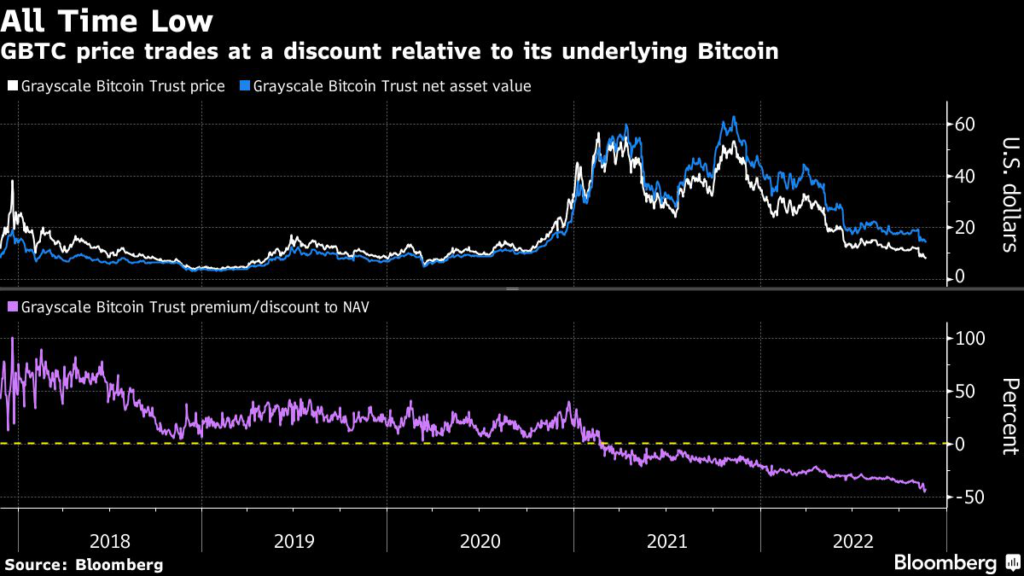
Wood has been a buyer of Grayscale Bitcoin Trust, known as GBTC, even as the trust sinks to a record discount relative to its underlying Bitcoin. The ARK Next Generation Internet exchange-traded fund (ticker ARKW) has purchased GBTC shares three separate times already this month for the first time since July 2021. While the discount has punished long-term holders of the trust, the gap should narrow over time and there’s “a lot of upside,” Wood said.

Roughly $10 billion sits in GBTC, and Bloomberg Intelligence estimates that the trust holds more than 3% of all mined Bitcoin. Last week, Grayscale released a letter from Coinbase Global  Inc. Chief Financial Officer Alesia Haas saying that the trust’s coins are in cold storage and can’t be lent out. While FTX’s blowup has heightened jitters among crypto investors, Wood is “comfortable” with GBTC’s custody arrangements. 

“We had to do our homework on it and we know that all of the Bitcoin behind GBTC is in cold storage at Coinbase, and Coinbase has confirmed this,” Wood said. “So we feel quite comfortable with it here.”

Broadly, Wood said she expects Bitcoin to emerge stronger than ever from the crypto conflagration ignited by FTX.com, likening the collapse to Bernie Madoff’s infamous ponzi scheme. She’s sticking by her bullish forecast of $1 million for the coin by 2030, citing the underlying technology of digital-assets. Bitcoin edged back above $16,000 in New York as of 5:00 p.m. 

“Well we always look for the ‘whale’ in a situation like this and if there was a whale out there, it was FTX and Sam Bankman-Fried, king of the hill, she said. “I’m sure there’s going to be more fallout.”

The quick demise of FTX sent shockwaves not just in the crypto industry but also in Wall Street. Several venture capital firms, including prominent ones such as Paradigm, BlackRock Inc. and Tiger Global Management had backed the firm only to be publicly humiliated following the collapse. Sequoia Capital, for instance, wrote down the full value of its multi-million bet on the exchange and apologized to its investors.

“The thing that is shocking is how many people were very close to him and one would have presumed looked at all of the documents and got a sense of the books,” Wood said.  “I think he had this aura around him or something that caused people to ask fewer questions than might otherwise been the case. It’s very hard to understand.”

Wood noted she only had one interaction with Bankman-Fried via video call ahead of an April conference. 

–With assistance from Tim Stenovec and Carol Massar.

More stories like this are available on bloomberg.com

©2022 Bloomberg L.P.
Crypto ATM Operator Coin Cloud Discussed Equity From Genesis

(Bloomberg) — Coin Cloud, which operates automated teller machines that sell crypto currencies, had been seeking additional capital from Genesis, a digital asset brokerage, but it’s unclear if discussions are continuing as its rescuer itself struggles to raise cash.  

Genesis had provided an unsecured loan of around $100 million to Coin Cloud, according to people with knowledge of the situation. In the latest discussions, Genesis had considered injecting equity into Coin Cloud, said the people, who asked not to be identified because the matter is private.

Representatives at Genesis and parent company Digital Currency Group declined to comment. Coin Cloud declined to comment.

Coin Cloud recently hired advisers to help rework about $125 million of the ATM operator’s debt, as the implosion of Sam Bankman-Fried’s FTX unleashed fear of contagion and exacerbated a prolonged rout in digital asset prices.

Genesis has spent the past several days seeking at least $1 billion in fresh capital for its lending unit and warning potential investors that it may need to file for bankruptcy if its efforts fail. The firm halted redemptions shortly after revealing it had $175 million locked in an FTX trading account. 

Ducera Partners has been advising lenders to Coin Cloud, as Bloomberg reported last week, a group that includes Genesis. Meanwhile, M-III Partners and B. Riley Securities are advising Coin Cloud. 

Las Vegas-based Coin Cloud has a network of Bitcoin ATMs across more than 4,000 locations in the US and Brazil. 

More stories like this are available on bloomberg.com

©2022 Bloomberg L.P.

Stocks, Bonds Rally With Focus on Rate Outlook: Markets Wrap

(Bloomberg) — US stocks rallied on Tuesday as investors adjusted their expectations in response to Federal Reserve officials indicating that they’ll continue to raise interest rates but are open to slowing their tempo. 

The S&P 500 closed at its highest level since Sept. 12. The Nasdaq 100 rose more than 1%. Upbeat earnings from a handful of retailers including Best Buy Co. and Abercrombie & Fitch Co. boosted sentiment during the trading session. Nordstrom Inc., which reported lackluster results after markets closed, fell in late trading.

Treasuries rallied, with the benchmark 10-year yield around 3.76%. Oil rose amid an uncertain supply outlook alongside a proposal by the European Union to soften Russian crude sanctions. The dollar snapped a three-day climb. 

In recent days, Fed officials have broadly maintained their steadfast stance to fight inflation. Yet San Francisco Fed President Mary Daly also said that officials need to be mindful of the lags in the transmission of policy changes, while her Cleveland counterpart Loretta Mester said she’s open to moderating the size of rate hikes. On Tuesday, the Richmond Fed Manufacturing Survey came in slightly below expectations, with data confirming the peak inflation narrative. 

“We think the Fed leadership wants to get off the 75-basis-point-a-meeting hamster wheel even though it is finding it hard to do so while maintaining control of financial conditions,” Evercore ISI’s Krishna Guha wrote in a note. “We think the Fed is still heading for a ‘hawkish slowing.’ And, for us at least, the slowing part is what matters.”

Despite hints of moderation, the Fed is likely to raise its estimate of the terminal rate as early as December, in part because inflation may prove sticky, said Sonia Meskin, head of US macro at BNY Mellon Investment Management.

“I don’t know if I would read too much into the sort of daily repricing from the macro perspective at this stage, but I would be interested to see the labor market data for November and then any indication of whether this information weakening is sustained or not,” Meskin said by phone. “I think those would really be more indicative of the future of the policy trajectory.” 

Thanksgiving week in the US also tends to carry a “historically bullish tone” for stocks, Craig Johnson, chief market technician at Piper Sandler, said in a note. The week has started with a dip on Monday and then improves around the Thursday holiday about 68% of the time since 1950, he said. 

Read More: Fed’s George Says Higher US Savings May Mean Higher Rates Needed

Despite Tuesday’s rally, China’s Covid control restrictions are still weighing on investors. Shutdowns can have a negative impact on supply-chain dynamics and possibly exacerbate inflation issues across economies. These restrictions now impact a fifth of China’s economy. Chinese stocks listed in the US fell on Tuesday for a third straight session. 

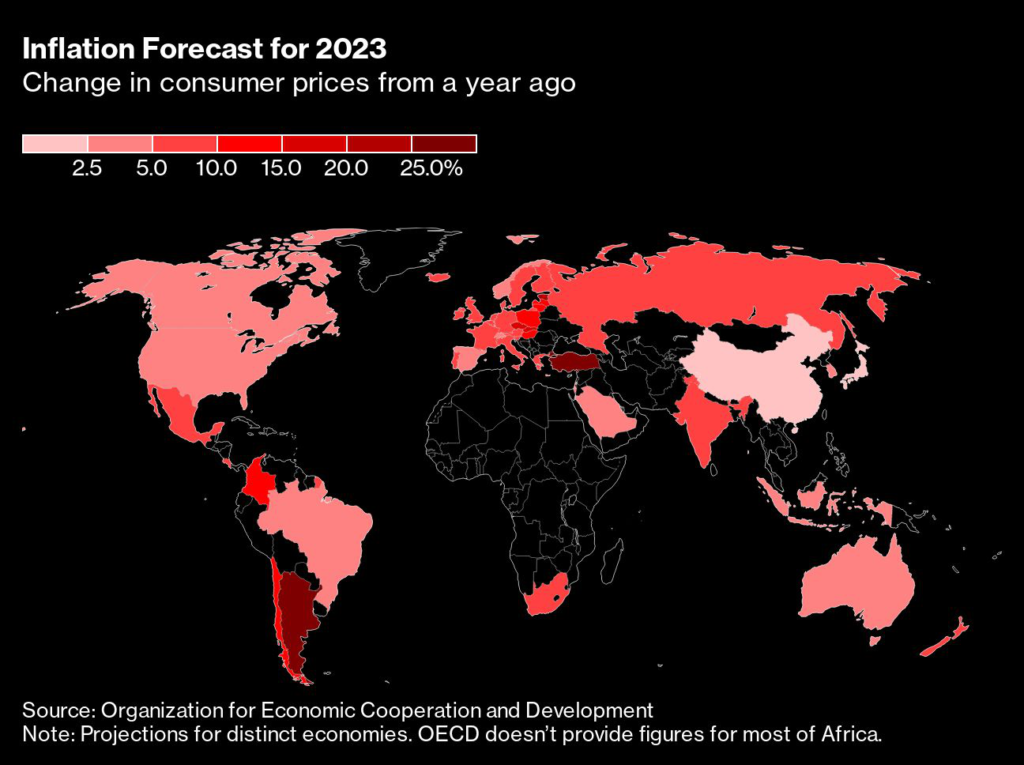
Meanwhile, the OECD said the world’s central banks must continue to raise rates to fight inflation, even as the global economy sinks into a significant slowdown. The unexpected surge in prices and its impact on real incomes is hurting people everywhere, creating problems that will only worsen if policy makers fail to act, the Paris-based organization said.

Key events this week:

  • S&P Global PMIs: US, Euro area, UK, Wednesday
  • US MBA mortgage applications, durable goods, initial jobless claims, University of Michigan sentiment, new home sales, Wednesday
  • Minutes of the Federal Reserve’s Nov. 1-2 meeting, Wednesday
  • ECB publishes account of its October policy meeting, Thursday
  • US stock and bond markets are closed for the Thanksgiving holiday, Thursday
  • US stock and bond markets close early, Friday

Some of the main moves in markets:

Stocks

  • The S&P 500 rose 1.4% as of 4 p.m. New York time
  • The Nasdaq 100 rose 1.5%
  • The Dow Jones Industrial Average rose 1.2%
  • The MSCI World index fell 0.8%

Currencies

  • The Bloomberg Dollar Spot Index fell 0.5%
  • The euro rose 0.6% to $1.0300
  • The British pound rose 0.6% to $1.1889
  • The Japanese yen rose 0.6% to 141.24 per dollar

Cryptocurrencies

  • Bitcoin rose 3.1% to $16,116.23
  • Ether rose 3% to $1,126.48

Bonds

  • The yield on 10-year Treasuries declined seven basis points to 3.76%
  • Germany’s 10-year yield declined two basis points to 1.98%
  • Britain’s 10-year yield declined five basis points to 3.14%

Commodities

  • West Texas Intermediate crude rose 1.4% to $81.14 a barrel
  • Gold futures were little changed

This story was produced with the assistance of Bloomberg Automation.

–With assistance from Felice Maranz, Vildana Hajric, John Viljoen and Emily Graffeo.

More stories like this are available on bloomberg.com

©2022 Bloomberg L.P.
HP to Cut Up to 6,000 Jobs Over Three Years as PC Demand Falters

(Bloomberg) — HP Inc. will eliminate as many as 6,000 jobs over the next three years amid declining demand for personal computers that has cut into profits.

Earnings, excluding some items, will be $3.20 to $3.60 a share in the fiscal year ending in October 2023, HP said Tuesday in a statement. Analysts, on average, projected $3.61 a share, according to data compiled by Bloomberg. Free cash flow will be about $3.25 billion, which also falls short of estimates.

The forecast assumes a 10% decline in computer sales in the fiscal year, Chief Executive Officer Enrique Lores said in an interview. “We expect a challenging market environment,” he said. 

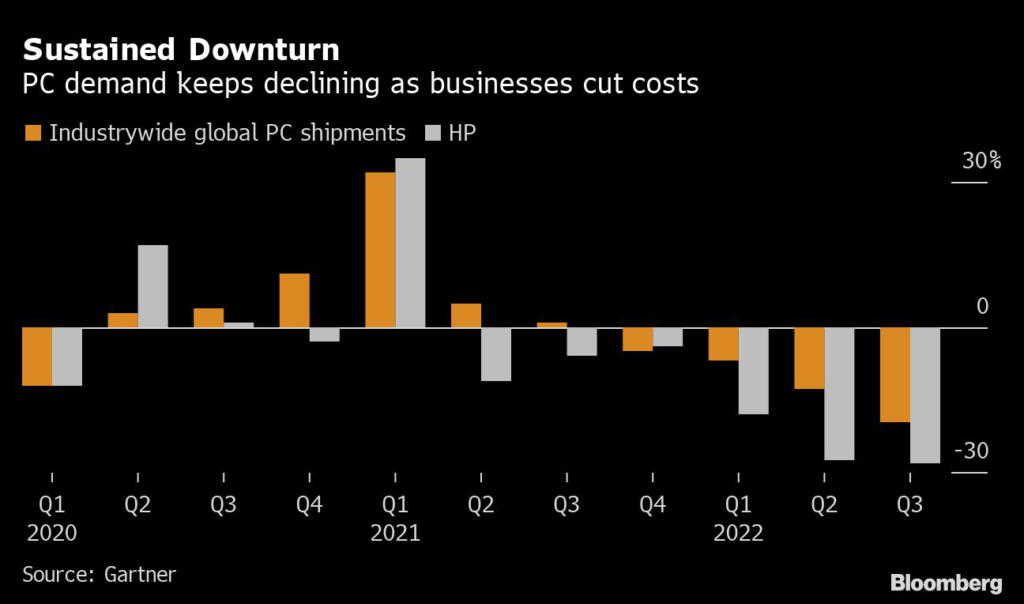
HP, which makes most of its money by selling computers, has been navigating a sustained downturn in PC demand. It began with lower-end consumer products but has spread as companies reduce their workforces and curb technology investment, Lores said. Industry analyst Gartner Inc. said global PC shipments declined almost 20% in the third quarter — the biggest fall since it began tracking the metric in the mid-1990s. Dell Technologies Inc., which generates 55% of its revenue from PC sales, on Monday gave a lackluster outlook for the current quarter and said some customers have “paused purchases” in the near term.

To manage costs, HP will cut as much as 10% of its 61,000-employee global workforce over the next three years and reduce its real estate footprint, Lores said. The company will incur an estimated $1 billion in restructuring charges, with about 60% in fiscal year 2023, which began this month. By the end of fiscal 2025, the plan should save as $1.4 billion a year, HP said in the statement.

“It’s an acknowledgment of the new realities of the printing and PC market,” said Woo Jin Ho, an analyst at Bloomberg Intelligence.

Shares gained about 1% in extended trading after closing at $29.38 in New York. The stock has dropped 22% this year.

Numerous technology companies have announced workforce reduction plans in recent weeks. Meta Platforms Inc. and Amazon.com Inc. each began cutting about 10,000 jobs while Twitter Inc. wiped out more than half its staff of 7,500 employees. Hard-drive maker Seagate Technology Holdings Plc. said it would cut about 3,000 jobs while Cisco Systems Inc. last week unveiled a plan to reduce an unspecified number of jobs and close offices.

HP, which also makes printers, will look to invest in new lines of business such as subscription services. The Palo Alto, California-based company already offers ink subscriptions, and it will now explore plans for other products like printer paper and computers, Lores said.

Fiscal fourth-quarter revenue declined 11% to $14.8 billion, which was slightly better than analysts’ expectations. Profit, excluding some items, was 85 cents a share, also topping estimates.

Sales in the Personal Systems Group, which includes the computer business, fell 13% to $10.3 billion, led by a 25% drop in consumer revenue. Sales in the Printing unit dropped 7% to $4.5 billion, which beat estimates. 

(Updates with comments from analyst in the sixth paragraph.)

More stories like this are available on bloomberg.com

©2022 Bloomberg L.P.

FTX Is Allowed to Hide the Identity of Its 50 Biggest Creditors

(Bloomberg) — FTX creditors, including rich investors who don’t want their names made public, can remain anonymous and still participate in the company’s bankruptcy case for now, a judge ruled at the company’s first court hearing Tuesday. 

US Bankruptcy Judge John Dorsey agreed to let the fallen crypto exchange redact the names of the 50 biggest unsecured creditors owed a total of $3.1 billion. The US Bankruptcy Code normally requires the names be filed in documents available to the public. Representatives for FTX argued those creditors are also customers and disclosure would allow rivals to steal their business. 

The sudden fall of Sam Bankman-Fried’s crypto empire into bankruptcy Nov. 11 was so fast, and so disorganized that many standard procedures, including Tuesday’s hearing, have been subject to delays. The hearing began with FTX attorney James Bromley saying a “substantial amount” of the group’s assets “have either been stolen or are missing.” 

At least two groups of crypto creditors sent lawyers to the hearing to support the company’s request to keep their identities secret. One included members that are among FTX’s largest unsecured creditors — likely setting the stage for future fights for assets among various groups.

Dorsey agreed to hold a hearing next month to give objectors, including the US Trustee, the federal bankruptcy watchdog, the chance to convince him to release the names. 

“There is certainly a pull and tug here” between privacy and the public nature of the US court system, said Dorsey, who is based in Wilmington, Delaware. 

FTX made its first appearance in bankruptcy court on Tuesday following a Chapter 11 filing one of its lawyers called “unprecedented.” Dorsey approved standard motions allowing the company to continue operating and paying employees while Chief Executive Officer John J. Ray III and advisers pore over the company’s books in search of cash, cryptocurrency and assets that could be sold to help repay creditors. 

“Unfortunately, the FTX debtors were not particularly well run, and that is an understatement,” said Bromley, co-head of the restructuring practice at law firm Sullivan & Cromwell. “We stand here today with an absence of information.”

Dorsey also let the company keep secret details about the firms tracking down assets and those protecting the platform from cyber attacks. Normally, every major firm hired by a bankrupt company must be made public in a court filing.

Read more: FTX Collapse Ensnares Creditors Big and Small All Over the World

Asset protection and recovery is one of the top objectives for the case, Bromley said at the hearing. Maximizing value is key for the process, whether it means selling or reorganizing businesses, and FTX will likely ask Dorsey for permission to sell some assets “quite quickly,” he added.

Bromley said the types of controls put into the system at FTX now include traditional market-standard accounting, audit, data management and human resources. The FTX team is also coordinating with regulators in the US and around the world. Advisers are in frequent communication with the US Justice Department and the Southern District of New York’s cyber-crimes unit, which has opened a criminal investigation related to FTX, Bromley said.

In addition, the US House and Senate have requested that Ray, the new CEO, testify at some point in December.

A separate case filed in federal court in New York related to liquidation proceedings in the Bahamas will be transferred to Delaware, Dorsey ruled. FTX’s US restructuring advisers and regulators in the Bahamas will try to work out rules for sharing information and assets, attorney Chris Shore said. 

“There is a tension that is going on right now,” Shore said, referring to bankruptcy rules in the US and efforts by the Bahamas liquidators to get control of assets and information about FTX’s collapse.

The case is FTX Trading Ltd., 22-11068, U.S. Bankruptcy Court for the District of Delaware. 

–With assistance from Claire Boston.

(Updates with hearing details throughout.)

More stories like this are available on bloomberg.com

©2022 Bloomberg L.P.
Retailers Rally Into Holiday Season After Earnings Blowouts

(Bloomberg) — A slew of retailers from Best Buy Co. to Abercrombie & Fitch Co. blew past earnings expectations Tuesday, sparking a rally in their shares at the start of a key holiday season.

Consumer-electronics retailer Best Buy was the top-performing stock on the S&P 500 Index Tuesday with a 13% gain after improving its annual outlook for profit and comparable sales. Abercrombie, American Eagle Outfitters Inc. and Burlington Stores Inc. climbed at least 18% each on better-than-expected quarterly reports, with Burlington’s 21% jump marking its biggest advance in more than nine years.

Michael O’Rourke, chief market strategist at Jonestrading, viewed the retailers’ earnings reports as better than feared, saying expectations for the space have been low ever since many retailers cut their annual profit forecasts in May. 

“The smaller retailers who reported the past couple of weeks have benefited from the expectations reset,” he said. “Managing inventory and margin pressure in the inflationary environment remains a headwind, but they are making progress.”

The reassuring updates are providing a welcome boost for retail stocks, which have underperformed the broader equities market this year. The positive reports also come just days ahead of Black Friday, which kicks off the all-important holiday shopping season in earnest. The fourth quarter typically represents the strongest period of sales for retailers, though this year, more stores and chains are warning that frugal shoppers are going to cut into their bottom lines. 

Read more: Holiday Shopping Looks Anything But Festive for Retail Stocks

Wells Fargo Securities analyst Zachary Fadem said the holiday shopping season will be a “big swing factor” and the next major catalyst for Best Buy shares. He reiterated his equal weight rating on the stock, awaiting greater visibility.

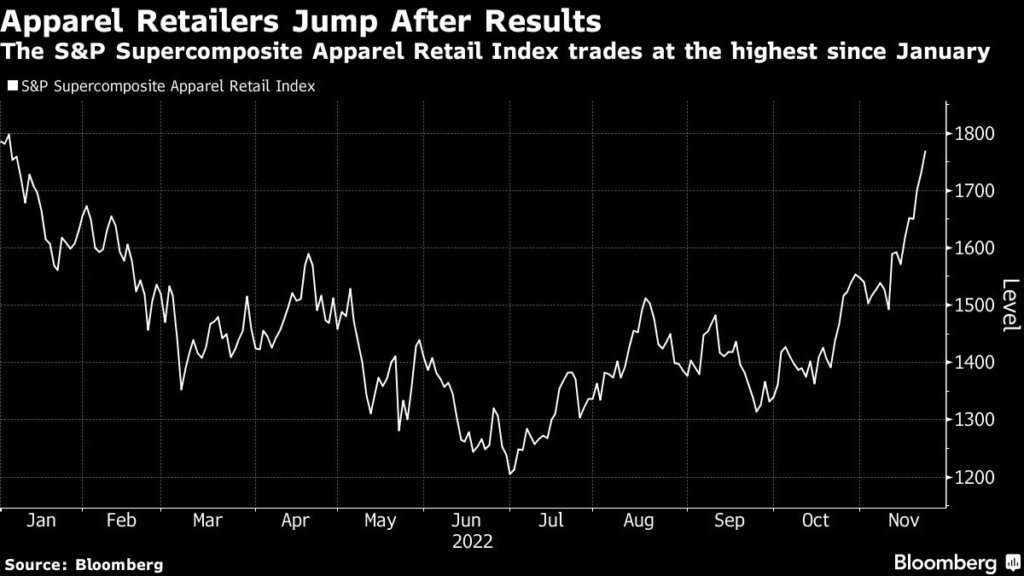
The S&P Supercomposite Apparel Retail Index rose 2.2% Tuesday, led by gains in Abercrombie and American Eagle. The index is up for a third day and has traded around the highest level since the start of the year in recent sessions following a deluge of consumer-focused earnings reports last week.

Dollar Tree Inc.’s weaker-than-expected update stood in contrast to other retailers’ reports. The deep-discount retailer was the worst-performing stock on the S&P 500 Tuesday after projecting that annual earnings per share will come in at the lower end of its previous outlook range. 

Nordstrom Inc. capped the wave of retailer earnings reports for the holiday-shortened week. After markets closed, the department-store operator reiterated its full-year outlook even after topping profit and revenue estimates in the third quarter.

(Updates share-price moves throughout and chart; adds details on Nordstrom earnings in last paragraph.)

More stories like this are available on bloomberg.com

©2022 Bloomberg L.P.

Close Bitnami banner
Bitnami