
Bloomberg

Crypto Collapse Opens 1,350% Gap Between Stocks, Price Targets

(Bloomberg) — Predicting the price of a stock a year from now is hard, even for Wall Street’s best analysts. But for investors who bought into the bullish expectations behind cryptocurrency-related stocks at the beginning of this year, those forecasts now look like pipe dreams.

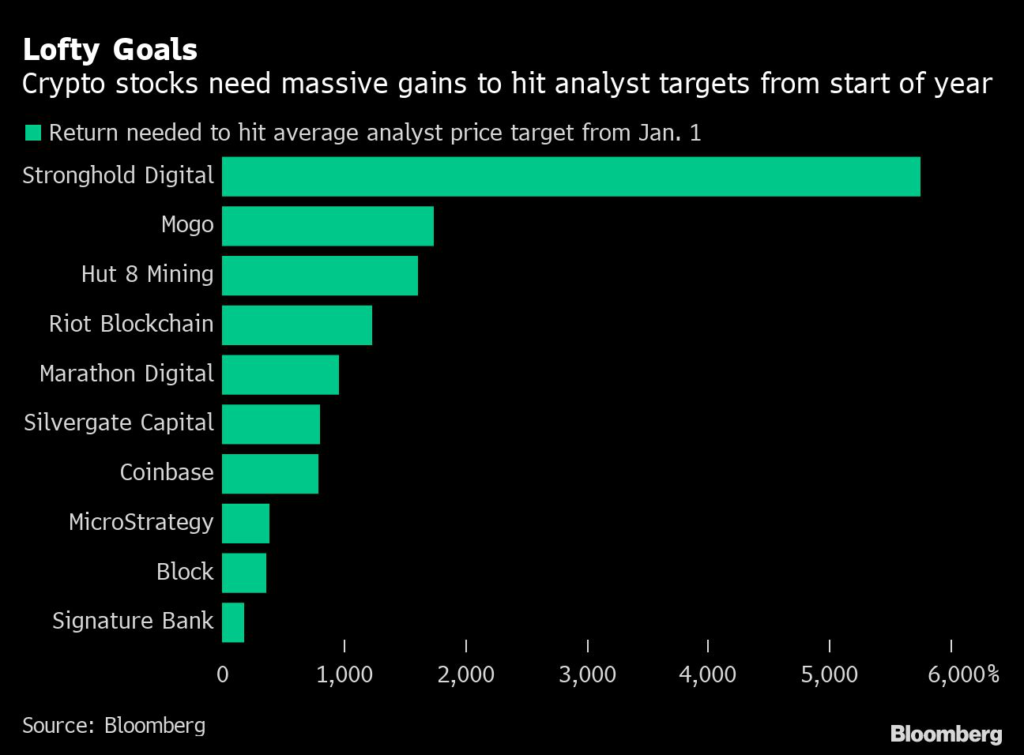
For 10 crypto stocks tracked by Bloomberg, with at least three analyst price targets at the start of 2022, the average return needed to reach their 12-month price target from Jan. 1 is nearly 1,350%. To put that in perspective, it took Amazon.com Inc. more than eight years — from 2013 to its record high in late 2021 — to return investors that amount. 

Shares of crypto exchange Coinbase Global Inc. would need to rally a staggering 782% from their current level in order to reach their average 12-month analyst price target from the beginning of this year. Still, that pales in comparison to Stronghold Digital Mining, Inc. which entered the year with a target of $41.25 and now trades for less than a dollar per share, requiring a 5,492% jump to reach that mark.

This year’s swift plunge in the price of Bitcoin, which reached 65% following the collapse of Sam Bankman-Fried’s FTX, is the main culprit behind the lopsided projections. The world’s largest digital asset touched a record high of nearly $69,000 in early November 2021, fueling a wave of bullish optimism for almost anything connected to the space. 

Still, analysts were slow to react to the rapid decline in Bitcoin. The average analyst price target on Coinbase increased roughly 5% over the two months following Bitcoin’s all-time high. Over that same period, Bitcoin plunged more than 38% and Coinbase’s share price sank roughly 37%. Since then, analysts have decreased their 12-month price target for the crypto exchange by an average of 80%.

BTIG analyst Mark Palmer became the latest to slash his outlook for crypto bank Silvergate Capital, cutting his base case projection to $51 a share on Tuesday from the $135 price he initiated the stock at in August.

“Our new price target reflects our reduced estimates for digital asset customer deposits on the Silvergate Exchange Network in the aftermath of the collapse of FTX and amid the ongoing ‘crypto winter,’” Palmer wrote in a note to clients.

Still, Palmer maintained his buy rating on the stock, calling it “very undervalued,” while adding that the decline in its share price “has been due in part to a widespread lack of understanding of the company, its balance sheet, status as a regulated bank, the SEN and the SEN Leverage program.”

He’s not alone in maintaining his bullish conviction. The current average price target for the stock, which has slumped more than 80% this year, calls for Silvergate to roughly double from its current level over the next year.

It’s a similar story among other crypto stocks. Across the 10 stocks tracked by Bloomberg, the average 12-month return from current levels is about 165%, that compares to nearly 110% from the start of this year.

(Updates with Tuesday closing prices.)

More stories like this are available on bloomberg.com

©2022 Bloomberg L.P.
Genesis Balance Sheet Reveals Web of Loans Across Silbert Empire

(Bloomberg) — The troubled brokerage Genesis Global has $2.8 billion in outstanding loans on its balance sheet, with about 30% of its lending made to related parties including its parent company, Barry Silbert’s Digital Currency Group, according to people familiar with the matter.

Among them, a lending subsidiary named Genesis Global Capital had been lending money to Genesis Global Trading — the brokerage unit that has become a key counterparty to institutions across the crypto industry. In a letter to shareholders on Tuesday, Silbert said that intercompany loans were made “in the ordinary course of business.”

Silbert noted that DCG has a liability of $575 million to Genesis. In the letter, he also described a $1.1 billion promissory note, due June 2032, which he said came about as the parent company stepped in to assume liabilities from Genesis related to the implosion of digital-assets hedge fund Three Arrows Capital.

Besides the intercompany loans due in May of 2023 and the promissory note, DCG’s only debt is a $350 million credit facility “from a small group of lenders led by Eldridge,” the shareholder letter said.

“Let me be crystal clear: DCG will continue to be a leading builder of the industry and we are committed to our long-term mission of accelerating the development of a better financial system,” Silbert wrote. “We have weathered previous crypto winters and while this one may feel more severe, collectively we will come out of it stronger.” He added that DCG has only raised $25 million in primary capital and is on track to see $800 million in revenue this year.

Bloomberg reported Monday that Genesis has sought fresh capital while warning that it may need to file for bankruptcy if its efforts fail, according to people with knowledge of the matter. For the investors who were approached for the $1 billion lifeline being sought, some began to balk at the interconnectedness between the entities, according to people familiar with the discussions. Another simply said it was a matter of how these types of firms do business. 

Additionally, the more-than-$1 billion loan between DCG to the Genesis entity is a link that’s made some potential investors unsure about whether they would owe Silbert’s firm more money if their investment in Genesis were to fail.

Silbert’s Digital Currency Group is the parent company of Genesis and has an interest in more than 200 other firms. Genesis issued a statement Monday saying “we have no plans to file bankruptcy imminently.” 

Genesis is a counterparty to many in the digital-asset space and is closely watched as a gauge of the industry’s strength. It’s among the crypto lenders that are feeling acute strain after a prolonged rout in virtual-coin prices amid multiple high-profile blowups. 

More stories like this are available on bloomberg.com

©2022 Bloomberg L.P.
FTX Attorney Says ‘Substantial Amount’ of Assets Are Either Stolen or Missing

(Bloomberg) — A “substantial amount” of FTX Group’s assets “have either been stolen or are missing,” an attorney representing the firm told a bankruptcy court Tuesday in the company’s first court appearance since its rapid descent into insolvency. 

“Unfortunately, the FTX debtors were not particularly well run, and that is an understatement,” James Bromley, co-head of the restructuring practice at law firm Sullivan & Cromwell, told a judge in Wilmington, Delaware. “We have probably witnessed one of the most abrupt and difficult corporate collapses in the history of corporate America.”

In the hearing Tuesday, U.S. Bankruptcy Judge John Dorsey approved standard motions allowing FTX to continue operating and paying employees while Chief Executive Officer John J. Ray III and advisers pore over the company’s books in search of cash, cryptocurrency and assets that could be sold to help repay creditors. He also temporarily allowed the names of key creditors to remain secret. 

Read more: FTX Collapse Ensnares Creditors Big and Small All Over the World

The fall of Sam Bankman-Fried’s crypto empire into bankruptcy Nov. 11 was “unprecedented,” Bromley added, noting that an unusual amount of time had past between the company’s filing and its first court hearing. 

Once Bankman-Fried signed over control of business, everyone realized for the first time “the emperor had no clothes,” Bromley told the court. The US House and Senate requested that Ray, FTX’s new CEO, testify at some point in December.

Asset protection and recovery is one of the top core objectives now at FTX, in addition to implementation of controls, transparency and investigation, Bromley said at the hearing. Maximizing value is also key for the process, whether it means selling or reorganizing businesses, and FTX will likely ask Dorsey for permission to sell some assets “quite quickly,” he added.

Bromley said the types of controls put into the system at FTX now include traditional market-standard accounting, audit, data management and human resources. The FTX team is also coordinating with regulators in the US and around the world. Advisers are in frequent communication with the US Justice Department and the Southern District of New York’s cyber-crimes unit, which has opened a criminal investigation related to FTX, Bromley said.

At least two groups of crypto creditors sent lawyers to the hearing to support the company’s request to keep their identities secret. One of the groups includes members who are among FTX’s 50 biggest unsecured creditors, setting the stage for future fights for assets among various creditor groups

Dorsey overruled objections from the US Trustee, an arm of the US Justice Department that serves as a bankruptcy watchdog, and allowed the names of major creditors to remain undisclosed for now. The company’s top 50 unsecured creditors are owed more than $3 billion. A hearing on the issue is scheduled for Dec. 16, and another hearing on what’s known as “second day” motions will follow in January. 

Dueling liquidation proceedings in the Bahamas will be transferred to Delaware, Dorsey ruled. FTX’s US restructuring advisers and regulators in the Bahamas will try to work out rules for sharing information and assets, attorney Chris Shore said. 

“There is a tension that is going on right now,” Shore said, referring to bankruptcy rules in the US and efforts by the Bahamas liquidators to get control of assets and information about FTX’s collapse.

–With assistance from Claire Boston.

(Updates with hearing details throughout.)

More stories like this are available on bloomberg.com

©2022 Bloomberg L.P.

Social Media Accounts Helped Stoke British Violence, Rutgers Finds

(Bloomberg) — A network of fake accounts originating both inside and outside of the UK helped to stoke violence between Muslims and Hindus in a British city earlier this year, according to research first provided to Bloomberg News.

An estimated 500 inauthentic accounts that called for violence and promoted memes as well as incendiary videos were created on Twitter Inc. during riots in Leicester between late August and early September this year, according to the Network Contagion Research Institute at Rutgers University. 

Hundreds took to the streets in the days following a cricket match between long-held rivals India and Pakistan on Aug. 27, with some rioters carrying sticks and batons and throwing glass bottles as police were deployed to calm the masses. Homes, cars and religious artifacts were vandalized during the clashes, which went on for weeks and resulted in 47 arrests, according to Leicestershire police. 

Social media was rife with videos claiming to show mosques being set alight and claims of kidnapping, forcing police to issue warnings that people should not believe misinformation online. Many of the Twitter accounts that amplified the unrest originated in India, researchers said. 

Anti-Muslim sentiment has been rising in majority-Hindu India under Prime Minister Narendra Modi, leading  to a narrative that Hindus outside the country, some of whom who are not Indian, subscribe to Hindutva, a kind of Hindu nationalism. An initial video purporting to show Hindutva Hindus attacking Muslim men sparked uncorroborated claims that local, politically motivated activists amplified, researchers said. The video sparked the interest of a foreign influence network, the involvement of which contributed to real-world violence, according to the findings.

US technology companies played a key role in fanning the confrontations, according to Leicester Mayor Peter Soulsby, numerous media reports and participants including Adam Yusuf, a 21-year-old who told a judge that he brought a knife to a demonstrations and was “influenced by social media.”

“Our research finds that both domestic networks of assailants and foreign actors now compete to use social media as a weapon in the midst of heightened ethnic tensions,” said Joel Finkelstein, founder of NCRI. “Our methods highlight a process and technology that democracies need to learn to take preventative measures and protect themselves and their communities.”

Using data collected from Google’s YouTube, Meta Platforms Inc.’s Instagram, Twitter and ByteDance Ltd.’s TikTok the NCRI report published Wednesday provides one of the most detailed views of how foreign influencers spread disinformation at a local level, transpiring into clashes in one of the most diverse cities in the UK. 

Mentions of “Hindu” exceeded mentions of “Muslim” by nearly 40%, and Hindus were largely depicted as aggressors and conspirators in a global project for international dominance, NCRI’s linguistic analysis found. They found that 70% of violent tweets, using sentiment analysis from Google’s Jigsaw service, were made against Hindus during the Leicester riot timeframe.

One particularly effective meme, eventually banned by Twitter, circulated under the hashtag #HindusUnderAttackInUK, researchers said. The cartoon depicted the Muslim community as insects, alleging that different aspects of Islam were “combining together to destroy India.”

Researchers also found evidence of bot-like accounts which disseminated both anti-Hindu and anti-Muslim messaging, each blaming the other for the violence. The bots were identified based on the time of account creation and the number of repeated tweets, with some tweeting 500 times per minute, according to the findings. 

“It’s not Hindus versus Muslims it’s Leicester versus extremist Hindus who came here through fake Portuguese passports, they started coming here 5 years ago, before the Hindus and Muslims lived peacefully,” wrote one account flagged by NCRI. Another, which has been banned, said that Hindus were trying to “mobilize a global genocide.” 

Largely, the researchers found that UK-based assailants used social media platforms as a weapon to organize attacks and amplify conspiracies against British Hindus, which in turn caused a “tit-for-tat relationship between these two forces,” said Finkelstein. 

After the first instances of fake videos spread on Twitter, a “highly orchestrated echo chamber,” from India kicked into amplify tweets “solely blaming Muslims for the events in Leicester,” the report claimed, which in turned spurred even more violence against Hindus in Leicester. 

This suggested that local community tensions were ripe for exploitation on Twitter by external nationalist groups, the researchers warned. The BBC and disinformation research company Logically also found evidence that a lot of the social media posts during the unrest hailed from India, some 5,000 miles away.

Fiyaz Mughal, an author of the report and the founder of Tell MAMA, a service that allows people in the UK to report anti-Muslim abuse and monitors Islamophobic incidents, said he was shocked at how quickly social networks “could jump on these issues.” Mughal said the events in Leicester proved the “risk to the national security of any country today.”

Twitter didn’t respond to a request for comment. 

Claudia Webbe, the MP for Leicester East, told Bloomberg News the riots were undoubtedly sparked by social media. Although hundreds of police were deployed to areas around the West Midlands to monitor the demonstrations, she said she believed most of her constituents within the Hindu and Muslim community had largely been affected “through their phones.” 

“Even the people who didn’t take to the streets were in fear because of what they were receiving through WhatsApp and Twitter — they were afraid to go outside for weeks,” she said.

“You’ve got these overseas influences who are trying to drive political hate and the desire to sow division,” she said. 

(Updates headline and first paragraph to more accurately reflect report’s findings.)

More stories like this are available on bloomberg.com

©2022 Bloomberg L.P.
Twitter Agrees to Talks With Fired Africa Staff Over Severance

(Bloomberg) — Twitter Inc. agreed to engage with fired staff from its only African office after they were offered poorer-than-announced severance packages.

Affected employees in the Ghanaian capital, Accra, have secured talks with Twitter after a letter sent requesting that the company comply with local employment law, according to a lawyer representing the staff. Around 20 people worked in the West African country’s office.

“We look to begin negotiations as soon as practicable,” the attorney, Carla Olympio, said in an email Tuesday. 

Twitter spokespeople didn’t immediately respond to an email requesting comment. 

Elon Musk, who acquired the company for $44 billion last month, fired nearly all of the African team as part of sweeping cuts — eliminating a division that had been seen as part of Twitter’s future. President Nana Akufo-Addo had tweeted in April last year that the office marked “the beginning of a beautiful relationship between Twitter and Ghana.” Jack Dorsey, then chief executive officer of Twitter, also said he sought to move to the country “at some point.”

Since Musk took over, thousands of staff around the world have been fired or walked out. In Accra, an initial termination letter said employees would receive a month’s notice, which later improved to a month’s notice plus two months severance. 

That was still below the offer tweeted by Musk on Nov. 4.

“This is not an ordinary situation and so Twitter must obey redundancy provisions under Ghanaian law,” Olympio said. Companies have to notify authorities at least three months before implementing a redundancy, show they are working to mitigate any negative impact, and plan for negotiation of redundancy pay.

“You can’t compel anyone to treat people with respect but you have to obey the law,” said Olympio, who heads Agency Seven Seven, an Accra-based business advisory company.

Ghana’s employment minister, Ignatius Baffour-Awuah, has met with the affected employees. A ministry official declined to immediately comment when reached by phone.

More stories like this are available on bloomberg.com

©2022 Bloomberg L.P.
Google Urged by US Lawmakers to Fix Misleading Abortion Ads

(Bloomberg) — A pair of US lawmakers on Tuesday urged Google to do more to ensure that ads displayed alongside abortion-related searches indicate whether the service is actually offered.

Alphabet Inc.’s Google introduced a policy in 2019 that requires those advertising alongside search queries related to abortion to be certified based on whether they provide the procedure. In a letter addressed to Alphabet Chief Executive Officer Sundar Pichai, Senator Mark Warner, a Democrat from Virginia, and Representative Elissa Slotkin, a Michigan Democrat, expressed concern that the search giant does not consistently apply those rules, which can lead users to crisis pregnancy centers — non-medical organizations that encourage visitors to keep their pregnancies.

“As many states are increasingly narrowing the window between getting a positive pregnancy test and when you can terminate a pregnancy, every day counts,” the letter states.

The lawmakers cited a joint analysis by Bloomberg News and the nonprofit Center for Countering Digital Hate, which found that ads displayed against Google searches such as “Planned Parenthood,” “Plan C pills” and “pregnancy help” didn’t carry labels that would indicate whether an advertiser was an abortion provider.

Read More: Google Is Still Failing to Label Many Ads From Anti-Abortion Centers

For years, anti-abortion organizations known as crisis pregnancy centers have paid to advertise alongside searches related to the procedure, confusing women in need of medical care, and drawing criticism from reproductive health advocates.

“We believe Google’s failure to apply disclaimer labels to these common searches appears to be a violation of your June 2019 policy,” the lawmakers wrote. “We urge you to take proactive action to rectify these and any additional issues surrounding misleading ads, and help ensure users receive search results that accurately address their queries and are relevant to their intentions.”

A Google spokesperson said that workers at the company “regularly review our policies and have made updates to our list of in-scope abortion queries as needed.” The company added that it has “clear and longstanding policies that govern abortion-related ads on our platforms, which we apply consistently to all advertisers.”

Google told Bloomberg in September that ads aimed at what the company considers to be more general queries — which may include the names of abortion providers that offer other services — do not show the labels.

Warner and Slotkin also raised concerns about research from the Tech Transparency Project, first reported by Bloomberg, that found over a dozen ads in which crisis pregnancy centers were correctly marked with the label “does not provide abortion,” yet the text of the ads suggested otherwise.

“Such deceptive advertising likely reduces the effectiveness of labels,” the lawmakers wrote.

The Google spokesperson said the company reviewed ads flagged by TTP and took down those that violated company policy.

Warner and Slotkin asked Google to disclose which search terms it deems to be related to getting an abortion and to share the measures it will take to root out ads that violate its policies against misrepresentation.

Google finds itself at the center of a political tug of war over how to handle ads placed by the crisis centers, which outnumber abortion clinics by 3-to-1 in the US, according to research from the University of Georgia College of Public Health. 

Many democrats have urged the company to take more steps to limit the prevalence of such organizations in ads and search results, while some Republicans argue that the groups are being unfairly discriminated against.

(Adds comment from Google starting in paragraph 7)

More stories like this are available on bloomberg.com

©2022 Bloomberg L.P.
Crypto Collapse Opens 1,400% Gap Between Stocks, Price Targets

(Bloomberg) — Predicting the price of a stock a year from now is hard, even for Wall Street’s best analysts. But for investors who bought into the bullish expectations behind cryptocurrency-related stocks at the beginning of this year, those forecasts now look like pipe dreams.

For 10 crypto stocks tracked by Bloomberg, with at least three analyst price targets at the start of 2022, the average return needed to reach their 12-month price target from Jan. 1 is nearly 1,400%. To put that in perspective, it took Amazon.com Inc. more than eight years — from 2013 to its record high in late 2021 — to return investors that amount. 

Shares of crypto exchange Coinbase Global Inc. would need to rally a staggering 792% from their current level in order to reach their average 12-month analyst price target from the beginning of this year. Still, that pales in comparison to Stronghold Digital Mining, Inc. which entered the year with a target of $41.25 and now trades for less than a dollar per share, requiring a 5,758% jump to reach that mark.

This year’s swift plunge in the price of Bitcoin, which reached 65% following the collapse of Sam Bankman-Fried’s FTX, is the main culprit behind the lopsided projections. The world’s largest digital asset touched a record high of nearly $69,000 in early November 2021, fueling a wave of bullish optimism for almost anything connected to the space. 

Still, analysts were slow to react to the rapid decline in Bitcoin. The average analyst price target on Coinbase increased roughly 5% over the two months following Bitcoin’s Nov. 9 high. Over that same period, Bitcoin plunged more than 38% and Coinbase’s share price sank roughly 37%. Since then, analysts have decreased their 12-month price target for the crypto exchange by an average of 80%.

BTIG analyst Mark Palmer became the latest to slash his outlook for crypto bank Silvergate Capital, cutting his base case projection to $51 a share on Tuesday from the $135 price he initiated the stock at in August.

“Our new price target reflects our reduced estimates for digital asset customer deposits on the Silvergate Exchange Network in the aftermath of the collapse of FTX and amid the ongoing ‘crypto winter,’” Palmer wrote in a note to clients.

Still, Palmer maintained his buy rating on the stock, calling it “very undervalued,” while adding that the decline in its share price “has been due in part to a widespread lack of understanding of the company, its balance sheet, status as a regulated bank, the SEN and the SEN Leverage program.”

He’s not alone in maintaining his bullish conviction. The current average price target for the stock, which has slumped more than 80% this year, calls for Silvergate to roughly double from its current level over the next year.

It’s a similar story among other crypto stocks. Across the 10 stocks tracked by Bloomberg, the average 12-month return from current levels is about 170%, that compares to nearly 110% from the start of this year.

More stories like this are available on bloomberg.com

©2022 Bloomberg L.P.

Stocks Rally as Investors Expect Fed to Slow Pace: Markets Wrap

(Bloomberg) — US stocks rose as investors recalibrate their expectations in response to Federal Reserve officials indicating that they’ll continue to raise interest rates but are open to slowing their tempo. A batch of upbeat earnings also buoyed sentiment.

The S&P 500 and the Nasdaq 100 rose. Best Buy Co. jumped after raising its profit forecast. Abercrombie & Fitch Co. and American Eagle Outfitters Inc. also rose after reporting results that beat estimates. Retailers clearing out their inventories with a series of sales could help reduce inflation, which could ultimately make the Fed turn dovish.   

The dollar fell. US Treasury yields slipped. Oil rose after Saudi Arabia pushed back against reports of a potential OPEC+ production increase.

Fed officials have broadly maintained their steadfast stance to fight inflation. Yet San Francisco Fed President Mary Daly also said that officials need to be mindful of the lags in the transmission of policy changes, while her Cleveland counterpart Loretta Mester said she’s open to moderating the size of rate hikes. On Tuesday, the Richmond Fed Manufacturing Survey came in slightly below expectations, with data confirming the peak inflation narrative. 

“We think the Fed leadership wants to get off the 75-basis-point-a-meeting hamster wheel even though it is finding it hard to do so while maintaining control of financial conditions,” Evercore ISI analyst Krishna Guha wrote in a note. “We think the Fed is still heading for a ‘hawkish slowing.’ And, for us at least, the slowing part is what matters.”

Despite hints of moderation, the Fed is likely to raise its estimate of the terminal rate as early as December, in part because inflation may prove sticky, said Sonia Meskin, head of US macro at BNY Mellon Investment Management

“I don’t know if I would read too much into the sort of daily repricing from the macro perspective at this stage, but I would be interested to see the labor market data for November and then any indication of whether this information weakening is sustained or not,” Meskin said by phone. “I think those would really be more indicative of the future of the policy trajectory.”

Thanksgiving week in the US also tends to carry a “historically bullish tone” for stocks, Craig Johnson, chief market technician at Piper Sandler, said in a note. The week has started with a dip on Monday and then improves around the Thursday holiday about 68% of the time since 1950, he said. 

The bond market isn’t pushing the idea that rates are going to go up anymore, according to Chris Iggo, chief investment officer at AXA Investment Managers.

“Further increases are priced in, but the Fed seems to be okay with the market’s belief that rates will go to 5%,” he said. “I think we’re close to the Fed pausing on interest rates, although they are not going to admit that until they actually do it.”

Despite Tuesday’s rally, China’s Covid control restrictions are still weighing on investors. Shutdowns can have a negative impact on supply-chain dynamics and possibly exacerbate inflation issues across economies. These restrictions now impact a fifth of China’s economy. Chinese stocks listed in the US fell on Tuesday. 

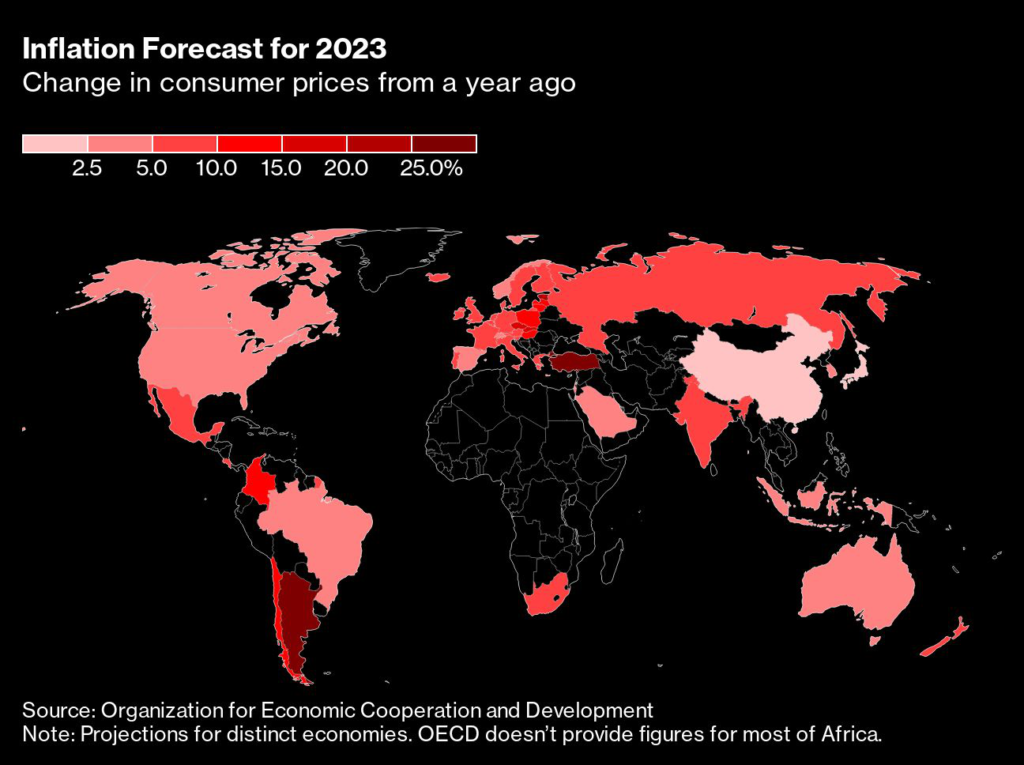
The OECD said the world’s central banks must continue to raise interest rates to fight soaring and pervasive inflation, even as the global economy sinks into a significant slowdown. The unexpected surge in prices and its impact on real incomes is hurting people everywhere, creating problems that will only worsen if policy makers fail to act, the Paris-based organization said.

Key events this week:

  • Fed’s James Bullard speak, Tuesday
  • S&P Global PMIs: US, Euro area, UK, Wednesday
  • US MBA mortgage applications, durable goods, initial jobless claims, University of Michigan sentiment, new home sales, Wednesday
  • Minutes of the Federal Reserve’s Nov. 1-2 meeting, Wednesday
  • ECB publishes account of its October policy meeting, Thursday
  • US stock and bond markets are closed for the Thanksgiving holiday, Thursday
  • US stock and bond markets close early, Friday

Some of the main moves in markets:

Stocks

  • The S&P 500 rose 0.8% as of 1:04 p.m. New York time
  • The Nasdaq 100 rose 0.7%
  • The Dow Jones Industrial Average rose 0.8%
  • The MSCI World index fell 0.8%

Currencies

  • The Bloomberg Dollar Spot Index fell 0.5%
  • The euro rose 0.5% to $1.0292
  • The British pound rose 0.5% to $1.1881
  • The Japanese yen rose 0.6% to 141.28 per dollar

Cryptocurrencies

  • Bitcoin rose 2.7% to $16,060.23
  • Ether rose 2.2% to $1,117.72

Bonds

  • The yield on 10-year Treasuries declined six basis points to 3.77%
  • Germany’s 10-year yield declined two basis points to 1.98%
  • Britain’s 10-year yield declined five basis points to 3.14%

Commodities

  • West Texas Intermediate crude rose 2.3% to $81.89 a barrel
  • Gold futures were little changed

This story was produced with the assistance of Bloomberg Automation.

–With assistance from Felice Maranz, Vildana Hajric, John Viljoen and Emily Graffeo.

More stories like this are available on bloomberg.com

©2022 Bloomberg L.P.
Amazon’s Twitch Makes Changes to Address Child Predation on Platform

(Bloomberg) — Twitch, the video game livestreaming site popular with teens and kids, announced changes it’s making on the platform to increase safety for its young users in the wake of criticism that it enables child predation.

On Tuesday, Amazon.com Inc.-owned Twitch said it has introduced mandatory phone verification requirements and fortified technology used to catch and terminate accounts belonging to people under 13, among other measures. 

“Grooming is particularly insidious because it can be hidden in plain sight, and there are fewer established industry practices for detecting it,” Twitch said in a blog post. “These predators are not welcome and will not be tolerated on Twitch, and today we’re sharing an update regarding the continuous work we’re doing to combat them.” 

In September, Bloomberg News published a report describing rampant child predation on Twitch and the platform’s insufficient moderation tools. Bloomberg analyzed 1,976 Twitch accounts with follower lists comprised of at least 70% kids or young teens. More than 279,016 apparent children were targeted by predators, according to data collected by a researcher who studies livestreaming websites. The researcher asked to remain anonymous due to concerns over potential career repercussions from being associated with such a disturbing topic. In a subsequent analysis over the past month, Bloomberg has discovered new predatory accounts and more children being targeted.

Read about how child predators stalk and engage with kids on Twitch

In the wake of the report, the UK internet regulator Ofcom contacted Twitch to discuss its poor protections for children on the platform. “We are actively reviewing whether Twitch’s measures are sufficiently robust enough to prevent the most harmful material being uploaded,” an Ofcom spokesperson said in an email. 

Critics say the root of child predation on Twitch has been the ease with which kids can lie about their age, sign up for an account and immediately livestream themselves to anonymous and unquantifiable audiences. YouTube and TikTok both require users to possess a certain number of followers before livestreaming on mobile devices; TikTok, owned by ByteDance Ltd., recently announced plans to increase its age requirement for livestreaming to 18 from 16, effective Nov. 23, and Alphabet Inc.’s YouTube doesn’t “list,” or make searchable, mobile livestreams from users under 17 by default. 

Twitch still lags behind competitors when it comes to age-verification and barriers to livestreaming for kids. Unlike others, Twitch hasn’t required two-factor authentication for users signing up on mobile. With the latest updates, Twitch will now require at least one phone verification before livestreaming, which it says will help block children who previously had been suspended for streaming while underage from creating new accounts. According to a new analysis of the predatory accounts in the data set, these accounts are still finding and following on average hundreds of apparent children a day.

“In the face of a tsunami of new legislation around the world, it is good to see some online services taking early steps towards adopting privacy-preserving age assurance methods, but none of the major global platforms most popular with kids has yet adopted sufficiently comprehensive, audited age checks to keep children safe online,” said Iain Corby, executive director at the Age Verification Providers Association, a global trade body. “Many still underestimate the risks their site pose to young users, particularly through enabling contact with dangerous adults about which parents often have little or no awareness.”

It’s notoriously challenging to moderate live video in real time. Twitch broadcasts more than 2.5 million hours of live content in 35 languages every day. The site’s moderation relies heavily on user reports, which, in part, resulted in the May terrorist attack in Buffalo, New York, livestreaming for 24 minutes on Twitch. The site was able to stop the livestream by the shooter within two minutes after violence began, according to a 47-page report from New York State Attorney General Letitica James on the role Twitch and other online platforms played in the mass shooting. Twitch now says it’s refining the technology human moderators use to review and take action on reports regarding children under 13. 

Twitch’s discoverability features, which have helped expand its ecosystem of creators, have also made it easy for predators to find children. Kids who are streaming from their home bedrooms on their mobile phones can attract dozens or hundreds of viewers within minutes, including child predators who ask for live sexual acts through Twitch’s chat feature. Two predators watching a child’s livestream in November said they discovered the kids through Twitch’s “recently started” feature, which reveals accounts with low follower numbers, often indicative of child accounts. The livestream attracted 165 viewers within 35 minutes, according to a Bloomberg analysis. 

In 2020, Twitch removed its “recently started” feature, which can make underage accounts easier for predators to identify, for about two content categories, but the activity persists in almost all others. On Tuesday, Twitch said it’s “expanding the signals we use to catch and terminate accounts belonging to users under 13.”

After Bloomberg’s report, several Twitch employees said they were surprised and upset by revelations of the scale of child predation on the platform. “There are a lot of people who are frankly very upset,” said Tom Verrilli, Twitch’s chief product officer, in an October interview at TwitchCon, the company’s developer conference. “Like on the rest of the internet, we understand that there are people who want to use Twitch for harm. We are always building against that.”

Verrilli said in September that fixes around child safety were “on our roadmap that we will probably accelerate as a result of the article” by Bloomberg. Twitch announced in early October it was removing a key feature used to assemble the report, cited in the Bloomberg report, that allowed third parties to track Twitch users’ following lists. Verrilli said the change wasn’t related to Bloomberg’s report. On Tuesday, Twitch said it has updated default privacy settings for its direct messaging feature Whispers and blocked the ability to use certain search terms to find content on the platform. It has also deepened collaboration with third-party organizations who report inappropriate behavior on the platform and track grooming trends in the industry. Twitch said it also completed its acquisition of Spirit AI, which works with language processing to sift through online chat features and that will help build tools to detect harms written in text on Twitch.  

–With assistance from David Ingold and Olivia Solon.

More stories like this are available on bloomberg.com

©2022 Bloomberg L.P.

Analog Devices Forecast Signals It’s Dodging Broader Slump

(Bloomberg) — Analog Devices Inc., one of the largest makers of semiconductors used in industrial equipment and cars, gave a bullish forecast for the current period, indicating that demand in those two markets is holding up better than the broader chip industry. 

First-quarter revenue will be about $3.15 billion, the company said in a statement Tuesday. Excluding certain items, profit will be about $2.60 a share. Analysts estimated sales of $3.02 billion and earnings of $2.39 a share.

The outlook helped reassure investors after a rocky stretch for the chip business, which is coping with a slowdown in technology spending and the fallout from new rules on exports to China. Semiconductors used in vehicles and factory equipment have remained a bright spot, even as some of the industry’s largest companies, including Intel Corp., Nvidia Corp. and Micron Technology Inc., warn of a slowdown.

While orders did decelerate in the first half of the fourth quarter, they leveled out at what the company considers normal levels and have stayed that way into the current period, Chief Financial Officer Prashanth Mahendra-Rajah said in an interview.

“We take stabilizing orders as a good sign,” he said. “For right now, for the current quarter and a little bit ahead, we feel good.” 

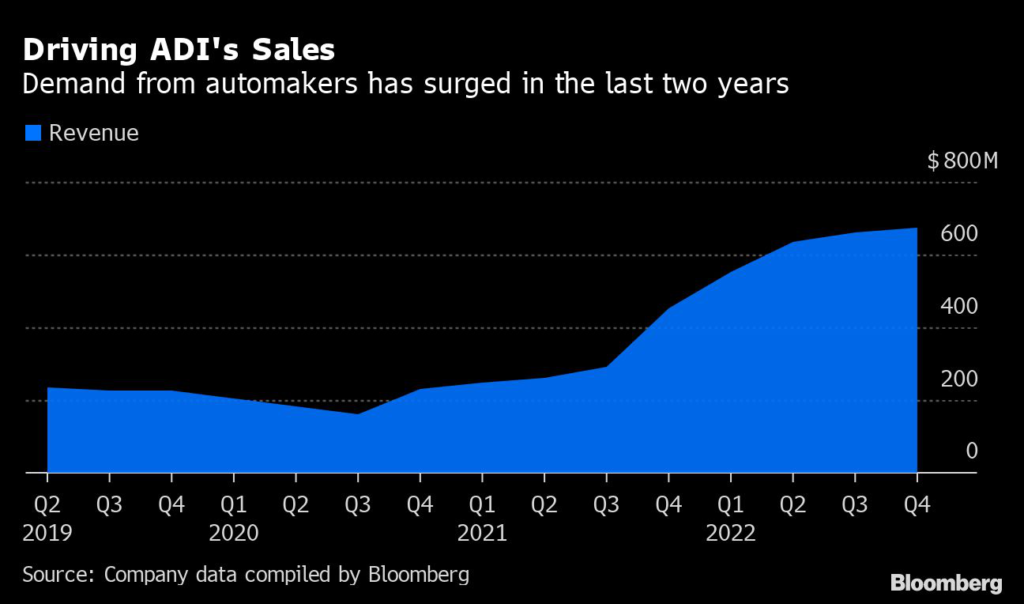
The company’s automotive business is benefiting from that industry’s migration to more battery-powered vehicles. Analog Devices makes semiconductors that control those batteries. It’s also a major supplier of the systems that move video signals around cars, meaning it’s getting more orders as cars increasingly become equipped with cameras as part of driver-assistance packages.

By region, China and Asia are show the biggest amount of weakness due to the worsening economy, he said. Europe and North America have held up relatively well. Analog Devices gets about 20% of its sales from China. 

Analog Devices shares rose more than 5% in New York trading at midday. They had fallen 9.4% this year through Monday’s close, though that’s a better performance than the Philadelphia Stock Exchange Semiconductor Index, which is down 32%.

Based in Wilmington, Massachusetts, Analog Devices specializes in analog and embedded computing components, a sector led by Texas Instruments Inc. 

Analog chips convert real-world things — like sound and pressure — into electronic signals. And the rush to add automation to factory equipment and buildings stirred new demand in recent years. The move toward battery-powered cars has also fueled the market.

Automotive revenue rose 49% from a year earlier, Analog Devices reported. Industrial-related sales were up 40%, and its consumer division — its smallest unit – an increase of 19%.

Revenue was $3.25 billion in the period, which ended Oct. 29. That yielded a profit of $2.73 a share, excluding some items. Analysts estimates had called for sales of $3.15 billion and earnings of $2.59 a share.

–With assistance from Debby Wu.

(Updates with comments from CFO from fourth paragraph.)

More stories like this are available on bloomberg.com

©2022 Bloomberg L.P.

Close Bitnami banner
Bitnami