Bloomberg

China Set to Fine Ant Group More Than $1 Billion, Reuters Says

(Bloomberg) — Chinese authorities are planning to impose a fine of more than $1 billion on Jack Ma’s Ant Group Co., paving the way for the ending of a regulatory overhaul, Reuters reported, citing people familiar with the matter. 

The central bank is preparing the penalty which could land in the second quarter of next year, Reuters said, adding that the regulator has been in touch with Ant about the plans. 

Ant and the central bank didn’t respond to Reuters’ requests for comment. 

More stories like this are available on bloomberg.com

©2022 Bloomberg L.P.

Kuaishou Revenue Beats Estimates After Fending off ByteDance

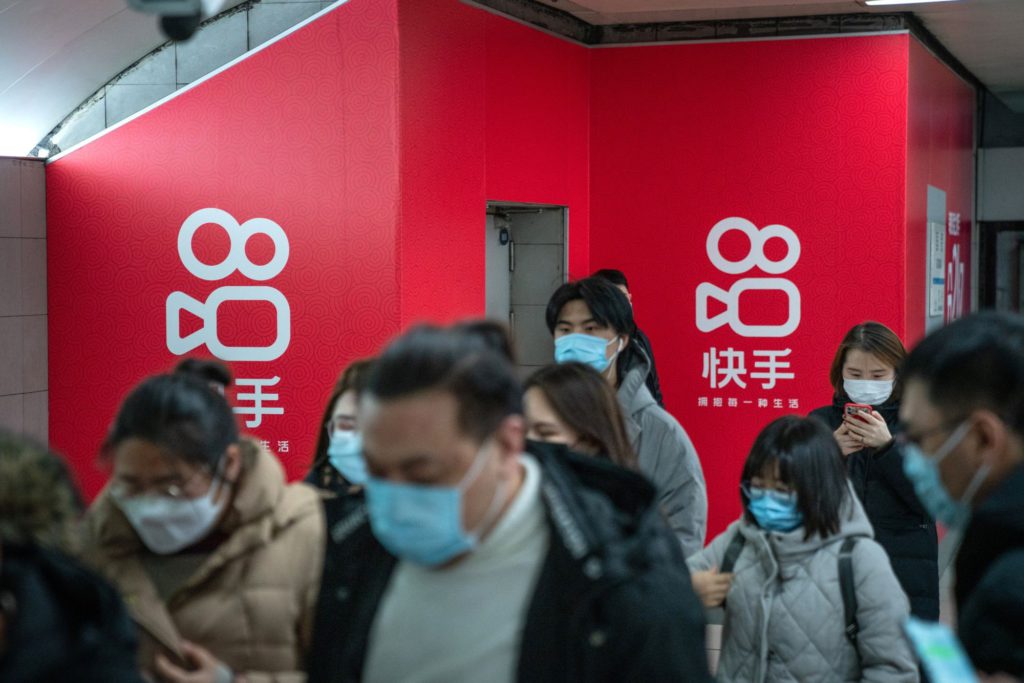
(Bloomberg) — Kuaishou Technology’s revenue beat estimates, holding its own against a slowing Chinese economy and competition from TikTok owner ByteDance Ltd.

Revenue was 23.13 billion yuan ($3.2 billion) for the three months ended September, compared with the average analyst projection for 22.6 billion yuan. Net loss came in at 2.7 billion yuan, versus the estimated loss of 3.7 billion yuan.

China’s largest short-video company after ByteDance is struggling with sluggish consumer spending and strict Covid restrictions, while competition intensifies from Tencent Holdings Ltd.’s WeChat and Bilibili Inc. Chinese retail sales contracted 0.5% in October in their first decline since May, falling short of expectations for slight growth.

Like its bigger internet foes, Kuaishou has initiated aggressive cost-cutting measures in recent quarters, scaling down marketing expenses, especially in overseas markets. The Beijing-based outfit now targets making its domestic division break even on an adjusted net income basis this year.

“The weak macro environment will likely continue to drag on the stock in the near term,” Daiwa Capital Markets analysts led by Carlton Lai wrote in a note before the results. “The key focus for Kuaishou remains domestic margin improvement and monetization progress in overseas markets, particularly Brazil.”

Chinese tech stocks climbed this month after investors cheered signs of policy shifts in the Communist Party’s stance on fronts ranging from its pandemic playbook to real estate prices and ties with the White House. Kuaishou’s market value is down more than 80% from its 2021 peak, and the stock is now trading at roughly 2 times sales, versus about 4 times at Tencent.

One of Kuaishou’s earliest backers, Tencent, announced last week that it’s distributing $20 billion of Meituan stakes as a special dividend, a year after a similar giveaway of its JD.com Inc. holdings. That fueled speculation that Tencent will further divest its Chinese internet portfolio and pivot to overseas gaming assets.

Kuaishou, for its part, has been relying less on a traffic boost from Tencent, whose WeChat platform is seeking to establish its own dominance in mini-videos. Kuaishou has teamed up with Meituan to provide food-delivery services to its social media users, part of a broader trend of realignment in the Chinese internet ecosystem.

More stories like this are available on bloomberg.com

©2022 Bloomberg L.P.

Tesla Revamps China Marketing Strategy as Rivals Lure Customers

(Bloomberg) — Tesla Inc. is changing its marketing approach in China as fierce competition from domestic rivals and uneven demand puts its growth plans in the world’s biggest electric-car market at risk. 

The EV pioneer has extended insurance subsidies of as much as 8,000 yuan ($1,100) for new buyers, according to a post on its Weibo account, reinstated a user referral program and even advertised on a local TV shopping channel — a rare move for a company that’s proudly eschewed traditional advertising avenues. 

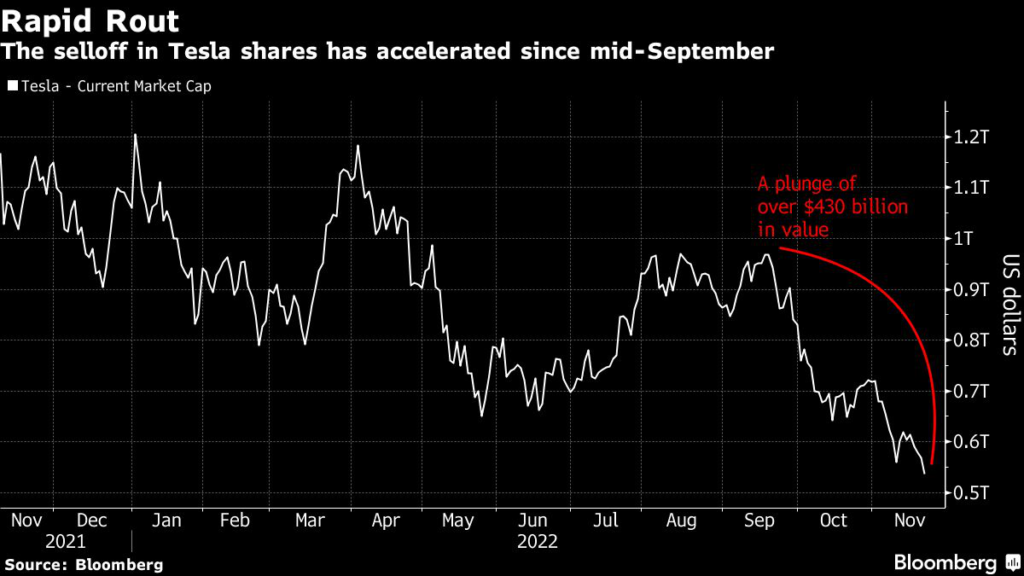
The moves come after Tesla cut prices across its Chinese lineup for the first time in 15 months in October, as it faces a slew of headwinds there, from persistent Covid restrictions to more muscular local competitors. The prospect of more challenging conditions in China is adding to pressure on the carmaker’s shares, which sank to a two-year low on Monday and have lost almost half of their value in less than two months. 

Read more: Tesla in Tailspin as China Risk Returns Amid Twitter Chaos 

Tesla recently upgraded its Shanghai factory to double capacity to about 1 million cars a year. Yet in a sign the company is struggling to boost sales to meet those ambitions, wait times for cars in China have shrunk to as little as one week from as long as 22 weeks earlier this year. 

Failing to shift the extra production could endanger Chief Executive Officer Elon Musk’s target of 50% annual global sales growth for years to come. 

“We can tell from the shortened lead time that the order intake for Tesla in China is insufficient,” said Wang Hanyang, an auto analyst at Shanghai-based 86Research Ltd. “The company is facing great competition from local competitors as well as lower consumer confidence. The promotions, including insurance subsidies, may also extend into next year.” 

Musk last month flagged that demand has been “a little harder” to come by due to China’s property market slowdown and Europe’s energy crisis, after the automaker reported lower-than-expected third-quarter revenue. Tesla shipped 71,704 cars from its Shanghai plant last month, down from a record high of 83,135 in September.

China is home to the most competitive EV market, with homegrown automakers such as BYD Co. — which sold a record 217,816 vehicles last month — and upstarts including Nio Inc. and Xpeng Inc. expanding their lineups. Domestic car companies accounted for almost 80% of EV sales through the first seven months of the year, according to China’s Passenger Car Association. 

Read more: Slow to the EV Game, Foreign Car JVs in China Face Bleak Future

Local EV makers have also been adept at appealing to Chinese buyers, offering features like in-built karaoke systems and fragrance dispensers, as well as lavish customer service. Companies like BYD and SAIC-GM-Wuling Automobile Co. also offer a range of low-cost vehicles for budget-conscious drivers.  

Tesla isn’t the only upmarket EV maker cutting prices in China. Mercedes-Benz Group AG last week slashed the cost of two electric car models by as much as $33,000 amid flagging sales. 

With a starting price of 265,900 yuan for the Model 3 sedan and 288,900 yuan for a Model Y SUV, Teslas have traditionally appealed to wealthier buyers in China’s biggest cities. The company is now looking to attract drivers in smaller cities where EV penetration isn’t as high. 

In a recent marketing campaign that was a first for the automaker, it asked would-be customers to nominate cities for the automaker to take cars for potential buyers to test drive, and offered some respondents use of a Model 3 for a week. Previously, it asked customers to travel to their nearest showroom for a test drive. 

Tesla also reintroduced its user referral program last month — an offer that was dumped in the US last year. Owners who refer family and friends to buy a Tesla in China are rewarded with small gifts like wireless headphones or strollers, along with the chance to win a visit to the Shanghai factory or the free use of a Tesla for a year. Last month, the company closed its flagship showroom in Beijing’s Parkview Green shopping mall. 

China’s continued reliance on lockdowns and other Covid restrictions is impacting car sales, and that has seen Tesla pressured “to take immediate actions to promote sales,” Cui Dongshu, the secretary general of China’s Passenger Car Association, said at a briefing earlier this month. 

Previously criticized by local media for being “arrogant” toward Chinese customers, Tesla recently surveyed owners in the country, asking questions about their preferred promotional offers and what services they expected as they wait to take delivery of their vehicle. 

“We expect a few more promotions to boost demand and max deliveries before year end,” said Junheng Li, chief executive officer of equity research firm JL Warren Capital LLC. 

Otherwise, Tesla’s monthly new order intake in China might only be around 20,000 to 30,000 units after it normalizes in December, while Shanghai’s monthly output is now about 80,000 to 85,000 cars, she said. 

A chief story for Tesla in 2023 will be “overcapacity,” Li said. 

More stories like this are available on bloomberg.com

©2022 Bloomberg L.P.

Paytm Slumps as Macquarie Sees Risk from Ambani Financial Foray

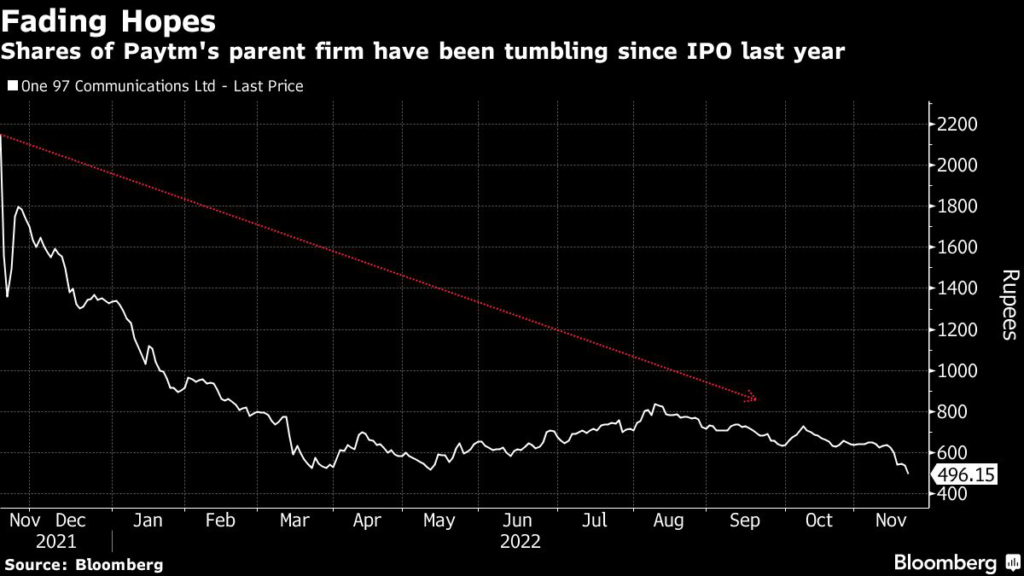
(Bloomberg) — Shares of One 97 Communications Ltd., the parent of India’s leading digital payments brand Paytm, plunged to a record low on Tuesday after Macquarie Group Ltd. analysts flagged risks from billionaire Mukesh Ambani’s foray into the financial services business. 

Reliance Industries Ltd.’s Jio Financial Services Ltd. “can pose a significant growth and market-share risk” for players such as Paytm and Bajaj Finance Ltd., Macquarie analysts led by Suresh Ganapathy wrote in a note on Monday. 

The shares fell more than 11% in Mumbai, to head for their lowest level since the company’s debut on exchanges last November. The stock has dropped about 75% from its listing price as Paytm’s losses widened and SoftBank Group Corp. lowered its stake in the company.

Reliance already has a non-banking finance company license which it can leverage to kickstart consumer and merchant lending in a big way, according to the Macquarie analysts, who have a target of 450 rupees on Paytm with an underperform rating. The stock was trading at 487 rupees as of 1:05 p.m. local time. 

The warning comes after Reliance Industries last month announced it would spin off and list its financial services unit to bolster its presence across consumer businesses. This throws up a new challenge for Paytm which has struggled since its $2.3 billion IPO in 2021, which was one of the biggest offerings in India ever. 

“Jio’s plan has added woes for Paytm,” said Prashanth Tapse, an analyst at Mehta Securities. “The plummeting valuations of consumer technology companies is making it difficult for new investors to keep faith in these stocks.”

More stories like this are available on bloomberg.com

©2022 Bloomberg L.P.
Foxconn Hires TSMC Pioneer as Semiconductor Strategy Adviser

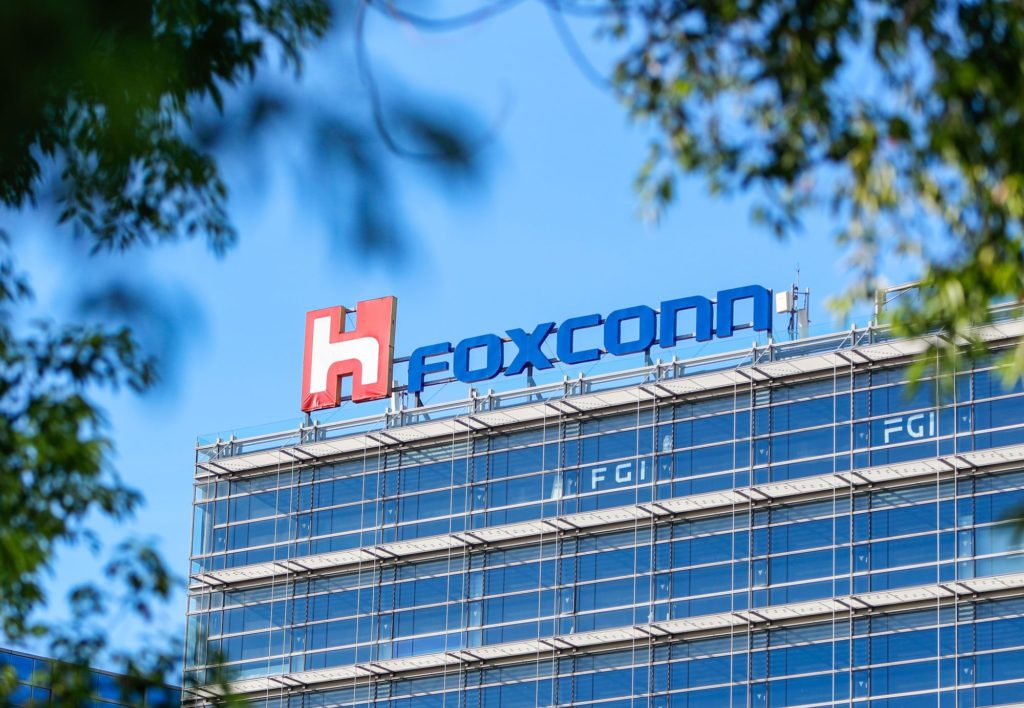
(Bloomberg) — Foxconn has appointed chip industry veteran Chiang Shang-yi to a newly created role of semiconductor strategy officer, as Apple Inc.’s most important partner takes a step toward realizing its chipmaking ambitions.

Chiang, who is credited as a key figure in the growth and development of Taiwan Semiconductor Manufacturing Co., is stepping into his new position immediately and will report directly to Young Liu, the chairman and chief executive officer of Foxconn, also known as Hon Hai Precision Industry Co.

“We are grateful to have such a seasoned semiconductor veteran join us at this important juncture in the Group’s development,” Liu said in the statement announcing the hire on Tuesday.

Foxconn’s core business is in assembling rather than fabricating electronics, but the company has been branching out into related fields as it looks for new avenues for growth. It has undertaken an ambitious project to get into the electric-vehicle business, among other ventures.

Now in his 70s, the former TSMC executive most recently occupied the role of vice chairman at China’s biggest chipmaker, Semiconductor Manufacturing International Corp. , but it was a short stint that he ended within months of joining. Before that, he had been invited to run government-backed Honxin Semiconductor Manufacturing Co. in China’s central Wuhan, but resigned for personal reasons before the over 100-billion-yuan ($14 billion) project ran into funding trouble in 2020.

More stories like this are available on bloomberg.com

©2022 Bloomberg L.P.
Italy to Raise Energy Windfall Tax in €35 Billion Budget

(Bloomberg) — Italy has signed off on a €35 billion ($36 billion) budget law for next year which will raise a windfall tax on energy companies in order to expand aid to families and businesses hit by higher prices.

The new budget, the first presented by Giorgia Meloni’s right-wing administration, plans to increase the tax rate on additional profits made by selling energy to 35% from the current 25% until mid 2023, according to a government statement released early on Tuesday. In 2023, the tax will be calculated on additional net income declared by companies selling energy at higher prices, and not on sales as it is done at the moment.

The law approved by the cabinet now faces long parliamentary scrutiny and is set to change before final approval. Some of the budget measures will stir political tension within the governing alliance, composed of Meloni’s Brothers of Italy, Forza Italia and the League. 

Political decision

A particularly divisive issue within Parliament will be the government plan to cancel over time a citizen income introduced by the government led by Giuseppe Conte, to instead finance measures to boost natality.

Over €21 billion of the budget will be allocated to relief for families and businesses facing high energy prices, adding to about €75 billion already spent by the government to keep the economy afloat. At the same time, the government is reducing a state-funded discount on gasoline prices to €0.15 per liter from €0.25 per liter.

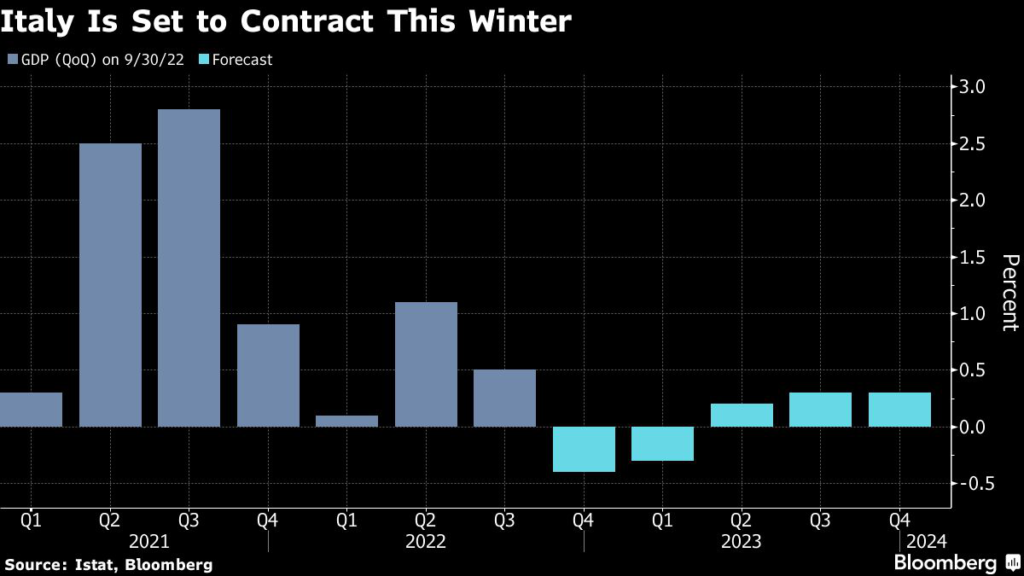
While Italy’s economic output grew 0.5% in the third quarter, a contraction is expected in the final three months of the year, Finance Minister Giancarlo Giorgetti told lawmakers in Rome earlier this month. 

The budget law also earmarks funds for measures including:

  • extending a flat tax rate on incomes of up to €85,000 for professionals and individual businesses;
  • a minor review of the current pension systems;
  • reducing VAT on basic goods for children;
  • raising the limit on cash payments to €5,000 from €1,000;
  • restarting work toward the construction of a bridge linking Sicily with mainland Italy.


(Adds details and context throughout)

More stories like this are available on bloomberg.com

©2022 Bloomberg L.P.
Stocks Mixed With Fed in Focus, China Lockdowns: Markets Wrap

(Bloomberg) — Stocks were mixed Tuesday as investors parsed comments from Federal Reserve officials on interest rate hikes and weighed the impact of Covid infections in China. 

A gauge of Asian equities came off its intraday highs as equities in Hong Kong slid with China’s daily virus infections climbing to near the highest on record. Covid-control restrictions now affect a fifth of China’s economy. 

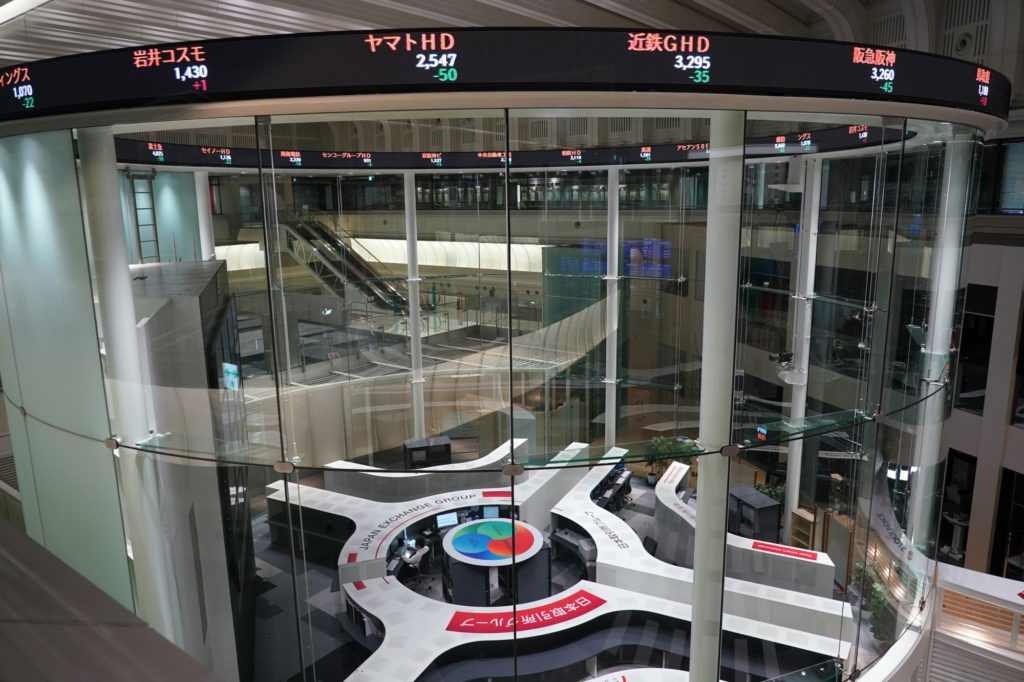
Japanese shares led gains in the region, supported by weakness in the yen, while the Australian market followed energy and materials companies higher. Contracts for European equities trimmed gains and those for the US fluctuated. 

Fed officials have broadly maintained their steadfast stance to fight against inflation. Yet San Francisco Fed President Mary Daly also said that officials need to be mindful of the lags in the transmission of policy changes while her Cleveland counterpart Loretta Mester said she’s open to slowing the tempo of rate hikes. 

The dollar weakened against all major currencies and Treasury yields declined.

“In a year like this, it is so difficult and often a fool’s errand to read too much into any one speech from one Federal Reserve official,” Sarah Ponczek, financial adviser at UBS Private Wealth Management, said on Bloomberg Television. “The reality is that we do expect that the Federal Reserve is still likely going to raise interest rates again in December.” 

JPMorgan Chase & Co. strategist Marko Kolanovic, who until recently had been one of the most vocal bulls on Wall Street, said risky assets may languish until the Fed reverses course on its hawkish campaign to raise interest rates. A near-term pivot is likely not in the cards and JPMorgan expects assets to still be “rangebound with a more pronounced downside risk.”

Meanwhile, China reopening may only be a story for the second quarter of next year as the country is entering winter months, according to Dwyfor Evans, head of Asia Pacific macro strategy at State Street Global Markets. 

“To actually expect a very conservative political body to suddenly open up China and remove restrictions in November and into the most dangerous season as it were for these type of pandemic instances, we always thought that was very, very optimistic,” Evans said on Bloomberg Television.

News of salary cuts at Chinese e-commerce firm JD.com also dragged down sentiment.

Oil steadied as investors assessed a clouded supply outlook and concerns over weaker demand in China. Gold rose on weaker dollar.

Cryptocurrency prices also steadied, in a lull from the selloff sparked by the demise of Sam Bankman-Fried’s FTX empire. Investors remain braced for more ructions as further digital-asset sector bankruptcies loom.

Key events this week:

  • US Richmond Fed manufacturing index, Tuesday
  • OECD releases Economic Outlook, Tuesday
  • Fed’s Loretta Mester and James Bullard speak, Tuesday
  • S&P Global PMIs: US, Euro area, UK, Wednesday
  • US MBA mortgage applications, durable goods, initial jobless claims, University of Michigan sentiment, new home sales, Wednesday
  • Minutes of the Federal Reserve’s Nov. 1-2 meeting, Wednesday
  • ECB publishes account of its October policy meeting, Thursday
  • US stock and bond markets are closed for the Thanksgiving holiday, Thursday
  • US stock and bond markets close early, Friday

Some of the main moves in markets:

Stocks

  • S&P 500 futures were little changed as of 6:30 a.m. London time. The S&P 500 fell 0.4% Monday
  • Nasdaq 100 futures were little changed. Nasdaq 100 fell 1.1%
  • Euro Stoxx 50 futures rose 0.2%
  • Japan’s Topix index rose 1.1%
  • Hong Kong’s Hang Seng Index fell 1.9%
  • China’s Shanghai Composite Index was little changed
  • Australia’s S&P/ASX 200 Index rose 0.6%

Currencies

  • The Bloomberg Dollar Spot Index fell 0.1%
  • The euro rose 0.1% to $1.0256
  • The Japanese yen rose 0.2% to 141.82 per dollar
  • The offshore yuan rose 0.3% to 7.1591 per dollar

Cryptocurrencies

  • Bitcoin rose 0.7% to $15,748.45
  • Ether rose 0.2% to $1,095.74

Bonds

  • The yield on 10-year Treasuries declined three basis points to 3.79%
  • Australia’s 10-year yield was little changed at 3.59%

Commodities

  • West Texas Intermediate crude rose 0.2% to $80.20 a barrel
  • Spot gold rose 0.3% to $1,742.56 an ounce

This story was produced with the assistance of Bloomberg Automation.

–With assistance from Tommi Utoslahti.

More stories like this are available on bloomberg.com

©2022 Bloomberg L.P.
Xi’s Common Prosperity Roars Back With 20% Pay Cuts at JD.com

(Bloomberg) — JD.com Inc. is slashing salaries for about 2,000 managers by 10% to 20% and diverting some of those savings toward a $1.4 billion employee benefits fund, aligning China’s No. 2 online retailer with Xi Jinping’s “common prosperity” campaign to share the wealth.

Billionaire JD.com founder Richard Liu will donate 100 million yuan ($14 million) of his own money toward staff welfare, a person familiar with the matter said. China’s largest online retailer after Alibaba Group Holding Ltd. will also set up a 10 billion yuan fund to provide staff with interest-free home loans, the person added, asking not to be identified because it hasn’t been publicized.

The moves emerged weeks after Xi reiterated a drive toward common prosperity, a concept that — twinned with a sweeping crackdown on powerful internet firms — roiled markets in 2021 by pushing business leaders and cash-rich companies to explore ways to re-distribute wealth. That effort receded from public view as Beijing sought stability in the run-up to the October Party Congress, where Xi secured a precedent-busting third term.

Xi is now expected to revitalize one of his signature policies, with uncertain outcomes for investors and China’s largest corporations. Beyond JD, senior executives across China’s $58 trillion financial system are also facing additional pay cuts as firms from investment banks to mutual funds weigh options to comply with Xi’s mantra. JD’s shares extended losses to trade as low as 4.5% in the afternoon.

“I hope this move can realize the dream of securing a house for all employees who have worked for more than five years, including for our courier and customer service brothers,” Liu announced in an internal memo seen by Bloomberg News.

A JD.com spokesperson confirmed the contents of the memo, which was first reported by Chinese online media. 

Read more: China Bankers Face Deeper Pay Cuts in ‘Common Prosperity’ Push

Under the common prosperity campaign, Xi’s administration sought to rein in “disorderly expansion of capital.” In response, wealthy tech entrepreneurs like Liu began giving back.

Pinduoduo Inc., the fast-rising online commerce giant challenging Alibaba in the countryside, last year pledged its next $1.5 billion in profit to farmers’ welfare. Tencent Holdings Ltd. said it will double the amount of money allocated toward social responsibility programs to about $15 billion. And Alibaba promised to commit 100 billion yuan over five years to support small companies. Meanwhile, tech billionaires from PDD’s Colin Huang to ByteDance Ltd.’s Zhang Yiming and Xiaomi Corp.’s Lei Jun donated vast sums to a plethora of causes.

JD’s salary cuts follow a wave of job and cost reductions worldwide by companies struggling with a potential recession. The Chinese firm, which like Alibaba weathered two years of strict Covid controls that precipitated a downturn, last week reported an 11% rise in quarterly revenue. It’s riding out the slowdown better than Alibaba, the target of a bruising antitrust crackdown in 2021.

Liu stepped down this year as JD’s chief executive officer, joining other tech tycoons that exited top management roles after the internet crackdown. The entrepreneur will focus on longer-term strategies while mentoring younger management, JD said at the time. He would also contribute to the revitalization of rural China, the firm said, a priority of Xi’s.

Liu in October settled a lawsuit filed by a student in Minnesota who accused him of rape in 2018. The case, which drew international attention to gender rights in China, helped contribute to his gradual retreat from the helm of the company he founded in 1998. The donation he unveiled Tuesday will go toward a children’s relief fund, according to the memo.

Read more: JD’s Founder Steps Down as CEO of $92 Billion Empire

More stories like this are available on bloomberg.com

©2022 Bloomberg L.P.
Xi’s Common Prosperity Roars Back With JD.com Executive Pay Cuts

(Bloomberg) — JD.com Inc. is slashing salaries for about 2,000 managers by 10% to 20% and diverting some of those savings toward a $1.4 billion employee benefits fund, aligning China’s No. 2 online retailer with Xi Jinping’s “common prosperity” campaign to share the wealth.

Billionaire JD.com founder Richard Liu will donate 100 million yuan ($14 million) of his own money toward staff welfare, a person familiar with the matter said. China’s largest online retailer after Alibaba Group Holding Ltd. will also set up a 10 billion yuan fund to provide staff with interest-free home loans, the person added, asking not to be identified because it hasn’t been publicized.

The moves emerged weeks after Xi reiterated a drive toward common prosperity, a concept that — twinned with a sweeping crackdown on powerful internet firms — roiled markets in 2021 by pushing business leaders and cash-rich companies to explore ways to re-distribute wealth. That effort receded from public view as Beijing sought stability in the run-up to the October Party Congress, where Xi secured a precedent-busting third term.

Xi is now expected to revitalize one of his signature policies, with uncertain outcomes for investors and China’s largest corporations. Beyond JD, senior executives across China’s $58 trillion financial system are also facing additional pay cuts as firms from investment banks to mutual funds weigh options to comply with Xi’s mantra. JD’s shares extended losses to trade as low as 4.5% in the afternoon.

“I hope this move can realize the dream of securing a house for all employees who have worked for more than five years, including for our courier and customer service brothers,” Liu announced in an internal memo seen by Bloomberg News.

A JD.com spokesperson confirmed the contents of the memo, which was first reported by Chinese online media. 

Read more: China Bankers Face Deeper Pay Cuts in ‘Common Prosperity’ Push

Under the common prosperity campaign, Xi’s administration sought to rein in “disorderly expansion of capital.” In response, wealthy tech entrepreneurs like Liu began giving back.

Xi’s Unquestioned Grip on China Fuels Economic Unease: QuickTake

Pinduoduo Inc., the fast-rising online commerce giant challenging Alibaba in the countryside, last year pledged its next $1.5 billion in profit to farmers’ welfare. Tencent Holdings Ltd. said it will double the amount of money allocated toward social responsibility programs to about $15 billion. And Alibaba promised to commit 100 billion yuan over five years to support small companies. Meanwhile, tech billionaires from PDD’s Colin Huang to ByteDance Ltd.’s Zhang Yiming and Xiaomi Corp.’s Lei Jun donated vast sums to a plethora of causes.

JD’s salary cuts follow a wave of job and cost reductions worldwide by companies struggling with a potential recession. The Chinese firm, which like Alibaba weathered two years of strict Covid controls that precipitated a downturn, last week reported an 11% rise in quarterly revenue. It’s riding out the slowdown better than Alibaba, the target of a bruising antitrust crackdown in 2021.

Liu stepped down this year as JD’s chief executive officer, joining other tech tycoons that exited top management roles after the internet crackdown. The entrepreneur will focus on longer-term strategies while mentoring younger management, JD said at the time. He would also contribute to the revitalization of rural China, the firm said, a priority of Xi’s.

Liu in October settled a lawsuit filed by a student in Minnesota who accused him of rape in 2018. The case, which drew international attention to gender rights in China, helped contribute to his gradual retreat from the helm of the company he founded in 1998. The donation he unveiled Tuesday will go toward a children’s relief fund, according to the memo.

Read more: JD’s Founder Steps Down as CEO of $92 Billion Empire

More stories like this are available on bloomberg.com

©2022 Bloomberg L.P.
FTX Group Bankruptcy Filing Shows Cash Balance of $1.24 Billion

(Bloomberg) — An FTX Group bankruptcy filing showed that the fallen cryptocurrency exchange and a number of affiliates had a combined cash balance of $1.24 billion.

The document from Alvarez & Marsal North America LLC, the proposed financial adviser to FTX, said trading house Alameda Research and related firms had a cash balance of almost $401 million.

Among FTX exchange platforms, FTX Japan had a cash balance of $171.7 million, the breakdown showed.

The latest tally as of Nov. 20 “identifies substantially higher cash balances than the debtors were in a position to substantiate as of Wednesday, Nov. 16,” according to the filing.

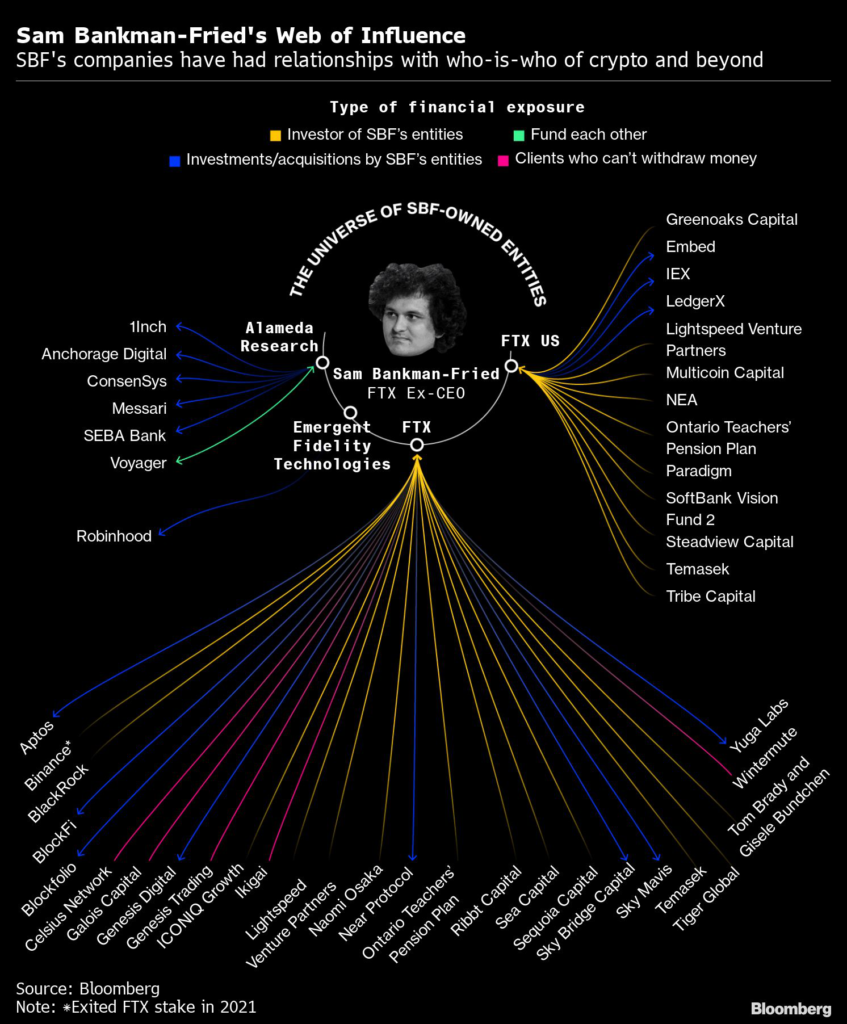
Sam Bankman-Fried’s FTX empire slid into a chaotic bankruptcy on Nov. 11, potentially leaving more than a million creditors and fomenting turmoil in the crypto sector.

Earlier court papers showed that FTX-linked entities owed their 50 biggest unsecured creditors a total of $3.1 billion. Preliminary filings have also indicated FTX assets and liabilities of at least $10 billion each.

The range of institutional and individual investors ensnared by the wipeout is sapping liquidity in digital-asset markets and stoking fears of contagion.

(Updates with context about FTX liabilities in the sixth paragraph.)

More stories like this are available on bloomberg.com

©2022 Bloomberg L.P.
Close Bitnami banner
Bitnami