Bloomberg

Bahamas to Let Delaware Judge Handle Part of FTX Restructuring Case

(Bloomberg) — Bahamas court officials dropped their opposition to moving one piece of FTX’s restructuring case to a US court in Delaware, according to a court filing.

Liquidators appointed in the Bahamas for one FTX affiliate agreed to move a case they filed in New York to Delaware, where more than 100 units are under the oversight of a federal judge, FTX lawyers said in papers filed in US Bankruptcy Court in Wilmington, Delaware.

The liquidators had filed a bankruptcy case in Manhattan, asking a federal judge there to officially recognize and support their restructuring case in the Bahamas. That would have set up potentially contradictory court rulings from two different US judges handling different parts of Sam Bankman-Fried’s crypto empire.

The liquidators reserved their right to oppose any actions that FTX officials propose in the Delaware cases. Restructuring advisers took over FTX after Bankman-Fried resigned as chief executive officer on Nov. 11. Since then, those advisers have accused him of trying to undermine their efforts in order to move assets away from a US court in favor of one in the Bahamas.

Last week, liquidators in the Bahamas moved to solidify control over the insolvency of FTX Digital Ltd., a subsidiary within Bankman-Fried’s crypto enterprise, bankruptcy court papers show. They argued that account holders with assets in FTX’s custodial wallets are likely creditors of the Bahamian unit and are seeking to probe the rest of the crypto exchange’s corporate entities.

Under the proposed deal, liquidators will still be able to make those arguments, but any decisions would likely be made by US Bankruptcy Judge John Dorsey, who is overseeing the bulk of the FTX bankruptcy case.

A smaller FTX-related case is moving forward in the Bahamas under the control of the liquidators, who were appointed to find assets that can be used to repay creditors of FTX Digital.

The case is FTX Trading, 22-11068, US Bankruptcy Court, District of Delaware (Wilmington).

More stories like this are available on bloomberg.com

©2022 Bloomberg L.P.

Zoom’s Sales Growth Slows Even as Enterprise Business Stays Steady

(Bloomberg) — Zoom Video Communications Inc. declined about 6% in extended trading after reporting its slowest quarterly sales growth on record and slightly reduced its full-year revenue forecast.

Revenue increased 5% to $1.1 billion, in line with analysts’ average estimate. For the full year, the software company reduced its sales forecast to as much as $4.38 billion from its August projection of as much as $4.4 billion.

The full-year sales guidance issued Monday assumes that Zoom’s enterprise business will grow more than 20% while revenue from online consumer and small business customers will decline about 8%, Chief Financial Officer Kelly Steckelberg said on a conference call with analysts. In a sign the enterprise business remains steady, Zoom reported quarterly profit that exceeded Wall Street estimates and raised its full-year earnings forecast.

Zoom, which burst into public consciousness during the height of the pandemic, is fighting to reverse a slowdown in growth for its video communications service by expanding its tools for business. At its annual user conference earlier this month, it unveiled email and calendar services, which it hopes will keep more workers on the platform. 

“We drove revenue above guidance with continued momentum in enterprise,” Chief Executive Officer Eric Yuan said in a statement, highlighting better-than-expected profit. But the company continues to be affected by currency fluctuations and “heightened deal scrutiny for new business,” he said on the call.

Tyler Radke, an analyst at Citigroup Inc., was skeptical the company’s growth would return anytime soon. “Despite some modest revenue upside, the leading indicators suggested signs of incremental deterioration,” he wrote after the results were released.

Zoom shares, which have been hovering close to pre-pandemic prices, declined to a low of $74.73 in extended trading after closing at $80.26 in New York. The stock has dropped 56% this year. 

In the period ended Oct. 31, the company said it had 209,300 enterprise customers, an increase of 14% from a year earlier. Analysts, on average, projected Zoom would report 210,105. Large businesses make up a growing share of Zoom’s revenue as it loses consumers and small businesses.

Churn among consumers and small businesses has begun to stabilize in the quarter. Average monthly churn among those online customers was 3.1% in the fiscal third quarter, down from 3.7% in the same period last year.

The online business is still having “a dampening affect on the overall growth rate of the company,” Steckelberg said on the call.

As for potential acquisitions, Zoom is looking “every day,” Steckelberg said. “The compression in valuations is not lost on us.”

Zoom said it had 3,286 customers contributing more than $100,000 in trailing 12 month revenue, an increase of 31% from the period a year earlier. Sales in the Americas region grew 11% while Europe, the Mideast and Africa sank 9% due to currency fluctuations and the impact of the war in Ukraine. Revenue in the Asia-Pacific region declined 3%, Steckelberg said. 

Fiscal third-quarter profit, excluding some items, was $1.07 a share, the San Jose, California-based company said in a statement. Analysts, on average, projected 83 cents a share. Full-year earnings will be as much as $3.94 a share, the company said, an increase from Zoom’s August forecast of as much as $3.69 a share.

(Updates with comments from analyst in the sixth paragraph.)

More stories like this are available on bloomberg.com

©2022 Bloomberg L.P.

Dell Gains After Beating Sales Estimates on Demand for Tech Services

(Bloomberg) — Dell Technologies Inc. projected revenue in the current quarter that fell short of analysts’ estimates, saying economic uncertainty has begun to affect information technology customers. 

Sales will be as much as $24 billion in the quarter ending in January, Chief Financial Officer Tom Sweet said in a conference call. Analysts, on average, projected $24.9 billion. Profit, excluding some items, will be $1.50 to $1.80 a share, compared with analysts’ average estimate of $1.61 

Forecasting for the upcoming fiscal year is difficult as economic uncertainty is dampening IT spending intentions, Sweet said on the call. “Some customers have paused purchases in the near term.”

The disappointing forecast came after Dell had reported stronger-than-expected sales and profit in the fiscal third quarter. Sales slipped 6% to $24.7 billion in the period ending Oct. 28, the Round Rock, Texas-based company said Monday in a statement. Profit, excluding some items, was $2.30 a share, compared with analysts’ average estimate of $1.60.

Dell “combated slower demand and drove record profitability” in the quarter, Co-Chief Operating Officer Chuck Whitten said. “We anticipated the changing landscape and responded quickly.” Dell also managed its supply chain by reducing its backlog, which also helped boost results, said Co-Chief Operating Officer Jeff Clarke.

The sales decline was due to an ongoing slump in demand for personal computers, which generate about 55% of Dell’s total revenue. That segment slipped 17% in the fiscal third quarter, in line with estimates, led by a 29% plunge in consumer sales. 

The shares, which had increased as much as 8.8% after the results were announced, gave back all of the gains, falling about 2% in extended trading after the forecast. The stock closed at $41.07 in New York and has declined 27% this year.

Dell isn’t alone in seeing falling computer demand. Global PC shipments dropped more than 19% in the third quarter, according to Gartner Inc., the steepest decline since the industry analyst began tracking the metric in the mid-1990s. As economic and political uncertainty has made companies more selective with information technology spending, computer upgrades haven’t been high priorities, wrote Mikako Kitagawa, a Gartner analyst.

Meanwhile sales from Dell’s Infrastructure Solutions Group, which includes its technology services, increased 12% to $9.6 billion from a year earlier. Server and networking sales climbed 14% to $5.2 billion, while storage revenue gained 11% to $4.4 billion.

More stories like this are available on bloomberg.com

©2022 Bloomberg L.P.

US Stocks Drop With Fed Policy, China in Focus: Markets Wrap

(Bloomberg) — US stocks dropped as investors parsed comments from Federal Reserve officials who broadly remained steadfast in their fight against inflation. Mounting concerns that China may tighten Covid curbs after a string of reported deaths also continued to weigh on investors.

Technology stocks, which are typically more sensitive to interest rates, dragged the S&P 500 lower. The Nasdaq 100 ended the day down 1.1%. Oil emerged from a volatile session largely unchanged after Saudi Arabia denied a report that it is discussing an oil-production increase for the OPEC+ meeting next month. The dollar climbed for a third day as investors sought haven assets. Treasuries were mixed. 

Investors are closely watching what Fed speakers say about the outlook for interest rates. While several central bank officials in recent days have restated their intention to remain relentless until inflation is under control, they differ on how far they’ll go. On Monday, San Francisco Fed President Mary Daly said that officials will need to be mindful of the lags with which monetary policy is transmitted through the economy as they raise rates further. Her Cleveland counterpart Loretta Mester said she’s open to slowing the tempo of rate hikes. 

“This shouldn’t be regarded as a pivot or anything new,” said Michael Contopoulos, director of fixed income at Richard Bernstein Advisors. “A real pivot is when the Fed starts to cut rates and/or pause quantitative tightening. That is nowhere in sight.”

Atlanta Fed President Raphael Bostic, meanwhile, has said he favors slowing the pace of interest rate increases, with no more than 1 percentage point more of hikes, to try to ensure the economy has a soft landing. Boston Fed President Susan Collins has reiterated her view that options are open for the size of the December interest-rate increase, including the possibility of a 75 basis-point move. 

Traders this week will also be looking to minutes of the most recent Fed policy meeting for further clues on the central bank’s path ahead. 

“For the Fed right now, if we do get some slowing in inflation — which it seems like we might — but you’re not seeing it in the slowing of service inflation, that’s related to a tight labor market,” Veronica Clark, economist at Citigroup, said on Bloomberg Television. “You do need to see that loosening in the labor market data.” 

Meanwhile, China saw its first Covid-related death in almost six months on Saturday and another two were reported on Sunday. Worsening outbreaks across the nation are stoking concerns that authorities may again resort to harsh restrictions. Shutdowns could have a negative impact on supply-chain dynamics and possibly exacerbate inflation issues across economies. 

Key events this week:

  • US Richmond Fed manufacturing index, Tuesday
  • OECD releases Economic Outlook, Tuesday
  • Fed’s Loretta Mester and James Bullard speak, Tuesday
  • S&P Global PMIs: US, Euro area, UK, Wednesday
  • US MBA mortgage applications, durable goods, initial jobless claims, University of Michigan sentiment, new home sales, Wednesday
  • Minutes of the Federal Reserve’s Nov. 1-2 meeting, Wednesday
  • ECB publishes account of its October policy meeting, Thursday
  • US stock and bond markets are closed for the Thanksgiving holiday, Thursday
  • US stock and bond markets close early, Friday

Some of the main moves in markets :

Stocks

  • The S&P 500 fell 0.4% as of 4:01 p.m. New York time
  • The Nasdaq 100 fell 1.1%
  • The Dow Jones Industrial Average fell 0.1%
  • The MSCI World index rose 0.6%

Currencies

  • The Bloomberg Dollar Spot Index rose 0.7%
  • The euro fell 0.8% to $1.0239
  • The British pound fell 0.6% to $1.1818
  • The Japanese yen fell 1.2% to 142.11 per dollar

Cryptocurrencies

  • Bitcoin fell 2.8% to $15,800.01
  • Ether fell 3.2% to $1,104.71

Bonds

  • The yield on 10-year Treasuries was little changed at 3.83%
  • Germany’s 10-year yield declined two basis points to 1.99%
  • Britain’s 10-year yield declined five basis points to 3.19%

Commodities

  • West Texas Intermediate crude fell 0.4% to $79.73 a barrel
  • Gold futures fell 0.8% to $1,755.20 an ounce

This story was produced with the assistance of Bloomberg Automation.

–With assistance from Isabelle Lee.

More stories like this are available on bloomberg.com

©2022 Bloomberg L.P.

Crypto Markets Sag as Funds Drained From FTX Switch Out of Ether

(Bloomberg) — Cryptocurrency prices slumped in the ongoing crisis sparked by the downfall of Sam Bankman-Fried’s once powerful FTX empire.

The largest token Bitcoin has shed as much as 4.7% to $15,485 on Monday, the least since November 2020. Second-ranked Ether is roughly 5% lower. Meme token Dogecoin — a gauge of the most speculative sentiment in an already racy digital playground — is down about 12% over the past two days.

Administrators are picking over the wreckage of the FTX bankruptcy, discovering that $3.1 billion is owed to top creditors. The scope of the money outstanding is stoking worries that more digital-asset outfits will topple. 

Digital-asset brokerage Genesis is struggling to raise fresh cash for its lending unit, and it’s warning potential investors that it may need to file for bankruptcy if its efforts fail, according to people with knowledge of the matter.

Genesis, which has faced a liquidity crunch in the wake of crypto exchange FTX’s bankruptcy filing this month, has spent the past several days seeking at least $1 billion in fresh capital, the people said. That included talks over a potential investment from crypto exchange Binance, they said, but funding so far has failed to materialize.

Crypto lender BlockFi Inc. could be next: people with knowledge of the matter said last week that it’s preparing to file for bankruptcy within days.

“The FTX issues are really an urgent reminder of the need for regulatory clarity and a real regulatory framework for crypto,” Christian Catalini, founder of the MIT Cryptoeconomics Lab, said on Bloomberg TV.

He added that hype and speculation over the minting and trading of tokens “has generated a massive distraction from building actual products and services that reach consumers, solve actual problems.”

FTX, Ether

Ether has underperformed Bitcoin over the past couple of sessions in part amid speculation that some of the $663 million drained from FTX as it slid into bankruptcy is now being transferred out of the token.

The person or entity that raided FTX emerged last week as one of the world’s biggest holders of Ether, with a haul of about $288 million.

Blockchain specialist Chainalysis said in tweets Sunday that funds taken from FTX “are on the move” and some were being shifted from Ether to Bitcoin, likely as part of an effort to “cash out.”

The heady mix of corporate failure and potential criminality atop a 72% drop in a gauge of the top 100 tokens over the past year is naturally leading to all kinds of questions about the future — or lack thereof — for digital assets and their underlying blockchain technology.

Pershing Square Capital Management founder Bill Ackman said on Twitter that crypto represents less than 2% of his assets while adding that he remains positive on the sector overall, comparing its potential social impact to the telephone and the internet.

Crypto ‘Amateurs’

Bitcoin was trading at about $15,638 as of 2:40 p.m. in New York, a far cry from its November 2021 record high of almost $69,000. It touched a two-year low of $15,574 on Nov. 9. Ether was hovering around $1,082.

“We’ve got to get past this early stage of amateurs in crypto,” Bobby Lee, founder of crypto storage solution provider Ballet Global Inc., said on Bloomberg Television. He added that Bitcoin could fall as low as $10,000 if crypto markets are hit by more major blowups.

For crypto market prices: CRYP; for top crypto news: TOP CRYPTO.

More stories like this are available on bloomberg.com

©2022 Bloomberg L.P.

FTX Latest: US Lawmakers Began Probe of Firm Months Before Crash

(Bloomberg) — Long before Sam Bankman-Fried’s FTX cryptocurrency empire collapsed this month, it already was on the radar of federal prosecutors in Manhattan. The US Attorney’s Office for the Southern District of New York, led by Damian Williams, spent several months working on a sweeping examination of cryptocurrency platforms with US and offshore arms and had started poking into FTX’s massive exchange operations, according to people familiar with the investigation.

Bitcoin spot hit a 52-week low at $15,574.23 on Monday. So far this year, the bellwether token has declined 66.4%. 

Commodity Futures Trading Commission Chairman Rostin Behnam will testify at a Senate Agriculture Committee hearing on Dec. 1 about the collapse of FTX, the committee said in an announcement. 

The wipeout of Bankman-Fried’s crypto empire, including crown jewel FTX and sister trading desk Alameda Research, is helping to reduce liquidity across the crypto market. 

Key stories and developments:

  • Transcript: Matt Levine on the Collapse of Alameda and FTX
  • Crypto Exchange Tokens Pose Extreme Risks, BOE’s Cunliffe Says
  • FTX Fiasco Adds Wrinkle to Plan for Crypto Accounting Rules
  • Crypto Arb Trades Roar Back as FTX-Battered Quants Flee Market
  • Want to Know Where Crypto Is Headed? Remember 2008: Bill Dudley

(Time references are New York unless otherwise stated.)

Bitcoin Hits 52-Week Low at $15,574.23 (4:46 p.m.)

Bitcoin spot hit a 52-week low at $15,574.23 on Monday. So far this year, the bellwether token has declined by 66.4%. 

Its 52-week high was $48,215.74 on March 28. 

US Prosecutors Opened Probe of FTX Months Before Its Collapse (4:14 p.m.)

Long before Sam Bankman-Fried’s FTX cryptocurrency empire collapsed this month, it already was on the radar of federal prosecutors in Manhattan.

The US Attorney’s Office for the Southern District of New York, led by Damian Williams, spent several months working on a sweeping examination of crypto currency platforms with US and offshore arms and had started poking into FTX’s massive exchange operations, according to people familiar with the investigation.

Fidelity Must Reconsider Bitcoin Exposure in 401(k)s: Senators (3:43 p.m.)

Democratic senators Dick Durbin, Elizabeth Warren and Tina Smith are urging Fidelity Investments to reconsider allowing 401(k) plan sponsors to offer exposure to Bitcoin. 

“The recent implosion of FTX, a cryptocurrency exchange, has made it abundantly clear the digital asset industry has serious problems,” the senators said in a letter to Fidelity CEO Abigail Johnson. 

Tiger Global’s Now-Worthless FTX Bet Had Bain’s Due Diligence (3:03 p.m.)

Bain & Co. was among consulting firms that helped conduct due diligence for Tiger Global Management’s investment in now-defunct crypto exchange FTX, according to people familiar with the matter. 

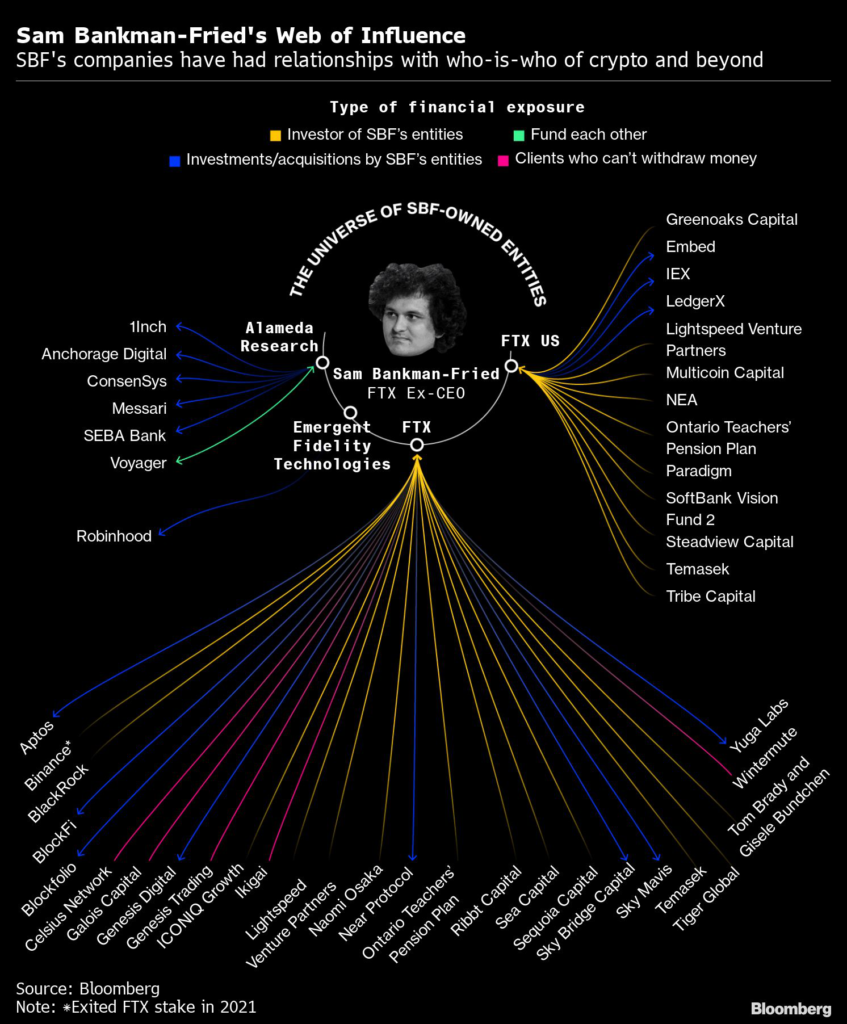
Tiger Global, which pays Bain more than $100 million a year to research private companies, has now written down its $38 million FTX stake to zero, the people said. Sam Bankman-Fried’s oversight of a vast web of FTX-linked entities was one of the risks highlighted during the due-diligence process, but the money manager still believed it was a sound investment at the time, one of the people said. 

Crypto Markets Sag as Funds Drained From FTX Switch Out of Ether (2:44 p.m.)

Cryptocurrency prices slumped Monday in the ongoing crisis sparked by the downfall of Sam Bankman-Fried’s once powerful FTX empire.

The largest token Bitcoin has shed about 6% over two days, while second-ranked Ether is roughly 10% lower. Meme token Dogecoin — a gauge of the most speculative sentiment in an already racy digital playground — is down 14%.

CFTC Chief to Testify at Dec. 1 Senate Hearing on FTX Collapse (1:44 p.m.)

Commodity Futures Trading Commission Chairman Rostin Behnam will testify at a Senate Agriculture Committee hearing on Dec. 1 about the collapse of crypto exchange FTX, the committee said in an announcement. 

Cathie Wood Goes on Coinbase Buying Spree as Wall Street Sours (12:21 p.m.)

Wall Street’s waning conviction in Coinbase Global Inc. has done little to deter Cathie Wood. Instead, she’s been scooping up shares of the struggling cryptocurrency exchange in the wake of the collapse of FTX.

Wood’s Ark Investment Management funds have bought more than 1.3 million shares of Coinbase since the start of November, worth about $56 million based on Monday’s trading price, according to data compiled by Bloomberg. The shopping spree, which started just as FTX’s demise began, has boosted Ark’s total holdings by roughly 19% to about 8.4 million shares. That equates to around 4.7% of Coinbase’s total outstanding shares.

‘Alameda Gap’ Seen Helping Dry Up Liquidity Across Crypto Market (11:26 a.m.)

The wipeout of Sam Bankman-Fried’s crypto empire, including its crown jewel FTX exchange and sister trading desk Alameda Research, is helping to reduce liquidity across the crypto market. 

The decline has been dubbed the “Alameda Gap” by blockchain-data firm Kaiko, named for the trading group at the center of the storm which is closing its books. Plunges in liquidity usually come during periods of volatility as trading shops pull bids and asks from their order books to better regulate risks, Kaiko noted in a Nov. 17 newsletter. 

Crypto ETPs See Net Inflows $44.4 Million Led By Proshares’ BITO (9:25 a.m.)

Global exchange-traded products focusing on cryptocurrencies and related themes posted a net inflow of $44.4 million in the week to Nov. 18, according to Bloomberg calculations.

ProShares Bitcoin Strategy ETF had net inflows of $15.7 million, followed by ProShares Short Bitcoin Strategy ETF with $12.3 million. Bitcoin-themed ETPs led the inflows at $33.1 million, followed by Ether with $14 million. Solana-focused products saw the biggest outflows at $3.3 million, followed by Ripple ETPs with $1.4 million.

Congress Plans Hearings to Probe FTX Collapse: Crypto in DC (9:08 a.m.)

House and Senate panels are planning hearings in December about bankrupt crypto exchange FTX and its former chief executive officer, Sam Bankman-Fried, amid renewed calls for Congress to strengthen regulation and oversight for the industry. 

The House Financial Services Committee is seeking testimony from Bankman-Fried, his trading house Alameda Research, rival exchange Binance, as well as other FTX employees. US and Bahamian authorities are also discussing bringing Bankman-Fried to the US for questioning. 

Crypto Exchange Tokens Pose Extreme Risks, BOE’s Cunliffe Says (8:11 a.m.)

Exchange-issued crypto tokens such as bankrupt FTX Group’s FTT can pose “extreme” risks when accepted by their issuers as collateral, Cunliffe said.

“A firm accepting its own unbacked cryptoasset as collateral for loans and margin payments, as there are indications may have happened with FTX, creates extreme ‘wrong-way’ risk — i.e. when the exposure to a counterparty increases together with the risk of the counterparty’s default,” he said in a speech on Monday. 

Crypto Arb Trades Roar Back as FTX-Battered Quants Flee Market (7:32 a.m.)

The wild-west days of crypto markets are back again as the large trading houses that once thrived on arbitraging price gaps pull back in the wake of FTX’s collapse. That’s opening up profitable opportunities for anyone that still dares to trade. 

Prices for essentially identical assets on various platforms are diverging in a clear sign the dominoes are still falling across the crypto trading world. The gap between the funding rates of identical Bitcoin futures on Binance and OKEx, for instance, has been as wide as an annualized 101 percentage points and remained at least 10, compared to mostly single-digit gaps last month.

FTX Fiasco Adds Wrinkle to Plan for Crypto Accounting Rules (5:00 a.m.)

US accounting rulemakers were already considering tackling the thorny issue of accounting for freshly minted crypto tokens in their prolonged effort to write guidance for digital assets. Then came the collapse of crypto exchange FTX, and a new headache for accounting rulemakers.

While questions about the worth of FTX’s self-generated tokens are just a part of the company’s puzzle, there’s an area where the Financial Accounting Standards Board could bring clarity to the market: ensuring that businesses creating a crypto token don’t just assign it a value and report it on their balance sheets as an asset.

FTX’s Federal Net Operating Loss Carryover Stood at $3.7 Billion (2:32 a.m.)

Crypto exchange FTX and related companies now in bankruptcy collectively had a carryover federal net operating loss of at least $3.7 billion as of Dec. 31 last year based on tax returns, according to court filings.

The document from Alvarez & Marsal North America LLC, released as part of the Chapter 11 process, also showed that the minimum state net operating loss carryforward stood at $715 million. Earlier filings signaled the losses could help offset tax liabilities.  

More stories like this are available on bloomberg.com

©2022 Bloomberg L.P.

IBM Sues Micro Focus for Copying Its Software

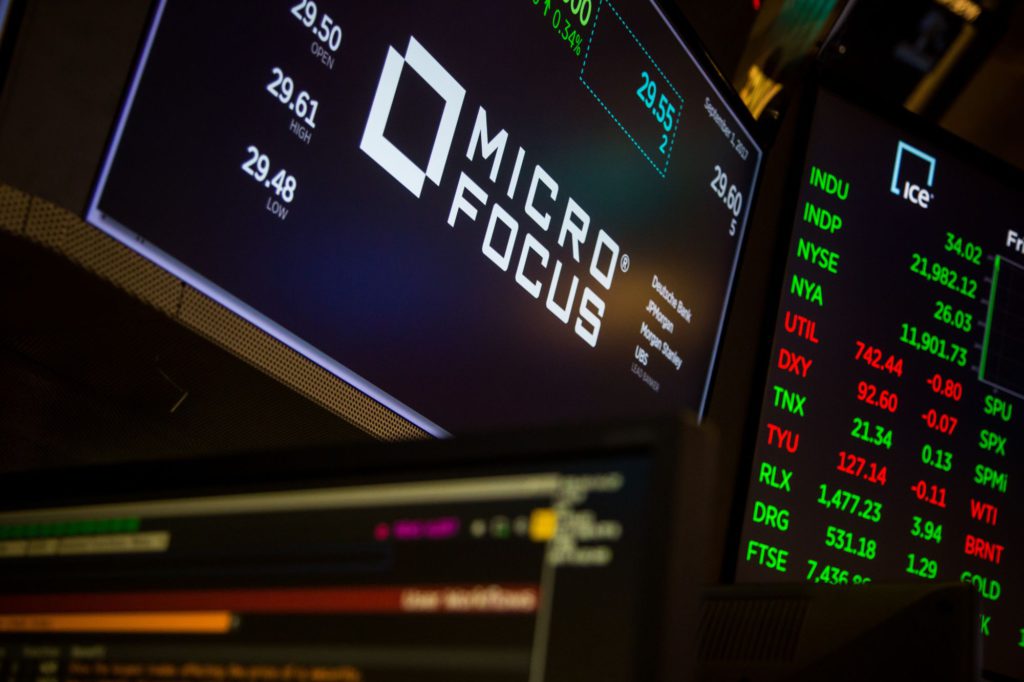
(Bloomberg) — International Business Machines Corp. sued Micro Focus International Plc, alleging it contracted with IBM to develop software applications for its mainframe systems and then copied its programs to create a competing product.

In the lawsuit, filed on Monday in federal court in New York, IBM claims the Newbury, UK-based firm copied software for its Customer Information Control System Transaction Server, or CICS TS, which allows companies to run mainframe applications for operations such as travel requests and payroll online and communicate with other systems.

IBM says Micro Focus had access to its software for almost two decades and at one point copied it to make the rival product, Micro Focus Enterprise Suite. The product offers a web service implementation that includes a file for mapping data that has almost the same architecture and design as a similar file created by IBM, according to the suit, which seeks unspecified damages for claims of copyright infringement and breach of contract.

“These striking similarities indicate that Micro Focus copied elements of IBM’s copyrighted works to create a derivative work in at least Micro Focus Enterprise Developer and Micro Focus Enterprise Server,” IBM alleged. “There is no way such astonishing conformity could arise through attempts to meet similar functional requirements, or as a result of coincidence.”

Micro Focus didn’t immediately respond to an email seeking comment on the suit.

Micro Focus sells enterprise software to thousands of companies, including Airbus SE, Hewlett Packard Enterprise Co. and Kellogg Co., according to its website. It has seen declines in its revenue and adjusted earnings before interest, taxes, depreciation and amortization every fiscal year since 2018. Canada’s Open Text Corp. agreed in August to buy Micro Focus for about $6 billion including debt. 

Read More: Open Text to Buy Software Firm Micro Focus at 99% Premium 

In May IBM ended Micro Focus’s involvement in a program that allows third parties to use access to its products and software to develop software applications for its mainframe systems, according to the complaint. 

“IBM cannot stand idle while a licensee exceeds the grant of its license and blatantly disregards its contractual obligations by reverse-engineering and copying IBM’s copyrighted software, creating a derivative work, and then promoting and profiting from that pirated software,” the company said in the suit.

The case is IBM Corp. v. Micro Focus International Plc, 22-cv-9910, US District Court, Southern District of New York (White Plains).

More stories like this are available on bloomberg.com

©2022 Bloomberg L.P.

Coinbase Hits Record Low as Crypto Contagion Anxiety Intensifies

(Bloomberg) — Coinbase Global Inc. shares hit an all-time low amid rising investor skittishness over how far the fallout from rival exchange FTX’s insolvency might spread. 

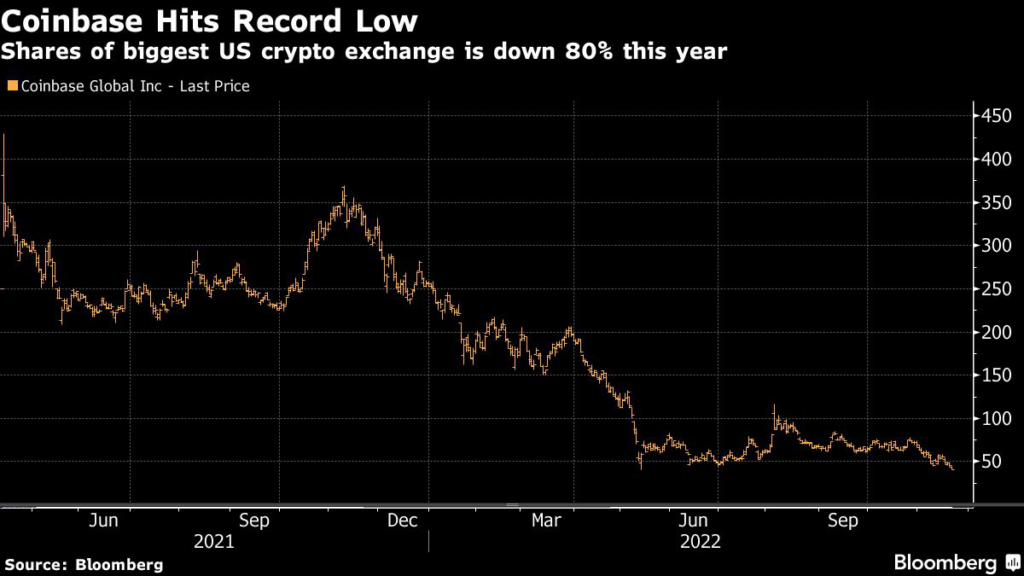
The largest US cryptocurrency exchange’s stock dropped as much as 10.3% to $40.61 before closing down 9% on Monday, leading other crypto-related shares lower. Year-to-date, Coinbase’s shares have plunged more than 80%, while cryptocurrency bellwether Bitcoin is down 65%. Coinbase shares reached a high of $429.54 in April 2021 after making their debut on the Nasdaq. 

The drop aligns with a downturn in digital asset prices, which have fallen after the collapse of Sam Bankman-Fried’s crypto empire. Bitcoin dropped as much as 4.1% to $15,589 on Monday, just short of a two-year low hit on Nov. 9. The token has tumbled around 75% from a record high of almost $69,000 reached about a year ago. Also on Monday, Ether dropped as much as 5.5%.  

Shares of Marathon Digital Holdings Inc, MicroStrategy Inc., Riot Blockchain Inc. and Core Scientific Inc. all respectively dropped by as much as 10% as well. 

“If the $15,500 level breaks for Bitcoin, there is not much support until the $13,500 level, followed by the psychological $10,000 level,” wrote Ed Moya, senior market analyst at Oanda.

Coinbase has 14 buy, 12 hold, and 6 sell ratings. On Friday, Bank of America downgraded Coinbase to neutral from buy.

“We feel confident that COIN is not ‘another FTX,”’ wrote analyst Jason Kupferberg in a note. “But that does not make them immune from the broader fallout within the crypto ecosystem.”

Meanwhile, Cathie Wood’s Ark Investment Management funds have purchased more than 1.3 million shares of Coinbase since the start of this month.

(Adds the closing share price in the second paragraph.)

More stories like this are available on bloomberg.com

©2022 Bloomberg L.P.

Carvana Stock Rout Hits 97% This Year With Used-Car Prices Crumble

(Bloomberg) — Online car dealer Carvana Co.’s shares tumbled to an all-time low as investors grow more concerned about the continuing decline in used-vehicle prices.

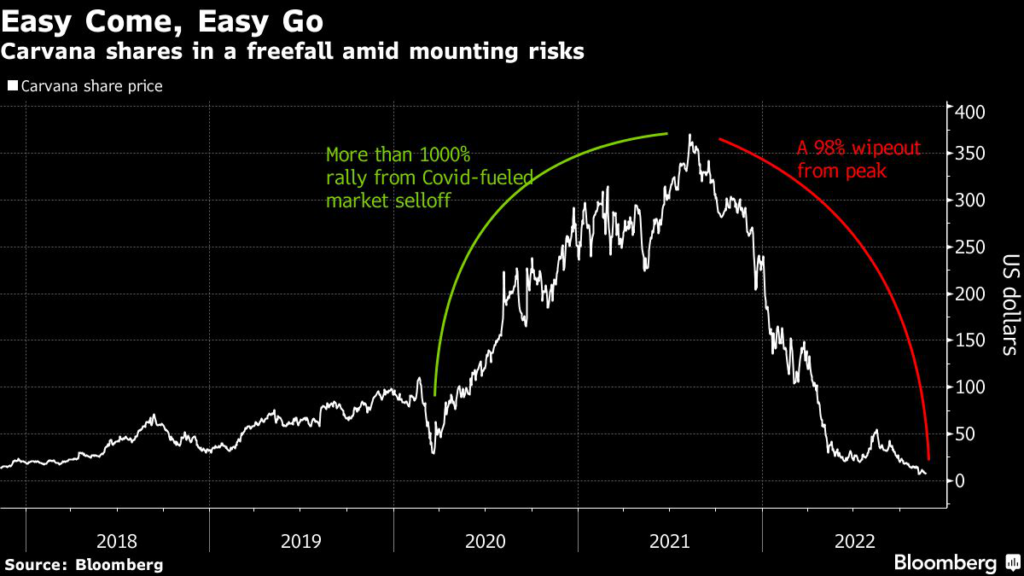
The price of the company’s stock closed down 13% to $7.05, a record low. Carvana, which was once touted as a disruptor in the used-car dealer industry for its online sales, has seen recession-wary investors flee this year from risky and expensive growth stocks. 

Carvana’s shares have plummeted 97% so far this year as potential buyers grapple with higher interest rates and stubborn inflation. Just last week, the company said it was cutting about 1,500 jobs, or 8% of its workforce, after burning through $2 billion of cash over the six months ended March 31 by at least one measure. Meanwhile, the trading in its bonds show the market believes there is a high chance of default. 

“As used car prices fall, we believe that Carvana will struggle to make a profit on vehicles previously purchased at high prices,” Argus Research analyst Taylor Conrad wrote in a Monday note, downgrading the rating on the stock to sell from hold and noting the company is highly leveraged. “We believe that the shares are overvalued.”

Overall, Wall Street’s stance on Carvana has taken a U-turn this year, as valuations of unprofitable companies all around the market tumbled, with investors fleeing for safety and cash becoming scarcer. The average analyst price target on the company currently stands at $24, a far cry from the $375 just a year back.  

It reflects the story of yet another stock-market darling of the pandemic time, whose business is confronting the challenges of returning to a more normal pace following a surge in demand. In the third quarter, hedge funds cut their positions in Carvana, making it among the biggest declines in the consumer discretionary group. 


(Updates stock move in second paragraph and first deck-head.)

More stories like this are available on bloomberg.com

©2022 Bloomberg L.P.
US Prosecutors Opened Probe of FTX Months Before Its Collapse

(Bloomberg) — Long before Sam Bankman-Fried’s FTX cryptocurrency empire collapsed this month, it already was on the radar of federal prosecutors in Manhattan.

The US Attorney’s Office for the Southern District of New York, led by Damian Williams, spent several months working on a sweeping examination of crypto currency platforms with US and offshore arms and had started poking into FTX’s massive exchange operations, according to people familiar with the investigation.

The focus was on compliance with the Bank Secrecy Act, the people said. Authorities have used the law, requiring financial institutions take steps to prevent money laundering and terrorism financing, to go after crypto platforms that allegedly falsely claimed that they don’t serve US customers. Bahamas-based FTX operated one of the world’s largest international crypto exchanges, as well as a separate and much more limited venue called FTX US that said it complies with the act.

It’s unclear whether prosecutors in Manhattan reached any conclusion in their probe before FTX — valued at nearly $32 billion in a January financing — collapsed, sending the crypto market into a dive and raising questions about the accuracy of its pledges to safeguard customer assets. That put the federal investigation into a new trajectory, the people said.

Representatives for the US attorney’s office and FTX declined to comment.

The months-long sweep shows FTX’s sprawling operations were raising questions even before billions of dollars in financial ties between the exchange operator and Bankman-Fried’s Alameda Research Ltd. investment arm alarmed investors and led his empire to unravel.

Prosecutors and regulators including the Securities and Exchange Commission and Commodity Futures Trading Commission are now seeking help from new FTX Chief Executive Officer John J. Ray III, who took over as part of its bankruptcy proceeding and is navigating what he described as “a complete absence of trustworthy financial information.”

Last week, Ray told the bankruptcy court in a filing that his team had found loans of more than $1 billion made by Alameda to Bankman-Fried and other executives. The filing also alleged software was used to conceal the use of customer funds. Whether any such conduct broke laws will be left to prosecutors. So far, they haven’t accused anyone of wrongdoing. 

Read More: Bankman-Fried’s Island Haven Draws Scrutiny After FTX Demise

Long known for its prowess in tackling complex financial crimes, the US attorney’s office in Manhattan has handled the lion’s share of the government’s crypto cases since digital assets came into vogue a decade ago. That includes a half-dozen in the year through October, roughly double the number brought by other Justice Department offices in that period, an analysis of federal dockets shows.

The office benefits from longstanding working relationships between its prosecutors and FBI and SEC investigators, as well as its location in the nation’s largest financial hub. Funds passing through Wall Street, or an email exchange with one of the city’s many firms, can help give prosecutors there an edge in claiming jurisdiction.

Many securities laws were enacted in the 1930s, long before digital currencies came along, forcing investigators to structure their cases with special care, said Samson Enzer, a former prosecutor in SDNY’s Securities and Commodities Fraud Task Force. He worked on the first prosecution tied to an initial coin offering when prosecutors were just starting to question whether securities laws applied to the asset class.

“We had to think a lot of these issues through, and you’re going up against well-resourced defendants,” he said. “You have to consider what arguments they might make. How do we persuade a court?”

Wire fraud

Federal investigators have used a variety of laws to go after crypto platforms.

Southern District prosecutors invoked the Bank Secrecy Act in 2020 against senior employees at the Seychelles-based crypto platform BitMEX, which allegedly allowed more than $209 million of transactions with known dark-net markets. BitMEX argued it didn’t need anti-money laundering or know-your-customer policies in part because it didn’t have US customers and wasn’t registered in the US. But clients circumvented the platform’s attempts to block IP addresses in the US, according to a government sentencing memo filed in federal court. 

The loss of customer funds at FTX means authorities will examine whether the exchange misled clients about how their assets would be held, former prosecutors said. To prove wire fraud, investigators would have to show someone at FTX did so for gain using a wire, such as a phone call, email or text.

The FTX bankruptcy case will aid prosecutors in figuring out what documents exist to subpoena. Investigators will also seek communications between employees, whether that’s via email, Slack, Signal or WhatsApp, as well as testimony from witnesses, said Anand Sithian, a former federal prosecutor now at Crowell & Moring. 

“What is going to be hard when you issue a subpoena to financial institutions it can take 30, 60, 90, days to process,” Sithian said. “Here if you send a subpoena, I don’t know that the company, FTX, would have that ready. They might need to recreate that.”

More stories like this are available on bloomberg.com

©2022 Bloomberg L.P.

Close Bitnami banner
Bitnami