Bloomberg

Tesla Rout Accelerates as China Covid Risk Returns During Twitter Chaos

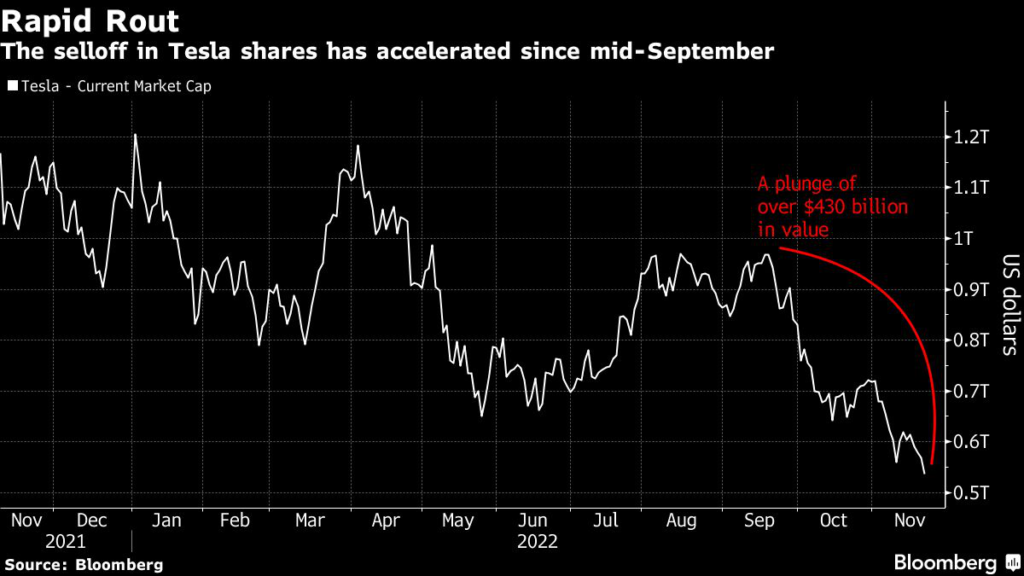
(Bloomberg) — The rout in Tesla Inc. shares is accelerating as a recall and signs of China’s return to Covid Zero curbs adds to a litany of investor concerns, with Chief Executive Officer Elon Musk focused on turning around Twitter Inc. 

The electric-vehicle maker’s stock dropped 6.8% at $167.87 in New York Monday, the lowest since November 2020. Trader anxiety was higher after a city near Beijing returned to lockdowns, putting both production and sales at risk. Tesla also initiated a recall of more than 300,000 cars due to faulty taillights. 

Tesla’s shares have lost nearly half of their value in less than two months as supply-chain snarls mount, raw-material costs soar and potential buyers feel the squeeze of stubborn inflation and rising interest rates.

On top of that, Musk has been preoccupied by his newly acquired social-media platform, leaving some investors to worry that Tesla’s strategy may fall to the wayside. 

“Weakening macro data in China is leading to concerns on Tesla, who has already lowered price once to stimulate demand and has a heavy export output in the first half of fourth quarter,” Cowen analyst Jeffrey Osborne wrote in a Friday note.

The analyst added that hedge funds seem to be shifting to a negative bias on the stock due to risk there’s been “a loss of focus” on Tesla since Musk acquired Twitter. 

The company’s recent stock decline marks a major retracement of several milestones reached during its meteoric rise in 2020 and 2021. 

Tesla was supplanted as the fifth-most valuable company on the S&P 500 Index by old-economy stalwart Berkshire Hathaway Inc. earlier this month. 

The car company, which lost its trillion-dollar-valuation status in late April, only needs its shares to tumble another 5.7% from current levels for the valuation to drop below $500 billion.

(Updates stock moves in second and ninth paragraphs.)

More stories like this are available on bloomberg.com

©2022 Bloomberg L.P.

Intel Foundry Leader to Depart, Shaking Up Gelsinger’s Turnaround Plan

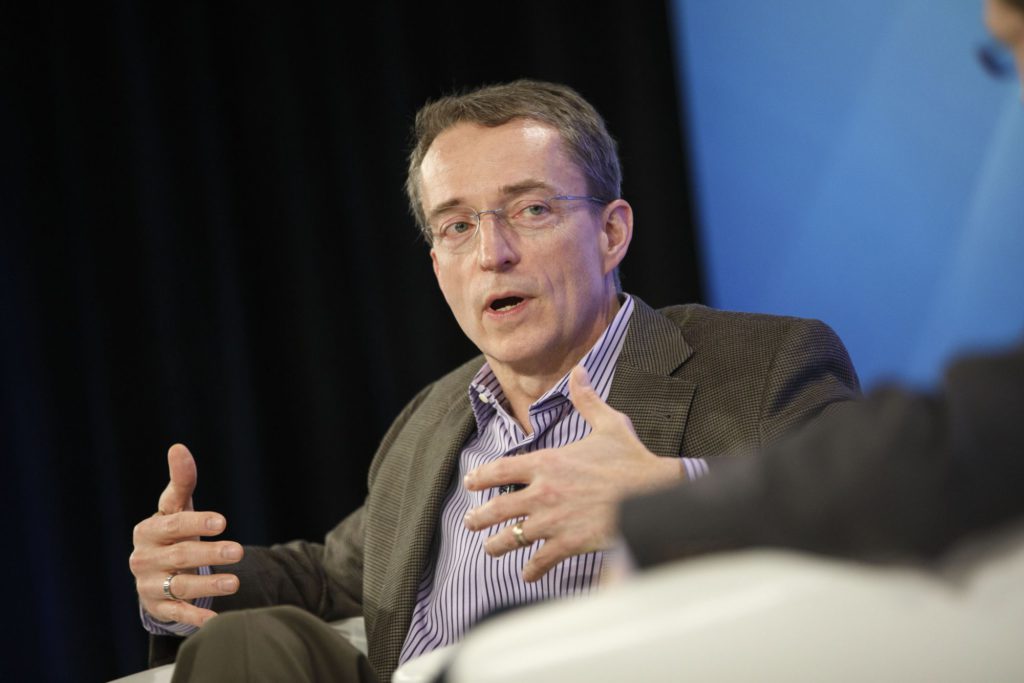
(Bloomberg) — Intel Corp. executive Randhir Thakur, who oversaw a key part of the company’s comeback plan — its push into the contract-manufacturing industry — is leaving the chipmaker. 

Thakur “has decided to step down from his position to pursue opportunities outside the company,” Intel said in an emailed statement. “He will stay on through the first quarter of 2023 to ensure a smooth transition to a new leader.”

The departure marks a shake-up for Chief Executive Officer Pat Gelsinger’s turnaround plan. After losing its role as the leader of the $580 billion chip industry, Intel has set out to expand its operations. That includes becoming a so-called foundry — a business that makes chips for other companies. It’s an area dominated by Taiwan Semiconductor Manufacturing Co. and Samsung Electronics Co., two companies that are unlikely to cede their territory easily. 

TSMC pioneered the modern foundry model, helping companies such as Apple Inc., Qualcomm Inc. and Advanced Micro Devices Inc. innovate and expand without the burden of running their own multibillion-dollar chip factories. 

Thakur had sought to get Intel on that same track. The effort has included plans to build new plants in the US and Europe, a wager that companies like Apple and Qualcomm will give Intel at least some of their business. 

Thakur will stay on until Intel completes its acquisition of Tower Semiconductor Ltd. It’s paying $5.4 billion for the provider of outsourced chip manufacturing. 

The Register earlier reported Thakur’s plan to leave Intel.

More stories like this are available on bloomberg.com

©2022 Bloomberg L.P.

Amazon Backed Out of Taking a Stake in Argo. Then the Self-Driving Startup Folded.

(Bloomberg) — Amazon.com Inc. emerged as a potential savior for Argo AI, the now-defunct startup backed by two of the world’s biggest automakers, before the deal fell apart because of a sputtering economy, concerns about control and flagging faith in fully autonomous driving.

The online retailer was prepared to invest several hundred million dollars into Argo last spring, according to people familiar with the matter who disclosed Amazon’s involvement for the first time. Amazon planned to use Argo’s self-driving technology to automate some of the electric delivery vans it’s buying from Rivian Automotive Inc., setting up a test fleet in multiple US cities.

Argo’s key backers — Ford Motor Co. and Volkswagen AG — were eager to attract a third partner to Argo to help shoulder the high cost of developing self-driving technology, the people said. VW’s then-Chief Executive Officer Herbert Diess even traveled to the US to meet with Amazon co-founder Jeff Bezos earlier this year to discuss the deal.

The budding relationship soured as Ford and VW grew wary that Amazon would divert Argo’s talent and attention, said the people, who asked not to be identified revealing internal deliberations. The companies also struggled to come up a governance structure for how they would share control of Argo. Additionally, the retail giant was turned off by the high cost of Argo’s technology, one of the people said.

Without Amazon on board, Argo was unable to attract other investors and bolster its credibility to eventually go public. Ford and VW last month shut down Argo, which at one time was valued at more than $7 billion.

Amazon didn’t immediately respond to a request for comment. Ford, VW and Rivian declined to comment, and Argo didn’t respond to a request for comment. 

Amazon’s pullout and Argo’s sudden demise underscores the start-and-stop progress toward cars and trucks that will drive themselves. 

Read more: Tesla, Ford and VW sound death knell for driverless cars 

Skepticism has been growing about the commercial viability of full self-driving cars at a time when global automakers are investing billions to shift to electric vehicles to meet increasingly stringent regulations to combat climate change. Even so, the investment community was caught off guard when Argo abruptly ran aground. 

Argo’s Promise

Founded by autonomy all-stars Bryan Salesky, an alum of Google’s self-driving car project now known as Waymo, and Pete Rander, a former leader of Uber Technologies Inc.’s robo-taxi unit, Argo was highly regarded for its technical skills and big-name backers. 

Ford originally invested $1 billion in Argo in 2017 to get the company off the ground, with VW following with a $2.6 billion investment completed in 2020.

Now Ford, which is spending $50 billion on electric vehicles through 2026, has abandoned plans to pursue full self-driving and instead is focusing on semi-autonomous technology like its Blue Cruise hands-free driving feature. Chief Executive Officer Jim Farley has said Ford will hire hundreds of Argo employees to work on semi-autonomous features.

Ford ultimately concluded that the payoff on the breakthroughs required for robo-taxis and driverless delivery would be more than five years away.

Doug Field, Ford’s chief advanced technology officer, called full-self driving “the hardest technical problem of our time. It’s harder than putting a man on the moon.”

Enter Amazon

But a year ago, Ford and VW still saw a path forward for Argo if it could attract additional investment. Amazon’s interest sparked hope that Argo had found the third big backer it had long sought.

It also dovetailed with Amazon’s deal with Rivian to buy 100,000 electric delivery vans by the end of the decade. Ford and Amazon had been early investors in Rivian, though Ford has since reduced its stake.

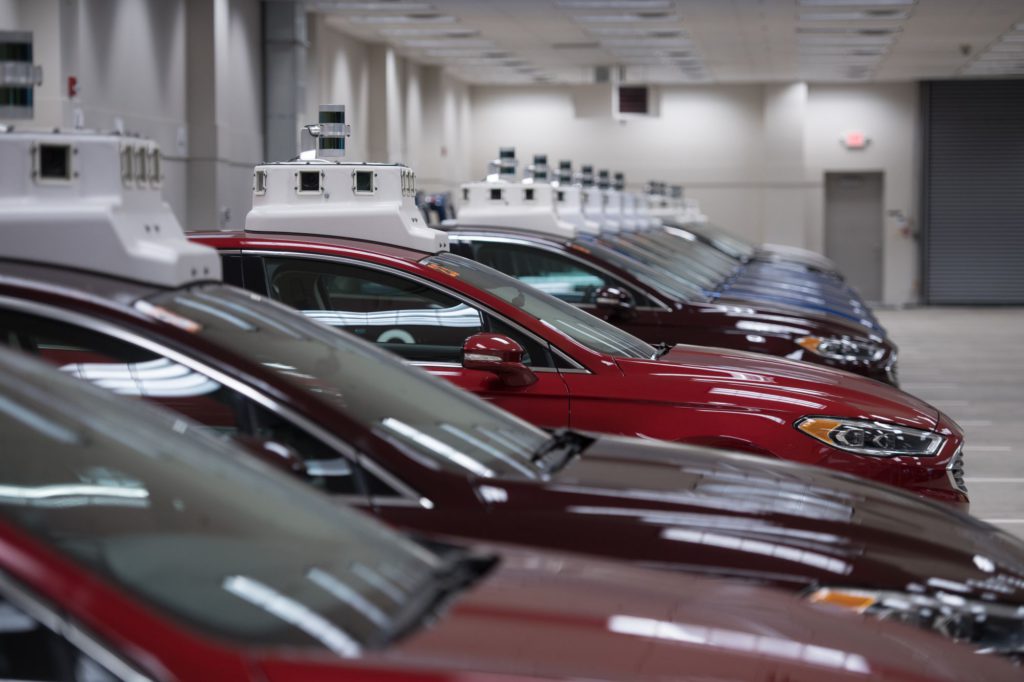
Argo and Amazon first began working together with a pilot project in Miami in 2019. A test fleet of Ford Fusion hybrids outfitted with Argo’s self-driving system ran pre-determined routes from an Amazon warehouse to final destinations — dry runs of so-called last-mile delivery. No packages were actually delivered, but Amazon liked what it saw, the people said. 

By early this year, there was so much optimism that Amazon would do a deal with Argo that the self-driving firm staffed up to work on outfitting the Rivian vans with autonomous technology, the people said. Argo hired about 150 people to work on the Amazon business, bringing its global workforce to more than 2,000. 

The plan called for Amazon to steadily increase its investment in Argo as the partnership achieved major milestones, the people said.

Dealmakers Depart

But by spring, Ford and VW still hadn’t agreed to terms on sharing Argo with Amazon. Ford would eventually acquiesce. VW remained wary that Amazon — with a reputation for dominating partnerships — would draw talent and resources away from the German automaker’s ambitious self-driving strategy, according to the people. 

At about that time, Russia’s invasion of Ukraine further destabilized a global economy dealing with supply-chain issues and, in the US, the highest inflation in 40 years. Suddenly, spending billions on a still-unproven technology didn’t look like a such a good bet.

And then key players involved in the deal began departing their companies. At Amazon, the mergers and acquisitions executive championing the deal and working directly with Argo left. Around the same time, Dave Clark, CEO of Amazon’s consumer business, also exited.

Talks lost momentum and then the biggest exit occurred. VW CEO Diess, architect of the automaker’s investment in Argo and a driver of the Amazon deal, was ousted by the board amid concerns about the company’s direction and a debacle with glitchy software in its cars. Only three months earlier he had tweeted an image from happier times, when he was discussing VW’s own electric cars with Bezos.

With the Amazon deal dead, Argo had to lay off the 150 employees it hired to work on the new business. The shifting economy has taken a toll as well on Amazon, which is planning some 10,000 layoffs of its own.

There was one glimmer of hope. VW considered an 11th-hour bailout of Argo this fall when Ford determined it would no longer fund the self-driving firm, the people said. VW looked at covering Ford’s investment in Argo and taking it over completely. Instead, VW invested $2.3 billion to set up an autonomous driving joint venture with China’s Horizon Robotics Inc. 

With self-driving sentiment in retreat and investors closing their wallets, Argo ultimately had nowhere left to turn.

More stories like this are available on bloomberg.com

©2022 Bloomberg L.P.

Tiger Global’s Now-Worthless FTX Bet Had Bain’s Due Diligence

(Bloomberg) — Bain & Co. was among consulting firms that helped conduct due diligence for Tiger Global Management’s investment in now-defunct crypto exchange FTX, according to people familiar with the matter. 

Tiger Global, which pays Bain more than $100 million a year to research private companies, has now written down its $38 million FTX stake to zero, the people said. Sam Bankman-Fried’s oversight of a vast web of FTX-linked entities was one of the risks highlighted during the due-diligence process, but the money manager still believed it was a sound investment at the time, one of the people said. 

A representative for Chase Coleman’s Tiger Global declined to comment, and Bain didn’t immediately reply to messages seeking comment.  

This month’s implosion of FTX has caused billions of dollars of potential losses for investors and sparked legal and regulatory probes. It also prompted questions about how warning signs were missed by institutional investors, including hedge funds and venture capital firms. Ontario Teachers’ Pension Plan was among them, writing off its entire $95 million investment, while Sequoia Capital marked down its $214 million wager to zero. 

Read more: Investor Studied Crypto For Years, Then Missed FTX’s Red Flags

Tiger Global’s FTX investment was a tiny portion of its $12.7 billion Private Investment Partners 15 fund. The firm first backed FTX in October 2021, when the crypto exchange was valued at $25 billion, and again in January at a $32.5 billion valuation, according to PitchBook data.

The FTX bet was one of 358 venture capital investments Tiger Global made last year, and one of 290 so far in 2022, according to PitchBook. 

More stories like this are available on bloomberg.com

©2022 Bloomberg L.P.
‘Astounding’ $575 Million Crypto Fraud Yields Arrests in Estonia

(Bloomberg) — Two Estonian men arrested in their nation’s capital were charged in the US with defrauding hundreds of thousands of people worldwide in a $575 million cryptocurrency fraud and money-laundering conspiracy.

Sergei Potapenko and Ivan Turogin, both 37, persuaded victims to enter into fraudulent rental contracts for crypto mining equipment and to invest in a virtual currency bank that wasn’t really a bank, the Justice Department said Monday in a statement.

In an indictment unsealed in Seattle federal court, Potapenko and Turogin were also accused of using shell companies to launder the fraud proceeds through at least 75 real estate properties, six luxury vehicles, cryptocurrency wallets and thousands of crypto mining machines.

“The size and scope of the alleged scheme is truly astounding,” said Seattle US Attorney Nick Brown. “These defendants capitalized on both the allure of cryptocurrency, and the mystery surrounding cryptocurrency mining, to commit an enormous Ponzi scheme.”

More stories like this are available on bloomberg.com

©2022 Bloomberg L.P.
Musk Fires More Twitter Sales Workers After ‘Hardcore’ Purge

(Bloomberg) — Elon Musk laid off more Twitter Inc. workers from the sales side of the social network’s business beginning late on Sunday, further trimming a staff that had already been decimated by cuts and resignations.

Last week, Musk had asked workers to commit to his more “hardcore” version of the company or leave. Sales employees signed on to his vision in greater numbers than workers on the technical side, which saw mass resignations, according to people familiar with the matter. Musk is using the cuts to balance out the remaining staff, said the people, who asked not to be identified discussing internal decisions.

Some of those who were fired started to receive notice on Sunday, according to two people familiar with the matter, though it’s unclear how many will be impacted in the current round. Platformer earlier reported the news.

Twitter’s sales organization held an all-hands meeting on Sunday with Musk and the new head of sales, Chris Riedy, two people said. Many employees showed up expecting some announcement about cuts, after Bloomberg reported Saturday that more were coming. Instead, Musk used the time to talk about ongoing updates, including his decision to reinstate the account of former US President Donald Trump, one of the people said. He also explained that the company needed to make ads more targeted to particular users, according to another person familiar with the remarks. There was no mention of layoffs during the meeting. 

Employees who were cut received notice via emails entitled: “Your Role at Twitter.”

“After further review of our workforce, we have identified roles within our organizational structure that are no longer necessary,” the note reads, according to a copy seen by Bloomberg. “Today is your last working day at the company.” The note, which goes on to explain that details on severance and returning company property is coming later, is signed, “Twitter.”

An internal counter of employees currently reads 2,750, one person said, though some resignations and cuts may still be in the process of being counted. Twitter had more than 7,000 employees before Musk took over in late October.

–With assistance from Ed Ludlow.

(Updates with job cut memo in fifth paragraph)

More stories like this are available on bloomberg.com

©2022 Bloomberg L.P.
US Stocks Pare Drop After Comments From Fed’s Daly: Markets Wrap

(Bloomberg) — US stocks trimmed declines after San Francisco Federal Reserve President Mary Daly warned that too much tightening could be “unnecessarily painful” for the economy. Mounting concerns that China may tighten Covid curbs after a string of reported deaths continued to weigh on investors.

The S&P 500 and the Nasdaq 100 fell, but are off session lows. Crude futures pared losses after Saudi Arabia denied a report that it is discussing an oil-production increase for the OPEC+ meeting next month. The dollar gained as investors sought haven assets. Treasury yields dipped.

Investors are closely watching what Fed speakers say about the outlook for interest rates. While several central bank officials in recent days have reiterated their resolve to keep raising rates, they differ on how far they’ll go. On Monday, Daly said that officials will need to be mindful of the lags with which monetary policy is transmitted through the economy as they raise interest rates further in order to drive down inflation.

“This shouldn’t be regarded as a pivot or anything new,” Michael Contopoulos, director of fixed income at Richard Bernstein Advisors, said about Daly’s comments. “A real pivot is when the Fed starts to cut rates and/or pause quantitative tightening. That is no where in sight.”

Atlanta Fed President Raphael Bostic, meanwhile, has said he favors slowing the pace of interest rate increases, with no more than 1 percentage point more of hikes, to try to ensure the economy has a soft landing. Boston Fed President Susan Collins has reiterated her view that options are open for the size of the December interest-rate increase, including the possibility of a 75 basis-point move.

Traders this week will also be looking to minutes of the most recent Fed policy meeting for further clues on the central bank’s path ahead. 

“For the Fed right now, if we do get some slowing in inflation — which it seems like we might — but you’re not seeing it in the slowing of service inflation, that’s related to a tight labor market,” Veronica Clark, economist at Citigroup, said Monday on Bloomberg Television. “You do need to see that loosening in the labor market data.” 

Meanwhile, China saw its first Covid-related death in almost six months on Saturday and another two were reported on Sunday. Worsening outbreaks across the nation are stoking concerns that authorities may again resort to harsh restrictions. Shutdowns could have a negative impact on supply chain dynamics and possibly exacerbate inflation issues across economies. 

“China is such a large portion of global growth. It matters. So that’s why what news was this morning I think was so important,” Lindsay Rosner, multi-sector portfolio manager at PGIM Fixed Income, said by phone. “There is not an expectation in the market of a complete removal of the zero Covid policy. But I think if Covid has taught any of us anything is that it can’t be predetermined.”

Key events this week:

  • US Richmond Fed manufacturing index, Tuesday
  • OECD releases Economic Outlook, Tuesday
  • Fed’s Loretta Mester and James Bullard speak, Tuesday
  • S&P Global PMIs: US, Euro area, UK, Wednesday
  • US MBA mortgage applications, durable goods, initial jobless claims, University of Michigan sentiment, new home sales, Wednesday
  • Minutes of the Federal Reserve’s Nov. 1-2 meeting, Wednesday
  • ECB publishes account of its October policy meeting, Thursday
  • US stock and bond markets are closed for the Thanksgiving holiday, Thursday
  • US stock and bond markets close early, Friday

Some of the main moves in markets :

Stocks

  • The S&P 500 fell 0.2% as of 1:48 p.m. New York time
  • The Nasdaq 100 fell 0.8%
  • The Dow Jones Industrial Average rose 0.1%
  • The MSCI World index rose 0.6%

Currencies

  • The Bloomberg Dollar Spot Index rose 0.8%
  • The euro fell 0.9% to $1.0235
  • The British pound fell 0.7% to $1.1803
  • The Japanese yen fell 1.3% to 142.16 per dollar

Cryptocurrencies

  • Bitcoin fell 1.8% to $15,963.78
  • Ether fell 3.4% to $1,102.52

Bonds

  • The yield on 10-year Treasuries was little changed at 3.83%
  • Germany’s 10-year yield declined two basis points to 1.99%
  • Britain’s 10-year yield declined five basis points to 3.19%

Commodities

  • West Texas Intermediate crude was little changed
  • Gold futures fell 0.8% to $1,755.20 an ounce

This story was produced with the assistance of Bloomberg Automation.

–With assistance from Isabelle Lee, John Viljoen and Catarina Saraiva.

More stories like this are available on bloomberg.com

©2022 Bloomberg L.P.
Biggest Bitcoin Fund Hits 45% Discount as Parent’s Woes Deepen

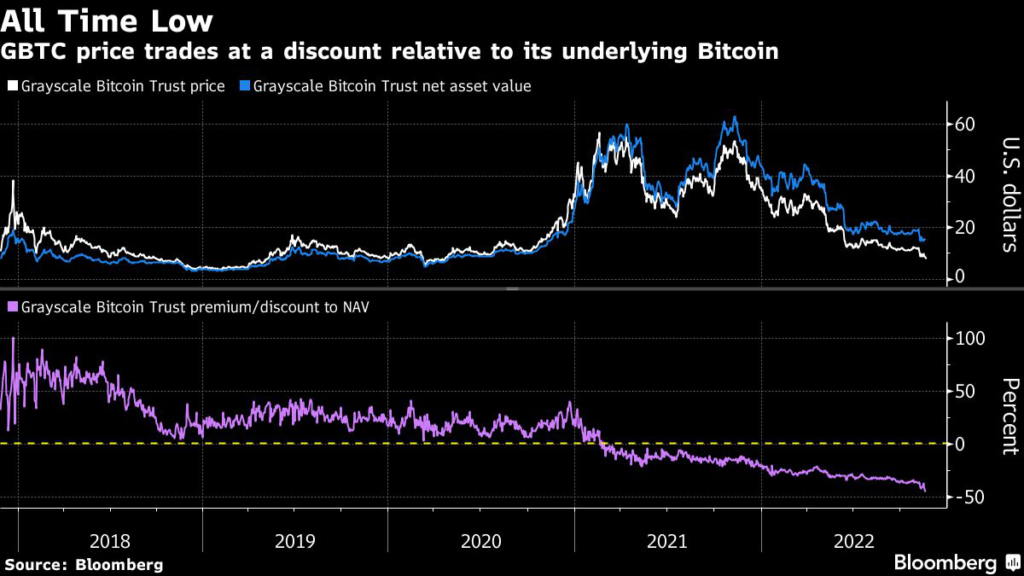
(Bloomberg) — Cascading crypto blowups have only exacerbated problems for Grayscale’s $10.5 billion Bitcoin fund. 

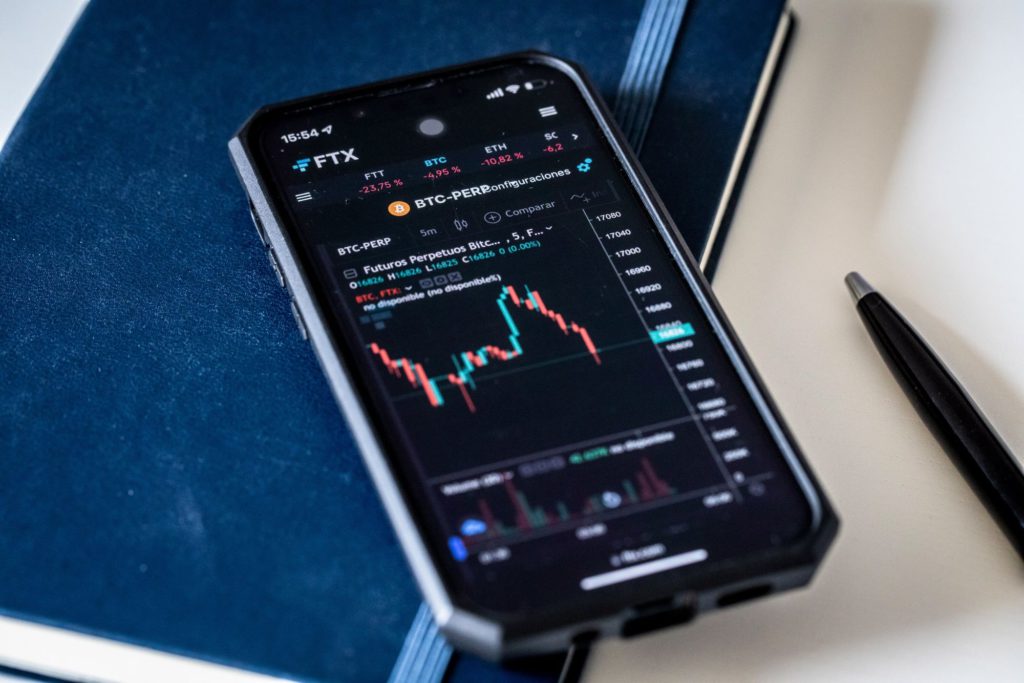
The Grayscale Bitcoin Trust (ticker GBTC) closed a record 45% below the value of its underlying coins on Friday, according to Bloomberg data. The shares fell another 5% on Monday. The dislocation has widened dramatically in recent weeks as GBTC — which can’t redeem shares to shift with cooling demand as traditional ETFs do — has fallen to a greater degree than Bitcoin itself.

Shares are being offloaded in the secondary market as the industry deals with shockwaves from crypto-exchange FTX’s bankruptcy this month. That sent the likes of Genesis into a tailspin, with the lender halting withdrawals last week — fueling questions about the health of its parent company, Digital Currency Group, which also controls digital-asset manager Grayscale Investments. Fears of fallout among already shellshocked investors likely explains why GBTC is selling off to a greater degree than Bitcoin itself, according to Bloomberg Intelligence.

“There is a lot of concern and news reports and rumors about DCG, the parent of Grayscale,” Bloomberg Intelligence analyst James Seyffart said. “I think people just want to get away from anything that could be coming down, even if it’s only a remote possibility.”

A Grayscale representative didn’t immediately return an email for comment. 

GBTC’s share price has plunged 77% in 2022, compared with Bitcoin’s 65% fall. While GBTC has soared 1,000% since the end of 2015, the world’s largest cryptocurrency has surged more than 3,600% in that time frame.

Bloomberg Intelligence estimates that GBTC holds more than 3% of all mined Bitcoin, which is custodied with Coinbase Global. On Friday, Grayscale shared a letter from Coinbase Chief Financial Officer Alesia Haas saying that the trust’s coins are in cold storage and can’t be lent out. 

Grayscale has few options for narrowing the discount beyond converting into a physical Bitcoin exchange-traded fund, a structure that US regulators have repeatedly denied. It’s unlikely that the firm would opt to liquidate GBTC given that the product generates a hefty annual recurring revenue through its fees, according to a Bloomberg Intelligence report. Additionally, there’s no longer an option for shareholders to force a liquidation through a proxy vote, the report said. 

–With assistance from Vildana Hajric.

More stories like this are available on bloomberg.com

©2022 Bloomberg L.P.
Biden Promises No ‘Fowl Play” at Chocolate and Chip Turkey Pardoning

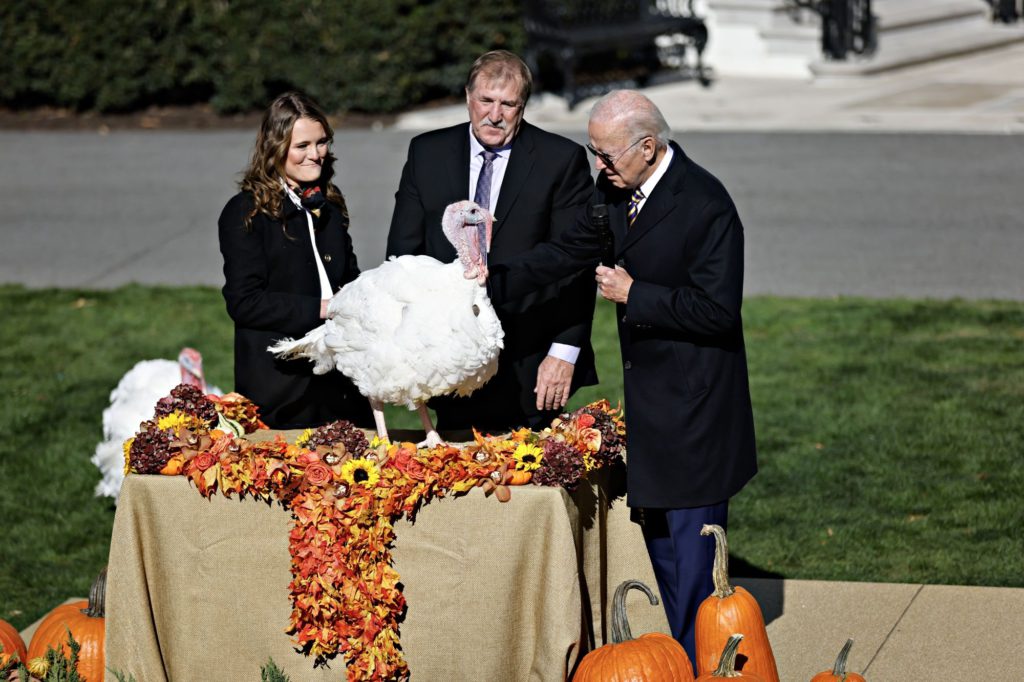
(Bloomberg) — President Joe Biden made light-hearted references to Democrats’ success in the midterm elections as he pardoned two turkeys, Chocolate and Chip, in what has become a quirky Thanksgiving tradition under presidents of both parties.

“The votes are in, they’ve been counted, verified. There’s no ballot stuffing, there’s no ‘fowl’ play,” Biden joked Monday during the ceremony on the White House’s South Lawn. He added the “only red wave this season” would be if his German shepherd, Commander, knocked over the cranberry sauce at Thanksgiving dinner. 

Biden’s remarks were repeatedly interrupted by the turkeys gobbling and Commander’s barking. The president also subtly likened the turkeys to potential presidential challengers two years from now.

“They interacted with the children to show their softer side,” he said. “Sounds like another flock hoping to come to Washington in 2024.”

The turkey pardoning tradition has a hotly debated origin. Some say Abraham Lincoln was the first to grant clemency to a turkey, while others give credit to Harry Truman for beginning the tradition. 

Past presidents, including Ronald Reagan, endured memorable press conferences when the turkeys attempted to fly away. It became an annual event under President George H.W. Bush in 1989.

This year’s birds were reared near Monroe, North Carolina.

The pardoning comes after November midterms where Biden’s Democrats performed better than expected amid voter anxiety about soaring inflation.

Thanksgiving dinners in the US will cost 20% more this year than last year, according to the Farm Bureau. 

The average cost of the traditional feast for 10 is $64.05, according to the survey, up from last year’s average of $53.31. The Farm Bureau dinner includes prices for turkey, stuffing, sweet potatoes, rolls with butter, peas, cranberries, a veggie tray, pumpkin pie with whipped cream, and coffee and milk.

Later Monday, the president and first lady Jill Biden will travel to Cherry Point, North Carolina, to share a “Friendsgiving” dinner with service members and their families. 

Biden at the pardoning, said chocolate is his favorite ice cream flavor, but joked the birds could have been named “Chips and Science,” a reference to a law he signed in August to boost domestic manufacturing of semiconductors. 

–With assistance from Nancy Cook, Lindsey Rupp and Jordan Fabian.

More stories like this are available on bloomberg.com

©2022 Bloomberg L.P.
Biden Promises No ‘Fowl Play’ at Chocolate and Chip Turkey Pardoning

(Bloomberg) — President Joe Biden made light-hearted references to Democrats’ success in the midterm elections as he pardoned two turkeys, Chocolate and Chip, in what has become a quirky Thanksgiving tradition under presidents of both parties.

“The votes are in, they’ve been counted, verified. There’s no ballot stuffing, there’s no ‘fowl’ play,” Biden joked Monday during the ceremony on the White House’s South Lawn. He added the “only red wave this season” would be if his German shepherd, Commander, knocked over the cranberry sauce at Thanksgiving dinner. 

Biden’s remarks were repeatedly interrupted by the turkeys gobbling and Commander’s barking. The president also subtly likened the turkeys to potential presidential challengers two years from now.

https://t.co/ZugiKevier

— President Biden (@POTUS) November 21, 2022


“They interacted with the children to show their softer side,” he said. “Sounds like another flock hoping to come to Washington in 2024.”

The turkey pardoning tradition has a hotly debated origin. Some say Abraham Lincoln was the first to grant clemency to a turkey, while others give credit to Harry Truman for beginning the tradition. 

Past presidents, including Ronald Reagan, endured memorable press conferences when the turkeys attempted to fly away. It became an annual event under President George H.W. Bush in 1989.

This year’s birds were reared near Monroe, North Carolina.

@POTUS pardons Thanksgiving turkeys: Chocolate and Chip. (Chocolate chip is Biden’s favorite ice cream flavor.) pic.twitter.com/9xU7I7q87F

— Akayla Gardner (@gardnerakayla) November 21, 2022


The pardoning comes after November midterms where Biden’s Democrats performed better than expected amid voter anxiety about soaring inflation.

Thanksgiving dinners in the US will cost 20% more this year than last year, according to the Farm Bureau. 

The average cost of the traditional feast for 10 is $64.05, according to the survey, up from last year’s average of $53.31. The Farm Bureau dinner includes prices for turkey, stuffing, sweet potatoes, rolls with butter, peas, cranberries, a veggie tray, pumpkin pie with whipped cream, and coffee and milk.

Later Monday, the president and first lady Jill Biden will travel to Cherry Point, North Carolina, to share a “Friendsgiving” dinner with service members and their families. 

Biden at the pardoning, said chocolate is his favorite ice cream flavor, but joked the birds could have been named “Chips and Science,” a reference to a law he signed in August to boost domestic manufacturing of semiconductors. 

–With assistance from Nancy Cook, Lindsey Rupp and Jordan Fabian.

More stories like this are available on bloomberg.com

©2022 Bloomberg L.P.

Close Bitnami banner
Bitnami