Bloomberg

Cristiano Ronaldo Hits 500 Million Instagram Followers After Louis Vuitton Ad

(Bloomberg) — Cristiano Ronaldo became the first person to pass 500 million followers on Instagram after posting a Louis Vuitton ad featuring himself and fellow football player, Lionel Messi.

The only account with more followers is Meta Platforms Inc.-owned Instagram’s official page, a spokesperson for the social media website confirmed. Argentina’s Messi is the second-most-popular celebrity with 376 million followers, according to his account’s statistics. He’s closely followed by Kylie Jenner, with 372 million.

In the ad, Ronaldo and Messi, who are competing for their national teams at the World Cup in Qatar, lean on Louis Vuitton-branded trunks while playing chess. The Portuguese player posted the image, shot by photographer Annie Leibovitz, on Saturday.

The photo had gathered more than 36.8 million likes by Monday. The most-liked photo ever on the platform remains the post of the World Record Egg, with 55.9 million likes accumulated since 2019, a spokesperson for Instagram said, adding that the company only keeps data for the past three months.

In 2010, Leibovitz also photographed another generation of football players for the trunk maker. That ad featured Pele, Zinedine Zidane and the late Diego Maradona and was also launched ahead of that year’s World Cup.

A Louis Vuitton representative said it was the first time both players participated in an ad for the French brand, but declined to say how much each is making from this commercial.

In an Instagram post, Antoine Arnault, who heads image and communications at the luxury conglomerate LVMH Moet Hennessy Louis Vuitton SE said he was “really proud” of having helped bring about this campaign. He described the players as “two kings. Two idols.”

Since the World Cup started, Ronaldo, 37, has also posted ads for cryptocurrency exchange platform Binance and an anti-dandruff shampoo brand.

More stories like this are available on bloomberg.com

©2022 Bloomberg L.P.

NASA’s Orion Capsule Comes Within 81 Miles of the Moon On Way to Lunar Orbit

(Bloomberg) — NASA’s new Orion crew capsule came within 81 miles of the lunar surface Monday. Its path also took the spacecraft over the Apollo 11 landing site, Tranquility Base, where astronauts first landed on the moon in 1969.

The flyby occurred after Orion ignited its main engine for 2 1/2 minutes, a critical maneuver that put the vehicle on course to enter the moon’s orbit later this week. 

The lunar approach is part of NASA’s Artemis I mission, which launched from Florida early on Nov. 16. The flight is the first major mission in the space agency’s Artemis program, which aims to send the first woman and the first person of color to the moon.

No astronauts are on board Orion. Artemis I is testing the hardware that NASA plans to use to send people to the the moon in the future.

Since its launch on top of NASA’s new Space Launch System rocket, Orion has spent the last 5 days on its way to lunar orbit. The capsule must perform a series of engine burns, as well as harness the gravity of the moon to put Orion into an elongated orbit known as a distant retrograde orbit.

Monday’s burn was one of two major maneuvers that Orion must do to enter lunar orbit. On Nov. 25 at around 4:52 p.m., Orion will perform a second burn to insert itself into orbit, where it will remain for about a week before leaving on the journey home. While in orbit around the moon, Orion will travel beyond 248,655 miles (400,170 kilometers) from Earth. That’s the farthest a vehicle made for humans has ever traveled before.

Orion performed its engine burn Monday morning while traveling on the far side of the moon, during a communication blackout from Earth. Once the vehicle emerged from the blackout, NASA was able to acquire its signal again and Orion sent down images of a distant planet Earth, appearing as a tiny orb surrounded by darkness.

More stories like this are available on bloomberg.com

©2022 Bloomberg L.P.

‘Alameda Gap’ Seen Drying Up Liquidity Across Crypto Markets

(Bloomberg) — The wipeout of Sam Bankman-Fried’s crypto empire, including its crown jewel FTX exchange and sister trading desk Alameda Research, is helping to reduce liquidity across the crypto market. 

The decline has been dubbed the “Alameda Gap” by blockchain-data firm Kaiko, named for the trading group at the center of the storm which is closing its books. Plunges in liquidity usually come during periods of volatility as trading shops pull bids and asks from their order books to better regulate risks, Kaiko noted in a Nov. 17 newsletter. 

“The Alameda Gap in liquidity could be here to stay, at least in the short term,” wrote the analysts.  

These market makers fulfill an especially valuable role in the liquidity-sensitive crypto space by buying and selling coins. But as they turn more conservative in times of crisis, that results in thinner liquidity where users have greater difficulty buying or selling an asset, which in turn makes the market more volatile, said Hank Huang, chief technology officer at Kronos Research. 

“Market makers are shutting off or getting funds into a safe place first,” added Tiantian Kullander, co-founder of Singapore-based crypto trading platform Amber Group, adding that they’re “awaiting the storm to pass.”

Bankman-Fried’s bankrupt crypto empire owes its 50 biggest unsecured creditors a total of $3.1 billion, court papers released Sunday show, with a pair of customers owed more than $200 million each. The creditors, whose names and locations weren’t disclosed, are among the vast array of people and institutions caught up in FTX’s insolvency.


Kaiko measures the market’s liquidity by calculating the quantity of bids and asks within 2% of the mid-price for one token’s trading pairs on exchanges. The metric for Bitcoin trading pairs denominated in US dollars and Tether across centralized exchanges dropped to its lowest level since early June, Kaiko said in a Nov. 11 report. 

To be sure, some market makers have pointed out that the impact of Alameda winding down its business is not as severe as FTX’s collapse, as both Amber and Kronos’s Huang said they noticed Alameda had not been as active market-making recently. Its biggest impact may have been on the Solana ecosystem, where it was a major backer of the protocol. 

In fact, some of the biggest crypto market makers remain active, despite being affected by FTX’s meltdown.

Chris Zuehlke, global head at Cumberland — the crypto offshoot of trading giant DRW — said that his firm saw “a pretty big uptick” in trading activity, as its exposure to FTX was limited to under $10 million. 

Other large market makers have also disclosed their exposure to FTX, including Jump Crypto, the digital-asset division of Jump Trading, and London-based trading shop Wintermute. 

Zuehlke added that one positive outcome of the FTX fallout is that large market players could soon change the process for how they determine whom to trade, lend and borrow with. 

“The crypto industry, the news and assets all inherently move at a higher velocity than you’ve seen in traditional markets,” he explained. “And I think in order to operate effectively and efficiently in that environment, you need to develop policies and procedures on the risk-management side that take all that into account.”

Meanwhile, there has been an increase in activity on major decentralized exchanges, with total volume surging by more than 45% in the past 30 days, according to data from DefiLlama. 

“A lot of the market makers themselves are even more interested in DeFi,” said Antonio Juliano, founder and CEO of decentralized exchange dYdX. “I do think it’s going to be directionally positive long term.”

Cold storage wallets and decentralized exchanges are likely to be the big winners here, notes Kaiko. “I say should because history has shown us investors have short memories, repeating the same mistakes over and over,” wrote the analysts. 

More stories like this are available on bloomberg.com

©2022 Bloomberg L.P.

EV Battery Heavyweights Revive City’s Dream of Factory Glory

(Bloomberg) — In the race to build a North American hub to support the electric-vehicle industry and challenge China’s dominance, one tiny Quebec community is charging ahead.

Becancour is drawing corporate giants to the French-speaking Canadian province with its ambitions to make this industrial outpost, halfway between Montreal and Quebec City, a key gear for an EV battery supply chain to serve the continent.

The community of 14,000 people on the southern shore of the St. Lawrence River has attracted at least a dozen companies focused on the EV battery industry since March. Germany’s BASF SE, the world’s largest chemical maker, secured industrial land on Becancour’s outskirts for a battery materials and recycling site. Brazilian mining giant Vale SA is looking to build a nickel sulfate plant in this area. General Motors Co. has already agreed to be a customer.

Ford Motor Co. is in talks with Korean battery firms to construct a $700 million cathode factory here, while GM is partnering with South Korea’s Posco Chemical Co. Ltd. to erect a $400 million plant to produce materials for the US automaker’s EV battery platform, starting in 2025.

“Becancour really stood out as being extremely attractive, it’s kind of perfectly nestled between Canadian mineral sources and our factories,” said David Paterson, a vice president at GM Canada. “The most important benefit is Quebec’s hydroelectricity — when you compare prices of electricity, Quebec wins anywhere in North America.”

Besides cheap, renewable power that can feed an energy-intensive manufacturing industry, Becancour’s other competitive advantages include ease of access to US and European markets via major roads, railways and shipping along the St. Lawrence. The city is also close to a resource-rich region of Quebec that boasts an abundance of battery metal deposits.

Becancour is an example of how industry is pushing to regionalize supply chains to meet an anticipated surge in demand for electric vehicles. The epic shift to EVs has sparked a global rush to lock in supplies of lithium, nickel, cobalt and other key ingredients to fill future demand. Meanwhile, strained logistics and China’s dominance from mining to refining have underscored the need for several battery hubs worldwide, along with access to the raw materials needed to feed the industrial complex.

Canada already shows promise for developing a supply chain for lithium-ion batteries due to its abundant resources and environmental standards, with the nation taking second spot in a global ranking by BloombergNEF.

“China is still leading the way, but Canada has shown it is the future of the lithium-ion battery supply chain,” said Ellie Gomes-Callus, an analyst with Bloomberg’s energy and data analysis unit. “While cell manufacturing and demand are musts, having raw materials and high ESG performance go a long way.”

Quebec’s government also has coherent policies supporting development of an EV battery supply chain. The province’s investment arm acts as a venture capitalist and provides substantial backing for critical mineral projects, giving a vote of confidence and enticing private capital. Investissement Quebec takes equity stakes in some projects it considers vital and offers loans that can be partly forgiven and carry favorable interest rates.

Quebec invested in Canada’s only advanced lithium project when it took a stake in Nemaska Lithium Inc. after its 2019 collapse when prices of the silvery white metal plunged. Livent Corp., the world’s third-largest lithium producer, also invested.

Today, Nemaska is betting big on Becancour. The firm plans to open a facility within five years to produce battery-grade lithium hydroxide with materials from a mine it’s developing in northern Quebec. Involvement from the provincial government has been key.

“They provide us with the energy, provide us with the infrastructure, and back it with policies that allow us to get the funding we need,” Livent Chief Executive Officer Paul Graves said.

Becancour has tried many times since the 1960s to become a world-class industrial hub, but the global energy transition is bringing new optimism to the area even if there’s little sign of an imminent battery-fueled boom — yet. The “downtown” is just a scattering of houses and businesses peppered along a two-lane road, with the settlement quickly fading into empty fields bisected by highways. On the city’s eastern edge lies an industrial park, dominated by a 1980s-era aluminum smelter that looms over a cluster of manufacturing facilities.

Still, Quebec has spent C$350 million ($260 million) in Becancour on infrastructure to link undeveloped industrial lands owned by the government. Work has already begun, with construction crews prepping a gravel roadbed for paving. Freshly dug trenches nearby hold stacks of concrete pipes.

One beneficiary will be Nouveau Monde Graphite Inc., which bought a site for a C$923 million plant that could start producing battery materials in three years — providing it can raise enough money to build facilities. Like a prospector staking a claim, the Quebec-based firm has erected a giant roadside sign that declares “Nouveau Monde Graphite: Future Site” in French.

Becancour’s future hinges on turning words and expressions of interest into firm commitments. Some projects depend on financing that has yet to be secured, while others require approvals and permits to proceed. With several North American jurisdictions jockeying to be the next big spot for an industrial hub built on EV batteries, delays and broken promises could be a devastating blow to ambitious dreams. Understandably, skepticism lingers.

“You need serious financial backing, you need a good mix of debt and equity,” said J-P Martins, who advises firms on battery supply chain issues at consultancy Partners in Performance. “You can’t get there just with a spreadsheet and some drawings of your plant and some lab results. You need customers, you need secured supply chain.”

Quebec and Becancour are pitted against the US in attracting EV and battery investments. So far, the southern neighbor is winning. Ford said a year ago that it would invest $11.4 billion in Tennessee and Kentucky to build two EV hubs, the largest outlay in its history. GM set a company record with its $6.5 billion investment in Michigan in January.

Doubts are understandable because past projects haven’t worked out, said Donald Olivier, who heads the government entity that manages Becancour’s industrial park. “That skepticism will fade when people see the investors’ machinery coming in.”

Becancour is on the right track to be the next battery hub as long as big investment picks up, said Chris Berry, president of consultancy House Mountain Partners.

“We just need to get a lot more money coming into the space, and we need to see it soon.”

The federal and provincial government — which both have strategies to expand development of critical minerals and supply chains — are keen to make Quebec a North American supplier of EV battery components. Quebec’s investment alone in Becancour could reach C$3 billion, Economy Minister Pierre Fitzgibbon said. He’s been at the heart of discussions around the area’s development and expects to announce two to three more projects in the coming months. Still, he recognizes this small city has limits.

“Just with the announced projects, we will be at 3,000 to 4,000 workers,” Fitzgibbon said. “It will take infrastructure and housing. We have time, but we will have to work hard.”

More stories like this are available on bloomberg.com

©2022 Bloomberg L.P.

Objects of Wonder: 11 Holiday Gift Ideas That Are Truly Magical

(Bloomberg) — Every year, the team at Bloomberg Pursuits creates a whole slew of gift guides—steering our readers toward the best spirits, or the most extravagant luxury trinkets, or items that aren’t even physical gifts at all! But this year we wanted to get back to what’s best about the act of giving: sparking a sense of wonder in someone. To that end, here are 11 of the most enchanting objects we’ve seen in our many years of research on these guides. Each of them has curiosity built into the gift itself, and you’ll find that many offer a new view into nature, life or just your bedroom at home. These are our 2022 Gifts of Wonder.

Dandelight, by Studio Drift


This piece of artwork for your desk or shelf combines delicate phosphorus bronze and real dandelion seeds underneath a glass dome for a visually compelling sculpture that emphasizes the fragility—and power—of life. Dandelions are often viewed as weeds, but what child hasn’t found joy in picking up a bloom and blowing to watch the seeds scatter into the air? For this sculpture, flowers are hand-picked in the Netherlands, and the seeds are then connected by hand to an LED light, one by one, to create a flower that glows dreamily from within. The visible battery adds to the bare, bold aesthetic. Studio Drift; $515

Ring of Fire, Stave Puzzles

No puzzlemaker in the world is more revered—and feared—than Vermont-based Stave, where the staff hand-cuts each board into complex and confounding combinations. Puzzles are separated into categories such as Treat, Trick, Teaser, Troublemaker and, of course, Tormentor. The Ring of Fire puzzle is in the last category, which means that many pieces may be about the same color or shape, but each has only one place where it will correctly fit. The trio of hand-painted snakes that twist themselves into its correct final form symbolize eternity, which might be how long it takes your giftee to get there. Stave Puzzles; $1,346

DJI Avata Drone


There’s no better way to reignite someone’s curiosity in the wondrous world around them than by viewing it from a different angle. And with this small First Person View (FPV) drone from the masters at DJI, they can swoop among treetops, weave around birds and even zoom between the rooms in their own house.

The camera’s field of view is 155 degrees, and with state-of-the-art motion stabilization and 4K video, the resulting footage will stunningly capture everything from action sports to soothing nature scenes.

Weighing just a pound and featuring prop guards (for the safety of the people in the aforementioned house), this drone is also incredibly nimble. The Pro-View package comes with a Goggles 2 headset and joystick-like Motion Controller, both of which make the Avata intuitive to steer and a great introductory product for those who are trying FPV drones for the first time. DJI; $1,388

MoMA Avocado Vase

For those too young to wield a drone, or for those who appreciate a slower pace, designers Ed Spurr and Amy Hall Browne of ILEX Studio have created this clean and ingenious kitchen planter. All it takes is some water and the pit of an avocado to start a little, lovely educational odyssey. Spurr got the idea after organizing flowers for an opening reception for a series of plant drawings by the artist Ellsworth Kelly, and the vases are available at the MoMA Design Store in a series of colors based on Kelly’s Colored Paper Image XXII (Blue Green Yellow Orange Red (1976–77), an artwork in MoMA’s permanent collection. MoMA; $65

Loona Lamp


Simple and stunning, the Loona Lamp can act as a dreamy nightlight or an object of office decor that offers inspiration and calming vibes. The textured plastic moon, at 5 inches in diameter, floats over the 5-by-5-inch wood base as it glows and slowly rotates. The magic is in magnetic fields, which your gift recipient will feel as they gently set up the lamp, and the details of the moon’s surface are so crisp they may just discover they’ll have a favorite spot to try and find in the sky one night. Loona Lamp; $300

Celestron NexStar 5SE Computerize Telescope


If you want to set their sights a little higher than the nightstand—as in, all the way to the stars—the Nextar 5Se is a great introductory telescope for amateur stargazers. Celestron’s orange tube features a 5-inch mirror that will provide clear views of planets and familiar stars, and astronomical phenomena such as the Orion Nebula. Crucially, the fully automated GoTo mount comes programmed with more than 40,000 celestial bodies.

After budding astronomers align the telescope using three bright objects they themselves can identify in the sky, it’ll be able to show them almost anything they’d want to look for, with enough detail to clearly see Saturn’s rings or that favorite spot on the moon.

Weighing only 15 pounds, it’s easy to take along to a friend’s house or even camping. Celestron; $939

National Geographic Stunning Science Chemistry Set

To enjoy the marvels of physics a little closer to home, a top-notch chemistry set is a magnificent gift for the young and the curious. Recommended for ages 8 and up, this one’s approved by both National Geographic and New York’s American Museum of Natural History. Everything from creating a geyser or volcano to launching a rocket and causing colorful chemical reactions is possible with this engaging set, which includes kid-friendly direction, illustrations and insight into the chemistry of what they’re creating with their own hands. AMNH; $50

Lumio Lito


For some little wonderers, reading is more their métier. And for them, consider this book-shaped nightlight, which casts a cozy glow every time they crack it open. The “book” cover materials range from maple to walnut to fabric, and its durability means it can go camping or even get wet without causing harm. Swing it open 360 degrees, and it can be used as a standing table lamp. For those who love seeing a recipient’s eyes literally light up when they see what their gift can do, this is the perfect present. Lumio; $225

Mecanigma Puzzle Box


This one’s not for the faint of heart. But for those brave enough to tackle an incredibly complex solo construction endeavor, the Mecanigma Puzzle Box comes in 541 ready-to-assemble pieces. (Braver still is she who takes on a maddening construction task with the help of a partner.) The mind-bending result is a puzzle box of the highest order, with 15 movements in a steampunk-inspired cacophony of gears and articulated mechanisms.

The history of the puzzle box as an art form is diffuse; they appeared in the 19th century in both Victorian England, as keepsake souvenirs, and the Hakone region of Japan, as places to secure important tools. These modern iterations—which are made from laser-cut poplar plywood by NKD Puzzle in Lodève, France—include no digital parts, but will prove harder than almost any computer or video game challenge they’ve faced. (If you’d like to just order a completed puzzle box, which they don’t need to build themselves, NKD sells those, too.) NKD Puzzle; €278 ($289)

Cayago Seabob F5

The closest someone can probably ever get to feeling like they’re personally flying—like you sometimes do in your dreams—is to shoot through the water and rocket from under the surface while hanging onto a personal water jet. If you’ve ever experienced a Seabob while on a cruise, or at a seaside resort while wearing scuba gear, you’ll know how amazing it feels and how it can open someone’s eyes to worlds they never thought they could explore.

The entry-level F5 dives to 40 meters in depth at speeds of just over 12 mph underwater, but for guests and kids, an onboard computer system allows you to set slower, shallower safety controls. Great for lakes and the seashore with goggles, Seabobs can also be used in pools and other smaller bodies of water. Seabob; $9,940


Ikorii Magnetic Sand Hourglass

We might bring many things within reach—the sea floor, the tops of trees, even the stars—but the one thing we will never bring under our own control? Time.

Still, watching it slip by can be a wonderfully calming experience. For the person who finds themselves constantly overscheduled or pulled in different directions, a plain, beautiful hourglass can sometimes be the perfect little antidote to an otherwise harried day.

The best we’ve encountered over the years is the Ikorii hourglass with magnetic sand shards, which create a spellbinding little sculpture that’s different every time the glass bulbs are flipped. Instead of worrying where the time went, isn’t it time to wonder what’s coming next? Ikorii; $45


More stories like this are available on bloomberg.com

©2022 Bloomberg L.P.

FTX Latest: House, Senate Line Up Hearings to Investigate Crash

(Bloomberg) — House and Senate panels are planning hearings in December about bankrupt crypto exchange FTX and its former chief executive officer, Sam Bankman-Fried, amid renewed calls for Congress to strengthen regulation and oversight for the industry. 

Global exchange-traded products focusing on cryptocurrencies and related themes posted a net inflow of $44.4 million in the week to Nov. 18, according to Bloomberg calculations. Solana-focused products saw the biggest outflows at $3.3 million, followed by Ripple ETPs with $1.4 million.

Exchange-issued crypto tokens such as bankrupt FTX Group’s FTT can pose “extreme” risks when accepted by their issuers as collateral, Bank of England Deputy Governor Jon Cunliffe said in a speech on Monday. 

FTX and related companies now in bankruptcy collectively had a carryover federal net operating loss of at least $3.7 billion as of Dec. 31 last year based on tax returns, according to court filings.

Key stories and developments:

  • Crypto Exchange Tokens Pose Extreme Risks, BOE’s Cunliffe Says
  • FTX Fiasco Adds Wrinkle to Plan for Crypto Accounting Rules
  • Crypto Arb Trades Roar Back as FTX-Battered Quants Flee Market
  • Want to Know Where Crypto Is Headed? Remember 2008: Bill Dudley
  • What Does the Fall of FTX Mean for the Future of Crypto?

(Time references are New York unless otherwise stated.)

Crypto ETPs See Net Inflows $44.4 Million Led By Proshares’ BITO (9:25 a.m.)

Global exchange-traded products focusing on cryptocurrencies and related themes posted a net inflow of $44.4 million in the week to Nov. 18, according to Bloomberg calculations.

ProShares Bitcoin Strategy ETF had net inflows of $15.7 million, followed by ProShares Short Bitcoin Strategy ETF with $12.3 million. Bitcoin-themed ETPs led the inflows at $33.1 million, followed by Ether with $14 million. Solana-focused products saw the biggest outflows at $3.3 million, followed by Ripple ETPs with $1.4 million.

Congress Plans Hearings to Probe FTX Collapse: Crypto in DC (9:08 a.m.)

House and Senate panels are planning hearings in December about bankrupt crypto exchange FTX and its former chief executive officer, Sam Bankman-Fried, amid renewed calls for Congress to strengthen regulation and oversight for the industry. 

The House Financial Services Committee is seeking testimony from Bankman-Fried, his trading house Alameda Research, rival exchange Binance, as well as other FTX employees. US and Bahamian authorities are also discussing bringing Bankman-Fried to the US for questioning. 

Crypto Exchange Tokens Pose Extreme Risks, BOE’s Cunliffe Says (8:11 a.m.)

Exchange-issued crypto tokens such as bankrupt FTX Group’s FTT can pose “extreme” risks when accepted by their issuers as collateral, Cunliffe said.

“A firm accepting its own unbacked cryptoasset as collateral for loans and margin payments, as there are indications may have happened with FTX, creates extreme ‘wrong-way’ risk — i.e. when the exposure to a counterparty increases together with the risk of the counterparty’s default,” he said in a speech on Monday. 

Crypto Arb Trades Roar Back as FTX-Battered Quants Flee Market (7:32 a.m.)

The wild-west days of crypto markets are back again as the large trading houses that once thrived on arbitraging price gaps pull back in the wake of FTX’s collapse. That’s opening up profitable opportunities for anyone that still dares to trade. 

Prices for essentially identical assets on various platforms are diverging in a clear sign the dominoes are still falling across the crypto trading world. The gap between the funding rates of identical Bitcoin futures on Binance and OKEx, for instance, has been as wide as an annualized 101 percentage points and remained at least 10, compared to mostly single-digit gaps last month.

FTX Fiasco Adds Wrinkle to Plan for Crypto Accounting Rules (5:00 a.m.)

US accounting rulemakers were already considering tackling the thorny issue of accounting for freshly minted crypto tokens in their prolonged effort to write guidance for digital assets. Then came the collapse of crypto exchange FTX, and a new headache for accounting rulemakers.

While questions about the worth of FTX’s self-generated tokens are just a part of the company’s puzzle, there’s an area where the Financial Accounting Standards Board could bring clarity to the market: ensuring that businesses creating a crypto token don’t just assign it a value and report it on their balance sheets as an asset.

FTX’s Federal Net Operating Loss Carryover Stood at $3.7 Billion (2:32 a.m.)

Crypto exchange FTX and related companies now in bankruptcy collectively had a carryover federal net operating loss of at least $3.7 billion as of Dec. 31 last year based on tax returns, according to court filings.

The document from Alvarez & Marsal North America LLC, released as part of the Chapter 11 process, also showed that the minimum state net operating loss carryforward stood at $715 million. Earlier filings signaled the losses could help offset tax liabilities.  

Ballet’s Lee Says Need to Get Past ‘Amateurs’ in Digital-Asset Sector (11:45 a.m. HK)

Bobby Lee, CEO and founder of crypto storage provider Ballet Global, said in an interview that “bad actors” that are poorly run need to be “flushed out” in order to restore faith in crypto. He added that “we’ve got to get past this early stage of amateurs in crypto.”

Lee said the latest troubles in virtual coins will set back the industry by a year or two. He predicted that Bitcoin could fall as low as $10,000 if crypto markets are hit by more major blowups.

Bill Ackman Says He’s Invested in Crypto (6:25 a.m. HK)

The Pershing Square CEO said in tweets laying out his thoughts on the crypto industry that he has small investments in a number of crypto projects, including VC funds and firms that help with compliance or reducing fraud in the industry. The crypto investments represent less than 2% of his assets, he added. 

Ackman said that he remained positive on crypto overall despite the recent troubles, comparing its future potential impact on the economy and society to that of the telephone and internet.

More stories like this are available on bloomberg.com

©2022 Bloomberg L.P.

 Former AQR Quant Says Wall Street Isn’t Doing Portfolio Diversity Right

(Bloomberg) — How many stocks does a portfolio need to mimic the market reliably? It’s become fashionable to say not too many: maybe as few as 30. New research claims that’s delusional.

It’s work by Roni Israelov, a former principal at AQR Capital Management and now chief investment officer for Boston-based financial services firm NDVR. After examining risk and return in model portfolios of various sizes during the 25 years through 2019, Israelov and his colleague Yin Chen found that a fully diversified portfolio needs way more stocks than people think to avoid “unlucky outcomes.”

They were testing an increasingly popular notion in academic circles that says stuffing just a few dozen stocks into a fund is enough to ensure it behaves like the broader market. While that holds true a lot of the time, Israelov found, it falls apart at the margin — too many bad outcomes befall investors with too few stocks. Depending on what’s in the basket, a less-blessed investor can suffer way worse returns or higher volatility.

“The traditional studies essentially just assume everything has the same expected return and the same volatility,” Israelov said in an interview. “That’s a large part of where the problem lies — you know, stocks don’t have the same average returns.”

The way he sees it, the purpose of a diversified portfolio is to reduce the role of luck in performance. By his estimate, achieving that requires at least 200 stocks.

The reasons people are wrongly persuaded by the concentration argument are complicated but might be summarized as follows. Looked at from the top down, portfolios made up of 20 or 30 or 100 or 200 stocks all tend to bounce around in a similar way. Their “average volatility” is basically the same, leading analysts to conclude that the experience of owning them must be the same, too.

Israelov decided to test the idea in a cumbersome but particularly real-world fashion, by letting a computer pick out and build thousands of random stock portfolios over two decades and see what they actually do. The idea was to check if the top-down approach was masking wrinkles in the returns ordinary investors actually pocketed from portfolios of different sizes.

He found that it was. While average volatilies among different-sized combinations were similar, smaller portfolios in Israelov’s computer-generated research kept spitting out a weirdly high number of bad outcomes when compared with the market as a whole. The more stocks you added, the less often they did this.

The finding is a broadside against a popular view that argues that burdens including the cost of keeping track of a large number of holdings means managers should put a lid on how many stocks they own. 

While diversification isn’t the goal of every investor, a look at exchange-traded funds shows they generally keep a fairly low level of holdings. According to data compiled by Bloomberg, the median size of actively managed ETFs is 35 stocks. For all ETFs it’s 104. 

How to construct portfolios or measure their performance is the topic of extensive Wall Street research, more so in a year when the Federal Reserve’s most aggressive monetary tightening in decades has sparked a violent selloff across assets. The S&P 500 sank into a bear market, wiping out all its post-pandemic gains when adjusted for inflation. 

Earlier this month, Inigo Fraser Jenkins at AllianceBernstein proposed that actively managed funds should consider using inflation as a yardstick in the era of runaway consumer prices, rather benchmarks like the S&P 500. 

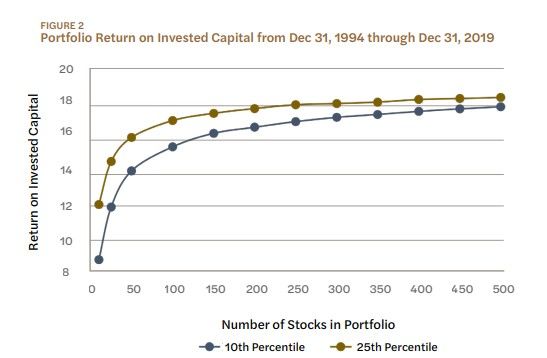
Israelov’s team built 5,000 portfolios of various sizes that rebalance monthly. They theorized that if a certain-sized portfolio was truly diversified, it would avoid outlier returns that strayed way below the market. Certain groups of stocks will always be unlucky ones; the idea was to make sure even that didn’t do undue damage to returns.

Plotting the worst outcomes for a wide range of baskets where the number of stocks spans from 10 to 500, the team found that differences among outcomes remained high until the size got to around 250 stocks. Anyone holding 20-30 stocks was at risk of missing considerable upside. How much? Even a particularly unlucky 250-stock investor ended up about 40% richer than a particularly unlucky 25-stock investor during the study’s period. 

The finding, Israelov says, should be of interest to investors who flock to the niche market of direct indexing, where they’re often recommended to hold 60 to 80 stocks to replicate a benchmark’s performance.  

“What we try to do is really pick things apart and understand the behavior of different decisions,” he said. “From the diversification side, you know that 60 to 80 wasn’t quite as many as we thought would be beneficial.”

More stories like this are available on bloomberg.com

©2022 Bloomberg L.P.
Women Are Key Metaverse Users, But Men Dominate Jobs Shaping It

(Bloomberg) — Women are spending more time in the early iterations of the metaverse and are more likely to spearhead initiatives in the new and developing next generation of the internet, but men still hold 90% of executive positions at organizations shaping this emerging economy. 

According to a report out Monday by McKinsey & Co., “women are still locked out of leadership roles” that are key to creating and setting standards in the metaverse.

Companies like Meta Platforms Inc. and Unity Software Inc. are investing heavily in the metaverse, which is described as a virtual and augmented reality world where people will work, socialize, and learn. McKinsey’s report, which surveyed about 2,000 people, asserts that women are playing VR games, exercising in VR, digital shopping using AR, and taking classes in virtual classrooms at a higher rate than men. 

However, men are purchasing nonfungible tokens and using gaming platforms more than women. 

McKinsey’s survey of 450 senior executives indicated that women are also implementing metaverse initiatives at their companies more often than men. Some 60% of women, compared with 50% of men, said they had set up more than two such projects, primarily around marketing or employee learning and development. 

At the same time, women hold just 8% to 10% of leadership positions at organizations driving metaverse standards, including the Metaverse Standards Forum and Open Metaverse Alliance for Web3, according to the report. That’s similar to the roughly 9% of Fortune 500 companies women lead, according to the survey. Women hold fewer than 25% of senior leadership roles in tech generally, according to a Deloitte report last year.

More stories like this are available on bloomberg.com

©2022 Bloomberg L.P.

Money-Losing Tech Stocks Fade Again as Fed Stays Hawkish

(Bloomberg) — The brief record rally this month in shares of unprofitable and highly valued technology companies is starting to look like a short-lived blip amid a steady drumbeat of hawkish commentary from Federal Reserve officials.

A basket of money-losing tech stocks compiled by Goldman Sachs Group Inc. jumped 15% on Nov. 10 after a report showed US consumer-price inflation cooled in October more than forecast. The news led to speculation the Fed had room to slow its pace of interest-rate increases. 

Investors tried to keep pushing the stocks higher: A similarly positive report on producer prices led to a smaller pop last week. But the index has since faltered, leaving it below where it closed on Nov. 10. It sank 2.8% on Monday, on track for a fourth straight decline. The Nasdaq 100 Index fell 0.5%.

While rising rates have hammered tech stocks broadly this year, riskier companies have been hit especially hard. It’s a dramatic reversal from the steady climb they enjoyed during the pandemic, when economic stimulus and the Fed’s easy-money policies spurred a flurry of speculative buying. 

“There are people who will buy almost anything on any sign of good news, and a ‘dash for trash,’ where people jump into junky or unprofitable stocks, is a classic thing to see on days like that,” said Randy Frederick, vice president of trading and derivatives for Charles Schwab Corp. “While it’s never a great idea to be in low-quality names, these look especially risky now as the conditions for speculation have reversed.”

The Goldman basket is down 62% this year, while the Nasdaq 100 is down 29%. Among notable names, C3.ai Inc. is down 60%, SentinelOne Inc. has dropped 68%, and Asana Inc., Okta Inc., and UiPath Inc. have all collapsed more than 70%. Even after their declines, all trade at a premium to the Nasdaq 100 in terms of price to estimated sales.

Higher rates hurt shares of unprofitable and high-valuation growth companies the most, because their shares are priced on their prospects far out in the future, with bond yields used to discount into today’s dollars the value of earnings that companies may not see for years. Inflation, along with the Fed’s attempt to combat it by aggressively raising rates, has led to Treasury yields jumping from 1.5% at the start of the year to 3.76%, and recently hitting their highest since 2008.

In the latest sign the Fed may not be about to reverse course, St. Louis Fed President James Bullard last week said the US central bank should raise interest rates to at least 5% to 5.25% to combat inflation, well above the current 3.75% to 4%.

The comments followed a similar statement from San Francisco Fed President Mary Daly. Governor Christopher Waller expressed openness to the Fed raising rates by half a percentage point next month, less than recent increases of 0.75 point, but he downplayed the significance of the CPI report.

“I cannot emphasize enough that one report does not make a trend,” he said. “It is way too early to conclude that inflation is headed sustainably down.”

If the Fed does maintain an aggressive strategy of hikes, the yield headwind could grow more pronounced. And while rapidly climbing sales led to these stocks receiving nosebleed valuations, the prospect of a recession has diminished their attractiveness on growth characteristics, giving investors another reason to focus on companies with positive earnings and cheaper valuations. 

Jim Awad, senior managing director at Clearstead Advisors, expects investors will sort tech stocks into two categories: companies with durable earnings and cash flow, which should regain their losses over time, and then the speculative, unprofitable ones.

“Investors will remain gun shy about the second class of company,” he said. “They got so overvalued, they’ve fallen so much, and some investors have been devastated. The momentum game is over. They can maybe bounce from here, but they won’t be market leaders the way they were before the peak.”


Tech Chart of the Day

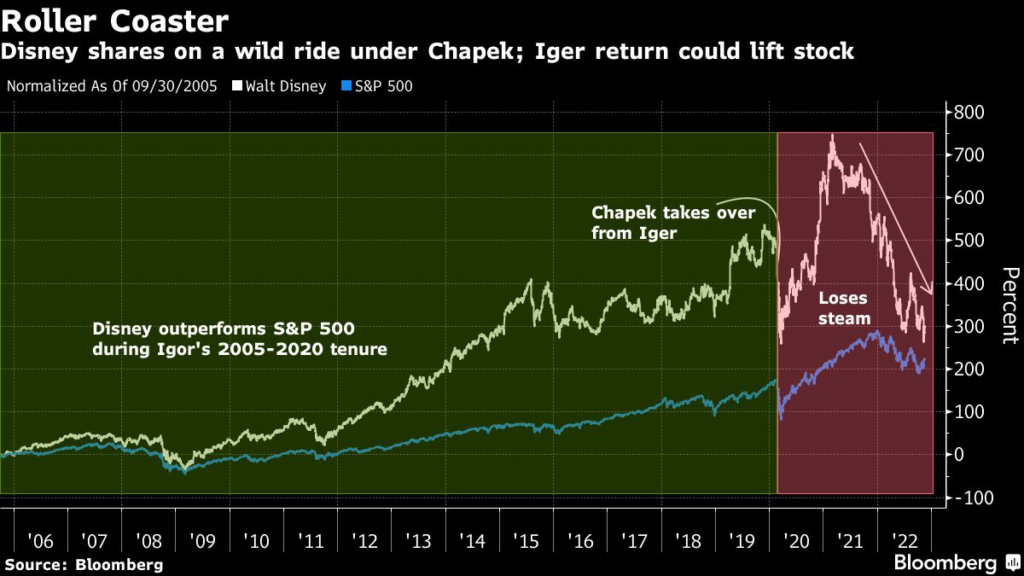
Shares in Walt Disney jumped 8.5% Monday as investors cheered the surprise return of Bob Iger to the helm of the theme-park and entertainment company. Disney, which Iger led for 15 years until February 2020, has shed $114 billion in market value this year, and shares are set for their biggest annual drop since the 1970s. Iger, who replaces Bob Chapek, now faces the challenge of reversing that decline. 

Top Tech Stories

  • Walt Disney Co. shares jumped after it brought back former leader Bob Iger to replace his successor Bob Chapek as chief executive officer, a surprise capitulation by the board after a string of disappointing results.
    • Chapek leaves Disney’s top job with exit payments and benefits that could be worth more than $23 million. That’s without including the millions more he could collect in the coming years if the company’s share price recovers.
  • For investors looking for a dip-buying opportunity in the global chip industry, Berkshire Hathaway Inc. may have a recommendation: Taiwan Semiconductor Manufacturing Co.
    • TSMC founder Morris Chang said the congratulations he offered Chinese President Xi Jinping about the congress that his ruling Communist Party recently held were his own personal view.
  • American musician Ye has returned to Twitter after a two-week hiatus from the social network, and new owner Elon Musk welcomed him back on the platform. Musk also reinstated Donald Trump, but the former president says he’ll stick with his own Truth Social network.
    • Twitter Inc.’s head of France announced his departure in a tweet on Sunday ahead of what may be additional layoffs at the embattled platform coming as soon as Monday.
  • GoTo Group reported a narrower third-quarter loss, helped by cost cuts at the Indonesian ride-hailing and e-commerce giant.
  • The founder of Atoss Software AG is exploring strategic options for the German-listed developer after it attracted takeover interest from private equity firms, people familiar with the matter said. Atoss software helps companies manage their workforces.
  • Two US senators called TikTok a Chinese surveillance tool, issuing a bipartisan warning as the Biden administration weighs a deal that could let the video-sharing app keep operating in the US.

–With assistance from Subrat Patnaik and Thyagaraju Adinarayan.

(Updates to market open.)

More stories like this are available on bloomberg.com

©2022 Bloomberg L.P.
Bill Gates-Led Fund Backs Pulsed-Power Technology to Clean Up Mining

(Bloomberg) — A climate fund founded by Bill Gates is investing in technology that uses surges of electricity to shatter rocks and mineral ores in a bid to reduce energy usage and carbon emissions at mines. 

A European fund tied to Gates’ Breakthrough Energy Ventures invested €12 million ($12.3 million) in the I-ROX pulsed-power venture with Robert Friedland’s I-Pulse Inc.

The technology is based on short, high-intensity bursts of power to streamline crushing and grinding processes that today make up the most energy-intensive and expensive part of mining.  

That would help producers of metals like copper and nickel achieve carbon-reduction targets, thereby boosting industry efforts to gain acceptance for expansions to meet growing demand in the transition away from fossil fuels.

More stories like this are available on bloomberg.com

©2022 Bloomberg L.P.
Close Bitnami banner
Bitnami