Bloomberg

Tory Politician Calls on Coca-Cola to Justify Qatar Soccer Deal

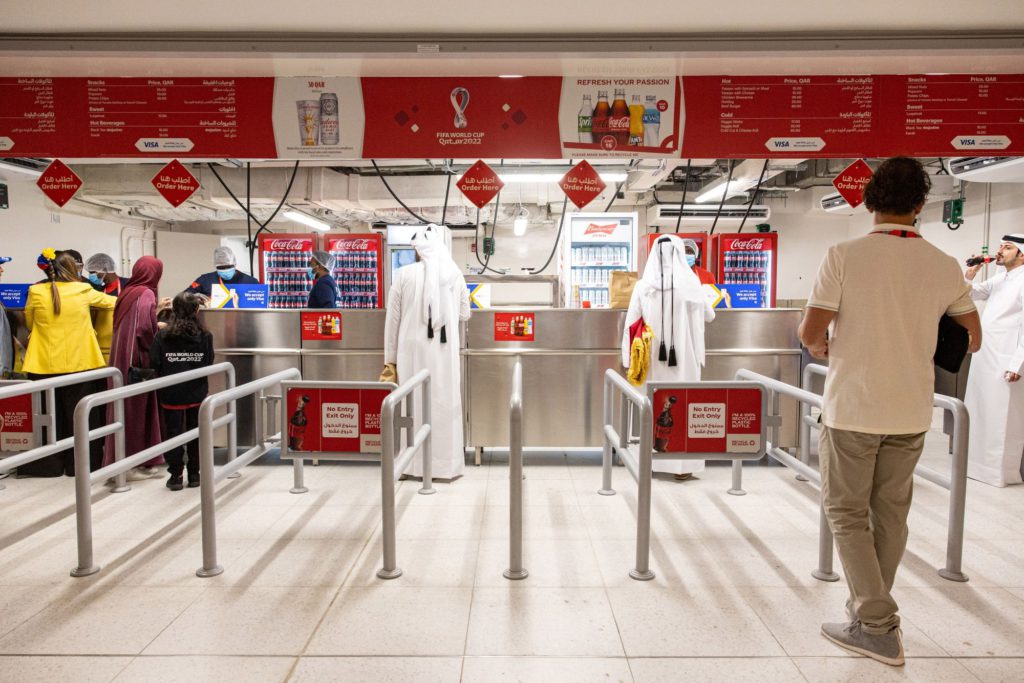
(Bloomberg) — A peer in Rishi Sunak’s ruling Conservative Party called on Coca-Cola Co. to justify its decision to sponsor the FIFA World Cup in Qatar after the hosts and FIFA president were accused of making homophobic comments before the tournament began.

Robert Hayward, a Tory member of the House of Lords, demanded answers from Coca-Cola at an event the company is hosting in London on Monday. The drinks manufacturer is sponsoring a showing of the England v Iran match for lawmakers at a pub near Parliament. Hayward founded the world’s first gay rugby club in 1995.  

Ahead of the tournament, former Qatari football international and world cup ambassador Khalid Salman said homosexuality — which is illegal in the conservative Muslim country — amounts to “damage in the mind.” On Sunday the president of FIFA, Gianni Infantino also sparked outrage after accusing the West of hypocrisy and claiming to feel “gay,” “African” and “disabled.” 

On Monday seven national football teams, including England, said they won’t wear a rainbow armband showing solidarity with LGBTQ rights, bowing to pressure from FIFA because players might receive a yellow card for the show of support.

“I was disappointed that Coca-Cola and other companies ever took the decision to sponsor the World Cup in Qatar, given the country’s record on human rights,” Hayward said in an interview. He called FIFA’s decision on the armbands “depressing.”

Qatar’s Tarnished World Cup Is Too Big for Brands to Boycott

Around 76 companies are sponsoring the tournament or the teams taking part, ranging from Adidas AG and Volkswagen AG to Microsoft Inc’s XBox. 

“These major worldwide companies should make their positions clear to show whether they are concerned about the comments of the last few days,” Hayward said. 

“We strive for diversity, inclusion and equality in our business, and we support these rights throughout society,” a spokesperson for the company said in an e-mail. “Our experience has shown that change takes time and must be achieved through sustained collaboration and active involvement. We have long supported the LGBTQI+ community, and we will continue our work to respectfully advocate for our values through our policies and practices throughout the world.”

More stories like this are available on bloomberg.com

©2022 Bloomberg L.P.

GoTo Reports Narrower Quarterly Loss on Spending Slowdown

(Bloomberg) — GoTo Group reported a narrower third-quarter loss, helped by cost cuts at the Indonesian ride-hailing and e-commerce giant.

The adjusted loss before interest, taxes, depreciation and amortization shrank to 3.7 trillion rupiah ($235 million) from 4.2 trillion rupiah a year earlier, the Jakarta-based company said Monday. Net revenue, which strips out incentives to driver and merchant partners and promotions to users, tripled to 4.6 trillion rupiah, a sign that appetite for online services keeps increasing in Southeast Asia’s largest economy despite accelerating inflation.

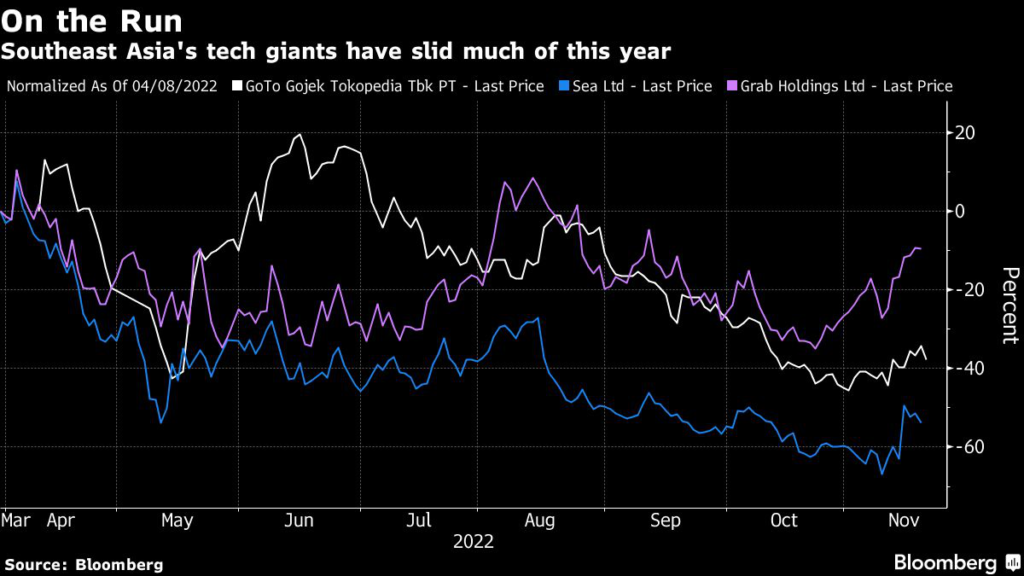
GoTo is trying to convince investors of its profit-making potential after its shares lost 38% since its initial public offering in Jakarta early this year. The company, formed through a merger of ride-hailing provider Gojek and e-commerce firm Tokopedia, said last week it’s cutting 12% of its workforce, or 1,300 jobs, as it braces for a challenging economic climate.

Like technology companies worldwide, GoTo is confronting the effects of stiffer competition, economic slowdown and heightened investor focus on profitability. The risk of customers becoming more budget-conscious in the face of an impending recession has triggered job cuts, closures of business units and other measures across the tech industry. Sea Ltd., Southeast Asia’s largest tech company, cut about 7,000 jobs in the past six months.

GoTo and its publicly traded peers Sea and Grab Holdings Ltd. are rushing to assuage investor concerns over mounting losses after years of heady expansion succumbed to the global economic downturn. Grab last week reported a narrower third-quarter loss than analysts had estimated and increased its annual revenue guidance slightly to as much as $1.35 billion.

GoTo said contribution margin — a measure of profitability the company adopted that doesn’t account for certain items such as some sales and marketing costs — turned positive in September, ahead of schedule, for its on-demand segment, which includes ride-hailing and food delivery. For the company as a whole, it expects a positive margin in the first quarter of 2024.

The company’s shares are set to face a potential test in the coming weeks, after a lock-up on some of its owners’ holdings ends on Nov. 30. Chief Executive Andre Soelistyo reiterated on a conference call that GoTo is in talks with holders for a controlled sale of their stakes, a move aimed at avoiding a possible stock slump. He said there are no assurances at this stage a transaction will take place.

For the full year 2022, the company predicted gross revenue will rise to 22.6 trillion rupiah to 23 trillion rupiah and gross transaction value to increase to 613 trillion rupiah to 619 trillion rupiah.

–With assistance from Fathiya Dahrul.

(Updates with comment from CEO in seventh paragraph)

More stories like this are available on bloomberg.com

©2022 Bloomberg L.P.

Crypto Exchange Tokens Pose ‘Extreme’ Risk, BOE’s Cunliffe Says

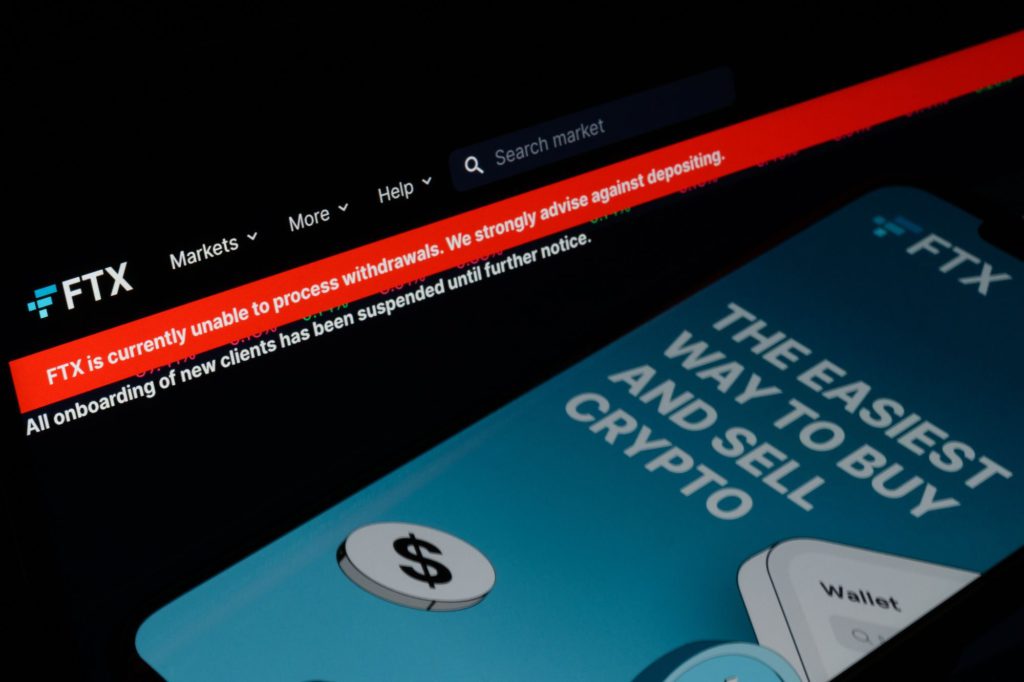
(Bloomberg) — Exchange-issued crypto tokens such as bankrupt FTX Group’s FTT can pose “extreme” risks when accepted by their issuers as collateral, Bank of England Deputy Governor Sir Jon Cunliffe said.

“A firm accepting its own unbacked cryptoasset as collateral for loans and margin payments, as there are indications may have happened with FTX, creates extreme ‘wrong-way’ risk — i.e. when the exposure to a counterparty increases together with the risk of the counterparty’s default,” Cunliffe said in a speech on Monday. 

Cunliffe said the volatility of unbacked cryptoassets like exchange tokens makes them vulnerable to runs, exacerbating their price swings. “Indeed, in the FTX case, there are indications that it could have been a run on its crypto coin, FTT, which triggered the collapse,” Cunliffe added.

The failure of FTX.com earlier this month has rocked the crypto ecosystem, eroding trust in centralized exchanges and leaving 50 customers with claims of more than $21 million each. FTX unraveled quickly after Changpeng “CZ” Zhao, the founder of rival Binance, announced plans to unload a roughly $530 million holding of FTT. 

Billions of Dollars Flee FTX Woe to Crypto’s Decentralized Roots

As a result, decentralized finance platforms and protocols — where traders rely on lines of code to manage the platform’s risk automatically — have seen an 11% uptick in volumes this month. Investors have also flocked to using offline wallets known as cold storage for their crypto, as they fear further contagion among centralized platforms.

Cunliffe said he had “yet to be convinced that the risks inherent in finance can be effectively managed” by DeFi’s reliance on code over human input. “That scepticism is greater if the activity in question is the trading, lending, etc. of super volatile assets without intrinsic value,” he added.

This is because such protocols have yet to display their robustness to handle risk and the potential to amplify fire sales “at scale and over time”, Cunliffe said. 

Moreover, because some platforms have stakeholders who earn revenue from their operation, it’s also not clear if they are “are truly decentralized.”

(Updates headline, adds context and further comment from fifth paragraph onward)

More stories like this are available on bloomberg.com

©2022 Bloomberg L.P.

US Earnings to Watch: Best Buy, Nordstrom, Zoom, Deere, Black Friday

(Bloomberg) — Results from American retailers last week underscored trends showing consumers are tightening their budgets heading into holiday season. While Walmart, Macy’s, Home Depot and Lowe’s delivered better-than-expected results, Target performed “well below” its own expectations and provided a dim outlook, plunging its shares into their worst week since September. Investors are shifting their focus to Best Buy and Nordstrom, which report this week, and may watch for increased volatility in the sector’s stocks due to mixed expectations. The pullback in consumer discretionary spending is evident, as the segment has so far posted the fewest EPS beats during this reporting period, contributing to the poorer earnings performance overall among S&P 500 companies compared to last year. While holiday dollars spent is likely to be aided by higher prices from inflation, the growth rate is expected to be slower than in the past several years, and clearing excess inventory during the season will be a key factor for retailers’ profitability.

  • To subscribe to earnings coverage across your portfolio or other earnings analysis, run NSUB EARNINGS.
  • Click to see the highlights to watch this week from earnings reports in Europe and Asia.

Earnings highlights to look for this week: 

Monday: Zoom Video (ZM US) is due after the closing bell. The pandemic darling is expected to post low-single-digit revenue growth for the third quarter, the slowest pace of expansion since its initial public offering in 2019, as Bloomberg Intelligence said the return-to-office shift led to steep declines in online segment sales. In addition to tough comparisons from elevated revenue a year ago, shrinking IT budgets and deteriorating macro environment are likely to add challenges to new customer growth among small- and mid-sized firms, Citi analysts said when they cut the stock’s price target last week. Revenue guidance for the current quarter could also come down further due in part to slowing demand among Enterprise customers, they added. 

Tuesday: Best Buy (BBY US) reports before the market open. Early promotions might not have helped boost third-quarter revenue at the electronics and home-office equipment retailer after all, BI analysts said, as Bloomberg Second Measure data suggest Best Buy’s October sales were the weakest compared with other retailers. Revenue for the quarter is expected to contract 13% year-on-year — the steepest in almost nine years — and the projected 13% fall in comp sales would be the biggest decline in at least 22 years. Investors will watch for comments on demand trends especially after Target’s lackluster outlook and the earlier management commentary on the comeback of holiday deals. 

  • Nordstrom (JWN US) third-quarter results are due after the close. Despite reaffirming its full-year sales growth outlook in October, the department store’s revenue is expected to fall for the first time in six quarters, with analysts expecting about a 2% dip year-over-year, as demand from more affluent customers may begin to show some weakness in the period. “Clearance racks are pervasive” at Nordstrom’s stores, according to Bloomberg Intelligence, and the company’s push to move its bloated inventory — expected to reach a record $2.98 billion — with higher markdowns could erode gross margin. The retailer is expected to decelerate its merchandise growth in the third quarter, with progress on inventory rebalancing and promotions plans a key topic for the earnings call, said analysts at Telsey Advisory Group.

Wednesday: Deere (DE US), reporting before the open, is expected to post accelerated profit and sales growth in fiscal 4Q due to higher production rates, better pricing and easing input costs, BI said, improving from weaker-than-expected results in 3Q. Demand conditions remain favorable given supportive commodity prices and flush farmer cash flows, according to Citi. Coupled with an extended order book, momentum should continue to build as Cowen analysts anticipate the best year on record for both the top and bottom line when management provides their initial guidance for fiscal 2023, though the reading may represent cycle peak. 

Thursday: US markets are closed for Thanksgiving.

Friday: Retailers could see mixed results this holiday season as consumers hunt for bargains on Black Friday. Holiday sales by value will be aided by elevated prices driven by inflation, yet profitability may be crimped in a highly promotional environment with aggressive markdowns to clear excess inventory, BI analysts noted. Spending at early sales events in October boded well for Nike (NKE US), Amazon (AMZN US) and Walmart (WMT US) as they recorded the strongest growth from a year ago, according to BI, while Best Buy and Nordstrom tickets contracted the most. BI said the mixed results suggest that the sector may meet Deloitte’s forecast for 4%-6% growth but could fall short of the National Retail Federation’s estimate of 6%-8%, a lower year-over-year growth rate than the past several years. And while households are expected to partly shift back to in-store shopping, both Deloitte and the NRF anticipate e-commerce sales to record low double-digit growth, outpacing traditional brick-and-mortar stores as it is still more convenient for shoppers to compare prices online. 

  • For more on how retailers are dealing with inventory glut and other environmental, social and governance themes in the latest ESG Stock Watch.

More stories like this are available on bloomberg.com

©2022 Bloomberg L.P.

Meta Sued in UK to Stop Personal Data Collection for Ads

(Bloomberg) — Meta Platforms Inc. is facing demands that it stop harvesting personal data for targeted advertisements in a fresh UK lawsuit that goes to the heart of Facebook’s business model.

Tanya O’Carroll, a technology and human rights campaigner, filed the suit at London’s High Court challenging Facebook’s “surveillance advertising,” she said. Facebook violates general data protection regulations by processing and profiling her personal data that’s then tailored for the advertisements, she argues.

The case attacking Meta’s business model adds to a series of regulatory and legal risks for Meta in Europe, ranging from trans-Atlantic data flows to antitrust actions in Germany and the UK. 

Meta has built tools for privacy check-up and ad preferences, where it explains what data people have shared and how they can exercise control over the type of ads they see, Meta said in an emailed statement. “We know that privacy is important to our users, and we take this seriously,” Meta’s spokesperson said.

Meta has yet to file its defense papers in the case.

O’Carroll objected to “being surveilled and profiled.” 

“A win could set a precedent for millions of users of search engines or social media in the UK and EU who have been forced to accept invasive surveillance and profiling to use digital platforms,” she said. 

More stories like this are available on bloomberg.com

©2022 Bloomberg L.P.

Holiday Shopping Looks Anything But Festive for Retail Stocks

(Bloomberg) — Wall Street is starting to doubt that retailers can snap out of a yearlong stock-market slump as consumers increasingly tighten their belts heading into the crucial holiday shopping season.

It’s been a brutal 2022 for retail stocks. And sales from the fourth quarter, traditionally the strongest time of the year, may not be a savior this time around as more stores and chains warn that frugal shoppers are going to cut into their bottom lines. 

Some traders are clearly betting against the sector or hedging their exposure to even deeper losses. 

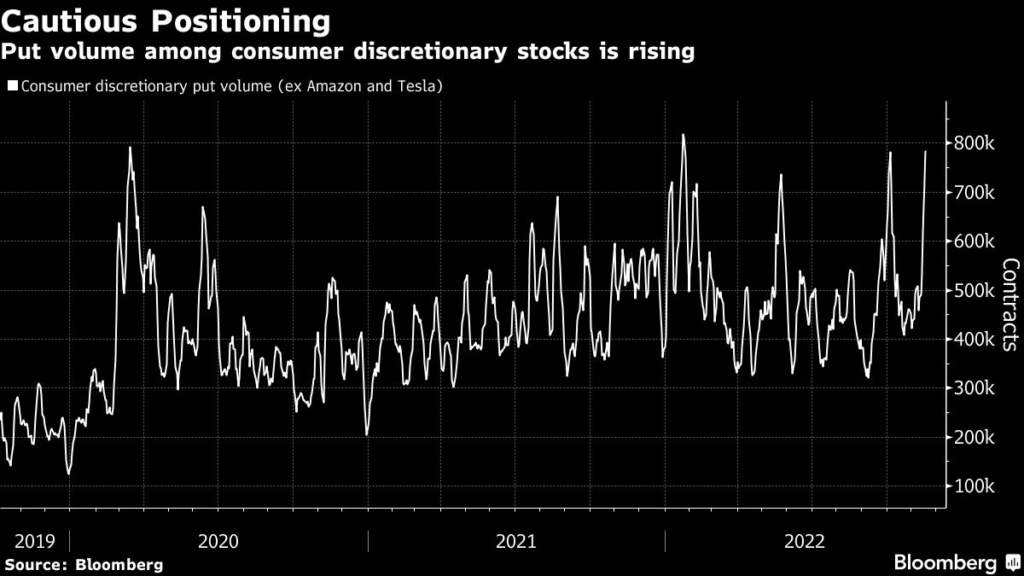
Trading volume in bearish put options for the consumer discretionary sector spiked recently, with the turnover now at levels similar to those during the March 2020 pandemic selloff. Similar skepticism was seen in May when a slew of retailers cut their annual profit forecasts.

A cautious approach is understandable. Target Corp. tumbled after announcing that sales trends softened in October, calling out weakness in key gift areas like toys. The National Retail Federation also predicted that holiday sales would grow at a significantly slower pace than last year. And Amazon.com Inc. projected the slowest holiday-quarter growth in its history, sending its market value briefly below $1 trillion.

The bad news reflects how much inflation, growing economic uncertainty and rising interest rates are weighing on holiday spending plans. 

“The consumer is going to be looking for deals, and that will end up likely pressuring margins,” said Mark Stoeckle, chief executive officer of Adams Funds. “So if you believe that, why would you own these stocks right now?”

During the third quarter, the firm’s Adams Diversified Equity Fund, which has about $2 billion in assets under management, sold its stakes in Target and Walmart Inc. in favor of more defensive consumer stocks, like beverage companies and Tractor Supply Co., which sells animal feed and farm equipment.

And there clearly are more skeptics in the market. Shares out on loan for the members of the S&P 500 Consumer Discretionary Index, an indication of short positioning against the group, are up to 3.7% on average from 2.7% at the beginning of the year, according to data from S&P Global Market Intelligence.

The final months of the year are more crucial than ever for retailers, as the S&P 500 Retailing Index has lost more than 30% in 2022. Soaring inflation is forcing shoppers to pay more for essentials, and that’s left stores stuck with a glut of excess products, causing retailers to mark down prices at the expense of profits.

Read more: Holiday Shopping Deals Roar Back in US With ‘Massive’ Discounts

Kohl’s Corp.’s earnings report highlighted the uncertainty, as the discount department store withdrew its annual profit forecast and said that sales have slowed. While Walmart’s quarterly results topped analyst expectations, it is taking a wait-and-see approach with its holiday projections.

Target shares are down 30% this year through Friday’s close, while Kohl’s has slumped 37%. Walmart erased its loss for 2022 following earnings last week, and the stock is now up 3.8% for the year.

Read more: Apparel Earnings Beats May Be Eclipsed by Soft Holiday Season

US retail sales actually climbed the most in eight months in October, according to Commerce Department data released last week. But sales at department stores still fell, and other key discretionary categories like electronics and sporting goods declined. Looking ahead, Goldman Sachs surveyed 1,000 US consumers and found that nearly half plan to spend less this holiday season than they did last year. 

One thing’s for sure: it will be a bumpy ride for investors in retail shares. From 2011 to 2021, the average stock in Goldman’s basket of consumer companies saw a 2.9% move, in either direction, from the day before Thanksgiving to the day following Cyber Monday, while the SPDR S&P 500 Trust (ticker SPY) typically moved 1.3%.

Investors will be closely watching quarterly earnings reports this week from Best Buy Co., Nordstrom Inc. and several mall-based apparel retailers for further perspective on holiday sales trends.

Stacey Widlitz, president of SW Retail Advisors, said it’s difficult to predict how the next couple of months will play out, with companies trying to sell through bloated inventories as consumers curb spending. 

“You’re definitely seeing a customer that’s being much more careful about what they’re buying,” she said. “It’s like the perfect storm for this holiday.”

–With assistance from Jessica Menton.

(Adds details on retailers’ share-price performance in 12th paragraph.)

More stories like this are available on bloomberg.com

©2022 Bloomberg L.P.

Rivian Employees Say Rapid Production Led to Injuries, Safety Oversights in Illinois Plant

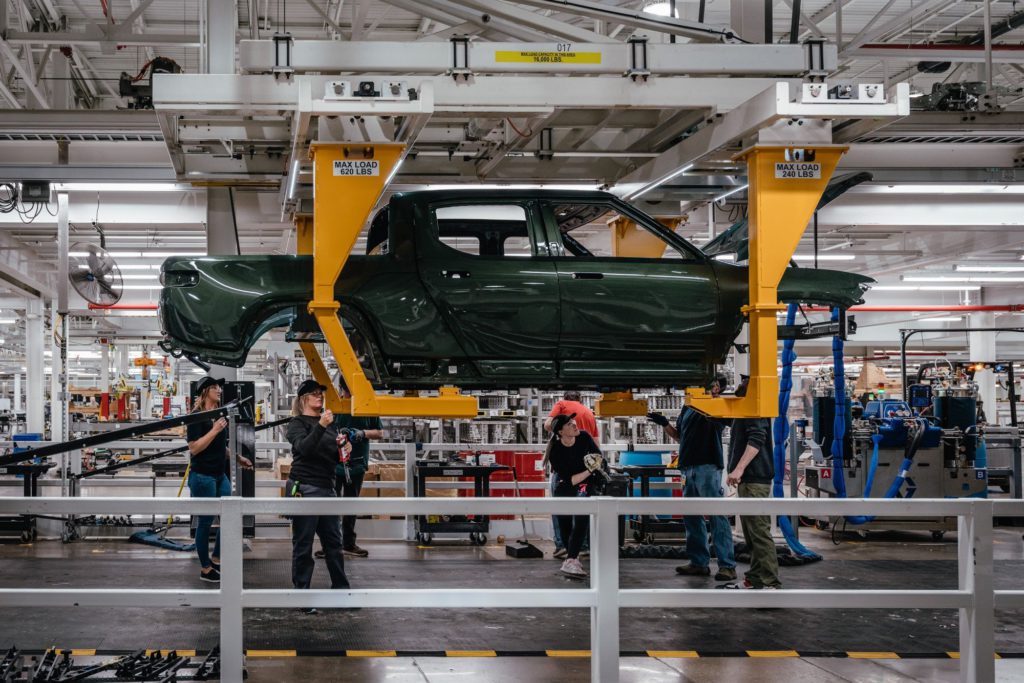
(Bloomberg) — At least a dozen employees at Rivian Automotive Inc. have accused the electric-vehicle maker of safety violations at its Illinois plant, according to complaints filed with federal regulators. 

The complaints allege the company ignored known hazards and deprioritized safety resources, leaving some workers to share respirators needed during the manufacturing process. They also detail a range of injuries, including a crushed hand, a broken foot, a sliced ear and broken ribs. One Rivian employee said management fished damaged electrical cables out of the garbage and told employees to use them.

Together, the filings depict an automaker that cut corners as it scaled rapidly to keep pace in the competitive electric-vehicle space. Some employees described safety protocols that faded as production pressures grew on its trademark plug-in pickup truck. 

“There’s a certain level of danger involved in manufacturing,” Don Jackson, one of the employees who filed a complaint, said in an interview. “But I was expecting safety to be a little more prioritized.”

In statements to Bloomberg News, a Rivian spokesperson disputed workers’ allegations but declined to comment on specific complaints, citing employee privacy. The spokesperson said the dozen complainants represent just 0.2% of the 6,700 employees at the plant.

“Creating a safe and inspiring environment is a daily practice we expect of every Rivian employee and is part of our operating procedures,” the company said in an emailed statement, adding: “We are not aware of any manager directing employees to share respirators.”

The allegations were filed over the past two months with the US Occupational Safety and Health Administration and are directed at the automaker’s only operational plant, in Normal, Illinois. All 12 employees, one of whom has since left Rivian, filed their complaints in coordination with the United Auto Workers union, which has been trying to organize Rivian plant workers over the past year. The UAW shared the filings with Bloomberg News.

Several of the complaints describe hazards that did not result in injury, but that employees feared would.

Jackson, who joined the company in March, said in his complaint that “trucks frequently veer into pedestrian aisles” and bulldoze racks in a manner that could cause them to accidentally strike people.

There have been “many near misses” with powered industrial vehicles nearly hitting people, wrote Kailey Harvey, another employee. Sensors meant to display whether trucks were correctly locked in place sometimes give false readings because they aren’t calibrated to the height of the vehicles, she wrote. 

“At first, it was really great,” Harvey, a former UAW member who joined Rivian last year, said in an interview. “Slowly, as production kept climbing, the concern for safety dropped.” 

In a short period of time, Irvine, California-based Rivian has recruited an army of engineers, vehicle assembly technicians and factory floor managers from legacy automotive names like Ford Motor Co. and General Motors Co., mostly at its flagship plant in Normal, which is capable of building 150,000 electric vehicles a year. It’s also hired top talent from Tesla Inc. and Apple Inc. as part of a push to scale up and produce mass-market electric vehicles.

Rivian quickly emerged as a viable challenger in the EV market dominated by Tesla and a few legacy automakers, attracting keen interest from an A-list of Wall Street investors and strategic backers like Ford and Amazon.com Inc. The company’s initial public offering last November was the sixth biggest in US history. 

The employee claims “suggest a factory that is far from operational excellence,” said David Michaels, who led OSHA under former President Barack Obama and is now a professor at George Washington University’s public health school. “If workers are being hurt, it is evidence that the factory management is not doing its job in ensuring that operations are being performed properly.” 

“These reported injuries reflect poor management control of production processes, suggesting that the quality of the factory’s output will also be suboptimal,” he added.

The company’s shares fell 1.7% as of 7:25 a.m. Monday in New York. The stock tumbled 71% this year through Friday’s close.

Rivian said data it compiles for OSHA show it already outperforms its peers on health and safety. Its Total Recordable Incident Rate is 2.5 cases for every 200,000 hours worked, less than the industry average of 6.4 cases, according to the company. The data also show Rivian’s safety performance improving, with the incident rate dropping 44% since January, a spokesperson said. “Our proactive actions and activities are having a significantly positive impact on safety,” Rivian said.

OSHA concerns about safety at fledgling EV-makers — driven by worker complaints — are not new. In 2018, California regulators probed Tesla’s workplace safety as the market leader dramatically ramped up production of its first mass market vehicle. 

OSHA currently has open investigations into seven complaints at the Normal plant, an agency spokesperson said. Previously, the regulator issued four “serious” citations against Rivian, including three from earlier this year that ended in settlements with the agency.

‘Like Talking to a Wall’

Some workers said they had notified management about their concerns before filing complaints with federal regulators. Jackson wrote that he had raised safety concerns with numerous supervisors, but they went unheard. “It’s like talking to a wall,” he said in the interview.

One employee, Heather Barschdorf, wrote directly to Rivian Chief Executive Officer RJ Scaringe with worries that hazards in her work area could affect her pregnancy.

“The fumes in my area make us sick some days even without being pregnant,” she wrote in the Sept. 23 email to Scaringe, which was viewed by Bloomberg News. Her email said she had experienced miscarriage in the past and was at very high risk for another one.

“Many people in my area have become sick with flu like symptoms from exposure to the galvanized metal parts we are welding,” Barschdorf later wrote in an OSHA complaint filed Sept. 30. “I have asked for accommodation as a pregnant person including ventilation for paint fumes and respiratory protection numerous times and have been denied.” Her filing said she was given a dust mask in lieu of the proper kind of respirator.

Scaringe never replied to her email, she said, though a human resources representative referenced it in a later meeting with Barschdorf. The company did not act on her repeated requests to be moved to a different section of the factory, she said in an interview. “Rivian’s not listening to us,” she said.

Two weeks after filing her OSHA complaint, Barschdorf suffered a miscarriage. In November, she resigned from the company. 

Asked about Barschdorf’s account, a Rivian spokesperson wrote, “There is no evidence that anything in the work environment caused or contributed to a personal miscarriage” for any staff at the plant.

“We do not comment on open agency cases nor on any situation that has any potential pending litigation,” the spokesperson added. “We value employee feedback and hear employee concerns, and we take appropriate action for each situation.”

Rivian has spent millions of dollars on safety and has a team of more than 70 safety, health and environmental professionals, a spokesperson said, adding that the company conducts routine trainings and inspections.

In February, a battery-pack explosion caused a fire with 10-foot-high flames, according to the complaint from Harvey. “I witnessed a person pull the fire alarm and nothing happened,” she wrote. After evacuating, employees were told to walk back through the smoke for a head count. “People were coughing and at least one worker had an asthma attack while walking through the smoke,” she wrote, adding that since the fire “no drills or follow-up training have been held” for her shift about where to go in similar situations.

Rivian said that after that fire it developed a “comprehensive thermal event response plan.” The company spent $70,000 to acquire a sophisticated gas measurement device from Finland that could be used to assess air quality indoors after fires, a spokesperson said.

(Updates with share movement in 16th paragraph.)

More stories like this are available on bloomberg.com

©2022 Bloomberg L.P.

Traders Flee Crypto Markets After FTX Collapse

(Bloomberg) — The wild-west days of crypto markets are back again as the large trading houses that once thrived on arbitraging price gaps pull back in the wake of FTX’s collapse. That’s opening up profitable opportunities for anyone that still dares to trade. 

Prices for essentially identical assets on various platforms are diverging in a clear sign the dominoes are still falling across the crypto trading world. The gap between the funding rates of identical Bitcoin futures on Binance and OKX, for instance, has been as wide as an annualized 101 percentage points and remained at least 10, compared with mostly single-digit gaps last month. 

It’s a throwback to the early days of crypto, when speculators — including former FTX Chief Executive Officer Sam Bankman-Fried himself — found easy money simply buying one asset on an exchange and selling it for more on another. It’s a lucrative form of quantitative trading, which uses algorithms to profit from these price gaps. But as more sophisticated Wall Street converts entered the crypto markets, those differences shrank, making it harder to make money on the strategy.

Now with FTX’s demise sending chills through cryptocurrency markets, these players — including both big and obscure quant funds — are shrinking positions or even closing shop, causing these mispricings to stick around for longer. 

 “If you know what you’re doing and you have the confidence to have your money on exchanges, there are very profitable places to trade,” said Chris Taylor, who runs crypto strategies at GSA Capital, a 17-year-old quant fund that waded into the nascent asset class last year. 

Started by young alumni of Chicago firm Jane Street Capital, FTX touted itself as an exchange “built by traders, for traders,” with margin lending and a wide array of derivatives. Until its implosion it was consistently among the five largest exchanges in terms of volumes — and a favorite among quants. 

Collateral Requirements

Unlike traditional markets, where hedge funds borrow through prime brokerages, crypto traders have to put up collateral directly on exchanges. So when FTX began to restrict withdrawals, hordes of retail and professional speculators essentially lost access to much of their assets available for trading, with any recovery now dependent on a slow and winding bankruptcy process. 

The losses are now surfacing. Kevin Zhou, co-founder of hedge fund Galois Capital, said roughly half of its capital was stuck on FTX, according to the Financial Times. Travis Kling, who managed money for Point72 Asset Management before starting a crypto fund, said a large majority of his firm Ikigai’s assets are on the bankrupt platform. Wintermute, one of the largest market makers, said it has $55 million on FTX. 

As quants cut risk, dislocations are re-emerging. On the largest exchange Binance, the funding-rate gap between Bitcoin futures against Binance USD and those against Tether — meaning both track the price in dollar terms — has widened to an average 15 percentage points on an annualized basis since Nov. 9, compared with nearly nothing in October. (The funding rate is an interest payment that’s used to keep perpetual futures in line with the spot price.)

“Everybody is heading for the hills,” said Mitchell Dong, chief executive officer at Pythagoras Investments, which oversees about $100 million. The return of some price spreads shows “things that were previously arbed out are not so arbed out.” 

Strategy on Exposure 

His firm is writing off its 1% and 7% exposures to FTX in its market-neutral and trend-following funds respectively, he added. 

Fasanara Digital, which runs about $100 million, has dialed down its risk exposure to nearly zero, says partner Nikita Fadeev. 

Traders now have to decide whether to write off their exposure to FTX or create a so-called sidepocket that separates those assets from the main fund, says Barnali Biswal, chief investment officer at Atitlan Asset Management, which runs a fund that allocates to different quant managers and has 75% in cash right now. 

“The age-old arbitrage strategies are more and more lucrative,” said the former Goldman Sachs managing director. “However, contagion risk is elevated. So we are being conservative in our approach.”

For most of crypto history until last year, the market teemed with obvious inefficiencies, drawing Chicago giants like Jump Trading and Jane Street. With the advent of pro traders that were used to picking pennies in far more competitive mainstream markets like American stocks, those price gaps narrowed and the easy money vanished. 

The return of these anomalies now is a sign FTX’s fall has buffeted quant traders even more than this year’s other crypto crashes, like the deaths of TerraUSD and Three Arrows Capital. Bitcoin has dropped another 21% this month, taking its 2022 loss to 65%. 

The downfall of what was once a trusted exchange will make professional traders seek ways to avoid putting up collateral on any centralized platforms, for instance by using prime brokerages instead, says GSA’s Taylor. In short, they will want crypto to look more like Wall Street — if the exchanges allow it. 

“There was a lot more trust in FTX than there was in Terra/Luna,” he said. “You are now seeing some of the big players pull back not completely but try to have less collateral on centralized exchanges and think more about counterparty risk.” 

(Updates two charts, spread in paragraph after second chart and prices in third-last paragraph)

More stories like this are available on bloomberg.com

©2022 Bloomberg L.P.
Atoss Software Founder Weighs Options Including Sale

(Bloomberg) — The founder of Atoss Software AG is exploring strategic options for the German-listed developer after attracting takeover interest from private equity firms, people familiar with the matter said.

Atoss Chairman Andreas Obereder is working with advisers as he discusses possibilities including a sale, the people said, asking not to be identified discussing confidential information. The company has attracted interest from buyout firms including Hg, as well as Carlyle Group Inc. and Permira, though some have dropped due to concerns over valuation, the people said.

Shares of Atoss rose as much as 13% on Monday. The stock was up 6.9% at 1:02 p.m. in Frankfurt, giving the company a market value of €1.2 billion ($1.3 billion).  

Obereder owns about 50% of the Munich-based firm, according to data compiled by Bloomberg. The controlling shareholder’s price expectations and tight financing markets could make it more difficult to reach an agreement, the people said.

An investor-relations official at Atoss said the company has been receiving inbound expressions of interest from suitors from time to time, though the group isn’t running a sale process. He declined to comment on whether the founder is exploring options for his stake. 

Representatives for Hg, Carlyle and Permira declined to comment. 

Atoss develops software to help companies in sectors ranging from health care to transportation manage their workforces, according to its website. It generated revenue of about €82 million in the first nine months of the year, 18% more than the same period in 2021.

–With assistance from Dinesh Nair.

(Updates with suitor names, company response, latest share move from second paragraph)

More stories like this are available on bloomberg.com

©2022 Bloomberg L.P.
US, EU Aim to Hit Back at Non-Market Policies With Eye on China

(Bloomberg) — The US and the European Union aim to work together to counter what they call non-market policies, including in China, according to a draft statement ahead of high-level talks due in Washington next month.

The two sides will pledge to explore which policy tools could tackle the threat posed by such practices, including in the medical devices sector in China, as well as through certain government-controlled investment funds, says the draft, which was obtained by Bloomberg News and is subject to change as discussions on the text continue.

A reference by the EU to some of China’s market-impacting policies would represent a win for the US as Washington has been pushing the bloc to take a tougher stand on the issue. European leaders have sought a middle path on China, with French President Emmanuel Macron calling Friday for engagement with Beijing and resisting efforts to divide the world into competing blocs. 

US Secretary of State Antony Blinken, US Trade Representative Katherine Tai are scheduled to meet with European Commission Vice Presidents Valdis Dombrovskis and Margrethe Vestager, and commissioner Thierry Breton in the Washington, DC, area on Dec. 5 as part of the consultative US-EU Trade and Technology Council, where the transatlantic partners want to strengthen their bilateral cooperation.

The US and the EU have shared data and examined the market presence of US and EU medical devices companies in China, and are also collaborating on concerns relating to the investment funds, the draft says. The two sides will work together on exploring policy tools to address these challenges, continue to share assessments of the impact of economic and industrial directives, seek to foster supply chain diversification and reduce dependencies, the draft statement says.

Dombrovskis told a conference in Brussels on Monday that trade work with the US in relation to non-market economies is “by now a well-established work stream where we are cooperating.” He added that the two sides “share many of the same concerns as regards third-country practices. So obviously there’s lots of scope for discussions and for finding common approaches.”

Trade Initiatives

The draft statement shows there is also a push for concrete market openings and joint trade initiatives, but these issues are still under discussion.

The current text refers to launching a transatlantic initiative on sustainable trade. The aim would be to support the transition to low carbon economies. This issue is part of a parallel bilateral discussion to address the EU’s concerns on a recently passed US tax and climate law, which includes subsidies and tax credits for electric vehicles made in North America.

The law, which was titled the Inflation Reduction Act, has emerged as a point of contention among countries seeking to maintain a tightly united front in the face of Russian military aggression and heightened tensions with China. French Finance Minister Bruno Le Maire warned last week that US efforts to support domestic clean energy initiatives could unfairly damage European industry.

The draft also refers to a previous agreement on a so-called early warning mechanism to address and mitigate semiconductor supply chain disruptions in a cooperative way. The text mentions the possibility of the sides signing an administrative arrangement to implement the mechanism.

Sweeping US export controls on chips, which may soon be extended to other strategic technologies, have fueled European concern about American overreach. In October, President Joe Biden restricted the sale of semiconductors and chip making equipment to China in a bid to stem its economic development, and asked key allies to comply, raising fears of a split in the global economy. 

–With assistance from Stephanie Bodoni.

More stories like this are available on bloomberg.com

©2022 Bloomberg L.P.

Close Bitnami banner
Bitnami