Bloomberg

Singapore Defends Itself Against Binance Stance Post FTX Fallout

(Bloomberg) — The Monetary Authority of Singapore defended its stance on Binance.com and collapsed crypto exchange FTX, following criticisms about the differing treatment of the two firms since the regulator had previously alerted the public to Binance.com.

The “clear difference” between the two was that Binance.com was “actively soliciting” users in the city-state, to the extent of offering listing in Singapore dollars among other incentives, while FTX was not, the MAS said in a statement on Monday. In response to “questions and misconceptions” that it was possible to protect local users who dealt with FTX, such as by ringfencing their assets or ensuring that FTX backed its assets with reserves, the MAS reiterated that FTX isn’t licensed in the country and again warned about the dangers of dealing with unregulated entities.  

Singapore Regulator Says Reviewing FTX Unit’s Application

“The most important lesson from the FTX debacle is that dealing in any cryptocurrency, on any platform, is hazardous,” the MAS said. “There is no protection for customers who deal in cryptocurrencies. They can lose all their money.” 

The MAS also revealed that the country’s white-collar police started investigation into Binance.com for “possible contravention of the Payment Services Act,” referring to its rule under which it allows licensed payment and digital token service providers to operate. It said it had gotten several complaints about Binance.com between January and August last year, and there were also announcements in multiple jurisdictions of unlicensed solicitation of customers by the firm during the same period.

More stories like this are available on bloomberg.com

©2022 Bloomberg L.P.

FTX’s Federal Net Operating Loss Carryover Stood at $3.7 Billion

(Bloomberg) — Crypto exchange FTX and related companies now in bankruptcy collectively had a carryover federal net operating loss of at least $3.7 billion as of Dec. 31 last year based on tax returns, according to court filings.

The document from Alvarez & Marsal North America LLC, released as part of the Chapter 11 process, also showed that the minimum state net operating loss carryforward stood at $715 million.

Earlier filings signaled the losses could help offset tax liabilities. 

The filing asked for an extension of deadlines to submit schedules of assets and liabilities and said that the debtors “historically did not keep reliable books and records.”

Sam Bankman-Fried’s failed FTX empire filed for bankruptcy on Nov. 11, potentially creating more than a million creditors and convulsing crypto.

For crypto market prices: CRYP; for top crypto news: TOP CRYPTO.

More stories like this are available on bloomberg.com

©2022 Bloomberg L.P.

FTX Latest: Crypto Fears Contagion as Billions Owed to Creditors

(Bloomberg) — Sam Bankman-Fried’s bankrupt FTX crypto exchange owes its 50 top unsecured creditors a total of $3.1 billion. FTX Trading Ltd. and about 100 affiliated companies are starting a strategic review of global assets.

Investors continue to pull funds from digital-asset exchanges despite the latter’s efforts to reassure markets about their stability. Crypto lender BlockFi Inc. is on the cusp of its own Chapter 11 filing. 

Crypto markets are on the back foot, holding Sunday losses that have pushed Bitcoin — the largest token — to about $16,000. Second-ranked Ether is also struggling amid indications that some of the $663 million drained from FTX as it slid into bankruptcy is now being transferred out of the token.

Key stories and developments:

  • FTX Owes Its 50 Biggest Unsecured Creditors More Than $3 Billion
  • Crypto Markets Sag as Funds Drained From FTX Switch Out of Ether
  • Wall Street Beat: FTX Lesson for Taking Funds by Debt and Tokens
  • FTX’s Point of No Return Was Ellison’s Tweet, Trade Data Show
  • Bankman-Fried’s Island Haven Draws Scrutiny After FTX Demise

(Time references are New York unless otherwise stated.)

Crypto Markets Sag as Funds Switch Out of Ether (12:00 p.m. HK)

Bitcoin has shed about 3% over two days, while second-ranked Ether is roughly 7% lower. Meme token Dogecoin is down 11%.

Ether has underperformed Bitcoin recently in part amid speculation that some of the $663 million drained from FTX as it slid into bankruptcy is now being transferred out of the token. The person or entity that raided FTX emerged last week as one of the world’s biggest holders of Ether, with a haul of about $288 million.

Ballet’s Lee Says Need to Get Past ‘Amateurs’ in Digital-Asset Sector (11:45 a.m. HK)

Bobby Lee, CEO and founder of crypto storage provider Ballet Global, said in an interview that “bad actors” that are poorly run need to be “flushed out” in order to restore faith in crypto. He added that “we’ve got to get past this early stage of amateurs in crypto.”

Lee said the latest troubles in virtual coins will set back the industry by a year or two. He predicted that Bitcoin could fall as low as $10,000 if crypto markets are hit by more major blowups.

Bill Ackman Says He’s Invested in Crypto (6:25 a.m. HK)

The Pershing Square CEO said in tweets laying out his thoughts on the crypto industry that he has investments in a number of crypto projects, including VC funds and firms that help with compliance or reducing fraud in the industry. The crypto investments represent less than 2% of his assets, he added. 

Ackman said that he remained positive on crypto overall despite the recent troubles, comparing its future potential impact on the economy and society to that of the telephone and internet.

Celsius Was Lax With Crypto Custody, Examiner Finds (12:45 a.m. HK)

A new report on the bankrupt crypto lender details shortfalls in controls and operations at two of the company’s product offerings.

The programs, Custody and Withhold, allowed users to keep their digital coins in the lender while supposedly maintaining ownership of them. The programs’ users have been claiming that they shouldn’t be lumped together with other unsecured creditors and should be reimbursed in full. 

Examiner Shoba Pillay found that Celsius launched the Custody program “without sufficient accounting and operational controls or technical infrastructure.” As a result, Custody wallets were overfunded through June 10, but then became underfunded by $50.5 million — a 24% shortfall — by June 24.

Vitalik Buterin: FTX Offers Lessons for Crypto (11:00 p.m. HK)

Despite the recent upheaval, Buterin said blockchain base layers and decentralized-finance protocols worked “flawlessly.” 

“What happened at FTX was of course a huge tragedy,” he told Bloomberg. “That said, many in the Ethereum community also see the situation as a validation of things they believed in all along: centralized anything is by default suspect.”

FTX Owes 50 Biggest Unsecured Creditors More Than $3 Billion (10:45 pm HK)

Bankman-Fried’s bankrupt crypto empire owes its 50 biggest unsecured creditors a total of $3.1 billion, court papers show.

FTX-linked entities owe their single biggest unsecured creditor more than $226 million, according to a redacted list in court papers filed late Saturday. 

All of them were listed as customers and 10 have claims of more than $100 million each, the filings show.

The 50 largest claims are all from customers owed $21 million or more. 

FTX Starts Global Asset Review as Part of Chapter 11 (3:18 a.m.)

FTX Trading Ltd. and about 100 affiliated companies are starting a strategic review of global assets as a part of the Chapter 11 bankruptcy process.

“Based on our review over the past week, we are pleased to learn that many regulated or licensed subsidiaries of FTX, within and outside of the US, have solvent balance sheets, responsible management and valuable franchises,” FTX Group’s new Chief Executive Officer John J. Ray III said in a statement.

The FTX companies, known as FTX Debtors, have engaged Perella Weinberg Partners LP as lead investment bank and started preparing some assets for sale or reorganization, according to the statement.

FTX Fires Sam Bankman-Fried’s Top Deputies, WSJ Reports (10:07 p.m.)

FTX said it fired three top deputies of former Chief Executive Officer Sam Bankman-Fried, the Wall Street Journal reported.

FTX co-founder and chief technology officer Gary Wang, engineering director Nishad Singh and Caroline Ellison, who ran Alameda Research, were terminated from their positions, the paper said, citing an FTX spokeswoman late Friday. The paper didn’t say if it attempted to reach the executives for comment.

More stories like this are available on bloomberg.com

©2022 Bloomberg L.P.

Berlin Ready to Back French Bid to Outflank Musk With New Rocket

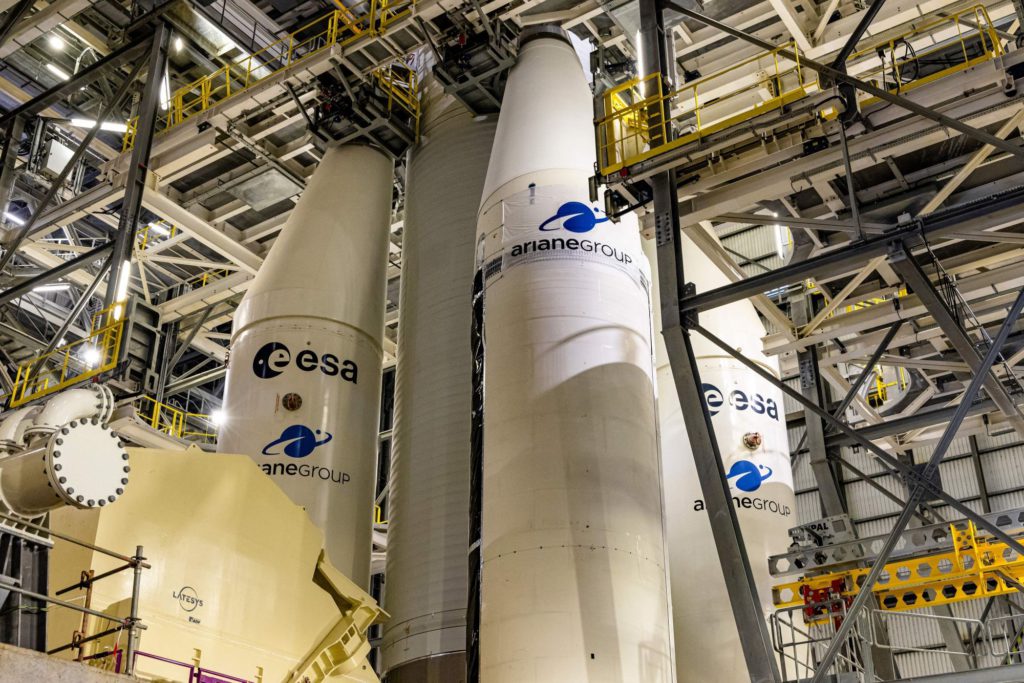
(Bloomberg) — Germany is ready to back the development of a new generation of French-built space launchers better able to compete with the latest rockets from Elon Musk’s Space Exploration Technologies Corp.

Berlin will put its weight behind future projects of ArianeGroup, a joint venture of Airbus SE and Safran SA, so long as those programs are open to technology from European startups, according to people familiar with the plans. 

Specifically, Germany plans to back the next generation Ariane 7 launcher, said one of the people, who asked not to be identified because the preparations are private.

Officials for ministers in Germany and France declined to comment on Ariane 7. ArianeGroup also didn’t respond to messages after office hours Friday.

The emergence of SpaceX has ramped up competition for Ariane, with the US firm’s reusable craft having a cost advantage over its rival’s expendable launchers. Still, the French rocket, which undertook its first mission in 1979, remains politically important in providing the European Union with an independent launch capability for satellites and space missions.

ArianeGroup, based in a Paris suburb, has around 7,000 employees in France and Germany and manufactures its rockets in sections in Europe before they’re shipped to French Guiana for assembly and launch.

While the firm describes the current Ariane 5 as “the most reliable space launcher on the commercial market,” Musk’s Falcon 9 is challenging it amid burgeoning demand for communications satellite missions. The latest Ariane 6 rocket, designed to give Europe an edge, has suffered delays with its first blast-off now scheduled for late 2023.

Political Tensions

An announcement on a future Ariane 7, would be good news for industrial relations between France and Germany, which have become fractious in recent months.

Tensions over defense projects have spilled over into the space sector, with Berlin emphasizing the need for private companies building their own launchers to beef up competition in the sector as satellite demand proliferates. Paris has instead pushed for a common EU solution, according to officials.

Read More: Berlin’s Alliance With Paris Starts to Creak With EU in a Fix

In another sign that the relationship may be improving, French Prime Minister Elisabeth Borne is traveling to Berlin Friday after a September visit was canceled. 

That’s after Berlin delivered a blow to Paris when it agreed to build a missile defense shield with other members of the NATO alliance that could include German, US and Israeli equipment. France, meanwhile, has been developing a ground-to-air defense system with Italy known as Mamba.

Germany’s defense ministry also said Friday that an “industrial agreement” has been reached on the next phase of a European jet-fighter program that affirms an “equal-footing approach” while giving France overall responsibility.

The accord on the Future Combat Air System, which is being led by Dassault Aviation SA of France and the German arm of Airbus, follows months of bickering between Paris and Berlin over issues including intellectual property rights, export licenses and the budget.

–With assistance from Arne Delfs and Chris Reiter.

More stories like this are available on bloomberg.com

©2022 Bloomberg L.P.

Berlin to Back French-Built Rockets in Race Against Musk

(Bloomberg) — Germany is ready to back the development of a new generation of French-built space launchers better able to compete with the latest rockets from Elon Musk’s Space Exploration Technologies Corp.

Berlin will put its weight behind future projects of ArianeGroup, a joint venture of Airbus SE and Safran SA, so long as those programs are open to technology from European startups, according to people familiar with the plans. 

Specifically, Germany plans to back the next generation Ariane 7 launcher, said one of the people, who asked not to be identified because the preparations are private.

Officials for ministers in Germany and France declined to comment on Ariane 7. ArianeGroup also didn’t respond to messages after office hours Friday.

The emergence of SpaceX has ramped up competition for Ariane, with the US firm’s reusable craft having a cost advantage over its rival’s expendable launchers. Still, the French rocket, which undertook its first mission in 1979, remains politically important in providing the European Union with an independent launch capability for satellites and space missions.

ArianeGroup, based in a Paris suburb, has around 7,000 employees in France and Germany and manufactures its rockets in sections in Europe before they’re shipped to French Guiana for assembly and launch.

While the firm describes the current Ariane 5 as “the most reliable space launcher on the commercial market,” Musk’s Falcon 9 is challenging it amid burgeoning demand for communications satellite missions. The latest Ariane 6 rocket, designed to give Europe an edge, has suffered delays with its first blast-off now scheduled for late 2023.

Political Tensions

An announcement on a future Ariane 7, would be good news for industrial relations between France and Germany, which have become fractious in recent months.

Tensions over defense projects have spilled over into the space sector, with Berlin emphasizing the need for private companies building their own launchers to beef up competition in the sector as satellite demand proliferates. Paris has instead pushed for a common EU solution, according to officials.

Read More: Berlin’s Alliance With Paris Starts to Creak With EU in a Fix

In another sign that the relationship may be improving, French Prime Minister Elisabeth Borne is traveling to Berlin Friday after a September visit was canceled. 

That’s after Berlin delivered a blow to Paris when it agreed to build a missile defense shield with other members of the NATO alliance that could include German, US and Israeli equipment. France, meanwhile, has been developing a ground-to-air defense system with Italy known as Mamba.

Germany’s defense ministry also said Friday that an “industrial agreement” has been reached on the next phase of a European jet-fighter program that affirms an “equal-footing approach” while giving France overall responsibility.

The accord on the Future Combat Air System, which is being led by Dassault Aviation SA of France and the German arm of Airbus, follows months of bickering between Paris and Berlin over issues including intellectual property rights, export licenses and the budget.

–With assistance from Arne Delfs and Chris Reiter.

More stories like this are available on bloomberg.com

©2022 Bloomberg L.P.
Buffett’s Berkshire Ups Stakes in Japanese Trading Houses

(Bloomberg) — Warren Buffett’s Berkshire Hathaway Inc. increased its stakes in five of Japan’s major trading companies, according to filings released on Monday. 

Berkshire Hathaway first bought stakes in Japan’s trading houses — also known as “sogo shosha” — in August 2020, acquiring about 5% of each of the firms. 

The trading companies, which invest in oil and natural gas projects globally, have booked stellar earnings in the most recent quarter fueled by the boom in commodities. Mitsui announced a 140 billion yen ($1 billion) stock buyback earlier this month on the back of a jump in earnings from higher energy prices. 

Berkshire’s insurer National Indemnity Co. increased its stake in Mitsubishi Corp. to 6.59% from 5.04%, according to documents filed to the Finance Ministry in Tokyo. The entity also added to its stakes in Marubeni Corp., Itochu Corp., Mitsui & Co. and Sumitomo Corp. It was unclear from the filings when the stakes were increased. 

In a statement announcing its purchase of the initial stakes in 2020, Berkshire said it may increase its holdings in any of the firms up to 9.9%.

National Indemnity did not immediately respond to Bloomberg requests for comment. 

Related story: Buffett’s 1977 Letter Hints at Why He Likes Japan Trading Houses

Mitsubishi shares jumped as much as 3.6% as of 10:10 a.m. local time Monday, the most since Nov. 1. Marubeni shares rose as much as 3.4%, while Sumitomo stocks gained 2.2%.  

The trading companies weren’t the only major increases in Buffett’s Asian portfolio. Berkshire Hathaway acquired a $5 billion stake in chip giant Taiwan Semiconductor Manufacturing Co. in the most recent quarter in a bid to benefit from its cheap valuation, technology leadership and solid fundamentals. 

Separately, Berkshire Hathaway is mulling a possible yen-denominated bond offering, according to a note from Mizuho Securities Co., as borrowers seek out the relatively stable Japanese credit market amid a global debt rout.

(Updated with Berkshire’s past statement in fifth paragraph.)

More stories like this are available on bloomberg.com

©2022 Bloomberg L.P.
Stocks Drop Amid China Covid Worries, Fed Rate: Markets Wrap

(Bloomberg) — Stocks and emerging-market currencies decline in Asia amid concern that China may tighten Covid curbs after reported deaths, and as investors weigh the outlook for US rate hikes. 

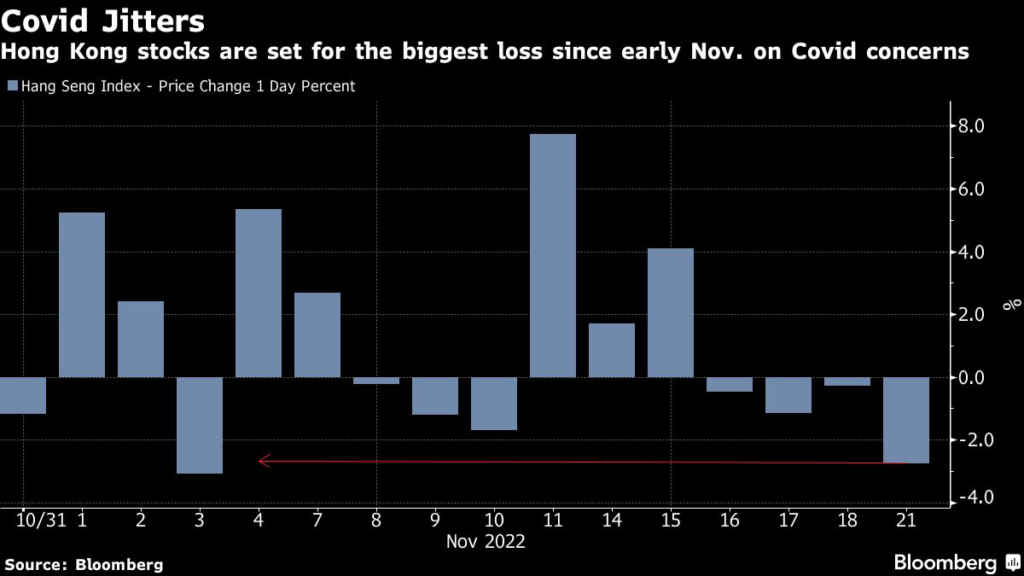
Shares in Hong Kong led the drop, with the benchmark Hang Seng Index falling more than 3%. The MSCI AC Asia Pacific index weakened to a one-week low, while US futures fell. The dollar rose against both Group-of-10 peers and emerging-market currencies. 

China saw its first Covid-related death in almost six months on Saturday and another two were reported on Sunday. A city near Beijing that was rumored to be a test case for the ending of virus restrictions has suspended schools, locked down universities and asked residents to stay at home for five days. 

The latest cases of Covid infections and deaths in China are posing a challenge to the Chinese authorities, according to Steve Brice, chief investment officer for wealth management at Standard Chartered Bank. 


“We’ve seen a very strong rally in China markets in recent times,” on the expectations of a relaxation of curbs, Brice said on Bloomberg Radio. “So investors would be very kind of interested to see what the response is going to be.”

The Malaysian ringgit fell after an election delivered the nation’s first-ever hung parliament. South Korea’s Kospi dropped more than 1% amid weakness in tech and battery stocks as global funds take profit following a recent rebound in the gauge.

Treasuries rose across the curve on higher demand for havens. 

“The China news on Covid is weighing on investor sentiment,” said Imre Speizer, a strategist at Westpac Banking Corp. in Auckland. That’s “driving haven bids, with the dollar a prime beneficiary,” he said.

Looking beyond Asia, traders this week will also be looking to minutes of the most recent Federal Reserve policy meeting for more clues on the course of rate hikes. 

Atlanta Fed President Raphael Bostic said he favors slowing the pace of interest rate increases, with no more than 1 percentage point more of hikes, to try to ensure the economy has a soft landing. Boston Fed President Susan Collins reiterated her view that options are open for the size of the December interest-rate increase, including the possibility of a 75 basis-point move.

Kim Forrest, chief investment officer at Bokeh Capital Partners, said investors could look to the Treasury market for clues on Fed’s rate-hike trajectory. The yield on the 10-year Treasury has fallen precipitously since the top in late October and shows “a softening inflationary environment,” she said on Bloomberg Television. 

“The bond market is a little bit smarter about what the Fed needs to do and what it’s going to do. It’s been telling us that the Fed probably won’t be able to get its rates up to 5% nor will it need to,” Forrest said.

Elsewhere, oil dropped as concerns about Chinese’s Covid curbs that could hurt demand and gold slid.

Key events this week:

  • US Chicago Fed national activity index, Monday
  • US Richmond Fed manufacturing index, Tuesday
  • OECD releases Economic Outlook, Tuesday
  • Fed’s Loretta Mester and James Bullard speak, Tuesday
  • S&P Global PMIs: US, Euro area, UK, Wednesday
  • US MBA mortgage applications, durable goods, initial jobless claims, University of Michigan sentiment, new home sales, Wednesday
  • Minutes of the Federal Reserve’s Nov. 1-2 meeting, Wednesday
  • ECB publishes account of its October policy meeting, Thursday
  • US stock and bond markets are closed for the Thanksgiving holiday, Thursday
  • US stock and bond markets close early, Friday

Some of the main moves in markets :

Stocks

  • S&P 500 futures fell 0.4% as of 11:47 a.m. in Tokyo. The S&P 500 rose 0.5% Friday
  • Nasdaq 100 futures fell 0.4%. The Nasdaq 100 was little changed
  • Japan’s Topix index was little changed
  • South Korea’s Kospi index fell 1.3%
  • Hong Kong’s Hang Seng Index fell 2.8%
  • China’s Shanghai Composite Index fell 1.1%
  • Australia’s S&P/ASX 200 Index fell 0.1%
  • Euro Stoxx 50 futures fell 0.4%

Currencies

  • The Bloomberg Dollar Spot Index rose 0.3%
  • The euro fell 0.3% to $1.0289
  • The Japanese yen was little changed at 140.40 per dollar
  • The offshore yuan fell 0.6% to 7.1663 per dollar

Cryptocurrencies

  • Bitcoin fell 1.6% to $15,989.8
  • Ether fell 1.8% to $1,121

Bonds

  • The yield on 10-year Treasuries declined four basis points to 3.79%
  • Australia’s 10-year yield declined two basis points to 3.59%

Commodities

  • West Texas Intermediate crude fell 1% to 79.30 a barrel
  • Spot gold fell 0.4% to $1,744.16 an ounce

This story was produced with the assistance of Bloomberg Automation.

–With assistance from Ruth Carson.

More stories like this are available on bloomberg.com

©2022 Bloomberg L.P.

Buffett’s Berkshire Ups Stakes in Five Japanese Trading Houses

(Bloomberg) — Warren Buffett’s Berkshire Hathaway Inc. increased its stakes in five of Japan’s major trading companies, according to filings released on Monday. 

Berkshire Hathaway first bought stakes in Japan’s trading houses — also known as “sogo shosha” — in August 2020, acquiring about 5% of each of the firms. 

The trading companies, which invest in oil and natural gas projects globally, have booked stellar earnings in the most recent quarter fueled by the boom in commodities. Mitsui announced a 140 billion yen ($1 billion) stock buyback earlier this month on the back of a jump in earnings from higher energy prices. 

Berkshire’s insurer National Indemnity Co. increased its stake in Mitsubishi Corp. to 6.59% from 5.04%, according to documents filed to the Finance Ministry in Tokyo. The entity also added to its stakes in Marubeni Corp., Itochu Corp., Mitsui & Co. and Sumitomo Corp. It was unclear from the filings when the stakes were increased. 

National Indemnity did not immediately respond to Bloomberg requests for comment. 

Related story: Buffett’s 1977 Letter Hints at Why He Likes Japan Trading Houses

Mitsubishi shares jumped as much as 3.6% as of 10:10 a.m. local time Monday, the most since Nov. 1. Marubeni shares rose as much as 3.4%, while Sumitomo stocks gained 2.2%.  

The trading companies weren’t the only major increases in Buffett’s Asian portfolio. Berkshire Hathaway acquired a $5 billion stake in chip giant Taiwan Semiconductor Manufacturing Co. in the most recent quarter in a bid to benefit from its cheap valuation, technology leadership and solid fundamentals. 

Separately, Berkshire Hathaway is mulling a possible yen-denominated bond offering, according to a note from Mizuho Securities Co., as borrowers seek out the relatively stable Japanese credit market amid a global debt rout.

More stories like this are available on bloomberg.com

©2022 Bloomberg L.P.
Musk Welcomes Ye Back to Twitter After Inviting Trump’s Return

(Bloomberg) — American musician Ye has returned to Twitter after a two-week hiatus from the social network, and new owner Elon Musk welcomed him back on the platform.

Posting from an iPhone on Sunday, the artist formerly known as Kanye West first tested that he was still unblocked — his account had been temporarily suspended and restored at the end of October, which Musk said was not his decision — before following up with “Shalom : )”. Ye’s earlier suspension had been due to an antisemitic tweet. The hip hop artist last month agreed to buy social media platform Parler, embraced by conservatives as an alternative to Twitter.

Musk responded positively to Ye’s initial tweet, tweeting “Don’t kill what ye hate, Save what ye love.”

Twitter’s new leader, who’s also chief executive officer of Tesla Inc. and SpaceX, spent the weekend polling his followers on the platform whether to restore the access of Donald Trump, the former US president who was permanently suspended following the Jan. 6 breaching of the US capitol. Some 52% responded in the affirmative and Trump is now clear to return — though he’s responded saying that he’ll stick to his own social network, Truth Social.

Musk’s latest tweet depicts Twitter as a drug that Trump will be sorely tempted to return to. The billionaire Twitter owner’s courtship of the network’s controversial figures — beside himself — threatens to further alienate advertisers, who have been wary about associating their brands with the service in recent times.

Twitter has been setting new highs for user numbers under Musk’s leadership, which has attracted attention for abrupt job cuts, equivocation on product changes and an ultimatum to employees to either stay for a new “hardcore” work culture or leave.

–With assistance from Kurt Wagner.

More stories like this are available on bloomberg.com

©2022 Bloomberg L.P.
Asia Earnings To Watch Next Week: Baidu, Xiaomi, Meituan, Kuaishou

(Bloomberg) — Kuaishou Technology, ByteDance’s rival in China, may have been overlooked for Hang Seng Index inclusion last Friday but it still has plenty of chance as there are a number of places up for grabs before the benchmark membership expand to 80 as targeted.  

This week, the livestreaming firm, along with several of China’s biggest technology firms including Meituan and Xiaomi, will need to show how resilient it is in the face of uncertain economic outlook amid the country’s strict Covid policy when it announces quarterly results. 

It hasn’t been a great earnings season for Chinese companies overall. Of the more than 500 MSCI China Index companies that have reported quarterly results so far, nearly two-thirds of them missed estimates, according to Bloomberg Intelligence analysts Sufianti and Kumar Gautam. Indian companies fared slightly better, with 53.6% of companies on MSCI’s India gauge missing estimates.

Yet earnings in the two biggest emerging markets may improve next year, with analyst consensus predicting firms in both countries to post double-digit EPS growth, BI equity strategist Marvin Chen said in a note. “A key difference is that India’s growth appears structural, with 2023’s earnings building upon this year,” Chen said. “China is largely in a rebound after earnings contracted this year due to lockdowns related to China’s Covid Zero policy.”

Still, it remains unclear at what pace China might ease its virus restrictions, and investors will be eagerly awaiting any signs of relaxation that could drive earnings recovery.

  • With the region’s earnings season winding down, this will be our last Asia Earnings Week Ahead this year. We’ll resume when reports ramp up again in January.
  • To subscribe to earnings coverage across your portfolio or other earnings analysis, run NSUB EARNINGS function on the Bloomberg terminal.
  • For more on what’s going on in other regions, see the US Earnings Week Ahead or the EMEA Earnings Week Ahead, and see the ESG Stock Watch for a selection of the environmental, social and governance themes that may come up on earnings calls.

Highlights to look for this week:

Tuesday: Baidu (BIDU US) will report after the market close in Hong Kong. Its third-quarter revenue will remain flattish but may see year-on-year expansion in the fourth quarter, according to Bloomberg consensus estimates. Baidu enjoyed a sustained recovery in its core advertisement business during summer but it began to stall as Covid cases soared with Chinese authorities imposing restrictions, according to CCB International. With China announcing a significant calibration of the Covid Zero policy, investors are assessing the implication on advertising sentiment and cloud project delivery by the company. US audit officials completed the first round of on-site inspections ahead of schedule this month and any development in the investigation may affect US-listed Chinese companies including Baidu.

  • Uncertain outlook: Kuaishou (1024 HK) is set to unveil third-quarter results after market close. Bloomberg consensus estimates show a 10% increase in its third-quarter revenue from a year earlier, with income from live streaming and online marketing services rising. Operating loss is also expected to narrow by nearly 55% year-on-year. Yet, Kuaishou’s exposure to advertising could be a risk given the slow recovery in the overall advertising market, analysts at Morgan Stanley and CICC wrote. Growth is predicted to decelerate in 2023, with Morgan Stanley slashing its price target to HK$60, citing China’s gradual reopening process. Shares of Kuaishou dropped to a historic low at the end of October.

Wednesday: Xiaomi (1810 HK) plans to report results after market close. Third-quarter revenue is expected to drop 10% from a year earlier after a 20% decline last quarter, according to Bloomberg Consensus estimates. Xiaomi, which was once China’s largest smartphone brand, has been hit hard by worldwide headwinds like rising interest rates and inflation. The global smartphone market had its worst third quarter since 2014 and the downtrend in demand may continue for a further nine months, research firm Canalys said. The market may have to further revise down 2023 forecasts with escalating recession concerns, which could be near-term pressure for Xiaomi, according to Citigroup. The company also faces fierce domestic competition and disputes in the high-growth Indian market. Any updates on its electric vehicles business will also be in focus.

Thursday: Chow Tai Fook (1929 HK), one of the world’s largest jewelers by market value, will announce first-half earnings after market close. Results are expected to have taken a hit amid Covid outbreaks in Greater China. Jewelry-buying trips to Hong Kong might lose their allure as its items have become more broadly available on mainland China. The firm could use earnings in Hong Kong and Macau to expand its mainland business this fiscal year through March, Bloomberg Intelligence said in a note in September. Any mentions of its rental expenses and store footprint would be worth noting as the city’s property downturn has dragged on.

Friday: Meituan (3690 HK) is due to report earnings after market close. It is one of the few Chinese Internet companies that managed to expand at a double-digit pace despite macroeconomic headwinds. Consensus estimate shows 22% sequential growth in third-quarter revenue despite recent surge in Covid infections across the country. The market is watching for comments after China’s top leaders reinforced the need to stick with the Covid Zero policy with more targeted restrictions. Quarterly losses may narrow gradually because of new initiatives and cash flow may improve due to a pickup in transactions for its core food-delivery service with a lean cost model, according to Bloomberg Intelligence. The Chinese food delivery titan combined its food delivery, hotels and other commerce businesses into a new division it dubbed “core local commerce” last quarter, which is expected to grow 26% sequentially in the coming earnings. The firm is also mulling an expansion into Hong Kong and international markets, according to people familiar with the matter.

(Updates top graphs with Kuaishou.)

More stories like this are available on bloomberg.com

©2022 Bloomberg L.P.
Close Bitnami banner
Bitnami