

Bloomberg

Malaysia’s Hung Parliament Clouds Market Outlook, Analysts Say

(Bloomberg) — Malaysia saw its first-ever hung parliament in Saturday’s election after none of the three major coalitions won enough seats to form a majority, extending the political crisis in an economy on a fragile rebound.

While uncertainty remains, investors are expected to take the results in their stride as most have factored in a hung parliament as a “default position,” according to analysts. 

The ringgit dropped by 0.60% against the dollar to 4.5837 following the election results, with the Malaysian currency the worst performer in Asia on Monday. Malaysia 10-year yields are steady at 4.32% while the nation’s equity benchmark dropped as much as 1.5%. Most of Malaysia’s gaming and alcohol-related stocks drop following the Islamic party PAS’ advance in the elections.

REad: Malaysia’s Alcohol, Gaming Stocks Drop After PAS Electoral Wins

Malaysian party leaders have until Monday afternoon to inform the nation’s monarch of their choice for prime minister and the alliances they have formed. 

Veteran opposition leader Anwar Ibrahim’s reformist coalition won 82 parliamentary seats in the elections, the biggest haul among the competing blocs. Meanwhile, former prime minister Muhyiddin Yassin said he has enough support to make a bid for the premiership.

Here is what analysts and money managers have to say:

Megat Fais, a strategist at Citigroup Inc.

“A lack of strong majority government remains less than ideal from a policy-making standpoint, especially with concerns over Malaysia’s fiscal position.”

A Yassin-led coalition government can put more scrutiny on gaming, brewery and tobacco shares while “apolitical” sectors such as planters and glovemakers could be seen as places to hide. Investors could remain wary of construction-related stocks, given the sector’s dependence on policy implementation.

“In the event of a sell-off by foreign investors, banks (eg. Public Bank) could be negatively impacted given the strong foreign inflows YTD.”

Alexander Chia, an analyst at RHB

“This outcome constitutes a worst-case scenario for markets, with investor sentiment likely to remain clouded when markets reopen – depending on the duration of the power vacuum, the quality of the Cabinet members, and the parliamentary majority of the eventual government that will determine its ability to institute reform.”

“The strong electoral performance by the PN coalition was a surprise and we expect regulatory risks to spike higher especially for the gaming, brewery and tobacco sectors.”

Stephen Innes, managing partner at SPI Asset Management

A smorgasbord of political choices favored a hung government, a default position for most market participants. From the market’s perspective, the results may fail to ease concerns over the recent phase of political instability, which has been hanging like a dark cloud over Malaysian capital markets.

Still, there will be no earthquake reaction like the one we saw post-2018 election, and given the hung parliament was a consensus, I suspect the market will take the result in its stride as the political landscape is unlikely to change too much from the present murky situation.

More importantly, investors are shrugging off the hawkish US Federal Reserve and still peering down the China reopening-looking lens, which should be favorable for the local capital markets.

Danny Wong, chief executive officer of Areca Capital

Once the new government is formed and this political uncertainty can be removed, markets will not react that drastically. This will reduce uncertainty in the short term, say one year. Beyond that, one needs to play by ear.

We like banks due to the rising interest rates and potentially the new government’s focus on reviving the economy. Avoid government-linked companies and commodities.

Nirgunan Tiruchelvam, analyst at Aletheia Capital

The initial reaction from the market will be a muted one, where there will be a risk of approach to investing in Malaysia. A hung parliament could lead to a lot of horse-trading but once the shape of a coalition becomes clearer, market sentiment could change dramatically toward Malaysia.

Still, the fundamental investment thesis toward Malaysia is quite clear, irrespective of the coalition. There are three sectors to focus on, which include commodities, as Malaysia is a leading producer of rubber, palm oil, and tin. 

Next year could also be the year of Southeast Asian travel and companies that are exposed to travel and tourism could see strong investments. Consumer companies like food and beverage producers that are able to ride the recovery as people go back to normal activity could also do very well.

Win Thin, global head of currency strategy at Brown Brothers Harriman & Co.

Ringgit “may underperform within EM until some clarity is seen.”

In terms of coalition government, veteran opposition leader Anwar Ibrahim is well regarded by investors but his attempts to forge an alliance “may be held hostage by some of the smaller parties.”

Malaysia Latest: Anwar Confident He Will Have a Chance to Lead

Winson Phoon, head of fixed income research at Maybank Securities:

Parties can still negotiate to form a functioning government, but don’t expect frictionless working relationships.

This is not a surprise outcome to the bond market and a hung parliament has been a baseline scenario for many investors. We expect a bond-neutral reaction as market will likely take a wait-and-see approach pending clarity on the new government and key appointments.

–With assistance from Matthew Burgess and Marcus Wong.

(Updates to add equity market reaction in second paragraph.)

More stories like this are available on bloomberg.com

©2022 Bloomberg L.P.
Buffett’s $5 Billion TSMC Purchase Adds to Wave of Bullish Calls

(Bloomberg) — For investors looking for a dip-buying opportunity in the global chip industry, Berkshire Hathaway Inc. may have a recommendation: Taiwan Semiconductor Manufacturing Co.

Warren Buffett’s conglomerate picked up a $5 billion stake in the firm in the recent quarter amid a rout that wiped out over $250 billion from the stock. It hasn’t commented publicly on the deal but market watchers attribute the purchase to TSMC’s cheap valuations, technology leadership and solid fundamentals. 

Berkshire’s buy, along with a similar move by Tiger Global Management LLC, may suggest that value is emerging in the chip industry after a turbulent period marked by slowing demand and US-China tensions. A growing number of Wall Street banks have reaffirmed bullish calls on TSMC, with analysts at Morgan Stanley saying the stock has reached “a good entry point.”

“With its superior technology leadership, TSMC is a great value play in the long-term if you look past the current semiconductor downcycle,” said Andy Wong, fund manager at LW Asset Management. “Buffett could be investing in the next-decade growth with burgeoning demand from IoT, renewable and automobiles.” 

TSMC’s shares have jumped about 10% in Taiwan since Berkshire’s acquisition was disclosed last week. Morgan Stanley says they are trading below their downcycle valuation with a 30% to 40% discount due to geopolitical risks, according to a Nov. 8 note.

The stock has a valuation multiple of around 12.6 times based on its estimated earnings for the next year, according to data compiled by Bloomberg. Goldman Sachs Group Inc. estimates that to be the lower end of the 10-year average. The company is cheaper than most of the members of the Philadelphia Stock Exchange Semiconductor Index, which tracks the biggest US-listed chip companies. 

“We expect TSMC to continue to show its resilience versus other peers during the industry downcycle given its superior execution,” Goldman analysts wrote in a Nov. 16 note. Valuations are attractive and the firm is best placed to capture the industry’s long-term structural growth in 5G, artificial intelligence, high-performance computing and electric vehicles, they added.

Cash Flow

TSMC also has another advantage: it has managed to deliver double-digit sales growth and a gross margin well above 50% this year despite a slowdown in the sector. This has capped the stock’s year-to-date loss at 21%, helping it outperform peers such as Micron Technology Inc. and SK Hynix Inc.

The Taiwanese company’s history of healthy cash flow and stable dividends may have also helped draw Buffett, according to analysts. 

“TSMC (and other foundries) all have to incur heavy capital expenditure in the race for tech/capacity leadership, but history shows TSMC has managed to generate respectable cash flows despite capex,” said Phelix Lee, equity analyst at Morningstar Asia Ltd. The company has a track record of paying dividends since the 2000s, he added. 

The stock’s latest dividend yield is 2.6%, higher than Micron’s 0.8% and almost on par with SK Hynix’s, according to data compiled by Bloomberg. 

Still, while Buffett’s bet has boosted retail sentiment toward the stock, the shares may continue to experience swings in the short term due to geopolitical risks and inventory adjustments in the chip industry.

The semiconductor sector is at the center of a growing rift between the US and China as the two nations vie for leadership in the global technology industry. Washington has imposed elevated sanctions on high-end chips produced for Chinese customers specifically to forestall them making their way into the hands of the Chinese military.

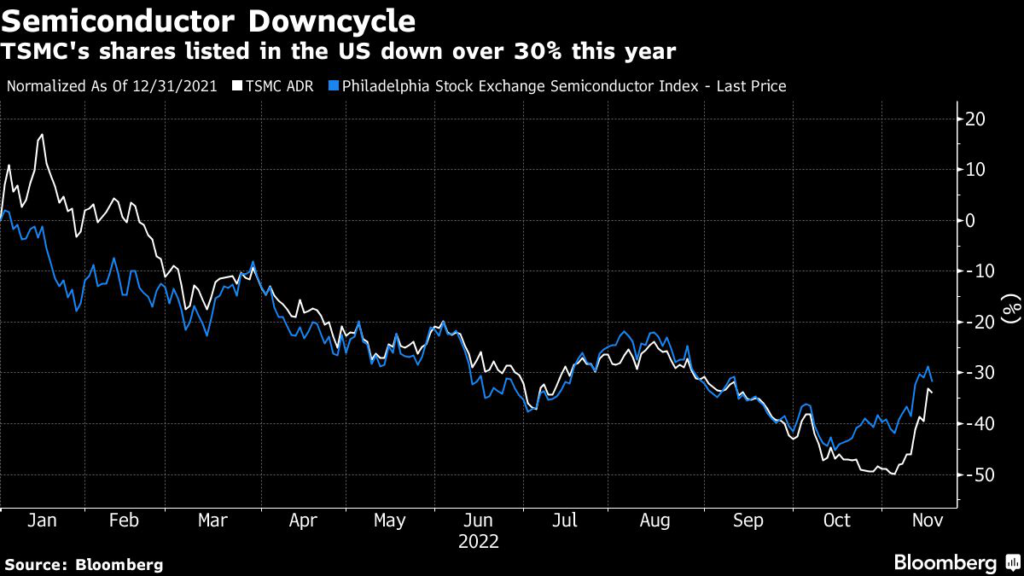
To reflect the risks, analysts have cut the average target price for TSMC’s stock by about 30% since February. Its shares listed in the US are down over 30% this year, in line with the drop posted by the global semiconductor benchmark.

“Investors are worried about higher-than-usual inventory, which shows no signs of easing yet,” said Jason Su, fund manager at Cathay Taiwan 5G Plus Communications ETF. “Companies including TSMC said earlier they expect inventory correction to continue through first half next year,” he said, adding that chip stocks are likely to rebound after inventory adjustments are completed.

More stories like this are available on bloomberg.com

©2022 Bloomberg L.P.

Your Sunday Briefing: All Eyes on Twitter and Black Friday

(Bloomberg) — Happy Sunday.

Perhaps this week can best be summed up by the three Bs — birds, bankruptcy and a big birthday (sorry, that’s four Bs.) The collapsed crypto trading firm FTX started a review of its global assets and hired big guns Perella Weinberg to help with the potential sale of any viable units. It owes its 50 biggest unsecured creditors a total of $3.1 billion, court papers show. And then there’s Twitter…

So here’s a few ideas to help make sense of the days ahead.The big exodus: Elon Musk is considering firing more Twitter employees as soon as Monday, this time targeting the sales and partnership side of the business. He already sacked half of the social network’s staff last month and told those remaining they can expect to work 80-hour weeks  — at the office, none of that working-from-home nonsense. While we don’t have hard numbers on the people still employed, multiple teams that were critical for keeping the service up and running are completely gone, or borrowing engineers from other groups.

The big buzz phrase:  “Soft landing” is back in rotation in some of the more optimistic corners of Wall Street. While some positive inflation data has boosted hopes the Federal Reserve will slow its rate increases, and a recession can be avoided, big money managers are staying defensive.  Stagflation is the consensus viewpoint among a whopping 92% of respondents in Bank of America’s latest fund-manager survey.

The big safety violation: At least a dozen employees of electric-vehicle maker Rivian accused it of safety violations at its Illinois plant. The complaints detail a range of injuries, including a crushed hand, and allege management fished damaged electrical cables out of the garbage to be reused. The filings depict an automaker that cut corners as it scaled rapidly to keep pace in the competitive electric-vehicle space. A Rivian spokesperson disputed workers’ allegations.

The big deal:  The COP27 climate talks in Egypt, which had appeared close to collapse on Saturday morning, secured a last-minute deal on an historic pact over loss and damage — the mechanism to pay poorer countries for harm caused by global warming. Still, some groups were disappointed by the limited progress in phasing out fossil fuels.

The big bird: Enjoy every bite of your Thanksgiving turkey, because a 16-pound bird is a whopping 21% more expensive this year compared with last, according to a survey from the Farm Bureau. Stuffing mix is up 69% due to a flour shortage stemming from Russia’s invasion of Ukraine. If you’re traveling by plane over the holiday, domestic, round-trip flights cost 10% more than last year.

The big market idea: Recent wild swings in Treasury yields suggest that turbulence may endure a while longer, so it’s probably good news that US markets are closed for Thursday’s holiday and there’s shortened bond trading on Friday.

The big buy:  Black Friday, which kicks off the holiday shopping season, may not be so cheerful for stores or investors who own retail stocks.  The S&P 500 Retailing Index has lost more than 30% in 2022 and consumers, worried about economic uncertainty and rising interest rates, will probably choose to be more frugal this year. 

The big birthday: Joe Biden turned 80 today. He already holds the record for being the oldest sitting president in US history.

The big blizzard: Bad luck if you’re in Western New York and hate snow. Plows are struggling to keep up as parts of Buffalo’s metro area face record-threatening accumulations of six feet or more thanks to an intriguing weather pattern know as the lake effect.  

The big miss:  Sam Bankman-Fried was a persuasive fellow, inducing some of the world’s biggest investors to give him billions for his now failed FTX cryptocurrency exchange. Among those missing red flags was Ontario Teachers’ Pension Plan, which ultimately invested and lost $95 million. Bloomberg reporter Layan Odeh takes a behind-the-scenes look at how the FTX equity purchase cycled through the Canadian pension manager’s due diligence process.

The big thoughts: Elizabeth Holmes has been sentenced to more than 11 years in prison for fraudulently building her blood-testing startup Theranos into a $9 billion company that collapsed in scandal. Bloomberg Opinion columnist Stephen Carter pins social media’s glee on schadenfreude, as the general public basks in the humiliation of a high-flying Silicon Valley celebrity brought low. 

ICYM our Big Take:  Guyana’s government is betting on a paradox. As rising sea levels imperil the South American country, it has stumbled upon a crude oil jackpot not far from its shoreline. The country’s leaders now believe the most effective way to rescue Guyana from fossil-fuel-induced climate change is to fully embrace the business of fossil fuels.

Hear this:  Brace yourself. Global financial leaders warn that the current era of expensive money is likely to stick around for at least another year. In a special edition of the Stephanomics  podcast from the Bloomberg New Economy Forum in Singapore, three experts in banking and monetary policy share why central bankers will be battling inflation in the short term as well as the long. 

On that note, have a good holiday week. We’ll see you on the other side.

More stories like this are available on bloomberg.com

©2022 Bloomberg L.P.

Bankrupt Crypto Lender Celsius Was Lax With Custody Program

(Bloomberg) — Sign up for our new Crypto newsletter and follow @crypto Twitter for the latest news.

A new report by the examiner of bankrupt crypto lender Celsius Network details shortfalls in controls and operations at two of the company’s product offerings related to digital assets it held in custody for customers, raising issues of whether and how these users can get reimbursed.

The programs, Custody and Withhold, were similar, and allowed users to keep their digital coins in the lender while supposedly maintaining ownership of them. The programs’ users have been claiming that they shouldn’t be lumped together with other unsecured creditors and should be reimbursed in full.

In her interim report, examiner Shoba Pillay found that Celsius launched the Custody program “without sufficient accounting and operational controls or technical infrastructure.” As a result, Custody wallets were overfunded through June 10, but then became underfunded by $50.5 million — a 24% shortfall — by June 24.

With the Withhold program, “no effort was made to segregate or separately identify any assets” associated with the accounts, the report said. “As a result, customers now face uncertainty regarding which assets, if any, belonged to them as of the bankruptcy filing,” Pillay wrote in the report. The findings may complicate customers’ efforts at reimbursement.

The judge in Celsius’s bankrupcty case approved the appointment of an examiner in September to probe how the lender stored its assets and whether any of them were comingled. The report noted that Celsius sped up the rollout of its Custody program due to regulatory pressure from New Jersey’s regulator. It also received inquiries or subpoenas from the Securities and Exchange Commission beginning in August of 2021.

Read more: Celsius Judge Approves Independent Probe of Lender’s Holdings

Celsius halted withdrawals in June and filed for bankruptcy in July after its risky bets fell through and it experienced a rush of customers seeking their funds back. Its troubles were part of a series of crises that roiled the industry in the spring and included the implosion of the TerraUSD stablecoin, the failure of hedge fund Three Arrows Capital and the bankruptcy of brokerage Voyager Digital. A new round of convulsions has hit the crypto market more recently with this month’s spectacular collapse of Sam Bankman-Fried’s FTX empire.  

Kyle Ortiz, partner at Togut, Segal & Segal LLP representing Custody account holders, and Deborah Kovsky-Apap, partner at Troutman Pepper represening Withhold account holders, didn’t immediately return requests for comment.

The bankruptcy case is Celsius Network LLC, 22-10964, US Bankruptcy Court for the Southern District of New York (Manhattan).

More stories like this are available on bloomberg.com

©2022 Bloomberg L.P.

TikTok Draws Bipartisan Fire in US on China Surveillance Concern

(Bloomberg) — Two US senators called TikTok a Chinese surveillance tool, issuing a bipartisan warning as the Biden administration weighs a deal that could let the video-sharing app keep operating in the US.

“It’s not just the content you upload to TikTok but all the data on your phone, other apps, all your personal information, even facial imagery, even where your eyes are looking on your phone,” Arkansas Republican Tom Cotton said on “Fox News Sunday.” TikTok is “one of the most massive surveillance programs ever, especially on America’s young people,” he said.

The app is “an enormous threat,” Senate Intelligence Committee chair Mark Warner, a Virginia Democrat, said on the program. “All of that data that your child is inputting and receiving, is being stored somewhere in Beijing,” he said.

President Joe Biden’s administration is seeking a security agreement with TikTok to spare it from a US ban floated under his predecessor Donald Trump. Critics remain concerned that data can leak to China via the popular app, owned by Beijing-based ByteDance Ltd. 

Two influential Republican lawmakers, Senator Marco Rubio of Florida and Representative Mike Gallagher of Wisconsin, said this month they’re introducing legislation to ban TikTok from use in the US and criticized the Biden administration for taking insufficient action.

FBI Director Christopher Wray reiterated the bureau’s national-security concerns last week, telling a House panel that potential Chinese government access to users’ data or software is reason to be “extremely concerned.” 

The administration is weighing a proposal to allow TikTok to continue to operate in the US — where it has millions of mostly young users — under ByteDance ownership. The arrangement would include routing US user traffic through servers maintained by Oracle Corp., with the US-based database giant auditing the app’s algorithms.

TikTok Chief Executive Officer Shou Zi Chew said last week that the company is working on an effort, called Project Texas, that will isolate sensitive data from its American users so that only staff in the US will have access. Speaking at the Bloomberg New Economy Forum in Singapore, he called the effort “extremely difficult and expensive to build,” but aimed at the concerns of American officials. 

TikTok has said that certain employees outside the US can access information from American users but denies that it is shared with the Chinese government.

Warner expressed skepticism, saying the code for the app is written in China and that it essentially serves a “broadcast medium” that could attempt to sway app users on contentious issues like Taiwan. Cotton renewed advice for Americans to delete the app and even get a new phone. 

“The Justice Department is trying to come up with a solution,” Warner said. “I’m going take a look at that solution, but they’ve got a huge mountain to climb.”

–With assistance from Todd Shields.

More stories like this are available on bloomberg.com

©2022 Bloomberg L.P.

Ethereum Co-Founder Vitalik Buterin Says FTX Saga Offers Lessons for Crypto

(Bloomberg) —

The collapse of FTX contains lessons for all of crypto, according to Ethereum co-founder Vitalik Buterin. 

Buterin emphasized the stability of crypto’s so-called underlying technology, the blockchain, while acknowledging the heavy impact of the meltdown of the Sam Bankman-Fried crypto empire.  

In the days since FTX filed for bankruptcy, entities ranging from BlockFi to Genesis to Gemini have been hit by the fallout. 

  • Read more: Crypto Contagion Is Entangling Even More Retail Customer Cash

Despite the upheaval, Buterin said blockchain base layers and decentralized-finance protocols worked “flawlessly.” 

“What happened at FTX was of course a huge tragedy,” Buterin told Bloomberg. “That said, many in the Ethereum community also see the situation as a validation of things they believed in all along: centralized anything is by default suspect,” he said. These beliefs also included putting one’s trust in “open and transparent code above individual humans,” he added.

Buterin, like many others in crypto Twitter, has in recent days weighed in on how crypto exchanges could help shore up confidence in their businesses. The downfall of Bankman-Fried has led to an industry-wide self-reckoning over transparency and risk.

Commenting on the earlier collapse of Do Kwon’s TerraUSD algorithmic stablecoin and associated Luna token, Buterin said “crashes like that are on the one hand necessary for the ecosystem.” On the other hand, he added, “I really wish that it happened when Terra/Luna was like 10 times smaller.”

  • Read more: How Onetime Crypto Titan Do Kwon Became a Fugitive: QuickTake

More stories like this are available on bloomberg.com

©2022 Bloomberg L.P.
FTX Owes Its 50 Biggest Unsecured Creditors More Than $3 Billion

(Bloomberg) — Sign up for our new Crypto newsletter and follow @crypto Twitter for the latest news.

Sam Bankman-Fried’s bankrupt crypto empire owes its 50 biggest unsecured creditors a total of $3.1 billion, new court papers show, with a pair of customers owed more than $200 million each.

FTX-linked entities owe their single biggest unsecured creditor more than $226 million, according to a redacted list of top 50 creditors filed late Saturday. All of them were listed as customers and ten have claims of more than $100 million each, the filings show.

The creditors, whose names and  locations weren’t disclosed, are among the vast array of people and institutions caught up in FTX’s insolvency. The 50 largest claims are all from customers owed $21 million or more. 

In the US, bankrupt companies are required to disclose information about their debts as part of insolvency proceedings. Creditors will get to weigh in on the best way for FTX to repay its debts as the bankruptcy unfolds. 

FTX said it has assets and liabilities of at least $10 billion each in preliminary court papers. The case may involve more than one million creditors, according to lawyers for FTX. 

The case is FTX Trading Ltd., 22-11068, U.S. Bankruptcy Court for the District of Delaware.

–With assistance from Luca Casiraghi.

(Updates with new headline and first paragraph showing total amount owed to top 50 creditors.)

More stories like this are available on bloomberg.com

©2022 Bloomberg L.P.
Europe Reasserts Middle Path on China, Pushing Back on Biden

(Bloomberg) — President Xi Jinping started his week overseas mending ties with the US, and ended it with European leaders making the case for resisting the Biden administration’s sweeping chip curbs on China. 

The shift in sentiment amounts to a victory for Xi on just his second foray outside of China since the pandemic began — a span that had seen Beijing’s relations with the US and its allies go from bad to worse. In October, President Joe Biden restricted the sale of semiconductors and chipmaking equipment to China in a bid to stem its economic development, and asked key allies to comply — raising fears of a split in the global economy. 

On Friday, French President Emmanuel Macron called for engagement with Beijing and resisting efforts to divide the world into competing blocs. That followed similar appeals from German Chancellor Olaf Scholz, who visited China earlier this month, and efforts by Dutch Prime Minister Mark Rutte to coordinate with other key chipmaking nations in resisting US pressure. 

“Now, progressively, a lot of people would like to see that there are two orders in this world,” Macron said in a speech to business executives at the Asia-Pacific Economic Cooperation CEO summit in Bangkok. “This is a huge mistake, even for both the US and China.” 

“We need a single global order,” he added, a line that drew extended applause. 

The French leader’s comments in particular show Europe is finding its footing in carving out a middle ground when it comes to China. While calls have grown in some European capitals to get tougher with Beijing on issues related to human rights and democracy, the sweeping US export controls on chips — which may soon be extended to other strategic technologies — have shifted the conversation from fears about China to concern about American overreach. 

‘Little Appetite for Confrontation’

With Germany heading toward recession and Europe facing a harsh winter without cheap Russian oil and gas, “there is little appetite for confrontation with Beijing,” said Noah Barkin, managing editor of the Rhodium Group’s China practice.

“For all the rhetoric about standing up to Xi, forging a common European front and mitigating the risks of economic engagement with China, the actions over the past month have fallen short,” he said. “The risk, if this continues, is more cracks in the transatlantic relationship. We are already seeing some of these cracks in Europe’s reaction to recent US technology controls aimed at China.”

Xi sought to exploit the divisions on his six-day trip to attend the Group of 20 summit in Bali and APEC in Thailand, during which he met with roughly 20 leaders — many of whom he hadn’t seen face-to-face in at least three years. In a meeting with Rutte in Bali, Xi urged the Dutch leader to avoid “decoupling” as the US piles pressure on ASML Holding NV, which has a virtual monopoly on a type of machine needed to make the most advanced chips. 

“We must oppose the politicization of economic and trade issues and maintain the stability of the global industrial chain and supply chain,” Xi told Rutte on Tuesday. The Chinese leader also called for increased cooperation in high-tech manufacturing with South Korea in a meeting with President Yoon Suk Yeol, whose nation is home to chip giants Samsung Electronics Co. and SK Hynix Inc. 

Later in the week on Thursday, Rutte met with Yoon during a visit to Seoul, where the two leaders pledged greater cooperation. A day later, Dutch Foreign Trade Minister Liesje Schreinemacher said the US shouldn’t expect the Netherlands to unquestionably adopt its approach to China export restrictions.

“The Netherlands will not copy the American measures one to one,” Schreinemacher said in an interview with Dutch newspaper NRC published on Friday. “We make our own assessment — and we do this in consultation with partner countries such as Japan and the US.”

The Biden-Xi summit showed that the world’s largest economies understand their responsibility to overcome divisions, but risks remain of a greater bifurcation without follow through in subsequent discussions, according to International Monetary Fund Managing Director Kristalina Georgieva. 

“We are in a world that is going from one shock to another — pandemic, war, inflation, cost of living crisis,” the Bulgarian economist told Bloomberg Television on Saturday. “And if we add on top of it the fragmentation in the world economy, it would be throwing gasoline on a fire. Nobody benefits from it.”

The US moves to restrict trade with China have also come under criticism in Asia, where nations like Singapore have warned against cutting off Beijing economically. Many governments in the region also viewed US House Speaker Nancy Pelosi’s trip to Taiwan earlier this year as unnecessarily provocative. 

Biden appeared to address those concerns after his meeting with Xi, telling reporters he didn’t see “any imminent attempt” by China to invade Taiwan and made clear the US policy toward the self-governed island “has not changed at all.” He said Xi was “straightforward,” adding that “I think that we understand one another.”

Avoiding a ‘Cold War’

“I absolutely believe there need not be a new Cold War,” he said. In subsequent days, the US and China restarted talks on the military and climate change. 

Though major European leaders are increasingly resistant to rising pressure from Washington, they are far from reaching a consensus on how to deal with an increasingly assertive China. 

Former Soviet bloc countries in particular are coming to view Beijing’s economic influence over the continent with suspicion. Finnish Prime Minister Sanna Marin on Thursday warned of Europe’s technological dependency on China, noting the risks of becoming too reliant on an authoritarian regime. 

Xi’s diplomatic support for Vladimir Putin, who invaded Ukraine shortly after declaring a “no limits” friendship with the Chinese leader, has also helped strengthen US-Europe bonds. The Chinese leader has recently moved to alleviate some concernhs about his relationship with Putin by drawing a red line on the use of nuclear weapons, which he mentioned during a meeting with Scholz and later repeated with Biden. 

Altogether, Xi’s actions at least have Europe thinking about a middle path. In an extended metaphor during his APEC speech, Macron likened the US and China to “two big elephants” in a jungle. 

“If they become very nervous and start a war, it will be a big problem for the rest of the jungle,” he said. “You need the cooperation of a lot of other animals.”

–With assistance from Cagan Koc, Debby Wu and Stephen Engle.

(Updates with talks resuming)

More stories like this are available on bloomberg.com

©2022 Bloomberg L.P.
U.S. Tells Gulf Allies Certain China Ties Would Cap Cooperation

(Bloomberg) — The White House’s top official responsible for the Middle East told US allies in the Gulf that deepening certain ties with China would hamper their cooperation with their chief strategic ally and security partner.

“There are certain partnerships with China that would create a ceiling to what we can do,” Brett McGurk, the White House’s Middle East Coordinator, told a panel Sunday at the IISS security conference in Bahrain. “It’s simply a fact and that’s the truth here as anywhere else in the world, based upon relationships between countries that are military competitors of ours.” 

A geopolitical rivalry between the US and China is testing loyalties in the oil-rich Gulf. Despite decades of close cooperation with Washington, including by hosting military bases, China has emerged as a major economic counterweight. The perceived US retreat from the region has sent allies in search of ways to diversify their security and diplomatic partnerships.

The United Arab Emirates offered one example last year, suspending talks on a $23 billion deal to purchase F-35 jets and other weaponry after failing to agree on conditions for the protections of US defense equipment.

The Biden administration has also pressured the UAE to remove Huawei Technologies Co. from its telecommunications network, and has pushed it to distance itself from China, the biggest buyer of Gulf oil.

Elsewhere, the White House signed an agreement with Saudi Arabia in July to invest in new US-led technology to develop 5G and 6G networks — part of efforts to try to limit the influence of China’s Huawei.

Top UAE Official Warns on Risk of ‘Cold War’ Between China, U.S.

Forcing countries in the region to pick sides is bad news, UAE presidential diplomatic adviser Anwar Gargash said last year, urging dialog between the US and China to avoid a new Cold War.

On Sunday, McGurk said US allies aren’t at the point of jeopardizing cooperation.

“Thus far, we are not seeing that type of relationship that is getting in the way of what we’re working here to build,” he said.

–With assistance from Matthew Martin.

More stories like this are available on bloomberg.com

©2022 Bloomberg L.P.
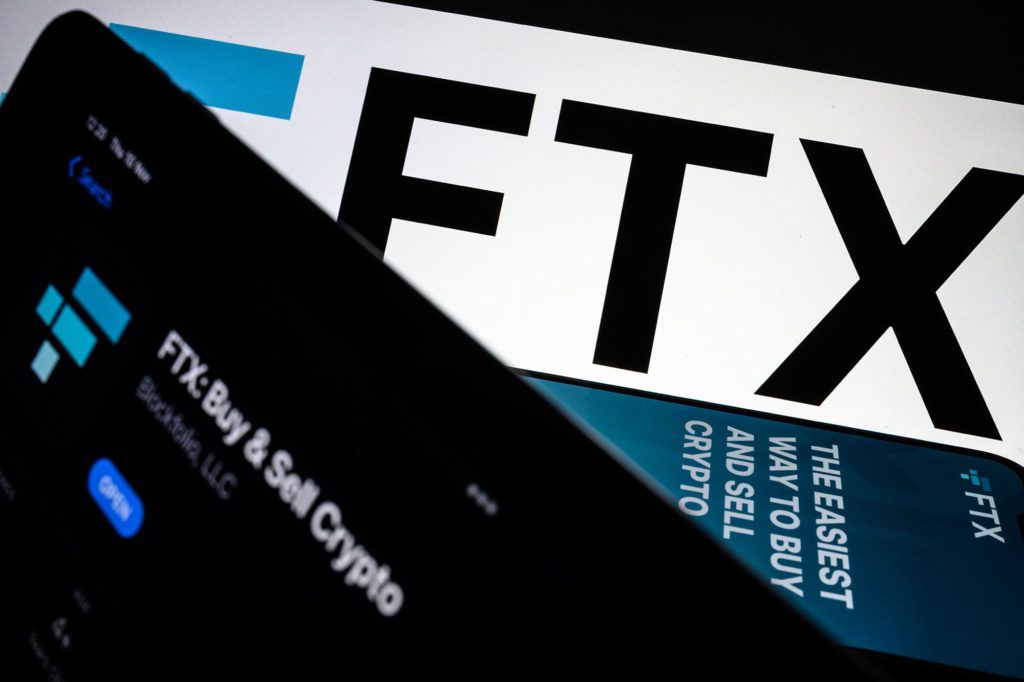
FTX Recently Sought Swiss Trading Licence But Failed, Says NZZ

(Bloomberg) — FTX Europe, the regional branch of the crypto exchange now in bankruptcy proceedings, unsuccessfully sought a trading licence in Switzerland, NZZ reported on Sunday, citing people close to the situation it didn’t name.

FTX Europe, based in Pfäffikon near Zurich, had applied to Swiss banking regulator Finma for a license for a so-called “organized trading system” which was declined recently, the paper reported. It didn’t give reasons for why the application failed.

Finma declined to comment, citing policy on applications, the paper reported and it was impossible to reach FTX Europe, which has now shut down. 

FTX Trading Ltd. and about 100 affiliated companies are starting a strategic review of global assets as a part of the Chapter 11 bankruptcy process.

The Swiss government had actively encouraged the development of a cryptofinance hub in and around the city of Zug, which embraced the moniker “Cryptovalley.” 


More stories like this are available on bloomberg.com

©2022 Bloomberg L.P.

Close Bitnami banner
Bitnami
