Bloomberg

Twitter Staff Wipeout Under Musk Spurs Fear Site Will Decay

(Bloomberg) — Twitter Inc.’s mass exodus of employees leaves the platform vulnerable to a broad range of malfunctions. The social network will succumb to a major glitch at some point, technologists predict. It’s just a matter of when.

The social network’s staff has shrunk to a fraction of its size since Elon Musk took over at the end of October, through layoffs and resignations. Musk this week asked employees to sign on to a more “hardcore” version of their jobs or leave; astonishing numbers opted out. 

Multiple teams that were critical for keeping the service up and running are completely gone, or borrowing engineers from other groups, according to people familiar with the matter. That includes infrastructure teams to keep the main feed operational and maintain tweet databases. #RIPTwitter trended on the site, as users and departed employees predicted an imminent shutdown and said their goodbyes.

“It’s a pretty dark picture,” said Glenn Hope, an engineer who worked at Facebook and Instagram and who earlier tweeted a list of possible scenarios that could cause failures on the social network. “The amount of tribal knowledge lost is simply staggering, possibly unprecedented.”

That doesn’t mean that Twitter will shut down completely and unexpectedly. More likely, remaining employees will be unable to fix issues in the code and the site will start to lose some functionality, or be vulnerable to a major hack, technologists said. In general, computer servers don’t run on autopilot. A platform like Twitter requires all sorts of software to keep it running — from the front-end website that people scroll to the back-end databases that store billions of tweets — and can be stressed during major global events like this weekend’s World Cup.

The complexity of these systems means they may require constant tweaking, maintenance and institutional knowledge of the way things are set up. Small bugs spiral into bigger bugs if not fixed — and Twitter’s is a system with more than 1,000 micro-services, said one former Twitter employee, who declined to be named talking about internal matters. Bugs must be patched or they spiral into threats for users’ security and data.

It gets even more complicated if software was built under rushed or less-than-ideal circumstances, said Chester Wisniewski, principal research scientist at the cybersecurity company Sophos Ltd. 

“It’s a nightmare scenario for almost any firm, especially a tech firm,” Wisniewski said.

It is natural for network security at a platform like Twitter to rot over time, as flaws in the company’s code base are found and nobody is left to fix them promptly, according to Alec Muffett, a software engineer who has worked in host and network security for more than 30 years, including at Facebook. The most plausible risks to Twitter’s network security now are account takeovers or privacy breaches, he said. 

And with far fewer engineers left at the company to troubleshoot operations issues, there is a risk that some critical system at Twitter will crash. “Like a table losing a leg, important parts of the site — or even the whole site — will fall over,” Muffett said. Users may lose the ability to retweet or log in, for instance.

If a site is unreliable, people may give up on using it. Advertisers might also lose confidence that the promotions they’re paying for are going to show up in front of the right people, further threatening Twitter’s financial future.

Elon Musk’s Tumultuous Twitter Takeover: Timeline

There are other concerns beyond keeping the site available, according to Hope. With fewer employees, Twitter may have a harder time grappling with thorny issues like content-takedown requests from foreign governments, the physical security of its data centers, or major events that lead to spikes in traffic and further tax its systems.

Then there’s the issue of user harm. If there aren’t enough adults in the room to constrain the poor behavior of some users, as Muffett put it, it could lead to a surge in upsetting trending content and abuse, further alienating visitors and advertisers. 

Much of the company’s trust and safety team declined to continue their employment at Twitter past Musk’s deadline for employees Thursday, according to people familiar with the matter. About half of the company’s information operations and threat disruptions teams also resigned, according to a person familiar — leaving just four US-based employees left to stamp out foreign disinformation campaigns on the platform. 

This leaves entire swaths of Twitter’s global audience without content moderation, including the entire Asia-Pacific region, the person said, except for one contractor who had been hired to help with spam in the Korean market.

Read more: Musk’s Twitter deal is still in focus for a US data-security review

On Thursday evening, just after hundreds of Twitter employees resigned from the company, the website Downdetector.com, which gathers reports of websites not working, showed a spike in outages at Twitter. The issues continued into Friday, according to data on Downdetector’s website.

Meanwhile, Musk posted late on Thursday evening that the site had “just hit another all-time high in Twitter usage lol.”

Matt Navarra, a social media consultant and media analyst, said that while more people have likely been on Twitter in recent days, it was not necessarily a sign of any sustainable growth. 

“The analogy people use is rubbernecking like with a car accident or a trainwreck, and we’ve seen similar activity on platforms like Twitter when crises occurred,” he said, adding there was no evidence for “quality” or “sustainability” of growth on the platform, no matter what Musk had said.

And for Hope, the former Facebook engineer, Twitter’s path forward without catastrophe is looking “narrow, and growing more narrow by the day.”

“Twitter is the public square, for better or worse,” he said. “There’s nothing like it, and I don’t think anyone wins by us losing it.”

–With assistance from Kurt Wagner, Michael Tobin and Ryan Gallagher.

(Updates with detail on employee departures in 14th paragraph)

More stories like this are available on bloomberg.com

©2022 Bloomberg L.P.

Gamers Seek Fame, Riches in World’s Next Esports Hub India

(Bloomberg) — Next to a primary school and a shabby playground in India’s financial capital Mumbai stands a plush four-story building that’s home to the world’s newest breed of athlete. 

More than 20 young “streamers” in residence spend their day playing video games, training hard for televised esports tournaments that draw in millions of viewers. Equipped with bunkbeds, cubicles and a kitchen with a full-time chef, the gaming house is one of many popping up around the country — testament to the explosive growth of an industry that’s attracting investment from around the world.

“We eat, sleep and play under the same roof,” said Animesh Agarwal, founder of Mumbai-based content creator and gaming talent management company S8UL. “When we play big ticket tournaments, it’s all about the mental play. We need to bring teams together to build trust.”

While still in its infancy compared to the US, China and Japan, investors are betting on huge growth in Indian esports — powered by one of the world’s youngest populations and cheap mobile data. Tournaments are attracting huge prime-time television audiences, while thousands pack into arenas to watch teams play shooter games on their mobile phones, with the action beamed onto giant screens.

Dubai-based esports firm Galaxy Racer is joining up with one of Asia’s largest music festivals Sunburn to host a three-day tournament from Nov. 18 in the city of Hyderabad, where players of the first-person hero shooter game Valorant will compete for a prize pool of $100,000. 

“India’s growing middle class will have more disposable income, which they will spend on entertainment of their choice,” said Akshat Rathee, managing director of Nodwin Gaming, which organized the three-week Battlegrounds Mobile India Masters Series tournament earlier this year. “These eyeballs are going to be worth a lot of money.”

The industry was jolted in July when India’s government demanded the Battlegrounds game be removed from app stores. But investors and gamers seem unfazed by the disruption and the potential for more regulatory action, figuring the order was aimed at a Chinese-backed firm and there are plenty of other blockbuster titles to fill the void.

“Our revenues have only gone up after the game was taken away,” said Rohit Jagasia, the founder of Revenant Esports, whose teams play a range of titles and announced a sponsorship deal from sportswear brand Puma in October.

The industry, excluding real money gaming, is expected to grow to $4 billion by the fiscal year ending March 2027, from $1.1 billion in 2022, according to gaming focused venture capital fund Lumikai. India was the largest consumer of mobile games in the world this fiscal year, topping China and the US with 15 billion downloads, it said.

Investor interest remains strong, even after the government action against Battlegrounds, said Lumikai’s founding general partner Salone Sehgal. “Investors care about the long-term picture, and that is still intact,” she said.

Mobile Global Esports Inc., a U.S.-based firm that runs India’s biggest university esports competition with more than 400 teams, raised $6.75 million in an initial public offering on the Nasdaq exchange in July. “It’s very clear that all components for a successful capitalistic venture with extreme upside exists here,” said Richard Whelan, founder of MOGO.

Unlike other gaming markets where play is console- or PC-based, Indian users access live-streams mainly via their mobile devices. Thanks to cheap data from wireless carriers such as Reliance Jio Infocomm Ltd., India is among the highest mobile data users in the world. The nation will have 1 billion smartphone users by 2026, from 750 million last year, according to Deloitte.

The rollout of 5G in India will give gaming a further boost, according to Sean Hyunil Sohn, the chief executive officer of Krafton India whose South Korean parent created hit video game PUBG: Battlegrounds, and the Indian version Battlegrounds Mobile. 

“When 5G is established, we will have much more resources to deploy more games into the Indian market,” said Sohn.

Back in the gaming house, the financial rewards are clear.

Salman Ahmad, 29, quit his job as a tech assistant at Google in New Delhi to be a full-time gamer. He now earns more than 1 million rupees ($12,000) a month, several times more than his Google salary, playing for S8UL.

Clad in stylish shades and designer clothing, he’s carefully cultivated a personal brand to generate revenue streams that include brand endorsements from Chinese mobile giant Redmi to Indian skincare company Mamaearth.

“Gaming has given everything to me,” said Ahmad, whose player name is Mamba. “I used to play games till 4 am during my engineering days — now I am supporting my family with it.” 

Saloni Pawar, 23, is one of a growing number of women gamers, though doesn’t play for S8UL or reside in its training house. She was the first woman to represent India internationally, and helped her team come second in a tournament in Thailand in 2019.

“My parents have told me to do more ‘girly’ things and not sit at home playing games,” said Pawar, who has almost 61,000 YouTube subscribers and has collaborated with brands such as LG and Asus. “But once money started flowing in, they turned supportive.”

The industry does face some difficulties, not least the fact that esports are not officially recognized as a sport — making it more difficult for players to gain visas to take part in international tournaments. There needs to be a clear distinction between esports that require skill, and other online “games of chance” such as rummy or poker, according to Lokesh Suji, director of Esports Federation of India. 

The government action against Battlegrounds Mobile has also fueled uncertainty for developers, according to Rishi Alwani, communications manager and writer at SuperGaming. “The concern is not whether this a permanent ban or not, it’s about the lack of clarity,” he said. 

There’s been no official government comment on the decision to remove the battle royale shooter game from app stores, though industry participants suspect concerns over data privacy.  India’s technology ministry didn’t respond to emailed requests for comment.

Meanwhile Rathee of Nodwin Gaming has big ambitions, and draws parallels to the Indian Premier League. Media rights for the IPL, one of the world’s most-watched sporting events, sold for more than $6 billion in June — making the competition more expensive to broadcast than England’s top-flight football.

“We want to do to gaming what IPL did to Indian cricket,” he said.


–With assistance from Sankalp Phartiyal.

More stories like this are available on bloomberg.com

©2022 Bloomberg L.P.

FTX Latest: Firm’s Bankruptcy Saga Takes a Political Turn

(Bloomberg) — The collapse of the crypto empire founded by political mega-donor Sam Bankman-Fried is being transformed into a new political battlefront as Republicans highlight links between Democrats and their one-time benefactor. 

Missouri Republican Senator Josh Hawley on Friday sent a broad request for correspondence between federal agencies and Democrats, including the Biden administration and the House and Senate Democrats’ campaign committees, regarding bankrupt crypto exchange FTX and trading house Alameda Research. Hawley said he’s trying to determine whether Bankman-Fried’s more than $37 million in political donations to Democrats may have created pressure on regulators to be lenient with the former crypto executive.

Meanwhile, short sellers have pounced on crypto-focused equities as the digital-assets space crumbles in the wake of FTX’s public implosion. Traders banking on losses in a handful of crypto stocks, including Block Inc., Coinbase Global Inc., MicroStrategy Inc. and five others, added $55 million worth of new shorts in the week through Friday, according to S3 Partners. 

The chair of a House panel is asking FTX to turn over documents and information by Dec. 1 as part of its investigation into the collapse of the once-prominent crypto platform. Details have been requested on the circumstances surrounding the crypto firm’s spiral into bankruptcy last week, including an explanation of the company’s liquidity issues, how those issues of the Bahamas-based parent company affected its US arm, and details of how customer funds were being used. 

Key stories and developments:

  • FTX Bankruptcy Bombshells Squeeze Crypto Lenders Behind Bull Run
  • Wall Street Beat: FTX Lesson For Taking Funds By Debt and Tokens
  • FTX’s Point of No Return Was Ellison’s Tweet, Trade Data Show
  • Bankman-Fried’s Island Haven Draws Scrutiny After FTX Demise (1)
  • FTX Existential Crisis Fix; TMT’s Mega-Cap Problem (Podcast)

(Time references are New York unless otherwise stated.)

Hawley Seeks Democrats’ Emails as FTX Collapse Turns Political (4:04 p.m.)

The collapse of the crypto empire founded by political mega-donor Sam Bankman-Fried is being transformed into a new political battlefront as Republicans highlight links between Democrats and their one-time benefactor.

Missouri Republican Senator Josh Hawley on Friday sent a broad request for correspondence between federal agencies and Democrats, saying he’s trying to determine whether Bankman-Fried’s more than $37 million in political donations to Democrats may have created pressure on regulators to be lenient with the former crypto executive.

Short Sellers Jump on Crypto Stocks Despite Steep Cost of Wagers (2:44 p.m.)

Short sellers have pounced on crypto-focused equities as the digital-assets space crumbles in the wake of FTX’s public implosion. 

Crypto stocks are nearly three times more shorted than the average share, even as short sellers are paying almost eleven times as much in financing costs to bet against them, according to data compiled by Ihor Dusaniwsky and Matthew Unterman at S3 Partners.

Traders banking on losses in a handful of crypto stocks, including Block Inc., Coinbase Global Inc., MicroStrategy Inc. and five others, added $55 million worth of new shorts in the week through Friday, according to S3’s analysis. Total crypto short interest for these eight stocks is more than $4.5 billion. 

Silvergate Shares Slide as FTX Fallout Attracts Short Sellers (1:16 p.m.)

Silvergate Capital Corp. shares slumped, putting them on pace to lose a quarter of their value this week, as investors punished the bank for its ties to bankrupt FTX.

Shares of the company, which held deposits for FTX, dropped 9.9% to $25.14 at 1:03 p.m. in New York. Thursday’s nearly 11% drop triggered a short-sale circuit breaker. Data from S3 Partners indicates short interest levels in Silvergate are around 11% of the shares available for trading.

FTX Looks at Years of Lawsuits to Recover Billions From Customers (1:12 p.m.)

FTX’s bankruptcy opens the door to creditors’ likely lawsuits looking to claw back billions of dollars in assets that customers and insiders withdrew before the crypto company’s abrupt Chapter 11 filing.

As the company’s advisers scramble to get a handle on its finances, they’ll have a slate of bankruptcy tools available that will allow them to try to wrangle funds back into the FTX empire to try to pay all creditors, though the efforts will likely take years.

Crypto Fallout Leaves US Retiree Benefits Mostly Unscathed (12:35 p.m.)

Most of the largest US state and local government pension funds have dodged the ongoing fallout from the collapse of crypto exchange FTX by not directly investing in digital tokens. For the pensions that have dipped into the risky asset class, the investments represent just a small amount of the retirement funds’ portfolio, and much of the limited exposure is indirect via crypto-related stocks or other investment products.

Nearly all of the top 10 US pension funds by assets said they are not invested in Bitcoin or any other cryptocurrencies, according to an informal survey by Bloomberg.

House Panel Seeks Documents in Investigation on FTX Blowup (11:13 a.m.)

The chair of a House panel is asking FTX to turn over documents and information by Dec. 1 as part of its investigation into the collapse of the once-prominent crypto platform. 

“FTX’s customers, former employees, and the public deserve answers,” said Representative Raja Krishnamoorthi, chairman of the House Oversight Subcommittee on Economic and Consumer Policy, in a Friday letter to former FTX CEO Sam Bankman-Fried and John J. Ray III, the new CEO and chief restructuring officer who oversaw the liquidation of Enron Corp.

He requested details on the circumstances surrounding the crypto firm’s spiral into bankruptcy last week, including an explanation of the company’s liquidity issues, how those issues of the Bahamas-based parent company affected its US arm, and details of how customer funds were being used. The subcommittee is also seeking internal documents and communications. 

FTX Auditor Defends Work as New CEO Blasts Financials (10:57 a.m.)

The auditors of FTX Trading Ltd. are defending their work, even after the new management of the imploded crypto exchange lambasted the auditors in a stunning bankruptcy filing.

“We believe the financial statements of FTX Trading Ltd. as of 12/31/21 were fairly stated and we stand behind our audit opinion,” New York-headquartered accounting firm Prager Metis CPAs LLC said in a statement to Bloomberg Tax. 

FTX CEO Bankman-Fried Dumped by Paul Weiss Due to Conflicts (10:47 a.m.)

Paul Weiss said Friday it has stopped representing embattled crypto mogul Sam Bankman-Fried, citing conflicts of interest.

Bankman-Fried, the former CEO of bankrupt FTX, is losing the firm’s help as US lawyers for the platform claim he is disrupting reorganization efforts through “incessant and disruptive tweeting.”

Fed’s Kashkari Says the ‘Entire Notion of Crypto Is Nonsense’ (9:55 a.m.)

Federal Reserve Bank of Minneapolis President Neel Kashkari said Friday that the whole idea of cryptocurrency is “nonsense” after the implosion of FTX Group revealed the industry’s shortcomings.

“This isn’t case of 1 fraudulent company in a serious industry,” Kashkari said on Twitter, commenting on an article about how investors fell for FTX. “Entire notion of crypto is nonsense. Not useful 4 payments. No inflation hedge. No scarcity. No taxing authority. Just a tool of speculation & greater fools.”

Man Group Readies Crypto Hedge Fund Despite FTX Chaos (9:13 a.m.)

Man Group Plc is close to starting a dedicated cryptocurrency hedge fund, delving deeper into a market that’s reeling from the collapse of exchange operator FTX. 

The world’s largest publicly-traded hedge fund firm has been developing the strategy led by money manager Andre Rzym for months, according to people with knowledge of the matter. The firm’s computer-led trading unit AHL is planning to start the fund as soon as the end of the year, said the people, asking not to be identified because the plan is private.

Crypto Informants Can Reap Millions From CFTC After FTX Blowup (7:46 a.m.)

A CFTC commissioner has urged crypto industry whistleblowers to come forward in the aftermath of FTX Group’s implosion, saying tipsters have previously received millions of dollars for their help. 

Commodity Futures Trading Commission’s Kristin Johnson said on Thursday that informants would get anonymity, adding that such tips play a crucial role in enforcement given the opaqueness of some of the crypto world. 

More stories like this are available on bloomberg.com

©2022 Bloomberg L.P.

Dutch Minister Says US Can’t Dictate Approach to China Exports

(Bloomberg) — The US shouldn’t expect the Netherlands to unquestionably adopt its approach to China export restrictions, a senior Dutch official warned, signaling a potential obstacle to the Biden administration’s trade fight.

“The Netherlands will not copy the American measures one-to-one,” Dutch Foreign Trade Minister Liesje Schreinemacher said in an interview with newspaper NRC published on Friday. “We make our own assessment — and we do this in consultation with partner countries such as Japan and the US.”

The comments marked the first time Dutch officials have publicly outlined their stance on the issue. The Biden administration is pushing for a multilateral agreement to impose restrictions on China, aiming to keep advanced chip technologies away from the country — and its military.

Schreinemacher’s statement highlighted the significant challenges the US is facing in persuading allies to join its campaign. While the Netherlands and Japan share many of the US’s security concerns, the two countries also see China as a major market that they would like to maintain access to.

The Netherlands is key to the struggle because the country’s ASML Holding NV is one of a handful of companies that dominate the market for semiconductor-manufacturing equipment. Its peers include Applied Materials Inc., Lam Research Corp. and KLA Corp. in the US, and Tokyo Electron Ltd. in Japan.  

Without getting specific, Schreinemacher said that the Netherlands is likely to introduce certain export controls on China by itself. The Dutch government needs more time to decide on potential new rules, she said.

“We already have restrictions in our export licensing policy. I can imagine that we will look at semiconductors and the chip market with a more critical eye,” the minister told NRC. “We are working on that shift and I think there is a chance that it will progress.” 

Read more: Biden seeks to force the world to align on China

ASML is already restricted from selling China its extreme ultraviolet lithography machines, which are needed to make the most cutting-edge chips. But the Dutch company is still allowed to offer less sophisticated products to Chinese customers. 

In early October, the Biden administration unveiled sweeping measures aimed at limiting China’s abilities to secure advanced artificial intelligence chips and semiconductor manufacturing equipment, roiling the $580 billion global chip industry.

US chip-equipment makers have indicated the new rules could erase billions of dollars in sales, while ASML and Tokyo Electron have said they expect a smaller impact.

Senior US officials — including Alan Estevez, the undersecretary of commerce for industry and security — are traveling to the Netherlands this month to discuss export controls. But an immediate accord isn’t expected to come out of the talks, Bloomberg News has reported. 

Meanwhile, Beijing is working to ensure other countries don’t cave to US demands. In a Group of 20 summit meeting on Tuesday, Chinese President Xi Jinping urged Dutch Prime Minister Mark Rutte to avoid disrupting global trade. 

“We must oppose the politicization of economic and trade issues and maintain the stability of the global industrial chain and supply chain,” Xi told Rutte. Rutte also visited South Korea this week to discuss tech issues and deepen chip ties.

–With assistance from Ian King.

More stories like this are available on bloomberg.com

©2022 Bloomberg L.P.

Elon Musk’s Tumultuous Twitter Takeover:  Timeline

(Bloomberg) — It’s been a rough start for Twitter Inc. under Elon Musk.

Since the tech billionaire took ownership of Twitter three weeks ago, he’s axed half of the company’s more than 7,000 employees, fired most of its executive leadership and demanded that those who remain return to the office immediately — ending remote work, monthly “days of rest” and free food. He’s also told staffers that bankruptcy was possible if the company doesn’t stop bleeding cash soon. 

With $1.2 billion in annual interest payments from the acquisition coming due, and possibly more with rising interest rates, Musk is in a rush to shore up cash. But with brands pulling back on spending, he’s also in a race to find new sources of revenue. As teams work around the clock on a paid verification product, impersonator accounts are proliferating and an exodus of advertisers is causing the company to lose $4 million a day, according to Musk.

Musk testified in a lawsuit over his pay at Tesla that he doesn’t want to be Twitter’s chief executive officer and expects to finish the reorganization of the company soon. He set a date of Nov. 29 to relaunch “Blue Verified” and told employees to commit to “hardcore” hours to get the job done, or leave with three months of severance. As hundreds head for the door, the company is now nearly one-tenth of its former size, by Bloomberg estimates. With this much smaller team, Musk called a meeting of remaining engineers to start building Twitter 2.0.

Here’s how the saga is unfolding:

Oct. 27: Musk takes control

After being forced to complete the deal to buy Twitter for $44 billion, Musk announces he has taken possession of the social network. His first act is to fire the board along with CEO Parag Agrawal, Chief Financial Officer Ned Segal, head of legal and policy Vijaya Gadde and General Counsel Sean Edgett, among others in executive leadership. 

He changes his Twitter bio to call himself “Chief Twit” and forms a small advisory team that includes celebrity attorney Alex Spiro, venture capitalist and engineer David Sacks, Neuralink Corp. CEO and head of Musk’s family office Jared Birchall, tech investor Jason Calacanis, and general partner of Andreessen Horowitz Sriram Krishnan. 

Oct. 28: Brands begin to take pause

As Musk plans to unban accounts and says he will charge for user verification, advertisers start to get nervous. General Motors Co. suspends ads, and others review their Twitter budgets.

Oct. 31: Top tweeters protest

Amid murmurings of plans to charge existing verified accounts, bestselling author Stephen King tweets, “$20 a month to keep my blue check? F— that, they should pay me. If that gets instituted, I’m gone like Enron.” Musk replies, “We need to pay the bills somehow! Twitter cannot rely entirely on advertisers. How about $8?” Musk double downs on promoting the product. A possible release date of Nov. 7 is debated.

Nov. 1: Teams working around the clock

The product team works over the weekend on Musk’s idea to charge users for blue check marks. A photo of product director Esther Crawford sleeping on the floor of a conference room, trying to make the deadline, goes viral. Meanwhile, managers are asked to make lists of who can be fired. Employees print out their software code for review by Musk and engineers from Tesla Inc., to determine if their contributions are worthy of keeping a job.


Nov. 3: Massive layoffs begin 

A memo is sent to all employees telling them of imminent layoffs and to watch for an email with the subject line: “Your Role at Twitter.” Badge access to offices is suspended as about  3,700 staffers receive word that they’ve been cut. Sources report chaos in the aftermath with “survivors” not knowing who their boss will be or which projects to work on, and project leader aren’t sure who is left on their teams. Realizing employees essential for the continuity of the business have been let go by mistake, some are asked to come back.

Co-founder Ev Williams tweets, “Heart’s out to the tweeps getting laid off today.” Days later, co-founder and former CEO Jack Dorsey, who was a proponent of Musk’s acquisition, adds, “I realize many are angry with me. I own the responsibility for why everyone is in this situation: I grew the company size too quickly. I apologize for that.” 

A class action lawsuit is filed questioning whether California employees were given enough notice under state law. 

Meanwhile, more advertisers tap the brakes, concerned that cuts to content moderation teams mean their ads could show up alongside unsavory content.

Nov. 5-6: Musk responds to celebrity protests

Unrest grows on the platform over the weekend, particularly over the issue of impersonator accounts. Actress Valerie Bertinelli starts a movement of people changing their Twitter names to “Elon Musk.” Comedian Kathy Griffin joins the protest, finds her account locked, and then Musk announces, “Going forward, any Twitter handles engaging in impersonation without clearly specifying ‘parody’ will be permanently suspended.”

Nov. 7: Musk urges followers to vote Republican before Election Day

Musk breaks out of the normal neutral posture of social media leaders when he tweets to his more than 100 million followers, “To independent-minded voters: Shared power curbs the worst excesses of both parties, therefore I recommend voting for a Republican Congress, given that the Presidency is Democratic.” He then pins the tweet to the top of his profile.

Nov. 8: Musk sells more Tesla

Despite a previous vow not to sell any more Tesla stock, Musk unloads an additional $3.95 billion, bringing the total sold in past year to $36 billion.

Nov. 9: Musk answers advertisers’ questions

In an attempt to stem the departure of brands from the platform, Musk hosts a Twitter Spaces Q&A with the head of sales Robin Wheeler, head of trust and safety Yoel Roth, and the CEO of the Interactive Advertising Bureau, David Cohen. More than 114,000 listeners tune in, including a number of official brand accounts such as Target, Pandora, Chipotle and Chevron. Musk brainstorms about how his subscription product can grow by building more commerce into the platform, including by offering high yield money market accounts on Twitter that users can link with their bank accounts.Soon after, the company’s blue check mark option becomes available for purchase, and immediately becomes a tool for impersonators. An account masquerading as Nintendo posts an image of Super Mario holding up a middle finger, while a fake Eli Lilly & Co. account tweets that insulin is now free. An impersonator Tesla account jokes about the carmaker’s safety record. Politicians and celebrities are also spoofed.

Nov. 10: More key executives quit as Musk warns of bankruptcy

In his first meeting with employees, Musk tells them to brace for  80-hour weeks and requires everyone back in the office full time, ending remote work and other perks like free food. He also says bankruptcy for the company is not out of the question if it doesn’t start generating more cash, and that teams need to move with urgency on the $8 subscription product.

Several executives in charge of keeping Twitter safe and accountable to its users quit, including Chief Information Security Officer Lea Kissner, Chief Privacy Officer Damien Kieran and Chief Compliance Officer Marianne Fogarty. Their departures raise concerns about the company’s ability to keep its platform secure and comply with regulations. Later in the day there is news that both Roth and Wheeler have resigned, although soon after Wheeler returns.

Nov. 11: Verified accounts get “official” tags 

Twitter adds badges that say “official” to verified accounts in some places, though confusion abounds.

More brands depart the platform, including theater guide Playbill. “Because of its tolerance for hate, negativity, and misinformation, our time with the social media platform has come to an end,” the company says in a statement. It warns fans to ignore any tweets from a Twitter account that contains the Playbill name. “Please understand that it is not us,” it says.

Nov. 14-15: Twitter quitter ranks grow

With the annual Macy’s Thanksgiving Day Parade fast approaching, the department store retailer tells Ad Age it’s taking a pause on the platform — the brand spent more than a $1 million on Twitter ads in the first half of November, according to Ad Age’s report. Fast food chain Chipotle, which hadn’t tweeted since Halloween, has suspended ads. And luxury fashion brand, Balenciaga, has deleted its account altogether, without so much as saying goodbye. 

A feeling is growing across the site that perhaps the platform’s days are numbered, as more people post links to accounts on new rival Mastodon and celebrities like Monica Lewinsky reminisce about good times. 

Meanwhile, Musk is busy purging engineers criticizing him and freezing the ability to write new code. He tells the B20 business conference that he has “too much on his plate” and is working the maximum he can “from morning to night seven days a week.” He says he’s been sleeping at Twitter headquarters in San Francisco, and intends to continue until the company is fixed: “The amount that I torture myself is next-level, frankly,” he says.

Nov. 16: Musk doesn’t want to be CEO

At a trial in Delaware Chancery Court over his $55 billion pay at Tesla, Musk says he doesn’t want to be CEO of the electric car maker, let alone Twitter or any company. He says that he expects the restructuring of the social network to be completed by the end of next week, that he plans on spending less time at Twitter and will ultimately find someone else to run it. Possibly he means it —Tesla board member James Murdoch testifies that Musk said he’s found a potential successor for Tesla.

Musk emails Twitter employees a form titled, “Would you like to stay at Twitter?” asking for a pledge to work long, intense hours with “Yes” as the only option. A response is required by the end of the next day — Nov. 17 — or they can leave with three months severance.  

He then tweets that “Blue Verified” will relaunch Nov. 29.

Nov. 17: #RIPTwitter is trending

As the employment deadline approaches, hundreds that don’t click yes on Musk’s ultimatum start to post their goodbyes across Slack, Blind and Twitter, many with a salute emoji and blue heart. Matt Miller, an engineer who has been with Twitter for nearly 10 years, counts down with peers in a video that goes viral and is seen more than 1.6 million times. “Let’s try the badges,” he asks at the clock strikes 5 pm, not knowing exactly how they’ll be fired for their defiance. An email alerts employees that offices have been closed until Monday, Nov. 21. Many start to speculate whether the company has enough workers to operate.


There’s a sense of a death watch as many wait for Twitter to go dark.

Nobel Prize-winning economist Paul Krugman tweets, “OK, if Twitter dies soon — suddenly looking like a real possibility — I do have a Mastodon account here https://mastodon.online/@pkrugman.” US Representative Alexandria Ocasio-Cortez tweets, “Shout out to all the workers at Twitter. You all built a vital place for connection and deserved so much better. Millions of people appreciate the space you built and the hard work that went into it. Thank you.” 

In response to the mass exodus, Musk tweets a string of jokes. “How do you make a small fortune in social media? Start out with a large one.” He also posts an image of Twitter’s tombstone. He spends the day trying to keep key engineers and rehires Ella Irwin to head up Trust & Safety.  Bloomberg estimates 12% to 13% of the workforce remains, although no official count has been released. 

Nov. 18: “Hardcore” life begins 

Musk summons remaining engineers to a meeting at Twitter headquarters in San Francisco to explain the Twitter tech stack to him. They are asked to email their achievements over the past six months and send screenshots of their most salient lines of software code. 

There are now nearly 1,000 names on the Tweeps Talent Directory started after layoffs began.

Tesla competitor Jaguar Land Rover swoops in, announcing it’s interested in Twitter’s departing employees and seeking to hire 800 workers across the UK, US, Ireland, India, China and Hungary to fill digital and engineering vacancies in the areas of autonomous driving, artificial intelligence, electrification, cloud software, data science and machine learning. 

–With assistance from Kurt Wagner.

(A previous version corrected the acquisition amount in the Oct. 27 section.)

More stories like this are available on bloomberg.com

©2022 Bloomberg L.P.

FTX Bankruptcy Bombshells Squeeze Crypto Lenders Behind Bull Run

(Bloomberg) — It was the Winklevoss twins, those Olympic rowers and Harvard schoolmates of Mark Zuckerberg, who made Ryan Horban feel comfortable enough to enter the risky realm of cryptocurrency lending.

Investing FOMO was raging early last year and Horban watched as tweet after tweet crossed his feed, each boasting of the fortunes everyone else seemed to be making. He took the plunge and put some coins into Gemini Earn, a Winklevoss vehicle that paid depositors interest rates of 7.4% at one point.

“There are so many bad actors in the space,” said Horban, a 40-year-old Californian who works in ecommerce. But Cameron and Tyler Winklevoss “are names that have credibility,” he said. 

Then the unthinkable happened: FTX, one of the most well-known and influential operations in crypto, started to blow up. Horban got scared. He put in a request to withdraw his coins, a few thousand dollars worth, from Gemini Trust Co. on Nov. 10. 

No luck. Like hundreds of thousands of others lured into the high-risk, high-return world of crypto’s version of shadow banks, he still hasn’t gotten his tokens back. 

Evangelists of the crypto industry insist problems like these are simply growing pains that, while unfortunate, are valuable lessons that will make lending projects more resilient in the future. 

Yet for investors like Horban who fear they’re getting burned, and even for those who’ve so far avoided the worst of the FTX fallout, it’s becoming clear that the party’s over.

The rush to the exits is causing pain throughout the industry, and casting doubt on the future of the lending projects that helped fuel the breakneck growth in digital-asset speculation.   

Despite all the modern technology at work, this crypto crisis resembles financial panics from more than a century ago, when men in top hats stormed brick-and-mortar banks in desperate attempts to access their savings. 

These days, digital-age bank runs have crippled not only FTX but a growing list of newfangled businesses with colorful names, from BlockFi to Genesis. And as was the case with the failed banks of the 1800s, there’s no Federal Reserve or FDIC to step in and restore calm as panic sets into this nascent financial system. 

Earlier Problems

The problems started earlier this year, when the failure of the Terra blockchain — and one of its apps that was paying out yields of almost 20% — vaporized some $60 billion in token value and helped lead to the collapse of hedge fund Three Arrows Capital, lender Celsius Network and brokerage Voyager Digital. 

Another round of contagion was set off this month with FTX’s implosion, as Sam Bankman-Fried’s empire filed for bankruptcy and the man who oversaw the liquidation of Enron Corp. called it the biggest failure of corporate controls he’s seen in his career. 

Genesis, a prominent digital-asset brokerage that’s part of Barry Silbert’s Digital Currency Group, revealed it had $175 million locked in an account at FTX. Shortly thereafter, it halted lending redemptions. Gemini, which lists Genesis Global as its only accredited borrower, had to delay withdrawals from its yield product for retail investors.

“Crypto also has the same problems as traditional finance in terms of counterparty risk,” said John Griffin, a finance professor at the University of Texas at Austin. “But the problems are magnified here because it has no Fed backstop and no cohesive regulatory framework.”

As with any crisis, some platforms are holding up better than others. Lender Nexo said it had no net exposure to Bankman-Fried’s FTX and Alameda Research trading firm. Another lender, Ledn, said it “has no exposure to Genesis and is fully operational,” while its outstanding loan to Alameda and its assets on FTX have “no impact on our clients’ assets.”

Yet many in the industry worry that the contagion has yet to spread to more companies that act as crypto-lending intermediaries. They’re known as centralized finance, or CeFi, operations in contrast to decentralized finance, or DeFi, protocols that can be just a collection of automated algorithms in the cloud. 

“We do not know the health of other CeFi lenders, and that is by their design,” said Sidney Powell, chief executive officer of Maple Finance, a crypto-capital marketplace where $1.9 billion in loans has been issued. “Balance sheets are opaque and it is unclear what assets are actually being held and how customer funds are being used. When you leave humans to oversee billions in customer assets with no transparency or oversight, more times than not customer interests come second.”

Told You So

Indeed, for many in DeFi — who trust these rational, transparent algos more than the centralized companies run by humans — the latest troubles are providing a “told-you-so” moment. 

Chris Zuehlke, the global head of Cumberland, the crypto offshoot of Chicago-based trading giant DRW, said when Celsius and Voyager started having trouble, it was hard to get a handle on their financial health since all the relevant information was not sitting on a blockchain for anyone to see. 

Now, with FTX’s bankruptcy putting another set of customer funds at risk, some crypto investors are turning to DeFi to avoid a similar fate, fund flows show.

Of course, DeFi isn’t without its own risks. The Terra blockchain’s Anchor lending protocol was, technically, a decentralized-finance project, though its control by Do Kwon and his Terraform Labs meant it wasn’t exactly the DeFi utopia that proponents prefer. 

Still, transactions were transparent and viewable by all, withdrawals were never suspended, and no bankruptcy courts ever got involved. It’s just that when it failed, those withdrawals occurred at pennies on the dollar — or less — compared with what depositors had put in. 

Trust Issues

But the million-Bitcoin question: Will casual investors reeling from the latest crisis be willing to plunge into the DeFi rabbit hole, and trust those algos — which, while transparent, are still susceptible to hacks and market manipulation — more than influential figures like the Winklevoss twins?  

With everyone waiting for the next shoe to drop, liquidity has been sucked out of crypto markets. Most large lenders are in bankruptcy or teetering on the brink. And it was lending that fueled, in large part, the last crypto bull market.   

Some individual investors, like Horban, haven’t given up entirely on crypto. Still, he’s not willing to leave his coins in accounts with exchanges. The “not your keys, not your coins” motto of early crypto adopters, which refers to the passkeys needed to prove ownership of crypto on the blockchain, is having a revival as reality sinks in that those keys were held by the likes of FTX and Gemini rather than investors who had accounts with them. Many are moving their tokens to “cold storage” hard drives not connected to the internet — the equivalent of keeping your savings under the mattress rather than in a bank.  

In Brooklyn, Sam Rosenbaum is thinking about her $30,000 crypto nestegg trapped in an account with Gemini. The 31-year-old, who works in venture capital, also viewed the Winklevoss name as a sign of Gemini’s trustworthiness when it came to those yields that were way above what’s earned in a traditional bank account. (Natalie Rix, a spokesperson for Gemini, didn’t immediately return a request for comment.) 

About $22,000 of Rosenbaum’s balance was in Gemini dollars — a token she assumed was less risky because it was pegged one-for-one to the US dollar, not some token whose value swings wildly. She says she’ll probably stick with traditional investments like real estate going forward. 

“It would be a long time before I do a lending product again,” Rosenbaum said.

“I was dodging all the bullets and was, like, I have the good one,” she said. “But there might not be a good one.”

–With assistance from Vildana Hajric and Muyao Shen.

More stories like this are available on bloomberg.com

©2022 Bloomberg L.P.
Beyond the Crypto Crash, a Big Squeeze Jolts Stock Markets Anew

(Bloomberg) — Being glued to crypto news this week meant missing adventures in regular markets that while lacking the same high drama, made up for it in terms of money at stake.

In case you missed it, stock and bond traders spent the last five days still caught in the thrall of an event that may be hard to recall for people mesmerized by the FTX.com collapse: Nov. 10’s inflation report, which ignited a short squeeze among traders expecting a worse number. Reverberations continued to be felt in terms of positioning, trading in derivatives and probably also in wrongly prepared portfolios.

As usual in 2022, the biggest venue of impact was the US stock options market, where trading volumes are smashing records as investors of all stripes rush into short-dated contracts to catch up. It’s creating snags for what had been billed as the great inflation trade, with the mighty dollar losing luster and technology shares reclaiming their long-lost leadership, at least briefly. 

The recalibration was prompted when a soft print on consumer prices triggered a reset of the perceived path for Federal Reserve monetary policy. Exacerbating it are money managers who had cut equity exposure to the bone during the bear market and found themselves caught out. With almost everyone sitting on the same side of the trade and exiting at once, an already-turbulent market got weirder. 

“Crypto is just part of a broader mosaic of an almost dysfunctional market,” Doug Fincher, hedge fund manager of Ionic Capital Management, said by phone. “Not to be cynical, but look at CPI last Thursday. It was two basis points better than expected, and the market exploded. There’s a massive amount of technical factor rotation. There’s just a lot of crosscurrents in a really volatile, strange market.”

The trend abated some during the week, with the S&P 500 closing lower over the period. Short-term Treasury yields regained some ground and the dollar edged higher as Fed officials reiterated their intention to keep raising rates.

Still, whether inflation has peaked is up for debate. There won’t be another reading for more than three weeks, and investors and policy makers alike have misjudged price trends since the pandemic hit. With data mostly coming in ahead of expectations this year, everyone from currency traders to bond investors were bracing for another big inflation number last week. 

When it didn’t pan out, a cascade of unwinding ensued. The dollar, darling asset of the inflation trade, is losing momentum. Down more than 4% in November, the US currency is poised for its worst month in two years. Two-year Treasuries, where large speculators built up record short positions before the CPI report, saw a rally that pushed yields down 25 basis points when it was released, the most in more than a decade.  

Tech stocks, among the biggest casualties during the Fed’s aggressive inflation-fighting campaign, got a respite. Up more than 9% since the day before the CPI data, the industry has beaten all other major groups in the S&P 500, in a partial reversal of dismal returns earlier this year. 

“These things are certainly bound to happen at around key critical junctures in economic and monetary policy, which is where we’re at — the Fed shifting from raising rates toward more of a deceleration in terms of hikes,” said Layla Royer, a senior equity derivatives salesperson at Citadel Securities. “It is a significant shift.”

A basket of the most-shorted stocks soared 18% over the four days through Tuesday, dealing a fresh blow to hedge funds who boosted bearish wagers during a 10-month rout and turning them into forced buyers. Their total short covering over the stretch hit levels not seen since the retail-driven squeeze in January 2021, data compiled by JPMorgan Chase & Co.’s prime broker show.  

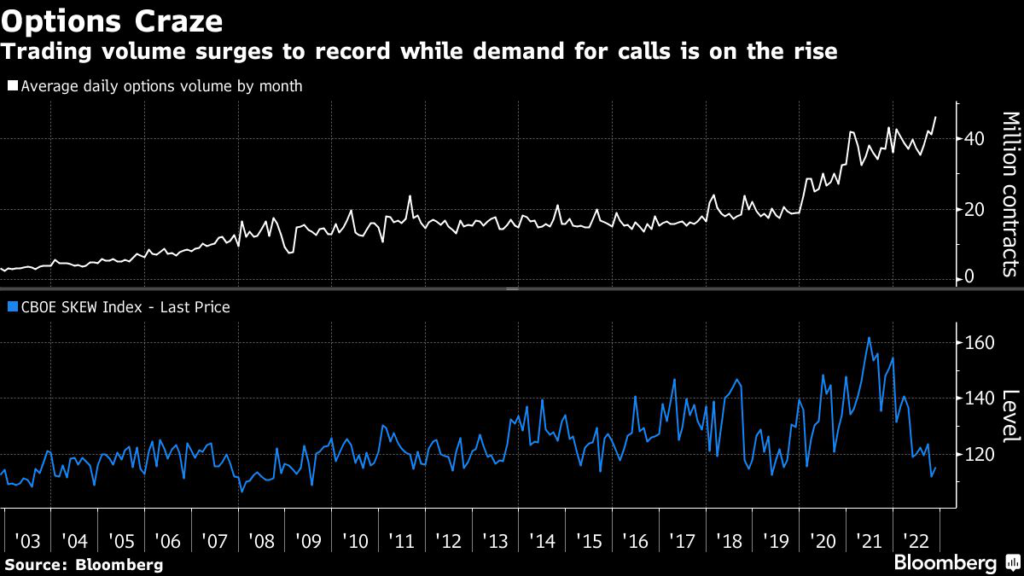
For a third time this year, the S&P 500 mounted a recovery of more than 10%. Such counter-trend rallies have spurred demand for bullish call options from those who have been defensively positioned in the market. As a result, the index’s skew — the relative cost of puts versus calls — this month fell to the lowest level in more than a decade. 

“Market screams back up. You’re at risk of losing your job because you’re going to underperform everybody,” said Dennis Davitt, founder of Millbank Dartmoor Portsmouth LLC, an investment firm that specializes in volatility strategies. “So the remedy for that is just by turning some of your equities into cash and then buying upside calls as a stock replacement.”

The Fed-induced market gyrations are encouraging investors to go all-in on options to place bullish and bearish bets alike. About 46 million contracts have changed hands each day in November, on course for the busiest month on record, data compiled by Bloomberg show. 

Helping drive the boom is the frenzy trading in derivatives maturing within 24 hours. Such contracts made up a whopping 44% of S&P 500 options volume in the past month, according to an estimate by Goldman Sachs Group Inc. 

For now, the fireworks following the CPI shock appeared to be dying down. The S&P 500 has moved less than 1% for six straight sessions on a closing basis, the longest stretch of calm since January. 

To Mike Bailey, director of research at FBB Capital Partners, the tranquility may not last. For one, the cross-asset rally has contributed to easing financial conditions that’s working against Fed Chair Jerome Powell’s goal to slow the economy.  

“We may get some buyer’s remorse over the next few weeks as investors fret over a potentially hot jobs number and any whiff of hawkishness from Powell and the Fed,” said Bailey. “Investors are coming up for air after a nice run since mid-October. The next question is, are we pricing in too much good news?” 

–With assistance from Melissa Karsh and Vildana Hajric.

More stories like this are available on bloomberg.com

©2022 Bloomberg L.P.

Stocks Eke Out Gains; Oil Tumbles as Demand Slows: Markets Wrap

(Bloomberg) — US stocks ended with a slight gain Friday after shrugging off Federal Reserve warnings that there was more policy tightening to come. Oil futures fell on signs that the market is currently awash in supply.

The S&P 500 Index added 0.5% Friday to finish the week down 0.7% and the Nasdaq 100 fell 1.2% in the five-day period. Trading volumes was muted throughout Friday’s $2.1 trillion options expiration, normally a day when volatility spikes as traders and dealers rebalance their big exposures.

Treasury yields rose again after hawkish comments Thursday from St. Louis Fed President James Bullard, who said interest rates needed to rise at least to 5%-5.25% to curb inflation. Also on Thursday, Minneapolis Fed President Neel Kashkari said it was an “open question” how far the central bank has to go with rates to bring demand back into balance.

Relentlessly rising interest rates are already weighing on global demand. Growth-sensitive copper and oil prices were set for weekly losses on concerns about a worsening outlook. US crude futures signaled an oversupply for the first time in almost a year. Higher mortgage rates sent sales of previously owned US homes down for a record ninth straight month in October.

Yet some equity investors said hawkish Fed commentary did not necessarily mean rates would peak at levels higher than previously thought. And traders continued to bet that the Fed will reverse course and begin cutting rates in the later part of 2023. 

“The Fed’s steady drumbeat that the campaign to curtail inflation isn’t finished hasn’t fallen on the market’s collective deaf ears,” Quincy Krosby, chief global strategist at LPL Financial, wrote. “Rather the growing evidence that inflation has plateaued has traders and investors alike poised to take advantage of the Fed’s step down to 50 basis points on December 14.”

Despite somber Fed  comments and continued turmoil in the cryptocurrency world, the S&P 500 was headed toward a loss of less than 1% on the week. 

“This week’s somewhat tight range might merely be a ‘breather’ that helps the market digest its recent gains before it heads higher,” Matt Maley, chief market strategist at Miller Tabak + Co., wrote. “Besides, Thanksgiving week tends to be a good one for the stock market.”

Chris Harvey of Wells Fargo expects the market to bounce around the 3,950 level until mid-December, when the next inflation print and Fed decision will provide traders with more clarity. But after that, the market trend will become “a ‘coin toss,’ with increasing evidence of an impending recession,” his team wrote in a note.

Hong Kong’s benchmark Hang Seng Index enjoyed a third straight week of gains, thanks to China’s steps to support the property sector and ease Covid restrictions. European stocks climbed on optimism over both China and bets that central banks will slow their rate hikes. 

Some of the main moves in markets:

Stocks

  • The S&P 500 rose 0.5% as of 4:03 p.m. New York time
  • The Nasdaq 100 was little changed
  • The Dow Jones Industrial Average rose 0.6%, more than any closing gain since Nov. 10
  • The MSCI World index fell 0.6% to the lowest since Nov. 10

Currencies

  • The Bloomberg Dollar Spot Index rose 0.2% to the highest since Nov. 10
  • The euro slipped 0.4%, more than any closing loss since Nov. 9
  • The British pound rose 0.1% to $1.1881
  • The Japanese yen fell 0.1% to 140.41 per dollar

Cryptocurrencies

  • Bitcoin fell 0.3% to $16,630.65
  • Ether rose 0.3% to $1,209.61

Bonds

  • The yield on 10-year Treasuries advanced five basis points to 3.82%
  • Germany’s 10-year yield was little changed at 2.01%
  • Britain’s 10-year yield advanced four basis points to 3.24%

Commodities

  • West Texas Intermediate crude fell 1.5% to $80.38 a barrel
  • Gold futures fell 0.7% to $1,765.10 an ounce

This story was produced with the assistance of Bloomberg Automation.

–With assistance from Emily Graffeo.

More stories like this are available on bloomberg.com

©2022 Bloomberg L.P.
GOP’s Hawley Wants Democrats’ Emails as FTX Collapse Turns Political

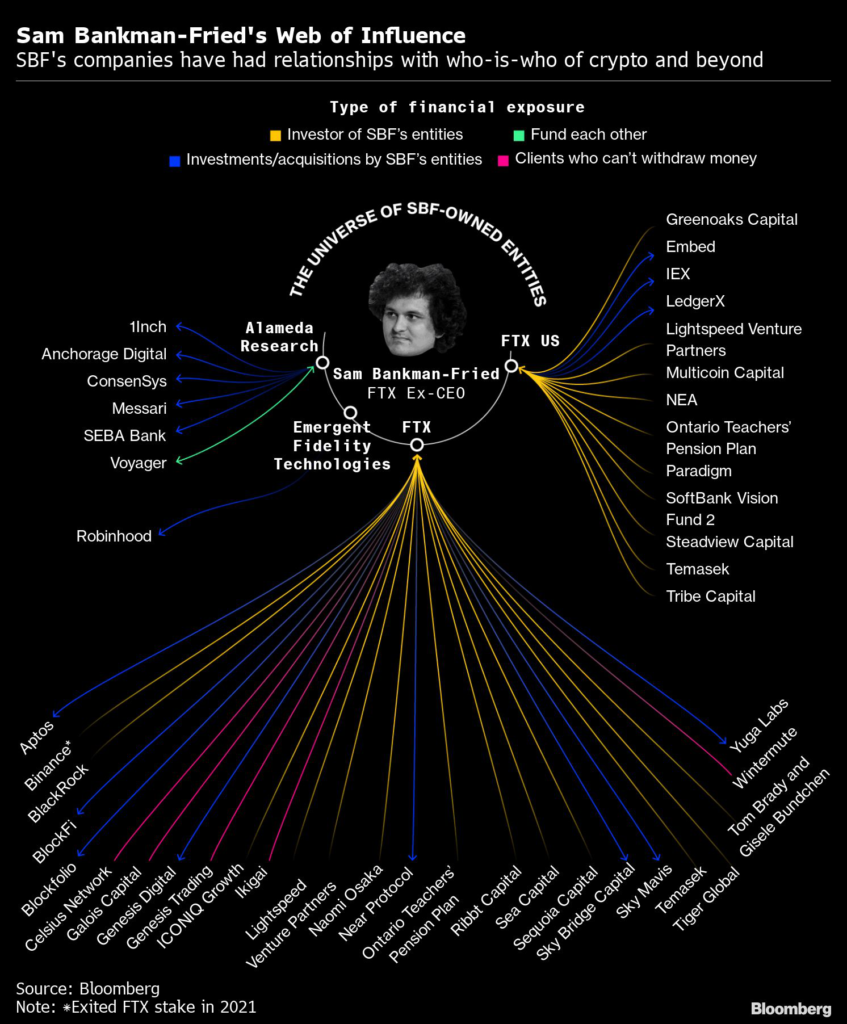
(Bloomberg) — The collapse of the crypto empire founded by political mega-donor Sam Bankman-Fried is being transformed into a new political battlefront as Republicans highlight links between Democrats and their one-time benefactor.

Missouri Republican Senator Josh Hawley on Friday sent a broad request for correspondence between federal agencies and Democrats, including the Biden administration and the House and Senate Democrats’ campaign committees, regarding bankrupt crypto exchange FTX and trading house Alameda Research.

Hawley said he’s trying to determine whether Bankman-Fried’s more than $37 million in political donations to Democrats may have created pressure on regulators to be lenient with the former crypto executive.

“Billions of dollars were stolen from investors and handed over to Democrats and left-wing organizations,” Hawley said in a letter Friday. “The fact that this scheme was revealed immediately after the midterm elections raises serious questions about whether federal regulators and law enforcement faced conflicts of interest in identifying, investigating, and thwarting the fraudulent scheme.”

Hawley’s request comes amid several congressional probes into the sudden collapse of FTX and is one of the most directly political investigations in what has so far been a largely bipartisan reaction to the exchange’s downfall.

The top Republican and Democrat on the House Financial Services Committee this week said they were planning to hold a hearing in December on the FTX collapse and that they expect to hear testimony from Bankman-Fried.

Republicans have been eager to point out that Bankman-Fried, who was until recently a billionaire, was the second largest individual donor to Democrats in the most recent election. But GOP candidates also took money from FTX executives. One of Bankman-Fried’s top lieutenants, Ryan Salame, gave $23.7 million in the most recent cycle, with the vast majority going to Republicans.

Bankman-Fried’s political involvements have also spurred several unproven theories that are gaining traction with the GOP on Capitol Hill. Several House Republicans signed a letter to Secretary of State Antony Blinken seeking information about whether federal aid to Ukraine was invested in FTX. Representative Tom Emmer, a Minnesota Republican, has also said he believes the Securities and Exchange Commission was helping FTX with “legal loopholes” to obtain a regulatory monopoly, but hasn’t provided proof.

More stories like this are available on bloomberg.com

©2022 Bloomberg L.P.

Short Sellers Jump on Crypto Stocks Despite Steep Cost of Wagers

(Bloomberg) — Short sellers have pounced on crypto-focused equities as the digital-assets space crumbles in the wake of FTX’s public implosion. They’re paying a steep price to place those wagers.

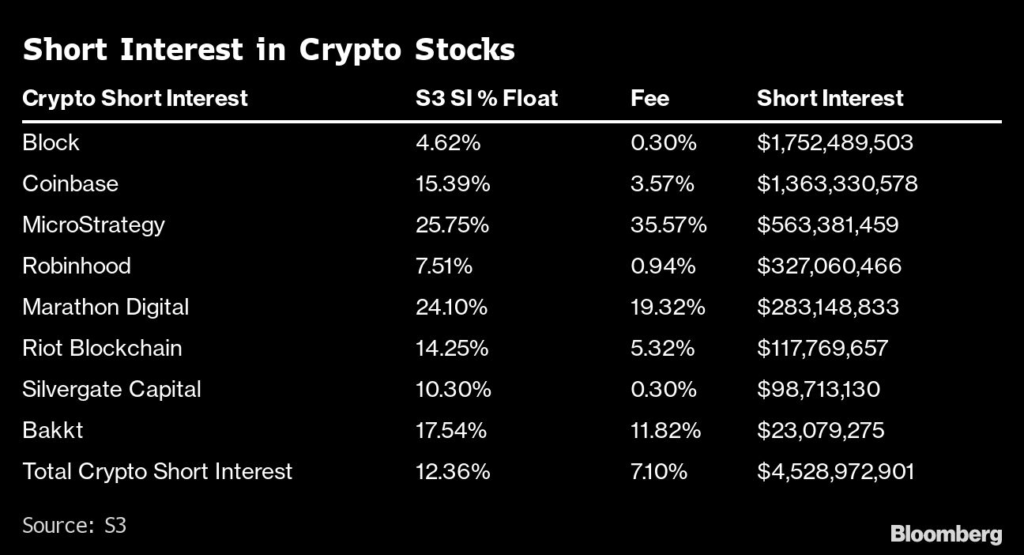
Crypto stocks are nearly three times more shorted than the average share, even as short sellers are paying almost eleven times as much in financing costs to bet against them, according to data compiled by Ihor Dusaniwsky and Matthew Unterman at S3 Partners. 

Traders banking on losses in a handful of crypto stocks, including Block Inc., Coinbase Global Inc., MicroStrategy Inc. and five others, added $55 million worth of new shorts in the week through Friday, according to S3’s analysis. Block and Coinbase alone saw about $27 million of new short selling combined. Total crypto short interest for these eight stocks is more than $4.5 billion. 

MicroStrategy, meanwhile, has roughly 26% of its tradable float shorted, according to S3 data. For Silvergate Capital Corp., short interest as a percent of float exceeds 10%.

“Sam Bankman-Fried’s failed crypto exchange FTX.com and resulting bankruptcy has thrown crypto-currencies and the crypto industry into a volatile cycle of price movement,” Dusaniwsky and Unterman wrote in a note. “Shorting these crypto stocks has been a very profitable trade in 2022.”

Even before FTX’s demise, the crypto space had been roiled by a number of other implosions and scandals this year. But sentiment has deteriorated even more drastically after FTX’s undoing because the company was considered a stable presence within the industry. Bitcoin, the largest digital asset by market value — whose price moves often serve as a read on crypto-market sentiment — has sunk below $17,000, from nearly $69,000 just a year ago. 

Crypto-focused stocks have suffered too. Shares of Coinbase and Silvergate have declined more than 80% this year, while those of MicroStrategy have dropped 70%. Wall Street analysts’ conviction in the shares is also ebbing. Coinbase, for example, has the lowest number of buy-equivalent ratings since August 2021, data compiled by Bloomberg show.

FTX is now in bankruptcy, with revelations of its inner workings during its last days slowly trickling out in a dramatic way through court filings. FTX’s Chapter 11 filing said that approximately 130 affiliated companies have commenced voluntary proceedings. And regulators are looking into FTX’s fallout as well.

Its descent into bankruptcy went from “‘Oh jeez, this is bad,’ to ‘Oh my god, this is horrible,’” said Art Hogan, chief market strategist at B. Riley Wealth. 

“We’ve already seen that FTX had a lot of tentacles. In the company alone, the cross-ownership in FTX into almost everything else that touches crypto means that there’s going to be more fallout to this,” he said in an interview. “So therefore, it’s intuitive to think that a lot of these real crypto-related companies are going to attract a lot of short sellers.”

More stories like this are available on bloomberg.com

©2022 Bloomberg L.P.

Close Bitnami banner
Bitnami