
Bloomberg

Sam Bankman-Fried’s Island Haven Is Drawing Scrutiny After FTX Demise

(Bloomberg) — Sam Bankman-Fried loved living in the Bahamas. Shacked up in his luxury penthouse with nine FTX colleagues, he could wander Nassau without being hassled.

And the Bahamas loved Bankman-Fried, the prestige of his crypto empire and the potential fortunes that it would bring.

Their relationship, which had seemed innocuous, is now under the spotlight after FTX’s rapid demise, with lawyers for the crypto exchange accusing Bankman-Fried of undermining reorganization efforts with “incessant and disruptive tweeting.” They also raised the suggestion that some FTX assets were ordered to be transferred to the Bahamian government after the bankruptcy filing. 

For the island nation, the collapse of one of its most visible companies is a blow to a years-long effort to build a digital-currency hub. Interviews with local residents show FTX’s presence was quickly felt in the little over a year since it moved to Nassau. 

“FTX had been the emblem of what many saw as an emerging crypto boom in the Bahamas,” said Amauri Frantz, a trader who resides on New Providence, the island home to Nassau. “None of the investment community here on the ground would have had a reason to doubt FTX’s ability to realize the dream of the Bahamas becoming a crypto hub.”

That much was clear seven months ago, when Bankman-Fried and Bahamas Prime Minister Philip Davis broke ground on a site that was meant to be a sprawling compound for 1,000 FTX workers, complete with a hotel and school. It symbolized the island’s growing stature in the crypto world, coming the same week digital-coin enthusiasts, celebrities and politicians descended on Nassau for a glitzy summit.

The scene on the ground looks much different these days.

The site sits largely empty. The early outlines of a building foundation have been poured. A few cabins are sprinkled about for the construction crew, though no one was there on an afternoon this week.

The Bahamian government has said the turmoil wasn’t preventable under its regulations. Its securities commission on Thursday said it took control of digital assets of FTX Digital Markets — which it said isn’t part of the US bankruptcy — for safekeeping. The regulator on Nov. 12 denied directing the entity to prioritize withdrawals for Bahamian clients. 

In a statement to Bloomberg News on Friday, Davis said that his government had taken “swift and immediate action” on FTX, and that the nation would continue to court the digital-asset industry.

“It was because the Bahamas had in place a robust regulatory framework for digital assets and digital asset businesses, that the regulator was able to take immediate steps in order to protect the interests of clients, creditors, and other stakeholders globally, and particularly those of FTX Digital Markets Ltd.,” the prime minister said.

‘Big Splash’

The Bahamas, home to about 400,000 people, has played a pioneering role in experimenting with e-money — in 2020, it launched the sand dollar, one of the world’s first central bank digital currencies, beating China’s digital renminbi to the market by six months. But FTX’s decision to move its headquarters there in September 2021 was a coup. Bankman-Fried told the crypto publication Blockworks that he was attracted to the country’s friendlier regulation and less-stringent Covid restrictions than Hong Kong, where it had been located.

FTX made it clear it planned to be there for the long haul as it started buying up real estate throughout western Nassau. As the company made aggressive claims to office space at Veridian Corporate Centre, locals started getting a sense they were seeing something unusual. 

“You can bet your bottom dollar everybody sat up and paid attention,” said Nikki Boeuf, president of the Bahamas Real Estate Association and a broker at Berkshire Hathaway HomeServices Bahamas.

The company started buying luxury residential properties, too, making “a big splash in a small pond” of the island market, said Boeuf, who wasn’t involved in any of the transactions but has spoken to agents who were. Only some of the property purchases have surfaced publicly, including at least $74.2 million on condos, houses, office space and land in 2022, according to a document reported by The Block.

Real estate purchases were called out in a bankruptcy-court filing Thursday by FTX Group’s new chief executive officer, John J. Ray III, who blasted the company’s faulty oversight and misuse of corporate funds. Some of the real estate was recorded in the personal names of employees and FTX advisers, he wrote.

Many of the homes were within the confines of the Albany Bahamas club, owned by billionaire British businessman Joe Lewis, singer Justin Timberlake and golfers Tiger Woods and Ernie Els. One of the world’s four casts of Arturo di Modica’s Charging Bull sculpture — made famous from its perch in Lower Manhattan — sits near the resort’s marina and its golf course was designed by Els. Bankman-Fried’s five-bedroom penthouse, which has its own swimming pool, was listed for nearly $40 million prior to FTX’s arrival.

In an August interview on Bloomberg’s “The David Rubenstein Show: Peer-to-Peer Conversations,” Bankman-Fried described the Bahamas as “pretty easy to live in,” noting that he’s recognizable in Nassau but also is able to walk down the street and has privacy there. Asked about the “dorm situation” in his penthouse, he said it’s a useful way to socialize and unwind in the evening.

“I don’t have enough sort of free time to, like, really put a lot of thought into engineering a social life,” he said. “So it’s — it’s useful if it’s just sort of there passively.”

FTX also made efforts to build local roots. The company, in partnership with a local nonprofit, had committed to expanding and revitalizing a community center in Nassau’s Bain & Grants Town, a landlocked district that’s poorer than some of the waterfront areas. 

The project called for new space for educational programs and food-distribution services, with work expected to be completed by the fall. But little was done besides paying for landscaping on the grounds, a person with knowledge of the matter said. 

Residents say the government heralded FTX’s arrival. It promoted “the fast-paced expansion and presence of FTX HQ in Nassau as an opportunity for Bahamians,” said Charles Johnson, 44, who owns one of the island’s CrossFit gyms, Da Box.

“But many Bahamians couldn’t honestly say that they engaged with the platform in a substantive way,” he said. “It was still mostly a platform for foreign investors.”

Groundbreaking, Celebrities

Perhaps the peak of excitement came in late April, with the celebrity-packed Crypto Bahamas summit and the ceremony for the new FTX headquarters. At the groundbreaking, Bankman-Fried tweeted a picture of the view of turquoise water and Davis touted the “positive footprints” the company has made throughout the country.

Davis kicked off the Crypto Bahamas conference days later, saying the country is “not only open and ready for business, but moving to the forefront of this most exciting era of digital asset innovation,” according to a news story in the Nassau Guardian. The event, sponsored by FTX and SALT, attracted the likes of Bill Clinton, Tony Blair, Tom Brady and Katy Perry. Tickets reportedly started at $3,000 a head.

Franklyn Lightbourne, 52, who operates a tour company and taxi-cab service in Nassau, said within 24 hours after the news of FTX troubles circulated in the local press, he began to book passengers who made their first question to him: “Do you or anyone you’re picking up have an FTX account?” The driver went on to explain that some of the visitors were trying to find ways to get money off the platform through locals who might be able to help or held assets of their own. 

“It was as if pirates had landed on our shores in hopes to find gold,” he said.

–With assistance from Steven Church.

(Updates with comment from the prime minister starting in 11th paragraph.)

More stories like this are available on bloomberg.com

©2022 Bloomberg L.P.
FTX’s Point of No Return Can Be Traced Back to This Tweet, Data Show

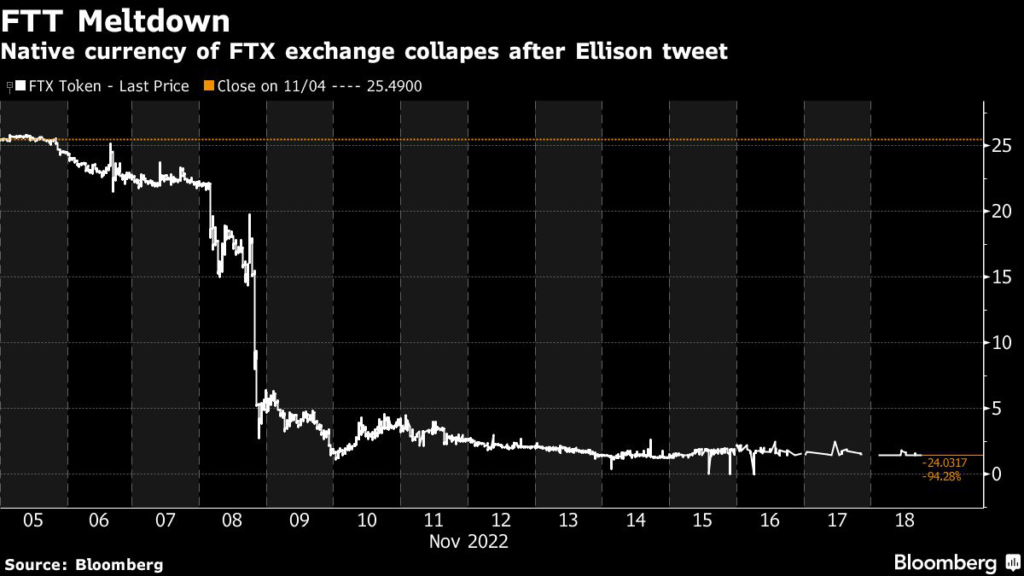
(Bloomberg) — When did it go from grim to hopeless for Sam Bankman-Fried’s crypto empire? Many answers have been offered. One decidedly narrow one says it was the moment his second-in-command went on Twitter trying to prevent a plunge in the token FTT.

While the overall collapse was caused by much larger forces — decisions that left Bankman-Fried’s businesses resting precariously on the coin, exposed to Binance chief Changpeng ‘CZ’ Zhao’s pledge to sell it — zero hour came when Caroline Ellison offered to buy it all from CZ at a below-market price. That’s when market liquidity evaporated in an asset FTX had valued at around $5 billion a week earlier. 

The analysis, compiled by risk-modeling firm Gauntlet, doesn’t purport to be a broad accounting of why FTX fell — mismanagement, deceit and a reported decision to use exchange funds to support Alameda Research stand as much bigger sins. But for traders interested in an hourly accounting on when the point of no return was reached, the details point to Ellison’s tweet.

By calculating the ratio of total buy orders versus total sells in FTT’s main trading pairs on crypto exchanges including FTX, Bitfinex and Bitstamp, weighed by the difference to the spot price, Gauntlet’s data shows that the ratio dropped to below negative 200% right after Ellison tweeted at 11:03 a.m. Eastern time on Nov. 6. That means there were about four sell orders for each buy. 

When order books on exchanges were balanced between sell and buy orders, the ratio is at zero. A negative 200% shows that the sell pressure for FTT skyrocketed and it kept for more than seven hours. 

“Market conditions across a variety of centralized exchanges that traded FTT against USD or USDC materially degraded against FTT soon after Ellison’s tweets,” Tarun Chitra, founder and CEO of Gauntlet, said. “And this led to the sharp decline in FTT that likely led to a cascade of margin calls and or liquidations for Alameda based on their balance sheet.”  

FTT is like many so-called native tokens used to draw transactions to exchanges by providing discounts to its holders. An added incentive was a so-called burn mechanism where FTX constantly bought the token to hypothetically boost demand by removing the acquired tokens on the blockchain permanently, according to a study by crypto research firm Messari.

The use of FTT didn’t appear to be problem until it was revealed that not only FTT was one of the main assets that made up FTX’s balance sheet, but also the token was used as collateral by Alameda Research accessing capital through both centralized and decentralized lenders.

In crypto, it’s not uncommon for trading firms to use tokens as collateral to receive loans from lenders, according to a Twitter thread by Cumberland, a major trading desk in crypto owned by Chicago-based DRW. Crypto entities in general face challenges getting access to traditional banking services. But unlike more popular collateral tokens like Ether, FTT is a relatively illiquid asset and had a fully diluted supply of about 352.2 million. A web page of FTX shows that 105 million of the total FTT tokens remain unsold.

Before Ellison’s tweet, the trading volume of FTT on centralized exchanges on Nov. 5 was at just $108 million, according to data from Coinmarketcap. On the same day, Ether’s trading volume was at $11 billion.

Liquidation Hunt

In decentralized finance, or DeFi, where everything can be monitored on blockchains, large traders sometimes profit from shorting the underlying collateral tokens of loans on decentralized lending projects. Because the price to liquidate the loan position can be seen on chain, with enough capital, some traders can push the market to trigger liquidations, thereby profiting from the price drop of the tokens used as collateral.

A recent analysis by blockchain data firm Nansen shows that Alameda Research had been sending FTT tokens to Genesis Global, one of the biggest lenders in crypto, as early as September 2021. Genesis Global on Wednesday announced that it has temporarily suspended withdrawals at its lending division because of a liquidity crunch, after it disclosed its lending relationship with Alameda on Nov. 9. Prices for FTT dropped by more than 70%. It traded at nearly $2.50, based on TradingView data, the same day when FTX temporarily paused withdrawals. 

While the opaqueness of centralized lending business makes it hard to know the price to liquidate Alameda’s loans, Ellison’s tweet triggered such a hunt. 

“You don’t tell someone a price level like $22 unless you have a lot of confidence that you need that price, especially in such a public manner,” Chitra said.

More stories like this are available on bloomberg.com

©2022 Bloomberg L.P.

Musk Summons Twitter Software Engineers to Friday Meeting

(Bloomberg) — Twitter Inc. owner Elon Musk summoned all of the social media platform’s software engineers to its headquarters for a meeting on Friday afternoon, urging employees to fly to San Francisco to be there in person.

Only those who can’t physically get to the Bay Area or have family emergencies will be excused from attending, Musk said in an email, which was viewed by Bloomberg News.

“Anyone who actually writes software, please report to the 10th floor at 2pm today,” Musk wrote in the email, sent just before 9 a.m. local time Friday.

The engineers were told to send Musk a bullet-pointed summary of what their coding work has achieved in the past six months, along with as many as 10 screenshots of the most salient lines of code. The meetings will be short, and are being held to help Musk “understand the Twitter tech stack,” he said in a follow-up email.

The billionaire, who acquired Twitter in late October for $44 billion, had already pushed out most of the previous executive team and cut half the company’s workforce, leaving it with about 3,700 employees. He had also fired many workers who spoke out against his strategy shifts and cultural changes at the company. 

Earlier this week, he gave remaining staff an ultimatum: Either commit to the company’s new “hardcore” work environment or leave. 

As of Thursday, many more workers than he expected declined to take the pledge, potentially putting Twitter’s operations at risk, according to people familiar with the matter. Some employees who were departing speculated that so many were leaving, along with their knowledge of how the product works, that the social network may have trouble fixing problems or updating systems during its normal operations, said the people, who asked not to be identified discussing internal processes.

After the deadline passed, Twitter emailed employees that it was temporarily closing its offices, and workers speculated this was because of the confusion over who should still be allowed access to the company’s premises.

Read more: Musk Tells Staff Accept ‘Hardcore’ Twitter or Leave in Email


More stories like this are available on bloomberg.com

©2022 Bloomberg L.P.

Musk’s About-Face on Remote Work Latest Example of WFH Whiplash

(Bloomberg) — Elon Musk has softened his tone on remote work to convince people to remain at Twitter Inc., joining a growing roster of business leaders who’ve realized the value of allowing more flexible arrangements — and the perils of forbidding them.   

Musk, who has often ridiculed working from home, had banned remote work in his first email to workers last week. But Twitter’s new owner sent a follow-up email Thursday softening his tone. “All that is required for approval is that your manager takes responsibility for ensuring that you are making an excellent contribution,” he wrote, adding that staffers should have in-person meetings with their colleagues at least once a month. 

The billionaire is one of several corporate chiefs to change their tune on working from home. Leaders on Wall Street, in Silicon Valley and everywhere in between have seen that strict return-to-office policies often backfire and offering more flexible work arrangements can improve productivity, job satisfaction and attrition. Apple Inc. tempered its stance amid employee resistance, Jefferies Financial Group Inc. said it has “no issue” with the bank’s staffers working from home from time to time, while carmaker General Motors Co. has also dialed back its return-to-office plan.

“Getting an entire organization, especially a large one, to move in tandem with the leader’s cultural vision often requires a considerable jolt to force the culture to bend in the right direction,” Joel Carnevale, an assistant professor at Syracuse University’s Whitman School of Management, said by email. “The problem, however, is that if the jolt is too strong and you bend the culture too far, you risk breaking it. This is why many leaders, including recently Elon Musk, have had to dial back these mandates, at least temporarily.” 

Even the most steadfast opponents of remote work, like JPMorgan Chase & Co. chief Jamie Dimon, have shifted somewhat. Earlier this year Dimon said about 40% of his workforce will operate in a hybrid model going forward. And Musk’s concerns about Twitter staffers defecting over his RTO policy are well-placed: Apple learned that the hard way when one of its top machine-learning experts left the company over its return-to-office policy, only to land at rival Alphabet Inc.

After more than two years of flexible work arrangements, many white-collar workers have grown accustomed to being able to work where and when they wish, freeing them up to care for kids, aging parents or to simply escape endless Zoom calls and take a stroll in the backyard after lunch. Among those who are able to work from home, nearly half have some sort of hybrid schedule, while about one in five are fully remote, according to WFH Research, an ongoing survey of tens of thousands of US adults by researchers including Stanford University economist Nicholas Bloom. 

“It’s fascinating but not surprising,” Bloom said about Musk’s move. “Market forces even apply to Elon Musk. Workers in technology value the ability to work from home as the same as a 10% pay increase. So cancelling this is effectively a 10% wage cut.”

Elon Musk’s Tumultuous Twitter Takeover: Timeline

Musk — who has boasted about sleeping on the factory floor of Tesla Inc., the electric-car maker he also runs — hasn’t exactly embraced working from home. His Thursday email also said that “any manager who falsely claims that someone reporting to them is doing excellent work or that a given role is essential, whether remote or not, will be exited from the company.” Musk has also asked employees to formally state whether they were willing to keep working at the company — a commitment that would include “working long hours at high intensity.” Employees had until 5 p.m. Eastern time Thursday to respond, and the negative reaction from so many “Tweeps” to the ultimatum prompted Musk to shut Twitter’s offices Friday. 

At some companies, the debate over remote work was settled long ago. Airbnb Inc. Chief Executive Officer Brian Chesky dumped his RTO plan back in April, instead telling his 6,000 employees that they could work remotely indefinitely. “Each of us works best in our own ways, and we’re giving you the flexibility to make the right choice based on where you’re most productive,” Chesky wrote in an email to staff.

“Equating excellent work with working early mornings, late evenings, and weekends reveals a belief that the only way to be an excellent employee is to devote one’s entire life to the company,” says Jason Schloetzer, a professor at Georgetown University’s McDonough School of Business. “And it’s become apparent that an increasing proportion of the workforce is becoming comfortable with pushing back.”

More stories like this are available on bloomberg.com

©2022 Bloomberg L.P.
Twitter’s Crypto Head and Staff Resign in Mass Musk Exodus

(Bloomberg) — The head of Twitter Inc.’s crypto development team has left the company, part of a mass exodus of employees since new owner Elon Musk issued a blanket ultimatum to staff.

Tess Rinearson, who was tapped to spearhead Twitter’s crypto team last year, posted a tweet late on Thursday with the salute emoji, followed by a blue heart  — the former being a symbol for departing Twitter employees to signal their goodbyes.

Rinearson also changed the Twitter bio on her now private account to “did not click the button”, referring to Musk’s requirement for all remaining staff to opt in to remain employed at the firm by clicking “yes” on a form before Thursday’s 5 p.m. Eastern Time deadline. If they did not respond, employees were offered three months’ severance.

She wasn’t the only exit from Twitter’s crypto unit that day, with Hamdi Allam, a senior software engineer on the project, also posting a tweet to say he’d left the business. Both didn’t immediately respond to requests for comment. 

Earlier on Thursday, so many employees had either decided to leave the firm or been dismissed that Twitter abruptly shuttered its offices. Musk had told staff to either accept his proposed “hardcore” work environment or leave, though in the final hours before the deadline, he tried to convince some key executives to stay.

Musk ‘Hardcore’ Ultimatum Spurs Exodus, With Twitter at Risk (1)

Under Rinearson’s leadership, Twitter had implemented a tool allowing crypto art collectors to link a nonfungible token to their profile pictures, distinguishable by their hexagonal shape on users’ accounts. Rinearson was previously vice president of engineering at blockchain development firm Interchain, working on projects like Cosmos. 

The future of Twitter’s crypto ambitions remained unclear on Friday, along with the social network’s ability to continue operating normally due to the amount of staff that had left the firm.

More stories like this are available on bloomberg.com

©2022 Bloomberg L.P.
Stocks Tread Water, Oil Falls on Demand Concerns: Markets Wrap

(Bloomberg) — US equities were mixed and oil futures fell one day after Federal Reserve policymakers disabused optimistic investors of the notion that interest rates would abate soon. 

The S&P 500 Index was largely unchanged and the Nasdaq 100 slipped 0.5% as trading volumes remained roughly 20% below the 30-day average for the time of day during Friday’s $2.1 trillion options expiration.

Treasury yields rose a day after hawkish comments from St. Louis Fed President James Bullard, who said interest rates needed to rise at least to 5%-5.25% to curb inflation. Also on Thursday, Minneapolis Fed President Neel Kashkari said it was an “open question” how far the central bank has to go with rates to bring demand back into balance.

Relentlessly rising interest rates are alreday weighing on global demand. Growth-sensitive copper and oil prices were set for weekly losses on concerns about a worsening outlook. US crude futures signaled an oversupply for the first time in almost a year. Higher mortgage rates sent sales of previously owned US homes down for a record ninth straight month in October.

Yet some equity investors said hawkish commentary did not necessarily mean rates would peak levels higher than previously thought. Traders continue to bet that the Fed will reverse course and begin cutting rates in the later part of 2023. 

“Although it’s a moving target, today the market has made peace with the Fed and the continual push toward increased forward guidance on the peak for rates,” said David Donabedian, chief investment officer of CIBC Private Wealth US, said in an interview. “Markets are increasingly comfortable and realistic about a 5%, 5.25% funds rate emerging next year and that perhaps investors are seeing light at the end of the tunnel.”

Despite sobering comments by Fed policymakers and turmoil in the cryptocurrency world, the S&P 500 was headed toward a loss of just 1% on the week. 

“This week’s somewhat tight range might merely be a ‘breather’ that helps the market digest its recent gains before it heads higher,” Matt Maley, chief market strategist at Miller Tabak + Co., wrote. “Besides, Thanksgiving week tends to be a good one for the stock market.”

Chris Harvey of Wells Fargo expects the market to bounce around the 3,950 level until mid-December, when the next inflation print and Fed decision will provide traders with more clarity. But after that, the market trend will become “a ‘coin toss,’ with increasing evidence of an impending recession,” his team wrote in a note.

Hong Kong’s benchmark Hang Seng Index enjoyed a third straight week of gains, thanks to China’s steps to support the property sector and ease Covid restrictions. European stocks climbed on optimism over both China and bets that central banks will slow their rate hikes. 

Some of the main moves in markets:

Stocks

  • The S&P 500 was little changed as of 1:42 p.m. New York time
  • The Nasdaq 100 fell 0.5%, falling for the third straight day, the longest losing streak since Nov. 3
  • The Dow Jones Industrial Average rose 0.2%, more than any closing gain since Nov. 10
  • The MSCI World index fell 0.6% to the lowest since Nov. 10

Currencies

  • The Bloomberg Dollar Spot Index rose 0.2%
  • The euro fell 0.3% to $1.0334
  • The British pound rose 0.2% to $1.1887
  • The Japanese yen was little changed at 140.30 per dollar

Cryptocurrencies

  • Bitcoin fell 0.7% to $16,567.23
  • Ether fell 0.1% to $1,203.95

Bonds

  • The yield on 10-year Treasuries advanced five basis points to 3.81%
  • Germany’s 10-year yield was little changed at 2.01%
  • Britain’s 10-year yield advanced four basis points to 3.24%

Commodities

  • West Texas Intermediate crude fell 3% to $79.21 a barrel
  • Gold futures fell 0.5% to $1,768.20 an ounce

This story was produced with the assistance of Bloomberg Automation.

–With assistance from Isabelle Lee and Emily Graffeo.

More stories like this are available on bloomberg.com

©2022 Bloomberg L.P.

Silvergate Capital Shares Slide as FTX Fallout Attracts Short Sellers

(Bloomberg) — Silvergate Capital Corp. shares slumped, putting them on pace to lose a quarter of their value this week, as investors punished the bank for its ties to the bankrupt FTX cryptocurrency exchange.

Shares of the company, which held deposits for FTX, dropped 9.9% to $25.14 at 1:03 p.m. in New York. Thursday’s nearly 11% drop triggered a short-sale circuit breaker. Data from S3 Partners indicates short interest levels in Silvergate are around 11% of the shares available for trading.

Sam Bankman-Fried’s sprawling crypto empire, which included FTX and trading firm Alameda Research, entered into bankruptcy last week after it became clear the exchange faced a shortfall of as much as $8 billion. The sudden failure raised questions about the threat of contagion, with companies spelling out their exposure as the fiasco sent the price of digital assets lower. Publicly traded companies with exposure to Bitcoin and other tokens have likewise suffered amid souring investor sentiment. 

Silvergate’s decline follows the appearance of a letter on social media indicating FalconX would no longer be using Silvergate’s real-time payments platform or its wires. “We can confirm we sent communication to our clients changing settlement instructions for the time being,” a spokeswoman for FalconX said in an email. “The market is in an elevated risk environment, so therefore we are operating out of an abundance of caution.”

Silvergate said in an emailed statement that the company “and its entire banking platform were purpose-built to withstand periods of market volatility. The Silvergate Exchange Network continues to operate as designed, providing their clients with the ability to move US dollars in real-time 24 hours a day, seven days a week.”

The company said in a Nov. 11 statement that FTX represented less than 10% of the $11.9 billion in deposits from digital-asset providers it held as of Sept. 30. On Wednesday it said that, as of Nov. 15, deposits from digital-asset customers excluding FTX and related entities averaged about $9.8 billion.

“We didn’t have any type of relationship with FTX, Alameda Research or any of the other entities other than the deposit relationship,” Silvergate Chief Executive Officer Alan Lane said on a conference call Thursday.

–With assistance from Sidhartha Shukla.

More stories like this are available on bloomberg.com

©2022 Bloomberg L.P.

SoftBank Partner Saurabh Jalan, Who Sits on WeWork Board, Exits

(Bloomberg) — Saurabh Jalan, an investing partner at a SoftBank Group Corp. subsidiary, has left the company.

Jalan, who joined the Japanese conglomerate in 2015, is on the board of WeWork Inc., the co-working company that counts SoftBank as its largest shareholder. SoftBank plans to appoint another director to the WeWork board in coming weeks.

A SoftBank spokesman said Jalan departed SoftBank Group International to pursue other opportunities, and declined to comment further. 

The company last month appointed an executive committee to oversee its second Vision Fund, Latin America funds and future vehicles following a decision by Rajeev Misra, who oversees its first Vision Fund, to step back from some responsibilities in order to establish a new firm, One Investment Management.

SoftBank’s Vision Fund arm, which started laying off employees in recent months, posted a $7.2 billion quarterly loss last week, driven by the declining value of portfolio companies such as SenseTime Group Inc., DoorDash Inc. and GoTo Group. Masayoshi Son is on the hook for about $4.7 billion on side deals he set up to boost his compensation, amid mounting losses in the company’s tech portfolio. 

Read more: SoftBank Sinks 12% After Loss and No New Buyback Program

More stories like this are available on bloomberg.com

©2022 Bloomberg L.P.
Crypto Fallout Leaves US Retiree Benefits Mostly Unscathed

(Bloomberg) — While it seemed like everyone was jumping into the cryptocurrency market in the last few years, one major investor showed restraint — a bet that seems to be paying off. 

Most of the largest US state and local government pension funds have dodged the ongoing fallout from the collapse of crypto exchange FTX by not directly investing in digital tokens. For the pensions that have dipped into the risky asset class, the investments represent just a small amount of the retirement funds’ portfolio, and much of the limited exposure is indirect via crypto-related stocks or other investment products.

“It would be a far more material effect if we had, for example, a stock market crash because that represents a broader portion of their pension investment portfolios,” Moody’s Investors Service Senior Credit Officer Thomas Aaron said. 

Nearly all of the top 10 US pension funds by assets said they are not invested in Bitcoin or any other cryptocurrencies, according to an informal survey by Bloomberg. A notable exception is the Florida Retirement System, with $182 billion in assets, which said they invested $119 million of net-assets in Bitcoin, Ether and Solana.

Two of the nation’s largest pensions, the California Public Employees’ Retirement System and New York State Common Retirement Fund, told Bloomberg via spokespeople that they do not have any direct exposure to cryptocurrency. But each note that they may have indirect exposure. 

“Anecdotally, we all know it’s there, but crypto is often buried within other alternative investments that pensions carry,” Doug Offerman, senior director at Fitch Ratings. “So, that degree of exposure is not always clear at any given moment.”

New York’s State Common Retirement Fund holds 172,828 shares of Coinbase Global Inc. a crypto exchange, as of Sept. 30, an investment of roughly $8 million — a small fraction of its $250 billion fund. And Calpers has an about $15 million exposure holding 319,037 shares, according to holdings data compiled by Bloomberg. 

Pensions that have taken the crypto dip have done so conservatively. Houston Firefighters’ Relief and Retirement Fund allocated 0.5% of its $5.5 billion assets last year into crypto. Handling the retirement benefits of over 6,600 active and retired firefighters, the Houston fund are among a few to invest in both Bitcoin and Ether.  

“We didn’t invest into yield-farming, or any of the exotic stuff,” said Ajit Singh, the chief investment officer for the fund. “All of the things happening right now with FTX, it doesn’t affect us.”

Similarly, Fairfax County Employees’ Retirement system has about 3.5% of their assets, or $150 million, in various strategies and funds with crypto exposure, Chief Investment Officer Andrew Spellar wrote in an email to Bloomberg. The most recent quarterly reports for those funds have been flat to up slightly, Spellar wrote. The county’s police officer fund also holds more than 7.5% of its assets in crypto, though its Chief Investment Officer Katherine Molnar said neither fund has any material exposure to FTX beyond standard market volatility.

Pensions likely have some risks tied to FTX, given the crypto exchange’s long list of partners and more than a millon creditors. While the New Jersey Department of Treasury told Bloomberg it does not actively seek to invest in crypto, its system has holdings in Coinbase and MicroStrategy Inc. as well as companies including BlackRock Inc. and Signature Bank, which have indirect exposure to crypto.

Funds are seeing some red with Bitcoin, the world’s largest cryptocurrency by market value, down over 71% since its high in November 2021, coupled with historically high inflation and volatility in equity and bond markets. Public pensions funded ratio declined to 74% from 78%, as of June 30, according to Center for Retirement Research.

Seeking Higher Returns 

David John, a senior policy adviser within AARP’s Public Policy Institute, said most pension funds will be largely shielded from the latest crypto winter. But he expects a number of retirees may see great losses from individual crypto investments in the coming years.

Read more: Crypto Contagion Is Entangling Even More Retail Customer Cash

According to Anthony Randazzo, executive director at Equable Institute, 14 pensions invested a small fraction in FTX either through hedge fund Tiger Global or private equity firm Institutional Venture Partners. Calpers, for instance, invested $300 million of its now $400 billion pension system in a Tiger Global fund that invested some money into FTX.  

The overall exposure is minuscule in a system of roughly 6,000 public sector plans, whose total assets hover around $4.5 trillion. 

“This is not going to make or break any of these pension funds,” Randazzo said.

But Randazzo said a number of pensions are beginning to dabble more in crypto because they have unrealistically high assumed rates of return. Houston Firefighters is among them with an ARR of 8.5%, substantially higher than the national average of 6.9%.

“Pension funds are famously yield chasers,” said Gil Luria, a strategist at D.A. Davidson. “The significant returns to crypto compelled institutional investors including public pension funds to start looking at allocation to crypto.”

Over the last decade or so, US pension funds have increasingly funneled money into risky asset classes to achieve desired return targets, said Offerman. That may become a problem since unlike funds and retail investors, systems are working with retiree money and any losses can be detrimental to the finances of local and state municipalities.

“They’re going to get some big wins and big losses,” said Randazzo. “But the downside of those losses are going to be felt by individuals in towns who don’t have the resources to pave roads or school districts” because of the higher contributions. 

–With assistance from Fola Akinnibi, Allison Nicole Smith, Martin Z. Braun, Romy Varghese, Felipe Marques, Elise Young, Brett Pulley, Shelly Hagan, Vincent Del Giudice, Shruti Date Singh and Natalia Lenkiewicz.

More stories like this are available on bloomberg.com

©2022 Bloomberg L.P.

Shoppers Spend Less, Leaving Companies That Deliver Goods Empty for the Holidays

(Bloomberg) — Companies that move and deliver goods are getting an early warning this week about a potential one-two punch that could hit hard this holiday season.

A deluge of retailer earnings reflected shoppers paring back spending as inflation soars and recession fear mounts. Meanwhile, consumer surveys by Citigroup Inc. and Goldman Sachs suggested that people increasingly want to spend their money in stores, which is bad news for parcel and last-mile delivery companies that benefitted from the online-shopping boom in the wake of the Covid pandemic.

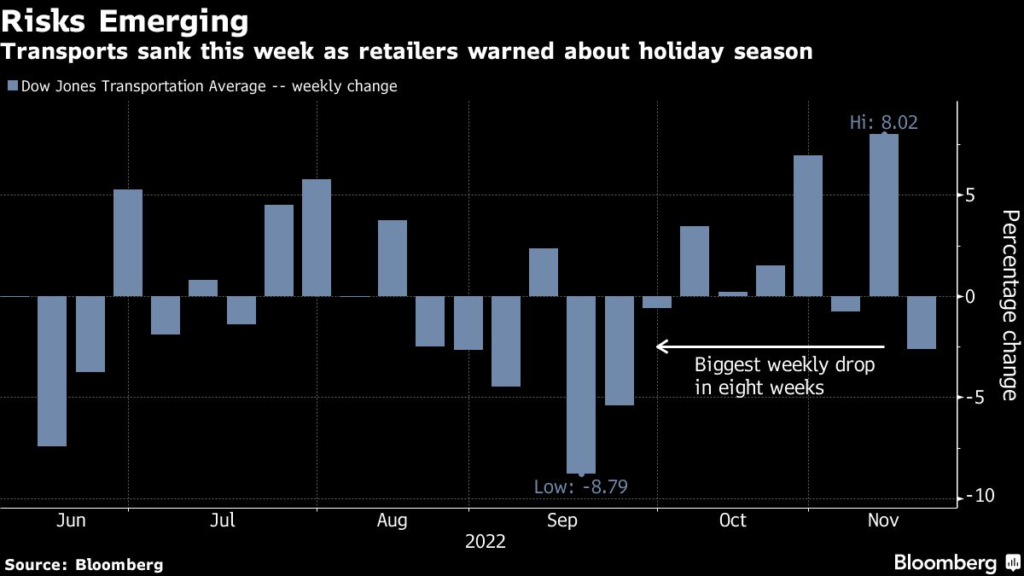
The Dow Jones Transportation Average has lost 2.6% so far this week, with Matson Inc. and Old Dominion Freight Line Inc. leading declines. The gauge is on pace for the worst week in two months.

The decline is understandable. A slew of retailers warned about diminishing demand this week, including Target Corp., Kohl’s Corp. and Williams-Sonoma Inc.. And strong third-quarter earnings from Walmart Inc. came down to its ability to lure shoppers with discounts amid surging inflation.

Overall, the outlook for the holiday shopping season is darker than usual — bad news both for retailers and transportation companies further down the supply chain.

That will likely lead to a “season of muted volumes for transports in the upcoming holiday season and into the start of 2023,” Susquehanna Investment Group analyst Bascome Majors wrote in a Thursday note. Walmart, Target, Home Depot Inc. and Lowe’s Cos. are among the highest-volume, publicly traded importers of containerized goods in the US, he wrote.

An additional risk for truckers and other transportation stocks is consumers’ increasing preference to do their shopping in stores, as Goldman and Citi found, which cuts into online purchases. For companies such as FedEx Corp., United Parcel Service Inc., XPO Logistics Inc. and Ryder System Inc., that can translate into weaker volumes.

“While e-commerce trends have remained sticky post-pandemic, only 40% of survey respondents indicated plans to spend more online this year, the lowest rate of increase we’ve seen since pre-pandemic,” Goldman Sachs analysts wrote in a Friday note.

More stories like this are available on bloomberg.com

©2022 Bloomberg L.P.

Close Bitnami banner
Bitnami