Bloomberg

Germany, Spain Review Presence on Twitter Amid Musk’s Turmoil

(Bloomberg) — Germany is watching developments at Twitter Inc. “with growing concern” and reviewing its presence on the platform, including potentially shutting down Chancellor Olaf Scholz’s handle. 

Scholz’s chief spokesman Steffen Hebestreit was quizzed about the government’s Twitter policy at a regular news conference Friday and said closing Scholz’s @Bundeskanzler account “can be one step but won’t necessarily be the final decision.”

“We have to observe the very dynamic developments on this platform and then draw our conclusions,” Hebestreit, who has his own official handle @RegSprecher, told reporters.

Separately, Spain’s deputy prime minister, Nadia Calvino, said they could leave the platform under certain circumstances. “We will continue to use Twitter, but if eventually it doesn’t supply the necessary security in terms of information, there will be other platforms that will fill that gap,” she told reporters in Madrid. 

Twitter said on Thursday it was temporarily closing its offices after Elon Musk issued employees an ultimatum to either stay with the company “working long hours at high intensity” or quit with three months’ severance pay.

Musk laid off half the company’s workforce after taking over, before having to ask some of them to return, raising concerns about the company’s viability.

Germany’s Federal Commissioner for Data Protection and Freedom of Information already deleted its Twitter account @BfDI_info this month, saying it hadn’t been able to satisfactorily complete a legal-compliance audit.

It also referred in a press release to “non-transparent developments” surrounding Musk’s takeover and said it would focus on its presence on micro-blogging service Mastodon.

The concerns regarding Twitter are prompting users to explore other services such as German social network Mastodon, the EU’s tech chief Margrethe Vestager said.

“This is a chance for people to explore what is out there because there is more to our digital life,” Vestager said at a press briefing in Madrid.

–With assistance from Chris Reiter.

More stories like this are available on bloomberg.com

©2022 Bloomberg L.P.

FTX Latest: Fed’s Kashkari Calls Whole Idea of Crypto ‘Nonsense’

(Bloomberg) — Federal Reserve Bank of Minneapolis President Neel Kashkari said Friday that the whole idea of cryptocurrency is “nonsense” after the implosion of FTX Group revealed the industry’s shortcomings.

A CFTC commissioner has urged crypto industry whistleblowers to come forward in the aftermath of FTX Group’s implosion, saying tipsters have previously received millions of dollars for their help.

Trading volumes on decentralized exchanges are up almost 11% this month to $62 billion, CryptoCompare data sourced from DefiLlama shows. Digital-asset investors are flocking to crypto’s decentralized heartland after witnessing the collapse of Sam Bankman-Fried’s FTX exchange. 

Democratic lawmakers who received millions of dollars in campaign donations from the former FTX chief executive officer say they will be ready to grill him about the exchange’s collapse. 

Key stories and developments:

  • FTX Hammers More Nails Into Crypto’s Coffin: Lionel Laurent
  • Eight Days Into FTX’s Bankruptcy Blow Up (Podcast)
  • Crypto Informants Can Reap Millions From CFTC After FTX Blowup
  • Ontario Teachers Writes Off FTX Stake, Citing Potential Fraud
  • Billions of Dollars Flee FTX Woe to Crypto’s Decentralized Roots

(Time references are New York unless otherwise stated.)

Fed’s Kashkari Says the ‘Entire Notion of Crypto Is Nonsense’ (9:55 a.m.)

Federal Reserve Bank of Minneapolis President Neel Kashkari said Friday that the whole idea of cryptocurrency is “nonsense” after the implosion of FTX Group revealed the industry’s shortcomings.

“This isn’t case of 1 fraudulent company in a serious industry,” Kashkari said on Twitter, commenting on an article about how investors fell for FTX. “Entire notion of crypto is nonsense. Not useful 4 payments. No inflation hedge. No scarcity. No taxing authority. Just a tool of speculation & greater fools.”

Man Group Readies Crypto Hedge Fund Despite FTX Chaos (9:13 a.m.)

Man Group Plc is close to starting a dedicated cryptocurrency hedge fund, delving deeper into a market that’s reeling from the collapse of exchange operator FTX. 

The world’s largest publicly-traded hedge fund firm has been developing the strategy led by money manager Andre Rzym for months, according to people with knowledge of the matter. The firm’s computer-led trading unit AHL is planning to start the fund as soon as the end of the year, said the people, asking not to be identified because the plan is private.

Crypto Informants Can Reap Millions From CFTC After FTX Blowup (7:46 a.m.)

A CFTC commissioner has urged crypto industry whistleblowers to come forward in the aftermath of FTX Group’s implosion, saying tipsters have previously received millions of dollars for their help. 

Commodity Futures Trading Commission’s Kristin Johnson said on Thursday that informants would get anonymity, adding that such tips play a crucial role in enforcement given the opaqueness of some of the crypto world. 

Billions of Dollars Flee FTX Woe to Crypto’s Decentralized Roots (6:30 a.m.)

Digital-asset investors are flocking to crypto’s decentralized heartland after witnessing the collapse of Sam Bankman-Fried’s FTX exchange.

Trading volumes on decentralized exchanges are up almost 11% this month to $62 billion, CryptoCompare data sourced from DefiLlama shows. Lending protocols such as Aave and Compound are also among those seeing strong user and transaction growth, analytics firm Nansen said. In contrast, depositors spooked by FTX have yanked cash from centralized exchanges.

Coinbase Cut to Neutral at BofA in Wake of FTX Collapse (6:30 a.m.)

Cryptocurrency exchange Coinbase was downgraded to neutral from buy at Bank of America due to uncertainty surrounding its outlook amid market turbulence.

“Coinbase likely faces a number of new headwinds” over the near to medium-term due to the collapse of FTX,” wrote analyst Jason Kupferberg, saying the company was not “immune from the broader fallout within the crypto ecosystem.”

Small-Cap Tech Decouples From Bitcoin Gyrations (5:07 a.m.) 

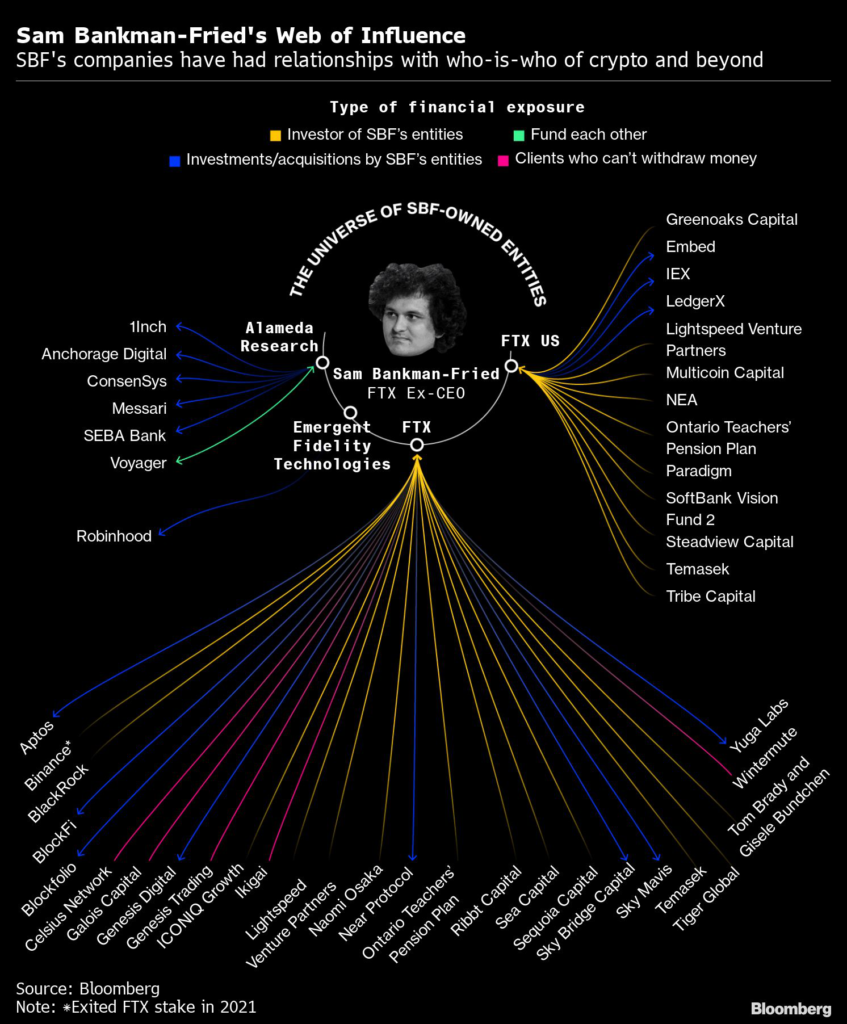
Small-cap tech stocks have started to part ways with Bitcoin as both the crypto’s stock and related industry influence wane. Following the March 2020 low, rolling annual changes in Bitcoin’s US dollar cross rate and the Russell 2000 tech sector have been 0.95 correlated. And since Bitcoin’s peak, small-cap tech is down 38.5% versus a 75.4% drop in the crypto token.

It could be that Bitcoin represents overall risk tolerance in markets, spelling a rally for higher-growth small caps when rising. Or there could be a fundamental linkage: the sector weight of semiconductors — an integral part of Bitcoin mining — has dropped to 19.6% from 22.2%, since Bitcoin’s peak.

Fintechs Still Pushing Crypto, Distance Themselves From FTX (1:00 p.m. HK)

FTX’s bankruptcy filing last week is the latest headwind for fintech companies that have grown rapidly in tandem with the surge in digital asset trading. 

Revolut, a finance app based in London, told users this week it did not have “material exposures” to FTX but was monitoring the situation. “This is a good reminder that crypto is very volatile: the value does go down, as well as up,” it said in an email. Crypto has already shrunk from about 35% of Revolut’s revenue last year to less than 5% this year.

Block Inc.’s Cash App, which allows consumers to transfer money or buy stocks and cryptocurrencies, said in a statement it was “Bitcoin-first” and committed to a “truly” decentralized payments system “not controlled by any person, bank, country, or corporation.” 

Bitcoin Heads for a Weekly Gain (11:50 a.m. HK)

Bitcoin is up some 3% this week, topping global stocks, while a gauge of the leading 100 virtual coins has added about 0.5%. That compares with Bitcoin’s 23% slide last week as FTX collapsed.

Crypto historians might argue the counterintuitive Bitcoin performance will continue. Since a low in 2018, Bitcoin has posted a weekly loss of at least 20% six times apart from the recent slide. The token jumped almost 9% on average over the subsequent month, according to data compiled by Bloomberg.

Bahamas Regulator Takes Control of FTX Assets (8:00 a.m. HK)

The Bahamas Securities Commission said in a statement it directed the transfer of all digital assets of FTX Digital Markets, or FDM, to a wallet that the commission controls for safekeeping.

“Urgent interim regulatory action was necessary to protect the interests of clients and creditors of FDM,” it said, adding that its understanding is that FDM is not a party to US Chapter 11 bankruptcy proceedings. It said it would engage with regulators and authorities in multiple jurisdictions.

Ontario Teachers Writes Off FTX Stake (7:10 a.m. HK)

The pension plan said it will write down its stake in FTX to zero, taking a $95 million loss barely a year after making its first investment.

Teachers said the writedown will have only a “limited impact” because it’s less than 0.05% of the pension fund. “However, we are disappointed with the outcome of this investment, take all losses seriously and will use this experience to further strengthen our approach,” the fund said in a statement Thursday. 

Bankman-Fried-Backed Lawmakers Ready To Grill Former CEO (5:01)

Lawmakers who received millions of dollars of campaign donations from Sam Bankman-Fried could soon get something else from the former FTX chief executive officer: testimony under oath. 

Recipients of those political contributions say they’re prepared to grill Bankman-Fried about why his crypto exchange suddenly crashed, potentially causing billions of dollars in losses for millions of FTX account holders. Before the collapse, he donated tens of millions of dollars from his crypto-empire fortune to benefit Democrats, making him the second-largest donor to the party this election.

–With assistance from Amanda Fung, Dara Doyle and Taryana Odayar.

More stories like this are available on bloomberg.com

©2022 Bloomberg L.P.

Stocks Settle Down as Traders Make Peace With Fed: Markets Wrap

(Bloomberg) — US equities were largely unchanged one day after Federal Reserve policymakers signaled that interest rates would continue to rise for a while. 

The S&P 500 index was up 0.2% and the Nasdaq 100 was flat as investors prepared for volatility during Friday’s $2.1 trillion options expiration.

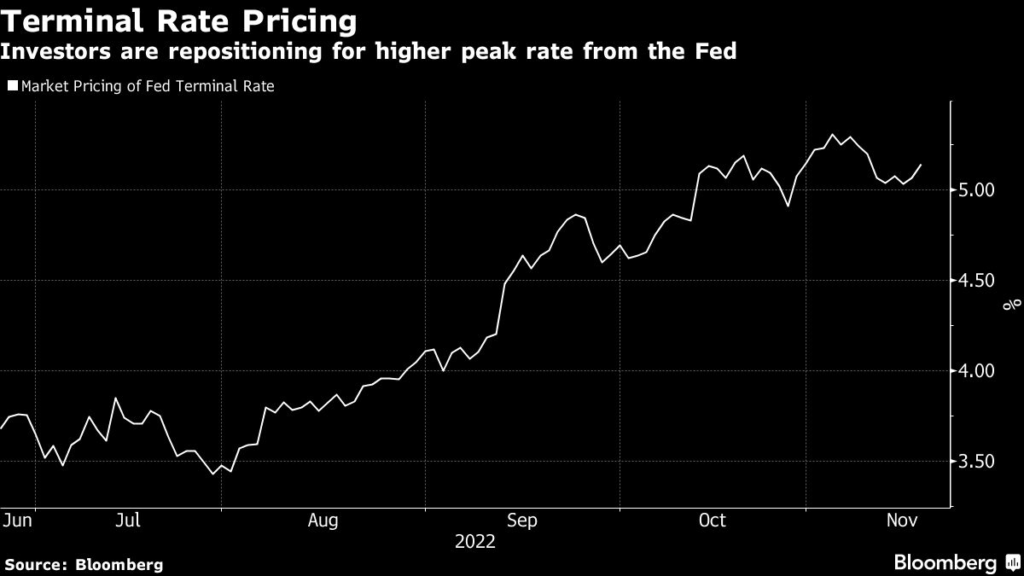
Treasury yields rose a day after hawkish comments from St. Louis Fed President James Bullard, who said interest rates needed to rise at least to 5%-5.25% to curb inflation. His comments prompted markets to dial up their expectations for how high US rates might go.

Yet some investors said hawkish commentary did not necessarily mean rates would peak at higher levels than previously thought. Traders continue to bet that the Fed will reverse course and begin cutting rates in the later part of 2023. 

“The Fed wants to ensure their job is not getting undone, the language is still robust and that there’s still a coordinated effort from board members to push on the hawkish button,” James Athey, investment director at Abrdn Investment Management Ltd., told Bloomberg Television. “That doesn’t mean the destination is necessarily a higher rate than where markets thought a week or two ago. I think they’re just trying to downplay investor’s spirits a bit.”

Fears are mounting though, that relentlessly rising rates will hit economic growth. Growth-sensitive copper and oil prices were poised for weekly losses, pressured by concerns over a worsening demand outlook. The Fed’s interest rate pressures on mortgage rates rippled through the US housing market, as sales of previously owned homes fell for a record ninth straight month in October.

Analysts at Bank of America Corp. warned that with a Fed policy pivot likely only in June or July, rate hikes and company earnings could prove a headwind to stocks. While investment inflows into equity funds swelled last week — lured by signs of a US inflation slowdown — “a fair chunk of the bear market rally is behind us,” they wrote. 

Europe’s Stoxx index rose more than 1%, led by energy, banking and utilities, and is now on track to extend a four-week rising streak  

Earlier, Hong Kong’s benchmark Hang Seng Index enjoyed a third straight week of gains, thanks to China’s steps to support the property sector and ease Covid restrictions. On Friday, the benchmark’s tech gauge touched a two-month high, led by Alibaba, which missed second-quarter revenues but upsized share buybacks.

Bitcoin was on course for a weekly gain even as the collapse of Sam Bankman-Fried’s FTX empire continues to rattle the crypto market.  

Some of the main moves in markets:

Stocks

  • The S&P 500 rose 0.2% as of 10:19 a.m. New York time
  • The Nasdaq 100 was little changed
  • The Dow Jones Industrial Average rose 0.3%, more than any closing gain since Nov. 10
  • The Stoxx Europe 600 rose 1%, more than any closing gain since Nov. 10
  • The MSCI World index fell 0.6% to the lowest since Nov. 10

Currencies

  • The Bloomberg Dollar Spot Index was little changed
  • The euro fell 0.1% to $1.0349
  • The British pound rose 0.3% to $1.1903
  • The Japanese yen rose 0.2% to 139.89 per dollar

Cryptocurrencies

  • Bitcoin fell 0.1% to $16,659.10
  • Ether rose 0.6% to $1,212.77

Bonds

  • The yield on 10-year Treasuries advanced two basis points to 3.79%
  • Germany’s 10-year yield was little changed at 2.02%
  • Britain’s 10-year yield advanced four basis points to 3.24%

Commodities

  • West Texas Intermediate crude fell 3.8% to $78.55 a barrel
  • Gold futures fell 0.5% to $1,769.50 an ounce

This story was produced with the assistance of Bloomberg Automation.

–With assistance from Tassia Sipahutar.

More stories like this are available on bloomberg.com

©2022 Bloomberg L.P.

FTX Collapse Shakes Wall Street’s Conviction in Coinbase

(Bloomberg) — Just last year, Wall Street banks were helping shepherd Coinbase Global Inc. into the public market as one of the hottest new stocks. Now, after a collapse in its share price — and pretty much everything else related to crypto — analysts are losing faith.

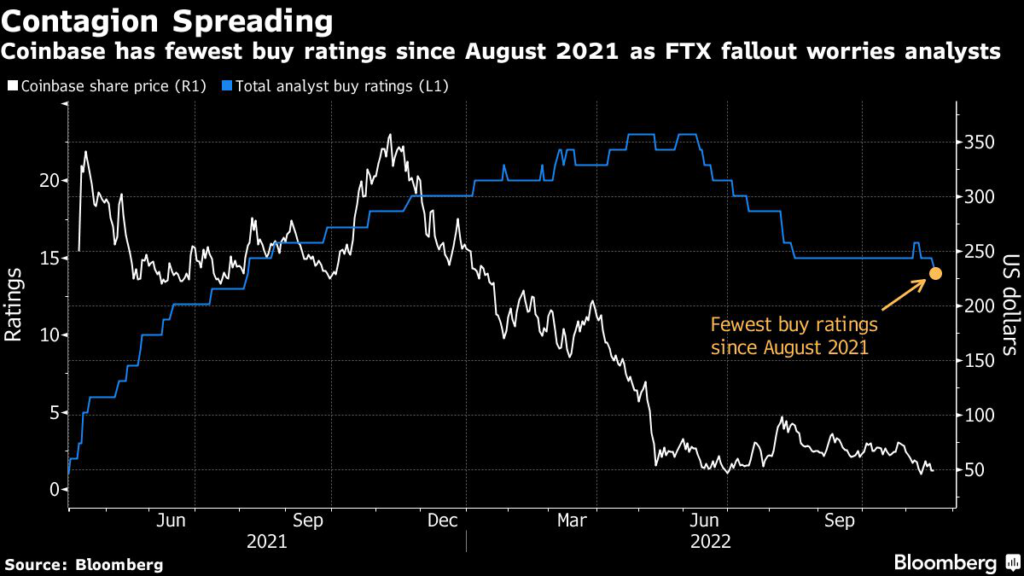
Bank of America Corp. became the latest firm to cut its rating on the cryptocurrency exchange, downgrading it to neutral from buy on Friday, citing concern about the broader fallout from the collapse of Sam Bankman-Fried’s FTX exchange. The move leaves Coinbase with 14 buy-equivalent analyst recommendations, its lowest number since August 2021, according to data compiled by Bloomberg.

“Coinbase likely faces a number of new headwinds over the near/medium-term due to the recent collapse of rival crypto exchange FTX,” Bank of America analyst Jason Kupferberg wrote in a note to clients.

Daiwa Securities cut its buy rating on the stock last week, adding to a rash of downgrades over the last few months. Analysts had been overwhelmingly bullish on Coinbase since its April 2021 direct listing, with nearly 80% buy recommendations as recently as mid-March.

Shares of the crypto firm have plunged this year, sinking more than 81%. Last week’s implosion of FTX sent the stock to a fresh record low close of $45.98 on Nov. 9. The decline has largely tracked the plunge in Bitcoin, which has tumbled below $17,000 per token from a record high of nearly $70,000 late last year.

While the downfall of FTX and the broader slump in crypto assets has shaken Wall Street’s conviction in Coinbase, not everyone is losing their nerve.


“We ultimately think Coinbase has a level of credibility as a public company and that its experience through multiple crypto cycles will make offshore exchanges like FTX look amateurish in comparison,” said Compass Point analyst Chase White.

–With assistance from Thyagaraju Adinarayan.

More stories like this are available on bloomberg.com

©2022 Bloomberg L.P.
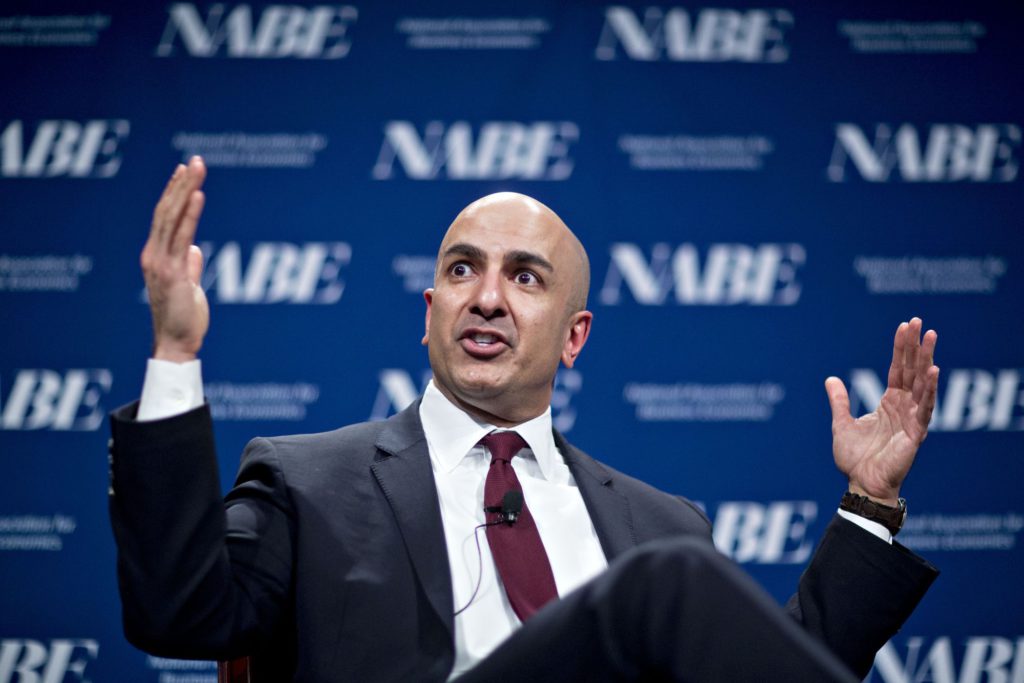
Fed’s Kashkari Calls Whole Notion of Crypto ‘Nonsense’

(Bloomberg) — Federal Reserve Bank of Minneapolis President Neel Kashkari said Friday that the whole idea of cryptocurrency is “nonsense” after the implosion of FTX revealed the industry’s shortcomings.

“This isn’t case of 1 fraudulent company in a serious industry,” Kashkari said on Twitter, commenting on an article about how investors fell for FTX. “Entire notion of crypto is nonsense. Not useful 4 payments. No inflation hedge. No scarcity. No taxing authority. Just a tool of speculation & greater fools.”

While many officials have warned about crypto risks and the need for regulation, Kashkari’s comment represents one of the most forceful denunciations by a Fed policymaker. 

Earlier this week, Fed Vice Chair Lael Brainard said she’s concerned that retail investors were taking losses and bemoaned a “domino effect” of one platform or firm’s failures spilling over elsewhere.

Also, Michael Barr, the Fed’s vice chair for supervision, warned Congress that it needed to pass legislation with strong crypto guardrails to prevent future financial-stability risks.

Meanwhile, the New York Fed is partnering with almost a dozen banks and other financial institutions to test out digital dollars, a sign that Wall Street intends to push ahead with its cryptocurrency agenda despite recent upheaval in the market. 

(Updates with background starting in third paragraph.)

More stories like this are available on bloomberg.com

©2022 Bloomberg L.P.
Crypto-Product Pipeline Goes Bust as Survival Questioned

(Bloomberg) — Even before the collapse of the FTX exchange brought the crypto industry to heel, the boom in virtual-currency exchange-traded products was deflating. 

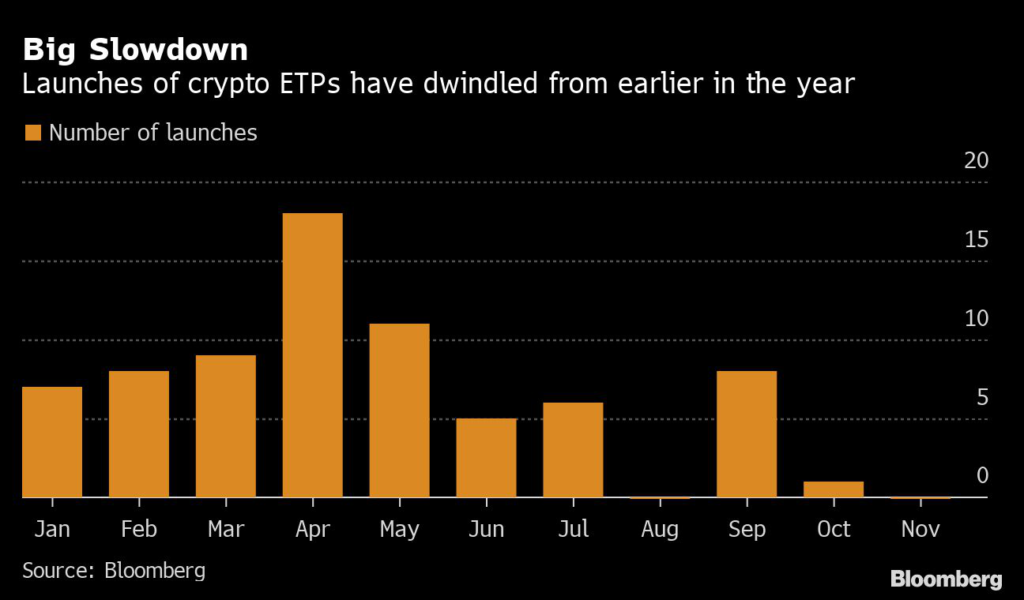
Launches worldwide for ETPs focused on digital assets have dwindled to a trickle, from 58 in the first half of the year to 14 in the third quarter, with just one debut in October, according to data compiled by Bloomberg. None have come to market so far in November, a month that’s seen the implosion of a number of once-supreme crypto firms. 

Meanwhile, there’s been an uptick in liquidations, with seven vehicles shuttering, according to a tally by James Seyffart at Bloomberg Intelligence. Cosmos Asset Management in Australia recently closed its Purpose Bitcoin Access ETF and its Purpose Ethereum Access ETF, while issuer 21Shares closed its ETP that tracked the FTX token. 

“I’m expecting a wave of crypto-related ETF liquidations over the next year,” said Nate Geraci, president of The ETF Store, an advisory firm. “There are simply too many crypto-related ETFs and not nearly enough investor demand to support them — especially during a ruthless crypto winter where some are questioning the entire viability of the space moving forward. There will certainly be some longer-term survivors here, but it’s going to be a complete bloodbath between now and then.” 

The crypto market has been beset by the disintegration of some of its most high-profile participants. FTX filed for bankruptcy amid a liquidity crunch, with revelations of its inner workings during its last days slowly trickling out in a dramatic way through court filings. The blowup pushed the price of Bitcoin below $17,000, down from its record of near $69,000 last year. The coin on Friday traded around $16,600. Other crypto firms and asset-managers have become ensnared by the pullback that followed FTX’s collapse.

Assets Plummet

Assets in crypto-focused products have plunged almost 72%, hovering around $22 billion as of mid-November, down from a peak of $78 billion in October of 2021. 

“Until we find the various crypto-related firm collapses like FTX in the rearview mirror, investors are unlikely to jump back into crypto-related products in the near term,” said Sylvia Jablonski, chief investment officer at Defiance ETFs. “There is a sense of instability in the crypto ecosystem, and it comes at a time when investors have been risk-off, pessimistic and generally avoiding any kind of growth-related products.”

ETP is the catch-all term that refers to exchange-traded funds, notes and commodities. Crypto vehicles globally use all these structures but are often colloquially referred to as ETFs.

Just last year, the crypto-funds pipeline produced products with great success amid a historic boom for the digital-assets market, when Bitcoin added 60% in value on top of a 305% gain the year prior. Last year also saw the roll-out of the first Bitcoin futures funds in the US, which received a wild reception.

“Typically there are at least a few months in lag time between the planning of a launch and the actual launch of an ETF, so it makes sense that there was a launching frenzy around April and May, which is five to six months after the crypto market peaked and seemed euphoric,” said Seyffart at BI.

Matt Hougan, chief investment officer at crypto-focused Bitwise Asset Management, says that the 2020-2021 bull market attracted a lot of “tourist companies” to the space. Those companies are being winnowed in the current bear market, he said on Bloomberg’s “What Goes Up” podcast.

Listen: Life in Crypto After FTX (Podcast)

Still, “I suspect there’ll be more crypto ETFs in five years than there are today,” he said, adding that “long term, ETFs are going to be one of the primary ways that investors gain access to crypto, and I suspect long term, you’ll see significant flows into the space.” 

(Updates with FTX revelations and Bitcoin price in fifth paragraph. An earlier version corrected the product tracked by the 21Shares ETP that closed in the third paragraph.)

More stories like this are available on bloomberg.com

©2022 Bloomberg L.P.
Here’s What Happened in the City of London This Week

(Bloomberg) — Follow us at @BloombergUK and on Facebook, wrap up your day with The Readout newsletter with Allegra Stratton and listen to our weekly podcast In the City.

Good afternoon from Bloomberg’s UK finance team. Jeremy Hunt’s Autumn Statement was blessedly boring, Britain’s economic turbulence is an opportunity for some fintechs, while a robot may decide who gets the next bank bailout. Here’s five stories that sum up the past five days.

1)  City of London Gets Long-Awaited Insurer Reform, Surcharge CutThe Chancellor confirmed on Thursday that the government would push forward with reforms for insurers and cut the surcharge on UK bank profits.2)  Clifford Chance to Quit Canary Wharf and Move Back to the CityThe law firm has been based in Canary Wharf since 2003 but is moving to the City of London. 3)  UK Fintechs Are Now on the Sharp End of Cost of Living CrisisHere’s how various startups are looking to position themselves as the natural home for customers who feel they have been poorly served by traditional banks.4)  Alias-Using Financier Tied to Kyrgyz Bank’s Collapse Joins UK Fintech’s BoardIn Kyrgyzstan, Mikhail Nadel is known for his alleged role in a political and banking scandal that shook the central Asian country. In the UK, the financier has just joined the board of an authorized payments firm.5)  Computer Says No? A Robot May Decide Who Gets Next Bank BailoutResearchers have created an algorithm that assesses whether a bailout is the best strategy for the public purse.

More stories like this are available on bloomberg.com

©2022 Bloomberg L.P.
Gloom Hanging Over Chip Stocks Met by Growing Chorus of Optimism

(Bloomberg) — Things have gotten so bad for semiconductor companies this year that Wall Street is starting to think there’s nowhere else for their shares to go but up. 

The selloff in Micron Technology Inc.’s shares this week after its outlook for 2023 prompted Citigroup Inc. and Wells Fargo to predict a bottom is near if not already here for the memory-chip maker. Meanwhile, Nvidia Corp.’s results boosted optimism that growth at the graphics-chip company is poised to re-accelerate. And Applied Materials Inc., the biggest producer of tools to make semiconductors, gave a better-than-feared forecast.

“We’re close to the bottom,” Kim Forrest, founder and chief investment officer at Bokeh Capital Partners, said in an interview. “We’ll bump along and we’ll get some more bad news and prices may go lower, but I don’t know that we really have conditions for companies to stop spending.”

Investors are beginning to price in a turnaround: The Philadelphia semiconductor index, which has risen 26% since its 2022 low in mid-October, traded up 0.7% on Friday. It’s still down by a third this year, on pace for its biggest drop since the financial crisis in 2008. 

The industry is grappling with falling demand for electronics after Covid-19 lockdowns helped fuel a boom in sales. US chip export restrictions aimed at depriving China of cutting-edge technologies are also taking a toll.

‘Time to Fish’

Despite risks to the global economy from central banks bent on fighting the highest inflation in decades, the sector’s high profitability, lowered profit estimates and beaten-down valuations are making chipmakers look attractive, according to Bank of America Corp.

“Numerous macro risks exist but seasonality and desire to look past this cycle could re-attract investors to chip stocks,” analyst Vivek Arya wrote in a research note on Nov. 11 titled “Time to fish.”

The past month’s rally has been fueled by optimism that inflation is cooling a bit, which could allow the Federal Reserve to slow the pace of interest rate increases. That’s lifted the broader market as well, but chip stocks, among the most cyclical part of the tech industry, have outperformed as investors speculated a deep recession may be avoided.

The disclosure that legendary value investor Warren Buffett’s Berkshire Hathaway Inc. bought a roughly $5 billion stake in Taiwan Semiconductor Semiconductor Manufacturing Co. also helped lift spirits. The world’s biggest contract manufacturer of chips, which counts Apple Inc. among its biggest customers, advanced 10% in US trading this week.  

In Europe, shares of chip-tool bellwether ASML Holding NV have rallied 45% from their October low. The Dutch company this month touted strong demand for its cutting-edge machine both in the near and medium term, while seeing limited direct impact from the US curbs on chip exports.

European semiconductor stocks probably will start outperforming the broader market in this quarter, with the group poised for a recovery in 2023, Bank of America Corp. analysts said this week. They cited light positioning in the stocks, a likely bottoming in the smartphone market this quarter and in the broader semiconductor market in the second half of next year, and peaking inventories.

Falling Estimates

Of course, not everyone thinks the industry’s pain is over. Barclays Plc said Micron’s outlook shows demand isn’t improving as quickly as expected, especially when accounting for troubling signs of deterioration in industrial markets and slowing growth in cloud computing.

“The whole semi group has gotten over their skis with this move higher,” analysts Tom O’Malley and Blayne Curtis said.

Chip-industry profit estimates for 2023 have fallen more than 20 percentage points this year, a much bigger drop than the rest of the tech sector. Earnings for semiconductor companies in the S&P 500 are now projected to shrink 13% next year, according to the average of analyst estimates compiled by Bloomberg Intelligence.

The chip benchmark is now priced at less than 18 times projected earnings, around the average over the past 10 years.

“We believe there has been enough bad news,” Credit Suisse Group AG analysts wrote in a report this week. “Semiconductors are in a period of sustained long-term growth, with factors such as AI, cloud computing and automotive all driving growth that’s more diversified versus the past.”


Tech Chart of the Day

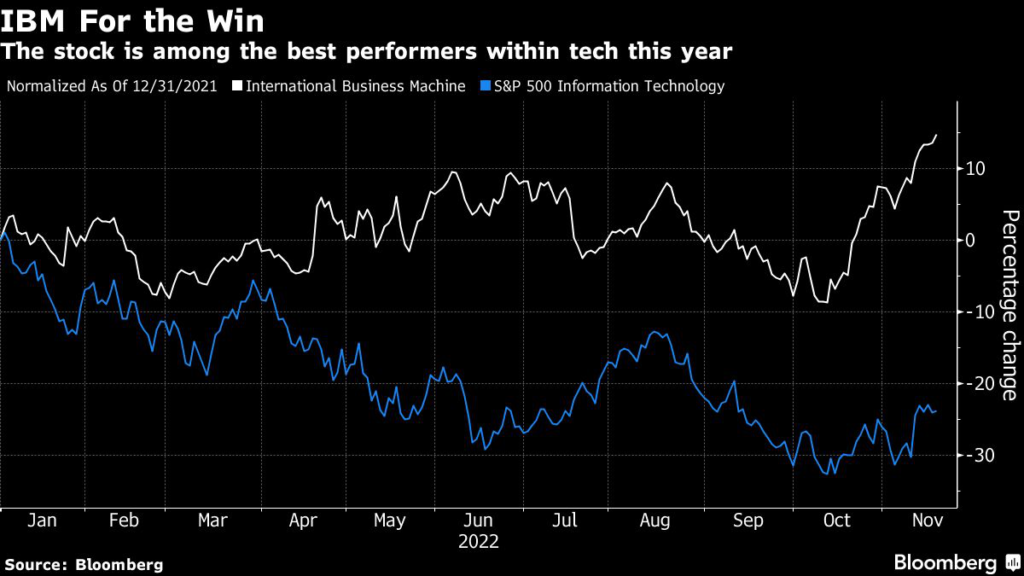
International Business Machines Corp. is a bright spot in tech this year, easily outperforming the overall sector as investors rotate into companies with consistent earnings and strong dividend yields. The stock has rallied six straight days, closing Thursday ats its highest since February 2020. IBM has returned 15% this year including dividends, compared with a 24% loss for the S&P 500 tech sector, with recent gains coming in the wake of strong results. On Thursday, IBM’s CEO said that unless there’s a “catastrophic recession,” corporate spending on technology should continue to increase. 

Top Tech Stories

  • Elon Musk gave Twitter Inc. employees an ultimatum to either commit to the company’s new “hardcore” work environment or leave. Many more workers declined to sign on than he expected, potentially putting Twitter’s operations at risk, according to people familiar with the matter.
    • Musk’s $44 billion takeover of Twitter is still facing US government scrutiny over national-security concerns that his foreign partners may be able to access user data, people familiar with the matter said.
    • Musk tweeted out an upbeat message saying Twitter beat its all-time high in usage late Thursday, on a day when many employees decided to leave the company.
    • Twitter on Thursday said it was temporarily closing its offices after Musk issued employees an ultimatum: Stay with the company “working long hours at high intensity” or quit with three months’ severance pay.
  • Amazon.com Inc. Chief Executive Officer Andy Jassy said the e-commerce giant will be cutting jobs into 2023 as it adjusts to business conditions, his first public comments about the cost-reduction plans roiling Amazon since reports that it planned to wipe out about 10,000 jobs.
  • Alibaba Group Holding Ltd. shares rose after the Chinese e-commerce company unveiled a new buyback plan and suggested Covid-19 restrictions are beginning to ease enough to benefit its business.
  • Masayoshi Son is now personally on the hook for about $4.7 billion on side deals he set up at SoftBank Group Corp. to boost his compensation, after mounting losses in the company’s tech portfolio wiped out the value of his interest in the second Vision Fund.
  • Ford Motor Co. sees a prolonged shortage of mature chips that automakers need for their vehicles.
  • Adobe Inc. and Figma Inc. have received a second request for information from the US Department of Justice on Adobe’s proposed $20 billion acquisition of its startup rival, signaling stepped-up antitrust scrutiny of the purchase.

–With assistance from Subrat Patnaik, Henry Ren and Ryan Vlastelica.

(Updates to market open.)

More stories like this are available on bloomberg.com

©2022 Bloomberg L.P.
Man Group Readies Crypto Hedge Fund Despite FTX Chaos

(Bloomberg) — Man Group Plc is close to starting a dedicated cryptocurrency hedge fund, delving deeper into a market that’s reeling from the collapse of exchange operator FTX. 

The world’s largest publicly-traded hedge fund firm has been developing the strategy led by money manager Andre Rzym for months, according to people with knowledge of the matter. The firm’s computer-led trading unit AHL is planning to start the fund as soon as the end of the year, said the people, asking not to be identified because the plan is private.

Man Group already trades cryptocurrency futures within AHL and will start the dedicated fund only after assessing counterparty risks, one of the people said. Chief Executive Officer Luke Ellis said last year the firm was weighing up whether crypto strategies were scalable. 

A spokesperson for Man Group declined to comment.

The move comes as the Nov. 11 collapse of FTX and sister trading house Alameda Research continues to reverberate through the financial industry. It follows earlier high-profile implosions of crypto outfits and comes amid a painful bear market in many digital tokens.

Hedge funds including Tiger Global Management, Third Point and Altimeter Capital Management participated in funding rounds for FTX, whose liquidators have this week flagged non-existent oversight and the misuse of client funds. FTX’s demise helped send the price of Bitcoin down 23% in a week, before the digital currency recovered some ground.


Volatility like this could be good news for hedge funds such as Man Group, which try to make money in rising as well as falling markets. Man’s crypto fund is likely to be tiny compared to the $138.4 billion it ran at the end of September.

Rzym, who is a partner at Man AHL, is tasked with identifying new alternative markets and developing trading models. He has worked on the firm’s expansion into securities such as interest rate swaps, credit default swaps, cash bonds and catastrophe bonds. He has been at the firm since 2005.

More stories like this are available on bloomberg.com

©2022 Bloomberg L.P.
GameStop’s HODLers Keep Hanging On

(Bloomberg Markets) — It’s been a rough year: Global markets have lost trillions of dollars in value, and consumers are being pinched by inflation. In the face of it all, some meme-stock die-hards remain undeterred.

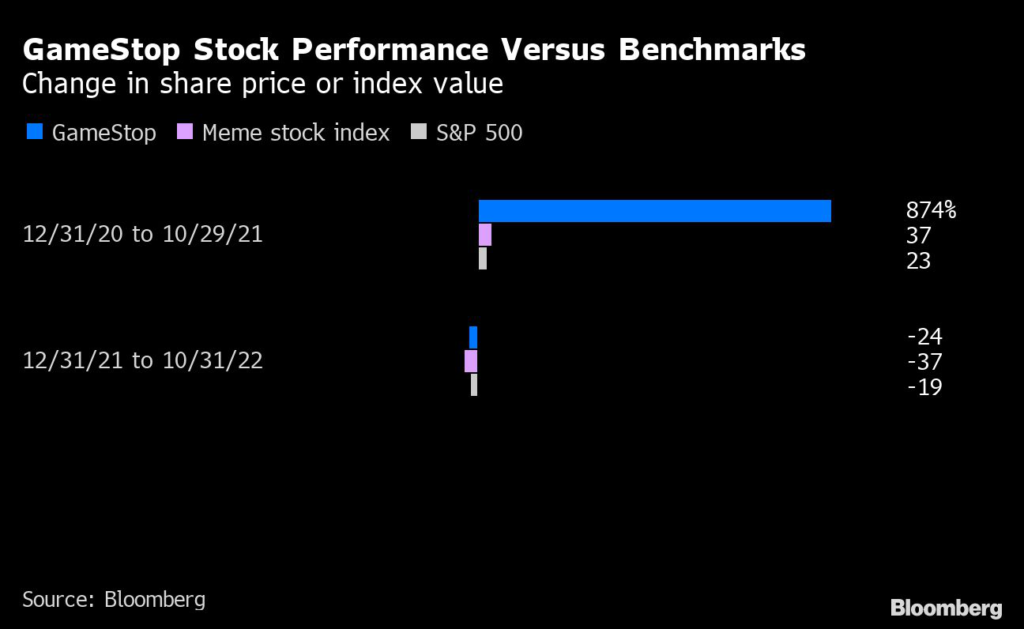
Individuals who bought GameStop Corp. early in the frenzy are still sitting on massive paper returns that outshine those of other speculative investments. Since the end of 2020, the video game retailer’s stock was up 501% as of Oct. 31, compared with the 3% rise for the benchmark S&P 500 and the 26% drop in a basket of 37 meme stocks tracked by Bloomberg.

These retail traders have embraced the motto “HODL,” or “hold on for dear life,” in a bet that the stock will see another surge even as Wall Street professionals remain skeptical, forecasting pain on the horizon. Three of the four analysts who track GameStop recommend clients sell shares—an unusually high percentage given that sell ratings generally make up less than 6% of all ratings. One particularly vocal critic is Michael Pachter at Wedbush ­Securities Inc., who notes that the company posted its first fiscal fourth-quarter loss in 2021. “Fundamentally, GameStop remains a mess,” he says.

Still, shareholders whom Pachter calls “Reddit Raiders” continue to crowd chatrooms and other social media platforms to discuss the potential windfall coming from their investment. ­Hundreds of thousands of accounts participate in Reddit threads dedicated to celebrating GameStop, while investment theories are featured in various Discord chats rife with spam, lewd memes and emoji.

Skepticism is either ignored or derided as “FUD,” an acronym for “fear, uncertainty and doubt,” or with a clown emoji. Attempts to interview dozens of online investors were met with distrust of the media that even spurred a Reddit thread of its own.

Many of the online accounts supporting GameStop say they’re in the stock because of Ryan Cohen, the founder of pet retailer Chewy Inc. who’s GameStop’s chairman and largest shareholder. The entrepreneur became an idol to amateur investors after he gained a seat on the board in January 2021. His iconic appeal was cemented by his tweets hitting back at critics, including a poop emoji with an image of a Blockbuster store (in response to comparisons of GameStop to the largely defunct movie rental franchise) and an apparent screenshot from a Pets.com television ad (a nod to those who compared Chewy to the failed pet goods retailer).

“I support Ryan Cohen, and I support what he’s done with GameStop,” says one man who would identify himself only as Daniel W., adding that he’s a 41-year-old New Yorker and that the largest position in his personal portfolio is GameStop. “Once I learned who he was and his past successes, it made me believe that he has the potential to be successful again.”

The retailer was in deep trouble before Cohen and the band of individual investors came to the rescue. Video gamers had been downloading new titles instead of visiting stores, and GameStop’s investors weren’t sure how it could support its more than $1 billion in debt and lease liabilities. Hedge funds were borrowing the stock heavily to sell it short, hoping to profit from its swoon.

Cohen set about hiring employees from Amazon.com Inc. to help with a new focus on digital sales. Frenzied stock purchases by retail traders helped fuel a short squeeze, forcing hedge funds to capitulate and buy the stock themselves at a loss. The rise in the stock price helped GameStop raise $1.67 billion from share sales, which it used to nearly wipe out its debt and invest in a marketplace for nonfungible tokens (NFTs) for gamers. That digital strategy has come at a cost: The company has lost more than $600 million since early 2021, and analysts expect the losses to continue in the coming quarters. Pachter, whose $6 price target is one of the lowest on Wall Street, says Cohen is spending too much on NFTs.

“The guy is the pied piper of retail—he’s not the Warren Buffett of retail,” he says. “I cannot explain the phenomenon of the cult of Ryan Cohen, because he’s not doing anything with GameStop.”

Cohen, who declined to comment for this story, has burned investors before. He disclosed a stake in Bed Bath & Beyond Inc. in March, triggering a buying frenzy, only to set off a stock plunge when he dumped it entirely in August and pocketed a $68.1 million profit.

“There’s an Oz-like quality to him,” says Peter Atwater, an adjunct professor of economics at William & Mary, a university in Williamsburg, Virginia. “Those mystics have an aura and an appeal all to themselves, because you can create whatever fantasy story you want to support that appeal.”

Since the start of 2021, individual investors have purchased over $768 million worth of GameStop, more than eight times the amount they bought in the three years prior, according to data compiled by Vanda Research. The bulk of the initial gains has been wiped out, erasing more than $16 billion in market value from a January 2021 peak.

“I don’t want to sell,” says Daniel. “There’s no fear on my end to hold through the storm that we’re in or that’s coming. I’m going to hold as long as I can financially hold.”

That sums up the mentality of the remaining investors who clutch the stock with their diamond hands and us-versus-them ethos: You can only lose money on an investment if you sell it.

Lipschultz covers equity markets for Bloomberg News in New York.

More stories like this are available on bloomberg.com

©2022 Bloomberg L.P.
Close Bitnami banner
Bitnami