Bloomberg

Fiat Has Nothing to Lose With Electric 500’s Surprise Second Act

(Bloomberg) —

This week, Fiat announced something surprising: The Italian auto brand will bring the electric version of its stylish city car back to the US, several years after pulling it off the market.

The return of the Fiat 500e is a bit of a head-scratcher. Americans like super sized, after all, with trucks and sport utility vehicles making up almost 80% of new-car sales last month. The cute little cinquecento might be good for navigating medieval alleyways in Europe, but driving on the highway in one between giant pickups and three-row SUVs can make one feel a little vulnerable.

Olivier Francois, the global head of the Fiat brand, is undaunted. He showed off three concept versions of the electric 500 at the Los Angeles auto show on Thursday, and said the model will make its way back to US showrooms in 2024.

This is just the latest twist in an already fascinating history for Fiat and the 500 in the US. Sergio Marchionne, the larger-than-life CEO who passed away suddenly in 2018, brought the brand and car back to America over a decade ago as part of a deal with then-President Barack Obama.

Marchionne used his master negotiating skills to persuade the Obama administration during the financial crisis to let Fiat take Chrysler out of bankruptcy without having to pay a dime for its initial 20% ownership stake. What Fiat brought to the table were platforms and powertrains for competitive small cars that Chrysler lacked (Obama famously asked why Detroit’s ailing automakers couldn’t make a Corolla.)

The Fiat 500 debuted in 2011 with a splashy ad campaign featuring Jennifer Lopez. The battery-powered version that followed ensured Chrysler could keep selling its lucrative Jeep SUVs and Ram pickups in states led by California that set stricter emissions rules.

Sales never lived up to expectations. The ever-candid Marchionne once lamented he lost as much as $20,000 on each electric 500 he sold and asked consumers not to buy it. He said soon after Fiat returned to the US that it had taken for granted how difficult succeeding in the highly competitive American market would be.

“We thought we were going to show up and just because of the fact people like gelato and pasta, people would buy it,” he said at the Detroit auto show in 2012. “This is nonsense.”

Unlike last time around, the 500e won’t be produced in North America. Stellantis will import it from Fiat’s electric vehicle hub in Turin, Italy.

The car is a success in Europe, ranking as the third best-seller this year through September. It sells for about €22,000 ($22,800) after incentives and offers 150 miles of battery range.

I asked Francois if this was Fiat’s attempt to offer an EV to the masses, something Stellantis CEO Carlos Tavares often says is direly needed.

Francois suggested Fiat is bringing the car back to the US as a sort of guinea pig: an experimental vessel to explore new business models, use cases and forms of ownership.

“The real return on investment of this project is learning, intel,” he told me. “We have nothing to lose and everything to win.”

Although Francois didn’t mention it, the Fiat 500 would work well with Stellantis’ Free2Move, the car-sharing and subscription business it’s been operating since 2016. While other automakers have bailed on car-sharing as a money-losing endeavor, Stellantis has been uniquely bullish, claiming it’s cracked the code to operating profitably.

Car-sharing works best in dense urban centers, which is precisely where Francois plans to market the new 500e. It’s an obvious fit.

More stories like this are available on bloomberg.com

©2022 Bloomberg L.P.

Fired by Musk or Zuckerberg? The Old Economy Welcomes You

(Bloomberg) — As Meta Platforms Inc., Twitter Inc. and other leaders of the new economy embark on an unprecedented round of firings, the stalwarts of the old economy are waiting with open arms.

Luxury carmaker Jaguar Land Rover said Friday it wants to hire about 800 technology workers to power its growth in fields ranging from autonomous driving to artificial intelligence, electrification and machine learning. 

British lender Barclays Plc is offering support for laid-off workers looking to start new fintech businesses and hopes to fill some of its thousands of technology job vacancies. 

“I’m a firm believer that when one door closes, another one opens and out of adversity can come opportunity,” Mark Ashton-Rigby, Barclays’ chief operating officer, wrote in a LinkedIn post this week. 

Some of the world’s biggest technology firms have begun firing thousands of employees in recent weeks, putting an abrupt end to more than a decade of rapid jobs growth. Bloomberg has reported that Amazon.com Inc. is cutting 10,000 positions, while Meta, led by Mark Zuckerberg, has said it’s making 11,000 employees redundant. At Twitter, at least 3,700 jobs are being cut, or about half the social media company’s workforce, under new owner Elon Musk.

Ashton-Rigby wrote that Barclays was extending its program for aspiring entrepreneurs, which provides a 20-week course to help them create their own fintech companies. Barclays has more than 3,000 open roles for technology staff around the world in areas such as engineering and innovation.

“If you’re embarking on a new chapter and are reading this, take it as a sign that there could be something very exciting for you just around the corner… apply today,” he wrote.

JLR, owned by India’s Tata Motors Ltd., said the tech workers it’s looking to recruit have skills that are essential to develop and build the carmaker’s next-generation of electric cars. It’s looking to hire across the UK, US, Ireland, India, China and Hungary.

More stories like this are available on bloomberg.com

©2022 Bloomberg L.P.

SandboxAQ Wins Pentagon Contract to Probe Quantum Threats

(Bloomberg) — SandboxAQ, a Google software spinoff focused on defending against the future threat of quantum code-cracking, has won its first contract with the US Department of Defense.

The company is due to announce later on Friday it started working with the US Air Force earlier this month. SandboxAQ under the deal will assess existing encryption and determine where software upgrades could help defend against hypothetical attacks from quantum technology. The company declined to disclose the financial terms of the contract.

The deal marks the first commercial award in what’s likely to be a decades-long process of US federal agencies upgrading their systems ahead  of the potential onset of quantum computing, a nascent technology that’s not yet operationally viable. The technology could break the encryption protocols currently in wide use, according to the US government and others.

Chief Executive Officer Jack Hidary told Bloomberg News ahead of the announcement the deal was “significant” not for its value but because it showed his company had met regulatory and due diligence hurdles required to work with the Department of Defense. SandboxAQ also has two other contracts with federal agencies that have yet to be disclosed, he said. 

The initial study will last 90 days, with potential for longer follow-on efforts, said Jen Sovada, president of public sector at SandboxAQ.

The Biden administration tasked national security systems in January to make plans to shift to so-called quantum-resistant cryptography. In May, the White House unveiled a broader plan to switch the entire US economy to quantum-resistant cryptography as much “as is feasible” by 2035.

That plan relies on work from the National Institute of Standards and Technology, which in July selected four algorithms intended to resist quantum code-cracking following a six-year global competition. SandboxAQ is creating software platforms that can plug in those new algorithms, which are due to be standardized in 2024 for widespread use.

The US government has repeatedly warned that foreign adversaries may have stockpiled encrypted stolen data en masse, and that they could use quantum computers to access that information in the event that technology comes to fruition.

An estimated 20 billion digital devices need to be upgraded or replaced in the next 20 years to accommodate new quantum-resistant algorithms, according to the World Economic Forum. 

The US Air Force did not immediately respond to a request for comment. 

More stories like this are available on bloomberg.com

©2022 Bloomberg L.P.

Stock Market Bulls Return as Fed Messages Digested: Markets Wrap

(Bloomberg) — US index futures pointed to a higher open on Wall Street and European shares rebounded after two days of losses triggered by Federal Reserve signals that interest rates would continue to rise for a while yet. 

Contracts on the US S&P 500 index added 0.7%, pointing to a recovery for the index which has slid more than 1% this week. Futures on the Nasdaq 100 surged 0.9%. In the premarket, chip equipment maker Applied Materials rose 4.4% after issuing a forecast-topping sales forecast. A host of tech names, including chipmakers Nvidia Corp. Meta Platforms Inc. and Amazon.com Inc., also gained. 

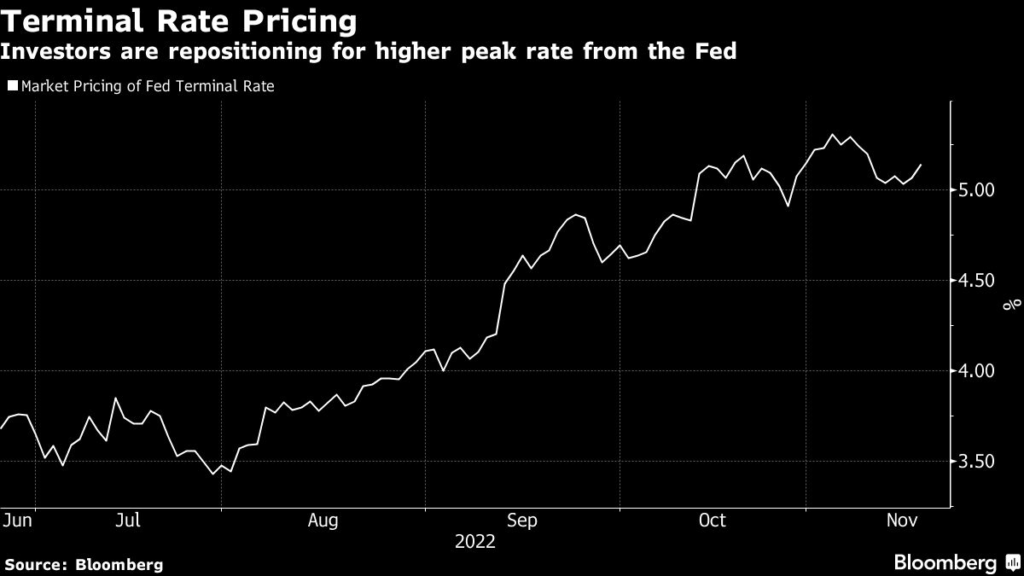
The moves come a day after shares were knocked sharply lower by hawkish comments from St. Louis Fed President James Bullard, who said interest rates needed to rise at least to 5%-5.25% to curb inflation. His comments prompted markets to dial up their expectations for how high US rates might go. 

The dollar steadied after surging in the wake of Bullard’s comments, while Treasury yields inched higher. But Bullard is only the latest policymaker to warn markets that while inflation appears to be easing off multi-decade highs, policy needs to be tightened further to tame price pressures. 

However, some investors said hawkish commentary did not necessarily mean rates would peak at higher levels than previously thought.

“The Fed wants to ensure their job is not getting undone, the language is still robust and that there’s still a coordinated effort from board members to push on the hawkish button,” James Athey, investment director at Abrdn Investment Management Ltd., told Bloomberg Television. “That doesn’t mean the destination is necessarily a higher rate than where markets thought a week or two ago. I think they’re just trying to downplay investor’s spirits a bit.”

Fears are mounting though, that relentlessly rising rates will hit economic growth, with a critical segment of the Treasury yield curve at the most steeply inverted in four decades — historically such an inversion has flagged recession in the world’s largest economy. Growth-sensitive copper and oil prices were poised for weekly losses, pressured by concerns over a worsening demand outlook. 

Analysts at Bank of America Corp. warned that with a Fed policy pivot likely only in June or July, rate hikes and company earnings could prove a headwind to stocks. While investment inflows into equity funds swelled last week — lured by signs of a US inflation slowdown — “a fair chunk of the bear market rally is behind us,” they wrote. 

Europe’s Stoxx index rose about 1%, led by energy, banking and utilities, and is now on track to extend a four-week rising streak  

Earlier, Hong Kong’s benchmark Hang Seng Index enjoyed a third straight week of gains, thanks to China’s steps to support the property sector and ease Covid restrictions. On Friday, the benchmark’s tech gauge touched a two-month high, led by Alibaba, which missed second-quarter revenues but upsized share buybacks.

Bitcoin was on course for a weekly gain even as the collapse of Sam Bankman-Fried’s FTX empire continues to rattle the crypto market.  


Key events this week:

  • US Conference Board leading index, existing home sales, Friday

Some of the main moves in markets:

Stocks

  • Futures on the S&P 500 rose 0.7% as of 7:45 a.m. New York time
  • Futures on the Nasdaq 100 rose 0.9%
  • Futures on the Dow Jones Industrial Average rose 0.5%
  • The Stoxx Europe 600 rose 1%
  • The MSCI World index rose 0.3%

Currencies

  • The Bloomberg Dollar Spot Index was little changed
  • The euro was little changed at $1.0371
  • The British pound rose 0.5% to $1.1921
  • The Japanese yen rose 0.1% to 139.99 per dollar

Cryptocurrencies

  • Bitcoin rose 0.5% to $16,757.3
  • Ether rose 1% to $1,217.66

Bonds

  • The yield on 10-year Treasuries advanced three basis points to 3.79%
  • Germany’s 10-year yield advanced three basis points to 2.05%
  • Britain’s 10-year yield advanced six basis points to 3.26%

Commodities

  • West Texas Intermediate crude fell 1.2% to $80.65 a barrel
  • Gold futures were little changed

This story was produced with the assistance of Bloomberg Automation.

–With assistance from Tassia Sipahutar.

More stories like this are available on bloomberg.com

©2022 Bloomberg L.P.

Crypto Whistleblowers in Line for Multimillion-Dollar Payouts

(Bloomberg) — A CFTC commissioner has urged crypto industry whistleblowers to come forward in the aftermath of FTX Group’s implosion, saying tipsters have previously received millions of dollars for their help. 

Commodity Futures Trading Commission’s Kristin Johnson said on Thursday that informants would get anonymity, adding that such tips play a crucial role in enforcement given the opaqueness of some of the crypto world. 

“In the context of the digital-asset space, the value of having those vocal whistleblowers and tipsters is critical,” Johnson said in an interview on the sidelines of a City & Financial Global conference in London, adding that crypto frauds can be “heartbreaking.” When it comes to payments to people who contribute to the CFTC’s ability to identify, investigate and prosecute cases, “the numbers are very big,” she said. 

Under the CFTC’s rules, whistleblowers can get awards worth between 10% and 30% of the money the agency collects in penalties from a case. The regulator awarded nearly $200 million to a single unidentified whistleblower in the 2022 fiscal year, the largest amount granted under the Dodd-Frank Act by the CFTC or Securities and Exchange Commission, the regulator said in a statement last month.

Johnson added that the appeal was intended “very broadly” and not just for FTX. “All we can do is put out the call because if someone is allowed to get away with it having done it once they will do it again.”

US regulators are investigating whether FTX.com mishandled customer funds, and they’re looking into the firm’s relationships with other parts of Sam Bankman-Fried’s crypto empire. The inquiries by the SEC and the CFTC relate to the liquidity crisis that has pushed FTX to the brink, Bloomberg News reported last week.

Advisers overseeing the ruins of FTX have laid bare a stunning list of allegations against the company’s former leadership, slamming non-existent oversight and the misuse of client funds as they struggle to locate billions of dollars in missing assets.

Johnson suggested that lawmakers should expand the jurisdiction of the CFTC to cover the spot market, and to make sure it can act if its believes that US customers or markets could be affected by activity on a platform outside the US. 

“It is ever more critical that we are vigilantly closing those regulatory gaps, tightening and weaving together the spaces where actors might act in the shadows,” she said.

–With assistance from Allyson Versprille and Ben Bain.

More stories like this are available on bloomberg.com

©2022 Bloomberg L.P.

Ukrainians Endure Widespread Blackouts After Russia’s Attacks

(Bloomberg) — Ukraine is approaching the winter months with blackouts spreading across the country, as Russia’s missile campaign pummels power stations, grid networks and other civilian facilities.

More than 10 million Ukrainians — about a quarter of the pre-war population — are without electricity, President Volodymyr Zelenskiy said in his overnight address Thursday, as the first snow fell in the capital Kyiv. 

“We’re doing everything to stabilize supply,” the Ukrainian leader said. The majority of the outages are affecting the region around Kyiv in central Ukraine, the western region of Vinnytsia, the area around the Black Sea port of Odesa in the south and the Sumy region in the north, he said.

Millions of Ukrainians have fled the country since Russia invaded in February. Some officials have encouraged them to stay abroad to reduce the strain on Ukraine’s infrastructure. Others have called for patience — or to relocate from large cities to suburbs or the countryside. 

Multiple emergency blackouts this week hit Kyiv with the heaviest power shortage since the war started, local grid company Yasno said. Temperatures in the capital are expected to plunge to minus 6 degrees Celsius (21 degrees Fahrenheit) on Sunday. 

On Tuesday, Russia launched the most severe air attack since the invasion began, and the onslaught has continued with crucial infrastructure facilities hit in the country’s east and south, including Odesa. 

Parts of Ukraine may be without electricity for days, and once restored, power may be available only for two to three hours a day, DTEK Energy Chief Executive Officer Dmytro Sakharuk said Thursday on national television. Repairs are increasingly difficult as critical facilities are destroyed. 

The Kremlin is deliberately targeting Ukraine’s energy infrastructure in an attempt to break the resistance of the Ukrainian people as Russian troops suffer painful setbacks on the battlefield. Moscow this month ordered a retreat from the southern city of Kherson, the only regional center seized during the war. 

Ruslan Martsinkiv, the mayor of Ivano-Frankivsk, a western Ukrainian town about 130 kilometers (80 miles) south of Lviv, urged residents to find shelter in the country or at private homes. 

“Someone may have relatives or friends there — it will be very difficult to survive in apartment buildings,” he said in a radio interview Thursday. “One needs to brace for the worst, since there will be no light for days, not just hours.”

The damage inflicted on Kherson’s energy infrastructure by the withdrawing Russian troops is estimated at as much as 2 billion hryvnia ($54 million), according to Volodymyr Hetmanov, CEO of VS Energy International Ukraine, which manages the local power grid. It’ll take up to three weeks to restore electricity in the city after infrastructure was completely destroyed, Hetmanov said in a statement. 

Ukraine’s businesses and households are grappling with limited electricity, heating and Internet access with greater demand for fuel generators, power chargers and SpaceX’s Starlink satellite network. In the month to Nov. 10, sales of diesel generators in the country’s largest home improvement chain soared tenfold, according to news wire Interfax Ukraine. 

More stories like this are available on bloomberg.com

©2022 Bloomberg L.P.

Ukrainian Blackouts Grow More Dire as Russia Steps Up Attacks

(Bloomberg) — Ukraine is approaching the winter months with blackouts spreading across the country, as Russia’s missile campaign pummels power stations, grid networks and other civilian facilities.

More than 10 million Ukrainians — about a quarter of the pre-war population — are without electricity, President Volodymyr Zelenskiy said in his overnight address Thursday, as the first snow fell in the capital Kyiv. 

“We’re doing everything to stabilize supply,” the Ukrainian leader said. The majority of the outages are affecting the region around Kyiv in central Ukraine, the western region of Vinnytsia, the area around the Black Sea port of Odesa in the south and the Sumy region in the north, he said.

Millions of Ukrainians have fled the country since Russia invaded in February. Some officials have encouraged them to stay abroad to reduce the strain on Ukraine’s infrastructure. Others have called for patience — or to relocate from large cities to suburbs or the countryside. 

Multiple emergency blackouts this week hit Kyiv with the heaviest power shortage since the war started, local grid company Yasno said. Temperatures in the capital are expected to plunge to minus 6 degrees Celsius (21 degrees Fahrenheit) on Sunday. 

On Tuesday, Russia launched the most severe air attack since the invasion began, and the onslaught has continued with crucial infrastructure facilities hit in the country’s east and south, including Odesa. 

Parts of Ukraine may be without electricity for days, and once restored, power may be available only for two to three hours a day, DTEK Energy Chief Executive Officer Dmytro Sakharuk said Thursday on national television. Repairs are increasingly difficult as critical facilities are destroyed. 

The Kremlin is deliberately targeting Ukraine’s energy infrastructure in an attempt to break the resistance of the Ukrainian people as Russian troops suffer painful setbacks on the battlefield. Moscow this month ordered a retreat from the southern city of Kherson, the only regional center seized during the war. 

Ruslan Martsinkiv, the mayor of Ivano-Frankivsk, a western Ukrainian town about 130 kilometers (80 miles) south of Lviv, urged residents to find shelter in the country or at private homes. 

“Someone may have relatives or friends there — it will be very difficult to survive in apartment buildings,” he said in a radio interview Thursday. “One needs to brace for the worst, since there will be no light for days, not just hours.”

The damage inflicted on Kherson’s energy infrastructure by the withdrawing Russian troops is estimated at as much as 2 billion hryvnia ($54 million), according to Volodymyr Hetmanov, CEO of VS Energy International Ukraine, which manages the local power grid. It’ll take up to three weeks to restore electricity in the city after infrastructure was completely destroyed, Hetmanov said in a statement. 

Ukraine’s businesses and households are grappling with limited electricity, heating and Internet access with greater demand for fuel generators, power chargers and SpaceX’s Starlink satellite network. In the month to Nov. 10, sales of diesel generators in the country’s largest home improvement chain soared tenfold, according to news wire Interfax Ukraine. 

More stories like this are available on bloomberg.com

©2022 Bloomberg L.P.

How an Industry Built on Pollution Is Getting a Tiny Bit Greener

(Bloomberg) — The amount of time between aircraft as they land at Toronto Pearson International Airport might seem prosaic to the untrained eye, but there’s a lot more going on than a pilot negotiating the gentle return to earth of hundreds of tons of metal. Every millisecond that passes is tied to a new technology touted as a partial solution to two intractable problems (albeit of wildly divergent importance).

We’re of course talking about airport delays and global warming.

A technology called Intelligent Approach (IA) is constantly working to tighten the space between incoming aircraft as they approach Pearson. It’s one of a number of new systems aimed at chipping away at the carbon footprint of an inherently dirty industry: commercial aviation.

Aircraft that rely on jet fuel aren’t going away anytime soon. While biofuels are slowly growing in use, scaling them to make a major dent in airplane emissions is arguably a long way off. And the battery technology necessary to even consider electric airliners is much more elusive. So commercial aviation says it’s looking to lop off emissions where it can—from the routes aircraft take to the time they spend circling airports, sitting on the tarmac or idling at the gate. All of that time wastes fuel and spews carbon dioxide into the atmosphere.

But while it may seem like any cut in emissions is a good thing, that may not be the case. Critics worry such technologies are a kind of airline greenwashing, inviting consumers to feel less guilty about air travel when they still should. Worse, there are fears these efforts might distract from the real solution.

“For the longest time, aviation as a sector has managed emissions by spreading discourses that, at some point in the future, the issues will be resolved,” says Stefan Gössling, a professor of tourism research at Linnaeus University in Växjö, Sweden. “[But] we have not come any closer to a break in emissions.” Airlines “all know that if they engage with the real issue, which is new fuels, they simply couldn’t afford it.”

Carbon emissions from aviation make up more than 2% of the global total. And because passengers, flights and distances are all increasing, it’s one of the fastest-growing sources of greenhouse gasses. All of this has put more pressure on airlines and airports to decarbonize.

Which brings us back to chipping away at the margins.

IA began as a collaborative effort between airports, air navigation service providers and airlines. When in 2014 researchers showed runway capacity could be increased by using flexible, time-based separations of approaching aircraft as opposed to fixed distances, the idea was born. In 2015, air navigation service provider NATS and technology provider Leidos teamed up to develop the software, first testing it at London Heathrow Airport.

The makers of IA say its mission is to land planes with more frequency and minimize delays, thus reducing fuel burn. It addresses part of a complex aviation puzzle made up of hundreds of operations across arrivals, departures and surface traffic, all of which can cause delays and thus more fuel to be burned.

Since many problems arise when filling an aircraft with fuel, food, luggage and people, or taxiing to and from the runway, there’s always uncertainty in flight schedules; something as simple as a passenger with a dog too big for its carrier can have knock-on effects. While airlines factor this in by adding buffers to flight times, it doesn’t always help: Around 20% of flights are delayed or cancelled each year. The financial impact spreads through the economy as lost time, money and opportunity—for airlines, passengers and companies. But its effect on the environment is worse: backlogs force aircraft to stack up overhead or linger in the taxiways—with their engines on.

“We can ensure that each aircraft lands as close as possible to its arrival time”

For its part, IA’s methodology is pretty straightforward. It takes into account the aircraft type and current weather conditions to calculate the minimum separation between two incoming aircraft. This involves predicting the “compression” that occurs between each pair of aircraft as the lead plane decelerates to its landing speed.

At most airports, the distance between aircraft A, as it makes its final approach, and aircraft B, next in line, is determined by aircraft size. The larger A is, the more turbulence it creates; the larger B is, the more turbulence it can handle. If you have an Airbus A380 with four jet engines followed by a small Beechcraft King Air, the separation needs to be large.

But this fails to account for variables such as wind speed and direction. It doesn’t acknowledge, for instance, that in a headwind the wake behind aircraft A dissipates faster, allowing for a smaller separation. Using radar and aircraft flight data, IA monitors aircraft as they begin their approach. On a calm day, A and B might need to be kept apart by three nautical miles (3.45 statute miles), but in a headwind that can be reduced to around 2.7 nautical miles.

Now in active use at Heathrow, IA enables up to two additional landings per hour in calm conditions and reduces circling time by around 4,784 hours each year, airport officials say. In doing so, it’s saving an estimated 14,442 tons of fuel consumption, or 46,000 tons of CO2.

“If we can deliver close to the same landing rate on a windy day as we can on a calm day, then we can ensure that each aircraft lands as close as possible to its arrival time,” explains Ben Sandford, one of IA’s Product Managers.

There is a dirty irony here. Using IA, airlines and airports can maximize their capacity for a fraction of the cost of building another runway. This means more planes can fly, burning more fuel and adding more greenhouse gases to the atmosphere. Nonetheless, Pearson joined Heathrow as a user of IA this year, and Amsterdam’s Schiphol Airport is to join them in 2023. 

At four other airports in Europe, Asia and the Middle East, officials have turned to IntellAct, an Israeli startup that uses CCTV to detect delays caused by cleaning, refueling and restocking of airplanes. Should IntellAct detect any one of these processes is taking too long, it suggests a workaround. If the fuel truck is behind schedule, for instance, IntellAct will recommend refueling take place while boarding passengers.

“A lot of delays can be mitigated with better planning and better communications,” says founder Udi Segall. “If airlines are reacting in real-time, then it’s already too slow.”

But it’s not just private enterprise that’s getting into the act. The Federal Aviation Administration is installing software developed by NASA that coordinates schedules of all airport departures. 

When a plane is ready to leave, pilots use its engines to taxi toward the runway. Because jet engines aren’t optimized for ground use, the fuel used on the ground is substantial. During a standard 15-minute taxi, a Boeing 747 can burn more than a ton of it. So rather than have planes line up in a physical queue, NASA’s Airspace Technology Demonstration 2 (ATD-2) software creates a virtual line, such that time normally spent burning fuel on the taxiway is spent at the gate, engines off.

“We can ensure that each aircraft lands as close as possible to its arrival time”

ATD-2 was first tested at Charlotte-Douglas International Airport in North Carolina. Over four years there, NASA says the software saved almost 6,000 hours of engine-run time, and as much or more than 1 million gallons of fuel. These savings were compounded by a reduction in engine maintenance costs. It also reduced flight delays by 933.6 hours and saved an estimated $4.5 million in value of time.

The system went live at Cleveland Hopkins International Airport last month, with the FAA saying it “will continue activations at dozens more airports in the coming months and years.”

More than 25 airlines have also turned to WheelTug, a device built into the nose-wheel to allow aircraft to push away from the gate without the need for a traditional tug powered by fossil fuels. Not only does it save between six and nine minutes of time per flight, but it can add around two extra flights per gate, according to tests performed at Mumbai International Airport.

But the biggest savings in commercial aviation emissions come from flight. There, too, companies are nibbling around the edges.

Last year, Alaska Airlines signed up with Airspace Intelligence, a Silicon Valley startup whose Flyways platform enables dispatchers to optimize routes between origin and destination. Controllers can use the software to more accurately incorporate weather, traffic volume and airspace constraints into their decisions.

Traditionally, a controller files the proposed route with a regulator around 45 minutes before take off, basing it on what the airspace is like at that particular moment. In some territories, flight paths are tightly prescribed, but in US airspace it’s generally open. The goal is normally to get the flight there as quickly as possible.

What Flyways does is evaluate a trajectory based on what the airspace is going to be like when the aircraft is flying through it. If, for example, a storm is forecast over New York when the aircraft will be there, the platform might avoid it. It will also optimize the route according to the wind direction, saving fuel.

The recommendation also takes into account surrounding air traffic, seeking to ensure not that the flight arrives early, but that it arrives at a time likely to cause the fewest delays in the wider aviation network.

“What is most valuable to an airline is not how fast a flight arrives, but that it arrives in a reliable way,” says Phillip Buckendorf, co-founder of Airspace Intelligence. In 12 months with Flyways, Alaska Airlines says it has saved an average of 2.7 minutes per flight and more than 6,500 tons of CO2 compared to flights not using the technology. That’s the equivalent of more than 17 million miles driven by an average gasoline-powered passenger vehicle.

But Gössling urges caution about relying on these technologies to meaningfully erode aviation’s ballooning environmental impact. They address the least harmful phases of the flight: taxiing, takeoff, approach and landing. At best, he estimates, efficient routing will reduce total emissions by 10%, and eradicating holding patterns will remove around 1%.

Indeed, he says their purported benefits extend no further than local air pollution, because any wider gains are erased by growing passenger numbers, which are forecast to double before 2037. Instead of focusing on reducing the taxi times and separation between incoming flights, the focus should be on minimizing emissions when aircraft are in full flight, Gössling says.

As admirable as they may be in a vacuum, these new platforms will promote a net increase in aviation emissions because they make flying more efficient and attractive, he warns. “We are talking about the most energy intensive form of consumption.” Gössling says. “None of these technologies, even in combination, will cut emissions from aviation to the necessary amount if the sector continues to grow.”

More stories like this are available on bloomberg.com

©2022 Bloomberg L.P.

How an Industry Built on Pollution Is Getting a Tiny Bit Greener—and Faster

(Bloomberg) — The amount of time between aircraft as they land at Toronto Pearson International Airport might seem prosaic to the untrained eye, but there’s a lot more going on than pilots negotiating the gentle return to earth of hundreds of tons of metal.

Every millisecond that passes is tied to a new technology touted as a partial solution to two intractable problems (albeit of wildly divergent importance).

We’re of course talking about airport delays and global warming.

A technology called Intelligent Approach (IA) is constantly working to tighten the space between incoming aircraft as they approach Pearson. It’s one of a number of new systems aimed at chipping away at the carbon footprint of an inherently dirty industry: commercial aviation.

Aircraft that rely on jet fuel aren’t going away anytime soon. While biofuels are slowly growing in use, scaling them to make a major dent in airplane emissions is arguably a long way off. And the battery technology necessary to even consider electric airliners is much more elusive. So commercial aviation says it’s looking to lop off emissions where it can—from the routes aircraft take to the time they spend circling airports, sitting on the tarmac or idling at the gate. All of that time wastes fuel and spews carbon dioxide into the atmosphere.

But while it may seem like any cut in emissions is a good thing, that may not be the case. Critics worry such technologies are a kind of airline greenwashing, inviting consumers to feel less guilty about air travel when they still should. Worse, there are fears these efforts might distract from the real solution.

“For the longest time, aviation as a sector has managed emissions by spreading discourses that, at some point in the future, the issues will be resolved,” says Stefan Gössling, a professor of tourism research at Linnaeus University in Växjö, Sweden. “[But] we have not come any closer to a break in emissions.” Airlines “all know that if they engage with the real issue, which is new fuels, they simply couldn’t afford it.”

Carbon emissions from aviation make up more than 2% of the global total. And because passengers, flights and distances are all increasing, it’s one of the fastest-growing sources of greenhouse gasses. All of this has put more pressure on airlines and airports to decarbonize.

Which brings us back to chipping away at the margins.

IA began as a collaborative effort between airports, air navigation service providers and airlines. When in 2014 researchers showed runway capacity could be increased by using flexible, time-based separations of approaching aircraft as opposed to fixed distances, the idea was born. In 2015, air navigation service provider NATS and technology provider Leidos teamed up to develop the software, first testing it at London Heathrow Airport.

The makers of IA say its mission is to land planes with more frequency and minimize delays, thus reducing fuel burn. It addresses part of a complex aviation puzzle made up of hundreds of operations across arrivals, departures and surface traffic, all of which can cause delays and thus more fuel to be burned.

Since many problems arise when filling an aircraft with fuel, food, luggage and people, or taxiing to and from the runway, there’s always uncertainty in flight schedules; something as simple as a passenger with a dog too big for its carrier can have knock-on effects. While airlines factor this in by adding buffers to flight times, it doesn’t always help: Around 20% of flights are delayed or cancelled each year. The financial impact spreads through the economy as lost time, money and opportunity—for airlines, passengers and companies. But its effect on the environment is worse: backlogs force aircraft to stack up overhead or linger in the taxiways—with their engines on.

“We can ensure that each aircraft lands as close as possible to its arrival time”

For its part, IA’s methodology is pretty straightforward. It takes into account the aircraft type and current weather conditions to calculate the minimum separation between two incoming aircraft. This involves predicting the “compression” that occurs between each pair of aircraft as the lead plane decelerates to its landing speed.

At most airports, the distance between aircraft A, as it makes its final approach, and aircraft B, next in line, is determined by aircraft size. The larger A is, the more turbulence it creates; the larger B is, the more turbulence it can handle. If you have an Airbus A380 with four jet engines followed by a small Beechcraft King Air, the separation needs to be large.

But this fails to account for variables such as wind speed and direction. It doesn’t acknowledge, for instance, that in a headwind the wake behind aircraft A dissipates faster, allowing for a smaller separation. Using radar and aircraft flight data, IA monitors aircraft as they begin their approach. On a calm day, A and B might need to be kept apart by three nautical miles (3.45 statute miles), but in a headwind that can be reduced to around 2.7 nautical miles.

Now in active use at Heathrow, IA enables up to two additional landings per hour in calm conditions and reduces circling time by around 4,784 hours each year, airport officials say. In doing so, it’s saving an estimated 14,442 tons of fuel consumption, or 46,000 tons of CO2.

“If we can deliver close to the same landing rate on a windy day as we can on a calm day, then we can ensure that each aircraft lands as close as possible to its arrival time,” explains Ben Sandford, one of IA’s Product Managers.

There is a dirty irony here. Using IA, airlines and airports can maximize their capacity for a fraction of the cost of building another runway. This means more planes can fly, burning more fuel and adding more greenhouse gases to the atmosphere. Nonetheless, Pearson joined Heathrow as a user of IA this year, and Amsterdam’s Schiphol Airport is to join them in 2023. 

At four other airports in Europe, Asia and the Middle East, officials have turned to IntellAct, an Israeli startup that uses CCTV to detect delays caused by cleaning, refueling and restocking of airplanes. Should IntellAct detect any one of these processes is taking too long, it suggests a workaround. If the fuel truck is behind schedule, for instance, IntellAct will recommend refueling take place while boarding passengers.

“A lot of delays can be mitigated with better planning and better communications,” says founder Udi Segall. “If airlines are reacting in real-time, then it’s already too slow.”

But it’s not just private enterprise that’s getting into the act. The Federal Aviation Administration is installing software developed by NASA that coordinates schedules of all airport departures. 

When a plane is ready to leave, pilots use its engines to taxi toward the runway. Because jet engines aren’t optimized for ground use, the fuel used on the ground is substantial. During a standard 15-minute taxi, a Boeing 747 can burn more than a ton of it. So rather than have planes line up in a physical queue, NASA’s Airspace Technology Demonstration 2 (ATD-2) software creates a virtual line, such that time normally spent burning fuel on the taxiway is spent at the gate, engines off.

“We can ensure that each aircraft lands as close as possible to its arrival time”

ATD-2 was first tested at Charlotte-Douglas International Airport in North Carolina. Over four years there, NASA says the software saved almost 6,000 hours of engine-run time, and as much or more than 1 million gallons of fuel. These savings were compounded by a reduction in engine maintenance costs. It also reduced flight delays by 933.6 hours and saved an estimated $4.5 million in value of time.

The system went live at Cleveland Hopkins International Airport last month, with the FAA saying it “will continue activations at dozens more airports in the coming months and years.”

More than 25 airlines have also turned to WheelTug, a device built into the nose-wheel to allow aircraft to push away from the gate without the need for a traditional tug powered by fossil fuels. Not only does it save between six and nine minutes of time per flight, but it can add around two extra flights per gate, according to tests performed at Mumbai International Airport.

But the biggest savings in commercial aviation emissions come from flight. There, too, companies are nibbling around the edges.

Last year, Alaska Airlines signed up with Airspace Intelligence, a Silicon Valley startup whose Flyways platform enables dispatchers to optimize routes between origin and destination. Controllers can use the software to more accurately incorporate weather, traffic volume and airspace constraints into their decisions.

Traditionally, a controller files the proposed route with a regulator around 45 minutes before take off, basing it on what the airspace is like at that particular moment. In some territories, flight paths are tightly prescribed, but in US airspace it’s generally open. The goal is normally to get the flight there as quickly as possible.

What Flyways does is evaluate a trajectory based on what the airspace is going to be like when the aircraft is flying through it. If, for example, a storm is forecast over New York when the aircraft will be there, the platform might avoid it. It will also optimize the route according to the wind direction, saving fuel.

The recommendation also takes into account surrounding air traffic, seeking to ensure not that the flight arrives early, but that it arrives at a time likely to cause the fewest delays in the wider aviation network.

“What is most valuable to an airline is not how fast a flight arrives, but that it arrives in a reliable way,” says Phillip Buckendorf, co-founder of Airspace Intelligence. In 12 months with Flyways, Alaska Airlines says it has saved an average of 2.7 minutes per flight and more than 6,500 tons of CO2 compared to flights not using the technology. That’s the equivalent of more than 17 million miles driven by an average gasoline-powered passenger vehicle.

But Gössling urges caution about relying on these technologies to meaningfully erode aviation’s ballooning environmental impact. They address the least harmful phases of the flight: taxiing, takeoff, approach and landing. At best, he estimates, efficient routing will reduce total emissions by 10%, and eradicating holding patterns will remove around 1%.

Indeed, he says their purported benefits extend no further than local air pollution, because any wider gains are erased by growing passenger numbers, which are forecast to double before 2037. Instead of focusing on reducing the taxi times and separation between incoming flights, the focus should be on minimizing emissions when aircraft are in full flight, Gössling says.

As admirable as they may be in a vacuum, these new platforms will promote a net increase in aviation emissions because they make flying more efficient and attractive, he warns. “We are talking about the most energy intensive form of consumption.” Gössling says. “None of these technologies, even in combination, will cut emissions from aviation to the necessary amount if the sector continues to grow.”

More stories like this are available on bloomberg.com

©2022 Bloomberg L.P.

Musk Will Need to Add Moderators in Europe, EU’s Breton Says

(Bloomberg) — Twitter Inc. owner Elon Musk will have to increase the number of  moderators in Europe, according to Thierry Breton, the EU’s internal market commissioner.

“He is in the process of reducing a certain number of moderators, but he will have to increase them in Europe,” Breton told Franceinfo in an interview. “He will have to open his algorithms. We will have control, we will have access, people will no longer be able to say rubbish.”

Breton earlier warned that Twitter would have to “fly by our rules,” shortly after Musk closed his $44 billion takeover last month.

The EU’s Digital Services Act gives governments more power to enforce rules governing how tech companies moderate content and to decide when they must take down illegal content. The DSA specifically will also force companies to moderate content in the languages they operate in.

If Musk doesn’t comply, Twitter will face fines of as much as 6% of annual sales and could even be banned.

Breton said he had proposed establishing a “working relationship” with Musk to discuss Europe’s expectations of the social media platform. “He knows perfectly well what the conditions are for Twitter to continue operating in Europe,” Breton said.

–With assistance from Jillian Deutsch.

(Adds context on EU regulatory powers over tech companies.)

More stories like this are available on bloomberg.com

©2022 Bloomberg L.P.

Close Bitnami banner
Bitnami