
Bloomberg

Two Favorites Tipped for PBOC’s Top Post as Women Also Make List

(Bloomberg) — The People’s Bank of China is likely to get a new leader next year, with speculation centering on two clear favorites to succeed current Governor Yi Gang or possibly the first woman to run the central bank in decades.

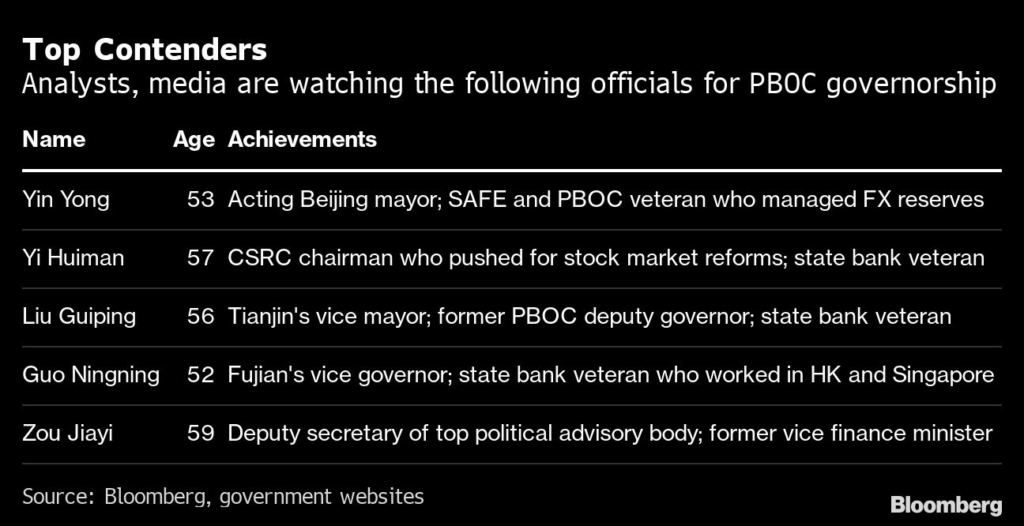
The acting mayor of Beijing, Yin Yong, and the country’s top securities watchdog, Yi Huiman, got five votes each in a survey of economists and political analysts by Bloomberg News this month. 

Those two names have been making the rounds since last month, when the Communist Party’s congress signaled Yi Gang may retire. More recently, two women with experience in finance and politics, Guo Ningning and Zou Jiayi, have also been tipped, according to research firm REDD Intelligence.

The new PBOC governor, who may only be appointed in March when the legislature meets, will be tasked with navigating monetary policy for the world’s second-largest economy. The stakes are high as Beijing takes steps toward easing the two biggest risks facing the economy — Covid restrictions and a property market crisis — with investors on high alert for signs of a recovery in growth. 

Unlike other major central banks like the Federal Reserve, the PBOC doesn’t have policy independence from the government. For example, it needs approval from the State Council, China’s cabinet, on major decisions regulating money supply, interest rates and exchange rates. 

President Xi Jinping’s strengthened role within the Communist Party after securing a third term in power has also raised concerns that the role of the State Council and key agency officials, such as PBOC governor, may be weakened.

“Xi will be looking first and foremost for a PBOC governor who is capable of providing financial stability,” said Christopher Beddor, deputy China research director at Gavekal Dragonomics. “A major part of the PBOC’s role since 2017 has been to de-risk the financial sector, and Xi’s report at the 20th Party Congress clearly signaled that priority will continue into the coming years as well.”

Here’s a look at some of the key candidates tipped to be the next central bank governor.

Yin Yong

Xi’s strategy with political appointments has colored some of the discussion around the governor job. Yin Yong, a 53-year-old Harvard University graduate who previously worked for China’s foreign exchange regulator and the central bank, was regarded as a strong candidate before being named acting mayor of Beijing last month. 

His elevation to that role signals Xi may want him for a more high-profile political role, since many senior state leaders have served as mayor — including current Politburo Standing Committee member Cai Qi and Vice President and anti-graft czar Wang Qishan.

But Yin still received five votes in the Bloomberg survey, suggesting economists think he has a good chance to become governor. Yin’s experience is well suited to the job, as he previously held a deputy governor role at the central bank and has years of experience at the State Administration of Foreign Exchange, the agency that manages the nation’s huge reserves.

If Xi wants Yin to become governor, such political maneuvering would likely keep current central bank head Yi Gang around for at least a little while longer, according to Hui Feng, co-author of “The Rise of the People’s Bank of China” and a senior lecturer at Griffith University. That’s because Xi would then be forced to look elsewhere for a new Beijing mayor, potentially delaying the PBOC process.

Yi Gang himself, meanwhile, is probably out of the running for another long-term stint, since he’s around the official retirement age and left the party’s elite central committee last month. But even that isn’t a sure bet — Yi’s predecessor Zhou Xiaochuan defied expectations back in 2013 that he would soon depart, only to extend his term another five years.

Yi Huiman

The political jockeying around Yin leaves open the possibility that Yi Huiman could be tapped as governor instead. The 57-year-old head of the China Securities Regulatory Commission was the Bloomberg poll’s only other vote-getter.

“Based on the current situation, Yi Huiman’s chances at the PBOC governorship have increased significantly,” said Bruce Pang, chief economist and head of research for Greater China at Jones Lang LaSalle Inc. He voted for Yi in the Bloomberg survey.

Unlike Yin, Yi has never worked at the PBOC. That would run against tradition, as many former PBOC leaders including Yi Gang and Zhou Xiaochuan served as deputy governors before they were promoted. 

But Xi’s willingness to “ignore previous promotion norms” suggests a lack of prior PBOC experience, such as is the case with Yi Huiman, “may not be an impediment,” said Neil Thomas, senior China analyst at Eurasia Group. Thomas sees Yi as the strongest candidate, though said Xi’s norm-busting has made it harder to predict personnel movements.

Yi’s background is instead in commercial banking, having worked at Industrial & Commercial Bank of China Ltd. — the nation’s largest lender by assets — for more than three decades. His success running the CSRC may have boosted his odds, given the agency’s prominence in helping to carry out stock market reforms.

Liu Guiping

Liu Guiping, 56, is a state bank veteran who was the PBOC’s deputy governor from late 2020 until April of this year. During his time at the central bank, he pushed for a new law to better coordinate policies to maintain financial stability and prevent risks.

Liu, currently Tianjin city’s executive vice mayor, spent more than two decades working at Agricultural Bank of China Ltd., one of China’s largest state banks. That experience, though, could instead set him up to run the China Banking and Insurance Regulatory Commission, according to Pang of Jones Lang LaSalle. That agency is currently being run by Guo Shuqing, who is the PBOC’s party secretary and who just also exited party leadership.

Like Yin and Yi, Liu is also a veteran of China’s financial system and does not have significant international experience — a potential reflection of “Xi’s preference for economic statism over Western-style free markets,” said Thomas of Eurasia Group.

Guo Ningning

Elevating a woman to the post of central bank chief would be particularly notable, considering Xi’s new Politburo has excluded women for the first time in 25 years and stoked concerns about regressing gender representation. 

Guo Ningning and Zou Jiayi are being considered by authorities, the research firm REDD Intelligence recently reported, citing unidentified sources. Each have extensive experience in politics or other roles involving monetary policy, banking and finance. 

One of the few women leaders born in the 1970s, 52-year-old Guo is considered a member of “the Luckiest Generation” of Communist Party cadres whose careers were lifted by opportunities provided by China’s startling economic rise. Guo was promoted to an alternate member of the party’s central committee in October. 

Before becoming the vice governor of Fujian province in 2018, Guo spent over two decades holding various roles at two of the biggest state-owned banks, the Agricultural Bank of China and Bank of China Ltd. She also holds a PhD in economics from the prestigious Tsinghua University in Beijing.

Guo is also media-savvy: She famously feasted on eels during a live stream in 2020 to promote local seafood on the e-commerce platform Taobao.

F

Zou, 59, is the deputy secretary-general of the the Chinese People’s Political Consultative Conference, a top political advisory body. From 2018 to 2021, she was a vice finance minister, and for part of that time she was also a member of the PBOC’s monetary policy committee.

She holds a master’s degree in economics from the Chinese Academy of Social Sciences, and spent most of her career at the Ministry of Finance in departments related to international economic relations. She speaks fluent English and served as the executive director for China at the World Bank from between 2005 and 2009. 

While not a member of the Politburo, Zou was promoted to the Communist Party’s elite central committee in October — one of just a handful of women to achieve that distinction.

More stories like this are available on bloomberg.com

©2022 Bloomberg L.P.
FTX Latest: Bankman-Fried Faces Grilling by Lawmakers He Backed

(Bloomberg) — Democratic lawmakers who received millions of dollars in campaign donations from Sam Bankman-Fried say they will be ready to grill the former FTX CEO about the exchange’s collapse.

Liquidators appointed by a Bahamian court to take over FTX Digital Markets Ltd.’s affairs said there’s “significant” concern that FTX management lacked authority to put the crypto businesses into bankruptcy in the US.

The embattled cryptocurrency mogul and two other top FTX executives received massive loans from affiliated trading arm, Alameda Research. Advisers overseeing the bankruptcy of FTX Group are struggling to locate the company’s cash and crypto, citing poor internal controls and record keeping. 

Ontario Teachers’ Pension Plan said it will write down its stake in FTX to zero, taking a $95 million loss. 

Key stories and developments:

  • Flash Boys Exchange IEX Wants New Crypto Path After FTX Blowup
  • Ontario Teachers Writes Off FTX Stake, Citing Potential Fraud
  • Here Are the Wildest Parts of the New FTX Bankruptcy Filing
  • FTX Offers a Master Class in Crypto Market’s Flaws: Editorial
  • Odd Lots: Understanding the Collapse of Sam Bankman-Fried’s Crypto Empire

(Time references are New York unless otherwise stated.)

Bahamas Regulator Takes Control of FTX Assets (8:00 a.m. HK)

The Bahamas Securities Commission said in a statement it directed the transfer of all digital assets of FTX Digital Markets to a wallet that the commission controls for safekeeping.

“Urgent interim regulatory action was necessary to protect the interests of clients and creditors of FDM,” it said, adding that its understanding is that FDM is not a party to US Chapter 11 bankruptcy proceedings. It said it would engage with regulators and authorities in multiple jurisdictions.

Ontario Teachers Writes Off FTX Stake (7:10 a.m. HK)

The pension plan said it will write down its stake in FTX to zero, taking a $95 million loss barely a year after making its first investment.

Teachers said the writedown will have only a “limited impact” because it’s less than 0.05% of the pension fund. “However, we are disappointed with the outcome of this investment, take all losses seriously and will use this experience to further strengthen our approach,” the fund said in a statement Thursday. 

Bankman-Fried-Backed Lawmakers Ready To Grill Former CEO (5:01)

Lawmakers who received millions of dollars of campaign donations from Sam Bankman-Fried could soon get something else from the former FTX chief executive officer: testimony under oath. 

Recipients of those political contributions say they’re prepared to grill Bankman-Fried about why his crypto exchange suddenly crashed, potentially causing billions of dollars in losses for millions of FTX account holders. Before the collapse, he donated tens of millions of dollars from his crypto-empire fortune to benefit Democrats, making him the second-largest donor to the party this election.

FTX’s ‘Zombie’ Token Still Has Value (3:34 p.m.)

A cryptocurrency whose sponsor went belly up, with no obvious use and a sordid role in a complicated deception? And still there’s about $500 million of the tokens sloshing around on digital trading platforms.

That’s the FTT token from the now-bankrupt exchange FTX, whose demise has cast a pall on the crypto space that industry participant say could take years to be lifted. The token reached a high of nearly $85 in September of last year, and though it’s seen its price drop roughly 98% since then, it still sports an eye-popping hypothetical market value on different exchanges and platforms. 

Liquidators Concerned That FTX Had No Authority to File Bankruptcy (1:07 p.m.)

Liquidators, appointed by a Bahamian court to take over FTX Digital Markets Ltd.’s affairs said they have “significant” concern that FTX management, led by Sam Bankman-Fried, lacked authority to put the crypto businesses into bankruptcy in the US.

More than 100 FTX-related entities filed for Chapter 11 in the US Bankruptcy Court for the District of Delaware after insolvency proceedings for Bahamas-based FTX Digital began on the island on Nov. 10.

Bankman-Fried Received $1 Billion Loan (11:39 a.m.)

FTX co-founder Samuel Bankman-Fried, one of his related companies, and two other top executives at the collapsed cryptocurrency exchange received massive loans from affiliated trading arm, Alameda Research, according to a bankruptcy court filing Thursday.

Alameda’s receivables included $4.1 billion in combined loans to “related parties,” according to a footnote in a document filed by John J. Ray III, who was appointed to oversee FTX as its chief executive officer during the proceedings. That includes $1 billion to Bankman-Fried, $2.3 billion to Paper Bird Inc., an entity majority owned by Bankman-Fried, $543 million to Nishad Singh, head of engineering at FTX, and $55 million to Ryan Salame, head of FTX Digital Markets. 

Franklin CEO: Decentralized Exchanges Will Get More Attention (11:24 a.m.)

Franklin Templeton’s Jenny Johnson sees the downfall of FTX likely pushing investors toward decentralized exchanges and seeking professional guidance on crypto assets.

The failure of the centralized exchange would drive crypto investors toward versions like Uniswap or SushiSwap, which are built on public chains, Franklin’s president and chief executive officer told Bloomberg News on Wednesday.

Democratic Senators Want Answers (11:14 a.m.)

Democratic Senators Elizabeth Warren and Dick Durbin seek information from FTX founder Sam Bankman-Fried on FTX’s collapse, in a letter to Bankman-Fried and the crypto exchange’s newly appointed CEO John Jay Ray III.

New FTX CEO Can’t Locate Company’s Cash, Crypto (9:29 a.m.)

Advisers now overseeing the carcass of Sam Bankman-Fried’s FTX Group are struggling to locate the company’s cash and crypto, citing poor internal controls and record keeping. 

“Never in my career have I seen such a complete failure of corporate controls and such a complete absence of trustworthy financial information,” John J. Ray III, the group’s new chief executive officer who formerly oversaw the liquidation of Enron Corp., said in a sworn declaration submitted in bankruptcy court. 

FTX Lawyers Accuse Bankman-Fried of Undermining Bankruptcy (8:39 a.m.)

Embattled cryptocurrency mogul Sam Bankman-Fried is undermining efforts to reorganize his crumbling empire with “incessant and disruptive tweeting” that appears aimed at moving assets away from the control of a US court in favor of one in the Bahamas, US lawyers for the bankrupt crypto platform FTX said in a court filing.

FTX, which is now under the control of John J. Ray III — a restructuring lawyer who oversaw the liquidation of Enron — asked a federal judge in Wilmington, Delaware, to transfer a competing bankruptcy case filed in New York by Bahamian liquidators to Delaware.

Binance Suspends Deposits of USDC (SOL), USDT (SOL) Token (7:57 a.m. New York)

Binance has temporarily suspended deposits of USDC (SOL) and USDT (SOL) “until further notice,” the company announced on its blog.

Binance Evidence on FTX Collapse Unacceptable, UK Lawmakers Say (6:27 a.m. New York)

Binance sent news articles — rather than internal records — to a UK Parliamentary committee probing the collapse of FTX.com and its planned sale of FTT token, a move that some UK lawmakers called disappointing and unacceptable.

Alison Thewliss, a member of the UK’s Treasury Committee, said in an interview on Bloomberg Radio that Binance sent news articles to the committee, while it had expected to receive internal records about the potential market consequences of Binance’s announced divestment of FTT. Thewliss said that Binance’s lack of transparency would influence the committee’s recommendations to government on regulating the crypto industry.


–With assistance from Sunil Jagtiani and Dara Doyle.

More stories like this are available on bloomberg.com

©2022 Bloomberg L.P.
What FTX’s Bankman-Fried Said When We Asked Him About Red Flags

(Bloomberg) —

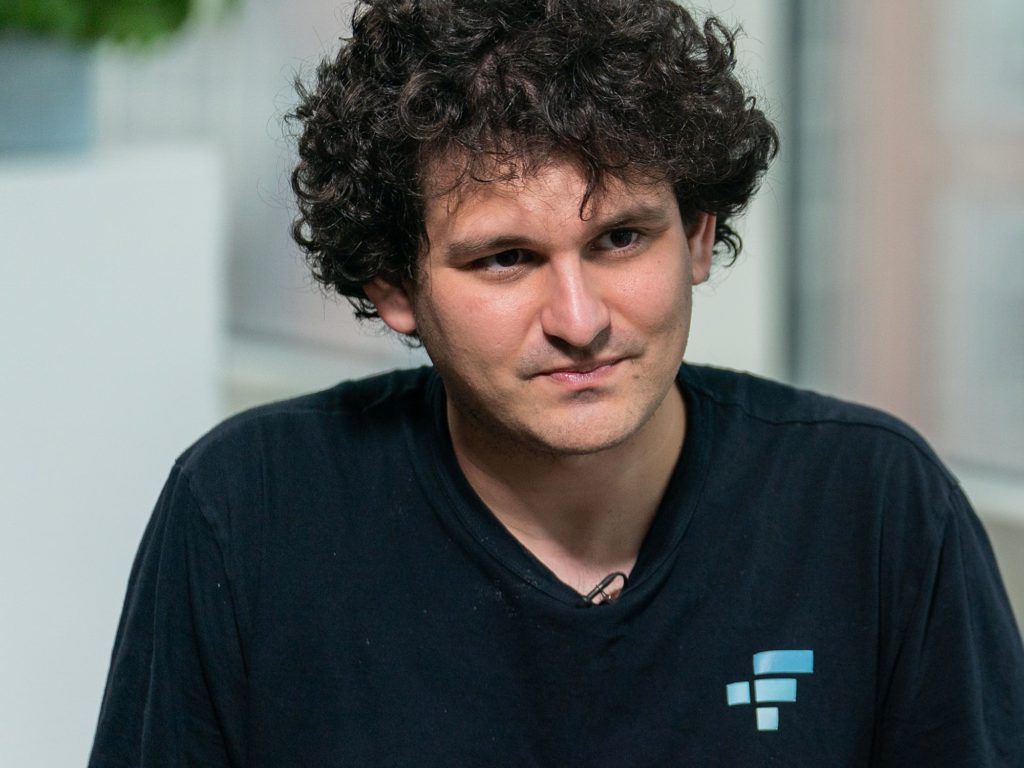
It was late August, and Sam Bankman-Fried appeared on a computer screen, sporting the black headphones, T-shirt and floppy bedhead that were his trademark as the ubiquitous face of crypto and the chief executive officer of FTX. 

Questions were building about the exchange’s relationship with Alameda Research, the trading firm he started that’s behind the collapse of the cryptocurrency exchange. At the time, however, Bankman-Fried appeared eager to dispel concerns and agreed to an extensive interview. Bloomberg News also spoke with Alameda CEO Caroline Ellison, who usually avoided the spotlight.

Bankman-Fried lost his usual jittery bravado when pushed about Alameda’s ties to the exchange. He often fumbled for his words and failed to provide direct answers to a simple question about where he lived. He maintained that the companies were adequately regulated and kept at a distance from each other.

We now know that much of what he said was untrue — or highly misleading at best. Documents filed in FTX’s bankruptcy depict a free-wheeling enterprise rife with conflicts of interest, self-dealing and very little controls over what happened to customers’ money. Funds were poorly tracked. Leadership was haphazard. Meaningful oversight appears virtually nil.

What actually happened behind the scenes at the crypto empire tumbled into ruin is still being pieced together in court. But the massive gulf between what Bankman-Fried said — and what was happening at the company he ran — has rattled investors’ confidence and sent tremors across the industry by raising doubts about the solvency of other cryptocurrency firms.

Here’s what Bankman-Fried and Ellison said and how it stacks up with what has since been disclosed. Some of the comments appeared in a Bloomberg News story published in September about the potential conflicts of interest at FTX and Alameda. 

On FTX’s relationship with Alameda

Bankman-Fried: “As of today, there isn’t that much of one there. You know, they obviously came from the same place originally. Or, you know, the same sort of original people … Most of the remaining nexuses have dropped off … Obviously, I know the people from Alameda decently well, but there isn’t like a large amount of, you know, ways remain that we are actively working together, anything like that … Alameda is a wholly separate entity.” 

“They’re different offices, like different principal offices. We don’t have any shared personnel. We’re also not the same company … We’re not all under the same corporate umbrella or anything like that.”

“I don’t trade partially because I don’t have time. It’s a full-time job running FTX,” he said. “But even if I did have time, I wouldn’t because of wanting to have separations.” 

Ellison: “They’re both owned by Sam, obviously. So ultimately, sort of aligned incentives in that way. We keep them quite separate in terms of day-to-day operations. We definitely have a Chinese wall in terms of information sharing to ensure that no one in Alameda would get customer information from FTX or anything like that, or any sort of special treatment from FTX. They really take that pretty seriously.”

Alameda and FTX were, in fact, deeply intertwined. In a bankruptcy filing Thursday, court appointed CEO John J. Ray III said there was no independent governance of Alameda — which was 90% owned by Bankman-Fried — and FTX, and noted that the trading fund had an exemption from certain parts of FTX’s protocols concerning the liquidation of customer funds. FTX imploded after revealing a roughly $8 billion shortfall on its balance sheet and reportedly used FTX customer money to fund risky bets made by Alameda. 

On internal controls

Bankman-Fried: “We have — I don’t remember the exact numbers, but I want to say about 100 people, at FTX, involved in compliance.”

It’s unknown how many compliance staff — or even employees — FTX actually had. In the bankruptcy filing, Ray said the company has been unable to provide a complete list of who worked for it and in what capacity, adding that the lines of responsibility are unclear. But he paints a damning portrait of the firm’s overall governance. “From compromised systems integrity and faulty regulatory oversight abroad, to the concentration of control in the hands of a very small group of inexperienced, unsophisticated and potentially compromised individuals, this situation is unprecedented,” he wrote. 

On living arrangements for FTX, Alameda employees

Bankman-Fried: “I’m hesitating because I — I mostly sleep on the bag. I don’t, it is legitimately not the case that I, that’s where you say – exactly I live. Yeah. So I do hang out a lot in that, in that apartment after – after work – I do live in – technically I live in a – technically I live alone, but don’t sleep there – I mostly sleep on couches and beanbags – but, but yeah.” 

In a separate interview with David Rubenstein, Bankman-Fried had said that he lived with colleagues in a “large apartment” near the office. Alameda and FTX shared a corporate campus in the Bahamas.

On regulation of FTX

Bankman-Fried: “We are the most regulated crypto exchange by far. We are regulated by some definition by more regulators than any exchange of any type.”

“I think it has historically been the case that crypto has been substantially more lightly regulated with much less oversight than traditional finance. But I don’t think it’s that’s actually true of FTX.”

Both FTX and Alameda lacked vigilant regulatory oversight, and the exchange’s decision to incorporate in the Bahamas made it subject to regulations that are different than those of the US, where there are strict rules on the handling of customer accounts. So it was false to suggest it was exposed to more regulation than any other exchange. Though FTX US fell under the purview of regulators, crypto investors lack many of the protections they take for granted in savings accounts or even on stock exchanges. Now employees and customers with assets on its platform don’t know if they’ll ever get their money back.

On company auditors

Bankman-Fried: “We are audited. We have financial audits, both for FTX US and FTX International. Each year. We have regulatory oversight, again, from a number of the largest jurisdictions in the world.”

Only portions of Bankman-Fried’s empire were audited, and the quality of those has been cast into doubt. While bankruptcy filings show FTX had been audited, Ray, the company’s new court-appointed CEO, said he had “substantial concerns as to the information presented in the financial statements.” One of the auditors, Prager Metis, describes itself as the “first-ever CPA firm to officially open its Metaverse headquarters” in the platform Decentraland. “I do not believe it appropriate for stakeholders or the Court to rely on the audited financial statements as a reliable indication of the financial circumstances” of the companies, the filing concludes. 

On leadership

Ellison: “I think he’s an amazing leader, obviously, and that’s kind of the thing that first drew me to Alameda and I think that’s why both Alameda and FTX have kind of succeeded thus far.”

“I’m excited to see what he continues to do with FTX. And in the crypto space more broadly.”

Bankman-Fried stepped down from his role as CEO and his company’s collapse is drawing comparisons with the infamous downfalls of Enron and Lehman Brothers. American and Bahamian authorities have discussed the possibility of bringing him to the US for questioning.

More stories like this are available on bloomberg.com

©2022 Bloomberg L.P.

Adobe Receives US Justice Request for More Data on Figma Deal

(Bloomberg) — Adobe Inc. and Figma Inc. have received a second request for information from the US Department of Justice on Adobe’s proposed $20 billion acquisition of its startup rival, signaling stepped-up antitrust scrutiny of the purchase.

The deal, which would be one of the largest takeovers of a private software maker ever, was announced Sept. 15 with a targeted completion in 2023. Adobe, the top maker of creative software for design professionals, is looking to expand its web-based offerings to make inroads with nonprofessional customers and small businesses. That market has gravitated in recent years to web-native companies such as San Francisco-based Figma, Canva Inc. and Lightricks Ltd.

The Justice Department on Monday asked Adobe and Figma to provide additional information on the deal, known as a second request, the companies said in a regulatory filing. The action means regulatory approval for the deal can’t come until at least 30 days after Adobe and Figma fulfill the request, the DOJ ends its review, or the parties agree to an extension, the companies said. Bloomberg earlier this month reported that the Justice Department had initiated an antitrust investigation of the proposed acquisition, according to people familiar with the issue.

Figma is used to prototype and design interfaces for apps and websites, and has built a devoted customer base due to its highly collaborative system, freemium pricing and lightweight interface. While it has trounced Adobe’s rival XD offering in recent years, San Jose, California-based Adobe argues that Figma isn’t a meaningful competitor.

Wall Street analysts criticized the purchase price and investors also seem skeptical, sending Adobe’s shares down 9% since the announcement and 40% for the year.

The merger agreement considers the possibility of an extended regulatory review, allowing for a later completion deadline of March 2024.

–With assistance from Sabiq Shahidullah.

More stories like this are available on bloomberg.com

©2022 Bloomberg L.P.
Musk’s ‘Hardcore’ Ultimatum Sparks Exodus, Leaving Twitter at Risk

(Bloomberg) — Elon Musk gave Twitter Inc. employees an ultimatum to either commit to the company’s new “hardcore” work environment or leave. Many more workers declined to sign on than he expected, potentially putting Twitter’s operations at risk, according to people familiar with the matter. 

So many employees decided to take severance that it created a cloud of confusion over which people should still have access to company property. Twitter closed its offices until Monday, according to a memo viewed by Bloomberg. “Please continue to comply with company policy by refraining from discussing confidential information on social media, with the press or elsewhere,” the memo added.

Read More: The Twitter Memo Shutting Offices After Musk’s Ultimatum

Musk tried, in the final hours before his deadline, to convince people to stay. Key staff were brought into meetings as the Thursday evening deadline neared to hear pitches on the social network’s future, according to people familiar with the matter. Musk, who had earlier said he was strictly against remote work, also sent a follow-up email Thursday softening his tone. 

“All that is required for approval is that your manager takes responsibility for ensuring that you are making an excellent contribution,” he wrote, adding that staffers should have in-person meetings with their colleagues not less than once per month. 

It wasn’t enough. Twitter’s internal communications channels filled with employees offering a salute emoji, which has become a symbol for departing the company. Former staff tweeted the salute publicly, too, along with their internal Slack messages. 

Some employees who were departing speculated that so many were leaving, along with their knowledge of how the product works, that the social network may have trouble fixing problems or updating systems during its normal operations, according to people familiar with the matter.

Twitter’s future is also complicated by a possible national security review of Musk’s deal by the US government, people familiar said earlier.

Elon Musk’s Tumultuous Twitter Takeover: Timeline

Musk on Wednesday had asked employees to formally state whether they were willing to keep working at the company – a commitment that would include “working long hours at high intensity.” Employees had until 5 p.m. Eastern time Thursday to fill out a Google form. 

The form included just one possible response: “Yes.” Anyone who failed to accept the form by the deadline was told they would be out of the company with three months severance.

The ultimatum from Musk came less than two weeks after he laid off 50% of Twitter’s workforce, or roughly 3,700 employees. Many Twitter workers consulted lawyers this week to determine what to do. The form included almost no details about the severance packages, and it was not immediately clear whether employees would receive legal protections that would allow them to keep vesting stock awards or maintain insurance coverage.

Musk brought back leaders who had departed, either as part of his own layoffs or through resignation, to convince others to stay, one of the people said. One returning leader is Ella Irwin, who will manage employees in Trust and Safety, according to a person familiar with the matter, who declined to be identified discussing non-public changes.

Musk later sent a follow-up email on remote work, according to a screenshot viewed by Bloomberg. “Any manager who falsely claims that someone reporting to them is doing excellent work or that a given role is essential, whether remote or not, will be exited from the company.”

(Updates with more departures in lead)

More stories like this are available on bloomberg.com

©2022 Bloomberg L.P.

California Boosts Electric-Car Charging Investment by $1 Billion

(Bloomberg) — California plans to spend an additional $1 billion to bolster its vehicle-charging network as it races to build the infrastructure needed to phase out gas-powered trucks and cars.

The five-year program will allocate 70% of the funding for medium- and heavy-duty vehicle charging, with the balance for light-duty equipment at or near multi-unit dwellings, according to a California Public Utilities Commission statement Thursday.

While California is a global leader in the fight against climate change, it will need significant charging investment to meet its ambitious emissions targets. Among the key goals: ceasing the sale of new gas-powered vehicles by 2035.

California’s new charging program will be funded by the state’s investor-owned utilities, with rebates to be offered starting in 2025 for customer investments in businesses, factories and apartments, the commission said. Higher rebates will be provided for projects in low-income and tribal communities.

The commission said it has approved more than $1.8 billion in ratepayer funding for transportation-electrification infrastructure over the past six years.

More stories like this are available on bloomberg.com

©2022 Bloomberg L.P.
Amazon CEO Says Job Cuts Will Continue Into 2023

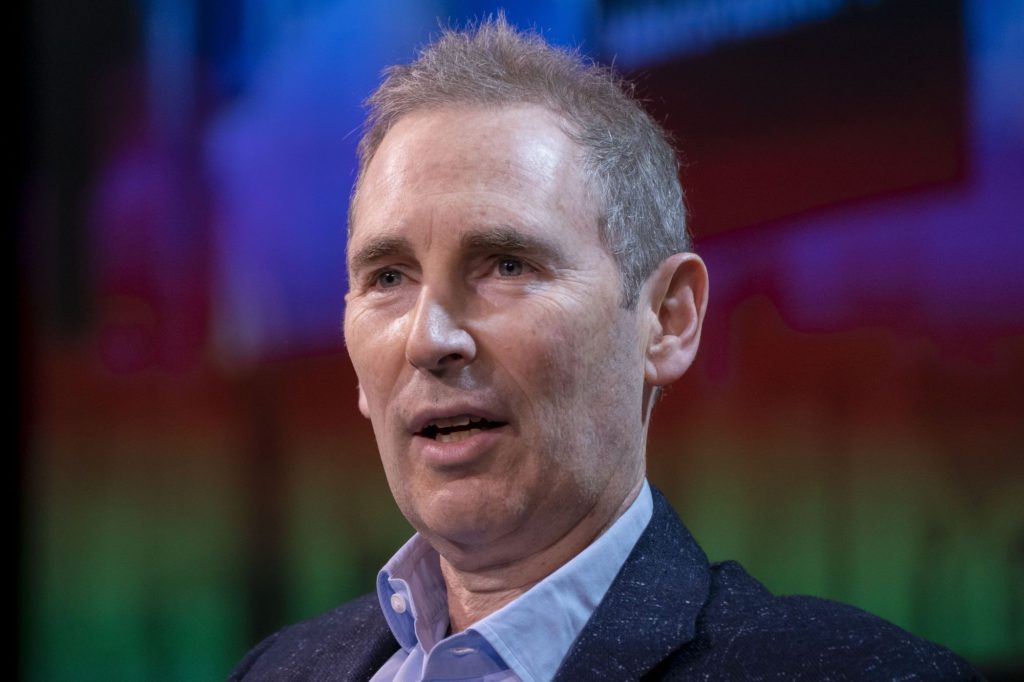
(Bloomberg) — Amazon.com Inc. Chief Executive Officer Andy Jassy said the e-commerce giant will be cutting jobs into 2023 as it adjusts to business conditions, his first public comments about the cost-reduction plans roiling Amazon since reports that it planned to wipe out about 10,000 jobs.

“Leaders across the company are working with their teams and looking at their workforce levels, investments they want to make in the future, and prioritizing what matters most to customers and the long-term health of our businesses,” Jassy said Thursday in the statement. “This year’s review is more difficult due to the fact that the economy remains in a challenging spot and we’ve hired rapidly the last several years.”

Jassy said people were notified in the company’s devices and books business and that some in Amazon’s “People, Experience and Technology” organization, which includes recruiters and human resources professionals, were offered voluntary buyouts. Many employees were given 60 days to find new jobs within the company, which would be followed by a severance package based on tenure if they fail to land new roles, according to documents reviewed by Bloomberg.

“Our annual planning process extends into the new year, which means there will be more role reductions as leaders continue to make adjustments,” he said. “Those decisions will be shared with impacted employees and organizations early in 2023.”

Jassy has been trying to reduce expenses amid slowing growth in several areas of Amazon’s business. The company has projected the smallest revenue increase ever for its holiday quarter. In the past few months, Jassy had put in place a hiring freeze on some corporate roles and shut down several experimental and smaller programs.

Amazon is among tech companies like Meta Platforms Inc. and Salesforce Inc. that are eliminating jobs following years of rapid growth. Amazon’s payroll swelled to 1.62 million global full- and part-time employees at the end of March, before dropping to 1.54 million as of Sept. 30.

Some workers, posting to company message boards, had been critical of Jassy for remaining silent this week since the job cuts became public and questioned why he hadn’t talked to them about the situation as Meta CEO Mark Zuckerberg did with his employees via a virtual townhall. With scant information from managers, Amazon’s online message boards quickly filled with posts from thousands of employees who swapped insights about layoffs and severance packages.

For the most part, chats reviewed by Bloomberg showed workers offering condolences and advice to those let go, particularly employees working on sponsored visas. Many complained that it was difficult to concentrate with so many colleagues left in limbo.

Mockery also made its way into the exchanges. Some compared the environment — with workers desperately trying to determine if they’d be the next person fired — to the Netflix thriller Squid Game, where cash-strapped people compete for survival in deadly versions of childhood challenges.

“If you didn’t get a notice today, congrats. You have survived Squid Game day 1,” stated one post earlier this week reviewed by Bloomberg. The post was met with laughing-face emoji reactions.

(Updates with employee reactions beginning in the seventh paragraph.)

More stories like this are available on bloomberg.com

©2022 Bloomberg L.P.
Crypto’s Most Urgent Question: Where Will FTX’s Aftershock Be Felt?

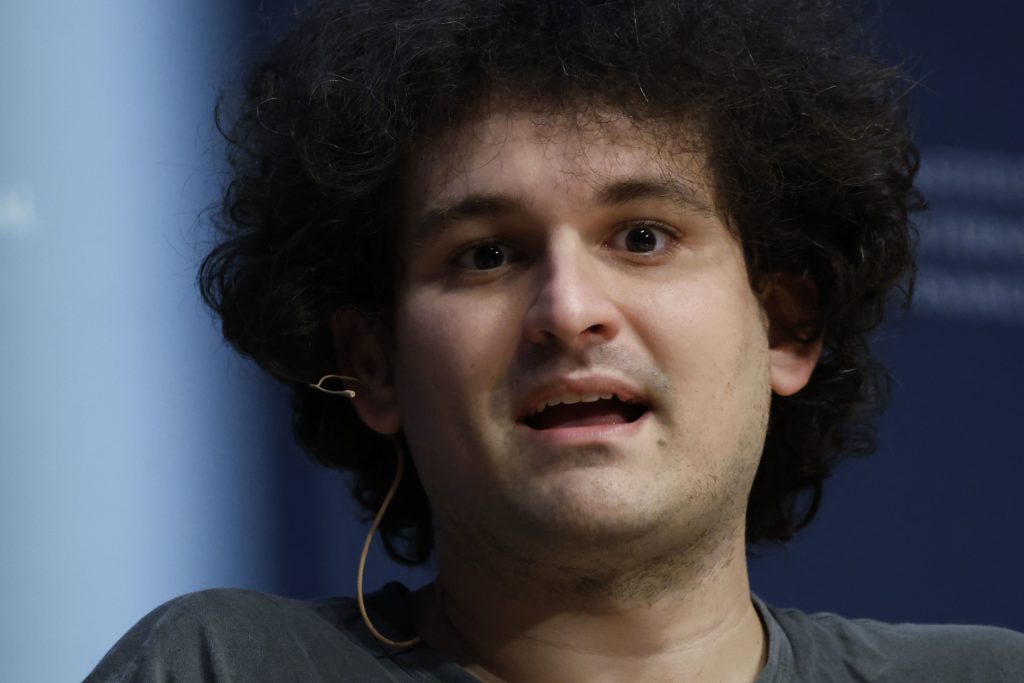
(Bloomberg) — The bankruptcy of Sam Bankman-Fried’s FTX.com put an end to questions about its survival and opened a panoply of new ones, most urgently: how far will the influence of its collapse reach?

Overstating FTX’s heft in the cryptosphere is difficult. From blue-chip venture investors to celebrity endorsements, from Silicon Valley to Washington, from lenders to yield farmers and market makers, the three-year-old firm cut a wide swath through online commerce. Getting a handle on the repercussions of its demise is apt to take months.

“The big fear right now, that indeed seems to be materializing, is a contagion effect,” said Greg Magadini, director of derivatives at Amberdata, a blockchain data provider. 

Painfully, the least sophisticated of FTX’s constituencies — people who put money on the exchange to trade or even just to save — may end up bearing the deepest wounds. Bankruptcies like the one it filed Friday in Delaware are notoriously slow-moving processes in which claims on a firm’s remains are judged against a host of stakeholders.

It’s likely a judge will decide what happens to the everyday traders who had money on the platform, according to Owen Lau, an analyst at Oppenheimer & Co.. 

“We don’t have precedents,” said Lau. According to Lau, a court could rule that retail customers could be treated like general unsecured creditors, meaning that their priority for getting money back would fall below creditors, most of whom are institutional players. In that case, average folks who traded on the platform would, simply, lose their money. 

Mom and pop dabblers are taking a simultaneous bath in the crypto market itself, where shockwaves from the filing have sent the price of coins reeling. Market bellwether Bitcoin plunged about 20% this week, bringing its decline from last year’s record high of almost $69,000 to around 75%. Ether, the second largest token, and altcoins sunk alongside it. FTX’s FTT token has tumbled roughly 85% in the past week alone.

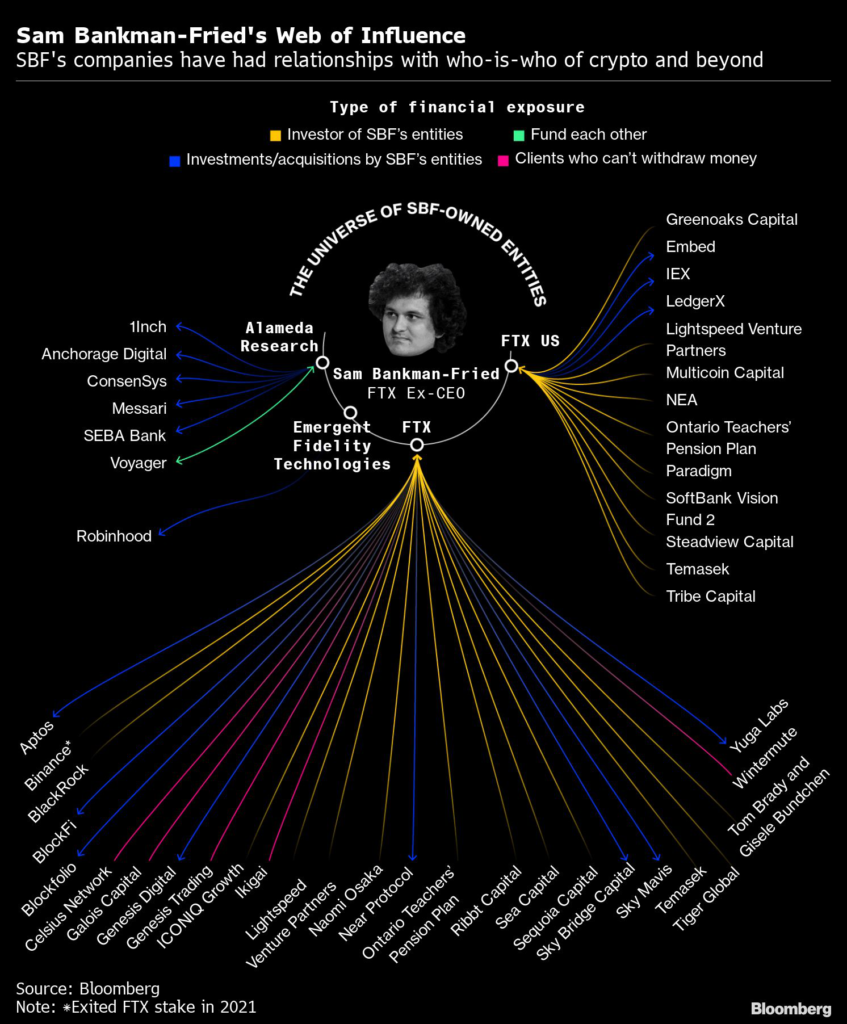
Beyond those lie what many fear to be a teeming underbelly of exposed institutions, great and small, who may have lent money to, traded with or otherwise linked their fortunes to the disgraced exchange. Already the casualty list is growing: BlockFi, the troubled digital-asset lender that Bankman-Fried’s firm was partially bailing out, paused client withdrawals. 

Genesis Trading reported that its derivatives business had about $175 million “in locked funds” on an FTX trading account. Billionaire Michael Novogratz told CNBC that his firm, Galaxy Digital Holdings Ltd, will likely not be able to recover its $77 million exposure to FTX. 

Meanwhile, FTX Ventures, the investment arm of the crypto exchange, has funneled money into nearly 50 projects, according to PitchBook data. Like so much else, it’s unclear what the impact will be for these companies, which include Aptos Labs, NEAR Protocol, and Mysten Labs.

“Portfolio companies might be OK, depending where they kept their assets,” wrote Magadini. “If portfolio companies kept some investments at FTX itself, those funds are likely going to be unusable going forward.”

Alameda Research, a crypto trading firm that was also co-founded by Bankman-Fried, offered a $485 million loan to Voyager Digital Ltd. that failed to save the crypto brokerage from bankruptcy. FTX.US later won an auction for Voyager Digital’s assets.

A group that can be assumed to have lost nearly everything in the collapse are investors in FTX, valued at nearly $32 billion in a January financing. Those include blue-chip names like the SoftBank Group Corp.’s Vision Fund, the Ontario Teachers’ Pension Plan, the Singapore wealth fund Temasek Holdings Pte, hedge fund Tiger Global Management and Lightspeed Venture Partners. Following the January fund-raising, Bankman-Fried told Bloomberg the funds would likely go toward mergers and acquisitions, with possible targets including payments businesses, NFT-centric firms and the metaverse.

(This story from Nov. 11 was corrected to remove an inaccurate reference to Helium in the 10th paragraph.)

More stories like this are available on bloomberg.com

©2022 Bloomberg L.P.
Applied Materials Forecast Signals It’s Weathering Slowdown

(Bloomberg) — Applied Materials Inc., the biggest maker of chip-manufacturing equipment, gave a better-than-feared sales forecast for the current quarter as supply-chain improvements help offset an economic slowdown. 

Fiscal first-quarter sales will be roughly $6.7 billion, up from a year earlier, the company said in a statement Thursday. That compares with an average analyst estimate of $6.34 billion.

The outlook brings fresh optimism that Applied Materials can weather a tumultuous stretch for the chip industry. The company, like its peers, is facing twin headwinds: a collapse in orders for some types of chips and an escalating standoff between China and the US. Large customers such as Micron Technology Inc. and Intel Corp. have said they will cut budgets to cope with weaker demand.

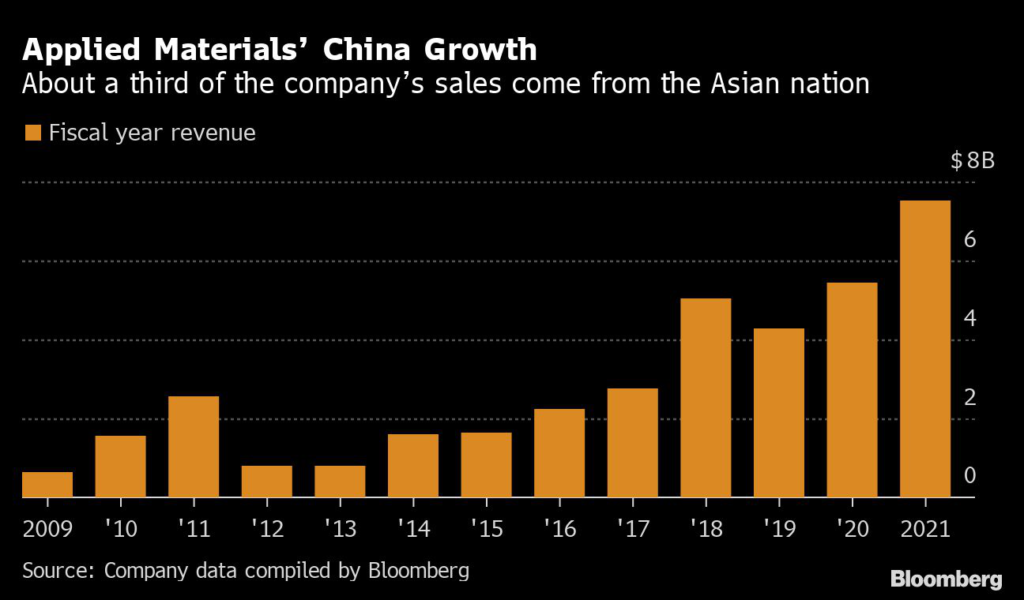
On the China front, Applied Materials on Thursday said it expects to lose as much as $2.5 billion in fiscal 2023 revenue due to new trade restrictions. If the US government expedites licenses needed to sell in China, the impact could be $1.5 billion to $2 billion, the company said.

The outlook was reassuring enough to send Applied Materials shares up more than 2% in extended trading Thursday. They’d earlier closed at $104.45, leaving them down 34% in 2022.

Chief Executive Officer Gary Dickerson expressed confidence that Applied Materials could outperform the broader industry and said that untangling supply snags will help it fill more orders. Though the economic environment is worsening, chipmakers are still spending money on new technology that can help them keep up with competitors, he said. 

“That race is relentless for our customers,” he said.

Read more: Micron warns that its outlook for 2023 has weakened

Fourth-quarter profit was $2.03 a share, excluding some items. Sales rose 10% to $6.75 billion in the period, marking the 12th straight quarterly expansion. Analysts predicted a profit of $1.68 a share and revenue of $6.38 billion.

In October, the Santa Clara, California-based company slashed its forecast for the fourth quarter, warning that the new export regulations would reduce sales by about $400 million. That hit will rise to $490 million in the current period, Applied Materials said. 

As Chinese customers prove to the US government that their plants and products don’t violate the new restrictions — or alter their plans to make sure they don’t — Applied Materials should be able to increase shipments to the area, Chief Financial Officer Brice Hill said.

The Biden White House announced the latest export curbs Oct. 7, part of a campaign to halt China’s ability to develop the most advanced chips and equip its military. Applied Materials and a handful of companies — US peers KLA Corp. and Lam Research Corp., the Netherlands’ ASML NV and Japan’s Tokyo Electron Ltd. — totally dominate the market for machines needed to make semiconductors. In addition to imposing rules on US companies, the administration is negotiating with European and Japanese governments to get them to do the same with their businesses. 

Read more: Chip industry braces for ‘heavy blow’ from China rules

The restrictions come at a tough time for the industry. After shortages during the pandemic, chipmakers had rushed to build new production. But now companies are looking to trim their budgets. The demand for PC-related chips has fallen as customers shun big-ticket purchases, and that’s weighed on chip stocks. The Philadelphia Stock Exchange Semiconductor Index, a key benchmark, has dropped 31% this year.

Companies such as Applied Materials and Intel can’t easily walk away from China, which is the biggest single market for their products and part of a global supply chain for electronics.

Like other tech companies, Applied Materials also is reining in job growth. The company is limiting hiring to “strategic positions,” it said Thursday.

–With assistance from Debby Wu.

(Updates with finance chief’s comments in 10th paragraph.)

More stories like this are available on bloomberg.com

©2022 Bloomberg L.P.
Kuaishou, JD Health May Join Hong Kong’s Hang Seng Index

(Bloomberg) — Hong Kong’s equity benchmark could add more tech and health-care stocks in its quarterly review as the index provider seeks to better embrace the new economy with an expanded member list. 

China’s livestreaming giant Kuaishou Technology, drug store operator JD Health International Inc. and electric vehicle maker Li Auto Inc. are among stocks that analysts say could join when Hang Seng Indexes Co. announces a revamp of the 73-member gauge on Friday. The company aims to boost the constituents of the benchmark to 80 and achieve a balanced representation of the stock market.

“Kuaishou could be the last tech name added to the Hang Seng Index before it reaches the 80-member milestone,” Bloomberg Intelligence analyst Marvin Chen wrote in a note. 

Following tech, stocks in health care and consumer sectors are in focus, he said. Top candidates include JD Health and Innovent Biologics Inc. given their significant weights in the health-care sector and strong investor interest. 

Hang Seng Indexes had initially planned to increase the number of HSI constituents to 80 by mid-2022, but hasn’t set a new timeline after missing that goal. It eventually aims to have 100 members. 

Read: Xi’s Three Big Pivots Rescue China Markets From Downward Spiral

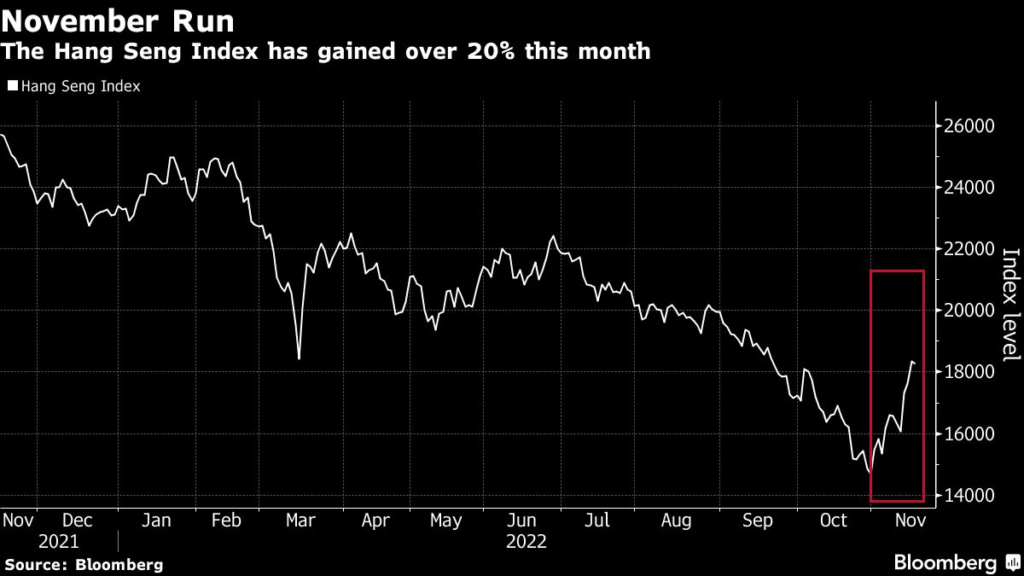
Sentiment for Hong Kong stocks has improved in November as some relaxation of Covid Zero restrictions on the mainland and property support measures soothed sentiment. The Hang Seng benchmark saw a stellar rally of over 20% this month, but remains among the worst performers globally this year. 

Brian Freitas, an analyst for independent research platform Smartkarma, also sees Smoore International Holdings Ltd., Trip.com Group Ltd. and Li Auto among potential additions.

There is unlikely to be any deletions as the index provider struggles to add stocks to achieve its target, Freitas added. But if it were to delete, he sees China Life Insurance Co. and Hengan International Group Co. as potential candidates.   

More stories like this are available on bloomberg.com

©2022 Bloomberg L.P.

Close Bitnami banner
Bitnami
